



Obsessive–compulsive disorder (OCD) and obsessive–compulsive symptoms (OCS) are common in people experiencing schizophrenia, with a reported prevalence from meta-analysis of 13.6 and 30.3% respectively (Swets Reference Swets, Dekker and van Emmerik-van Oortmerssen2014). This high prevalence may be attributed to the adverse effects of antipsychotic drugs, particularly those with notable anti-serotonergic effects, such as olanzapine, quetiapine and clozapine.
Among all antipsychotics, the strongest association has been observed with clozapine, with reported prevalence rates of clozapine-associated OCD (CAOCD) and OCS (CAOCS) reaching up to 47 and 76% respectively (Gürcan Reference Gürcan, Şenol and Yağcıoğlu2021). The impact of OCD on these individuals can be substantial, leading to distress, dysfunction and non-adherence to treatment. Therefore, it is essential to identify and proactively manage CAOCD/CAOCS. The evidence base to inform this practice is currently limited, mainly consisting of expert opinions, case reports and case series. This article reviews the literature and draws on our clinical experience.
Pathophysiology
Unlike most other atypical antipsychotics, clozapine exhibits a significantly stronger affinity (20 times greater) for serotonin 5-HT2 receptors than for dopamine D2 receptors. Although dopamine antagonism may relieve OCD symptoms, 5-HT2 antagonism has been linked to the onset or worsening of these symptoms. This may explain why low doses of clozapine sometimes alleviate symptoms, whereas higher doses can exacerbate both OCD and OCS. Case reports suggest that it might be a dose-related adverse effect.
Clinical presentation
In cases of treatment-resistant schizophrenia, OCS/OCD may be triggered or intensified by clozapine or may become more apparent as psychotic symptoms improve with treatment. The symptom profiles of antipsychotic-related OCS/OCD are indistinguishable from those of primary OCS/OCD. Although these symptoms can emerge at any point during treatment, current evidence suggests a potential correlation between the duration of clozapine use and the development of CAOCD/CAOCS, with symptoms often worsening over time and rarely appearing during the initial titration phase (Schirmbeck Reference Schirmbeck and Zink2012).
Management of CAOCD/CAOCS
Similar to individuals living with primary OCD, individuals receiving clozapine may not spontaneously report OCS. Therefore, informing patients that OCS/OCD can be a potential adverse effect is essential. Clinicians should proactively assess for emerging symptoms at baseline and regularly after initiating clozapine, preferably using standardised tools such as the Yale–Brown Obsessive–Compulsive Scale or related self-report questionnaires.
Particular caution is warranted when assessing aggressive or sexually intrusive thoughts, as these may raise risk assessment concerns. A detailed evaluation should differentiate ego-dystonic, intrusive obsessions from delusions, as it will inform the risk assessment.
Management strategies should be tailored to symptom severity and functional impact, and psychological and pharmacological treatment options should be considered.
Pharmacological treatment options
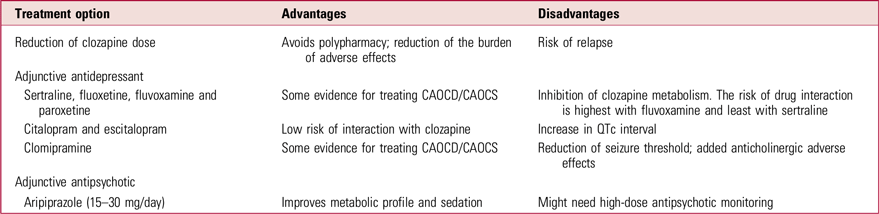
The main pharmacological treatment options (summarised in Table 1) are as follows.
Pharmacological treatment options for clozapine-associated obsessive–compulsive disorder and obsessive–compulsive symptoms (CAOCD/CAOCS)

Reduction of the clozapine dosage
Clozapine is the only antipsychotic with strong evidence for treatment-resistant schizophrenia, making switching generally not advisable. However, given that CAOCD/CAOCS may be dose-related, a cautious dose reduction can be considered if psychotic symptoms are stable, with regular plasma level monitoring to guide this decision.
Adjunctive medications
Antidepressants
High-dose selective serotonin reuptake inhibitors (SSRIs) or clomipramine can be used to treat CAOCD/CAOCS, similar to the treatment of OCD. Although no single SSRI has been proven superior in primary OCD, sertraline may be preferred in CAOCD/CAOCS owing to its low risk of interactions with clozapine (Kim Reference Kim, Barr and Lu2020). If an antidepressant is ineffective, switching to aripiprazole may be more beneficial than trying another antidepressant (Kim Reference Kim, Barr and Lu2020).
Antipsychotics
Most case reports and series indicate that aripiprazole is an effective treatment for CAOCD/CAOCS. The starting dose of aripiprazole for augmentation in primary OCD is 5 mg/day, which can be increased up to 30 mg/day, but higher doses (15–30 mg/day) have been used for CAOCD/CAOCS in case reports/series (Kim Reference Kim, Barr and Lu2020). Other antipsychotic drugs with positive results in case reports include amisulpride, risperidone, haloperidol, fluphenazine and ziprasidone (Tundo Reference Tundo and Necci2016; Kim Reference Kim, Barr and Lu2020). The addition of an antipsychotic might also allow for a reduction in clozapine dosage.
Mood stabilisers
A few case reports suggest lamotrigine and valproate as potential treatment options (Tundo Reference Tundo and Necci2016; Kim Reference Kim, Barr and Lu2020).
Psychological treatments
Cognitive–behavioural therapy (CBT) and exposure and response prevention (ERP) are effective treatments for primary OCD; however, there is limited literature on their application in CAOCD/CAOCS. Case reports suggest these therapies may be helpful, even though adaptations are often needed to address cognitive deficits, negative symptoms and limited insight (Schirmbeck Reference Schirmbeck and Zink2013; Tundo Reference Tundo and Necci2016).
Other treatments
Electroconvulsive therapy (ECT) and repetitive transcranial magnetic stimulation (rTMS) have been used in treatment-resistant OCD, but there is inadequate data to support their use in CAOCD/CAOCS.
Clinical implications
OCS and OCD are prevalent yet often underappreciated or unrecognised in patients treated with clozapine. Increasing awareness and implementing proactive management strategies can significantly improve treatment adherence and enhance the quality of life for these individuals.
Author contributions
S.H. conducted the primary literature review, drafted the initial manuscript and refined subsequent versions. S.G. developed the original idea for the article, provided supervision, carried out an additional literature review and assisted in writing and revising the manuscript.
Funding
None.
Declaration of interest
S.G. has received an honorarium for lectures from Viatris (a manufacturer of clozapine).



eLetters
No eLetters have been published for this article.