Introduction
The principal intention behind the follow up of patients with malignant tumours is the detection of tumour recurrence and secondary malignant tumours early enough to give patients a reasonable chance of survival.1 Whether any of the prevailing proposals regarding follow-up regimes positively influence survival remains to be demonstrated.1 Several studies have shown that most head and neck carcinoma recurrences are detected through symptoms reported by patients, rather than by physical examination of asymptomatic patients at scheduled follow-up visits.Reference Boysen, Løvdal, Tausjö and Winther2–Reference Pagh, Vedtofte, Duch, Lynggaard, Rubek and Lonka7 Nevertheless, whether the type of recurrence detection has any impact on survival remains unproven. The annual incidence of secondary malignant tumours in patients with head and neck carcinoma is 2–4 per cent.Reference Leon, Quer, Diez, Orùs, Lopez-Pousa and Burguès8
Differences in opinion regarding surveillance strategies urged us to examine our data on laryngeal squamous cell carcinoma (SCC). Using a retrospective analysis of patients with laryngeal SCC, treated over a period of 15 years in our clinic and with follow up of up to 22 years, we explored when and how laryngeal SCC recurrences were detected, and whether the type of recurrence detection influenced post-salvage disease-free survival. This study ultimately aimed to draw attention to issues that might improve the post-treatment surveillance of patients with laryngeal SCC.
Materials and methods
Over a period of 15 years (1983–1997 inclusive), we collected demographic and relevant clinical information for 1074 previously untreated patients with laryngeal SCC admitted to our institution. Our department collaborates closely with oncologists at Radiumhospitalet. Jointly, we are an academic tertiary referral centre that recruits patients mainly from the south-eastern part of Norway, with a population of approximately 2.6 million people. Initially, the tumours were classified according to the third edition of the Union for International Cancer Control (1982).Reference Harmer9 The classification was later updated according to the sixth edition (2002).Reference Sobin and Wittekind10
One of the authors (MB) has authorisation from the Norwegian Data Inspectorate to collect and evaluate data from patients' admitted to our department, and was the only person permitted to complete patients records. This author also holds concession from the Privacy and Data Protection Office at Oslo University Hospital.
Patients and treatment
Cases of subglottic and unclassifiable carcinomas were so few that these patients were excluded. Patients who were unfit for treatment because of distant metastases, mental illness, other severe diseases, or those with previous malignancies of the aerodigestive tract and patients with residual tumour following primary treatment. A total of 93 patients were excluded; hence, the study dataset comprised 981 patients considered ‘free of disease’ following primary treatment.
Independent of subsite, the primary treatment was primary radiotherapy with surgery in reserve.Reference Vermund, Boysen, Brandenburg, Evensen, Jacobsen and Kaalhus11,Reference Vermund, Boysen and Evensen12 Since 1996, tumour stage T1a glottic carcinomas have been preferentially treated with laser surgery.Reference Mahler, Boysen and Bröndbo13
Follow up
Our scheduled follow-up regime involved four to six visits in the first year, and two to three appointments in the second and third years following completed treatment. When indicated, patients were seen after shorter intervals.
After three years of follow up, patients considered ‘free of disease’ and without treatment-related complications were, as a rule, discharged from our regular out-patient surveillance. Thereafter, the referring hospital or family physician was in charge of follow up, with particular attention to nutrition, dental issues, psychosocial problems and thyroid function.
If recurrence, a secondary malignant tumour or a treatment-related complication was suspected, patients were immediately referred back to us. Salvage treatment consisted of radiotherapy, surgery or chemotherapy, depending on which option was available.
Complete follow-up data, including patient current status and cause of death, were obtained retrospectively by reviewing out-patient and hospital charts, and autopsy findings, and via direct contact with local hospitals, family physicians, and patients themselves or next of kin. It was noted whether the patient was alive and well at the last date of contact. In cases of death, it was recorded whether this was a result of the initial tumour, a secondary malignant tumour or a disease unrelated to cancer. Follow-up duration was calculated from the date of completed treatment. The latest recorded follow-up date was 15 October 2009.
A contrast-enhanced computed tomography (CT) scan of the primary site and neck was performed in all patients with stage II–IV tumours at four to six months after treatment, when sequelae from radiation treatment and surgery had subsided. Further CT or magnetic resonance imaging (MRI) was not performed unless there was suspicion of local or regional relapse, dissemination to distant sites, a secondary malignant tumour or treatment-related complications. Initially, a chest X-ray was performed once a year. Halfway through the follow-up period, a conventional chest X-ray, often supplemented with a CT examination, was performed in patients with symptoms suggesting lung disease. From 1999 onwards, neck ultrasonography, if indicated, supplemented with fine needle aspiration cytology (FNAC), became the standard technique for neck examination.
A fair number of patients treated for head and neck cancer will suffer unavoidable complaints related to treatment. For most of the patients receiving single-modality treatment, these complaints subside within two to four months.
All patients were briefly informed about symptoms and signs that might imply recurrence, and were strongly urged to make immediate contact with the responsible clinic or physician if such symptoms or signs occurred between scheduled appointments.
Recurrence detected through symptoms or complaints, whether persistent or aggravated, were considered symptomatic recurrence. Many patients may have a symptom, such as hoarseness, for many years after treatment. Recurrence detected through physical examination in an asymptomatic patient was considered an asymptomatic recurrence. Classification of a recurrence was not made until definite histological verification was obtained. Laryngectomy was considered necessary in some cases of severe chondronecrosis.
Our aim was disclosure of all secondary malignant tumours in our cohort, but only the diagnosis and treatment of secondary malignant tumours in the upper aerodigestive tract were considered in this study. Secondary malignant tumours were defined according to the criteria established by Warren and Gates: (1) both tumours were malignant; (2) the first and second tumours were geographically separate; and (3) the second tumour did not represent a metastasis from the first tumour.Reference Warren and Gates14
We noted whether recurrence and secondary malignant tumours were diagnosed through symptoms that patients reported at scheduled follow-up visits and appointments requested between scheduled appointments, or whether relapses were detected through clinical examination alone in asymptomatic patients. Throughout the study, our focus was histologically verified recurrences and not which particular symptom uncovered the recurrence.
Statistics
Data were stored and analysed with SAS statistical software version 9.3 (SAS Institute, Cary, North Carolina, USA). Chi-square and Fisher's exact tests were performed to analyse categorical data. Kaplan–Meier plots and log-rank tests demonstrated the incidence of recurrence and survival. A case was censored if death resulted from diseases unrelated to the index tumour, or if the patient was alive with no evidence of the original tumour or relapse at the last follow-up consultation or contact. A p-value of less than 0.05 was considered statistically significant.
Results
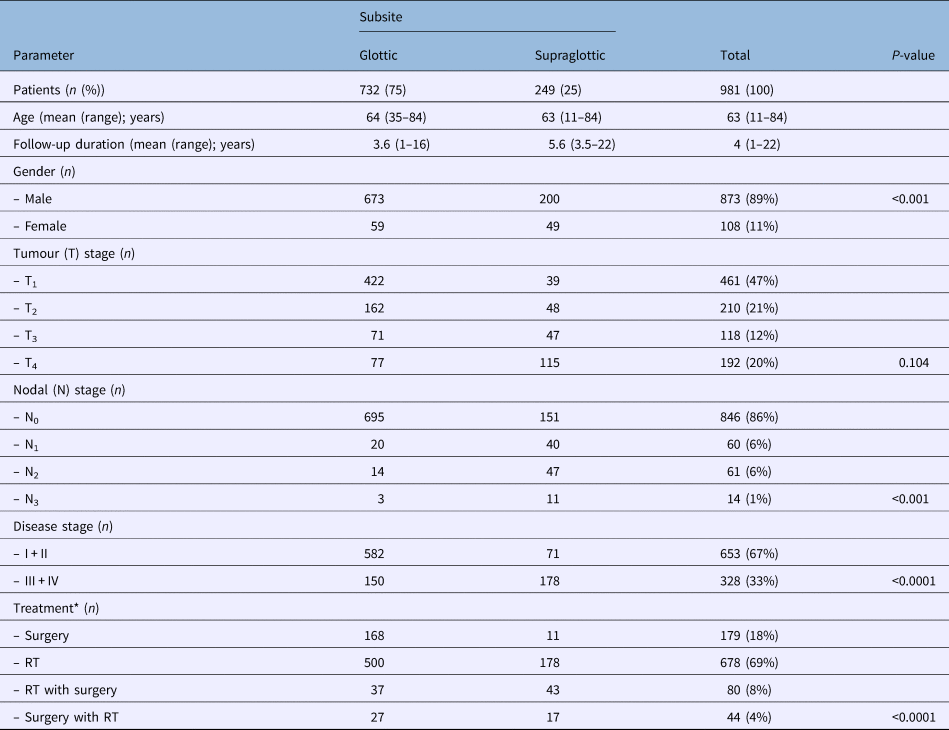
Table 1 presents relevant demographic, clinical, treatment and follow-up data of the 981 eligible patients. Of the included patients, 75 per cent were diagnosed with glottic carcinoma and 25 per cent with supraglottic carcinoma, respectively. Sixty-seven per cent of patients had stage I or II tumours.
Demographic and clinical data according to tumour subsite

*Fifteen patients with advanced disease received neoadjuvant chemotherapy with cisplatin and 5-fluorouracil. RT = radiotherapy
Recurrence was detected in 127 patients with glottic carcinoma and in 71 patients with supraglottic carcinoma. Nine patients had simultaneous recurrences at two sites.
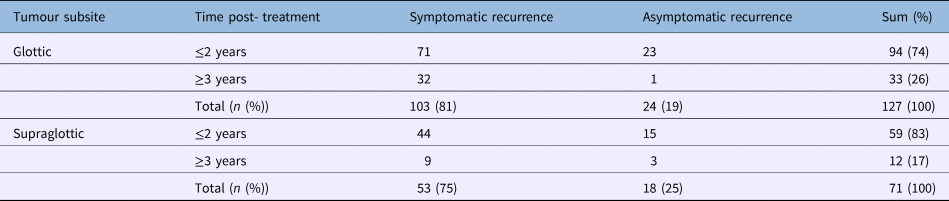
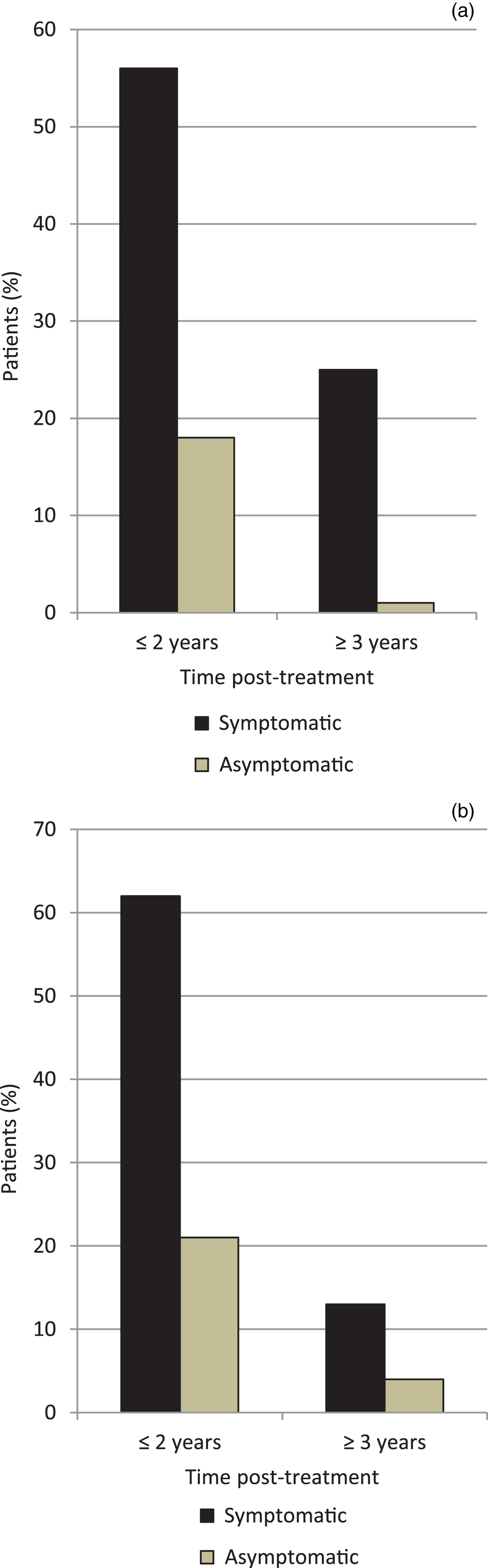
Table 2 presents the numbers and sites of histologically verified recurrences detected, according to length of time post-treatment. Symptomatic recurrences outnumbered asymptomatic (‘silent’) recurrences, both for glottic and supraglottic tumours. Recurrence detection through symptoms prevailed during the first two years after treatment. Most recurrences detected in the third year after treatment, or later, were symptomatic. Successful salvage of a secondary recurrence, or in some cases even a tertiary recurrence, was practically non-existent.
Recurrence detection (symptomatic vs asymptomatic) according to tumour subsite

Data represent numbers of cases, unless indicated otherwise.
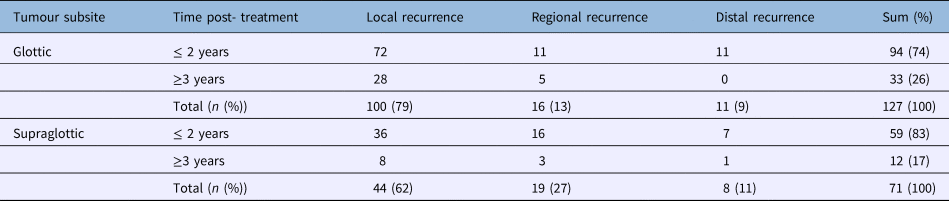
Table 3 presents the time from completed treatment and the recurrence site according to the tumour subsite. Seventy-four per cent of glottic tumour recurrences were diagnosed in the first two years after treatment, compared with 83 per cent for supraglottic tumours.
Recurrence type according to tumour subsite

Data represent numbers of cases, unless indicated otherwise.
Fifteen of the 19 recurrences at distant sites were disclosed through symptoms, of which 10 were lung metastases diagnosed before the fourth year of follow up. Seven of the patients with lung metastases were considered suitable for treatment, and received either surgery alone or surgery combined with radiotherapy. The remaining nine patients with distant metastases were deemed unfit for treatment, either for medical reasons or because of the site or degree of metastatic dissemination. All patients with metastases at distant sites died within three years of diagnosis.
Independent of tumour subsite, most regional recurrences were diagnosed during the first two years after treatment. Regional recurrence was relatively rare after longer than two years post-treatment. Relapse at the primary site amounted to 79 per cent for glottic tumours and 62 per cent for supraglottic tumours. Local recurrence continued to appear up to seven years post-treatment.
Neither sex nor age influenced the recurrence rate. There was, however, a significantly higher rate of local recurrences in patients treated with radiotherapy alone, most of which were advanced stage tumours.
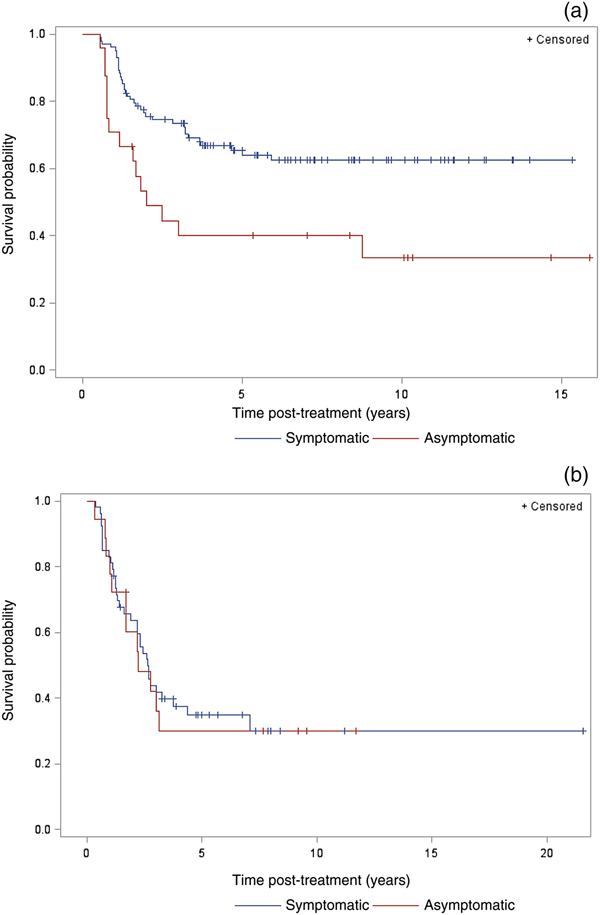
The means of recurrence detection (i.e. symptomatic vs asymptomatic recurrence) was significantly associated with improved post-salvage disease-free survival in glottic carcinoma patients only (p = 0.003; Figure 1). This is partly explained by a comparatively high salvage rate of early stage tumours (30 per cent), most of which had received single-modality treatment. Recurrence was diagnosed in 15 of 20 patients who requested an appointment in-between scheduled follow-up visits.
Post-salvage disease-free survival (product limit survival estimates) by type of recurrence detection (symptomatic vs asymptomatic patients) for (a) glottic tumours (p = 0.003) and (b) supraglottic tumours (p = 0.79).

For both subsites, we found a significantly higher survival rate for recurrences detected in the first two years of follow up (Figure 2).
Percentages of symptomatic and asymptomatic recurrence by time post-treatment for (a) glottic tumours (n = 127) and (b) supraglottic tumours (n = 71).

A total of 29 secondary malignant tumours were observed, of which 17 were located within the aerodigestive tract (9 head and neck, 7 lung, 1 oesophagus) and 8 of these were metachronous tumours. The latest secondary malignant tumour of the upper aerodigestive tract was detected 15 years after treatment. Three of the lung secondary malignant tumours were detected through scheduled radiographic examination. The rest of the secondary malignant tumours of the upper aerodigestive tract were detected following reports of new symptoms. All but three of the patients with secondary malignant tumours within the aerodigestive tract died from the secondary malignancy.
With the exception of radiation-induced mucositis and post-operative infections, severe complications that needed immediate attention were observed in 21 patients (2 with osteoradionecrosis of the mandible; 5 with tracheostomal stenosis; 3 with laryngeal stenosis; 3 with pharyngeal stenosis; 2 with hypothyreosis; 4 with necrosis of the skin, mucosa or cartilage; and 2 with severe fibrosis of the skin or subcutis).
Discussion
In this study, we challenge the prevailing proposals on follow-up guidelines for head and neck cancer,Reference Roman, Goldenberg and Givi15–Reference Grégoire, Lefebvre, Licitra and Felip17 and consider whether regular follow-up appointments in the surveillance of laryngeal SCC patients in fact demonstrate any survival advantage.1,Reference Morton, Hay and Macann18
There were two main observations of this single-institution study. Firstly, laryngeal SCC recurrence was overwhelmingly higher when detected as a result of symptoms reported by patients than through clinical examination in asymptomatic patients. Secondly, salvage treatment of symptomatic recurrences was significantly associated with improved post-salvage survival, compared with asymptomatic recurrences, for glottic but not supraglottic carcinomas. The favourable outcome for salvage treatment of symptomatic recurrences is mainly explained by the relatively high proportion of early recurrences of stage I–II tumours. The post-salvage survival of patients with originally advanced tumours and recurrences detected during the third year and later was dismal.
For head and neck carcinoma in general,Reference Boysen, Løvdal, Tausjö and Winther2–Reference Pagh, Vedtofte, Duch, Lynggaard, Rubek and Lonka7,Reference Simo, Homer, Mackenzie, Paleri and Roland16–Reference Manikantan, Khode, Dwivedi, Palav, Nutting and Rhys-Evans19 and in one study exclusively dealing with laryngeal carcinoma,Reference de Visscher and Manni20 most recurrences are diagnosed during the first two years after completed treatment.
The importance of the physician in head and neck SCC recurrence detection is less significant than previously thought. Several recent studies support our observation regarding the importance of patients’ self-reporting of symptoms suggesting recurrence.Reference Boysen, Løvdal, Tausjö and Winther2–Reference Pagh, Vedtofte, Duch, Lynggaard, Rubek and Lonka7,Reference Manikantan, Khode, Dwivedi, Palav, Nutting and Rhys-Evans19–Reference Ritoe, Krabbe, Kaanders, van den Hoogen, Verbek and Marres25 Generally, patients’ ability to detect and report symptoms is particularly conspicuous in the first two years of follow up.Reference Zätteström, Boysen and Evensen6,Reference Manikantan, Khode, Dwivedi, Palav, Nutting and Rhys-Evans19,Reference Stimpson, Batt and Vallance23 Furthermore, we observed that patients’ self-reporting of symptoms continues beyond the third year after completed treatment. As the survival advantage particularly relates to the early detection of recurrence of early stage tumours, patients with these tumours should be closely followed in the first two years after treatment.1,Reference Roman, Goldenberg and Givi15,Reference Simo, Homer, Mackenzie, Paleri and Roland16,Reference Morton, Hay and Macann18,Reference Manikantan, Khode, Dwivedi, Palav, Nutting and Rhys-Evans19
Frequent follow-up consultations that take place shortly after treatment completion have the advantage that the patient's ability to downplay important symptoms is less likely to occur, thereby enhancing compliance.Reference Haas, Hauser and Ganzer26 A five-year follow-up period seems ingrained in oncological practice, and head and neck oncologists and surgeons are no exception. Only a small fraction of the recurrences in this laryngeal carcinoma patient population occurred later than the fourth year of follow up, and the salvage rate of these late recurrences was very poor. It seems illogical for all patients to continue regular attendance beyond the point of time where recurrences are rare and the survival rate of late recurrences is modest.
A significant number of patients treated for head and neck cancer suffer treatment-related problems, co-morbidities and psychosocial problems, with a severe negative impact on their quality of life.Reference Nordgren, Abendstein, Jannert, Boysen, Ahlner-Elmqvist and Silander27 Three to five years after treatment, secondary malignant tumours are of more concern than recurrence, and these may represent a lifelong threat.Reference Bradley and Bradley28 Thus, our obligations and responsibility for patients’ welfare do not cease at the end of the period when curable recurrence can no longer be expected.
An attractive alternative to several current follow-up regimens that involve regular attendance at an out-patient clinic is a practice where clinical nurse specialists maintain a lasting continuity of follow up through regular telephone interviews. Nurses educated in ‘red flag’ symptoms that might indicate recurrence, secondary malignant tumours or treatment-related complications, and who are capable of providing help and advice concerning psychological and social problems that negatively affect patients’ quality of life, should be invariably accessible for consultation. Close collaboration between these nurses and the responsible physician guarantees that symptoms and signs suggesting recurrence, secondary malignant tumours, treatment-related complications and psychosocial problems are adequately attended.
The implementation of nurse-led follow up has been proven to be a justifiable cost- and time-effective option compared to routine physician-led follow up for several major types of cancer.Reference Lewis, Neal, Williams, France, Hendry and Russel29,Reference Kimman, Bloebaum, Dirksen, Houben, Lambin and Boersma30 Nurse-led follow up might be feasible in the lasting surveillance of head and neck cancer patients.Reference de Visscher and Manni20–Reference Kumar, Putnam and Robson22,Reference de Leeuw31
In addition, interestingly, Trinidade and colleagues found that their head and neck cancer patients preferred to communicate with a qualified nurse rather than a physician.Reference Trinidade, Kothari, Andreou, Hewitt and O'Flynn32 Kothari et al. reported that 84 per cent of their head and neck cancer patient population felt that follow-up visits were too frequent; most of their patients were in favour of a follow-up regimen based on the self-reporting of problems.Reference Kothari, Trinidade, Hewitt, Sing and O'Flynn33 These observations strongly support the notion that patients should be thoroughly educated about adverse symptoms that might signify recurrence, secondary malignant tumours or treatment-related complications, and patients should be encouraged to immediately seek medical advice if alarming symptoms arise. Because of a relatively high deprivation index in their cohort of patients, Lester and Wight were opposed to the benefit of patient education.Reference Lester and Wight34 Accordingly, any surveillance regimen should allow room for individualised follow up.
The current advice is to perform a baseline whole body 2-deoxy-2[18F]fluoro-D-glucose (FDG) positron emission tomography (PET) scan, which can be complemented with CT or MRI for the reliable identification of local, regional residual cancer, distant metastases or secondary malignant tumours at the outset of observation.Reference Flynn, Khaouam, Gardner, Higgins, Enepekeds and Balogh21,Reference Schwartz, Rajencran, Yuch and Coltrera35,Reference Goerres, Schmid, Bandhauer, Hugenin, von Schulthess and Schmid36 The accuracy of clinical symptoms, direct laryngoscopy with biopsy, CT, or conventional MRI in distinguishing between recurrence and radiotherapeutic and surgical sequelae is relatively low. Accordingly, CT and MRI are not advised as routine investigations in asymptomatic patients. It remains unclear whether further therapy controls with FDG-PET and novel radiological techniques such as diffusion-weighted MRI are cost-effective.Reference Zbären, de Bree, Takes, Rinaldo and Ferlito37,38 Low-dose helical CT is considerably more sensitive than conventional chest X-ray regarding the detection of lung cancer.38 Thyroid function should be monitored every 6–12 months.1
Distant metastases, most of which occur in the lungs, usually present within two years of the initial diagnosis. The survival of patients with recurrence at distant sites or with metachronous lung cancer is generally less than one year.Reference Geurts, Balm, van Velthuisen, van Tinteren, Burgers and van Zandwijk39 Ultrasonography of the neck, if indicated, with FNAC, is now considered a reliable technique to assess the presence of regional dissemination.Reference Steinkamp, Wissgott, Rademaker and Felix40
A ‘clean’ clinical evaluation and negative radiological evaluation may provide significant subjective reinforcement for a patient who sees a ‘negative’ examination finding as a relief, giving a feeling of security.Reference Haas, Hauser and Ganzer26 Such an assurance may, however, be false, and weaken the patient's attention to serious symptoms, subsequently delaying timely diagnosis and appropriate treatment. Unfortunately, only 15 of the 201 recurrences in this study were detected in patients who requested an appointment between scheduled follow-up visits. This indicates that the information we gave to patients was inadequate. The withholding of alarming symptoms and failure to make immediate contact with the responsible clinic should therefore be considered negative prognostic factors. In our opinion, there is a sound demand for appropriate patient education regarding red flag symptoms and signs. Patient-initiated visits in cases of alarming events should be emphasised.Reference Manikantan, Khode, Dwivedi, Palav, Nutting and Rhys-Evans19,Reference de Visscher and Manni20,Reference Wolfsenberger41 The best way to achieve this goal would be to prepare detailed leaflets, to guide patients regarding symptoms and signs they should be aware of, and advise on where to seek help when needed.
Regular attendance at an out-patient clinic represents significant direct and indirect costs for patients and society.Reference Virgo, Paniello and Johnson42 Optimising follow up by educating patients, encouraging self-reporting and entrusting allied health personnel with parts of the follow-up practice may mean that the surveillance of patients with laryngeal SCC can be tapered off three years after completed treatment if follow up is uneventful. In addition, such measures may improve survival, and may be time- and cost-effective.
• There are no data demonstrating a survival benefit of any particular surveillance programme
• Approximately 75 per cent of laryngeal squamous cell carcinomas (SCCs) reccur in the two first years after treatment
• Three-quarters of laryngeal SCC recurrences were detected following patients’ reports of symptoms rather than on routine physical examination
• Glottic carcinoma patients with symptomatic recurrence had higher disease-free survival than those with asymptomatic recurrence
• Patient education on recurrence symptoms, secondary tumours and complications may improve self-reporting
• Patient education and self-reporting may be time- and cost-effective, and even improve survival in laryngeal SCC patients
Conclusion
A unanimous consensus on the optimum post-treatment follow up in laryngeal cancer patients does not exist. We found that more than half of all laryngeal SCC recurrences were diagnosed following reports of symptoms by the patients. Furthermore, patients with symptomatic recurrence of glottic carcinoma had a more favourable outcome compared to recurrences detected through physical examination in asymptomatic patients. An emphasis on patient education regarding red flag symptoms and signs, patient-initiated visits, and robust referral routines may improve survival, and may prove to be time- and cost-effective.
Competing interests
None declared