An increasing body of research addresses the question of how second language (L2) speakers process L2 input and the extent to which their processing strategies parallel the strategies employed by native speakers (for two recent reviews, see Frenck-Mestre, Reference Frenck-Mestre, Kroll and de2005; Papadapoulou, Reference Papadopoulou2005). Although there is growing consensus that L2 speakers can use lexical–semantic and pragmatic information during on-line processing (e.g., Felser, Roberts, Marinis, & Gross, Reference Felser, Clahsen and Münte2003; Frenck-Mestre & Pynte, Reference Frenck-Mestre and Pynte1997; Williams, Möbius, & Kim, Reference Williams, Möbius and Kim2001), the extent to which L2 speakers take advantage of L2 morphosyntactic properties to build the syntactic structure of a sentence incrementally when comprehending L2 input remains controversial (e.g., Clahsen & Felser, Reference Clahsen and Felser2006; Dekydtspotter, Schwartz, & Sprouse, Reference Dekydtspotter, Schwartz, Sprouse, O'Brien, Shea and Archibald2006). One possible reason for conflicting results with regard to the processing of morphosyntactic information, in particular, may be because of differences in task-specific demands across studies. For example, L2 speakers may employ different strategies when asked to make an explicit grammaticality judgment after reading a sentence compared to when they are prompted to answer a yes/no comprehension question. This is an important factor to consider, as it relates to fundamental questions regarding L2 speakers’ knowledge of the target language grammar and how such information is organized and retrieved during language comprehension (cf. Jiang, Reference Jiang2004, Reference Jiang2007).
The present study addresses the possibility of task-induced effects by exploring how German native speakers and L2 German speakers (English first language [L1]) process subject versus object wh-questions in German during a self-paced reading comprehension task. This study builds on a previous study reported by Jackson and Dussias (Reference Jackson and Dussias2009), in which native and L2 German speakers read similar sentences using the self-paced reading paradigm in conjunction with a grammaticality judgment task. With regard to wh-questions, German differs from English in that the grammatical role of a wh-element in German is often unambiguously marked via case-marking information, whereas such roles are discerned by word order in English.Footnote 1 However, previous research has shown that processing case-marking information may be difficult for L2 German speakers, and only highly proficient L2 speakers tend to exhibit an on-line reading time preference for subject-first sentences, similar to German native speakers, when the discernment of word order relies on processing case-marking information in the input (e.g., Hopp, Reference Hopp2006). Thus, examining how L2 German speakers process this morphosyntactic feature of German and whether they use this information even when the task does not explicitly encourage them to do so, will further our understanding of how L2 speakers process grammatical information in their L2 during real-time language comprehension.
This paper is organized as follows. First, we will discuss previous findings from the L2 sentence processing literature regarding the processing of wh-questions in English, as well as recent studies examining how explicit task demands interact with L2 processing strategies. Then we will review several studies that have examined the processing of case-marking information and wh-questions by native and L2 German speakers. Following this we will present the methodological details of the present study, as well as our results. Finally, we will discuss the implications these results have for current models of how L2 speakers process and comprehend sentences in their nonnative language.
L2 PROCESSING OF wh-QUESTIONS
Several studies have shown that, similar to native speakers, L2 speakers will assign thematic roles to an ambiguous wh-element as soon as possible when processing wh-extractions, like Examples 1 and 2 below (Dussias & Pinar, in press; Juffs, Reference Juffs2005; Juffs & Harrington, Reference Juffs and Harrington1995). Using the self-paced reading paradigm, these studies have found that both native and L2 English speakers have greater difficulty processing subject extractions compared to object extractions upon reaching the complement clause (e.g., saw the patient), as evidenced by longer reading times on the complement clause in subject extractions compared to object extractions and lower accuracy on an accompanying grammaticality judgment task.
1. Who does the nurse know ___ saw the patient? (subject extraction)
2. Who does the nurse know the patient saw ___? (object extraction)
Although several explanations have been posited regarding the exact nature of this reanalysis process (e.g., Pritchett, Reference Pritchett1992, as outlined by Juffs & Harrington, Reference Juffs and Harrington1995; for arguments regarding the various explanatory models for this phenomenon, see also Carlson & Tanenhaus, Reference Carlson, Tanenhaus and Wilkins1988; De Vincenzi, Reference De Vincenzi, Crocker, Pickering and Clifton2000; Fodor, Reference Fodor, Altmann and Shillcock1993; Frazier, Reference Frazier1987; Gibson, Hickock, & Schütze, Reference Gibson, Hickock and Schütze1994), one common thread in many explanations is that native and L2 English speakers attempt to integrate the wh-element as quickly as possible into the target sentence. When reading the matrix clause, participants thus temporarily assign the thematic role of direct object to the initial wh-element, as it becomes clear at the auxiliary verb do that who cannot be the subject of the matrix clause. In subject extractions, such an assignment becomes untenable at the first word in the complement clause, leading to greater processing difficulties in the complement clause on subject extractions relative to object extractions.
Observing, however, that neither native nor L2 English speakers had difficulties on subject extractions out of nonfinite clauses, like Who does the boss expect the customers to meet next Monday?, Juffs (Reference Juffs2005) proposed an alternative explanation for this difficulty with subject extractions in English. Specifically, he hypothesized that the processing difficulty on subject extractions out of finite clauses, like Example 1, stemmed not from the thematic role of the wh-element per se, but rather the adjacency of two tensed verbs between the matrix and complement clause, compared to object extractions out of finite clauses and wh-extractions in general out of nonfinite clauses.
Recently, Dussias and Pinar (in press>) also showed that among English native speakers and L2 English speakers with higher L2 working memory skills, reanalysis was more difficult when the initial wh-element, who, was a plausible direct object of the matrix verb, as in Example 3, compared to when it was not a plausible direct object, as in Example 4 (for additional evidence that plausibility constraints can influence syntactic reanalysis, see also Frazier, Carminati, Cook, Majewski, & Rayner, Reference Frazier, Carminati, Cook, Majewski and Rayner2006; Pickering & Traxler, Reference Pickering and Traxler1998).
3. Who did the police know ___ killed the pedestrian? (subject extraction; plausible)
4. Who did the police declare ___ killed the pedestrian? (subject extraction; implausible)
For the L2 English speakers with lower L2 working memory capacity, however, this pattern was reversed, with longer reading times for subject extractions in the implausible condition compared to subject extractions containing a plausible matrix verb. These findings suggest that precisely how L2 speakers integrate syntactic and lexical–semantic information during on-line processing may depend on cognitive resources in the L2 (but for evidence that working memory does not always correlate with the on-line processing of wh-extractions, see Juffs, Reference Juffs2005).
With regard to the processing of long-distance wh-questions, a study conducted by Marinis, Roberts, Felser, and Clahsen (Reference Marinis, Roberts, Felser and Clahsen2005) points to more dramatic differences between L1 and L2 processing. Marinis et al. (Reference Marinis, Roberts, Felser and Clahsen2005) used a self-paced reading task to examine how native and L2 English speakers (Chinese, Japanese, German, and Greek L1) processed sentences containing long-distance wh-dependencies, such as Examples 5 and 6 below.
5. The nurse who the doctor argued ____ that the rude patient had angered ____ is refusing to work late.
6. The nurse who the doctor's argument about the rude patent had angered ____ is refusing to work late.
Reading times for both the English native speakers and the L2 English speakers were longer at had angered compared to nonextraction control sentences, indicating that both groups slowed down at the point they had to integrate the wh-element with its subcategorizing verb. For English native speakers, however, this effect was significantly reduced in sentences like Example 5, which contained an intermediate landing site for the wh-element (indicated by the dashes after argued). In contrast, no such effect was seen in the L2 speaker group. Marinis et al. (Reference Marinis, Roberts, Felser and Clahsen2005) concluded that the lack of intermediate gap effects among the L2 speakers stemmed from the fact that L2 speakers may not incrementally build the syntactic structure of a sentence to the same extent as native speakers during on-line processing.
Based on the results reported by Marinis et al. (Reference Marinis, Roberts, Felser and Clahsen2005) and several studies examining relative clause attachment preferences among L2 speakers (Felser, Roberts, et al., Reference Felser, Roberts, Marinis and Gross2003; Papadapoulou & Clahsen, Reference Papadopoulou and Clahsen2003; but for counterevidence, see Frenck-Mestre, Reference Frenck-Mestre, Sorace, Heycock and Shillcock1997, Reference Frenck-Mestre, Heredia and Altarriba2002; Miyao & Omaki, Reference Miyao, Omaki, Bamman, Magnitskaia and Zaller2006), Clahsen and Felser (Reference Clahsen and Felser2006) proposed the shallow structure hypothesis, namely, that the syntactic representations L2 speakers build when processing and comprehending L2 sentences may be less developed, or shallower, than the representations built by native speakers. L2 speakers may well be sensitive to L2 morphological information, even in instances where this morphological information differs from corresponding morphological properties in their L1 (e.g., Hoover & Dwivedi, Reference Hoover and Dwivedi1998; Hopp, Reference Hopp2006). However, they may not employ structure-based parsing principles to build a detailed syntactic representation of a sentence, as is often seen among native speakers when they process L1 input (e.g., Pickering, Clifton, & Crocker, Reference Pickering, Clifton, Crocker, Crocker, Pickering and Clifton2000). Rather, L2 processing may be driven primarily by linear-based strategies and lexical–semantic information.
THE IMPACT OF TASK DEMANDS ON L2 PROCESSING STRATEGIES
More recently, several studies have suggested that when multiple analyses of a sentence are available, the extent to which L2 speakers incrementally interpret a sentence and, in turn, exhibit on-line reading preferences for a particular analysis that approximate those found among native speakers, may be influenced by the demands imposed by the task itself. For instance, Williams (Reference Williams2006) found that when asked to make an explicit plausibility decision, the plausibility of the wh-filler as a direct object of the main verb had an immediate impact on the relative difficulty of syntactic reanalysis of temporarily ambiguous filler–gap constructions, such as Examples 7 and 8, among both native and L2 English speakers (disambiguating region italicized below).
7. Which machine did the mechanic repair the very noisy motorbike with 2 weeks ago? (plausible-at-verb)
8. Which customer did the mechanic repair the very noisy motorbike for 2 weeks ago? (implausible-at-verb)
However, once the task demand of making an explicit plausibility judgment was removed and replaced by an accompanying memory task, only the English native speakers who performed well on the memory task continued to exhibit an immediate sensitivity to plausibility constraints at the postverbal noun phrase. Plausibility effects among lower memory English native speakers were delayed, whereas effects among the L2 speakers were either delayed, in the case of higher memory L2 speakers, or did not appear at all. In line with the active filler hypothesis (cf. Frazier, Reference Frazier1987), Williams concluded that both native and L2 English speakers will initially posit a landing site, or gap, for the wh-element, regardless of associated task demands. However, whether they will use plausibility information during the on-line recovery from initial misanalyses can be influenced by the extent to which task demands encourage participants to attend to plausibility constraints in the first place, in combination with more general cognitive skills, including working memory.
Havik, Roberts, van Hout, Schreuder, and Haverkort (Reference Havik, Roberts, Hout, Schreuder and Haverkort2009) also found that task demands can have an impact on the on-line processing preferences of L2 speakers. In a self-paced reading task involving subject versus object-relative clauses, such as Examples 9 and 10 below, Dutch native speakers exhibited longer reading times on object-first sentences compared to subject-first sentences immediately following the disambiguating region (italicized below).
9. Daar is de machinist die de conducteurs heeft bevrijd uit het brandende treinstel. (subject relative)
There is the train-driverSG who the conductorsPL hasSG freed from the burning train-carriage.
“There is the train driver who has freed the conductors from the burning train carriage.”
10. Daar is de machinist die de conducteurs hebben bevrijd uit het brandende treinstel. (object relative)
There is the train-driverSG who the conductorsPL havePL freed from the burning train-carriage.
“There is the train driver who the conductors have freed from the burning train carriage.”
When accompanying true/false verification statements drew explicit attention to the assignment of grammatical roles (e.g., De machinist bevrijdde de conducteurs. “The train driver freed the conductors.”), L2 Dutch speakers (German L1) with higher L1 and L2 reading spans also exhibited greater reading difficulties on object-first compared to subject-first sentences. L2 Dutch speakers with lower L1 and L2 reading spans, however, did not exhibit any reading time differences across conditions. In a second experiment, in which only 25% of the target sentences were followed by a verification statement and only 25% of those statements directly tested the assignment of grammatical roles, the L2 Dutch speakers did not exhibit any on-line reading time differences according to sentence type, regardless of reading span. This lack of on-line differences according to word order contrasts with the L2 Dutch speakers’ off-line performance in Experiment 1, in which they did show a preference for subject-first sentences in Dutch, as well as previous studies that have shown a similar subject-first preference in German, the L2 participants’ native language (e.g., Schriefers, Friederici, & Kühn, Reference Schriefers, Friederici and Kühn1995). In contrast, both high-span and low-span Dutch native speakers continued to exhibit longer reading times on object-first sentences compared to subject-first sentences, although the effects were more pronounced among the higher-span native speakers. Similar to the findings reported by Williams (Reference Williams2006), this pattern of results suggests that the nature of the task itself, in conjunction with working memory capacity, can have an impact on how both native and L2 speakers use lexical–semantic and morphosyntactic information during on-line processing.
THE INTERACTION BETWEEN WORD ORDER AND CASE-MARKING INFORMATION IN GERMAN
English has a relatively weak morphological system for identifying the grammatical role of an argument, but German still maintains a relatively robust case-marking system. Research has shown that German native speakers rapidly use this information during on-line processing (e.g., Bader & Meng, Reference Bader and Meng1999; Fanselow, Kliegl, & Schlesewsky, Reference Fanselow, Kliegl, Schlesewsky, Kemper and Kliegl1999; Gorrell, Reference Gorrell, Hemforth and Konieczny2000). With regard to the processing of case-marking information among L2 German speakers, however, the results are more mixed. When reading so-called scrambled sentences during a self-paced reading task, Hopp (Reference Hopp2006) found that both native and L2 German speakers had greater difficulty comprehending less-preferred object-first sentences, such as Example 12, compared to subject-first sentences, such as Example 11.
11. Er denkt, dass der Physiker am Freitag den Chemiker gegrüsst hat. (subject first)
He thinks, that theNOM physicist on Friday theACC chemist greeted has “He thinks that the physicist greeted the chemist on Friday.”
12. Er denkt, dass den Physiker am Freitag der Chemiker gegrüsst hat. (object first)
He thinks, that theACC physicist on Friday theNOM chemist greeted has “He thinks that the chemist greeted the physicist on Friday.”
Yet only among the German native speakers and most highly proficient L2 German speakers did this pattern of comprehension results translate into on-line processing difficulties on object-first sentences immediately at the disambiguating noun phrase (italicized above). In contrast, less proficient German L2 speakers only exhibited different reading times at the final phrase in the sentence.
Jackson and Dussias (Reference Jackson and Dussias2009) also found that highly proficient L2 German speakers were sensitive to case-marking information during the on-line processing of unambiguous wh-questions, such as Examples 13–16 below. Of importance, such wh-questions are equally acceptable and pragmatically unmarked in German, regardless of word order, such that any processing difficulties cannot be traced to the greater acceptability of subject-first sentences (cf. Featherston, Reference Featherston2005). Using the self-paced reading paradigm, participants read these sentences and were prompted to judge whether the sentence was grammatical or ungrammatical.
13. Wer denkst du, bewunderte den Sportler nach dem Spiel? (subject extraction; present tense)
WhoNOM think you, admired theACC athlete after the game?
“Who do you think admired the athlete after the game?”
14. Wen denkst du, bewunderte der Sportler nach dem Spiel? (object extraction; present tense)
WhoACC think you, admired theNOM athlete after the game?
“Whom do you think the athlete admired after the game?”
15. Wer hast du gedacht, bewunderte den Sportler nach dem Spiel? (subject extraction; past tense)
WhoNOM have you thought, admired theACC athlete after the game?
“Who did you think admired the athlete after the game?”
16. Wen hast du gedacht, bewunderte der Sportler nach dem Spiel? (object extraction; past tense)
WhoACC have you thought, admired theNOM athlete after the game?
“Whom did you think the athlete admired after the game?”
Both the native and the L2 German speakers exhibited longer reading times at the matrix clause (e.g., denkst du “do you think”) on subject extractions compared to object extractions, stemming from difficulties integrating the nominative marked wer “who” into a matrix clause that precluded the possibility of who as the grammatical subject because of verb-agreement information. Similar to studies examining the processing of wh-questions in English (e.g., Dussias & Pinar, in press; Juffs, Reference Juffs2005; Juffs & Harrington, Reference Juffs and Harrington1995; Williams, Reference Williams2006; Williams et al., Reference Williams, Möbius and Kim2001), this result suggests that both the native and L2 German speakers attempted to integrate the initial wh-element into the sentence as soon as possible. Upon reaching the complement clause, however, reading time preferences reversed for both the native and the L2 German speakers, with longer reading times on object extractions compared to subject extractions at the complement verb among the German native speakers and at the complement noun phrase among the L2 German speakers. This difficulty on object extractions at the complement clause appeared regardless of the tense of the matrix clause, and thus regardless of the syntactic complexity of the matrix clause or the adjacency of two tensed verbs (cf. Juffs, Reference Juffs2005).
These results are in line with previous findings that have demonstrated a more generalized subject-first preference among German native speakers (e.g., Bader & Meng, Reference Bader and Meng1999; Fanselow et al., Reference Fanselow, Kliegl, Schlesewsky, Kemper and Kliegl1999; Gorrell, Reference Gorrell, Hemforth and Konieczny2000; Hopp, Reference Hopp2006; Jackson, Reference Jackson2008). Furthermore, like Jackson and Dussias (Reference Jackson and Dussias2009), research has shown that this subject-first preference in German appears even when the initial wh-element is unambiguously marked as a subject or direct object, indicating that on-line difficulties with object-first sentences cannot be traced solely to the syntactic reanalysis of temporarily ambiguous sentences (cf. Fanselow et al., Reference Fanselow, Kliegl, Schlesewsky, Kemper and Kliegl1999; Felser, Clahsen, & Münte, Reference Felser, Clahsen and Münte2003; Fiebach, Schlesewsky, & Friederici, Reference Fiebach, Schlesewsky and Friederici2002). Two recent event-related potential (ERP), studies (cf. Felser, Clahsen, et al., Reference Felser, Roberts, Marinis and Gross2003; Fiebach et al., Reference Fiebach, Schlesewsky and Friederici2002) suggest that the processing costs associated with unambiguous object-first wh-questions stem from having to hold an object wh-filler longer in working memory before it can be linked with its gap, as well as costs associated with semantically integrating an object wh-filler with its subcategorizing verb.
Although the findings reported by Jackson and Dussias (Reference Jackson and Dussias2009) point toward relatively similar processing preferences between native and L2 speakers, the task required participants to make an explicit grammaticality judgment after reading each target sentence, and the filler items included sentences that were ungrammatical because of violations in case-marking information, such as Example 17.
17. *Wen fürchtest du, braucht dringend einen Tierarzt?
WhoACC fear you, needs urgently aACC veterinarian?
As a result, German L2 participants in particular may have become more attuned to case-marking information than they would under different circumstances. Thus, it remains to be seen whether L2 German speakers would exhibit a similar subject-first preference, especially across clause boundaries, in a task in which the potential role played by metalinguistic knowledge is minimized.
As Jiang (Reference Jiang2004, Reference Jiang2007) and others have proposed (e.g., Ullman, Reference Ullman2001), L2 learners can often apply metalinguistic knowledge or explicit rule learning as a compensatory strategy for nativelike language use under explicit task demands. However, during on-line tasks that require more automaticized or implicit processing, incomplete lexical representations or nonintegrated L2 knowledge can hamper L2 processing. Under this view, L2 learners must first integrate knowledge of a given L2 structure into their mental representation before it can be automatically available and be used spontaneously without “deliberate effort or conscious awareness” (Jiang, Reference Jiang2007, p. 2). As Jiang (Reference Jiang2007) points out, measuring automaticity can be difficult, and all efforts must be made to minimize the extent to which explicit knowledge is involved in the task. The present study attempts to do just that by downplaying the role of case-marking information, which could have led the L2 participants in Jackson and Dussias (Reference Jackson and Dussias2009) to use explicit knowledge rather than automatic competence during on-line sentence processing.
PRESENT STUDY
By employing the self-paced reading paradigm in conjunction with a comprehension task, as opposed to a grammaticality judgment task, the present study explores how native and L2 German speakers process wh-questions in German when task demands do not explicitly encourage participants to pay attention to case-marking information. Based on previous results with German native speakers (e.g., Fanselow et al., Reference Fanselow, Kliegl, Schlesewsky, Kemper and Kliegl1999; Felser, Clahsen, et al., Reference Felser, Roberts, Marinis and Gross2003; Fiebach et al., Reference Fiebach, Schlesewsky and Friederici2002), we predicted that the L1 German speakers would continue to exhibit processing differences between object extractions and subject extractions. If there is a general preference for subject extractions over object extractions, then this should lead to longer reading times on the object-marked wen “whom” compared to the subject-marked wer “who” on the initial word of the sentence (cf. Fanselow et al., Reference Fanselow, Kliegl, Schlesewsky, Kemper and Kliegl1999; but for different findings, see Fiebach et al., Reference Fiebach, Schlesewsky and Friederici2002; Jackson & Dussias, Reference Jackson and Dussias2009). At the same time, if the German native speakers attempt to integrate this initial wh-element as quickly as possible into the matrix clause (cf. the active filler strategy, Frazier, Reference Frazier1987), reading times on later segments in the matrix clause should be longer on subject extractions than on object extractions, because number-agreement markings on the matrix verb and case-marking information on the matrix subject eliminated the possibility that the initial wh-element in subject extractions could be the grammatical subject of the matrix clause. In line with previous German studies (e.g., Fanselow et al., Reference Fanselow, Kliegl, Schlesewsky, Kemper and Kliegl1999; Fiebach et al., Reference Fiebach, Schlesewsky and Friederici2002; Jackson & Dussias, Reference Jackson and Dussias2009), we predicted that there should be a reversal of this preference with longer reading times for object extractions compared to subject extractions at the complement verb, reflecting difficulties at the point participants had to integrate the initial wh-element with its subcategorizing verb (see also Felser, Clahsen, et al., Reference Felser, Clahsen and Münte2003).
If the L2 German speakers remain sensitive to case-marking information and, based on this information, they attempt to integrate the initial wh-element into the sentence as quickly as possible (e.g., Dussias & Pinar, in press; Juffs, Reference Juffs2005; Juffs & Harrington, Reference Juffs and Harrington1995; Williams, Reference Williams2006), even in the absence of an explicit grammaticality judgment task, then they should continue to exhibit longer reading times on subject extractions compared to object extractions in the matrix clause, as they unsuccessfully attempt to integrate the subject-marked wer “who” into the matrix clause. Furthermore, if the L2 German speakers adopt structure-based parsing strategies similar to those outlined above with respect to the German native speakers, then reading times for object extractions should be longer than subject extractions at the complement clause and potentially on the initial wh-element itself, in line with previous L1 findings that have examined both this type of wh-question in particular (Fanselow et al., Reference Fanselow, Kliegl, Schlesewsky, Kemper and Kliegl1999; Jackson & Dussias, Reference Jackson and Dussias2009) and the interaction between German case-marking information and word order in general (e.g., Bader & Meng, Reference Bader and Meng1999; Gorrell, Reference Gorrell, Hemforth and Konieczny2000; Hopp, Reference Hopp2006; Jackson, Reference Jackson2008). If, however, the L2 German speakers do not adopt the same structure-based parsing strategies evidenced by native speakers (e.g., Fanselow et al., Reference Fanselow, Kliegl, Schlesewsky, Kemper and Kliegl1999; Felser, Clahsen, et al., Reference Felser, Roberts, Marinis and Gross2003; Fiebach et al., Reference Fiebach, Schlesewsky and Friederici2002), especially at the point that they must integrate the initial wh-element with its subcategorizing verb across a clause boundary, then there should be few, if any, reading time differences according to word order in the complement clause (cf. Clahsen & Felser, Reference Clahsen and Felser2006).
In examining reading time results from the matrix clause in conjunction with those from the complement clause, if the L2 German speakers do not use case-marking information to assign grammatical roles in the absence of an explicit grammaticality judgment task at any point while reading the target sentences, then there should be few, if any, differences in reading times for object extractions versus subject extractions in either clause (cf. Havik et al., Reference Havik, Roberts, Hout, Schreuder and Haverkort2009; Williams, Reference Williams2006). However, it is also possible that the L2 speakers will continue to exhibit larger processing costs on subject extractions in the matrix clause, as outlined above, but no corresponding differences according to extraction type in the complement clause. Such a scenario would suggest that L2 speakers can take advantage of structure-based parsing strategies (cf. the active filler strategy, Frazier, Reference Frazier1987; see also Dussias & Pinar, in press; Juffs, Reference Juffs2005; Juffs & Harrington, Reference Juffs and Harrington1995; Williams, Reference Williams2006), but that such strategies break down when faced with processing more complex syntactic structures in the L2, particularly sentences in which filler–gap dependencies extend across clause boundaries. Similarly, for both the German native speakers and the L2 German speakers, if the length and complexity of the matrix clause have an impact on the relative processing difficulty of subject versus object extractions, or on-line processing difficulties are influenced by the adjacency of two tensed verbs (cf. Juffs, Reference Juffs2005), then reading time differences according to word order may be exacerbated on the complement clause in past tense sentences, in which participants do not encounter the matrix-clause lexical verb until the end of the matrix clause.
METHOD
Participants
Thirty-two English native speakers with knowledge of German as an L2 were recruited to participate in the experiment. Participants were students at two large Midwestern universities and were compensated for their participation. All participants began learning German at age 12 or later.
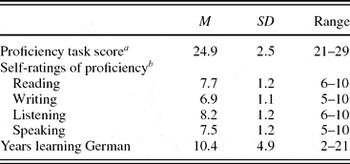
We used a language history questionnaire including self-ratings of L2 performance in reading, speaking, listening, and writing as a measure of language proficiency. A summary of this information can be seen in Table 1. It shows that, overall, the L2 participants judged themselves to be of advanced proficiency in German. As a secondary objective measure of proficiency, the L2 German speakers also completed an Internet-based proficiency test offered by the Goethe Institute that assesses grammatical and lexical competency in German. All participants scored above 21 (out of 30) on this task (M = 24.9). These results confirmed that, consistent with the language history questionnaire, participants were indeed advanced L2 speakers of German. In addition to the L2 German speakers, 24 German native speakers were tested in Leipzig, Germany, and served as a baseline comparison for the study.
Biographical information for second language German speakers

aThe proficiency task score is out of 30 possible points.
bThe self-proficiency ratings are on a scale of 1 to 10: 1 = least nativelike, 10 = most nativelike.
Materials
The experimental materials included 32 target sentences.Footnote 2 As seen in the examples below, the target sentences varied according to whether the extracted wh-element was the grammatical subject or the direct object of the complement clause and whether the matrix verb was in the present tense or present perfect tense.
18. Wer denkst du, vermisste den Lehrer in den Ferien? (subject extraction; present tense)
WhoNOM think you, missed theACC teacher during the vacation?
“Who do you think missed the teacher during the vacation?”
19. Wen denkst du, vermisste der Lehrer in den Ferien? (object extraction; present tense)
WhoACC think you, missed theNOM teacher during the vacation?
“Whom do you think the teacher missed during the vacation?”
20. Wer hast du gedacht, vermisste den Lehrer in den Ferien? (subject extraction; past tense)
WhoNOM have you thought, missed theACC teacher during the vacation?
“Who did you think missed the teacher during the vacation?”
21. Wen hast du gedacht, vermisste der Lehrer in den Ferien? (object extraction; past tense)
WhoACC have you thought, missed theNOM teacher during the vacation?
“Whom did you think the teacher missed during the vacation?”
Verb tense was included as a variable to examine whether the syntactic complexity of the matrix clause, and the adjacency of two finite verbs between the matrix and complement clause, would have an impact on the relative processing difficulty of this type of wh-question (cf. Juffs, Reference Juffs2005). Even though there was no effect of verb tense when participants were asked to make explicit grammaticality judgments when reading the target sentences (cf. Jackson & Dussias, Reference Jackson and Dussias2009), it remains to be seen whether the adjacency of two tensed verbs would compound processing difficulties under less explicit task demands.
As for case-marking information, nominative or accusative case markings unambiguously identified the initial wh-element as either a grammatical subject (wer “who”) or a direct object (wen “whom”). Verb-agreement information on the matrix verb eliminated the possibility that the intial wh-element could be interpreted as the subject of the matrix clause. In addition, matrix verbs were chosen to bias participants against interpreting the initial wh-element as a possible direct object of the matrix verb. This was accomplished by using verbs that require a dative marked indirect object, such as denken “to think,” verbs that are implausible with an animate direct object, such as behaupten “to claim,” or verbs that are biased toward a sentential complement in German, such as vermuten “to suspect.” A prepositional or adverbial phrase (e.g., letzten Sonntag “last Sunday”) followed the noun phrase in the complement clause. This was done so that processing costs associated with the noun phrase would not coincide with any potential sentence wrap-up effects.
In addition to the 32 target sentences, participants read 64 filler items. Sixteen filler items, such as Example 22 below, consisted of wh-questions that were similar to the target sentences but included additional matrix verbs and a wider variety of constructions in the complement clause. The remaining filler items included 32 declarative sentences, such as Example 23, and 16 wh-questions in which the initial wh-element was was “what,” such as Example 24. All three types of filler items included both subject-first and object-first sentences.
22. Wer behauptet er, vergaß den Herd in der Küche abzustellen?
“Who does he claim forgot to turn off the stove in the kitchen?”
23. Sie freut sich, dass ihr Bruder morgen ihre Eltern besucht.
“She is pleased that her brother will visit their parents tomorrow.”
24. Was hat er gesagt, kaufte der Mann seiner Freundin?
“What did he say the man bought his girlfriend?”
Each target sentence was manipulated according to the four conditions outlined in Examples 18–21 above. These sentences were evenly distributed across four lists, such that each participant read eight sentences for each target condition. These sentences were presented in a semirandomized order along with the 64 filler items. Participants also read 10 practice sentences at the beginning of the task to familiarize themselves with the task procedure.
Procedure
Participants were tested in a quiet room on a PC using the E-prime stimulus presentation software (Schneider, Eschman, & Zuccolotto, Reference Schneider, Eschmann and Zuccolotto2002). For the sentence reading task, sentences were presented using the noncumulative moving-window (i.e., self-paced reading) paradigm (Just, Carpenter, & Wooley, Reference Just, Carpenter and Woolley1982). Text appeared in black in 14-point bold Courier New on a white background. In keeping with previous research (e.g., Fanselow et al., Reference Fanselow, Kliegl, Schlesewsky, Kemper and Kliegl1999; Jackson & Dussias, Reference Jackson and Dussias2009), nouns phrases, adverbial phrases, and prepositional phrases were presented in their entirety; all other words followed a word-by-word presentation. Below is an example of how the target sentences were segmented for presentation:
25. Wer / hast / du / gedacht, / vermisste / den Lehrer / in den Ferien?
At the beginning of the task, participants were instructed both orally and in writing to read the sentences quietly to themselves as quickly and accurately as possible. Instructions were in German for all participants. Each trial began with the word “BEREIT” on the computer screen, at which point participants could press the space bar to begin reading the sentence.Footnote 3 The fixation word then disappeared, and the first word or phrase of the sentence appeared. When participants pressed the space bar, the first word or phrase disappeared and the next word or phrase appeared. In this manner, participants read the entire sentence.
Following the presentation of each target and filler sentence, participants were presented with a verification statement and they were instructed to decide whether the verification statement corresponded to the meaning of the original sentence. The verification statements for the target sentences and 48 of the filler items were constructed so as not to emphasize case-marking information and the assignment of grammatical roles in the original sentence, as seen in Examples 26 and 27 below. The verification statements for the remaining 16 filler items did highlight the assignment of grammatical roles through case-marking information, as seen in Example 28 below, to ensure that participants did not completely disregard this information while completing the reading task (cf. Havik et al., Reference Havik, Roberts, Hout, Schreuder and Haverkort2009).
26. Der Lehrer hatte Ferien.
“The teacher had vacation.”
27. Der Herd wurde nicht abgestellt.
“The stove was not turned off.”
28. Der Bruder besucht morgen die Eltern.
“The brother will visit the parents tomorrow.”
For half of the target sentences and half of the filler sentences, the correct response was “R” for richtig “correct” and for half of the items, the correct response was “F” for falsch “false.” To encourage participants to pay attention to the task, they were provided feedback regarding their response after each verification statement (e.g., Gibson & Warren, Reference Gibson and Warren2004; Pearlmutter, Garnsey, & Bock, Reference Pearlmutter, Garnsey and Bock1999; Trueswell & Kim, Reference Trueswell and Kim1998). In this manner, participants’ reading times and comprehension of each sentence was measured.
Given that several previous studies have shown that working memory capacity can have an impact on both L1 and L2 processing strategies (e.g., Dussias & Pinar, in press; Havik et al., Reference Havik, Roberts, Hout, Schreuder and Haverkort2009; Williams, Reference Williams2006; but for counterevidence, see Juffs, Reference Juffs2005), participants in the present study also completed a version of the Daneman and Carpenter (Reference Daneman and Carpenter1980) reading span task. To avoid a confound between working memory capacity and L2 proficiency, the German native speakers completed this task in German, whereas the L2 German speakers completed this task in their L1 English. The German version used translations of the English sentences.
In the reading span task, participants were instructed to read sentences out loud in a normal speaking tempo and then advance to the next sentence by pressing the space bar. Sentences were presented in their entirety, with five sets of sentences for each set size. The set size increased incrementally from two to six sentences after completion of a given set size. After each set of sentences, participants were prompted to orally recall the last word of each sentence in that set. Span size was calculated according to the largest set size in which a participant recalled all of the words for at least three of the five sets of sentences. A half point was awarded if the last words from two sets within a given set size were recalled correctly.
RESULTS
Comprehension accuracy
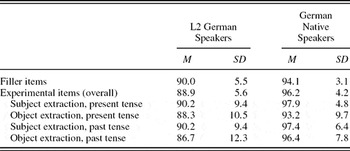
Overall comprehension accuracy on the task was high, with all participants in both groups scoring at least 80% on the task as a whole. Mean comprehension accuracy on the target and filler items are presented in Table 2. A one-way analysis of variance (ANOVA) comparing comprehension accuracy on the filler items revealed that the German native speakers were significantly more accurate than the L2 German speakers, F (1, 54) = 10.83, p < .01.
Mean comprehension accuracy

Note: L2, second language.
The results on the target sentences were entered into a repeated-measures ANOVA with verb tense (present tense vs. past tense) and word order (subject extraction vs. object extraction) as within-participants variables and group (native speakers vs. L2 speakers) as a between-participants variable. Analyses were conducted treating both participants as a random factor (F1) and items as a random factor (F2).
The results revealed no main effect of verb tense (F1 and F2 < 1). There was a main effect of word order in the participant analysis, F1 (1, 54) = 7.64, p < .01, that was not significant in the item analysis, F2 (1, 31) = 2.21, p > .1. Comprehension accuracy on subject extractions (M = 93.9%) was higher than on object extractions (M = 91.1%) across both groups. There was also a main effect of group in that the native speakers were more accurate than the L2 speakers on the target sentences overall, F1 (1, 54) = 29.35, p < .0001; F2 (1, 31) = 16.12, p < .0001, although comprehension accuracy on the target sentences was high for all participants in both groups (all >78.1%). There were no significant interactions (all F1 and F2 < 2).
Reading times
Only reading times for sentences with correct comprehension responses were included in the statistical analyses, leading to the exclusion of 3.8% of the German native speaker data and 11.1% of the L2 German speaker data. All reading times of <100 and >6,000 ms were excluded from the analysis (13 cases). In addition, for each condition within each participant group, reading times greater than 2 SD were excluded, leading to the exclusion of an additional 3.8% of the German native speaker data and 4.3% of the L2 speaker data.
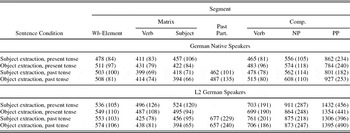
There were six main regions of interest: the wh-element, the matrix verb, the matrix subject, the past participle, the complement verb, and the complement noun phrase. In light of other L2 processing studies that have reported delayed effects among L2 speakers (e.g., Marinis et al., Reference Marinis, Roberts, Felser and Clahsen2005), analyses were also run on the sentence-final prepositional phrase. To preview the overall findings, it appears in Table 3 that both the native and the L2 German speakers initially read subject extractions faster than object extractions, a pattern that reversed for both groups at the matrix subject, where reading times were longer on subject extractions than on object extractions. At the complement clause, the pattern reversed again, but only for the native speakers: Native speakers took longer to read object extractions compared to subject extractions on both the complement verb and the complement noun phrase. In contrast, the L2 speakers took longer to read subject extractions in the past tense immediately at the complement verb, but otherwise they showed few differences across conditions on either segment in the complement clause.
Mean (standard deviations) reading times (ms)

Note: NP, noun phrase; PP, prepositional phrase; L2, second language.
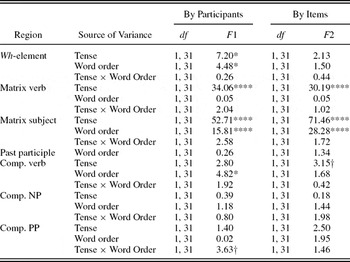
For each critical region in the sentence, mean reading times were entered into a 2 × 2 × 2 repeated-measures ANOVA with verb tense (present tense vs. past tense) and word order (subject extraction vs. object extraction) as within-participants variables and group (native speakers vs. L2 speakers) as a between-participants variable. Results from these omnibus ANOVAs revealed significant interactions with group on all sentence segments except the initial wh-element and the past participle (see Appendix A). Therefore, additional analyses were run on each segment within each language group, treating verb tense and word order as within-participants variables.
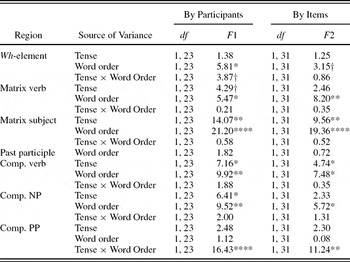
German native speakers. As seen in Table 4, there was a main effect of word order on the initial wh-element, although it only approached significance in the item analysis. This stemmed from longer reading times on object extractions (M = 510 ms) than subject extractions (M = 490 ms). This difficulty with object extractions carried over to the matrix verb, where there was also a main effect of word order because of longer reading times on object extractions (M = 423 ms) compared to subject extractions (M = 405 ms). Upon reaching the matrix subject, however, this pattern reversed, with significantly longer reading times on subject extractions (M = 438 ms) compared to object extractions (M = 408 ms). In addition, at the matrix subject there was a main effect of verb tense because reading times on present tense sentences (M = 439 ms) were longer than on past tense sentences (M = 406 ms). It was important that none of the word order effects in the matrix clause were modulated by verb tense, although the interaction between verb tense and word order approached significance in the participant analysis on the initial wh-element.
ANOVAs for German native speakers

Note: ANOVAs, analyses of variance; NP, noun phrase; PP, prepositional phrase.
†p < .1. *p < .05. **p < .01. ****p < .0001.
Upon reaching the complement clause, the German native speakers’ reading times were longer on object extractions compared to subject extractions on the complement verb (499 vs. 472 ms) and the complement noun phrase (591 vs. 559 ms), regardless of verb tense. There was also a main effect of verb tense on the complement verb, as well as the complement noun phrase in the participant analysis. For both segments, this was driven by longer reading times on past tense sentences (complement verb: M = 497 ms; complement noun phrase: M = 585 ms) compared to present tense sentences (complement verb: M = 474 ms; complement noun phrase: M = 565 ms). Finally, there was a significant interaction between verb tense and word order on the sentence-final prepositional phrase. Simple effects tests revealed that in present tense sentences, reading times on subject extractions (M = 862 ms) were significantly longer than reading times on object extractions (M = 784 ms), F1 (1, 23) = 7.30, p < .05; F2 (1, 31) = 4.68, p < .05. However, in past tense sentences, this pattern was reversed, with longer reading times on object extractions (M = 927 ms) compared to subject extractions (M = 801 ms), F1 (1, 23) = 10.63, p < .01; F2 (1, 31) = 5.85, p < .05.
L2 German speakers. On the initial wh-element there was a main effect of verb tense in the participant analysis on the initial wh-element (Table 5), in that the L2 German speakers’ reading times were longer on past tense sentences (M = 563 ms) compared to present tense sentences (M = 543 ms). At the same time, there was also a main effect of word order in the participant analysis. Similar to the German native speakers, the L2 German speakers’ reading times were longer on object extractions (M = 562 ms) than subject extractions (M = 544 ms). However, at the matrix verb there was only a main effect of verb tense, with longer reading times on present tense sentences (M = 492 ms), where participants read a main lexical verb (e.g., denkst “think”), compared to past tense sentences (M = 432 ms), in which they read the auxiliary verb (hast “have”). Upon reaching the matrix subject, there was a main effect of verb tense and a main effect of word order. In line with the German native speakers, L2 German speakers’ reading times were longer on present tense sentences (M = 509 ms) than on past tense sentences (M = 425 ms). Their reading times were also longer on subject extractions (M = 490 ms) compared to object extractions (M = 444 ms). Also in line with the German native speakers, there was no significant interaction between verb tense and word order on any segment in the matrix clause for the L2 German speakers.
ANOVAs for L2 German speakers

Note: ANOVAs, analyses of variance; L2, second language; NP, noun phrase; PP, prepositional phrase.
†p < .1. *p < .05. ****p < .0001.
Turning to the complement clause, in contrast to the results from the German native speakers, there were few significant effects among the L2 German speakers. At the complement verb, there was a significant effect of word order in the participant analysis, driven by longer reading times on subject extractions (M = 732 ms) compared to object extractions (M = 702 ms). On the complement verb, the effect of verb tense approached significance in the item analysis. Similarly, the interaction between tense and word order approached significance in the participant analysis on the final prepositional phrase. Otherwise there were no significant effects or interactions among the L2 German speakers in the complement clause.
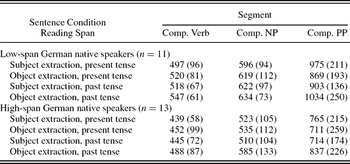
Post hoc analyses. To explore the possibility that the lack of effects in the complement clause among the L2 learners stemmed from individual differences across participants, post hoc analyses of covariance (ANCOVAs) were conducted on each segment in the complement clause. In these ANCOVAs, L1 reading span was entered as a covariate within each participant group. For the L2 speakers, there was also a significant positive correlation between reading span and L2 proficiency, as measured by participants’ score on the 30-point independent grammar and vocabulary task (R 2 = .378, p < .05). Therefore, in a second set of ANCOVAs, L2 proficiency was entered as a covariate factor for the L2 German speakers.Footnote 4 On any segments in which a covariate interacted with the sentence-level variables of verb tense or word order, follow-up ANOVAs were conducted using a median split to divide the respective native speakers or L2 participants into two groups.
Looking first at the German native speakers, an ANCOVA with word order and verb tense as within-participants variables and reading span as a covariate factor on the complement verb revealed no significant interactions between reading span and the sentence-level variables (all F < 2). Similarly, there were no significant interactions with reading span at the sentence-final prepositional phrase (all F < 2). As seen in Table 6, it appears that on these two segments, both the low- and high-span German native speakers exhibited similar reading time patterns across the four conditions. However, there was a significant three-way interaction between verb tense, word order, and reading span at the complement noun phrase, F (1, 22) = 5.59, p < .05. Follow-up ANOVAs with low-span German native speakers (n = 11) revealed no significant effects or interactions, verb tense: F1 (1, 10) = 3.01, p > .1; F2 < 2; word order: F1 (1, 10) = 3.08, p > .1; F2 (1, 28) = 2.36, p > .1; Verb Tense × Word Order: F1 and F2 < 1, although as seen in Table 6, their reading times were still numerically longer on object extractions compared to subject extractions for both present and past tense sentences.Footnote 5 Among the high-span German native speakers (n = 13), there was a main effect of verb tense in the item analysis, F1 (1, 12) = 3.13, p > .1; F2 (1, 31) = 4.97, p < .05, and a main effect of word order, F1 (1, 12) = 6.86, p < .05; F2 (1, 31) = 6.80, p < .05. These two main effects were qualified by an interaction between verb tense and word order that approached significance in the participant analysis, F1 (1, 12) = 4.12, p < .1; F2 (1, 31) = 1.48, p > .1. Even though this interaction was not significant because of the relatively small number of participants, it appears from Table 6 that for the high-span German native speakers, reading times on object extractions were still greater than subject extractions on past tense sentences. However, there was no longer any difference in reading times for present tense sentences.
Mean (standard deviations) reading times (ms) according to reading span for German native speakers

Note: NP, noun phrase; PP, prepositional phrase.
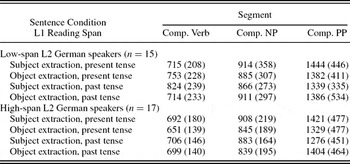
Among the L2 German speakers, an ANCOVA with L1 reading span as a covariate revealed a significant three-way interaction between verb tense, word order, and reading span at the complement verb, F1 (1, 30) = 4.22, p < .05. Among low-span L2 German speakers (n = 15), there was no main effect of verb tense (F1 and F2 < 2) or word order, F1 (1, 14) = 2.66, p > .1; F2 < 1. However, there was a significant interaction between verb tense and word order in the participant analysis, F1 (1, 14) = 9.11, p < .01; F2 < 1. As seen in Table 7, there was no significant difference in reading times according to word order in present tense sentences (F1 and F2 < 2), but reading times on subject extractions were longer than object extractions in past tense sentences in the participant analysis, F1 (1, 14) = 10.65, p < .01; F2 < 1. In contrast, there were no significant main effects or interactions among the high-span L2 German speakers (n = 17), verb tense: F1 and F2 < 2; word order: F1 (1, 16) = 2.03, p > .1; F2 < 1; Verb Tense × Word Order: F1 and F2 < 1. ANCOVAs on subsequent regions (the complement noun phrase and the sentence-final prepositional phrase) revealed no interaction between either verb tense or word order and reading span, nor a significant three-way interaction (all F < 2).
Mean (standard deviations) reading times (ms) according to L1 reading span for L2 German speakers

Note: L1, first language; L2, second language; NP, noun phrase; PP, prepositional phrase.
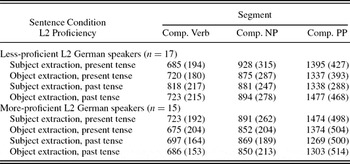
For the L2 German speakers, an ANCOVA treating L2 proficiency as a covariate also produced a significant three-way interaction between verb tense, word order, and L2 proficiency on the complement verb, F (1, 30) = 5.57, p < .05. Follow-up ANOVAs revealed a main effect of verb tense among the less-proficient L2 German speakers (n = 17), F1 (1, 16) = 9.30, p < .01; F2 (1, 31) = 3.28, p < .1. Although there was no main effect of word order, F1 (1, 16) = 2.87, p > .1; F2 < 2, there was a significant interaction between verb tense and word order, F1 (1, 16) = 9.43, p < .01; F2 (1, 31) = 3.27, p < .1. This significant interaction was the result of no significant reading time differences on present tense sentences (F1 and F2 < 2), but significantly longer reading times on subject extractions compared to object extractions on past tense sentences, F1 (1, 16) = 10.32, p < .01; F2 (1, 31) = 4.60, p < .05. For the more proficient L2 speakers (n = 15), there were no significant effects or interaction at the complement verb: verb tense: F1 and F2 < 1; word order: F1 < 2, F2 (1, 28) = 2.59, p > .1; Verb Tense × Word Order: F1 and F2 < 1.Footnote 6
On the subsequent noun phrase there were no significant interactions between the sentence-level variables and L2 proficiency (all F < 1). However, at the sentence-final prepositional phrase there was a significant interaction between verb tense and L2 proficiency, F (1, 30) = 5.74, p < .05; all other F < 2. Although there was no significant difference according to verb tense among the less proficient L2 speakers (F1 and F2 < 1), among the more proficient L2 speakers, reading times were longer on present tense sentences (M = 1424 ms) compared to past tense sentences (M = 1286 ms), F1 (1, 14) = 18.68, p < .01; F2 (1, 31) = 4.11, p < .1.Footnote 7
The results of the ANCOVAs, both with L1 reading span and L2 proficiency as covariates, indicate that the L2 speakers with lower L1 reading spans or lower L2 proficiency scores took longer to recover from their initial misanalysis of past tense subject extractions in the matrix clause. Beyond this effect, however, the results of the ANCOVAs do not point to a specific individual variable as the cause of the null results in the complement clause among the L2 participants overall. As can be seen in Table 8, even when the L2 participants are split into two groups based on L2 proficiency, reading times are very similar between subject and object extractions, especially for past tense sentences among the more proficient L2 participants.
Mean (standard deviations) reading times (ms) according to L2 proficiency for L2 German speakers

Note: L2, second language; NP, noun phrase; PP, prepositional phrase.
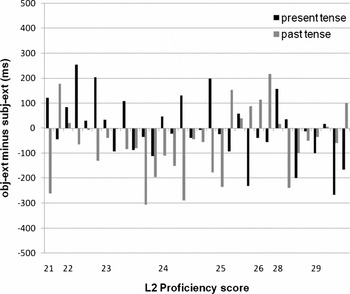
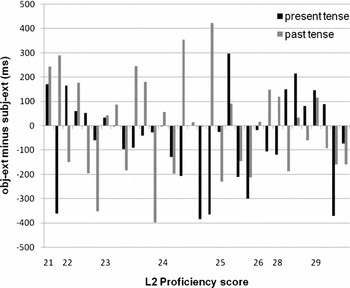
To further explore the lack of significant effects among both the less and more proficient L2 speakers at the complement clause, we calculated the difference in reading times between subject and object extractions for each participant on the complement verb and the complement noun phrase. This was accomplished by subtracting reading times for subject extractions from reading times for object extractions on present tense and past tense sentences for each segment. A positive number indicates that object extractions took longer to read than subject extractions; a negative number indicates the reverse.
As can be seen in Figures 1 and 2, with respect to the effect of L2 proficiency on processing preferences at the complement verb and noun phrase, the L2 speakers appear to exhibit a high degree of variability and no consistent pattern with regard to L2 proficiency. Within participants, there is a high degree of variability across conditions, with some participants exhibiting longer reading times on subject extractions for present tense sentences, but longer reading times on object extractions for past tense sentences. There is also a high degree of variability across participants, with some participants exhibiting few reading time differences as a function of word order, whereas other participants’ reading times on object versus subject extractions differ by more than 300 ms. Additionally, beyond graphically confirming the results of the ANCOVA, in which the less proficient L2 speakers showed difficulty in recovering from their earlier misanalysis of past tense sentences, the across- and within-participant variability does not appear to increase or decrease as a function of L2 proficiency. Together with the results from the ANCOVAs, these graphs underscore the unpredictability of the on-line processing strategies in the complement clause for this group of L2 speakers, regardless of L2 proficiency level.
Second language (L2) German speakers’ reading time differences (object extractions minus subject extractions; ms) according to L2 proficiency: complement verb.

Second language (L2) German speakers’ reading time differences (object extractions minus subject extractions; ms) according to L2 proficiency: complement noun phrase.

DISCUSSION
The major research question under investigation in the present study was whether native and L2 German speakers would use case-marking information and exhibit an on-line preference for subject extractions when prompted to read and comprehend German wh-questions during a self-paced reading task. The following summarizes the major findings:
• The L2 German speakers were less accurate in comprehending the filler sentences and the experimental items overall, compared to the German native speakers. However, both the native and L2 German speakers were more accurate in comprehending subject extractions than object extractions, regardless of verb tense.
• In the matrix clause, both the native and the L2 German speakers exhibited longer reading times at the initial wh-element on object extractions compared to subject extractions, an effect that carried over to the matrix verb among the German native speakers. At the matrix subject, however, this pattern reversed, with longer reading times on subject extractions than object extractions.
• Upon reaching the complement clause, the German native speakers exhibited greater processing costs on object extractions compared to subject extractions at both the complement verb and the complement noun phrase. Post hoc analyses suggested that this pattern held regardless of working memory capacity immediately at the complement verb. At the complement noun phrase, high-working memory native speakers still exhibited longer reading times on object extractions than subject extractions in the past tense, but their reading times on present tense sentences no longer differed according to word order. Low-working memory native speakers continued to exhibit longer reading times on object extractions than subject extractions, regardless of verb tense, although this difference was not statistically significant.
• Among the L2 German speakers, the only significant effect in the complement clause was that reading times on subject extractions were longer than on object extractions at the complement verb. Post hoc analyses indicated that this effect was driven by reading time differences on past tense sentences among L2 participants with lower L2 proficiency or lower L1 reading spans. Otherwise, the L2 participants exhibited no consistent reading time differences in the complement clause.
These findings will be discussed in relation to our initial predictions, and the implications these findings have regarding current models of L2 processing.
Incremental processing within the matrix clause
Looking first at results from the matrix clause, the results from the present study largely replicate the results reported by Jackson and Dussias (Reference Jackson and Dussias2009), as well as findings from previous German monolingual research (e.g., Bader & Meng, Reference Bader and Meng1999; Fanselow et al., Reference Fanselow, Kliegl, Schlesewsky, Kemper and Kliegl1999; Gorrell, Reference Gorrell, Hemforth and Konieczny2000). Comprehension accuracy was higher on subject extractions than on object extractions and reading times at the initial unambiguous wh-element, and the subsequent matrix verb among the German native speakers, were longer on object extractions compared to subject extractions. This points to a general preference for subject extractions over object extractions among both participant groups. Although no such on-line reading difficulty was found at the initial wh-element in Jackson and Dussias’ study, similar difficulties have been reported in previous German monolingual research (e.g., Fanselow et al., Reference Fanselow, Kliegl, Schlesewsky, Kemper and Kliegl1999).Footnote 8 Thus, not only did the native and L2 German speakers exhibit an overall preference for subject extractions, as evidenced by differences in comprehension accuracy according to word order, this preference also appeared in reading times on the initial wh-element. This suggests that upon reading the initial wh-element, both the native and L2 German speakers began to predict the subsequent structure of the matrix clause, leading to longer reading times when they realized they would have to construct a less-preferred object-first sentence because the initial wh-element was the accusative-marked wen “whom.”
In contrast to reading times on the initial wh-element, upon reaching the matrix subject (e.g., du “you”), reading times for subject extractions were significantly longer than those for object extractions among both groups. Similar to the reading time results from the same segment in Jackson and Dussias (Reference Jackson and Dussias2009), this likely reflects difficulties stemming from the fact that verb-agreement information in the matrix clause and case-marking information on the matrix subject eliminated the possibility that the initial wh-element could be the subject of the matrix clause. Specifically, after reading and processing unambiguous case-marking information on the initial wh-element, the participants had difficulty when they subsequently read the matrix clause subject and were confronted with two noun phrases containing nominative case markings in the same clause. This led to greater processing difficulties for subject extractions at the point that it became untenable to interpret the initial wh-element wer “who” as the subject of the matrix clause. These findings provide additional evidence that L2 speakers will try to integrate wh-fillers into a sentence as early as possible, in line with the Active Filler Hypothesis (cf. Frazier, Reference Frazier1987), and exhibit greater processing difficulties when such attempts fail (Dussias & Pinar, in press; Juffs, Reference Juffs2005; Juffs & Harrington, Reference Juffs and Harrington1995; Williams, Reference Williams2006; Williams et al., Reference Williams, Möbius and Kim2001).
In addition, the results from the matrix clause suggest that the L2 German speakers in the present study used case-marking information to assign grammatical roles, and then actively searched for an appropriate landing site for the initial wh-element, even though the accompanying comprehension statements did not explicitly encourage participants to pay attention to case-marking information. This indicates that not only can highly proficient L2 speakers process L2 morphosyntactic information on-line, even when such structures may be difficult to acquire (Jackson, Reference Jackson2008; see also Hoover & Dwivedi, Reference Hoover and Dwivedi1998), but that within a single clause, they can rapidly use such information to make on-line processing commitments regardless of the nature of the task.
Processing preferences across clausal boundaries
The results from the matrix clause would suggest that L2 speakers will continue to exhibit nativelike processing strategies even in situations in which task demands to not require that they process relevant L2 morphosyntactic information, but the reading time results from the complement clause indicate that this pattern may not carry over across clause boundaries or longer distances. Despite evidence pointing to similar processing costs between the German native speakers and the L2 German speakers with regard to reading times in the matrix clause, no such similarities emerged in the analyses of the reading time data from the complement clause.
Among the German native speakers, reading times on object extractions were longer than subject extractions at both the complement verb and the complement noun phrase, paralleling results from previous studies examining the processing of this type of wh-question in German (Fanselow et al., Reference Fanselow, Kliegl, Schlesewsky, Kemper and Kliegl1999; Jackson & Dussias, Reference Jackson and Dussias2009). Although there were differences regarding the length of time it took the low-span versus the high-span native speakers to recover, reading span did not impact the initial difficulty posed by object extractions directly at the complement verb. Such findings are in line with working-memory based accounts of why German native speakers exhibit a clear processing advantage for subject extractions, even when processing unambiguously marked wh-questions (Fanselow et al., Reference Fanselow, Kliegl, Schlesewsky, Kemper and Kliegl1999; Felser, Clahsen, et al., Reference Felser, Roberts, Marinis and Gross2003; Fiebach et al., Reference Fiebach, Schlesewsky and Friederici2002). Specifically, both reading time and ERP evidence has shown that regardless of working memory capacity, German native speakers exhibit greater processing costs at the point they begin to integrate an object wh-filler into a clause compared to a subject wh-filler. Working memory capacity only comes into play when considering the length and complexity of intervening material between a wh-filler and its landing site.
In contrast to the German native speakers, the only significant reading time difference among the L2 German speakers was that lower proficiency L2 speakers and L2 speakers with lower L1 reading spans took longer to recover from the difficulty associated with subject extractions in the matrix clause when reading past tense sentences. This difficulty is not surprising when one considers that the matrix clause was longer and syntactically more complex in past tense sentences compared to present tense sentences. In past tense sentences participants also did not encounter the lexical verb of the matrix clause until they read the clause-final past participle, such that they may have exhibited additional processing costs on subject extractions at the point they tried unsuccessfully to integrate the subject-marked wh-element with the past participle in subject extractions (for similar findings with regard to verb location, see Jackson, Reference Jackson2008). Although there were individual cases in which L2 speakers with very high proficiency scores had low L1 reading spans and L2 speakers with lower proficiency scores had high L1 reading spans, overall there was a positive correlation between L1 reading span and L2 proficiency, indicating that these two factors may be linked (cf. Kroll, Michael, Tokowicz, & Dufour, Reference Kroll, Michael, Tokowicz and Dufour2002). With regard to the present findings, this suggests that the L2 speakers who were less equipped to process the target sentences rapidly and efficiently, as a result of either L2 proficiency or working memory capacity or some combination, had greater difficulty recovering from an initial misanalysis, as has been reported more generally for L2 speakers in earlier sentence processing studies (e.g., Felser & Roberts, Reference Felser and Roberts2004; Williams et al., Reference Williams, Möbius and Kim2001).
However, beyond explaining the speed of recovery from effects in the matrix clause, neither L2 proficiency nor L1 working memory capacity could account for the lack of a clear subject or object preference in the complement clause among the L2 speakers. It is possible that the lack of significant effects could be because of the relatively small number of L2 participants in the present study. Future research that examines the importance of individual differences in L2 processing should allow for this possibility and collect data from a larger pool of L2 participants (e.g., Hoover & Dwivedi, Reference Hoover and Dwivedi1998; Jackson, Reference Jackson2008). At the same time, however, the total number of L2 participants in the present study (n = 32) is similar to the number of L2 participants in earlier sentence-processing studies that have found significant effects of working memory capacity among L2 speakers (e.g., Dussias & Pinar, in press; Williams, Reference Williams2006). This raises the possibility that the presence or absence of nativelike processing strategies among L2 speakers may not always correlate with individual differences, such as working memory capacity or L2 proficiency, at least among L2 speakers who have achieved a high level of L2 proficiency to begin with (cf. Clahsen & Felser, Reference Clahsen and Felser2006; Juffs, Reference Juffs2005). Alternatively, the added burden of processing syntactically complex structures could have led to the breakdown of structurally based parsing strategies among all of the L2 speakers, regardless of working memory capacity or L2 proficiency.
Comparing the lack of significant effects in the complement clause to the presence of significant effects in the matrix clause suggests that the L2 German speakers in the present study used case-marking information while reading the target sentences and employed a filler-driven strategy of trying to integrate the initial wh-element into the matrix clause as quickly as possible. However, their ability to consistently use morphosyntactic information in conjunction with a filler-driven processing strategy did not extend across clause boundaries (see also Felser & Roberts, Reference Felser and Roberts2004). On the one hand, results from the complement clause could be interpreted as evidence in favor of the shallow structure hypothesis (Clahsen & Felser, Reference Clahsen and Felser2006). Thus, the lack of a clear subject preference in the complement clause could be a sign that the L2 speakers did not use phrase-structure information to the same extent as native speakers and did not immediately attempt to integrate the initial wh-element into the complement clause, thus leading to no differentiation in reading times according to word order. However, closer examination of individual L2 participants’ reading times on the complement verb and complement noun phrase, as presented in Figures 1 and 2, reveal that this null result stemmed not so much from participants exhibiting no reading time differences according to word order in the complement clause, but rather from a high degree of variability between participants, with some participants taking longer to read object extractions and some participants taking longer to read subject extractions. This raises the possibility that at least the subset of L2 speakers who exhibited longer reading times for object extractions than subject extractions may have used structure-based parsing strategies along the lines of those outlined for the German native speakers.
At the same time, L2 proficiency may have played a role in the lack of significant effects in the complement clause among the L2 speakers. The L2 speakers in the current study were highly proficient in German, as seen in their responses to the language-learning background questionnaire and their high scores on an independent German proficiency task. However, given that their overall comprehension accuracy on the target sentences was significantly lower than the German native speakers, it is possible that their L2 German knowledge had not yet reached asymptote. In addition, unlike the L2 participants in Hopp (Reference Hopp2006), the L2 participants in the present study were residing in a predominantly English-speaking environment at the time of testing. Given recent evidence that language dominance can influence both L1 and L2 processing strategies (e.g., Blattner, Reference Blattner2007; Dussias & Sagarra, Reference Dussias and Sagarra2007), this may have also had an impact on the processing strategies employed by the L2 participants in the current study. Thus, future research using the same sentences, but with near-native speakers living in an L2 immersion environment at the time of testing, could help determine whether, with sufficient proficiency and exposure, L2 speakers can reach the point that they are able to consistently exhibit nativelike reading time patterns when processing more complex sentences, especially as it pertains to using structure-based parsing strategies across clause boundaries.
The effect of task demands
Although L2 proficiency may ultimately explain differences between the present results and studies that have found more nativelike reading time patterns among near-native L2 speakers (e.g., Hopp, Reference Hopp2006), the question still remains as to why the present results differ from those reported by Jackson and Dussias (Reference Jackson and Dussias2009), in which the L2 German speakers did exhibit significant processing difficulties on object extractions at the complement noun phrase. Given that the participants in the present study were recruited from a population of L2 speakers similar to those who participated in the study reported by Jackson and Dussias, L2 proficiency does not provide a satisfactory explanation for differences between the two studies. Rather, similar to Williams (Reference Williams2006) and Havik et al. (Reference Havik, Roberts, Hout, Schreuder and Haverkort2009), the results from the present study suggest that, especially among L2 speakers, processing strategies may be sensitive to task-related demands.
Parallel to Jiang (Reference Jiang2004, Reference Jiang2007), this suggests that even though L2 speakers at this level may have acquired the German case-marking system, they may not use case-marking information in conjunction with structure-based parsing strategies that favor subject-first sentences in German, especially as it pertains to integrating unambiguously marked wh-fillers with their subcategorizing verb in multiclause sentences. Specifically, the fact that the L2 German speakers in Jackson and Dussias (Reference Jackson and Dussias2009) exhibited increased processing costs on object extractions at the complement noun phrase may reflect some sort of case-matching strategy because the accompanying grammaticality judgment task encouraged them to focus their attention on case-marking information. Thus, even though their reading time patterns may have approximated those of the German native speakers, the underlying strategies leading to such patterns were not the same. Similarly, even once explicit task demands are removed, as in the present study, L2 German speakers can continue to exhibit an on-line sensitivity to incongruities in case-marking information within a single clause (here the matrix clause) as they assign sentential arguments the appropriate grammatical role and build the syntactic structure for that clause. However, such strategies break down as syntactic complexity increases, leading to greater variability in on-line reading times across participants in the complement clause.
An alternative, although not necessarily incompatible, explanation for the lack of consistent reading time patterns in the complement clause is the idea that the L2 speakers may have relied on “good enough” representations when reading the target sentences (cf. Ferreira, Bailey, & Ferraro, Reference Ferreira, Bailey and Ferraro2002; see also Sanford & Sturt, Reference Sanford and Sturt2002). Ferreira et al. (Reference Ferreira, Bailey and Ferraro2002) argue that even for native speakers of a language, full syntactic representations are difficult to construct and fragile to maintain. Because a larger discourse context and real-world knowledge often render a full syntactic representation unnecessary for comprehension, people may opt to build only partial semantic and syntactic representations during language comprehension. The fact that the target sentences in the present study were unambiguous, assuming one paid attention to the case-marking information on the initial wh-element, may have even encouraged the L2 participants to construct incomplete syntactic representations, regardless of the degree to which they had acquired implicit knowledge of the German case-marking system. In these terms, the lack of significant effects in the complement clause is less a sign that L2 speakers are unable to capitalize on structure-based parsing strategies, but rather that they may have opted not to do so in the current task because of the increased processing burden imposed by the structural complexity of the target sentences.
CONCLUSION
In summary, the main research question driving the present study was whether L2 German speakers would exhibit a subject preference while processing and comprehending wh-questions in German, even when specific task demands did not explicitly encourage participants to pay attention to case-marking information in the input. Results showed that the L2 German speakers continued to exhibit sensitivity to case-marking information during on-line processing, and an overall subject preference, as measured by comprehension accuracy and reading times on the initial unambiguous wh-element, similar to German native speakers. However, this subject preference did not extend to reading times in the complement clause, in contrast to the German native speakers in the present study and in previous monolingual German research (Fanselow et al., Reference Fanselow, Kliegl, Schlesewsky, Kemper and Kliegl1999; Jackson & Dussias, Reference Jackson and Dussias2009). Although native speakers’ processing strategies may be less prone, although still not impervious, to differences in task demands, the present study suggests that L2 speakers often adopt processing strategies to fit the demands imposed by the task itself, especially when faced with processing complex sentences in their nonnative language. These resulting strategies may not mirror the strategies employed by a majority of native speakers of the language in question, and they may be highly individualized, varying dramatically from L2 speaker to L2 speaker. Nevertheless, they highlight the ability of L2 speakers to make sophisticated use of the linguistic and cognitive resources they have at their disposal to successfully process and comprehend L2 input.
APPENDIX A
Omnibus ANOVAs for phrase-by-phrase reading times

Note: ANOVAs, analyses of variance; NP, noun phrase; PP, prepositional phrase.
†p < .1 *p < .05. **p < .01. ****p < .0001.
ACKNOWLEDGMENTS
This research was funded in part by grants from Language Learning: A Journal of Research in Language Studies and Eunice Kennedy Shriver National Institute of Child Health and Human Development Grant R03HD058765 (to C.N.J.). We thank Laura Smith and Christine Gardner for their assistance in collecting the L2 German speaker data and Sonja Kotz for her assistance in collecting the German native speaker data. We also thank the three anonymous Applied Psycholinguistics reviewers for their feedback and suggestions that greatly improved this paper. The content is solely the responsibility of the authors and does not necessarily represent the official views of the Eunice Kennedy Shriver National Institute of Child Health and Human Development or the National Institutes of Health.