INTRODUCTION
The taxonomy of cirratulids has been a challenge from the beginning, because the currently accepted diagnostic characters change through ontogeny making it difficult to tell juveniles apart from adults. The main genera can be differentiated by the number of tentacular filaments (a pair or two groups), as well as their position, segmental origin and relative position with respect to the branchiae. In addition, capillary chaetae and spines are diagnostic features, in some cases to generic level and in others to separate closely related species. If individuals are incomplete, lacking the posterior region or immature, the risks of misidentification increase drastically.
The family has been divided into three main groups: the multi-tentaculates, bi-tentaculates from hard substrates, and bi-tentaculates from soft substrates (Blake, Reference Blake, Blake, Hilbig and Scott1996). The multi-tentaculates have two dorsal groups of feeding tentacles placed on one or several segments. There are five accepted genera: Cirratulus Lamarck, Reference Lamarck1818, Timarete Kinberg, Reference Kinberg1866, Protocirrineris Czerniavsky, Reference Czerniavsky1881, Cirriformia Hartman, Reference Hartman1936 and Fauvelicirratulus Çinar & Petersen, Reference Çinar and Petersen2011. The main diagnostic character is the disposition of tentacular filaments, in one or more longitudinal rows in Protocirrineris or in transverse rows in the others. Another important character is the presence of unidentate spines in Timarete, Cirratulus and Cirriformia that are absent in Protocirrineris. The presence, number, origin and distribution of branchial filaments are also diagnostic to separate these genera.
The genus Cirratulus is the most species-rich cirratulid genus with more than 80 described species. Most species were described by northern hemisphere specialists working on material collected from that region. However, some specimens from the southern hemisphere were analysed by European researchers heading to Antarctica or unexplored regions of the southern hemisphere, such as America, Asia, Oceania and Africa during the 19th century. Some of these identifications were incorrect due to the lack of study in the southern hemisphere and being based on morphological similarities, identifying the specimens as the same species from the European region. This ‘European vision’ produced several cosmopolitan species or simply species not well identified. Furthermore, the original descriptions were frequently poor in detail and structures described, so the existence and distribution of the species of Cirratulus must be revisited. Some classical works made by Kinberg (Reference Kinberg1866) or Ehlers (Reference Ehlers1897) describe three multi-tentacular cirratulids for Argentina, two of them belonging to the genus Cirratulus.
Most worldwide records of the genus Cirratulus need to be revised because some reportedly cosmopolitan species may prove to be undescribed species with discrete distributions or belong to a complex of morphologically similar species. For example, the private collection of Lobo Orensanz has several lots of ‘Cirratulus near cirratus’ species, and it is suspected that this species from the northern hemisphere is not likely to be in austral regions of the southern hemisphere. This has been shown to be true for several other cirratulid species (Blake, Reference Blake, Blake, Hilbig and Scott1996; Magalhães et al., Reference Magalhães, Seixas, Paiva and Elias2014).
This work aims to review the Cirratulus material deposited in museums of natural history in Argentina, and update the descriptions of two species, Cirratulus jucundus (Kinberg, Reference Kinberg1866) and Cirratulus patagonicus (Kinberg, Reference Kinberg1866). Both species have their distributions expanded to shallow areas of Patagonia. In addition, Cirratulus mianzanii sp. nov. is described for subtidal areas off the Peninsula Valdes, in the South-west Atlantic.
MATERIALS AND METHODS
This revision of Cirratulus includes material deposited in two major natural history museums of Argentina, the Museo ‘Bernardino Rivadavia’ (MACN) from Buenos Aires city, and the Museo de La Plata (MLP) in La Plata city. Comparative material was also examined from the Smithsonian Institution National Museum of Natural History (USNM), Washington, DC.
The specimens of the new Cirratulus species were donated by the collectors Drs Claudia Bremec and Diego Giberto (INIDEP-CONICET). They were collected from off Peninsula Valdes (Patagonia, SW Atlantic).
The material was fixed in 5% formaldehyde and preserved in 70% ethyl alcohol. The specimens were examined with optical equipment (microscope and stereomicroscope) and also by a scanning electron microscope (SEM) JEOL, JSM-6460 LV. The material for SEM was prepared by performing dehydration in ethyl alcohol (70, 80, 90, 95 and 100%). Samples were dried in HMDS (hexamethyldisilazane), mounted on aluminium studs and metalized with Au–Pd.
Type material of Cirratulus mianzanii sp. nov. and voucher specimens of the three species are deposited in the Invertebrate collection of the Museo de Ciencias Naturales de La Plata.
RESULTS
SYSTEMATICS
Family cirratulidae Ryckholt, Reference Ryckholt1851
Genus Cirratulus Lamarck, Reference Lamarck1818
DIAGNOSIS (after Blake, Reference Blake, Blake, Hilbig and Scott1996)
Prostomium wedge-shaped, elongate or blunt, usually with eyespots; peristomium with 2–3 annulations. Two groups of tentacular filaments arising from a single anterior segment. Branchiae first present from the same chaetiger as tentacular filaments, occurring singly, continuing over most of the body to posterior end. Parapodial rami well separated. Chaetae including capillaries and acicular spines.
Cirratulus jucundus (Kinberg, Reference Kinberg1866)
(Figure 1)
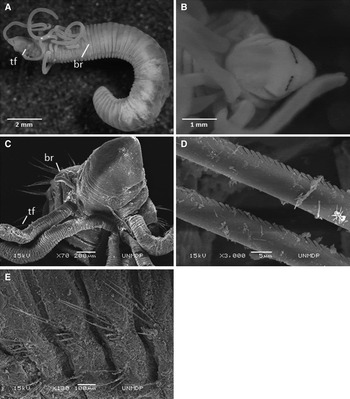
Cirratulus jucundus. (A) Complete specimen, tentacular filaments (ft), branchiae (br); (B) eyespots on the prostomium; (C) dorsal anterior showing peristomium and origin of tentacular filaments (ft) and first branchiae (br); (D) serrate capillaries; (E) pattern of capillaries and acicular spines in noto- and neuropodium. (A, B), optical microscopy photo; (C–E) SEM photograph.

Promenia jucunda Kinberg, Reference Kinberg1866; 254
Cirratulus jucundus: Augener, Reference Augener1931; 306
COMPARATIVE MATERIAL EXAMINED
Argentina: off Tierra del Fuego-Bahia de Thetis, 54.628441°S 65.238474°W (WGS84), coll. Umana, C. Angel, November 1940, intertidal, MLP. OI 2681 (An 6827), 7 specimens; off Santa Cruz-Puerto Deseado, 47.750000°S 65.866667°W (WGS84), coll. Zelaya, Diego, 11 December 2006, intertidal, MLP. 3592-2, 4 specimens.
ADDITIONAL MATERIAL EXAMINED
Argentina, off Tierra del Fuego, 54°44′25″ S 63°51′25″ W, coll. SOSC, 12 May 1971, Station 71-2-32, vessel RV ‘Hero’, cruise number 712, intertidal, identified by Blake, J.A. (1, USNM 1129456). Antarctic Ocean: station ED-8, Exped. Deep Freeze I, 1955-56 (2, USNM 1129146).
DESCRIPTION
Complete specimens 15–25 mm long, 1–3 mm wide for 49–79 chaetigers (Figure 1A). Body round in cross section. Body colour in alcohol pale yellow throughout. Pygidium with terminal anus.
Prostomium short, conical, two anterior chaetigers in length; eyespots present, organized in a postero-dorsal row of about eight dark eyespots (Figure 1B), smaller specimen with fewer number of larger eyespots, juveniles with single or two eyespots; nuchal organ depression postero-lateral and elongated. Peristomium 3 anterior chaetigers in length, with three same-sized annuli (Figure 1C).
First pair of branchial filaments from posterior end of chaetiger 1; branchiae one pair per segment throughout; abundant anteriorly and absent on posterior chaetigers; branchiae arising close to notopodial base and quickly becoming more dorsal, but not reaching mid-dorsum (Figure 1A); branchial filaments short and thick. Two groups of about 8–10 tentacular filaments arise between posterior end of peristomium and posterior end of chaetiger 1 (Figure 1B, C).
Notopodium and neuropodium separated. Anterior notopodia with two longitudinal rows of five capillary chaetae each. Capillary chaetae serrate under SEM (Figure 1D). Notopodial acicular spines similar throughout, lower acicular spines short alternating with short capillaries, upper row longer (Figure 1E); acicular spines present from chaetigers 6–9; spines less numerous posteriorly. Neuropodial acicular spines similar in shape throughout, 3–5 present from chaetiger 1, alternating with short capillaries, reduced posteriorly. Noto- and neuropodial spines similar in shape and size, slightly curved distally.
METHYL GREEN STAINING PATTERN
No distinctive staining pattern. Complete specimens stained a light green.
HABITAT
Intertidal region. Some samples were collected from Spartina-vegetated salt-marsh environments in Puerto Deseado and were associated with Capitella sp., Caulleriella sp. and Cirriformia sp.
REMARKS
This species differs from Cirratulus patagonicus by the presence of rows of eight distinct dark eyespots postero-laterally on the prostomium. The number and size of eyes appear to be size-dependent, smaller individuals were observed to have fewer eyespots than larger ones. In addition, the number of tentacular filaments can also be used to separate these two species, C. patagonicus with 15–20 filaments and Cirratulus jucundus with 8–10 filaments. The notopodial spines are first present in chaetiger 6–9 in C. jucundus, and between 10–12 in C. patagonicus.
REPRODUCTION
There is no available information about sexual or asexual reproduction for this species.
DISTRIBUTION
This species was originally described from Estrecho de Magallanes (Magellan Strait), near the Bucket Island and has been reported from South Argentina, in Tierra del Fuego and Antarctica. The present report extends its distribution to Puerto Deseado, 1300 km north of Tierra del Fuego.
Cirratulus patagonicus (Kinberg, Reference Kinberg1866)
(Figure 2)
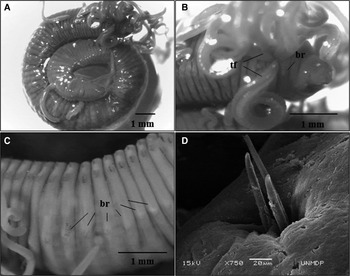
Cirratulus patagonicus. (A) Complete specimen; (B) lateral anterior showing peristomium and origin of tentacular filaments (ft) and first branchiae (br); (C) position of branchial filaments (br); (D) pattern of capillaries and acicular spines in noto- and neuropodium. (A–C) optical microscopy photo; (D) SEM photograph.

Archidice patagonica Kinberg, Reference Kinberg1866: 255 [ia. Bucket]
Cirratulus patagonicus: Hartman, Reference Hartman1966; 27, pl. 7: fs. 6–8 [catalogue]
COMPARATIVE MATERIAL EXAMINED
Argentina: off Santa Cruz – Puerto Deseado, 47.746759°S 65.89754°W (WGS84), coll. Birabén, Maximiliano, 20 February 1935, intertidal, MLP. OI 2568 (An 06680), 7 specimens. Off Tierra del Fuego-Puerto Brown, canal Beagle, coll. Medina, 17 April 1980, MACN-In 32927: Poliquetos.
ADDITIONAL MATERIAL EXAMINED
Tierra del Fuego, Le Maire Strait, West of South Sandwich Islands, 54°46′12″S 64°42′42″W, coll. SOSC, 27 Apr. 1971, Station 71-2-16, vessel RV ‘Hero’, cruise number 712, intertidal, identified by Blake, J.A. (11, USNM 1129552).
DESCRIPTION
Complete specimens (Figure 2A) 3–20 mm long, 1–4 mm wide for 20–80 chaetigers. Body short, rounded dorsally and ventrally flattened. Segments with deep inter-segmental groove. Body colour in alcohol pale yellow throughout. Pygidium with terminal anus.
Prostomium short and broadly rounded, one anterior chaetiger in length; postero-dorsal row of six pale eyespots, sometimes absent; nuchal organ depression postero-lateral and elongated. Peristomium two anterior chaetigers in length, with three same-sized annuli; first annulus may form dorsal crest (Figure 2B). First two chaetigers twice as long as other anterior chaetigers.
First pair of branchial filaments from posterior end of chaetiger 1 near notopodial base; one pair per segment throughout and only absent on last 5–10 chaetigers; branchiae arising with some distance from notopodial base and shifting to mid-dorsum from chaetigers 2–4 (Figure 2C); branchial filaments short and thick. Two groups of about 15–20 tentacular filaments from chaetiger 1.
Notopodium and neuropodium separated. Anterior notopodia with two longitudinal rows of 5–6 capillary chaetae each. Notopodial acicular spines similar throughout, 2–4 present from chaetiger 10–12, alternating with short capillaries (Figure 2D). Neuropodial acicular spines similar throughout, 3–4 present from chaetiger 1, alternating with long capillaries. Noto- and neuropodial spines curved distally, similar in shape; neuropodial spines slightly thicker than notopodial ones.
METHYL GREEN STAINING PATTERN
No distinctive staining pattern. Complete specimens stained with light green.
HABITAT
Intertidal region.
REPRODUCTION
There is no available information about sexual or asexual reproduction for this species. Some specimens collected in April appeared full of oocytes.
DISTRIBUTION
This species was originally described from Strait of Magellan (Tierra del Fuego), and it has been reported from South Argentina and sub Antarctic areas.
REMARKS
See Remarks for Cirratulus jucundus. One particular character of Cirratulus patagonicus is the position of branchiae throughout the body, which can almost reach a dorsal position on mid-body segments.
Cirratulus mianzanii sp. nov.
(Figure 3)
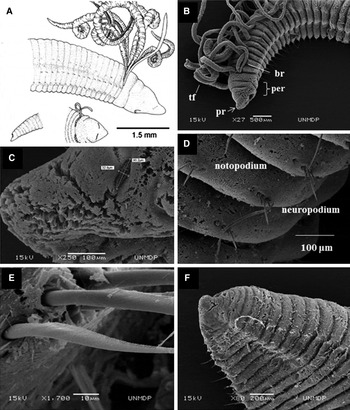
Cirratulus mianzanii sp. nov. (A) Schematic view; (B) lateral anterior showing prostomium (pr), peristomium (per) and origin of tentacular filaments (ft) and first branchiae (br); (C) lateral anterior showing nuchal organs; (D) pattern of capillaries and acicular spines in noto- and neuropodium; (E) serration of capillary chaetae; (F) pygidium. (B–F) SEM photograph.

TYPE MATERIAL
Holotype: complete adult, 18 mm long, 2 mm wide for 60 chaetigers (MLP-Oi 4086). Off Peninsula Valdez, SW Atlantic Ocean, Argentina, Station 7, 42.786°S 62.821°W, 76 m depth, salinity: 33.34, temperature: 13.6°C, coll. Drs Claudia Bremec and Diego Giberto, 15 December 2008.
Paratypes: (4) complete adults, 15–20 mm long, 1–2 mm wide for 59–65 chaetigers (MLP-Oi 4087). Off Peninsula Valdez, SW Atlantic Ocean, Argentina, same station, collector, and date as holotype.
DESCRIPTION
Body fusiform, long, anterior region with lateral projections (shoulders) then rounded in cross section, dorsally inflated, grooved ventrally (Figure 3A, B), with very narrow dark line along body. Pygidium with ventral lobe and anus sub-terminal, dorsal (Figure 3A, F). Colour yellowish in alcohol but some specimens with more brownish colouration.
Prostomium conical, round, as long as the two first chaetigers; with lateral oval nuchal organs (Figure 3C), and oblique row of five black eyespots almost continuous (5–8 in paratypes), subdermal, not observed with SEM. Peristomium short, with three dorsal annuli (two or three annuli in paratypes), three chaetigers in length, first annulus not distinctly separated from prostomium (Figure 3A, B). Two groups of 4–6 tentacular filaments, arising from groove between peristomium and first chaetiger; first pair of branchial filaments below tentacular filaments from same groove (Figure 3A, B). Branchiae one pair per chaetiger, less abundant in middle region and absent in last chaetigers. Branchial filaments arise close to notopodium in first chaetigers, then slightly more dorsal to posterior region. Distance between branchial insertion with respect to notopodium equal to half the distance between noto- and neuropodium.
Noto- and neuropodium separate; anterior and mid chaetigers with a single row of 3–7 serrate capillary chaetae in notopodium, 2–4 serrate capillary chaetae in neuropodium, number of capillaries reducing towards posterior region. Capillary chaetae with basal blade distinctly striated, and a coarse serration seen under optical microscope and SEM (Figure 3E). Acicular spines slightly curved distally from chaetiger 22 (21–24 in paratypes) in notopodium, alternating with serrate capillaries; 2–4 neuropodial acicular spines from chaetiger 10 (9–10 in paratypes) (Figure 3D) with one capillary chaeta between spines.
METHYL GREEN STAINING PATTERN
No distinctive staining pattern. Complete specimen stained a light green.
HABITAT
Sand bottoms at subtidal depths. The species has been reported accompanied by an indeterminate Actiniaria, amphipods and polychaetes belonging to the families Phyllodocidae, Paraonidae and Opheliidae.
REPRODUCTION
There is no available information about sexual or asexual reproduction for this species.
DISTRIBUTION
This species is described off Peninsula Valdez, in the SW Atlantic Ocean, Argentina.
REMARKS
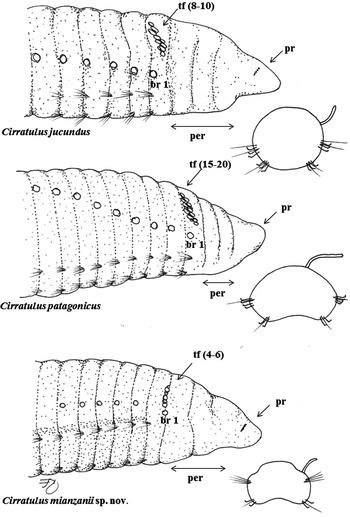
Cirratulus mianzanii sp. nov. is similar to Cirratulus jucundus in the general body morphology, including the number and position of eyespots, but differs in respect to the number of tentacular filaments: C. jucundus has 8–10 in each fascicle but there are 4–5 in C. mianzanii sp. nov. In addition, the position of the first pair of branchiae is in the first chaetiger in C. jucundus, but in the groove between the peristomium and first chaetiger inferior to the tentacular filaments in C. mianzanii sp. nov. (Figure 4); the neuropodial spines appear from the first chaetiger, and the notopodial spines from chaetigers 6–9 in C. jucundus, whereas in C. mianzanii sp. nov., neuropodial spines are from chaetigers 9–10 and notopodial spines from chaetigers 21–24. The pygidium is terminal in C. jucundus, but with a ventral lobe and anus sub-terminal in C. mianzanii sp. nov.
Schematic view of the three Cirratulus species mentioned in this work, showing comparative features of anterior region and cross-sections of C. jucundus, C. patagonicus, and C. mianzanii sp. nov. Abbreviations: prostomium (pr), peristomium (per), first branchiae (br) and tentacular filaments (tf) with the number of filaments between brackets.

Another similar species is Cirratulus patagonicus with similar body morphology, however it has two groups of 15 or more tentacular filaments whereas C. mianzanii sp. nov. has only 4–5 tentacular filaments. The first pair of branchial filaments in C. mianzanii sp. nov. arise from the groove in between the peristomium and first chaetiger below the tentacular filaments whereas in C. patagonicus they arise from the posterior region of chaetiger 1 (Figure 4). Neuropodial spines start from chaetiger 1 in C. patagonicus and notopodial spines from chaetigers 10–12, whereas neuropodial spines are from chaetigers 9–10 in C. mianzanii sp. nov. and notopodial spines from chaetigers 21–24. The pygidium has a ventral lobe and anus subterminal (dorsal) in C. mianzanii sp. nov. whilst it is terminal, lacking lobes in C. patagonicus. The cross-sections of these species also show differences, mostly in respect to the position of branchiae throughout the body (Figure 4).
Additional useful characters are related to the ultrastructure of the capillary chaetae and organization of the eyespots. The capillary chaetae are serrated under optical microscope in C. mianzanii sp. nov. whereas it only appears finely serrated when observed under SEM in C. jucundus and C. patagonicus. The eyespots are also distinct and have been observed as almost continuous in C. mianzanii sp. nov. and C. patagonicus, whereas they are distinctly separated in C. jucundus.
ETYMOLOGY
The species is dedicated to Dr Hermes Mianzan (1957–2014), marine biologist in the field of gelatinous plankton, dear and missed.
DISCUSSION
The original description of Promenia jucunda and Archidice patagonicus, made by Kinberg (Reference Kinberg1866), is inadequate under current taxonomic standards for the family Cirratulidae because many characters have only recently been found to be relevant to separate species. For this reason, the re-description is the first step to understand the taxonomy of multi-tentaculate cirratulids from the Argentine coast. The geographic distribution of Cirratulus jucundus is extended from Antarctic and sub-Antarctic regions to continental areas of South America in the Atlantic Ocean. Further evidence emerged with the examination of additional material deposited in the Argentinean natural science museums and the personal collection of Lobo Orensanz (1945–2015).
Additional characters related to the relationship between the length of the prostomium and peristomium, segmental origin of the notopodial and neuropodial spines, ultrastructure of the capillary chaetae, presence of lobes in the pygidium, relative origin of the branchial filaments in relation to the tentacular filaments and position of the branchiae in relation to the notopodial base and how it changes along the body could be used to distinguish closely related species of Cirratulus.
The cosmopolitan status of Cirratulus cirratus needs to be further investigated. Most ecological studies had identified this species from very different biogeographic regions around the globe. It is very likely that many of these records are misidentifications and that this species could be restricted to its type locality. This was the case for Caulleriella alata (Southern, Reference Southern1914), described for Ireland and recorded worldwide; in Argentina, this species record was later re-identified and a new species formally described for the SW Atlantic (Elías & Rivero, Reference Elías and Rivero2008). Other records of multi-tentaculate cirratulids from South America are equally doubtful, such as Timarete oculata (Treadwell, Reference Treadwell1932), originally described from Brazil and lumped into the Timarete filigera species complex. This species was later re-validated and re-described in Magalhães et al. (Reference Magalhães, Seixas, Paiva and Elias2014). Other examples are the widely reported Mediterranean species Timarete filigera (Delle Chiaje, Reference Delle Chiaje1828) and Cirriformia tentaculata (Montagu, Reference Montagu1808) with many citations in the Brazilian literature (Amaral et al., Reference Amaral, Nallin, Steiner, Forroni and Gomes2006–2012) but very unlikely to occur in South America (Magalhães et al., Reference Magalhães, Seixas, Paiva and Elias2014). Timarete punctata (Grube, Reference Grube1859) is a complex of species and it has been recorded throughout the Atlantic (western and eastern), Indian (western) and Pacific (western) oceans (Magalhães et al., Reference Magalhães, Seixas, Paiva and Elias2014).
The material collected by Lobo Orensanz has several records of ‘Cirratulus near cirratus’ species that clearly do not correspond to this species and possibly correspond to more than one species. Multi-tentaculate cirratulids are difficult to identify because branchiae and tentacular filaments are often preserved grouped and difficult to differentiate, and the prostomium and peristomium can be retracted if not relaxed before fixation. On top of that, many species were poorly described and the type material has been lost.
The examination of specimens by scanning electronic microscope allows us to determine that eyes in this genus lack crystalline structures, being subdermal eyespots as described by Day (Reference Day1967). Other features observed with SEM were the morphology of the nuchal organs (elliptical as in Caulleriella) and capillaries serrated on one edge. These features may be relevant for the diagnosis of species.
ACKNOWLEDGEMENTS
Drs Claudia Bremec and Diego Giberto (INIDEP, Mar del Plata) provided the material which was described as the new species of Cirratulus. Miss Maria Silvia Rivero was very important in the first steps of this work, providing references and advice. Dra. Maria Eugenia Becherucci helped with the figure design. SEM images were obtained by Lic. Monica Oppedisano from the Laboratorio de Microscopía Electrónica de la Facultad de Ciencias Exactas y Naturales de la Universidad Nacional de Mar del Plata.
FINANCIAL SUPPORT
This study was supported by the ‘Systematics and Taxonomy of Austral Cirratulidae (Polychaeta)’ grant project PICT 2013 No. 1511 of Agencia Nacional de Promoción de Ciencia y Técnica.