

INTRODUCTION
Nuclear weapons testing has led to a significant increase in atmospheric 14CO2 activity, peaking in the Northern Hemisphere in 1963 (Meijer et al. Reference Meijer, van der Plicht, Gislefoss and Nydal1995; Levin et al. Reference Levin, Naegler, Kromer and Worthy2010). Following the signing of the moratorium on atmospheric nuclear weapons tests, the activity has been declining to this day. Due to this, carbon samples originating after 1955 show an activity that significantly exceeds the radiocarbon (14C) activity values for samples from all previous periods. The curve showing the time course of 14C activity is therefore useful for 14C dating of samples since the period of nuclear testing and can therefore be of considerable use in various environmental studies, protection of endangered organisms as well as in forensic medicine (Wild et al. Reference Wild, Arlamovsky, Golser, Kutschera, Priller, Puchegger, Rom, Steier and Vycudilik2000 Schmied et al. Reference Schmied, Brunnermeier, Schupfner and Wolfbeis2011; Nakamura et al. Reference Nakamura, Koike, Aizawa and Okuno2015).
Compared to conventional 14C calibration curves, e.g. IntCal13, SHCal13, 14C bomb peak dating allows significantly better time resolution (Hogg et al. Reference Hogg, Hua, Blackwell and Zimmerman2013; Hua et al. Reference Hua, Barbetti and Rakowski2013; Reimer et al. Reference Reimer, Bard, Bayliss, Beck, Blackwell, Ramsey, Buck, Cheng, Edwards, Friedrich, Grootes, Guilderson, Haflidason, Hajdas, Hatté, Heaton, Hoffmann, Hogg, Hughen, Kaiser, Kromer, Manning, Niu, Reimer, Richards, Scott, Southon, Staff, Turney and van der Plicht2013). However, the bomb peak has two sides. This can be a disadvantage and can lead to ambiguity in dating results. The observed (relatively narrow) earlier interval corresponds to the period of relatively rapid increase in activity during the 1950s and early 1960s, and the later interval is over a substantially longer period of decrease beginning from 1963 and continuing to this day. Therefore, without additional data, it is not usually possible to exclude one of the two time intervals determined by projecting the analysis results on a bomb calibration curve. The result of bomb peak 14C dating can be unambiguous only rarely in cases of only one type of tissue; with samples dated to the period of culminating 14C activityFootnote † . Eliminating the implication of ambiguity requires the analysis of at last two samples with a known time gap. For instance, to determine unambiguous date of birth, it can be sufficient to compare activities in tooth enamel from two or more teeth from a given adult individual (Spalding et al. Reference Spalding, Buchholz, Bergman, Druid and Frisen2005).
If 14C bomb peak dating is used in forensic medicine, it is necessary to determine the time since the death of the individual. In Czech criminal law, the termination of criminal liability for murder—the so-called limitation period—is set to 20 years from the death (Act 140/1961 Coll.; Marquez-Grant and Fibiger Reference Marquez-Grant and Fibiger2011; Iscan and Steyn Reference Iscan and Steyn2013).
When dating skeletal remains, it is first necessary to critically assess the suitability of individual parts for dating, especially in terms of carbon turnover timeFootnote ‡ in the given tissue type (Nydal et al. Reference Nydal, Lovseth and Syrstad1971; Hodgins Reference Hodgins2009). If the skeletal remains are found in a state of complete skeletalization, either bone (fat or collagen) or teeth can be extracted for dating purposes. In bone collagen from older individuals, continuous carbon replenishment can give rise to complications, as the collagen carbon turnover time spans decades rather than years, and the resulting activity of 14C therefore depends on the date of death and age of the individual (Ubelaker et al. Reference Ubelaker, Buchholz and Stewart2006; Hodgins Reference Hodgins2009). Bone fat is characterized by a relatively short carbon turnover time, of the order of a few years (Hodgins Reference Hodgins2009). However, in bones deposited in soil for decades, it can be tricky to isolate the carbon fraction corresponding to bone fat of sufficient quality, i.e., free from residual contamination by extraneous organic matter from the soil. Datable chemical forms of carbon than can be isolated from teeth include the carbonate form from enamel or dentine and tooth collagen from dentine (Spalding et al. Reference Spalding, Buchholz, Bergman, Druid and Frisen2005; Goldberg et al. Reference Goldberg, Kulkarni, Young and Boskey2011; Cook and MacKenzie Reference Cook and MacKenzie2014; Cook et al. Reference Cook, Dunbar, Black and Xu2006, Reference Cook, Ainscough and Dunbar2015). The abundance of the carbonate form, corresponding to the time of dental crown foundation, is relatively low in the enamel and therefore only a small quantity of carbon is available for dating (Cook et al. Reference Cook, Ainscough and Dunbar2015). Carbonates and collagen in dentine correspond in age to tooth emergence, but some supplementation of these carbon forms during the subsequent life of the individual cannot be excluded (Alkass et al. Reference Alkass, Buchholz, Druid and Spalding2011). The availability of soft tissue samples (hair, nails) where only short carbon turnover times can be expected is a significant advantage for estimating date of death (Hodgins Reference Hodgins2009).
MATERIALS AND METHODS
Anthropological Methods
In the present study, we investigated skeletal remains of two adult decedents, recovered by the police in different places (one outdoors in a forest, the other indoors in a flat). For both sets of skeletal remains, detailed documentation and basic demographic evaluation (determination of sex, age, robustness, height) were carried out. Determination of sex from the bones was made following Ascadi et al. (Reference Acsádi, Nemeskéri and Balás1970) and Bruzek (Reference Bruzek2002). The pelvic and long limb bones were assessed according to Dibennardo and Taylor (Reference Dibennardo and Taylor1983). The methods used by Lovejoy (Reference Lovejoy1985), McKern and Stewart (Reference McKern and Stewart1957), and Meindl et al. (Reference Meindl, Lovejoy, Mensforth and Walker1985) were followed for estimating age. Where permitted by their preservation state, metric feature evaluation according to Martin and Saller (Reference Martin and Saller1957) was performed on the skeletal remains. Estimation of height was performed according to the metric evaluation of the long leg bones by Sjøvold (Reference Sjøvold1990). In order to estimate the time of death, environmental effects at the location of the body, the extent of autolysis of the remaining soft tissue, the condition of the medullary cavities of the long limb bones, and the color and surface structure of the bones were all evaluated. In cases where the time of death could not be clearly established, an estimation was made based on the circumstances of death for administrative purposes. This is the procedure for closing cases routinely applied by law enforcement authorities.
Considering the distribution of findings, our experience indicates that in the Moravian-Silesian Region (northeast part of the Czech Republic, 1.2 million inhabitants) approximately 5–10 human remains are found every year. Over half of these cases are skeletal remains from World War II and are usually found during construction work (Handlos et al. Reference Handlos, Svetlik, Dobiáš, Smatanová, Dvořáček, Joukal, Marecová and Horáčková2017). The rest belong primarily to missing persons. Generally, they are either suicides, the homeless, or people lost in the mountains. These individuals are usually found on the surface where they have been exposed to the environment as well as being affected by the local flora and fauna. A small minority of cases comprise dead persons in flats and other sheltered spaces. In most cases, they were lonely individuals who were not in contact with their relatives.
Particularly in cases where no soft tissue including cartilage remains on the skeleton, the estimated range for the time of death is quite broad (often in the order of decades), and this is not precise enough for law enforcement purposes.
Description of Human Remains
In November 2015, human remains belonging to an unknown adult were found in a state of almost complete skeletalization in the forest near Ostrava in the Czech Republic (Individual I). Only scraps of autolytic tissues were retained, along with remnants of cartilage and hair. According to the anthropometric and anthroposcopic analysis of the skeletal remains, we found that it was an adult male. The body height, determined from long bones according to Sjøvold (Reference Sjøvold1990), was between 180 and 181 cm. From the findings on teeth, seam obliteration and arthrotic changes on the spine, we determined the biological age of the deceased to be between 55 and 65 years. The first determination of the time of death, based on a macroscopic assessment of individual bones, was estimated to be within 1–2 years previously. Considering the other circumstances of the case, the time of death was set at the turn of 2014/2015 for administrative purposes. Further investigation by the Czech Police did not reveal the identity of the dead man.
In February 2016, human remains belonging to an adult in a state of particular skeletalization were found in a block of flats in Ostrava in the Czech Republic (Individual II). Among the soft tissues, only mummified residues of skin, hair, and nails were retained. According to the anthropometric and anthroposcopic analysis of the skeletal remains, we found that it was an adult male. The body height, determined from long bones according to Sjøvold (Reference Sjøvold1990), was between 172 and 174 cm. From the findings on teeth, seam obliteration and arthrotic changes on the spine, we determined the biological age of the deceased to be between 55 and 65 years. The first determination of the time of death, based on a macroscopic assessment of individual bones, was estimated to be within 2–10 years previously. Considering the other circumstances of the case, the time of death was set at the turn of 2013/2014 for administrative purposes. Further investigation by the Czech Police found that the skeletal remains belonged to a man born in 1957 based on genetic examination. His last contact with other tenants of the house was on Christmas 2013. Since then, the deceased had not been seen or reported missing.
Sample Processing
Samples of bones (about 2 g) were processed by Soxhlet extraction to remove/isolate residual fractions of fat using chloroform/methanol, 2:1 v/v, following routine described by Folch et al. (Reference Folch, Lees and Sloane Stanley1957), and Jim et al. (Reference Jim, Ambrose and Evershed2004). After extraction, the solvent from bone fat was removed by evaporation under reduced pressure.
Collagen from bones and teeth was subsequently isolated (Longin Reference Longin1971). The same routine was applied also for keratin samples: hairs (0.05 g, with a maximum length of 10 cm from hair roots) and nail (0.04 g from parts close to the nail bed).
To analyze the tooth specimen (first premolar, 0.5 g, Individual II), collagen was isolated from the dentine as the only possible analyte. Carbonate chemical form from the enamel was not analyzed as our laboratory has not yet validated the routine for processing these samples.
The pretreated samples were placed into quartz tubes containing prebaked oxidation agent (CuO) and torch sealed under dynamic vacuum. Samples were combusted for a minimum of 6 hours in a muffle furnace heated to 900°C. The tubes were then cooled, cracked and CO2 was cryogenically transferred into an assembled Pyrex glass tube reactor with the appropriate reagents. A subsequent graphitization step was performed in sealed Pyrex tubes using powdered Zn and Fe (Rinyu et al. Reference Rinyu, Molnár, Major, Nagy, Veres, Kimák, Wacker and Synal2013, Reference Rinyu, Orsovszki, Futó, Veres and Molnár2015; Orsovszki and Rinyu Reference Orsovszki and Rinyu2015). The resulting graphites were torch-sealed below the top of the inner reactor tube (through the wall of outer tube, without opening) to avoid contamination by atmospheric 14CO2. Outer parts of the reactor were then removed and the sealed inner tube with graphite was packed for transport. Measurement of graphite was performed at the MICADAS facility in the Hertelendi Laboratory of the Environmental Studies (DebA), ATOMKI HAS in Debrecen, Hungary (Kromer et al. Reference Kromer, Lindauer, Synal and Wacker2013; Molnár et al. Reference Molnár, Janovics, Major, Orsovszki, Gönczi, Veres, Leonard, Castle, Lange, Wacker, Hajdas and Jull2013a, Reference Molnár, Rinyu, Veres, Seiler, Wacker and Synal2013b; Rinyu et al. Reference Rinyu, Molnár, Major, Nagy, Veres, Kimák, Wacker and Synal2013).
RESULTS OF 14C ANALYSIS
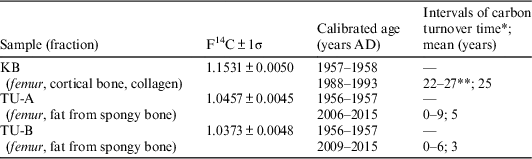
The measured activities together with the uncertainties were expressed as F14C and interpreted using the CALIBomb program using the current LEVIN calibration curve for Europe, see Tables 1 and 2 (Levin and Kromer Reference Levin and Kromer2004; Reimer et al. Reference Reimer, Brown and Reimer2004; Reimer and Reimer Reference Reimer and Reimer2004; Levin et al. Reference Levin, Naegler, Kromer and Worthy2010; Hammer and Levin Reference Hammer and Levin2017).
Individual No. I: results of 14C dating.

* Time to year 2015 (when individual No. I was found).
** Interval of characteristic carbon turnover time for collagen.
Individual No. II: results of 14C dating.

* Time to year 2014 (probable/supposed year of death).
** Interval of characteristic carbon turnover time for bone collagen.
Analyses of Hairs and Nail
These samples were analyzed only for Individual II. The nominal F14C values of the observed activities from this type of specimen were the lowermost and both values agree within uncertainties. These tissues correspond to the shortest carbon turnover times in the human body (Hodgins Reference Hodgins2009).
Analyses of Bone Fat
The differenceFootnote § between the mean of activities (F14C) in fat (1.0434) and the mean of activities in nail and hair (1.0354) is statistically significant (Z-test based on the assumption that the expected values of observations are the same within each group and that the differences of observations in each group are only due the uncertainties of analyses, p-value 2.1%). It seems, that the results of 14C analysis in fat samples extracted from spongy parts of bone (TU-A, TU-B, FT fractions) and cortical bone fraction (AT fraction) showed mean carbon turnover times a few years.
TU-B activity (Table 1) cannot be considered as outlying value compared to the remaining three 14C activities (TU-A in Table 1 and AT, FT in Table 2) with their 95% confidence interval. Z-test comparing this observation with the mean of the remaining three observation does also not show significant difference (p-value 12%).
Bone Collagen Analyses
The supporting data suggested that the age of both sets of human remains was not more than a few years old. To compare informative values of bone collagen, the intervals and mean values of characteristic carbon turnover time were estimated, despite of the knowledge that there is continuous partial carbon exchange (Geyh Reference Geyh2001). The observed characteristic carbon turnover times in these cases ranged from 20 to 34 years. This interval referred to Individual II. From these results, it can be concluded, that the characteristic carbon turnover time due to the varying rate of carbon exchange in bone collagen differed significantly even within one individual. Published literature also shows a relatively wide range of characteristic carbon turnover times for bone collagen (Geyh Reference Geyh2001; Ubelaker et al. Reference Ubelaker, Buchholz and Stewart2006; Hodgins Reference Hodgins2009; Calcagnile et al. Reference Calcagnile, Quarta, Cattaneo and D’Elia2013; Cook and MacKenzie Reference Cook and MacKenzie2014; Cook et al. Reference Cook, Ainscough and Dunbar2015; Ubelaker and Parra Reference Ubelaker and Parra2011). Moreover, in older individuals, the rate of bone collagen alteration can be influenced by the use of drugs (Geyh Reference Geyh2001). As can be seen from Table 2 (Individual II), where more samples of collagen isolated from a larger set of bones were analyzed, direct use of bone collagen analyses to determine the time of death by 14C dating did not yield a sufficiently narrow interval useful for legal purposes.
The results of bone collagen analyses reported in Tables 1 and 2 are given for bones where the extraction process was designed primarily to minimize the possibility of carbon penetration from the lipid fraction into the isolated collagen (reported as fraction K). Only the bone (collagen, sample E) shown in Table 2 was not pretreated using the extraction procedure. The results of collagen analyses isolated from the same bone with and without extraction pretreatment (E and EK) agree within uncertainties.
Analyses of Collagen from Tooth Dentine
This sample (Individual II) showed the highest 14C activity in our sample set, and was relatively close to the maximum of bomb peak calibration. Projection of the analysis results on the calibration curve (LEVIN) yielded two time intervals. During the earlier interval of 1963–1964, Individual II would have been 6–7 years old according to the officially verified date of his birth (1957) and thus we could exclude this interval. The later interval corresponded to an age of 13–15 years. The lower edge of this interval corresponded approximately to the average age of first premolar emergence (Ash and Nelson Reference Ash and Nelson2003).
DISCUSSION
The samples analyzed in this pilot study can be divided into three groups, which depends on carbon turnover times and their consequent informational value:
(i) Samples with short carbon turnover times not exceeding just a few years. These periods were close or even below the level of statistical significance of our observations. This group includes the bone fat samples and those of hair and nails.
(ii) Samples with mean characteristic carbon turnover times in decades (bone collagen) in the case of both decedents with the age 55–65 (individual I) and 56 years (Individual II). However, the characteristic carbon turnover times varied significantly varied also within a single individual.
(iii) Tissues formed at a particular age with no subsequent significant supplementation. This is the case of the collagen samples prepared from dental material. It appears that the age of collagen corresponds approximately to the time of tooth emergence, when massive dental tissue production can be expected.
The most accurate result of death by 14C dating can be expected in cases where tissues with short carbon turnover times are preserved. However, in this case, it may be advisable to base the interpretation on the analysis of several types of samples with short carbon turnover times (hair, nails, bone fat) to determine/estimate a more credible time interval of the death. In particular, hair and nail samples may be affected by carbon derived from, e.g. cosmetics, and bone fat has a carbon turnover time of approximately 7 years (Hodgins Reference Hodgins2009; Santos et al. Reference Santos, De La Torre, Boudin, Bonafini and Saverwyns2015). Dietary changes over the course of an individual’s life, can also lead to a decrease in 14C activity in body tissues, for example due to the influence of the freshwater reservoir effect or marine reservoir effect (i.e. freshwater and/or marine fish, which have 14C level lower than that of their contemporaneous terrestrial foods, becoming a larger portion of his/her diet). Increased abundance of marine or freshwater fish in the diet can be indicated by the analysis of stable isotopes 13C and 15N in proteins (Bonsall et al. Reference Bonsall, Cook, Hedges, Higham, Pickard and Radovanovič2004; Keaveney and Reimer Reference Keaveney and Reimer2012; Cook et al. Reference Cook, Ainscough and Dunbar2015; Müldner Reference Müldner2015).
As we can see from our results and from the literature, dating of bone collagen alone is not conclusive for determining the time of death of a given individual because of variable bone remodeling and usually relatively long mean value of characteristic carbon turnover time (Geyh Reference Geyh2001; Ubelaker et al. Reference Ubelaker, Buchholz and Stewart2006; Hodgins Reference Hodgins2009; Ubelaker and Parra Reference Ubelaker and Parra2011; Calcagnile et al. Reference Calcagnile, Quarta, Cattaneo and D’Elia2013; Cook and MacKenzie Reference Cook and MacKenzie2014; Cook et al. Reference Cook, Ainscough and Dunbar2015).
By comparing the analyses of samples with longer and shorter carbon turnover times, we can eliminate ambiguity in dating results using a 14C bomb peak. In following years, the decreasing 14C activity will reach a pre-bomb level. Tissue dating from human remains will therefore yield two intervals /groups of intervals. The older group will include several partial intervals starting about 1630 and ending close to 1955. If intervals from the older group cannot be ruled out based on the state of the remains at the site of detection, analysis of bone collagen from older individuals (and presence of bomb 14C) will become an important tool for interpreting the results over the next several decades.
Analysis of collagen from a tooth specimen yielded results that roughly corresponded to the emergence of that particular tooth (in this case, the first premolar; see above). The time of death of the individual can then be estimated on the basis of published average age at tooth emergence (between 11 and 13 years old in this case) and the osteological estimate of the individual’s age. In spite of the relatively wide intervals (for individuals up to approximately 70 years old, the estimation interval is less than 10 years, but for older individuals, the interval can be considerably wider), osteological age estimation can reach the limits of usability for legal purposes (Act 140/1961 Coll.; Marquez-Grant and Fibiger Reference Marquez-Grant and Fibiger2011; Iscan and Steyn Reference Iscan and Steyn2013). Enamel or dentine carbonate analysis can be a significant advantage given the high probability of tooth preservation in human remains even in a state of complete skeletalization. The relatively wide range in the time of death determined by a combination of osteologically determined age and 14C dating of teeth will also allow corroboration of the narrower death interval determined by analysis of tissue(s) with short carbon turnover time or of bone fat. If the wider interval (determined using dental samples) does not confirm the result determined by analysis of samples with short carbon turnover times, it would be necessary to treat the interpretation of the results with considerable caution.
Likewise, the reliability and accuracy of the final estimation of the death interval can be improved based on the rate of aspartic acid racemization (D-aspartic acid/L-aspartic acid: D/L Asp) using bones and teeth. The correlation coefficient between the rate of racemization and chronological age was relatively high in the sternum, skull, and femur and lower in other types of bones (Ohtani et al. Reference Ohtani, Masushima, Kobayashi and Yamamoto2002). Age estimation in teeth could be more problematic. In teeth the ratio of D/L aspartic acid in dentine varies between the lingual side and vestibular side of the crown dentine. It may be affected by differences in factors such as temperature, humidity, pH, tissues metabolic rates (Ohtani Reference Ohtani1997; Ohtani and Yamamoto Reference Ohtani, Ito and Yamamoto2003). In an article by Ohtani and Yamamoto, the estimated ages were accurate within a range of ±3 years (Ohtani and Yamamoto Reference Ohtani and Yamamoto2010). Whereas racemization analysis indicates the chronological age of the individual at the time of death, 14C analysis gives an estimated year of birth (Alkass et al. Reference Alkass, Buchholz, Ohtani, Yamamoto, Druid and Spalding2010).
When the estimations of date of death based on 14C analyses of samples with different carbon turnover times are established without statistically significant discrepancies, such results have much higher credibility than that determined by a single tissue analysis, albeit with a relatively short carbon turnover time. In cases where the discrepancy between death intervals according tissues with different carbon turnover times was observed, it could indicate a change in diet during the life of the individual, e.g.: fresh water/marine fish consummation or increased abundance of food from local sources which was significantly affected by Suess effect (Suess Reference Suess1955).
Thus we envisage the credible determination of death time using 14C dating, based on a range of available samples from recovered remains of (not-juvenile) humans, following typical scenarios, recovery of collagen-containing bones is assumed in all cases (Handlos et al. Reference Handlos, Svetlik, Dobiáš, Smatanová, Dvořáček, Joukal, Marecová and Horáčková2017):
A. The remains are in good condition, hair, nails, bone fat, teeth are preserved—the results of the death-time (time intervals) estimates overlap with no significant differences, the analysis of stable isotopes in the hair, nails and collagen did not show increased proportions of fish in the diet;
B. Bone fat and teeth survived in the remains—estimated intervals of the death time are in agreement;
C. Teeth and bones were found in the remains—only limited possibility of credible 14C dating results (too wide a time interval of death).
Probably, in all cases, death-time estimation using aspartic acid racemization will improve the credibility of final death-time estimation. In cases where some significant discrepancies are found in estimated time intervals some interfering effect is indicated (e.g.: dietary influences, sample contamination); additional analyses will therefore be necessary to explain the observed differences, given the availability of sufficient quantity/scale of samples.
Therefore, to achieve the highest credibility in the final determination of the time interval of death using 14C dating, it is important to try and find residual scalp hair, nails or body hair during the examination of skeletal remains on site. Late post-mortem changes in these cases are due to a combination of several factors: atmospheric influences, depth of deposition of human remains, and presence of specific flora and fauna, etc. (Mann et al. Reference Mann, Bass and Meadows1990). This was the reason we designed the pilot study to include two deceased men found under completely different conditions.
Based on macroscopic assessment of skeletal remains from Individual I, the time of death was estimated between 1 and 2 years before the remains were found. In this case, partially preserved soft tissues and cartilage were crucial to determine the time of death which, in light of the atmospheric effects at the site of the body, allowed the determination within a narrow time range. 14C dating of two samples of bone fat gave a mean interval of 0–9 years (Table 1). The observed interval, although carbon turnover time of lipids was close to the statistical significance level, confirmed that the skeletal remains were from a person deceased less than 20 years and as such, allowed for criminal prosecution.
Based on anthropological assessment of skeletal remains from Individual II, the time of death was estimated between 2 and 10 years before the remains were found. A broad time interval was determined using the specific conditions prevailing at the site. The body was in a dry and warm environment with access to necrophagous insects and, in addition to the development of mummification, soft tissues had almost been completely consumed by larvae, making it impossible to determine the time of death. 14C dating of hair and nails showed a death interval of 0–6 years (Table 2). This interval was also in a good agreement with the results of 14C analyses of bone fat and collagen isolated from dentine (dentine in the combination with age estimation of Individual II). These results corresponded well with the conclusions of the police investigation, when the last contact with the deceased took place during Christmas 2013, i.e. three years before the body was found.
Given the small number of samples derived from only two findings analyzed as part of this pilot study, several research items can be proposed to improve the future use of 14C analyses for the determination of the time interval of death.
1. Clarification of the mean characteristic carbon turnover time in the form of bone collagen in juvenile individuals (Ubelaker and Parra Reference Ubelaker and Parra2011): in this case, the mean characteristic carbon turnover time cannot be longer than the age of the individual. In these cases, refinement of this time would contribute to more accurate results for the time of death, especially for individuals over the age of 10 years;
2. Dependence of the mean characteristic carbon turnover time in bone collagen on the type of bone: based on our analysis, it seems that different bones of the human body differ significantly with respect to mean characteristic carbon turnover time. In analyzing individual bones, especially from older individuals, it would be necessary to identify trabecular or laminar parts of bones where relatively small variations in the mean characteristic carbon turnover times can be expected (Barta and Štolc Reference Barta and Štolc2007; Calcagnile et al. Reference Calcagnile, Quarta, Cattaneo and D’Elia2013; Cook et al. Reference Cook, Ainscough and Dunbar2015). Refinement of this time will allow a more effective use of bone collagen analysis to estimate the time of death. For this purpose, however, a relatively large set of samples will need to be analyzed;
3. Isolation of lipids from ancient bones, preserved under suitable condition in soil: this could be another interesting research topic for dating. Ancient bone lipids, represented mainly by steroidal fraction with minor appearance of fatty acids, could be found in a sufficient state of preservation in a porous system of bones (Evershed et al. Reference Evershed, Turner-Walker, Hedges, Tuross and Leyden1995; Jim et al. Reference Jim, Ambrose and Evershed2004; Marzaioli et al. Reference Marzaioli, Fiumano, Capano, Passariello, Cesare and Terrasi2011; Colonese et al. Reference Colonese, Farrell, Lucquin, Firth, Charlton, Robson, Alexander and Craig2015);
4. Implementation and validation of analyses of carbonate carbon patterns from dentine and enamel samples (Spalding et al. Reference Spalding, Buchholz, Bergman, Druid and Frisen2005; Buchholz and Spalding Reference Buchholz and Spalding2010; Alkass et al. Reference Alkass, Buchholz, Druid and Spalding2011; Ubelaker and Parra Reference Ubelaker and Parra2011; Cook and MacKenzie Reference Cook and MacKenzie2014; Cook et al. Reference Cook, Ainscough and Dunbar2015): comparing the results of analyses of such samples would help indicate influences on 14C activity together with assessing the practical usability of dental collagen analyses. Corresponding routines for processing of carbonate samples have not yet been implemented in our laboratory.
CONCLUSION
The aim of this pilot study was to demonstrate the possibility of dating skeletal remains using a 14C bomb peak for forensic purposes. In the study, tissue samples (bone, nail, hair, and tooth) of two deceased individuals found in different environments (in terrain and in the interior of an apartment) were analyzed. The objective was to determine the date of death and age of both individuals and to compare the results with the findings of anthropological methods.
Bone collagen analyses confirmed the difficulties in the usability of these samples for direct determination of the time of death with forensic validity, in contrast to death intervals determined through the analysis of samples with short carbon turnover times (hair, nails, bone fat) that were consistent with other data (anthropological methods, information from police). To minimize ambiguity in the dating results and also to better indicate possible significant interferences, it is preferable to include samples with long carbon turnover, such as teeth and bone collagen. Because multiple types of samples were available for our analyses, we also propose a few guidelines for comparing and interpreting the results of individual analyses. The variable bone remodeling rates observed in our study and those in the literature indicate a need for comprehensive analysis of skeletal collagen turnover to improve the utility of recent collagen dating for forensic applications.
ACKNOWLEDGMENTS
This publication was supported by OP RDE, MEYS, under the project “Ultra-trace isotope research in social and environmental studies using accelerator mass spectrometry,” Reg. No. CZ.02.1.01/0.0/0.0/16_019/0000728, by institutional funding of Nuclear Physics Institute CAS (RVO61389005) and by the Czech Ministry of Interior (project MV-21618-1/OBVV-2017).