


Introduction
Delirium is a common neuropsychiatric syndrome occurring in approximately one in five general medical inpatients (Siddiqi et al. Reference Siddiqi, House and Holmes2006; Ryan et al. Reference Ryan, O’Regan, Caoimh, Clare, O’Connor, Leonard, McFarland, Tighe, O’Sullivan, Trzepacz, Meagher and Timmons2013) that is independently associated with elevated health-care costs, morbidity, and mortality (Witlox et al. Reference Witlox, Eurelings, De Jonghe, Kalisvaart, Eikelenboom and Van Gool2010). Despite these concerns, delirium remains underappreciated, despite the need for more consistent and timely diagnosis and treatment (González et al. Reference González, Martínez, Calderón, Villarroel, Yuri, Rojas, Jeria, Valdivia, Marín and Carrasco2009; O’Hanlon et al. Reference O’Hanlon, O’Regan, Maclullich, Cullen, Dunne, Exton and Meagher2014). Although recognised for more than two millennia (Adamis et al. Reference Adamis, Treloar, Martin and Macdonald2007), our understanding of delirium as an entity is variable and management practices lack consistency.
In part, this reflects the heterogeneous nature of delirium whereby it occurs in a variety of populations with varying clinical presentations and comorbidities, but also relates to awareness and perception of existing knowledge, as delirium is under-represented in undergraduate and postgraduate curricula (Davis & MacLullich, Reference Davis and MacLullich2009; Fisher et al. Reference Fisher, Gordon, MacLullich, Tullo, Davis, Blundell, Field and Teodorczuk2015), an important factor in fostering appreciation of the significance of delirium, as well as ownership of the confused patient (Teodorczuk et al. Reference Teodorczuk, Mukaetova-Ladinska, Corbett and Welfare2013). Educational interventions around delirium diagnosis and treatment, along with event monitoring and care pathways, are thus an important element for promoting better delirium care in clinical systems and have demonstrated capacity to improve confidence around delirium assessment and management as well as knowledge of delirium care (Ramaswamy et al. Reference Ramaswamy, Dix, Drew, Diamond, Inouye and Roehl2011; Yanamadala et al. Reference Yanamadala, Wieland and Heflin2013).
Psychiatrists have an important role in delirium care by virtue of their knowledge of neuropsychiatric symptoms and familiarity with therapeutic strategies used to manage delirious patients. Psychiatrists often provide the expert opinion that is crucial to clarifying diagnosis in complex neuropsychiatric presentations and are frequently asked to advise regarding optimal management of challenging cases of delirium (Lyne et al. Reference Lyne, O’Donoghue, Bonnar, Golden, McInerney, Callanan and Ryan2010). This report describes an educational workshop delivered to a group of psychiatrists under the auspices of the College of Psychiatrists of Ireland which aimed to stimulate informed discussion regarding best application of existing knowledge regarding delirium care in everyday practice.
The specific aims of this study were to explore baseline attitudes, perspectives and knowledge about delirium diagnosis and management amongst psychiatrists, and to assess the impact of an educational intervention (i.e. a four-part interactive workshop) upon immediate post-workshop knowledge of delirium-relevant information.
Methods
A workshop comprising four elements addressing delirium care was held at the winter meeting of the College of Psychiatry for Ireland in November 2015. Attendees included a heterogenous mix of trainee and consultant psychiatrists attending the conference who were of varying experience and from a range of subspecialties.
The workshop involved a 2-hour interactive format in four 30-minute sections; (i) the relevance of delirium as an entity; (ii) definition of and diagnostic approaches to delirium, and assessment of attention, (iii) diagnosis of different clinical subtypes and differentiation of complex cases of delirium from other diagnoses, and (iv) management (see Table 1). Each section emphasised three key issues that were considered in the context of best evidence from the published literature. The workshop was delivered by three facilitators (the authors of this paper) who took turns at leading proceedings and at other times merged with the audience to stimulate interaction. At the beginning of the workshop, the larger group was divided into eight smaller groups, to facilitate peer discussion, each consisting of approximately eight participants. Each section included a variety of activities; didactic components, brainstorming, snowballing, problem solving, examples of key phenomena presented by video, and clinical and research scenarios to exercise new knowledge. These various methods allowed for a highly interactive process despite the large attendance (n = 62).
Workshop components
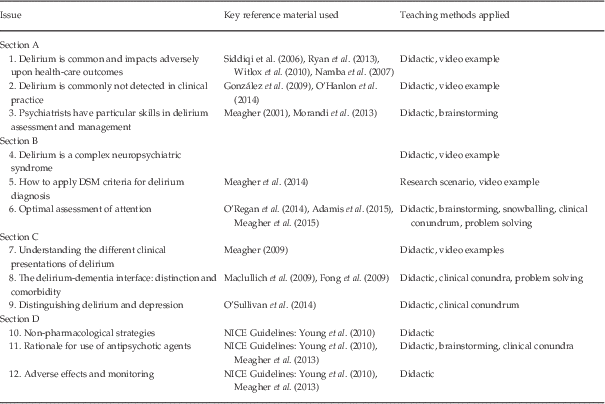
The workshop is available on YouTube at www.youtube.com/watch?v=Ut04KQGpy0s
Assessment of workshop
Attendees were asked to complete an anonymously coded questionnaire at the beginning and conclusion of the workshop. This explored attitudes towards delirium, including its relevance to psychiatry as well as participants’ confidence in terms of diagnosis and management. These were rated on a 10-point visual analogue scale from ‘not relevant’ or ‘not confident’ (1) to ‘highly relevant’ or ‘extremely confident’ (10). Specific questions explored awareness of diagnostic criteria and core features of delirium, preferred approach to bedside testing of attention (a core diagnostic feature), as well as management of two contrasting presentations of delirium – one ‘simple’ case of hyperactive delirium without major neurocognitive comorbidity, and another complex case of hypoactive delirium in a very old patient with comorbid dementia.
In view of the twin problems in delirium detection of (i) not applying actual diagnostic criteria along with (ii) basing diagnosis upon non-diagnostic features that are variable in presence, we generated an accuracy index for delirium diagnosis by combining omissions and commissions. This provides an overall measure of accuracy in awareness of actual diagnostic features of delirium.
The pre- and post-intervention anonymously coded questionnaires were matched, and both provided the option for text answers in addition to the response categories provided. The questionnaire is provided in the Appendix.
Statistical analysis
Statistical analyses were conducted using SPSS 21.0. Responses are shown in frequencies and percentages, with both mean [±standard deviation (s.d.)] and median scores shown for data collected on the visual analogue (1–10) scale. Wilcoxon’s signed ranks test was used to compare non-parametric repeated measures (e.g. comparing perceived confidence in diagnosis/treatment of delirium and accuracy index score before and after the intervention). A χ 2 test was used to compare the frequency of psychotropic drug use for the two case examples.
Results
A total of 62 psychiatrists attended the workshop, all of whom completed the pre-workshop questionnaire. The specialty breakdown of participants was general adult psychiatry (n = 42; 69%), psychiatry for later life (n = 6; 10%), child and adolescent psychiatry (n = 3; 5%), consultation-liaison (CL) psychiatry (n = 2; 3%), other (psychiatry for intellectual disability, women’s mental health, forensic psychiatry; n = 7; 10%), no specialty specified (n = 3; 5%). Post-workshop questionnaires were completed by 41 participants (66%). The results from the questionnaires are described below, separated into pre-workshop and post-workshop responses.
Pre-workshop responses
Perception of the relevance of delirium to psychiatry as a specialty
Respondents rated their perception of the relevance of delirium to psychiatry as a specialty on a 10-point scale from ‘not relevant’ (score 1) to ‘extremely relevant’ (score 10). Before the workshop, the majority perceived delirium as a condition with high relevance to psychiatry (90% rating it >5 and 61%⩾8; median score of 8). Those from a CL or psychiatry for later life background (n = 8) rated delirium as more relevant to psychiatry compared with other psychiatry specialties (median 10 v. 8) but this did not reach statistical significance (p = 0.06).
Perceived confidence in diagnosis
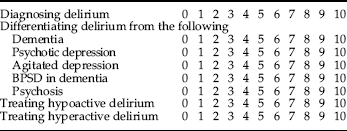
Respondents were asked to indicate their level of confidence (on a 10-point scale) in the diagnosis of delirium, including specifically distinguishing it from key differential diagnoses such as dementia, mood disorder, and psychosis. The overall level of confidence in diagnosis was modest, with 82% rating this as >5, and 37% rating this as ⩾8 (median score 7).
Before the workshop, confidence in distinguishing delirium from each key differential diagnosis was moderate: dementia (median 7; range 2–10), psychotic depression (median 7; range 3–10), agitated depression (median 7; range 2–10), behavioural and psychological symptoms of dementia (BPSD) (median 6; range 1–10), and psychosis (median 7; range 2–10). There was a significant improvement in each of these scores following the workshop, see Table 2.
Impact of workshop upon perceived confidence in delirium diagnosis and actual awareness of diagnostic criteria in those completing both pre- and post-workshop questionnaires (n = 41)
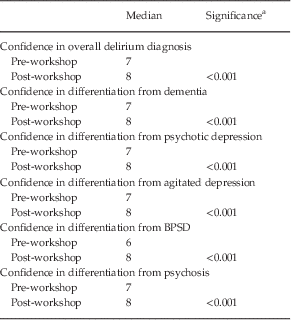
BPSD, behavioural and psychological symptoms of dementia.
a Wilcoxon’s signed ranks test.
Awareness of diagnostic features of delirium
Respondents were asked to indicate their understanding of the relevance of nine features (seven neuropsychiatric disturbances and two contextual features) to the diagnosis of delirium according to DSM-5 criteria. These included mandatory elements (inattention, acute onset, and/or fluctuating course), supportive feature (clouded consciousness, altered level of alertness), and features that occur in delirium but are not necessary for a diagnosis (disorientation, psychomotor changes, hallucinations, disorganised thinking).
The level of endorsement of each as a required diagnostic feature is shown in Table 3. Mandatory features not endorsed by respondents were designated incorrect omissions, while non-required features that were endorsed by respondents were deemed incorrect commissions. An accuracy rating for delirium diagnosis was generated by combining omissions and commissions. Of note, only nine participants (15%) were able to correctly identify DSM-5 delirium criteria without omissions or commissions. Interestingly, the correlation between accuracy rating and perceived self-confidence in diagnosis was only modest (Spearman’s ρ, r = 0.27, p = 0.03).
Symptoms endorsed as mandatory features for DSM-5 delirium
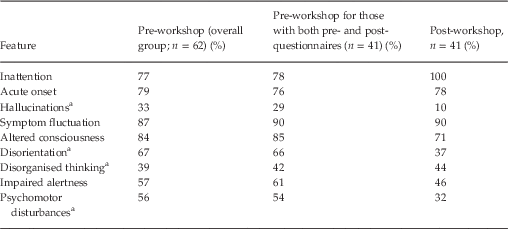
a Denoted features that are not diagnostic.
Testing of attention
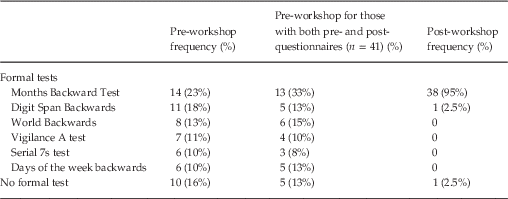
Participants were asked to indicate their preferred approach to testing attention (from a list of eight options) when assessing for suspected delirium. The preferences both before and after the workshop are shown in Table 4.
Preferred test of attention in assessing patients with suspected delirium (n = 62)
Perspectives on therapeutic interventions for different presentations
The level of confidence in managing different clinical presentations of delirium (rated 1–10) was higher for patients with hyperactive (median 7; range 2–10) compared with hypoactive (median 6; range 1–9) presentations (Z = −3.7; p<0.001). Participants were then asked to describe their usual practice in terms of managing two contrasting presentations; (a) hyperactive delirium in a 75-year-old man without significant comorbidity, and (b) hypoactive delirium in an 88-year-old woman with comorbid advanced dementia.
For the hyperactive presentation, 13 (22%) of 60 who responded indicated that they would avoid pharmacotherapy. Of the rest (n = 47), 44 (94%) indicated they would typically use an antipsychotic agent as first line, three indicated a preference for benzodiazepine treatment in monotherapy and five indicated combined antipsychotic-benzodiazepine therapy. In respect of antipsychotic agents, 38 indicated a specific preference; haloperidol (n = 30; 79%), quetiapine (n = 5; 13%), and risperidone (n = 3; 8%). For the hypoactive presentation, 43 (72%) indicated that they would avoid using pharmacotherapy. Of the rest (n = 17), 13 (76%) indicated they would typically use an antipsychotic agent as first line with three indicating a preference for benzodiazepine treatment and one for a cholinesterase inhibitor. In respect of antipsychotic agents, 11 indicated a specific preference; haloperidol (n = 6), quetiapine (n = 4), and risperidone (n = 1). A preference for using pharmacological strategies was more frequent for hyperactive than hypoactive presentations (χ 2 = 28.1; p<0.001).
Post-workshop perceptions
Participants were asked to repeat their responses to each of the pre-workshop questionnaire items at the conclusion of the workshop. A total of 41 attendees completed both pre- and post-workshop questionnaires and responses for those with both pre- and post-questionnaires were compared to assess the short-term impact of the intervention on attitudes, perspectives and knowledge.
After the workshop, the perceived relevance of delirium to psychiatry increased with 95% rating it >5 and 81% ⩾8 (median 9.5; range 4–10). This represented a significant increase amongst those who completed both before and after questionnaires (Z = −2.95; p = 0.003). There was a significant improvement in the perceived confidence in delirium diagnosis along with the range of key differential diagnoses (all p<0.001; see Table 2). Of note, in addition to this improved level of perceived confidence, the accuracy index in terms of awareness of DSM-5 diagnostic criteria significantly improved (i.e. lower scores) (pre-median 3; range 0–5 v. post-median 1; range 0–4; z = 4.1; p<0.001). Post-workshop, the number of respondents who correctly identified DSM-5 delirium diagnostic features without error had increased somewhat to 11 (i.e. 27% of those who completed both pre- and post-questionnaire and increased from 6/41 (15%) pre-questionnaire. The appreciation of inattention as a mandatory feature increased to 100%, while (incorrect) endorsement of disorientation and psychomotor disturbance as mandatory diagnostic features reduced to 15 (37%) and 13 (32%), respectively (see Table 3).
The workshop emphasised evidence supporting the use of the Months Backward Test (MBT) for assessment of delirium-relevant inattention and this was reflected in the post-workshop preferences whereby 38/40 (95%) respondents endorsed the MBT as their preferred approach to assessing attention at the bedside (see Table 4).
Impact of workshop upon treatment strategies for different presentations of delirium
Following the workshop, the perceived confidence in treating delirium improved for both hyperactive (pre-median 7; range 1–10 v. post-median 8; range 5–10; Z = −4.9; p = 0.001) and hypoactive (pre-median 6; range 1–9 v. post-median 7; range 3–10; Z = −5.0; p<0.001) presentations. For the hyperactive presentation, of 41 who responded post-workshop, three (7%) indicated that they would avoid using pharmacotherapy; 38 indicated that they would use an antipsychotic agent; haloperidol (n = 20; 53%), quetiapine (n = 7; 18%), and risperidone (n = 4; 11%), olanzapine (n = 1; 3%) and no specific agent identified (n = 6; 16%). For the hypoactive presentation, of 41 who responded post-workshop, 19 (46%) indicated that they would avoid using pharmacotherapy while the number who would use antipsychotic treatment increased to 54% (n = 22). In respect of antipsychotic agents, 15 indicated a specific preference; haloperidol (n = 8; 53%), quetiapine (n = 3; 20%), and risperidone (n = 4; 27%).
For those who responded both pre- and post-workshop, the changes in treatment preferences were as follows; for the hyperactive case, of eight respondents who indicated a preference for no-drug treatment, five indicated a preference for antipsychotic use after the workshop. For the hypoactive case, of 30 respondents who indicated a preference for no drug treatment pre-workshop, 13 (43%) switched to indicating their preference to include antipsychotic treatment. There were no cases of respondents changing to withholding antipsychotic use post-workshop.
Discussion
This study of the attitudes and practices regarding delirium amongst psychiatrists participating at an educational workshop highlights the potential to enhance knowledge regarding delirium care, even in this already specialist group. We found considerable variation in perceptions of the relevance of delirium, varied levels of confidence in diagnosis and management according to the different clinical presentations of delirium, a lack of consistency in approaches to bedside cognitive assessment, and varied practice in terms of management of delirium. This four-part multifaceted interactive workshop was associated with significant improvements in perceived confidence in recognising and managing different presentations of delirium, greater awareness of its diagnostic criteria and altered perspectives regarding optimal assessment and treatment practices.
Confidence around diagnosis of delirium differed according to different differential diagnoses, with distinction from the so-called behavioural and psychological symptoms of dementia considered especially challenging. This differentiation is well-recognised as being one of the most complex challenges in delirium diagnosis and hence was explored in detail during the workshop. Confidence in distinguishing delirium from five key differential diagnoses increased over the course of the workshop, although confidence in differentiating delirium from BPSD remained the lowest despite a significant improvement. These findings emphasise the challenges in diagnosing complex presentations with continued uncertainty as to what consists the BPSD and how they can be best diagnosed.
The pre-workshop questionnaire highlighted the lack of precision in psychiatrists’ awareness of diagnostic criteria for delirium. The finding that only 15% of participants were able to correctly identify required features for DSM-5 delirium is unexpected given the key role that psychiatrists often fulfil in terms of clarifying diagnosis in complex cases (Lyne et al. Reference Lyne, O’Donoghue, Bonnar, Golden, McInerney, Callanan and Ryan2010). The failure of 23% of respondents to identify inattention as a mandatory diagnostic feature is especially surprising. Disorientation and psychomotor disturbances were frequently endorsed as required features. Although disorientation is highly suggestive of delirium, it is not sufficiently consistent in presence to warrant being a mandatory diagnostic feature (Meagher et al. Reference Meagher2007; Leonard et al. Reference Leonard, Adamis, Saunders, Trzepacz and Meagher2015). Similarly, psychomotor disturbances are central to the identification of clinical subtypes of delirium, and occur in the majority of cases, but not included amongst diagnostic criteria in DSM-5. Accurate diagnosis of delirium is fundamental to improving management in real world practices and as such these misunderstandings were concerning. The stated diagnostic accuracy of attendees improved with exposure to the workshop, with improvements especially evident in terms of appreciating the roles of inattention, disorientation and psychomotor disturbances in establishing a diagnosis of delirium. The improvement in diagnostic accuracy was also matched by an improvement in confidence around making the diagnosis. Nevertheless, less than half of attendees correctly identified DSM-5 criteria at the conclusion of the workshop, suggesting that further improvements are desirable. Similarly, other work in trainee physicians has demonstrated that although knowledge of delirium as a clinical concept can be improved by educational initiatives, increasing awareness of the actual diagnostic criteria for delirium appear more resistant to such efforts (Jenkin et al. Reference Jenkin, Al-Attar, Richardson, Myint, MacLullich and Davis2016).
DSM-5 criteria for delirium emphasise inattention as a key diagnostic feature. However, although the guidance notes provide general descriptions of how sustained, selective and divided attention can be assessed, there is no mention of particular tests or how these should be interpreted. The workshop included a review of head to head studies of tests of attention in the diagnosis of neurocognitive disorders (O’Regan et al. Reference O’Regan, Ryan, Boland, Connolly, McGlade, Leonard, Clare, Eustace, Meagher and Timmons2014; Adamis et al. Reference Adamis, Meagher, Murray, O’Neill, O’Mahony, Mulligan and McCarthy2016). These studies favour the use of the MBT as a screening tool for delirium-relevant inattention and have stimulated a detailed review of the tool and how it can be optimally applied in everyday practice (Meagher et al. Reference Meagher, Leonard, Donoghue, O’Regan, Timmons, Exton, Cullen, Dunne, Adamis, Maclullich and Meagher2015). Post-workshop, exposure to these studies along with a small group breakout session focusing upon designing an efficient approach to systematic detection of inattention in a general hospital setting was associated with all but two participants endorsing the MBT as a first-line test of attention in everyday practice.
The final section of the workshop focused upon delirium management, with particular emphasis on pharmacotherapy. We identified baseline differences in the willingness to use antipsychotics (and varying preferences for different agents) which may reflect the differing subspecialty backgrounds of respondents, but also likely relates to varying appreciation of research that addresses the risks and benefits of pharmacotherapy in delirium (Meagher et al. Reference Meagher, Moran, Raju, Gibbons, Donnelly, Saunders and Trzepacz2013). These attitudes were amenable to provision of information such that participation in this educational event was associated with a more positive attitude towards pharmacotherapy in different clinical scenarios.
Haloperidol was the agent of first choice in delirium treatment for the majority of respondents. This echoes surveys of practice both in Ireland (Hally & Cooney, Reference Hally and Cooney2005) and elsewhere (Tropea et al. Reference Tropea, Slee, Holmes, Gorelik and Brand2008; Morandi et al. Reference Morandi, Davis, Taylor, Bellelli, Olofsson, Kreisel, Teodorczuk, Kamholz, Hasemann, Young, Agar, de Rooij, Meagher, Trabucchi and MacLullich2013). Haloperidol is the best studied agent but emerging evidence supports the use of atypical antipsychotics in some clinical scenarios, including where diminished extrapyramidal side effect potential is desirable (Meagher et al. Reference Meagher, Moran, Raju, Gibbons, Donnelly, Saunders and Trzepacz2013). The role of atypical agents was highlighted by many respondents through additional comments in response to this question.
The relatively low frequency of benzodiazepine use was reassuring given their limited role in most deliria and recognised deliriogenic effects (Zaal et al. Reference Zaal, Devlin, Hazelbag, Klein Klouwenberg, van der Kooi, Ong, Cremer, Groenwold and Slooter2015). Tropea et al. (Reference Tropea, Slee, Holmes, Gorelik and Brand2008) found that almost one-third of elderly delirious patients received benzodiazepines during their episode. Benzodiazepines are first-line treatment for delirium related to substance use or seizures and they can allow lower antipsychotic doses where extra sedation is desired. However, lorazepam can worsen mental state and is linked to elevated risk of delirium in ICU patients (Pandharipande et al. Reference Pandharipande, Shintani, Peterson, Pun, Wilkinson, Dittus, Bernard and Ely2006). Over 2 mg/day in lorazepam dose equivalents incurs a significantly elevated risk of delirium in patients with cancer (Gaudreau et al. Reference Gaudreau, Gagnon, Harel, Roy and Tremblay2005). A Cochrane review (Lonergan et al. Reference Lonergan, Luxenberg, Areosa-Sastre and Wyller2009) found no support for the use of benzodiazepines in the treatment of non-alcohol withdrawal-related delirium amongst hospitalised patients.
Delirium is a highly heterogenous syndrome that includes discrete clinical subtypes. These are most commonly defined according to their visible (motor) activity profiles with two contrasting patterns – relatively agitated with hypervigilance versus somnolent with reduced vigilance which are termed hyperactive and hypoactive subtype, respectively (Meagher, Reference Meagher, Leonard, Donnelly, Conroy, Adamis and Trzepacz2009). These presentations of delirium are managed quite differently in clinical practice with much greater use of antipsychotics in patients with hyperactive presentations (Mac Sweeney et al. Reference Mac Sweeney, Barber, Page, Ely, Perkins, Young and McAuley2010; Hui et al. Reference Hui, Reddy, Palla and Bruera2011; Meagher et al. Reference Meagher, McLoughlin, Leonard, Hannon, Dunne and O’Regan2011) despite little evidence to justify such behaviour as uncontrolled reports suggest similar response rates for patients with both hypoactive and hyperactive subtype (Platt et al. Reference Platt, Breitbart, Smith, Marotta, Weisman and Jacobsen1994; Liu et al. Reference Liu, Juang, Liang, Lin and Yeh2004; Boettger et al. Reference Boettger, Breitbart and Passik2011). Moreover, the poorer outcomes associated with hypoactive presentations may reflect confounding factors such as age, frailty and dementia comorbidity, but may also relate to less intense pharmacotherapy. Many clinicians attribute the beneficial effects of antipsychotic medications to sedative effects and therefore avoid such agents in patients with hypoactive presentations. As a consequence, medication use is often prompted by behavioural problems (including hyperactivity) rather than the core cognitive disturbances of delirium. Of note, a recent study (Meagher et al. Reference Meagher, McLoughlin, Leonard, Hannon, Dunne and O’Regan2011) exploring the temporal relationship between medication use and changes in motor subtype designation found that medication changes follow rather than precede shifts in subtype classification. As such, the available evidence provides little support for the differences in pharmacotherapy of delirium and challenges the notion that drug therapy should be reserved for hyperactive presentations since many hypoactive patients experience considerable distress or psychosis that improves with pharmacological treatment (Meagher et al. Reference Meagher, Moran, Raju, Gibbons, Donnelly, Saunders and Trzepacz2013). The inclusion of this evidence in the treatment section of the workshop was associated with an increased willingness to use antipsychotic therapy in general, but especially in hypoactive presentations.
Shortcomings and conclusion
This study has some shortcomings. First, the outcomes pertained only to short-term improvements in attitudes, perceptions and knowledge and it is unclear if this workshop will have any enduring effect upon clinician behaviour or patient outcomes. A recent systematic review of educational interventions in delirium recognition (Yanamadala et al. Reference Yanamadala, Wieland and Heflin2013) identified that studies combining predisposing, reinforcing and enabling constructs were more successful in achieving higher level outcomes. Although this workshop utilised a multifaceted interactive approach towards delirium education, we did not provide participants with educational resource material such as guidelines and protocols, and as it was conducted over a single session, we did not have the opportunity to meet again in order to allow for reflective practice, to answer questions and to consolidate knowledge. Furthermore, as delirium is best treated using a multidimensional and multidisciplinary approach, effective delirium educational interventions should extend to involve multiple health professions that learn from and with each other (Brajtman et al. Reference Brajtman, Higuchi and McPherson2006). Another recent systematic review of educational interventions in delirium (Sockalingam et al. Reference Sockalingam, Tan, Hawa, Pollex, Abbey and Hodges2014) identified that studies which combine interprofessional organisational interventions with practical tasks involving interprofessional practice are most likely to improve quality of patient care. Hence, our educational interventions should be designed to engage multidisciplinary groups and should also incorporate practical team-based exercises and assessments, as well as education of senior health-care management, in order to effect clinically significant change.
This workshop’s content may not be suited to all audiences given that this target group of psychiatrists had substantial prior knowledge of the subject and a significant number of participants possessed well-developed critical appraisal skills. Although only a small part of the first component of the workshop focused specifically upon psychiatry and its relevance to delirium care, the general pitch of the workshop was towards those with significant existing awareness of the challenges of delirium diagnosis and management. The impact of the workshop needs to be tested in non-psychiatrists – both in medical and non-medical health-care professionals. The anonymous data collection did not include respondent years of experience or intensity of contact with delirium as a clinical challenge which prevented this issue being explored. Despite these limitations, it was clear that the format was successful in engaging participants and associated with a positive change in attitudes towards delirium. The availability of the material as a series of video tutorials on YouTube can further enhance the accessibility of the workshop and provides an opportunity to compare the impact of the workshop when delivered in alternate formats.
Acknowledgements
The authors would like to thank the College of Psychiatry for Ireland for the opportunity to present this workshop at their winter meeting. Dr Maeve Leonard (RIP) provided much of the inspiration and wisdom that underpins the content of this educational resource.
Financial Support
This study was conducted as part of HRB project grant HRA_POR/2011/48.
Conflicts of Interest
None.
Ethical Standards
This study was approved by the Limerick Regional Ethics Committee. All participants were invited to engage with the workshop evaluation that would be the subject of a research report but also advised that this was in no way a mandatory requirement for attendees. The authors assert that all procedures contributing to this work comply with the ethical standards of the relevant national and institutional committee on human experimentation with the Helsinki Declaration of 1975, as revised in 2008. The study protocol was approved by the relevant institutional review board.
Appendix
Pre-workshop survey
Which area of psychiatry do you work in?
How relevant do you think delirium is to the practice of psychiatry?
(0 = not at all relevant; 10 = extremely relevant)
0 1 2 3 4 5 6 7 8 9 10
1. Confidence in the assessment and management of delirium
Please rate from 1 to 10, how confident you feel in relation to the following.
1 = no confidence whatsoever; 10 = fully confident
2. Delirium assessment
a. DSM-5 delirium diagnosis requires the presence of which of the following:
(circle all correct answers)
Inattention
Acute onset
Hallucinations
Fluctuating mental state
Clouding of consciousness
Disorientation
Disorganised thinking
Impaired level of alertness
Psychomotor disturbance
b. Describe below your understanding of the term ‘confusion’.
c. Describe below your understanding of the term ‘clouding of consciousness’.
d. Which attention test has shown most consistency in distinguishing delirium from other presentations? (Circle one correct answer)
‘WORLD’ backwards
Digit Span Backwards
Vigilance ‘A’ Test
Months of the Year Backwards
Serial 7’s
Spatial Span Forwards
Days of the week backwards
3. Delirium management
a. Which medication regime would you be most likely to use in a 75-year-old man with no major comorbidities presenting with hyperactive delirium post-hip surgery?
b. Which medication regime would you be most likely to use in an 88-year-old lady with advanced dementia admitted with hypoactive delirium due to volume depletion and hyponatraemia?



