The overall goal of the present study is to contribute to the knowledge base on the patterns and parameters for dual language learning. The study is framed within the Dynamic Systems Theory (DST), in which language is a complex system that emerges through interactions of simpler components found within and across language domains (lexicon and grammar), first and second languages (L1 and L2), and between language, social, and cognitive systems (de Bot, Lowie & Verspoor, Reference De Bot, Lowie and Verspoor2007). Within DST, interactions between languages or language domains can be unidirectional or bidirectional; and the nature of interactions can be supportive or competitive (van Geert, Reference van Geert1991). DST motivates the measurement of multiple language components across time points in order to understand how a complex system develops over time (Smith & Samuelson, Reference Smith and Samuelson2003). Accordingly, the present study measures lexical and grammatical skills in children's L1 and L2 over four yearly time points to empirically examine the presence, nature, and directionality of cross-domain and cross-language relationships.
DST posits that the development of a complex system is highly dependent on its initial state, and that changes in initial state can substantially change later outcomes (de Bot et al., Reference De Bot, Lowie and Verspoor2007); therefore, initial skills at Year 1 are entered into hierarchical linear models as predictors of later outcomes in the L1 and L2. The study focuses on lexical and grammatical domains to build on previous work with younger children, monolingual and simultaneous bilingual toddlers, that has found strong cross-domain associations within a language (e.g., Bates & Goodman, Reference Bates and Goodman1997) and minimal cross-domain, cross-language associations (e.g., Marchman, Martínez-Sussmann & Dale, Reference Marchman, Martínez-Sussmann and Dale2004). The following is a review of the literature that focuses on early school-age bilingual children and examines (a) cross-language relationships in a single domain (lexical or grammatical), (b) cross-domain relationships within and between the L1 and L2, and (c) L1-L2 relationships over time.
Cross-language associations within a single domain
Several studies have examined L1-L2 associations within either the lexical or grammatical domain. Branum-Martin, Mehta, Francis, Foorman, Cirino, Miller, and Iglesias (Reference Branum-Martin, Mehta, Francis, Foorman, Cirino, Miller and Iglesias2009) found that the presence and nature of cross-language associations in the lexical domain were task dependent. Within a large sample of 1,300 kindergarten and first grade students from 247 classrooms in Texas and California, researchers measured expressive vocabulary in each language using Picture Vocabulary subtests of the Woodcock Language Proficiency Battery – Revised (Woodcock, Reference Woodcock1991; Woodcock & Sandoval, Reference Woodcock and Sandoval1996) and the total number of different words (NDW) from narrative elicitation procedures (Heilmann, Miller, Iglesias, Fabiano-Smith, Nockerts & Andriacchi, Reference Heilmann, Miller, Iglesias, Fabiano-Smith, Nockerts and Andriacchi2008). Using hierarchical linear modeling to isolate student-level outcomes from classroom-level variability, researchers found no relationship between Spanish and English Picture Vocabulary (i.e., student-level correlations near zero) and positive relationships between Spanish and English NDW (i.e., student-level correlations ranging between .45 to .51).
Findings suggest that different measures tap into different aspects of vocabulary knowledge. Standardized tests measure vocabulary knowledge that is specific to each language such as producing labels that do not overlap in form (e.g., la mesa in Spanish, and table in English). In contrast, narrative elicitation requires children to use their vocabulary knowledge for a communicative purpose. The ability to use a variety of words to tell a story (i.e., NDW from narratives) may reflect a general language ability that is shared across languages (Branum-Martin et al., Reference Branum-Martin, Mehta, Francis, Foorman, Cirino, Miller and Iglesias2009). Narratives serve as a snapshot of how children simultaneously use their lexical and grammatical skills (Simon-Cereijido & Gutierrez-Clellen, Reference Simon-Cereijido and Gutiérrez-Clellen2009), and therefore are included in the present study to identify cross-domain and cross-language associations.
In the grammatical domain, positive cross-language correlations have been found using measures of syntactic complexity and mean length of utterance (MLU). Pearson (Reference Pearson, Oller and Eilers2002) examined narrative samples from 240 Spanish–English bilingual children in grades 2 and 5 and found positive correlations between Spanish and English MLU (r = .59) and Spanish and English complex syntax scores based on the inclusion of modals, aspect, and elaborated noun and verb phrases (r = .53). Similarly, Bedore, Pena, Gillam, and Ho (Reference Bedore, Pena, Gillam and Ho2010) found positive correlations between Spanish and English MLU (r = .26, p < .001) using narratives from 170 bilingual kindergarteners. Although cross-language associations varied in magnitude across measures and samples, correlations were consistently positive in nature, indicating a supportive relationship between L1 and L2 grammar. It is noted that the studies reviewed thus far have focused on Spanish–English bilinguals. Cross-language associations may differ for language pairs that are highly distinct, such as Vietnamese and English, the focus of the present study.
Cross-domain associations within and between the L1 and L2
Although there is a growing literature on cross-language relationships within a single language domain, fewer studies have examined relationships between domains and languages. In a study of Spanish–English bilingual children, ages 3 to 7, Simon-Cereijido and Gutierrez-Clellen (Reference Simon-Cereijido and Gutiérrez-Clellen2009) measured NDW and MLU using narratives in Spanish (n = 136) and English (n = 104). Correlation analyses revealed strong cross-domain associations within each language between Spanish NDW and MLU (r = .71, p < .001) and between English NDW and MLU (r = .64, p < .001). There were no significant cross-domain, cross-language associations. Using similar methods of narrative elicitation, Bedore and colleagues (Reference Bedore, Pena, Gillam and Ho2010) also found positive cross-domain associations in each language (Spanish NDW and MLU, r = .65, p < .001; English NDW and MLU r = .57, p < .001) and no cross-domain, cross-language associations.
Consistent with previous findings, Kohnert, Kan, and Conboy (Reference Kohnert, Kan and Conboy2010) found stronger associations within each language than between languages among a sample of 19 Hmong–English preschoolers. However, researchers also found differences in the strength of cross-domain associations for each language. Using narrative measures, there were strong cross-domain associations within each language (Hmong NDW and MLU: r = .54, p < .05; English NDW and MLU: r = .86, p < .01) and no cross-domain, cross-language associations. Associations between the independent measure of vocabulary, picture identification, and MLU continued to be significant in English (L2, r = .74, p < .01) but not in Hmong (L1, r = .29, n.s.). For this sample of sequential bilingual preschoolers, fewer cross-domain associations in the L1 may have reflected the relatively advanced stage of L1 development (compared to the initial stages of L2-learning), during which lexical and grammatical domains have become more differentiated (Kohnert et al., Reference Kohnert, Kan and Conboy2010).
Associations between the L1 and L2 over time
The number of studies with longitudinal data that examine relationships between domains and languages is highly limited. Verhoeven (Reference Verhoeven1994) collected oral language measures of Turkish (L1) and Dutch (L2) for 98 children at ages 6, 7, and 8. Lexical skills were measured using receptive and expressive vocabulary tasks, and grammatical skills were measured using sentence imitation tasks in each language. Using linear structural relations analysis (LISREL), Verhoeven (Reference Verhoeven1994) found strong longitudinal associations within each language, with correlations between time points ranging from .85 to 1.00 in the lexical domain and .79 to .92 in the grammatical domain. Cross-language associations were weak, ranging between .10 to .14 in the lexical domain and .11 to .25 in the grammatical domain. Analysis focused on each domain separately, and therefore cross-domain, cross-language associations were not reported.
Given the paucity of longitudinal studies that focus on lexical-grammatical associations, results from Uccelli and Páez (Reference Uccelli and Páez2007) are included here, which examined the direction of associations between lexical and discourse domains. Participants completed Picture Vocabulary subtests of the Woodcock Language Battery – Revised (Woodcock, Reference Woodcock1991; Woodcock & Muñoz-Sandoval, Reference Woodcock and Sandoval1996), and narrative tasks at the end of kindergarten and end of first grade. Narrative tasks yielded NDW in each language and narrative quality scores, which totaled scores for language (vocabulary, syntax) and story structure. English (L2) narrative quality in first grade was predicted by Spanish story scores in kindergarten, even after controlling for English Picture Vocabulary and English NDW. In contrast, Spanish narrative quality in first grade was solely predicted by Spanish Picture Vocabulary in kindergarten (i.e., no English measures). Findings indicated one-way transfer from the L1 to the L2.
Finally, as part of a longitudinal study on linguistic cue use among Vietnamese–English bilinguals, Pham and Ebert (Reference Pham and Ebert2015)Footnote 1 reported correlations between L1 and L2 picture naming and sentence repetition at three time points. Picture naming and sentence repetition were associated at each time point for Vietnamese (r = .53 to .75) and English (r = .58 to .83). Cross-language correlations at each time point were not significant between Vietnamese and English picture naming tasks (r = -.07 to .20, ns); Vietnamese and English sentence repetition tasks were positively related (r = .11 to .48) with only the correlation at Time 3 reaching statistical significance. There was a single cross-domain, cross-language association between Vietnamese sentence repetition and English picture naming at Time 3 (r = .63). However, caution must be taken when interpreting bivariate correlations of longitudinal data because the assumption of independence is violated (Long, Reference Long2012). The present study extends previous work through the inclusion of lexical and grammatical measures derived from narrative elicitation (NDW and MLU), the use of hierarchical linear modeling to statistically account for correlated data (Long, Reference Long2012), and testing of initial state predictors to account for longitudinal outcomes.
Study purpose and predictions
The purpose of this study is to examine cross-domain and cross-language relationships among sequential bilingual children who speak Vietnamese (L1) and English (L2). Growth trajectories for the L1 and L2 of this longitudinal sample have been reported previously (Pham & Kohnert, Reference Pham and Kohnert2014; Pham & Ebert, Reference Pham and Ebert2015). There are two sets of predictions that correspond to cross-sectional data at the first time point and longitudinal data over four years:
-
1. cross-sectional: Based on previous studies with sequential bilingual children (e.g., Kohnert et al., Reference Kohnert, Kan and Conboy2010; Simon-Cereijido & Gutierrez-Clellen, Reference Simon-Cereijido and Gutiérrez-Clellen2009), lexical-grammatical associations are predicted to be positive in nature. The number of associations found within each language will be greater than the number of associations found between the two languages; and no cross-domain, cross-language associations are anticipated.
-
2. longitudinal: Based on the few longitudinal studies available that include multiple time points, associations within each language are predicted to be stronger over time than associations between languages (e.g., Verhoeven, Reference Verhoeven1994). Lexical-grammatical associations may be stronger in the L2 than in the L1 (Kohnert et al., Reference Kohnert, Kan and Conboy2010). Previous longitudinal studies of lexical and grammatical skills have not provided a basis to predict the directionality of associations, which may be unidirectional or bidirectional.
Method
Participants
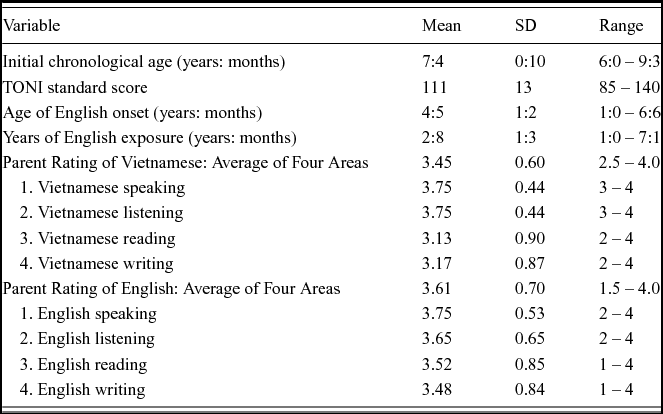
A total of 33 children (18 girls, 15 boys) participated in this study. Participants lived in the United States, and spoke Vietnamese (L1) as the primary home language and English (L2) at school and in the larger community. Table 1 displays demographic information. All participants passed hearing screenings and scored within the normal range of the Test of Nonverbal Intelligence, 3rd edition (Brown, Sherbenou & Johnsen, Reference Brown, Sherbenou and Johnsen1997), which has previously been used with culturally and linguistically diverse populations (e.g., Kohnert & Windsor, Reference Kohnert and Windsor2004). There was no history of special education services, cognitive or sensory impairment, and no parent concern for language development or learning.
Participant Demographics.

Note. Parent ratings were based on a four-point scale, with 4 = very well and 1 = very poor (Pham, Reference Pham2011). TONI = Test of nonverbal intelligence, 3rd edition (Brown et al., Reference Brown, Sherbenou and Johnsen1997).
Participants were recruited from a public elementary school in the southeastern region of the US, in which students received school instruction in English and an additional class in a second language. Vietnamese American students comprised 20% of the school population and received 90 minutes per day of Vietnamese language and literacy instruction in addition to the English curriculum. Participants on average began speaking English at age 4 years; 8 months and had an average of 32 months of English exposure at the start of the study. When asked to rate their children's speaking, listening, reading, and writing in each language (e.g., “Please select one of the following options: My child speaks Vietnamese very well, well, poorly, or very poorly”: Pham, Reference Pham2011), parents reported that their children had high proficiency in Vietnamese and English (see parent ratings in Table 1). The majority of participants qualified for reduced lunch (58%), a gross measure of low socioeconomic status.
Procedures and tasks
As part of a larger longitudinal project (Pham & Kohnert, Reference Pham and Kohnert2014), participants completed a set of language measures in the L1 and L2 at yearly intervals for a maximum of four years. Participants worked individually in a quiet area of their school or home with examiners fluent in the target language. Languages were separated by examiner, and the first language of administration was counterbalanced across participants. The present study consists of two tasks in each language: story-telling and picture naming.
Story-telling
Spontaneous language samples were collected using two wordless picture books: A Boy, A Dog, and A Frog (Mayer, Reference Mayer1967) for Vietnamese and One Frog Too Many (Mayer & Mayer, Reference Mayer and Mayer1975) for English. The two books were comparable in length and have been used interchangeably in narrative assessment (Strong, Mayer & Mayer, Reference Strong, Mayer and Mayer1998). Consistent with previous cross-linguistic story-telling procedures (Berman & Slobin, Reference Berman and Slobin1994), participants were asked to look through every page of the picture book and then tell the story to the examiner while turning the pages at their own pace. Language samples were digitally audio-recorded and transcribed by native speakers of Vietnamese and English using the Systematic Analysis of Language Transcripts software (SALT: Miller & Iglesias, Reference Miller and Iglesias2012). Transcribers segmented language samples into modified communication units (c-units) as recommended for bilingual samples when one of the languages – Vietnamese in the present study – permits subject omission (Heilmann et al., Reference Heilmann, Miller, Iglesias, Fabiano-Smith, Nockerts and Andriacchi2008). Analysis excluded incomplete or unintelligible utterances and word or phrase repetitions.
In addition to procedures for segmenting modified c-units outlined in Miller and Iglesias (Reference Miller and Iglesias2012), the following rules were applied to Vietnamese language samples, consistent with previous transcription work with isolating Asian languages such as Cantonese (To, Stokes, Cheung & T’sou, Reference To, Stokes, Cheung and T'sou2010) and Hmong (Kohnert et al., Reference Kohnert, Kan and Conboy2010):
-
• Serial verbs remained within the same modified c-unit: Con ếch đứng coi đứa bé [Frog stand look boy] “The frog is standing (and) looking at the boy”.
-
• Utterances that consisted of a topic + descriptive clause were considered one modified c-unit: Còn cái xô thì nó rớt xuống [Remaining the bucket it fall down] “And the bucket, it fell down”.
Two independent raters reviewed all language samples for accuracy and correspondence with audio recordings. Point-by-point reliability was conducted for modified c-units for 20% of the language samples by an independent and trained second rater, one for each language. Inter-rater reliability was calculated to be >90% for each language.
Dependent measures were total number of different words (NDW) and mean length of utterance (MLU). Vietnamese and English MLU were calculated in words, which is recommended when the language pair includes one language that does not use bound morphemes (Yip & Matthews, Reference Yip and Matthews2006). NDW and MLU in words are difficult to calculate in Vietnamese because multisyllabic words are written as monosyllables separated by spaces (Nguyen, Reference Nguyen1997), and there is considerable debate as to what constitutes a word versus a syllable (cf. Cao, Reference Cao1988). In order to calculate Vietnamese NDW and MLU in words, multisyllabic words were manually identified, connected with an underscore, and marked with a word code [comp] in SALT. Examples include bực_mình “upset”, chuẩn_bị “prepare”, and bây_giờ “now”. Multisyllabic words were then re-checked in all Vietnamese language samples using the Explore Multiple Transcripts - Word and Code List function of the SALT Reference Smith and Samuelson2012 Research version (Miller & Iglesias, Reference Miller and Iglesias2012). First, a list of all the words with the word code [comp] was generated. The list of multisyllabic words was then used to identify coding errors that needed to be manually corrected in individual transcripts. These two steps were repeated until all multisyllabic words were properly connected with an underscore and coded with the word code [comp].
Picture naming
Individual participants were presented with black-and-white line drawings on a computer screen and asked to name them as quickly as possible. Word stimuli consisted of 40 objects and 40 actions that were matched for high word frequency across languages using corpora databases in English (Baayen, Piepenbrock & Gulikers, Reference Baayen, Piepenbrock and Gulikers1995) and Vietnamese (Pham, Kohnert & Carney, Reference Pham, Kohnert and Carney2008). Picture stimuli were from the International Picture Naming Project (Szekely, Jacobsen, D’Amico, Devescovi, Andonova, Herron, Lu, Pechmann, Pléh, Wicha, Federmeier, Gerdjikova, Gutierrez, Hung, Hsu, Iyer, Kohnert, Mehotcheva, Orozco-Figueroa, Tzeng, Tzeng, Arévalo, Vargha, Butler, Buffington & Bates, Reference Szekely, Jacobsen, D’Amico, Devescovi, Andonova, Herron, Lu, Pechmann, Pléh, Wicha, Federmeier, Gerdjikova, Gutierrez, Hung, Hsu, Iyer, Kohnert, Mehotcheva, Orozco-Figueroa, Tzeng, Tzeng, Arévalo, Vargha, Butler, Buffington and Bates2004). Children completed the same 80 items in Vietnamese and English, arranged in a different order for each language. Accuracy and response time data for these tasks were reported previously in Pham and Kohnert (Reference Pham and Kohnert2014). The present study focuses on accuracy data (i.e., proportion correct) and includes picture naming tasks as an independent measure of vocabulary knowledge.
Data analysis
There were a total of 6 dependent variables (3 in each language): two measures from language sampling (NDW and MLU) and one measure from picture naming (proportion correct). Cross-sectional analysis consisted of bivariate correlations at Year 1 and partial correlations controlling for chronological age and the number of years of systematic exposure to English. Longitudinal analysis consisted of hierarchical linear modeling (HLM: Long, Reference Long2012) to examine predictive relationships between initial performance at Year 1 and language outcomes at Year 4. The time variable was centered on the fourth year (Year – 4) in order to capture language outcomes at the last yearly interval. Predictor variables consisted of language performance measures at Year 1. Age at Year 1 was used as a covariate to control for initial differences based on age. Models identified as “best fitting” had a relatively low AIC fit index, large total effect size (R2) and were considered the most parsimonious (i.e., included only the significant language predictors that accounted for unique variance - ∆R2). Statistical modeling was conducted using the lmer function of the lme4 package (Bates & Sarkar, Reference Bates and Sarkar2005) and summary function of the lmerTest package (Kuznetsova, Brockhoff & Christensen, Reference Kuznetsova, Brockhoff and Christensen2014) in R software. Participant attrition occurred over the course of the four-year study with 33 children at Year 1 and 12 children by Year 4 due to family relocation. Missing data were accounted for using maximum likelihood estimation (Widaman, Reference Widaman2006).
Results
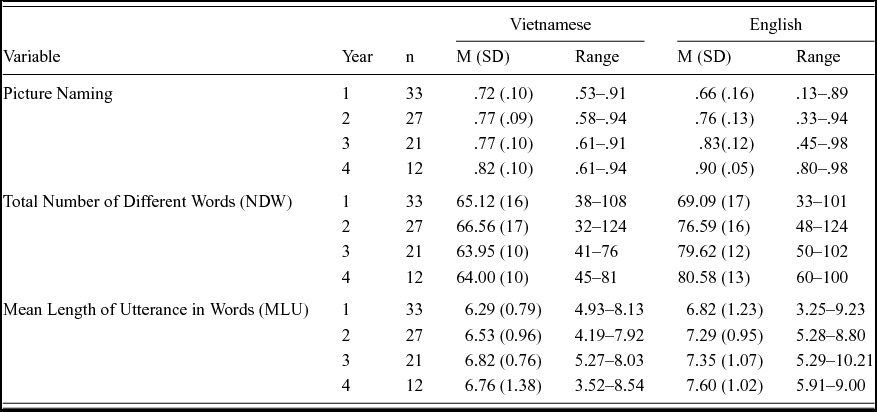
Table 2 displays descriptive statistics of the dependent measures. Picture naming increased in Vietnamese and English each year. On average, English NDW increased each year. In contrast, average Vietnamese NDW remained the same over time, indicating a plateau in Vietnamese lexical diversity, at least based on this measure. MLU increased over time in Vietnamese and English, indicating that participants on average were producing lengthier sentences with age. It is noted that while MLU can be compared over time within each language, absolute values of MLU cannot be compared between two highly distinct languages (cf. Thordardottir, Reference Thordardottir2005). Instead, the following analyses focus on the association between variables, such as whether increases in one are related to increases in the other.
Descriptive Statistics of Dependent Measures.

Note. While MLU can be compared across time within each language, absolute values cannot be compared between languages as Vietnamese and English differ greatly in sentence structure. Picture naming is calculated as proportion correct out of 80 items (Pham & Kohnert, Reference Pham and Kohnert2014).
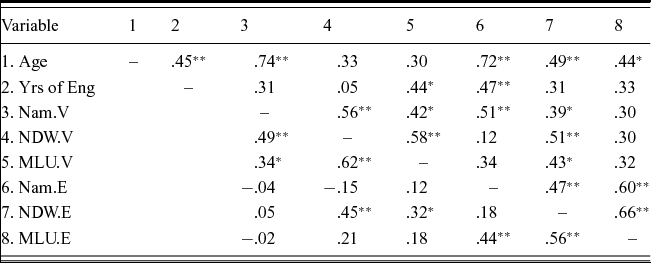
Bivariate and partial correlations are displayed in Table 3. Positive cross-domain relations were found within each language. Vietnamese MLU was positively related to Vietnamese NDW (r = .58, p < .01) and to Vietnamese picture naming (r = .42, p < .05); English MLU was positively related to English NDW (r = .66, p < .01) and English picture naming (r = .60, p < .01). Cross-domain relations within each language remained significant and positive even after controlling for age and years of English exposure (see bottom of Table 3).
Correlations at Year 1.

Note. Bivariate correlations are displayed above the diagonal. Partial correlations controlling for age and years of English exposure are displayed below the diagonal. Yrs of Eng = Years of English exposure. Nam = Picture naming. NDW = Number of different words. MLU = Mean length of utterance in words. V = Vietnamese. E = English.
* p < .05; ** p < .01
In contrast to the strong within-language associations found between lexical and grammatical domains, there were few cross-language associations. In the lexical domain, there were positive associations between Vietnamese and English picture naming (r = .51, p < .01) and Vietnamese and English NDW (r = .58, p < .01). However, after controlling for the effects of age and years of English exposure, only the relation between Vietnamese and English NDW remained significant (r = .45, p < .01). Regarding cross-domain, cross-language associations, there was an association between Vietnamese MLU and English NDW (r = .43, p < .05) that remained significant after controlling for age and years of English exposure (r = .32, p < .05).
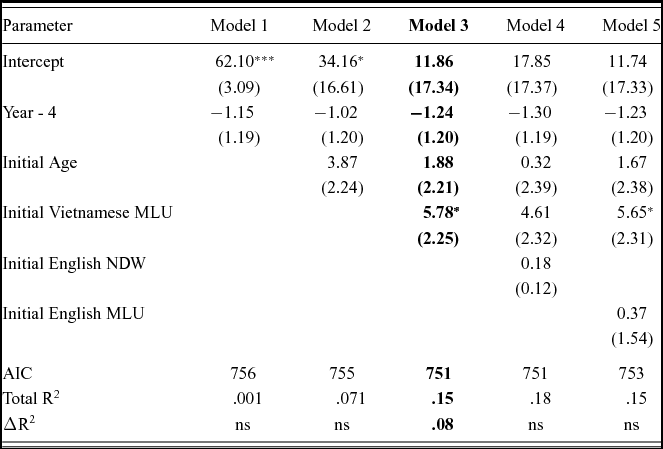
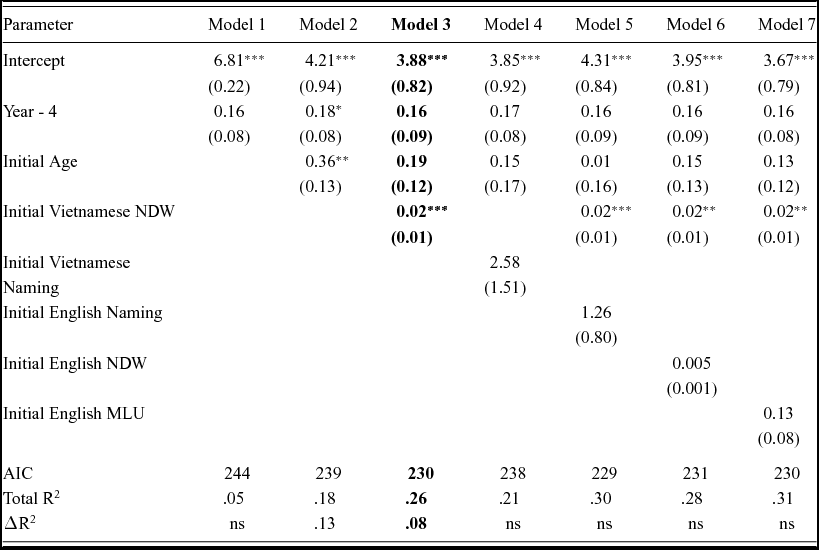
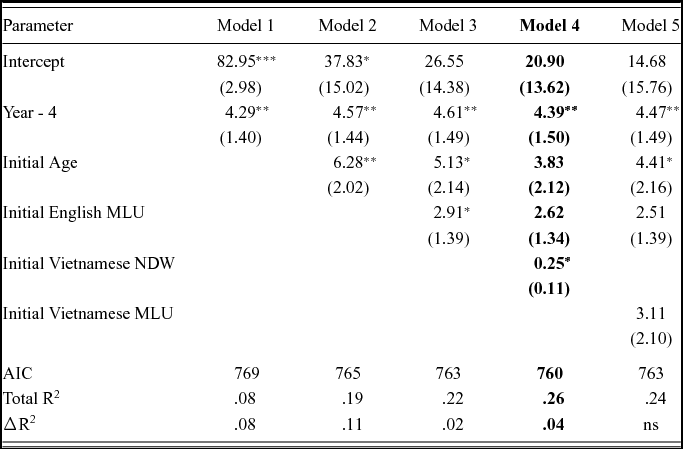
Longitudinal analysis consisted of four sets of HLMs with Vietnamese NDW, Vietnamese MLU, English NDW, or English MLU as separate dependent measures. Tables 4 and 5 display models for Vietnamese NDW and MLU, respectively. Vietnamese NDW was not predicted by initial age or yearly interval (Table 4), reflecting zero growth over time for this variable. The best fitting model (Model 3) included a within-language predictor, initial Vietnamese MLU, which accounted for 8% of unique variance in Vietnamese NDW, and no cross-language (English) predictors. As shown in Table 5, initial age and yearly interval were significant predictors of Vietnamese MLU, indicating positive growth for this variable over time. The best fitting model (Model 3) included a within-language predictor, initial Vietnamese NDW, which accounted for 8% of unique variance, and no cross-language (English) predictors.
Longitudinal Models with Vietnamese NDW as the Dependent Measure.

Note. The best fitting model is in boldface. Fixed effects estimates are displayed with SE in parentheses. Year is the time variable and is centered on the fourth year of data collection. ∆R2 corresponds to the unique variance accounted for by the last variable in the model. ns = not significant. * p < .05 ; ** p < .01
Longitudinal Models with Vietnamese MLU as the Dependent Measure.

Note. The best fitting model is in boldface. Fixed effects estimates are displayed with SE in parentheses. Year is the time variable and is centered on the fourth year of data collection. ∆R2 corresponds to the unique variance accounted for by the last variable in the model. ns = not significant. * p < .05 ; ** p < .01
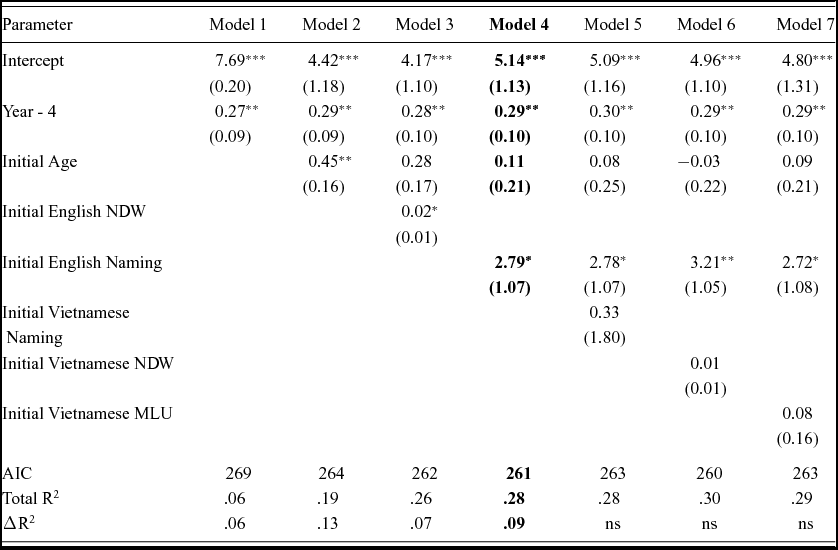
Tables 6 and 7 display models for English NDW and MLU, respectively. For both English variables, initial age and yearly interval were positive predictors, reflecting growth over time. The best fitting model for English NDW (Table 6, Model 4) included initial English MLU, accounting for 2% of unique variance (as shown in Model 3), and a cross-language predictor, initial Vietnamese NDW, which accounted for 4% of unique variance. The best fitting model for English MLU (Table 7, Model 4) included initial English picture naming, which accounted for 9% of unique variance, and no cross-language predictors.
Longitudinal Models with English NDW as the Dependent Measure.

Note. The best fitting model is in boldface. Fixed effects estimates are displayed with SE in parentheses. Year is the time variable and is centered on the fourth year of data collection. ∆R2 corresponds to the unique variance accounted for by the last variable in the model. ns = not significant. * p < .05; ** p < .01
Longitudinal Models with English MLU as the Dependent Measure.

Note. The best fitting model is in boldface. Fixed effects estimates are displayed with SE in parentheses. Year is the time variable and is centered on the fourth year of data collection. ∆R2 corresponds to the unique variance accounted for by the last variable in the model. ns = not significant. * p < .05; ** p < .01
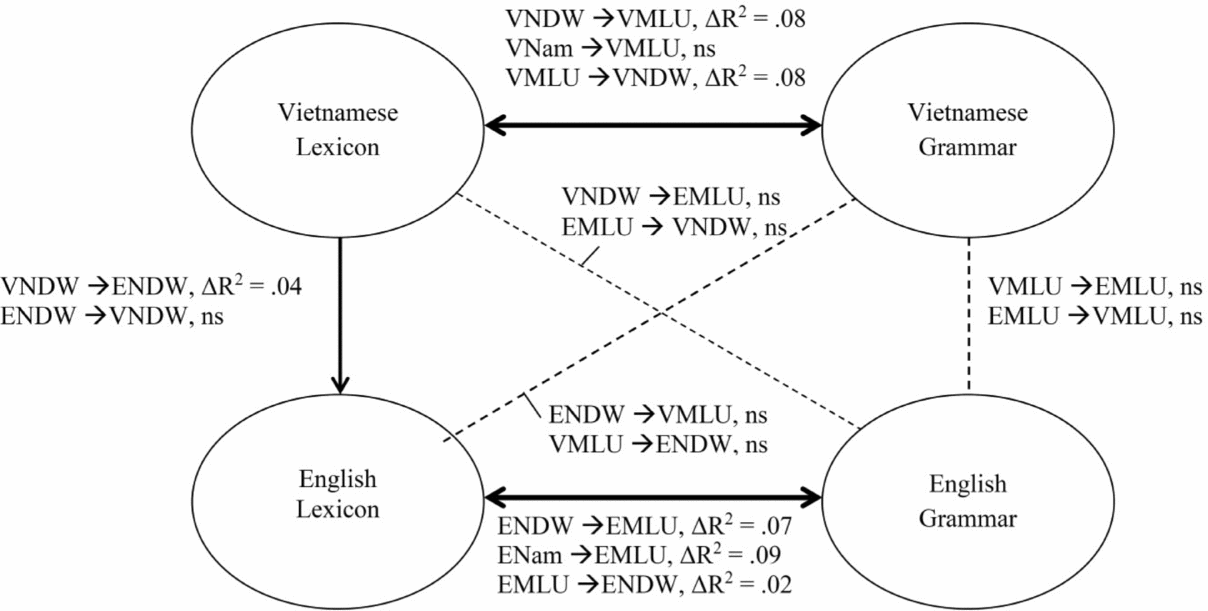
Figure 1 displays results from HLMs to visually represent the direction and relative strength of cross-domain relationships and relationships between the two languages. Collectively, data analyses suggest (a) stronger relationships within each language than between languages, (b) bidirectional associations between lexical and grammatical domains within each language, and (c) one-way transfer from the L1 to the L2 in the lexical domain.
Longitudinal Pathways for L1 and L2 Learning. Predictive longitudinal associations were calculated using hierarchical linear modeling. Solid lines (vs. dotted lines) depict the presence of longitudinal associations. Line thickness and arrows depict the strength and direction of associations, respectively. All associations shown are positive in nature. See Tables 4–7 for full models and corresponding fixed effects estimates. V=Vietnamese; E=English; Nam=Picture naming; NDW=Number of different words; MLU=Mean length of utterance; ns=not significant.

Discussion
This study identified associations within each language and between languages in a longitudinal sample of sequential bilingual children. There were two main findings. First, there were bidirectional within-language associations between lexical and grammatical domains. In the L1, initial Vietnamese NDW accounted for 8% of unique variance in later Vietnamese MLU, and vice versa. In the L2, initial English NDW accounted for 7% of unique variance in later English MLU, and initial English MLU accounted for 2% of unique variance in later English NDW. Findings are consistent with domain-general theories of language acquisition, including Dynamic Systems Theory (DST: de Bot et al., Reference De Bot, Lowie and Verspoor2007), in which language learning processes are shared across lexical and grammatical domains (e.g., Bates & Goodman, Reference Bates and Goodman1997; Kohnert et al., Reference Kohnert, Kan and Conboy2010; Marchman et al., Reference Marchman, Martínez-Sussmann and Dale2004). Within DST, positive associations between lexical and grammatical domains indicate a supportive relationship in which growth in one domain supports growth in the other and vice versa.
It was noted that lexical-grammatical associations were relatively stronger within the L2 than within the L1. Initial English Picture Naming accounted for 9% of variance in later English MLU, while Picture Naming and MLU were not related in Vietnamese. Fewer cross-domain associations in the L1 than in the L2 replicate Kohnert et al., (Reference Kohnert, Kan and Conboy2010) and extend findings to a longitudinal design and a school-age sample of sequential bilinguals. In contrast to simultaneous bilinguals who learn two languages from birth, sequential bilinguals start learning the L1 and L2 at different ages and stages of development (for review, see Kohnert, Reference Kohnert2013). Differences in the number and strength of within-language associations may indicate differences in how lexical and grammatical domains are connected within the L1 compared to the L2. Future studies that measure more language domains or more fine-tuned measures of lexical and grammatical domains are needed to identify “connected growers” (de Bot et al., Reference De Bot, Lowie and Verspoor2007) in the process of learning each language.
The second main finding was the presence and direction of cross-language associations. Based on longitudinal analysis, initial Vietnamese NDW predicted later English NDW, even after controlling for the effects of age and English MLU. In contrast, there were no cross-language (English) predictors for later Vietnamese outcomes. The finding of a unidirectional, longitudinal association from the L1 to the L2 is consistent with theories of language interdependence (Cummins, Reference Cummins1979), in which a strong foundation in children's L1 contributes to strong skills in the L2. Cummins’ theory was originally proposed for Spanish (L1) speakers in the US who are in the process of learning English (L2), and more transfer between the L1 and L2 may be anticipated for children learning two typologically similar languages. This study extends theories of linguistic interdependence to a language pair that does not share lexical or grammatical structures. Even in two highly distinct languages, the influence of the L1 on the L2 is evident. Future studies are needed to identify underlying cognitive mechanisms for cross-language transfer, particularly in the absence of structural overlap.
Within DST, the lack of bi-directional transfer suggests a conditional relationship (van Geert, Reference van Geert1991) in which growth in the L1 may contribute to growth in the L2, but not vice versa. Transfer, here, is defined as an overall, long-term influence of one language on the other, rather than in-the-moment priming effects in which the L2 can influence the L1 (e.g., Su, Reference Su2001). A long-term, conditional relationship between the L1 and L2 underscores the imbalance between a minority L1 and majority L2. While there are multiple pathways to support the majority L2, continued development of a minority L1 can be more challenging due to reduced contexts for L1 use outside of the home environment (Kohnert, Reference Kohnert2013). Findings with a longitudinal sample of Vietnamese–English bilinguals in the present study that are consistent with the literature on cross-language associations among Spanish–English bilinguals (e.g., Uccelli & Páez, Reference Uccelli and Páez2007) suggest that long-term unidirectionality from the L1 to the L2 may be a common pattern for children who speak two languages of unequal sociolinguistic status.
The finding of one-way transfer from the minority L1 to the majority L2 has educational and clinical implications. First, L2-only instruction may facilitate growth in the L2, but may not promote development in the L1. Indeed, a meta-analysis of bilingual vs. English-only school programs in the US indicates that both program types show comparable outcomes in English, but only bilingual programs show continued development in the L1 (Rolstad, Mahoney & Glass, Reference Rolstad, Mahoney and Glass2005). One-way transfer effects have also been found among clinical child populations. Treatment studies with Spanish–English bilingual children with language impairment have found similar English outcomes for English-only and bilingual treatments; however, increases in Spanish were only found following bilingual treatment (Ebert, Kohnert, Pham, Disher & Payesteh, Reference Ebert, Kohnert, Pham, Disher and Payesteh2014; Restrepo, Morgan & Thompson, Reference Restrepo, Morgan and Thompson2013). Second, the finding of a longitudinal association from the minority L1 to the majority L2 motivates educational programming that supports vocabulary growth in the L1 in order to promote positive change in L1 grammar and in the L2. Consistent with previous studies of typical bilinguals (Rolstad et al., Reference Rolstad, Mahoney and Glass2005) and bilinguals with language impairment (e.g., Ebert et al., Reference Ebert, Kohnert, Pham, Disher and Payesteh2014; Restrepo et al., Reference Restrepo, Morgan and Thompson2013), programs that incorporate children's L1 and L2 will promote bilingual growth, whereas programs that solely target the L2 will not provide adequate support for continued development in the L1.
Finally, it should be noted that this longitudinal sample of sequential bilinguals showed positive trajectories for the L1 and L2, most likely related to their bilingual schooling experiences (Pham & Kohnert, Reference Pham and Kohnert2014). The question is open as to whether bilingual children who experience L1 loss show the same within- and cross-language associations. Systematic study of within- and cross-language relationships is needed to examine how creating change in a specific component(s) can facilitate cascading effects across components. Naturalistic and experimental studies with repeated measures of multiple components are needed to test the robustness of within- and cross-language relationships outlined here and to ultimately build the knowledge base on how two languages are interconnected within a developing child.