Publishers are the custodians of culture.Footnote 1 They play a crucial, and indeed entrepreneurial, role in our current knowledge society and have been doing so for a very long time. Over the last two centuries, publishers have been instrumental in the growth of a better- educated and better-informed society, as they materialize and disseminate new knowledge among countries. Despite the empirical evidence, business and economics historians have devoted scant attention to analyzing this industry or its internationalization process, which is surprising considering that the study of multinational firms has experienced remarkable growth over the past five decades. The present article seeks to fill this gap in the historiography.
The study analyzes the variables that influence the international strategy of multinationals from industrialized and developing countries via a case study. It does so by researching the intense international competition between European and U.S. publishers in Latin American book markets during the First Global Economy, a phenomenon of international integration occurring between 1850 and 1914. The article pays special attention to the case of Spain, which provides an opportunity to compare the patterns of the internationalization process of companies from a late-developing country (not completely industrialized during the observation period) with the strategies developed by companies from rich and leading countries, such as Germany, the United States, France, and Great Britain.
Based on rich archival resources, the study offers both qualitative and quantitative data to support the research. Particularly, market penetration data in Latin American countries are used as a proxy to measure the international performance of industries. In addition, the research seeks to reconstruct and analyze the strategies developed by the publishers of these countries—varying in size, productivity, and development levels—to successfully participate in the geographically and culturally distant Latin American book markets.
The article is organized as follows. The first section provides a theoretical framework and a brief literature review. The second section offers an overview of the international publishing sector during the First Global Economy. The next two sections outline the internationalization strategies to develop Latin American markets, introduce the data sources, and offer reconstruction and analysis of the policies developed by publishers from different countries. The final section details the main conclusions of the study.
Theoretical Framework
The analysis of multinationals has received enormous attention as a topic of academic research over the last five decades. Several works by economists—such as John Dunning and Raymond Vernon, and prominent business historians such as Mira Wilkins—opened a fruitful line of research seeking to answer how, why, and when firms embark on a cross-border strategy.Footnote 2 Within these pioneering works, an influential theoretical framework was proposed by Jan Johanson and Jan-Erik Vahlne, two scholars of the University of Uppsala, to analyze the expansion path of multinationals, where companies tend first to internationalize and then speed up of the process. Their work asserts that companies choose initial export markets that are both geographically and culturally close, and then begin a path of gradual international expansion. Their model established a sequence of four steps: a typical exploratory export period with no regular export activities, an operation through local agents, the establishment of sales subsidiaries, and finally production or manufacturing in the host country.Footnote 3 During each period, the firm accumulates knowledge and reinforces its commitment to the international strategy.
Following these pioneering works, the topic of multinationals drew the attention of many scholars. At the risk of oversimplifying, the studies assess the complex managerial challenges that a cross-border strategy implies for multinationals, at both strategic and organizational levels. In the literature of the field, there is a general consensus that becoming a successful multinational involves a process of building a competitive advantage that enables the company to successfully operate in different scenarios or host countries. As Mauro Guillen and Esteban García Canal stated, “In order to pursue international expansion, the firm needs to possess capabilities that allow it to overcome the liability of foreignness; no firm-specific capabilities, no multinational.”Footnote 4 What are the sources of this competitive advantage? What are these capabilities that allow companies to overcome the liability of foreignness? Management and business literature has pointed out many company internal factors, as well as variables relating to the industry or country itself.
Technology and renowned brands are two conventional advantages that traditional studies observed in internationalized companies. In fact, many studies of renowned management and business history scholars confirmed that these two variables, together with the quality of professional managers (managerial expertise and strengths), were key resources to successfully participate in the global market.Footnote 5 These classic studies were mainly focused on and based on leading and early industrialized countries, especially those inhabited by Anglo-Saxons. A complementary perspective arose in the last decades of the twentieth century, when the visibility of multinationals from late developing, emerging, and nonleading countries—such as Spain, South Korea, and some Latin American countries—encouraged scholars to open up the geographical scope of the analysis. A new stream of research emerged with the aim of studying multinationals from emerging or middle-income countries.Footnote 6 In 1983 Louis Well was the first to highlight this phenomenon, naming these kinds of companies “Third World Multinationals.”Footnote 7 The aforementioned Spanish scholars Guillen and García Canal have widely developed this concept, demonstrating that in the last decades of the twentieth century, two global players competed in the world market: traditional multinationals, from leading countries, and the so-called “new multinationals,” from emerging countries. Their findings revealed that the latter group have different capacities that empowered them to successfully compete in the global landscape; namely, knowledge and organizational, managerial, political, and network capabilities.Footnote 8
Regardless of the distinction between “classic” and “new” multinationals, recent works underline the relevance of these capabilities and resources, particularly networks, to develop international strategies.Footnote 9 Indeed, in a revision of the classic Uppsala model, Johanson and Vahlne argued that this model, created in the 1970s, could be applied to the current turbulent and fast-moving international environment with slight modification. They stated that “the business environment is viewed as a web of relationships” and, consequently, “internationalization depends on a firm’s relationships and network.”Footnote 10 In other words, aside from the value of knowledge in the internationalization process, the authors emphasized the relevant role of networks in the current international business arena. Accordingly, they developed a business network model of internationalization that can be applied to analyze both resource-seeking and market-seeking internationalization.Footnote 11
Business historians have greatly contributed to this line of research.Footnote 12 They have reinforced the theories with relevant case studies of nations, industries, and enterprises, and showed that multinationals are vehicles of trade, capital, technology, and knowledge across borders. They also have a prominent role in building globalization processes.Footnote 13 Despite the remarkable growth of the international business history discipline, the internationalization of the publishing industry, with few exceptions, remains a neglected topic.Footnote 14 These few exceptions demonstrate that the internationalization of the publishing industry relies on knowledge and network capabilities, and is clearly affected more by cultural and linguistic borders than by national political borders, as is typical in other sectors.Footnote 15 Beyond these works, there are several studies on book publishing companies that illustrate the activities of publishers outside their political borders during the nineteenth and twentieth centuries.Footnote 16 The present study uses these theoretical and historical perspectives as frames of reference and to analyze the findings of the empirical research. Regarding the description of multinationals, this study adopts the definition established by Geoffrey Jones, which is that “firm(s) that control operations or income-generating assets in more than one country.”Footnote 17 Throughout this article, the term international competitiveness is broadly used to refer to an industry or company that successfully operates in one or more foreign markets with relevant market penetration.
The International Publishing Sector During The First Global Economy
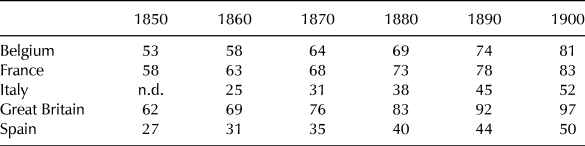
The pioneering industrialized nations each developed a competitive publishing industry. Great Britain, the United States, Germany, and France were the great powers of the international publishing sector in the nineteenth century. These countries had a large literate population compared with other countries at the time. Each population was a market that stimulated the creation of publishing companies and permitted the growth of the business. In fact, the increase in literacy in Britain, France, and Germany was spectacular in the second half of the nineteenth century, with broad sections of the population entering the reading market. According to José Carlos Rueda Laffond, in France at the beginning of the nineteenth century, 50 percent of men and 30 percent of women could read; in Great Britain, the percentages were 70 percent and 50 percent, respectively, by the middle of the century; in Germany, twenty years later, 90 percent of the population knew how to read.Footnote 18 Gabriel Tortella reported similar data for some European countries in the same period, as shown in Table 1.Footnote 19
Literacy rates in select European countries

Source: Tortella, “Patterns of Economic Retardation,” 11.
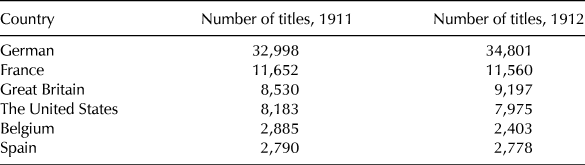
World book production in the first decade of the twentieth century had risen to 180,000 titles. The magazine Le Droit d’Auteur of Berne, in its issue of December 15, 1913, revealed the largest publishing countries by number of book titles, as shown in Table 2.Footnote 20
Top publishing countries, 1911–1912

Source: Le Droit d’Auteur of Berne, December 15, 1913, Bibliografía Española, January 1, 1914, 1–3, Biblioteca Nacional de España, Madrid, Spain.
The number of titles in German, however, does not correspond to a single country; it includes the whole production of titles published in the German language during those years in Germany, Austria-Hungary, Switzerland, Russia, Sweden, Norway, Denmark, the Netherlands, France, Great Britain, and Spain.Footnote 21 The inclusion of Spain in the list of leading countries may surprise the reader, as it was a nonindustrialized country at the beginning of the twentieth century. Indeed, Spain was a relegated nation in the international political and economic spheres. This lack of visibility had been accentuated after the disastrous and definitive loss of its colonial empire in 1898. A backward agricultural economy that was incapable of increasing its productivity and supporting the industrial sector, an indebted and heavily troubled Treasury that oriented state policies toward the short term, and the loss of colonial markets that would remain in the hands of the great powers were all factors that conditioned an uncompetitive industrial sector, also vitiated by its strong protectionist bias.Footnote 22
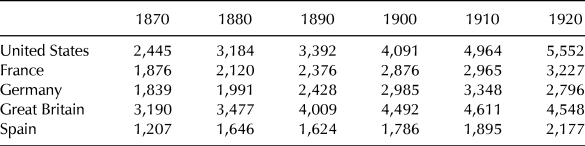
Spanish educational backwardness was also a significant problem, and is decisive in explaining the formation of the business system and its international behavior. Lack of schooling and low literacy rates were two major challenges for the Spanish economy. When comparing Spanish literacy rates with those mentioned for the leading European countries, the result is bleak (see Table 1). In Great Britain in 1900, for example, 97 percent of the population could read,Footnote 23 whereas in Spain only 42.15 percent of Spanish men and 25.14 percent of Spanish women knew how to read and write.Footnote 24 In the same year, 321 colleges and secondary schools were registered in Spain, but only 8,650 students were enrolled.Footnote 25 When this data is linked to the difference between Spanish per capita income and that of European countries, a clear picture emerges of the distance between the largest and richest markets—the United States, France, Great Britain, and Germany—and Spain (Table 3).
Per capita gross domestic product, 1870–1920*

Source: Groningen Growth and Development Centre, Angus Maddison (1926–2010).
* The comparison is in international dollars 1990.
In short, due to the economic backwardness of the country and, especially its educational backwardness, Spain did not participate as an active agent in the First Globalization Wave. This assertion was defended, for example, by Kevin H. O’Rourke and Jeffrey G. Williamson in their well-known work Globalization and History, as well as by prominent Spanish economic historians Gabriel Tortella and Clara Eugenia Núñez.Footnote 26 Paradoxically, in this depressed economic context, practically isolated from international modernity, the Spanish publishers developed an important sector (see Table 2). How then could the country spawn a cultural sector that achieved international competitiveness? The next sections discuss this question.
The Arrival of Foreign Editors in Latin America
The International Publishers Association (IPA) was created in Paris in 1896, with the main objective of ensuring the application of the recently signed 1886 international copyright agreement, resulting from the Berne Convention. The founding of this international body is proof of the relevance of the figure of the publisher, independent of the printer and bookseller. This new profession defended its property rights, expressed its concerns, and coordinated joint efforts for its voice to be heard as it struggled to protect its business on the international platform. This platform was on a global scale because the powerful publishers of the four leading countries were not content with only their domestic markets but opted for a more aggressive growth strategy: international expansion. The former colonies, in the case of the European nations, were the first foreign destinations. Nevertheless, the great international houses were soon attracted by a market demanding books in Spanish. Their sights, however, were set not on Spain but on a much wider territory: Latin America.
As an introduction, it seems appropriate to explain that after independence, several Latin American countries suffered a long period of instability. Nevertheless, during the second half of the twentieth century, most of them developed a new form of government, frequently called the “oligarchic state.” The First Globalization Wave heavily affected these processes. On the one hand, the demand for agricultural products and raw materials from the leading industrialized countries led the Latin American economies to establish an export-led growth model. On the other hand, some countries, such as Brazil and Argentina, also favored the migration of Europeans to their territories. At a national level, the few oligarchic elite—a legacy of the colonial period—owned important sectors of the economy, especially the export sectors. This elite class imposed their interests on the rest of the social groups, controlled the institutions, and influenced the general political and economic climates. These new oligarchic Latin American states took on the educational competences already developed by the Catholic Church. Latin American societies became secular, the idea of nation was affirmed, and a promising middle class used education as a vehicle of social progress.Footnote 27
How attractive were the Latin American markets? Did any demand exist? Latin American markets offered uneven incentives, with very heterogeneous demands. Because of the size of its cultural demand, the most attractive market was Argentina. The data on gross domestic product and per capita income between 1870 and 1930 indicates that Argentina enjoyed a prosperous economy, especially after 1900.Footnote 28 In fact, in 1910 Argentina’s per capita income was US$3,822—lower than the United States (US$4,964) and Great Britain (US$4,611), but higher than Italy (US$2,332), France (US$2,965), Germany (US$3,348) and, of course, Spain (US$1,895).Footnote 29 From the end of the nineteenth century, the consolidation of the state and the beginning of a period of enormous growth allowed Argentina to become an economic power. This growth resulted in an increase in disposable income, urbanization rates, and cultural levels, primarily concentrated in the city of Buenos Aires and its surrounding areas. The government of Domingo Faustino Sarmiento (1868–1874) marked a turning point in the education system, enhancing the cultural level of the country and fostering public education. The following regime, the República Conservadora (1880–1916), maintained this concern for education. In terms of the publishing market, this meant an increase in demand, due to the expansion of the reading public.Footnote 30 In addition to the better economic situation, some state policies positively influenced this increase in demand for books. These include the modernization of the education system and the financing of the network of public libraries through the Protective Commission of Popular Libraries.Footnote 31
Argentina was the only Latin American country with a local publishing industry. Nevertheless, the sector was at an early stage of development, and it was not until the first decade of the twentieth century when some relevant publishers arose. Companies such as El Ateneo (1912), founded by the Spanish emigrant Pedro García; Tor (1916); La Cultura Argentina (1915–1925); the Biblioteca Argentina (1915–1928); Ediciones Mínimas (1915); and Ediciones Selectas-América (1919) were illustrative examples of this promising publishing sector. Apart from these Argentinean companies, the Latin American publishing industry was practically nonexistent, composed of small companies publishing limited catalogs, with local authors or cheap editions—legal and illegal—of bestsellers.
The second Latin American cultural market was Mexico. The country’s population was about 15 million at the beginning of the twentieth century and had a per capita income of US$1,694 in 1910.Footnote 32 This, along with population growth and political stability during the Porfiriato Díaz dictatorship (1877–1911), gave the country a sense of confidence for the future. In terms of the publishing market, it is necessary to emphasize that, although the level of illiteracy was high, the Mexican government began to develop ambitious literacy programs that facilitated the free teaching of reading, writing, and accounting to everyone.Footnote 33 During the Porfiriato regime, the propagation of culture was stimulated through the founding of public schools and libraries. These programs generated future readership and made the government the direct customer of the publishers who supplied the new entities. Moreover, there was a wealthy minority of professionals who regularly consumed books published abroad.Footnote 34 Other markets such as Peru, Cuba, or Brazil were also attractive for publishers, although the appeal of Mexico and Argentina was greater, not only because of their domestic demand but also because of their geographic location, allowing redistribution through areas of Central and South America. The underdeveloped publishing sector in Latin America encouraged foreign competitors to enter the arena.
An important advantage of this study is the reliable source of both quantitative and qualitative data. Collections of reports from the Spanish diplomatic offices in Latin American countries were used in this study. The history of the source is simple. In the 1920s, Spanish publishers needed reliable information on book markets in Latin American countries to pursue international expansion. The domestic market was narrow, due to the low educational level of the country, as mentioned in the previous section, and they saw Latin American markets as the natural extension of the “Spanish market,” which is a term that different contemporaneous testimonies used to refer to the Latin American markets. The Barcelona Book Chamber pressed Spain’s Ministry of State to request this information from its diplomatic offices located in those countries. The Ministry of State delegated this task to the Oficina de Relaciones Culturales Españolas (Office of Spanish Cultural Relations), which sent a questionnaire to embassies and consular offices.Footnote 35 The information obtained from this source was processed and complemented with data provided by other primary and secondary sources, mostly contemporaneous (i.e., primary archives of Spanish publishers, sector-specific periodical publications and books).
The official reports, entitled “Questionnaire on the Trade of the Spanish Book,” constitute an excellent source for analyzing what was happening in the Latin American book markets during that period. In addition to the importance of the qualitative information, the reports also include a wealth of quantitative data compiled by diplomats from the countries’ official statistics. This article uses these statistics as a proxy to measure the international competitiveness of the foreign publishing sectors that operated in Latin America.
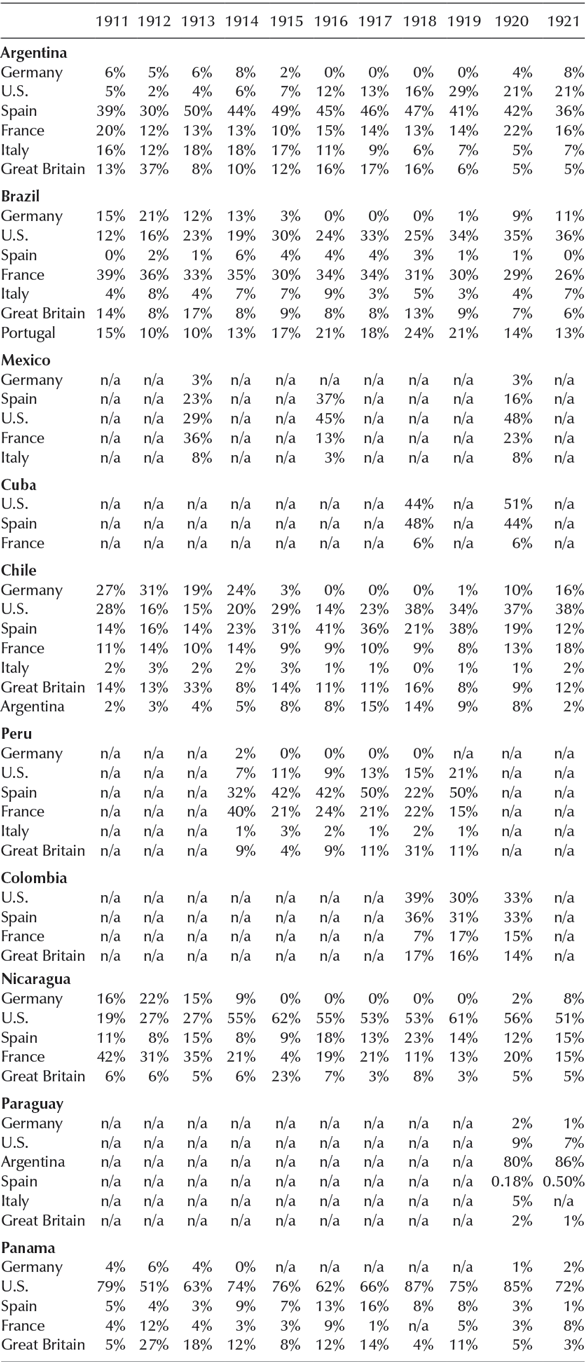
As indicated in Table 4, Spain contributed a high percentage of the total number of books imported in large markets, such as Argentina and Mexico, as well as in medium-sized markets, such as Peru and Cuba. French publishers had significant percentages in the import market in Argentina, Chile, Peru, and Nicaragua. Publishers in the United States commanded in Colombia, Chile, and Mexico. In Panama, the United States practically had a monopoly on imported books. The Brazilian market, one of the largest by import volume, was essentially dominated by France and the United States.
Import of books in major Latin American countries, 1911–1921, percentage over total country import figure*

Source: Author’s calculation from Consular Reports, Boxes 1273, 1274, and 1275, Section Foreign Affairs, General Administration Archive.
* Countries ordered by size of import market, largest to smallest.
Some statistics may need further explanation; these include the high import figures for Argentine books in the markets of Chile and Paraguay, which was more than 80 percent in the latter country. It is necessary to point out that behind these figures, there are no Argentine books in the strict sense, but that the statistics reflect the re-export of books of other nationalities—mainly Spanish—to those republics. As mentioned previously, Buenos Aires was a place of great strategic value because it allowed the control of distribution in South American countries. The Spanish consulate in Asunción (Paraguay) explained the situation as follows:
I must add that these numbers can be misleading, since the main contribution of books here is from Spain. What is happening is that as these booksellers have little capital, they do not work directly with Spain, but bring Spanish books from the big bookstores of Buenos Aires, and are listed in the statistics as Argentine import.Footnote 36
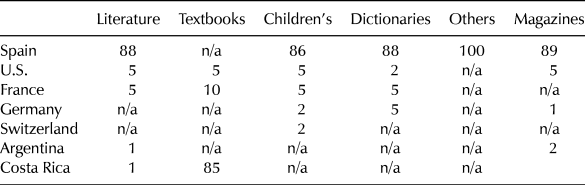
Some countries do not have official statistics, although there are generic testimonies on the level of penetration of the international book publishing sectors. In Puerto Rico, the report states: “It can be said that Spanish imports far outweigh those from other countries.… It is the Spanish houses that send the largest number of books here. Some come from France and the United States, edited in French and English, but in greater proportion in Spanish.”Footnote 37 El Salvador also did not provide official statistics, although the Spanish diplomat responsible for drafting the report pointed out that Spain ranked first, accounting for between 70 percent and 80 percent of the country’s total book imports.Footnote 38 In Costa Rica, the consular report indicates that the import market was practically dominated by Spanish works, as shown in Table 5.
Import of books and publishing products in Costa Rica, 1922*

Source: Author’s calculation based on responses to the Questionnaire on the Spanish Book in Costa Rica, Box 1274, Foreign Affairs Section, General Administration Archive.
* Data in kilograms.
The information provided in the previous tables indicates that the market shares of the different countries evolved over time. Statistics reveal that in Argentina from the early 1910s, the import book market was completely under Spanish dominance. In 1911 Spain already contributed 39 percent to the total number of books imported by the country. The percentage rose to 50 percent in 1913. Both statistics affirm, without any doubt, that the process of internationalization of Spanish publishing houses began before the Great War, during the period known as First Globalization. Additionally, in Table 4 it can be seen that the United States, France, Spain, and, to a lesser extent, Germany controlled the publishing market in Mexico. In Mexico, as in many medium and small markets (such as Cuba, Peru, and Chile), the Great War was reflected in the fall in percentage shares of the countries involved in the conflict, such as France and Germany—a situation used by Spanish publishers to increase their market share.
What types of titles are behind those numbers? In the Argentinean market, the segment with the highest demand was literature, which represented approximately 40 percent of the total market, followed by social sciences, medicine, physical sciences, and chemistry. France and Italy led in the field of historical studies, and French publishers set the standard for art books.Footnote 39 Children’s books—a very profitable market—was led by Spanish publishers, such as Calleja, and by British and U.S. houses. French publishers, particularly the well-known Larousse, were at the head of the dictionary sector. In medicine, German and French works were very successful. However, from the first decade of the twentieth century, some Spanish houses copied the strategy and the publishing format of several leading European rivals. They began to publish encyclopedias in Spanish, following the French model. Companies such as Montaner and Simón, and Espasa, successfully entered this business.Footnote 40 They also translated into Spanish important works of international literature, as well as technical and medical publications. Salvat, one of the most relevant Spanish publishers of the period, specialized in medicine and large format books, mainly translations from German.Footnote 41 Engineering and technology texts by French authors were also translated into Spanish, and sold well in the form of manuals for Spanish publishing houses, including Gustavo Gili, Bailly-Baillière, and Romo.
The quantitative and qualitative information obtained shows that language is the principle differentiator in the industry. As mentioned in previous literature, the internationalization strategy of the book publishing industry was conditioned more by cultural and linguistic borders than by national political borders.Footnote 42 Nevertheless, book publishing was, and remains, an extremely diverse industry, with an enormous variety of product types— from literature to comics to textbooks—and audiences—from children to adult. The experience of the Latin American markets shows that once the barrier of language was overcome, books printed in Spanish, no matter the origin of the publisher, were close substitutes for one another.
In Mexico, the second target market, Spanish market shares in the 1920s were significant in the areas of literature (40 percent), medicine (25 percent), pedagogy (25 percent), industry (10 percent), and magazines (25 percent).Footnote 43 In Mexico City, school books, stories, and gift books for children were in high demand. The publishing house Calleja participated in this business line, and was a pioneer in what has now become traditional for Spanish publishers in the Mexican market: public purchases.Footnote 44
In Nicaragua, the publisher Bruño achieved a significant volume of business thanks to the introduction of its textbooks by the Brothers of the Christian Schools.Footnote 45
In Peru, 70 percent of the book market was in literature; the remaining 30 percent was in other disciplines, among them medicine, pedagogy, philosophy, history, and practical manuals (electricity, agriculture, etc.). Literature books came from France and Spain; physical and mathematical sciences books came from Germany, England, and Italy.Footnote 46
In Colombia, the majority of history and law books came from Spain (60 percent), France (20 percent), and the United States (10 percent). Texts for higher education mostly came from Spain (25 percent), the United States (25 percent), and France (35 percent).Footnote 47 In Ecuador, Spain dominated in literature; France in textbooks for schools and colleges and scientific books; the United States in Anglo-Saxon literature; and Germany in books of devotion and religious literature.Footnote 48
Many French houses, such as Garnier and Hachette, exported translated novels by internationally famous French authors to all Latin American countries. Other houses specialized in technical books, manuals, and reference works, such as the U.S. publisher Appleton, which had success with math, mechanics, chemistry, and engineering manuals. The French company Flammarion was known for its psychology books, and its compatriot Felix Alcan for its works of philosophy. Devotional and religious books had a huge demand in Catholic Latin America. Herder, located in Freiburg, Germany, was a main supplier of these books. In Peruvian colleges and convents, for example, this publishing house reigned, thanks to its quality editions and economical prices. The U.S.-based American Book Company was responsible for filling much of the demand for school books in Cuba.Footnote 49 Similarly, the American Pedagogical Mission sold or donated teaching materials to schools, becoming an active agent of schooling in many countries. In fact, in Peru, the testimony of a contemporaneous diplomat defined the American entity as “controller of the primary and secondary instruction of the Republic.”Footnote 50 El Salvador imported most of its school textbooks from the United States. In Panama, thanks to agreements with the government, U.S. publishers had a monopoly on translating, printing, and selling all of the books necessary for teaching.Footnote 51 In general, the United States controlled 70 percent and 50 percent of the book import markets in Panama and Cuba, respectively.
Which publishers had the most presence in the Latin American markets? In both the large markets (Mexico, Argentina, Brazil) and small markets (Cuba, Nicaragua, El Salvador), the publishers with the highest market shares were France’s Viuda de Bouret, Hachette, Garnier, and Ollendorff; Germany’s Herder; Italy’s Usuelli and Bozzi; the United States’ Appleton, Macmillan, and Thomas Nelson;Footnote 52 and Great Britain’s Everyman’s LibraryFootnote 53 and the American Company of London. The most prestigious Spanish publishers were, in no particular order: Calleja, Reus, Salvat, Modern Spain, Gustavo Gili, Bailly-Baillière, Perlado Páez, Fernando Fe, Renaissance, Cervantes, Calpe, Mundo Latino, Prometeo, Espasa, Hijos de Reus, Sempere, Sopena, Rivadeneira, Editorial Mundo Latino, Maucci, Rafael Caro Raggio, Biblioteca Nueva, Editorial América, Collection Atenea, Jorro, and Beltrán.
Many of these publishers simply exported their production through distributors or agents. Notwithstanding, these were not simply the books that they did not sell domestically. The product was in fact adapted to the market: French, English, German, and U.S. companies all published in Spanish. A significant case was the U.S. publisher D. Appleton & Company. By 1845 Appleton began to publish books in the Spanish language, and some years later inaugurated a Spanish department to manage the promising new business line. As the company explained in a commemorative book celebrating its centennial: “The thought [was] to start with school books for which there was evident demand. A new series of readers in English had been moderately successful, and it was decided to make translations of these.”Footnote 54 The company expanded the focus of its Spanish catalog, which in 1867 comprised fifty books, including fiction and scientific and technical works.Footnote 55 The strategy turned out to be a great success. Indeed, in 1925 the company had great prestige in the U.S. sector, and its reputation was founded on medical books, educational books, and books in Spanish.
A “Haute Couture” Strategy to Conquer the Latin American Markets
What separated the international publishing companies in the Latin American markets? Did all international editors overcome geographical and cultural distances? In this section, I try to answer these questions by analyzing each variable that conditioned the arrival in new markets, and how they were managed by the publishers of each country.
Cultural Influences
In the internationalization of a cultural industry, such as the publishing sector, it is logical to think that proximity was important in the cultural relationship between the home country of the multinational and the destination. Colonial ties could predictably have played an important role in favor of Spanish publishers. However, at the beginning of the twentieth century, this cultural influence was not so clear. The political independence of the Latin American countries caused an intellectual movement to reject the Hispanic heritage that facilitated the entry of other cultural influences; this in turn enabled the arrival of a massive number of European and U.S. publishers.Footnote 56 A contemporaneous testimony (dated 1922) serves to illustrate the situation in the case of Cuba:
The effective American influence in Cuba is observed in all social and political acts. The difference of language is not enough to counteract the Yankee influence, which is getting everywhere, invading everything and denaturalizing principles and institutions of origin completely opposed to the American Anglo-Saxon ideology. The book published in the United States, whether written by a local author or a foreigner, occupies the main place in the Cuban bookstore. […] Everyday, the total amount of books imported from North America is increasing. The first explanation for this situation is the great spiritual affinity that was established between Cubans and Americans on Cuba’s independence, an affinity derived from the constant exchange of ideas, and from the sympathy with which the citizens of Cuba freely regarded and admired the values of the Great Republic. There are also other factors of a very different nature, but of real importance, such as the proximity of the exporting country, the frequent and methodical communication service by sea, the beneficial price of the customs tariff, or the facilities granted in the payment of purchases and marketing made by the semi-religious Yankee associations on this island.Footnote 57
The presence of foreign colonies stimulated the creation of schools and educational institutions that acted as vehicles for cultural activity abroad. In addition, there were institutions designed specifically to meet this objective. The founding of France’s Alliance Française in July 1883 and Germany’s Deutsche Akademie in May 1925 are good examples. The English equivalent, the British Council, would not be established until 1934. These entities not only favored the arrival of European publishers by consolidating cultural influences but also were direct customers for these companies. For example, the Alliance Française’s local organizations tested French students in schools and rewarded the best with French editions of classical authors. In the Anglo-Saxon countries, much of the cultural propaganda was channeled through private entities.Footnote 58 In the United States, the Rockefeller Foundation and Carnegie Foundation made significant book donations to Latin American universities and cultural societies.Footnote 59
The French cultural ascendancy was evident among the upper classes of the main Latin American publishing markets. Numerous testimonies support this affirmation. A clear example is the opinion of Spain’s trade aggregate in Argentina in 1922, referring to the upper classes of the country: “The upper classes have an essentially French background. French culture and books dominate universities and exert an ‘irresistible spiritual tutelage’ on the upper classes (and consequently on the entire population of the country), and ‘French’ is the daily bread of every intellectual work of Argentina.”Footnote 60
Similarly, Chile, Mexico, and Brazil were culturally oriented toward France. It was an influence that materialized in the exigency of the French language in higher education, the acclamation of its literature, and the continuous references to French authors. Germany followed in importance, although its dominance was felt with special intensity in the scientific and technical spheres. By the turn of the twentieth century, there was a change in leadership. The French and German cultural influence began to have a hard adversary: the economic power of the United States. A Spanish diplomat in Nicaragua offers a testimony that could be perfectly applied to all Latin American countries: “The most educated people of the Republic have been educated in France, Belgium and the United States. French (Latin American) propaganda and American capital share the moral and material influence in this country.”Footnote 61
Price Competitiveness
The publishers of the largest and richest developed countries presented clear advantages in one main area to achieve market penetration in the new territory: the ability to offer a lower sale price. The final price of a book was undoubtedly the most important concern faced by publishers in expanding their circulation in Latin America, according to the testimonies. Spanish publishers had a higher unit cost of production than their rivals and were accordingly less competitive in costs than those of the developed countries. Within the cost of production in Spain, particularly important were the high price of raw materials for the manufacture of books, especially paper, and the low number of printing presses. Spanish houses printed from three thousand to five thousand copies in each print run as compared with the two hundred thousand copies of French and German publishers, and therefore the unit cost was higher even when all else was equal. The absence of a large domestic market prevented Spanish firms from exploiting economies of scale. The “Questionnaire on the Trade of the Spanish Book” in Argentina summarized the problem of Spanish competitiveness concisely: “Spain produces at a higher price than the other countries of Europe.”Footnote 62
The costs of using the postal service, the most widely used system for shipments, also made Spanish books more expensive: sending a standard package of the same weight to Mexico from Spain cost 4.5 francs, and from France, 3 francs.Footnote 63 The distribution costs in Latin America also increased sale prices, and the exchange rate of the peseta seriously damaged Spanish exports. All these circumstances led to the Spanish book being much more expensive than that of European or American publishers. As a result, a book in Spanish produced in France sold 20 percent cheaper than one coming from Spain, and Swiss and German books were priced 25 percent to 30 percent lower, respectively.Footnote 64
Methods of Payment
The forms of payment offered by Spanish publishers for their U.S. clients did not facilitate the sale of Spanish books in those markets, as they were less favorable and more rigid than those of foreign publishers. It is difficult to generalize the conditions of payment, as they varied considerably depending on each company and not just on nationality. Moreover, each publisher applied flexible criteria depending on the level of trust it had with the long-distance Latin American customer, the volume of business, and the length of the commercial relationship between them. However, some general trends can be outlined. First, the payment modalities of European publishers were much more flexible before the World War I than after. Second, French publishers offered the most advantageous and flexible modes of payment, sixty or ninety days, which was a great incentive for booksellers. Most of the Spanish publishing houses, however, marked by a weak financial structure, could not offer a system of postponement and, when they did, it was with very short deadlines. Uruguayan booksellers, for example, stated that even at equal prices, it was more convenient for them to work with publishers other than those in Spain because they granted higher discounts and had better conditions.
Advertising
Modern French, German, and U.S. publishers also exceled over Spanish publishers in another matter of no less importance: publicity. Strange as it may seem, Latin American booksellers were often unaware of the titles they were ordering, and without possibility of repayment. The testimony of a Spanish distribution agent is especially illustrative on this point. Latin American bookstores previously bought books by weight: “Send us 15.000 pesetas of novels” and “Note X kilos of entertainment books.”Footnote 65
On the contrary, German and French publishers paid special attention to marketing, applying advanced management techniques that allowed them to regularly present their bibliographic production in catalogs and newsletters. In France, the Bibliographie de la France (1811), followed by the General Catalog of the Librairie Française (1840–1925), advertised all the works that were published in the country and counted among its subscribers the most important Latin American booksellers.Footnote 66 The professional magazine of German publishers, Börsenblatt für den Deutschen Buchhandel, reported on German publishing news. The wholesale house Koehler & Volckmar disseminated the printed catalogs in seven languages, sending them free of charge to more than twenty-seven thousand bookstores around the world.Footnote 67 In Spain, the first catalog that combined the global production of Spanish publishing houses did not appear until 1923 in three volumes.Footnote 68 The companies of the industrialized nations, especially U.S. publishers, also used other advertising tools. A Spanish diplomat speaking in 1922 expressed the point clearly:
The importance of the marketing and publicity of the books and magazines by the modern exigencies of trade is fundamental. Here in Cuba commercial retailing is done “in the North American style”: luminous advertisements; articles concealed in newspapers; large posters in the most appropriate places; fixed projections in cinematographs; and in general, all sorts of naïve things.Footnote 69
Trade Associations and Government Support
Trade associations and government support also played important roles in the internationalization of companies in some countries. European publishers were grouped into trade associations that increased efficiency, improved distribution, and reduced costs. In Germany, publishers centralized distribution through a single warehouse in Leipzig, servicing more than four thousand publishers. The buying and selling operations went through the Buchhandlerhaus (Book Circle), which concentrated the universal bookstore trade and fulfilled two main functions: to attend to the orders of the books that the German houses edited, and to buy through its own agents the works that were published in other languages and in other parts of the world.Footnote 70
As for France, both trade associations and government support were important. The Syndicat des Editeurs (Syndicate of Editors, since 1892), Societe d’Exportation des Editions Française (Society for the Export of French Editions, since 1916), and especially Maison du Livre Française (House of French Books, since 1920) were responsible for improving the diffusion of French books abroad by coordinating the efforts of its publishers.Footnote 71 This latter entity included 105 publishers and 534 bookstores, and its ultimate goal was to process orders more securely and faster by using a modern and systematic organization and by being in direct contact with more than 1,000 foreign booksellers. This institution centralized demands, shipments, and payments; organized exhibitions to promote French books; and even founded a library school to train representatives of the books.Footnote 72 It was, in short, a powerful instrument that favored the strategy of internationalization of French publishing houses and fostered the cultural activity abroad developed by the Française Alliance.
Unlike its major competitors, the Spanish industry did not have government support or strong trade union activities to assist them in their internationalization strategies. The trade associations developed later than those in other European countries, and their work was less efficient. Official Chambers of the Book were founded in Barcelona (1918) and Madrid (1922). The two Spanish consortia aimed specifically to boost the foreign action of companies that emerged later. The National Consortium of Export Editors was formed in Barcelona in 1929. The Spanish Book Exporter Union was founded in Madrid in 1930. However, these Spanish entities were underdeveloped and can hardly be compared with France’s Cercle de la Librairie (Circle of Libraries), Germany’s Börsenverein der Deustchen Buchländler (Association of the German Booksellers ), and England’s English Stationers’ Company.
In the French case, government support was not limited to promoting external cultural action or subsidizing trade union initiatives; it sometimes helped the financing of private projects. The most striking case was the bookstore El Palacio del Libro (The Palace of the Book), founded in Buenos Aires in 1923 by the Hachette publishing house, through its local subsidiary Sociedad General de Librería y Publicaciones (General Society of Bookshops and Publications).Footnote 73 The vast and sumptuous bookstore was designed by copying the most advanced German techniques. Nils Lamm, the Hachette employee responsible for its installation, had studied the system in Norway, Holland, and Germany before implementing it in Buenos Aires. The bookstore had a very modern distribution and sale system; it even had a sophisticated archive of customer files, which recorded clients’ tastes and history of acquisitions. In this way, each client could be informed, as a matter of routine, about the publication and reception of works that might interest them. The project was heavily subsidized by the French government because it sought to promote the diffusion of French books abroad.Footnote 74
Distribution
These tools, trade associations, and government support were especially important to combat a common problem: the distribution of works. Most business was done through exports. Publishers exported books from the home countries and used sales representatives to distribute their catalogs abroad. In some occasions, they entrusted the distribution of works to another publishing house, such as the aforementioned Hachette. The role of these agents was crucial in understanding the success of some publishers. The testimony of the U.S. company Appleton in 1845 illustrates this idea:
No list of South American booksellers or educators was available, and as vessels seldom sailed, a daring plan of distribution was resorted to. A vessel generally carried a heterogeneous cargo consigned to one man—a commission servant [commission agent] Several cases of books were put aboard, consigned to this man, with a memorandum invoice and suggestions as to means of distribution. It was a great risk but not a foolhardy one, and the Latin Americans turned out to be scrupulously honest. Many of the countries had recently emerged from revolutions; there was a thirst for knowledge, and the books sold so rapidly that business relations were easily established.Footnote 75
After an early phase of exports and distribution through agents, some houses decided to open commercial branches in Latin America. These commercial subsidiaries allowed the publishers to control the prices, discounts, and marketing strategies, as well as provide direct contact with the demand of those countries. This step meant a higher commitment to the internationalization strategy because it involved greater investment. In Brazil, the Garnier house was based in Rio de Janeiro, but had small branches throughout the country.Footnote 76 In Mexico City, there was a delegation of the publishing house Viuda de Bouret. As mentioned previously, the General Society of Bookshops and Publications, in Buenos Aires, was the delegation of Hachette and was established as one of the most important distributors not only for Argentina but also for adjacent markets.Footnote 77 The British Ackermann, founded by the Anglo-German publisher Rudolph Ackermann at the beginning of the nineteenth century, had branches in Colombia, Argentina, Mexico, Chile, Peru, and Guatemala.
Networks
One of the most important resources exploited by publishers to enter Latin American countries was the existence of colonies of European or U.S. emigrants. On the one hand, these emigrants constituted a direct demand for publishers. On the other hand, many of them opened bookstores in which they publicized the editions of the houses of their home countries, not only for their compatriots but also for local readers. In Mexico, for example, particularly notable were the Italian booksellers Hermanos Pontecorvo, the American bookstore American Book, and the German Muller Hermanos and Fausti Wirth & Saudler.Footnote 78 In Buenos Aires, there were importers of French origin such as Augusto Gallé and Lajouunane y Cía.Footnote 79
However, in this respect, Spaniards were clearly superior. The diffusion of the Spanish book in Latin America was supported, in this initial stage, by the existence of language colonies of Spaniards and, within them, booksellers born in Spain or children of Spaniards.Footnote 80 The colonies of emigrants were the great allies of Spanish publishers, constituting the social network that supported the process of internationalization from the first sporadic contacts. As I have shown, colonies had been a strategic element in the introduction of German, English, French, and American publishers; although in the Spanish case, the number of emigrants was overwhelmingly higher. In the two main markets, Spanish emigrants constituted a large group. The number of Spaniards in Mexico in the first decades of the twentieth century was about fifty thousand people. Its distribution, centered on the most important cities of the republic, and its occupation in the commercial sector, made the Spanish colony an important asset for Spanish publishers.Footnote 81 Among the Spanish emigrants who opened bookstores in the Aztec country were the three Porrúa brothers, born in Pie de la Sierra, Llanes, Asturias. They had arrived in Mexico at the end of the nineteenth century: José in 1886, Indalecio in 1888, and Francisco in 1890. In 1900 they installed in Mexico City a bazaar dedicated to the purchase and sale of books. The bookstore became one of the main importers of Spanish books in the Mexican capital, and remains so today. In Argentina, some examples of Spaniard-run bookshops in the capital were Valerio Abeledo; Antonio Chiqué y Cía.; Federico Crespillo; Enrique García; Martín García; Juan Roldán; and La Académica, created in 1916 on Avenida Callao by the Poblet brothers.Footnote 82 In Cuba, the most important bookstores were La Moderna Poesía and Librería Cervantes, both owned by Spaniards.Footnote 83
These were not isolated cases; the bulk of the Spanish colony, in the measure of its possibilities, advanced the diffusion of Spanish culture in its country of residence. In Mexico, the most exceptional case was that of Spanish merchant Joaquín Cifuentes, who founded Spanish Book Library. Inaugurated on September 3, 1923, the library was a meeting center, reading room, association headquarters, and place to celebrate literary evenings. The center was located on Calle Uruguay 49, next to the offices of the Chamber of Commerce of Mexico.Footnote 84 In Argentina, the colony was the great promoter of the Spanish Cultural Institution, created to promote bilateral cultural relations.Footnote 85 The Spanish colony financed the institution and occupied positions on the board of directors. The Spanish Cultural Institution was responsible for disseminating research and studies of any nature in Spain, as well as for promoting intellectual exchange between the two countries. For example, it financed trips to Argentina for Spanish teachers or intellectuals to give seminars and conferences. All these activities constituted an effective marketing of Spanish culture and authors. Conversely, the lack of Spanish diaspora in Brazil explains the low market penetration of Spanish companies in the country (see Table 4). The different language of Brazil and the practically nonexistent immigration networks hampered Spain’s entry mode and thus its limited results.
Typically, cultural institutions were the first external link for Spanish publishers—the trigger for internationalization. Indeed, the process of internationalization usually began thanks to a particular contact with a Spanish publisher or bookseller. As a result of these links between compatriots, a process of spontaneous, sporadic, and reactive exporting was initiated. For example, two of the most important Spanish multinationals in the sector, Salvat and Calleja, began their internationalization strategies in this informal way. The Calleja publishing house began its internationalization process in 1890 through its contact with the Herrero bookstore in Mexico City.Footnote 86 In the case of Salvat, intermittent contact with the U.S. market began at the end of the nineteenth century through the Mexican publisher-bookstore J. Ballescà y Cía., created by the Catalan emigrant José Ballescà Casals. The bookstore began selling books from the Catalan house and, in 1882, the managers of the two companies undertook a joint project: the edition of a book about Mexico through the ages. The book was printed in Barcelona in October 1897. The success of the project encouraged them to continue with other titles.Footnote 87
The Spanish houses, just like their European or U.S. rivals, channeled distribution through agents or representatives to boost sales. These agents, whether working for one or several publishers, played a decisive role in the early stages of the internationalization process of small- and medium-sized enterprises. This is reflected in many contemporaneous testimonies, such as that of Samuel Núñez López, one of the most active Spanish book importers in Brazil, who emphasized that “books published in Spain are the first to be known worldwide for the good portfolio of correspondents that our publishers have.”Footnote 88 The three most relevant agents by volume of business were: (1) Pedro Isla, sales representative of the Union Librera de Editores S.A., of Spain, who distributed the catalogs of Salvat, Saturnino Calleja, Seix, Editorial Labor, and Editorial Scientific Medical in Mexico; (2) Joaquín Oteyza, representative of Editorial Sopena; and (3) Nicolas Rueda, an agent for Montaner and Simón.
Those initial networks were a source of knowledge. Nevertheless, the lack of information about Latin American markets hampered the internationalization process, making information a highly valuable and sought-after commodity. For this reason, the second step in the strategy of internationalization was a trip by the directors of the publishing houses. On these business trips, publishers expanded their contacts, especially among the booksellers, and learned firsthand the characteristics of the demand of the country of destination, consumer preferences, and business practices. The information obtained on these trips allowed publishers to plan their internationalization strategies and gradually adjust to the demand by allocating personnel to this specific business line and by designing a defined commercial strategy. The agents were also assigned commercial research tasks. This can be seen, for example, in a letter of introduction, dated September 16, 1911, for Ernesto Escalas Chamení, an agent for the publisher Gustavo Gili. This agent’s tasks included the following:
Make a study of each country you visit. References of each client (capital, morality, intelligence, maximum credit they may warrant, current turnover, etc.). Means to promote business in each country, convenience of naming subagents, marketing, bibliography in major newspapers, facilities for reimbursement and turnover of small and large quantities, general transport and customs, bestseller books, business practices of houses from Paris, London, New York, Spain, etc., works to be published, means to regulate sales prices.Footnote 89
Although Gustavo Gili Roig would change distributors over the years, the inquiries requested were very similar. Each piece of data was captured in valuable customer records, which the publisher had been saving, updating, and perfecting since the beginning of its internationalization process.
The case of the Salvat publishing house illustrates the importance of information and business travel. The turning point in the company’s internationalization strategy came with the trip of Fernando and Santiago Salvat to Latin America, which lasted from 1912 to 1914. They would later become the publishing heirs to Latin America.Footnote 90 At the start of the trip, they were twenty-one and twenty years of age, respectively. It was their older brother, Pablo, already in charge of the family business, who organized the trip, which he conceived both as part of the learning process in the management of the publishing house and as a commercial opportunity. The idea was to enter into direct contact with these countries, learn about the demand for books, investigate markets to increase the company’s exports, and obtain data that would allow the company to adapt its offers to potential clients through the design of future catalogs.
The younger brothers had meticulously defined tasks. The first was to develop a database of American booksellers’ indices, with detailed information on various topics, from a store’s surface area and shop window size to the age of the booksellers. The brothers Salvat used the same tool as Gustavo Gili—paper files—to store and manage information about American customers. The second task was to visit medical professors (the medical branch represented 70 percent of the house’s catalog) to get recommendations of titles already published, to ask for suggestions of new titles, and even to offer to publish professors’ work, a clear copy of the strategy of European publishers such as Garnier and Ollendorf. The third task was to visit official representatives of Spanish diplomacy; that is, institutions created by Spanish and, more specifically, Catalan emigrants and by local authorities (such as the directors of national libraries, ministers of Education, and presidents of republics). The brothers were to collect information on the countries visited that could potentially be included in the planned Salvat Dictionary, and were to send reports with administrative details such as the cost of freight and customs requirements.Footnote 91
As I have shown, the experience of Spanish publishers is consistent with the theoretical model established by the Uppsala School. The gradual process began with a typical exploratory export period, with no regular export activities, and continued with exports through local agents. The firms increasingly accumulated knowledge and strengthened commitments to the international strategy, adapting its products and hiring personnel.
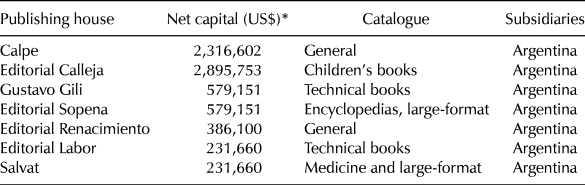
The next step in expanding internationally occurred in the first decades of the twentieth century, during the last period of the First Global Economy or immediately afterward, when the leading Spanish publishers moved to the next stage in the Uppsala scale: opening sales subsidiaries (Table 6).
Ranking of Spanish publishers

Source: Author’s calculations based on Anuarios Financieros y de Sociedades Anónimas (Yearbooks Financial and Limited Corporations), Salvat and Gustavo Gili Archives; Consular Reports, Boxes 1273, 1274, and 1275, Section Foreign Affairs, General Administration Archive
* Exchange rate Spanish peseta to U.S. dollar, 1915.
As a result of these business strategies, penetration rates in Latin American markets increased. Spanish publishers exported an average of 39 percent of their production, although some Catalan houses exceeded 50 percent production.Footnote 92 Gustavo Gili exported 52 percent of its production, and Salvat more than 50 percent. Maucci, the Italian publisher based in Barcelona, exported two-thirds of his production to the Latin American markets, relying on two bookstores opened by his brothers, with one store in Mexico and the other in Buenos Aires.Footnote 93 Sempere, a publishing house in Valencia, had 50 percent of its business outside of Spain. In fact, some titles sold better abroad than in the domestic market. For example, Karl Marx’s Capital sold nine thousand copies in Spain and fourteen thousand in America.Footnote 94 By linking this information to the figures in Table 4 and Appendix 1,Footnote 95 I show a positive image of the international competitiveness of Spanish publishing during the First Globalization Wave, at least in its final phase.
Conclusions
My goal in this article is to explain the intense international competition in Latin American book markets during the First Globalization Wave. From this perspective, the article offers new insights into the different patterns of internationalization. On the supply side, the largest and richest countries had the advantages of cost and strong competition, but the Spanish publishers’ cultural and linguistic advantages on the demand side proved more important.
What business tools did these publishers use to boost their internationalization process? The success of the European and U.S. publishers was built on their strong financial capacity, cost-and-price competitiveness, role of trade associations, and, in some cases, support of their respective governments. In sum, publishers such as the United States’ Appleton, France’s Garnier and Bouret, Germany’s Brockhaus, and Great Britain’s Ackermann had greater industrial and distribution capacity, larger print runs, and lower sales prices than Spain’s publishers. Nevertheless, Spanish companies, despite coming from a nonindustrialized and economically backward country, achieved great success in the international race to conquer Latin American book markets. By 1913 the data shows that Spain had 50 percent of the Argentinean market and 23 percent of the Mexican market, which were the two most important in Latin America. It is true that these figures refer to exporting goods from its home base, a commercial activity that reflects a low degree of engagement with the internationalization strategy. However, the percentage of penetration was high and shows the beginning of a promising internationalization strategy. The majority of Spanish companies lacked strong financial support, and this conditioned the pace of the cross-border process. The qualitative evidence confirms this hypothesis, as the publishers progressively adapted their products to the host markets by hiring personnel specific to the new lines of business in home and host countries, including specialized distribution agents. This process was reinforced when, in the first decades of the twentieth century, the most prominent publishers embarked on foreign direct investment strategies by establishing branches (mainly wholly owned subsidiaries) in various Latin American countries, turning these small companies into multinationals.
The qualitative and quantitative information included in the article adds some insights into the relevant role played by low cultural distance and the efficiency of social networks as tools to improve an internationalization strategy.Footnote 96 Spanish publishers managed to snatch the dominance of the most important book markets in Latin America away from the powerful European and American publishers. In this sense, the internationalization path analyzed here confirms several aspects of the Uppsala model, both classic and revisited: the choice of host countries, selected with a low cultural distance; the gradualness of the process; and the importance of relationships and networks to successfully manage international strategies. The business network model of internationalization developed by Johanson and Vahlne to understand current internationalization processes is also a helpful framework to examine the strategy of multinationals during the First Globalization Wave.
The findings of my research offer a complementary vision of the international competitiveness of Spanish enterprises at the turn of the nineteenth and twentieth centuries. Nevertheless, a limitation of the study, because it focused on a particular industry, is that it could not question the classic assumption established for the general Spanish economy: the nonparticipation of Spain in the First Globalization Wave. According to the literature, the two factors of a narrow domestic market and a low level of education prevented Spain from participating in the phenomenon of international integration. So why is this article’s finding so different from other studies? The answer is that these two factors conditioned the small size of Spanish publishing companies, their low-price competitiveness, and their inability to develop economies of scale and obtain large profits. In other words, the Spanish publishing industry was limited by its market size, a fact that reinforces the traditional view regarding the role of the domestic market in late Spanish industrialization.Footnote 97 However, in this case, the limitation imposed by these two factors acted as an incentive to look for foreign markets rather than as an obstacle to cross-border trade. The explanation for this difference lies in the educational and cultural levels of the publishers, which was far higher than average Spaniards. Although many publishers were self-taught, most of them were university graduates (e.g., Salvat, Gili), or were involved in efforts of educational reform in the country (e.g., Calleja, Calpe), or were immigrants with prior training and knowledge of languages (e.g., Maucci). In this light, the experiences of the publishers emerge as exceptions in the fabric of Spanish business.
SUPPLEMENTARY MATERIAL
To view supplementary material for this article, please visit https://doi.org/10.1017/eso.2019.24