INTRODUCTION
What is special about actions associated with objects is, precisely, their link to specific objects. Objects are designed to serve specific functions and, thus, specific actions. Consequently, objects' forms are closely linked to their function, and one expects a close relationship between the visual properties of objects and their associated actions. We will aim to show that the visual similarity of the objects to which actions are associated affects action production and identification.
Ska and Croisile (1998) observed that action similarity and object similarity influence action identification. They asked healthy elderly participants to name actions and observed confusions between visually similar actions (e.g., typing and playing the piano) or semantically similar actions (e.g., reading a book and opening a newspaper—both are related to similar activities), a pattern also observed in action production.
Rumiati and Humphreys (1998) asked participants to produce actions under speeded conditions and observed more visual errors (e.g., making the action associated with a cup when presented with the picture of a bowl) than semantic errors (e.g., making the action associated with a hammer when presented with the picture of a saw). They concluded that the prevalence of visual errors indicated that actions tended to be selected directly from the visual properties of objects.
This pattern of performance resembles that of some apraxic patients. Apraxia can be defined as a movement disorder associated with lesions to the left or right cerebral hemisphere (Heath et al., 2001; Roy et al., 2000) that cannot be attributed to sensory loss, weakness, poor movement coordination, or poor comprehension of or attention to commands (Rothi and Heilman, 1997). Apraxics' errors are varied and require a more extensive classification system such as those developed by Buxbaum et al. (1995, 1997) or Schwartz et al. (1995). They include sequence errors, omissions, additions, and quality errors (e.g., using too much or too little of an item). Importantly, substitution errors occur when patients erroneously perform an action on one object, when they should be performing this action on a different object—for example, placing the toothpaste under water instead of the toothbrush.
Substitution errors seem to involve objects that are visually or semantically similar. For example, patient HB places a juice lid on his thermos, arguably confusing two visually and semantically similar items (Buxbaum et al., 1997). Patient JK, observed in a natural setting, spreads shaving cream on his toothbrush, and picks it up to shave (Schwartz et al., 1995). Similarly, on object classification tests, patient DM indicates that soap is the associate of a butter dish (Buxbaum et al., 1997).
This pattern of errors suggests a link between action and perception systems. Indeed, Duffy and Duffy (1990) reported that deficits in action recognition and production often co-occur, and Roy (1996) suggested that impairment patterns where both deficits occur are linked to disruptions in a conceptual system for actions.
Contrastingly, Goodale et al. (1991) demonstrated that, although unable to recognize objects or estimate their orientation in a perceptual task, patient DF correctly oriented objects when task demands included acting on them, leading Goodale and Milner (1992) to suggest separate neural systems for perception and action. Roy (1996) also described impairment patterns where action identification and production are independently affected, suggesting that, although these processes interact, they can also be dissociated.
The use of well-known actions associated with objects makes it difficult to disambiguate between action similarity, which presumably relies on an action system, and object similarity, which relies on a perception system. One could confuse “reading a book” and “opening a newspaper” because both actions are similar, or because both actions are associated with visually and semantically similar items. Furthermore, because objects are designed to afford specific actions, action errors can be influenced by links between objects and their actions (learned through experience) or by perceptual features of objects that afford specific actions. Desmarais et al. (in press) developed a paradigm to explore the effect of object similarity independently of action similarity by using novel, affordance-free objects.
They asked healthy participants to learn to identify novel actions using nonword labels (e.g., a pulling action was called “baiv”). In one experiment, participants learned to identify actions not associated with specific novel objects (during learning trials, actions were performed on a cylinder), and in another experiment, participants learned to identify actions associated with novel objects (during learning trials, different actions were performed on different novel objects). In both experiments, test trials consisted of visually identifying actions performed on a cylinder. The authors noted that participants confused similar actions more often than dissimilar actions, demonstrating the importance of action similarity in action identification. However, the authors did not investigate the influence of object similarity on action identification, which will be investigated here.
CONTROLLING OBJECT SIMILARITY
In studies involving real objects, valid similarity measures are difficult to establish. Although past research used objective measures such as contour overlap (Tranel et al., 1997) and subjective measures such as similarity ratings (Dixon et al., 1997), these were shown to be biased predictors of confusions in memory (Desmarais and Dixon, 2005). They also cannot specify which aspects of objects allow us to disambiguate between different items. Furthermore, when confusing actions associated with visually and semantically similar objects (e.g., reading a book and opening a newspaper), it can be arduous to disambiguate between the influence of visual similarity (between the book and the newspaper) and semantic similarity (the two are read). To circumvent these problems, Desmarais and Dixon (2005) have developed a set of eight psychophysically scaled novel objects formed by perturbing an origin object along three visual dimensions: curvature, tapering, and thickness.
The objects' visual dimensions form a three-dimensional space where each object's position is described by a set of Cartesian coordinates. The object in position 0,0,0 is the “origin object,” and other objects involve perturbations of this origin object. The distance between two objects can be construed as visual city-block (VCB) distance, where the sum of the distances obtained separately on each dimension defines the distance between two objects (Shepard, 1987). The number of distinguishing attributes equals the number of VCBs that separate two objects: objects 0,0,0 and 0,0,1 are one VCB apart, whereas objects 0,0,0 and 1,0,1 are two VCBs apart, and objects 0,0,0 and 1,1,1 are three VCBs apart. Objects that are closer to each other in this space have fewer distinguishing attributes, and are more similar than objects that are further apart. Also, these objects are affordance-free; their perceptual features do not call for specific actions. Therefore, using this object set, one knows and controls the visual similarity relations among the exemplars.
CONTROLLING ACTION SIMILARITY
An action space similar to the visual space was created using the action dimensions of “pulling (15 cm in the sagittal plane),” “sliding (15 cm leftward in the transverse plane),” and “twisting (15 cm leftward rotation in the coronal plane).” Here the origin action (0,0,0) that anchors the action space is holding an object. Other points in space involve combining the different actions while holding the object and performing them simultaneously as one movement (e.g., pulling, sliding, and twisting in one fluid movement). This action space should be governed by the similarity between the actions—actions that are closer together have fewer distinguishing attributes than actions that are further apart. The number of distinguishing attributes equals the number of CBs that separate two actions. Hence, although the actions were not psychophysically scaled, one knows and controls the similarity relations among the actions that comprise this action space.
LEARNING ABOUT ACTIONS
James et al. (2001, 2002) and Harman et al. (1999) demonstrated the importance of passive viewing versus active interaction. Healthy participants made same/different or old/new judgments on novel objects presented on a computer screen or in a virtual reality environment. During the familiarization phase, participants either actively controlled the visual display, or passively viewed another participant's exploration of the object. Participants in the active condition recognized objects faster, demonstrating that actively exploring the visual features of novel objects led to better recognition. It is unknown, however, whether interactively learning about actions associated with objects might be important for their later production or visual identification—another factor we will examine here.
We will demonstrate the importance of object similarity on action production (Experiment 1) and identification (Experiment 2) by pairing novel objects with novel actions. Each experiment will include two conditions: (1) an aligned similarity condition where similar actions are associated with similar objects and dissimilar actions are associated with dissimilar objects, and (2) a misaligned similarity condition where similar actions are associated with dissimilar objects, and dissimilar actions are associated with similar objects. This paradigm will allow us to verify the hypotheses that (1) similar actions will be confused more often than dissimilar actions, (2) actions will be confused more often when associated similar objects than when associated with dissimilar objects, and (3) reproducing these actions during learning will result in fewer errors.
EXPERIMENT 1
Methods
Participants
Participants were 110 right-handed undergraduate students from the University of Waterloo, who received 12 dollars for their participation.
Materials
The materials were the eight actions depicted in Table 1, the eight gray objects shown in Table 2, and two manipulandi. Analyses were based on participants' confusions. To elevate the number of such confusions, four supplementary objects and four supplementary actions were added, but not analyzed. These black objects were associated with the same action as their gray counterpart, but they were held with the thumb and the index finger instead of the whole hand.
Stills depicting the eight actions

Specific association between actions and objects for the aligned similarity condition where all similar objects are also associated with similar actions

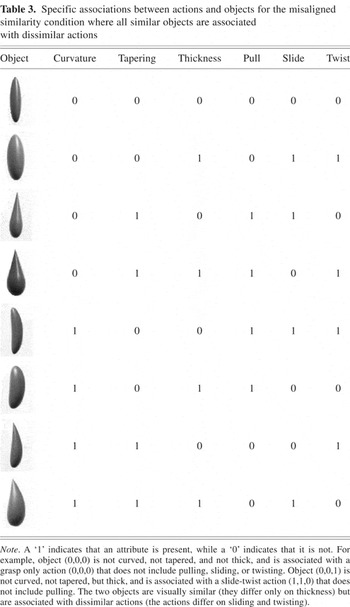
Participants sat to the left of the experimenter; manipulandi were placed at arm's length in front of each person. The manipulandi restricted the actions performed on the novel objects: users could move mounted objects by sliding them 15 cm leftward, pulling them out by 15 cm, or rotating them leftward so the top portion of the hand traveled a distance of 15 cm. The actions are depicted in Table 1. In an action space containing eight actions, 12 pairs of actions are one action city-block apart (1ACB), 12 pairs of actions are two ACBs apart, and 4 pairs of actions are three ACBs apart. In the aligned similarity condition, similar actions were paired with similar objects and dissimilar actions were paired with dissimilar objects. The specific pairings are shown in Table 2. In the misaligned similarity condition, similar actions were paired with dissimilar objects, and dissimilar actions were paired with similar objects (see Table 3).
Specific associations between actions and objects for the misaligned similarity condition where all similar objects are associated with dissimilar actions

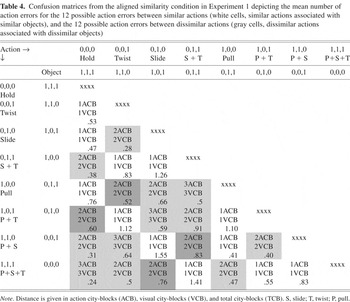
Tables 4 and 5 show the confusion matrices for the aligned similarity condition and the misaligned similarity condition. For the aligned condition (Table 4), the white entries show the confusions among similar actions (those that lie 1ACB apart) paired to similar objects (those that lie 1VCB apart). There are 12 such confusion entries. The gray entries show the confusions among dissimilar actions (those that lie 2 or 3 ACBs apart) paired to dissimilar objects (those that lie 2 or 3 VCBs apart). There are 12 such confusion entries.
Confusion matrices from the aligned similarity condition in Experiment 1 depicting the mean number of action errors for the 12 possible action errors between similar actions (white cells, similar actions associated with similar objects), and the 12 possible action errors between dissimilar actions (gray cells, dissimilar actions associated with dissimilar objects)

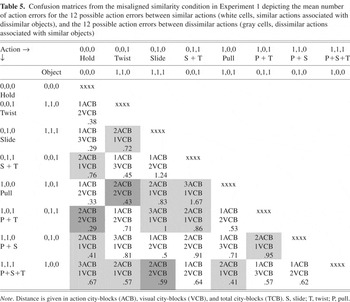
Confusion matrices from the misaligned similarity condition in Experiment 1 depicting the mean number of action errors for the 12 possible action errors between similar actions (white cells, similar actions associated with dissimilar objects), and the 12 possible action errors between dissimilar actions (gray cells, dissimilar actions associated with similar objects)

For the misaligned similarity condition (Table 5), the white entries again show the confusions among similar actions (those that lie 1ACB apart) only now these actions are paired to dissimilar objects (those that lie 2 or 3 VCBs apart). The gray entries show the confusions among dissimilar actions (those that lie 2 or 3 ACBs apart) paired to similar objects (those that lie 1 VCB apart). There are 12 such confusion entries.
The four black entries in Tables 4 and 5 show pairs of actions that were 2 ACBs apart that were associated with objects that were 2 VCBs apart. These pairings were identical for the aligned and misaligned similarity conditions and were not analyzed.
Eight nonwords matched in bigram frequency served to label the eight key gray objects: baiv, fint, grov, hong, jorl, malg, verp, and yoot (the four nonwords used to label the extra four black objects were bryf, cauv, lafe, and tarb). The associations between novel objects, novel actions, and nonwords were counterbalanced between participants.
Procedure
The procedure used in both experiments was conducted in compliance with ethics regulations at the University of Waterloo. Participants were randomly assigned to one of four conditions: 58 participants received the aligned similarity condition (32 in the watch condition, 26 in the imitation condition), and 52 participants received the misaligned similarity condition (28 in the watch condition, 24 in the imitation condition). All participants were presented with sequences of Learning Trials and Test Trials.
Learning trials
First, participants were instructed to keep their eyes closed. The experimenter signaled the beginning of each trial by saying, “This is how you use this object.” Participants opened their eyes and saw a copy of an object along with its written label on the manipulandum in front of them. The experimenter used another copy of the object, placed on the second manipulandum, to demonstrate how the object “was used.” Participants were instructed to watch the experimenter demonstrate the object's action, and to look at the associated label. Participants in the watch condition did not interact with the objects; participants in the imitation condition were instructed to concurrently imitate the experimenter using the object mounted in front of them. The experimenter signaled the end of learning trials by saying “now close your eyes.” Copies of the next object and its label were then mounted on the manipulandi. This sequence continued until all objects and actions had been presented once in random order.
Test trials
Participants were instructed to keep their eyes closed until the beginning of each trial. The experimenter signaled the beginning of test trials by saying, “What was the name of this object?” Participants were instructed to “name” the object using its label and, if they could not remember, to guess by selecting one of the labels from a card containing all alternatives. Participants were then instructed to demonstrate the object's action on the object mounted in front of them. Finally, participants closed their eyes until signaled to open them again. Test trials continued until all objects had been named and all actions had been performed. Within a block of test trials, each object was presented once in random order. Participants did not receive feedback on their performance until object naming and action production had been performed correctly twice consecutively, at which point participants were informed of their correct performance. A recurring pattern of learning trials followed by test trials continued until participants met this criterion. Testing time took approximately 90 min. By the end of the experiment all participants performed flawlessly.
Results and Discussion
Action errors were recorded and entered into a confusion matrix (e.g., Tables 4 and 5). For example, if object 0,1,0 was presented to a participant in the “aligned similarity condition,” they would be required to produce a slide (0,1,0) action. If they erroneously produced a slide and twist action (0,1,1) that error would be entered into the confusion matrix in the cell associated with row 0,1,1 and column, 0,1,0. Each cell corresponds to both a pair of actions and (because each action is linked to an object) a pair of objects. Hence each erroneous action denotes confusion between actions and between objects.
The aligned and misaligned similarity condition matrices are shown in Tables 4 and 5. The numbers in these tables represent the average numbers of confusions for each action–object combination, with every other action–object combination. The number of errors for the 12 pairs of similar actions (white entries) and the 12 pairs of dissimilar actions (gray entries) was collected and averaged for all participants. The combination of aligned and misaligned conditions enables us to assess four combinations of action and object similarity (similar actions paired to similar objects; dissimilar actions paired to dissimilar objects; similar actions paired to dissimilar objects; dissimilar actions paired to similar objects). Note that the nature of the aligned and misaligned pairings makes it impossible to fully cross action similarity and object similarity in any kind of traditional repeated-measures design: participants only contribute subsets of these crossings (e.g., similar–similar and dissimilar–dissimilar). Because of these constraints, we ignored any repeated-measures component of our design and analyzed the data using a three-way between-subjects analysis of variance (ANOVA) for which the factors were learning condition (watch vs. imitate), action similarity (similar actions vs. dissimilar actions), and object similarity (similar objects vs. dissimilar objects). This strategy is a conservative one, it fails to capitalize on removing known subject-to-subject variability arising from the fact that the same participants served in multiple conditions. As such, only variables with large effect sizes will reach significance.
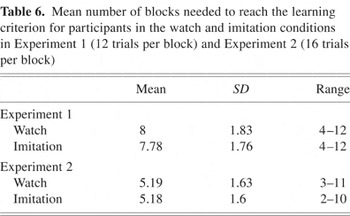
The main effect of action similarity [F(1,212) = 3.627, p = .058] was relatively small (partial η2 = .017). Similar actions (mean = .76 errors) were confused slightly more often than dissimilar actions (mean = .65 errors). The main effect of object similarity [F(1,212) = 45.847, p < .001] was larger (partial η2 = .178). Actions were confused much more often when associated with similar objects (mean = .88 errors) than when associated with dissimilar objects (mean = .54 errors). No other main effects or interactions were significant. The results are shown in Figure 1. A t test on the number of blocks to criterion in the watch and imitate conditions confirmed that participants needed the same number of blocks to reach criterion in each condition [t(108) = .597, not significant; see Table 6].

Mean number of action confusion errors (standard error) during action production (top panel) and action identification (bottom panel).
Mean number of blocks needed to reach the learning criterion for participants in the watch and imitation conditions in Experiment 1 (12 trials per block) and Experiment 2 (16 trials per block)

The relatively large effect of visual similarity on action production can also be seen by contrasting the values in the confusion matrices in Tables 4 and 5. Consider the 12 white entries in the aligned condition, which involve similar actions associated with similar objects (1ACB and 1VCB apart). Now consider the 12 white entries in the misaligned condition—they involve exactly the same highly similar actions (1ACB) that are now associated with dissimilar objects (either 2 or 3VCBs apart). The confusion rates for 10 of the 12 entries are lower in this misaligned condition, indicating the strong influence of visual similarity on action production. A comparison of the 12 gray cells in the aligned and misaligned conditions indicates this same influence of visual similarity. Here, the more visually discrepant pairings in the aligned condition led to better action performance than in the misaligned condition where the associated objects are visually similar. In total, visual similarity impacted performance in the predicted direction for 20 of 24 comparisons. By contrast, similar analyses on action similarity show no predictable influence on action production. When visual similarity was held constant and action similarity was varied (i.e., the white entries in the aligned condition, and the gray entries in the misaligned condition, and the gray entries in the aligned condition, and the white entries in the misaligned condition), action similarity influenced action production in the predicted direction on only 12 of 24 cells.
Furthermore, we conducted a supplementary analysis that distinguished between all confusions that were 1ACB, 2ACBs and 3ACBs apart. With eight key actions, there are 3 similar errors (1ACB), 3 marginally dissimilar errors (2ACB), and 1 very dissimilar error (3ACB). Each participant's errors were classified only in terms of ACB distance. If errors were independent of action similarity, the expected proportion of total errors should be 42.86% 1ACB, 42.86% 2ACB, and 14.28% 3ACB. For all participants the observed proportion of total errors was 46.50% 1ACB, 37.50% 2ACB, and 16.00% 3ACB—values significantly different from those expected by chance [χ2(2) = 26.34, p < .05]. When a similar analysis was applied to visual CB distance, the observed proportion of errors was 52.58% 1VCB, 36.01% 2VCB and 10.41% 3VCBs [χ2(2) = 107.19, p < .05]. These values highlight that, although action similarity does impact action production, there is a stronger effect from visual similarity.
The impact of object similarity suggests that participants relied on object features and their representations in memory when retrieving actions. We, therefore, looked specifically at incorrect actions that followed naming errors. Because we are analyzing eight objects/actions, a naming error can either be followed by the correct action (the action associated with the object presented), the action associated with the incorrectly given name (name errors), or a different action (random errors: one of the other six actions). The 1575 action errors that followed incorrect naming were divided into name errors (n = 568) and random errors (n = 1,007). These values were entered in a χ2 where the proportion of possible name errors (1/7 actions) and the proportion of possible random errors (the other 6/7 actions) determined the expected values. This analysis revealed participants were proportionally more likely to produce name errors than random errors[χ2(1) = 610, p < .001].
Experiment 1 demonstrated the impact of object similarity on action production. Experiment 2 will demonstrate the effect on action identification.
EXPERIMENT 2
Methods
Participants
Participants were 103 right-handed undergraduate students from the University of Waterloo, who did not participate in Experiment 1, and received 10 dollars for their participation in the experiment.
Materials
Materials were the eight objects, eight actions, and two manipulandi used in Experiment 1. Given the large effect of object similarity observed in Experiment 1, the four extra objects were not used.
Procedures
Participants were randomly assigned to one of four conditions: 52 participants received the aligned similarity condition (26 in the watch condition, 26 in the imitation condition), and 51 received the misaligned similarity condition (26 in the watch condition, 25 in the imitation condition).
The procedure was similar to that of Experiment 1; instead of producing actions, participants pointed to the correct action in an array of eight consecutively played movies depicting each action displayed on a computer screen. The location of each action varied between trials, and actions were presented in all possible locations. To make the two experiments comparable in difficulty, each object was presented twice during test trials, totaling 16 test trials between each block of 8 learning trials.
Results and Discussion
Action errors were recorded and entered in a confusion matrix. The data were entered in a 3-way ANOVA for which the factors were learning condition (watch vs. imitation), action similarity (similar actions vs. dissimilar actions), and object similarity (similar objects vs. dissimilar objects).
The analysis revealed a main effect of object similarity [F(1,198) = 17.481, p < .001]. Actions were confused more often when associated with similar objects (mean = 1.53 errors) than when associated with dissimilar objects (mean = 1.16 errors). No other effects were significant (see Figure 1).
A t test on the number of blocks to criterion in the watch and imitate conditions revealed that participants needed the same number of blocks to reach criterion in each condition [t (101) = .05, not significant; see Table 6].
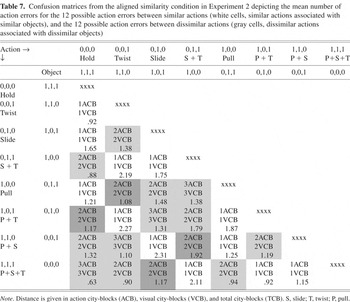
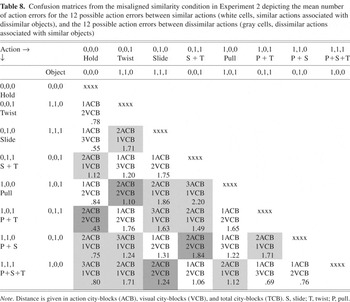
Again, an inspection of the confusion matrices for the aligned (Table 7) and misaligned similarity condition (Table 8) confirms the impact of object similarity. Visual similarity impacted performance in the predicted direction for 21 of 24 comparisons. In contrast, action similarity influenced action production in the predicted direction on only 14 of 24 cells.
Confusion matrices from the aligned similarity condition in Experiment 2 depicting the mean number of action errors for the 12 possible action errors between similar actions (white cells, similar actions associated with similar objects), and the 12 possible action errors between dissimilar actions (gray cells, dissimilar actions associated with dissimilar objects)

Confusion matrices from the misaligned similarity condition in Experiment 2 depicting the mean number of action errors for the 12 possible action errors between similar actions (white cells, similar actions associated with dissimilar objects), and the 12 possible action errors between dissimilar actions (gray cells, dissimilar actions associated with similar objects)

Again, each participant's errors were classified only in terms of ACB distance. For all participants, the observed proportion of total errors was 44.45% 1ACB, 41.76% 2ACB, and 13.79% 3ACB—values not significantly different from those expected by chance [χ2(2) = 4.055, not significant]. When a similar analysis was applied to visual CB distance, the observed proportion of errors was 49.47% 1VCB, 39.73% 2VCB, and 10.80% 3VCBs [χ2(2) = 80.78, p < .05]. These values highlight the strong effect of visual similarity on action identification.
Errors that followed incorrect object naming were divided into name errors (n = 1003) and random errors (n = 1535), and these numbers were entered in a χ2. This strategy revealed that participants were more likely to produce name errors than random errors [χ2(1) = 1316.7, p < .001].
The data from both Experiments was entered in a four-way ANOVA for which the factors were Experiment (1 vs. 2), learning condition (watch vs. imitate), action similarity (similar vs. dissimilar), and object similarity (similar vs. dissimilar). The analysis revealed a main effect of Experiment [F(1,410) = 166.99, p < .001]. Experiment 2 generated more errors (mean = 1.35 errors) than Experiment 1 (mean = .71 errors). There was also a main effect of object similarity [F(1,410) = 50.29, p < .001]. Actions were confused more often when associated with similar objects (mean = 1.19 errors) than when associated with dissimilar objects (mean = .84 errors). No other effects were significant. Contrary to previous findings, action similarity only had a small effect on action errors, and only in Experiment 1. This finding could potentially result from the sequence of tasks: in contrast to the Desmarais et al. (in press) studies, object naming was done before action identification, potentially enhancing the impact of object similarity and reducing that of action similarity. That participants produced more errors in Experiment 2 further suggests that action identification can be more difficult than action production, possibly because participants attempted to identify actions twice during test trials, increasing the number of errors produced. Also, the delay between naming objects and identifying their associated actions from sequentially presented movies could have increased task difficulty. Separating these sources of difficulty will require further research. More importantly, both experiments generated similar patterns of results, where actions were confused more often when associated with similar objects than when associated with dissimilar objects.
GENERAL DISCUSSION
We demonstrated the impact of object similarity on action production and identification by pairing the same actions with visually similar or visually dissimilar objects. Associating actions with visually dissimilar objects reduced action production and identification errors. Furthermore, following an object identification error, participants tended to produce or identify the action associated with the erroneous name rather than other wrong actions.
Object Similarity
These experiments demonstrate the impact of object similarity on action production and identification, and concur with the action production and identification literature surveyed earlier. The fact that any two actions were confused more often when associated with similar objects than with dissimilar objects suggests that the visual properties of objects are important when selecting actions. Importantly, the novel objects did not afford specific actions, suggesting that the impact of object similarity was mediated through the associations of objects with actions rather than through perceptual features that afford specific actions.
Tests of apraxia typically involve over-learned man-made objects that afford specific actions. Substitution errors can therefore result from confusing two objects associated with similar actions or two objects affording similar actions. Our findings suggest that object similarity can be sufficient to generate action errors. However, it does not suggest the mechanism through which object characteristics affect action production and identification.
The NAM model by Yoon et al. (2002) describes how object features can impact action production. It proposes that an object's visual presentation activates the structural description system. The visual attributes of objects are encoded, and a network captures the structural similarity between objects. The output of this network feeds directly to action outputs that select specific actions. Under a response deadline, the action selection outputs generated mostly visual errors—they selected actions associated with objects (e.g., pen) that were visually similar to those presented (e.g., knife). Visual–semantic errors (i.e., choosing the action associated with “fork” in response to a knife) were less numerous.
The NAM model can be directly applied to our results. The presentation of novel objects first activates their structural representation. Confusions between objects' representations can then lead to action production errors. If object 0,0,1 was presented but the representation of 0,1,1 mostly activated, participants may produce the action associated with object 0,1,1. In this case, the production of action errors would result from confusion between objects in memory. Desmarais and Dixon (2005) and Desmarais et al. (in press) have shown that similar objects are confused more often than dissimilar objects. Consequently, actions should be confused more often when associated with similar objects than when associated with dissimilar objects, as was observed here.
In our experiments, object naming preceded action production and identification. According to the NAM model, object naming requires the activation of semantics, which feed-forward into a name output and an action output. Naming occurs when a node's activity reaches an established threshold. Object naming could enhance the impact of object similarity by requiring that this threshold is reached before an action is selected. Indeed, action errors that followed incorrect naming tended to correspond to erroneous names given, potentially reflecting that the same erroneous name and action resulted from the activation of one erroneous object representation. It can also suggest that semantic information may play a role in action production.
Learning by Doing
Unlike in previous work by Desmarais et al. (2005), participants did not benefit from interacting with objects during learning trials. Recent work by Stefan et al. (2006) may explain why differences between the two learning conditions were minimized. They contrasted producing and observing thumb movements on TMS-evoked thumb movements, and reported that both conditions altered TMS-evoked thumb movement toward the practiced/viewed direction. They concluded that the “observation of movements led to the formation of a lasting specific memory trace in movement representations that resembled that elicited by physical training” (Stefan et al., 2006; p. 9344). Accordingly participants in the watch condition benefited from observing the experimenter's actions and formed action memory traces resembling those of participants in the imitation condition, minimizing differences between the two conditions.
SUMMARY AND CONCLUSION
Two experiments demonstrated the importance of object similarity for action production and identification. Actions were confused more often when associated with similar objects than with dissimilar objects. Furthermore, incorrect object naming led to action errors associated with the incorrect name. These findings indicate that object similarity should be taken into consideration when investigating actions associated with objects.
ACKNOWLEDGMENTS
This research was supported by a Natural Sciences and Engineering Research Council grant PIN 203130-98 awarded to the third author, by The Heart and Stroke Foundation of Ontario (funds awarded to the third and fourth authors), the RBJ Shlegel-UW Research Institute for Aging (funds awarded to the first and fourth authors), as well as by an Ontario Graduate Scholarship awarded to the first author. A special thanks to Curtis Watts, Michelle Manios, and Zarsheesh Divecha for their help carrying out these experiments.
APPENDIX A
Action (P = pull, S = slide, T = twist) and object (C = curved, Ta = tapered, Th = thick) attributes of the 12 similar and 12 dissimilar pairs of actions in Pairing 1. A ‘1’ indicates that an attribute is present, while a ‘0’ indicates that it is not. Numbers in bold indicate a dimension on which the two objects differ. Distance is given in action city-blocks (ACB), visual city-blocks (VCB), and total city-blocks (TCB).

APPENDIX B
Action (P = pull, S = slide, T = twist) and object (C = curved, Ta = tapered, Th = thick) attributes of the 12 similar and 12 dissimilar pairs of actions in Pairing 2. A ‘1’ indicates that an attribute is present, while a ‘0’ indicates that it is not. Numbers in bold indicate a dimension on which the two objects differ. Distance is given in action city-blocks (ACB), visual city-blocks (VCB), and total city-blocks (TCB).