Introduction
Seasonally Dry Tropical Forests (SDTFs) in Latin America are highly fragmented due to both natural and anthropogenic factors (Pennington et al., Reference Pennington, Pennington, Lewis and Ratter2006; Reference Portillo-Quintero and Sanchez-AzofeifaPortillo-Quintero & Sánchez-Azofeifa, 2010; Werneck, Reference Werneck2011). Because SDTFs occur on fertile soils, recent expansion of agriculture, farming and charcoal production have further fragmented them (Ratter et al., Reference Ratter1978; Pennington et al., Reference Pennington2000). It is now estimated that only c.5% of the original SDTFs remains in the Neotropics (Portillo-Quintero & Sánchez-Azofeifa, Reference Portillo-Quintero and Sanchez-Azofeifa2010).
Unlike the continuous Amazon, SDTF nuclei are scattered across the continent and are characterised by a high level of endemism and floristic dissimilarity between distinct nuclei (Prado & Gibbs, Reference Prado and Gibbs1993; Prado, Reference Prado2000; Linares-Palomino et al., Reference Linares-Palomino, Dirzo, Mooney, Ceballos and Young2011). The pattern of high floristic dissimilarity and endemism poses challenges for conservation science, where a relatively large number of smaller conservation units will be needed to represent the unique flora of each nucleus. Thus far, SDTFs have been generally poorly represented in global and national conservation plans, and only a few conservation areas exist. The challenge now is to identify conservation priority areas to start preserving what remains, especially in the face of climate change where dry-adapted ecosystems such as SDTFs might provide solutions in the face of increasing temperatures and severe droughts predicted in the future (Shaver et al., Reference Shaver2000; Jackson et al., Reference Jackson2009).
The inter-Andean valleys found between the Eastern and Western Andean Cordilleras are amongst the smallest SDTF nuclei in South America (Linares-Palomino et al., Reference Linares-Palomino, Dirzo, Mooney, Ceballos and Young2011). Despite their small size, inter-Andean SDTFs have been shown to be important for STDF conservation due to the high level of endemism in the flora and fauna (Linares-Palomino et al., Reference Linares-Palomino, Dirzo, Mooney, Ceballos and Young2011; Särkinen et al., Reference Särkinen2011a,Reference Särkinenb). Molecular phylogenetic studies have revealed that some of these endemics date back more than 10 million years (Pennington et al., Reference Pennington2010; Särkinen et al., Reference Särkinen2012), indicating that the endemic flora has evolved in an island-like manner in response to the extreme isolation and dispersal limitation of the valleys since the mountains rose up (Pennington et al., Reference Pennington2010; Särkinen et al., Reference Särkinen2012).
Amongst the inter-Andean valleys, the Marañón valley in northern Peru has been highlighted as the most diverse, with a high level of endemism (Fig. 1; Linares-Palomino et al., Reference Linares-Palomino2010; Särkinen et al., Reference Särkinen2011b). The valley is the largest of the inter-Andean SDTFs and lies within the Huancabamba depression where the northern and central Andean floristic elements meet (Equatorial, Marañón and Tarapoto nuclei, and Apurimac and Mantaro nuclei, respectively; Fig. 1) (Weigend, Reference Weigend2002; Linares-Palomino et al., Reference Linares-Palomino2010). Within the Marañón, over 50% of the reptile and bird fauna is endemic, with 16 endemic birds found in the narrow valley that comprises only 3750 km2 (BirdLife International, 2006; WWF, 2009; MINAM, 2012). Preliminary data indicate 28% endemism in the woody flora alone, with 52 endemic tree species (Linares-Palomino & Pennington, 2007), but detailed taxonomic studies indicate that these are likely to be underestimates (Hensold, Reference Hensold1999; Weigend, Reference Weigend2002; Young et al., Reference Young2002; Bridgewater et al., Reference Bridgewater2003; Hughes et al., Reference Hughes2003, Reference Hughes2004; Koch et al., Reference Koch2006; Linares-Palomino, Reference Linares-Palomino, Pennington, Lewis and Ratter2006; Ángulo et al., Reference Ángulo2008; Venegas et al., Reference Venegas2008; Lewis et al., Reference Lewis2010; Marcelo-Peña et al., Reference Marcelo-Peña2010; Särkinen et al., Reference Särkinen2011b).
Map of Seasonally Dry Tropical Forests (SDTFs) in Peru, modified from Linares-Palomino (Reference Linares-Palomino2004). The six recognised SDTF nuclei are labelled and colour coded: (a) Equatorial SDTF (red); (b) Marañón SDTF (yellow); (c) Tarapoto SDTF (light green); (d) Chanchamayo and Tambo river valley SDTF (dark green); (e) Mantaro SDTF (orange); and (f) Apurímac (brown).

Here, we present a detailed floristic survey of the Marañón valley based on plot, survey and herbarium data, and explore patterns of endemic species diversity in the woody vascular plant flora in the valley in order to quantify the conservation value of the area at national and international level. We test the prediction that the Marañón valley is well suited as a conservation target due to its position between the northern and southern Andean floristic elements within the Huancabamba depression, and the high representation of the Peruvian SDTF flora as a whole. We present an updated checklist of the woody flora of the Marañón valley, including the three watersheds of Rio Utcubamba, Rio Huancabamba and Rio Marañón, and identify centres of endemism within the valley. The results provide data for biodiversity management in the face of future changes in the Marañón valley, and help to highlight the conservation value of the area at both national and international level.
Methods
Study area
The study area lies in the departments of Amazonas, Cajamarca and La Libertad in Peru at 400–2200 m in elevation (Fig. 2). The extreme dryness of the Marañón valley is due to its location in relation to the leeward trade winds from the east and the circulation pattern of cold air masses to the central regions of the lowest valleys (Killeen et al., Reference Killeen2007). Additionally, scarce cloudiness and high temperature lead to increased evapotranspiration. Climate data from two weather stations located in the Marañón at Balsas (Dept. of Amazonas, 840 m elevation) and Pimpincos (Dept. of Cajamarca, 450 m elevation) from 2008 to 2013 show that the area receives an average annual rainfall of 550 mm. Maximum mean temperatures (28°C) are reached in August, whilst minimum temperatures of 25°C occur in March (SENAMHI, 2013). Relative humidity is highest in April (73%) and lowest in August (37%). In terms of geology, the Marañón valley is composed mostly of sedimentary rocks of the Mesozoic-Cenozoic (INGEMET, 1999; see www.ingemmet.gob.pe). The landscape is relatively dramatic, some areas containing sharp limestone peaks with vertical cliffs occurring amongst large sections of sandstone and limestone sequences.
Map of the Marañón valley of northern Peru with the study sites highlighted. RBS = Rapid Botanical Survey; P = plot.
Botanical surveys
A total of 124 inventory sites were established across the departments of Amazonas, Cajamarca and La Libertad (Fig. 2). These were identified using Rapid Botanical Surveys (RBS) that focused on quantifying species diversity across the valley and across elevational zones, while 50 m × 20 m plots, 12 of which were established as permanent plots, were used to study vegetation structure and composition within each zone. Herbarium studies were done to understand endemism and species distribution more fully within the valley.
The RBS surveys (n = 32) followed the methodology of Hawthorne & Abu-Juam (Reference Hawthorne and Abu-Juam1995) and Gordon et al. (Reference Gordon2004) with modifications proposed by Marcelo-Peña (Reference Marcelo-Peña2008). RBS surveys covered all woody species with stem diameter at ground level ≥2 cm, including vines and lianas. All species encountered in each RBS were vouchered. The time of each survey was 90 minutes in denser areas (e.g. S1, see below) and 60 minutes in less dense vegetation (e.g. S4, see below). Surveys were done by walking through the selected area without an established direction, recording all encountered species.
The 50 m × 20 m plots (n = 92) focused on individuals ≥5 cm DBH only. Only selected species were vouchered from plots when new records were encountered. Woody species not encountered in the inventory areas but found close to sampling sites were also collected to contribute towards the checklist. All botanical collections are deposited in the herbarium of the Universidad Nacional Agraria La Molina (MOL) in Lima, Peru.
The Marañón valley was divided into four geographical and five elevational sections in order to study species distribution patterns and endemism within the area. The four geographical sections were: (1) S1 in the northernmost area of the valley including Jaén, Bagua, Chachapoyas and Utcubamba (22 RBS, 7 plots); (2) S2 in the north-central part of the valley between Cumba and Cujillo (3 RBS, 17 plots); (3) S3 in the south-central part of the valley around Ocalli (2 RBS, 54 plots); and (4) S4 in the southernmost areas including Balsas, San Vicente and Chagual (5 RBS, 14 plots) (Fig. 2). The five elevational zones were: (1) Z1: 340–700 m; (2) Z2: 700–1100 m; (3) Z3: 1100–1500 m; (4) Z4: 1500–1900 m; and (5) Z5: 1900–2300 m. The geographical and elevational limits were determined based on collection density of herbarium records and field experience.
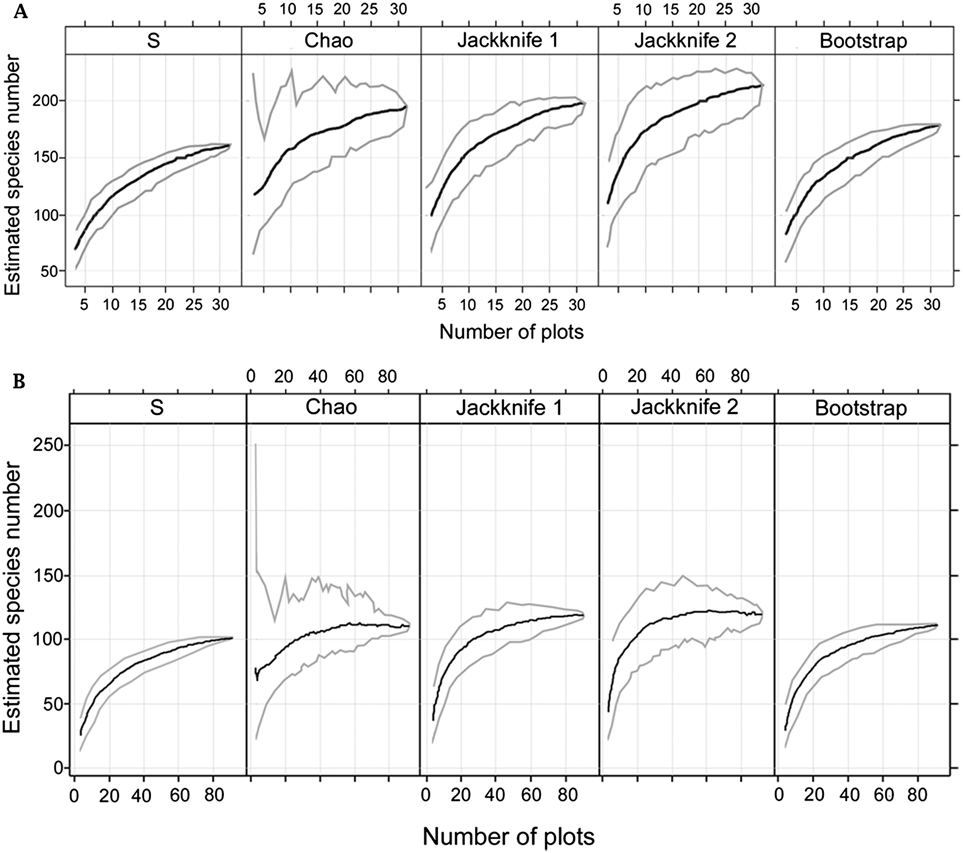
Sampling efficiency was analysed using species accumulation curves. Smoothed accumulation curves of estimated species were calculated according to four non-parametric estimators: (1) Chao 2; (2) First order Jackknife; (3) Second order Jackknife; and (4) Bootstrap (Colwell & Coddington, Reference Colwell and Coddington1994; Chazdon et al., Reference Chazdon, Colwell, Denslow, Guariguata, Dallmeier and Comiskey1998). A total of 100 randomisations were done in all calculations involving multiple rearrangements using the R statistical environment (Development Core Team, 2008).
Species checklist
In addition to plot and survey data, previous recordings of vascular plants from herbarium records and a literature survey (Humboldt et al., 1815–1825; Weberbauer, Reference Weberbauer1945; Ferreyra, Reference Ferreyra1996; Bridgewater et al., Reference Bridgewater2003; Marcelo-Peña, Reference Marcelo-Peña2008; Linares-Palomino et al., Reference Linares-Palomino2010; Marcelo-Peña et al., Reference Marcelo-Peña2010) were used to compile an updated checklist of woody plants for the Marañón valley SDTF. The herbarium records were also used to form a complete picture of species distributions, in order to assess endemism more accurately. All records from selected major herbaria relevant for the study area were reviewed, including MOL, CPUN and USM, as well as the online databases of the Missouri Botanical Garden (www.tropicos.org), the Field Museum (http://fm1.fieldmuseum.org/vrrc/), the New York Botanical Garden (sciweb.nybg.org/science2/vii2.asp), Muséum national d’histoire naturelle (http://science.mnhn.fr/institution/mnhn/collection/p/item/search/form) and the Peruvian seasonally dry forest database (http://rbg-web2.rbge.org.uk/dryforest/database.htm). Data for generic and species-level diversity for Peruvian SDTFs as a whole were taken from the most recent literature by Linares-Palomino & Pennington (2007) with additions from collections made by the authors during recent years in the Marañón, Tarapoto, Mantaro, Apurimac, Chanchamayo and Puerto Ocopa areas (unpublished data). Endemism was assessed based on data from Brako & Zarucchi (Reference Brako and Zarucchi1993), León et al. (Reference León2006), and the online IUCN Red List database (IUCN, 2001). Taxonomic treatment of families follows the phylogenetic approaches of the Angiosperm Phylogeny Group (APG III, Reference APG2009).
Results
Species diversity
The Marañón valley woody flora consists of 440 species, 221 genera and 61 families of vascular plants based on the RBS and plot surveys, herbarium study, and previous literature records. Of the woody species recorded, 241 are shrubs, 177 trees and 22 lianas or scandent shrubs. Most of the species reach >3 m height (n = 350), while 89 species are low-growing shrubs or lianas.
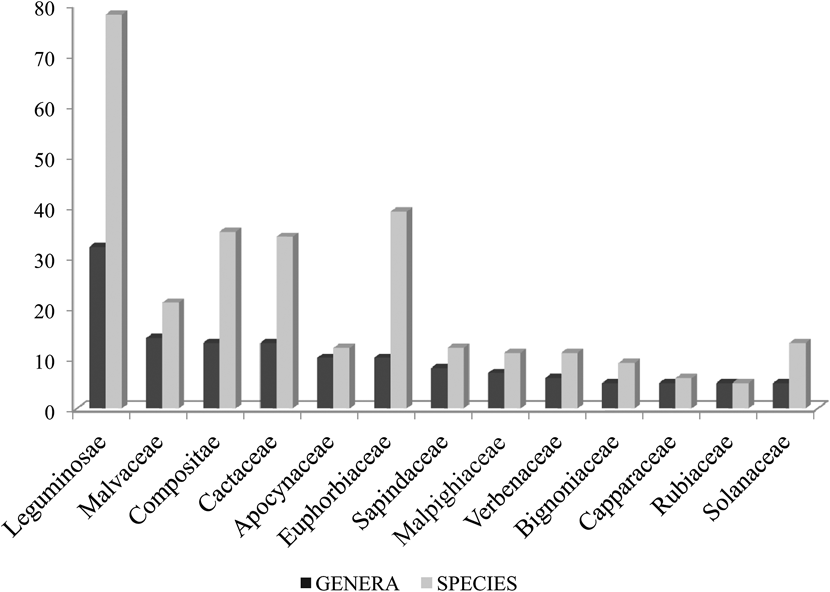
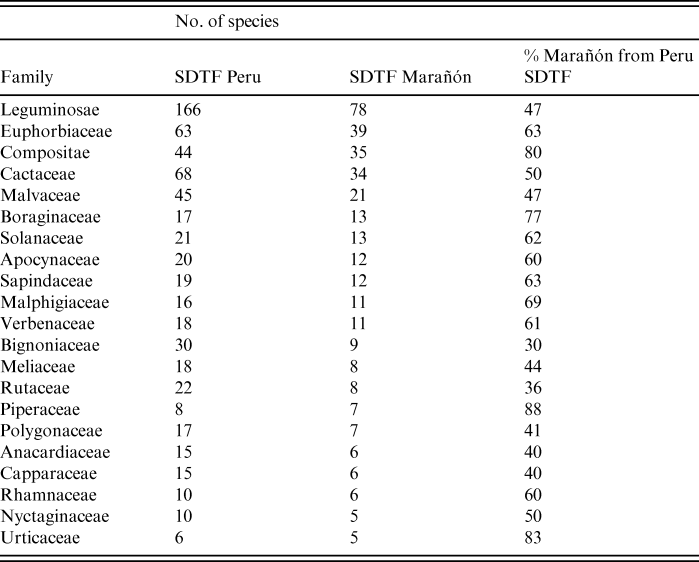
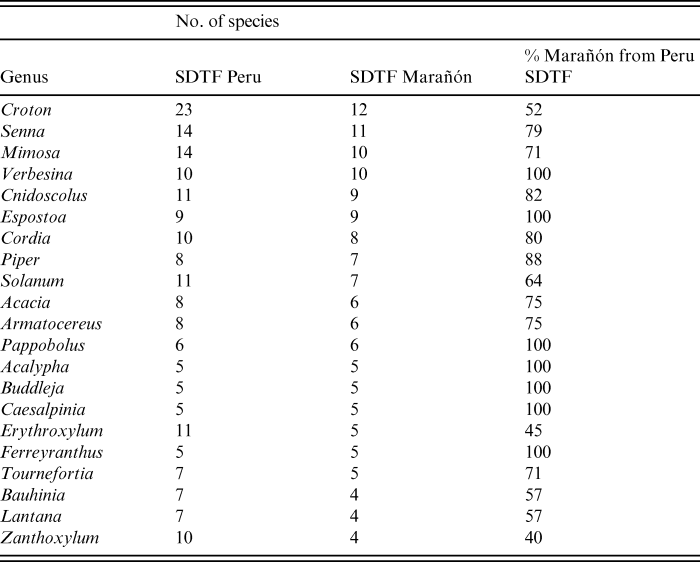
The most diverse families of the Marañón in terms of species are Leguminosae (78 spp.), Euphorbiaceae (39 spp.), Compositae (35 spp.), Cactaceae (34 spp.) and Malvaceae (21 spp.; Fig. 3). At generic level, Leguminosae is the richest family with 32 genera, followed by Malvaceae (14), Cactaceae (13), Compositae (13), Apocynacae and Euphorbiaceae (10) (Fig. 3). The most diverse genera include Croton (12 spp.), Senna (11 spp.), Mimosa and Verbesina (10 spp.), Espostoa and Cnidoscolus (9 spp.) and Cordia (8 spp.; Table 2). In terms of the Peruvian SDTF flora as a whole, Marañón represents an average of 56% (36–88%) of species and 78% (40–100%) of generic diversity (Tables 1 and 2). A total of 131 genera (30%) are represented by a single species in the Marañón.
Most diverse woody vascular plant families of the Marañón SDTFs based on plot and survey data presented here, combined with results from previous studies and herbarium work.
Number of species for the most species-rich families of the Marañón valley in relation to Peruvian SDFT diversity as a whole
Species diversity in the most species-diverse genera of the Marañón valley compared with Peruvian SDFT diversity as a whole
At more local level, species diversity varies greatly across the valley. Individual RBS surveys recovered more species per survey (16–56 spp.), with a mean of 39 species in the most diverse areas and 21 species in the least diverse areas, compared with plots which captured 2–29 species per plot. As expected, the RBS surveys covered more species diversity as a whole (165 species, 116 genera and 40 families) compared with the plot dataset (91 species, 72 genera and 30 families) despite a larger number of established plots.
We also used accumulation curves from non-parametric estimators to assess and compare the sampling efficiency of our survey and plot inventories. The results show that there is a steady increase of species richness without reaching the asymptote, and suggest that the full richness of the woody flora has not been reached with the number of sampling units used (Jackknife 1 and Bootstrap, Fig. 4). Plots recovered fewer shrubby species due to the diameter limit of ≥5 cm DBH, while the RBS surveys gave a better understanding of overall diversity measures including shrubs and lianas. Species not recovered in either plot or RBS survey data included a set of rare species known only from type localities: Cynanchum calycinum (Schltr.) Morillo, Monactis rhombifolia Sagást. & Dillon, Verbesina plowmanii Sagást., Hylocereus microcladus Backeb., Mimosa lamolina C.E.Hughes & G.P.Lewis, Piptadenia weberbaueri Harms, Eriotheca peruviana A.Robyns, Gossypium raymondii Ulbr., Eugenia curvipilosa McVaugh, Johnstonia axilliflora (M.C.Johnst.) Tortosa, Pradosia argentea (Kunth) T.D.Penn. and Cestrum weberbaueri Francey.
Smoothed accumulation curves of species richness according to non-parametric estimators Chao 2, Jackknife 1, Jackknife 2 and Bootstrap. A. Rapid Botanical Surveys (RBS). B. Plot surveys. Each panel shows the mean (grey) with a confidence interval (black) after 100 resamplings with replacement, following increasing sampling efforts (minimum and maximum census units). Number of maximum census units was 32 in the RBS and 92 in the plot survey dataset.
Species composition and abundance
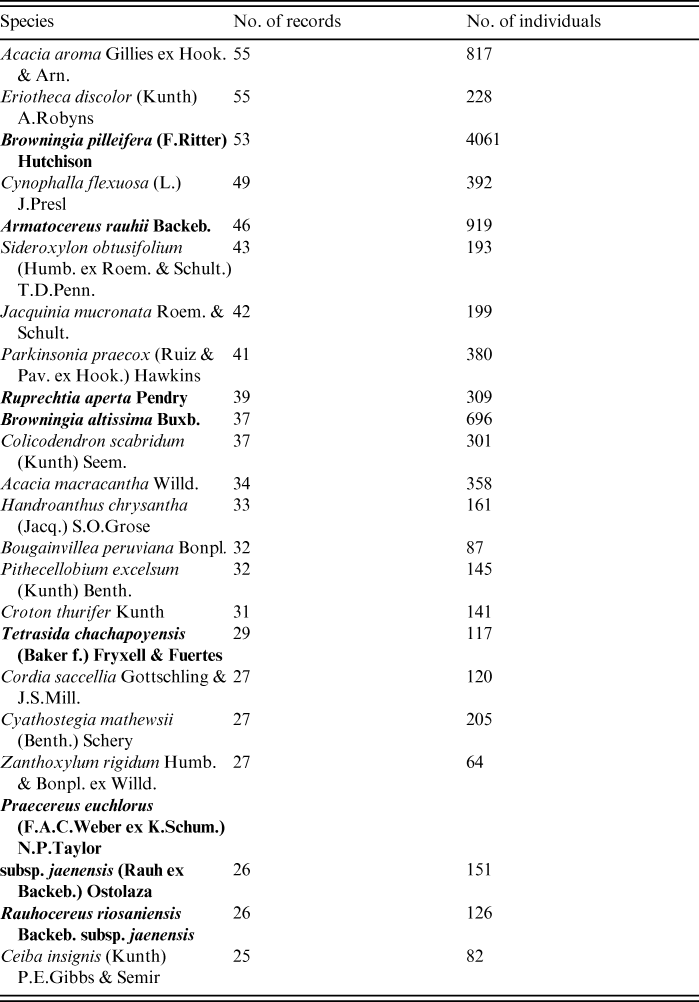
The plot data show that the most frequent families across the Marañón are Cactaceae (52%), Leguminosae (17%), Euphorbiaceae (5%), Capparaceae (4%), Malvaceae (3%), Apocynaceae (3%) and Boraginaceae (2%) based on the 15,400 measured individuals across the 124 inventory sites (Table 3). The high abundance of Cactaceae is mainly due to a small group of three species (Browningia altissima (F.Ritter) Buxb., Espostoa mirabilis F.Ritter and Armatocereus rauhii Backeb.) dominating the vegetation; together, these three species make up nearly half the total individuals (42%; Table 3). A total of 18% (64 spp.) are represented by two or fewer individuals in the survey data.
Most frequent and abundant species of the Marañón valley based on plot and survey data. Endemic dominant species are highlighted in bold
The combined RBS and plot data show that Acacia aroma Gillies ex Hook. & Arn. and Eriotheca discolor (Kunth) A.Robyns are the most frequent species in the valley, followed by Browningia pilleifera (F.Ritter) Hutchison, Cynophalla flexuosa (L.) J.Presl, Armatocereus rauhii, Sideroxylon obtusifolium (Humb. ex Roem. & Schult.) T.D.Penn., Jacquinia mucronata Roem. & Schult., Parkinsonia praecox (Ruiz & Pav.) Hawkins, Ruprechtia aperta Pendry and Browningia altissima (Table 3). There is large variation, however, in the set of the most frequent species across the valley from north to south. The most abundant species in the northernmost Marañón (S1) include Cordia iguaguana Melch. ex I.M.Johnst., Cynophalla flexuosa and Croton thurifer Kunth, whilst Acacia aroma and Browningia altissima dominate further south in S2. Six species dominate across both S1 and S2 but do not occur in the southernmost sectors (Tetrasida chachapoyensis (Baker f.) Fryxell & Fuertes, Ruprechtia aperta, Aspidosperma polyneuron Müll.Arg., Eugenia sp., Neea sp. nov. and Jacquinia mucronata). The most abundant species in S3 include three species of Cactaceae (Browningia altissima, Espostoa lanata (Kunth) Britton & Rose and Praecereus euchlorus subsp. jaenensis (Rauh ex Backeb.) Ostolaza), while a different set of Cactaceae species dominates in S4 (Browningia pilleifera, Armatocereus rauhii and Espostoa mirabilis). Six further species dominate in both S3 and S4 but not in the northernmost sectors (Acacia aroma, Colicodendrum scabridon (Kunth) Seem., Parkinsonia praecox, Vallesia glabra (Cav.) Link, Cnidoscolus diacanthus (Pax & K.Hoffm.) J.F.Macbr. and Leucaena trichodes (Jacq.) Benth.).
Vegetation density varies greatly across the Marañón as exemplified by the number of individuals recorded per plot (17–619). The densest vegetation is found in San Vicente in S4 with 619 individuals per plot, where Browningia pilleifera dominates with 574 individuals. The lowest stem density is found in Chagual, Balsas and La Pizarra, also in S4 in southern Marañón, where the climate is drier with sparser vegetation. Here, the endemic Parkinsonia peruviana C.E.Hughes, Daza & Hawkins, restricted to the southern parts of the valley, dominates, with 13 individuals (43% of total stems).
Endemism
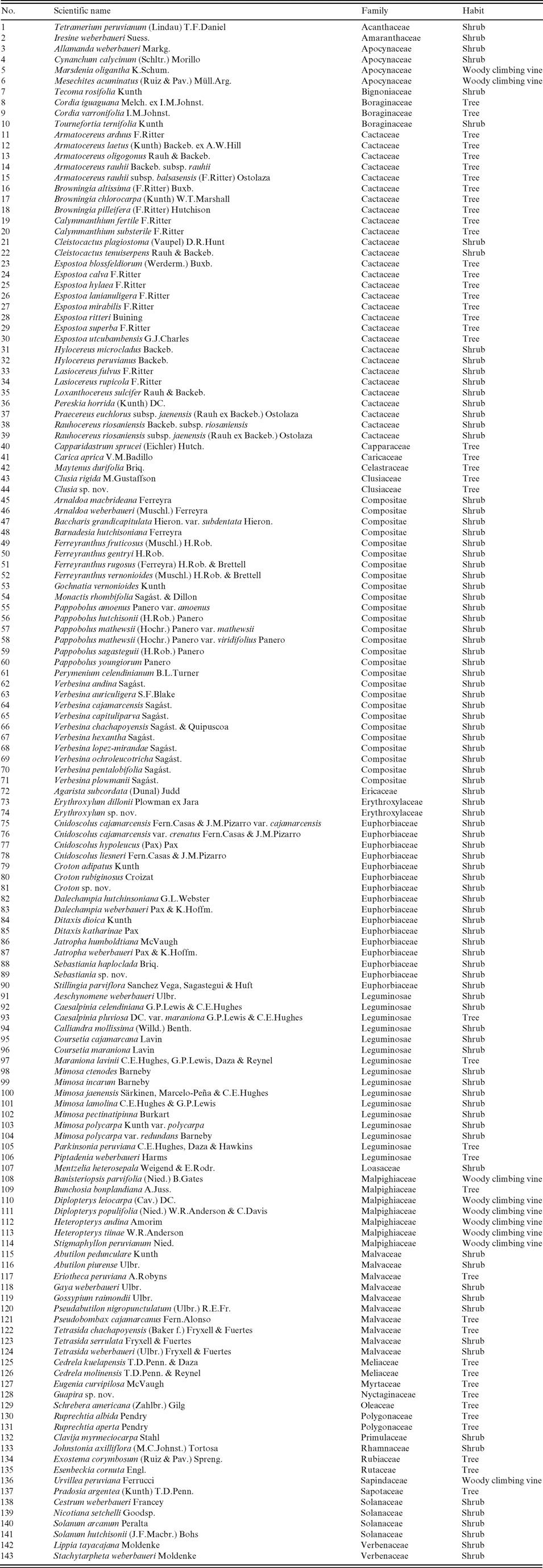
Of the 440 woody species recorded in the valley, 143 are endemic to the Marañón, representing 33% endemism in the woody vascular plant flora (Table 4). The families with the highest level of endemism are Compositae and Cactaceae (27 spp.), followed by Leguminosae and Euphorbiaceae (16 spp.), and Malvaceae (10 spp.). The six most endemic-rich genera are Verbesina (10 spp.), Espostoa (8 spp.), Mimosa (7 spp.), Pappobolus (6 spp.), and Armatocereus, Cnidoscolus and Ferreyranthus (4 spp.). Eight species new to science endemic to the Marañón were found during the study; these include four species of Croton (Ricarda Riina, pers. comm.) and two species of Clusia (Mats Gustafsson, pers. comm.). Four endemic genera are found in the Marañón: Calymmanthium and Lasiocereus (Cactaceae, each with two species), Johnstonia (Rhamnaceae, 1 sp.) and Maraniona (Leguminosae, 1 sp.).
List of woody endemic species recorded from the Marañón valley SDTFs, northern Peru
The survey and plot data show that many of the endemic species are locally abundant (Table 3). Examples of endemic species with high local abundance include Browningia pilleifera, B. altissima, Armatocereus rauhii, Ruprechtia aperta, Tetrasida chachapoyensis, Praecereus euchlorus subsp. jaenensis and Rauhocereus riosaniensis var. jaenensis (Rauh ex Backeb.) Ostolaza (Table 3). Endemic species that show the opposite pattern of low local abundance include Tetramerium peruvianum (Lindau) T.F.Daniel, Gochnatia vernonioides Kunth, Cnidoscolus hypoleucus (Pax) Pax, Mimosa jaenensis Särkinen, Marcelo-Peña & C.E.Hughes, and Solanum hutchisonii (J.F.Macbr.) Bohs: these species are always found in low numbers of individuals at each site. Endemic species that are only known from a single population include Caesalpinia celendiniana G.P.Lewis & C.E.Hughes, Heteropterys tiinae W.R.Anderson, Mimosa ctenodes Barneby and Schrebera americana (Zahlbr.) Gilg.
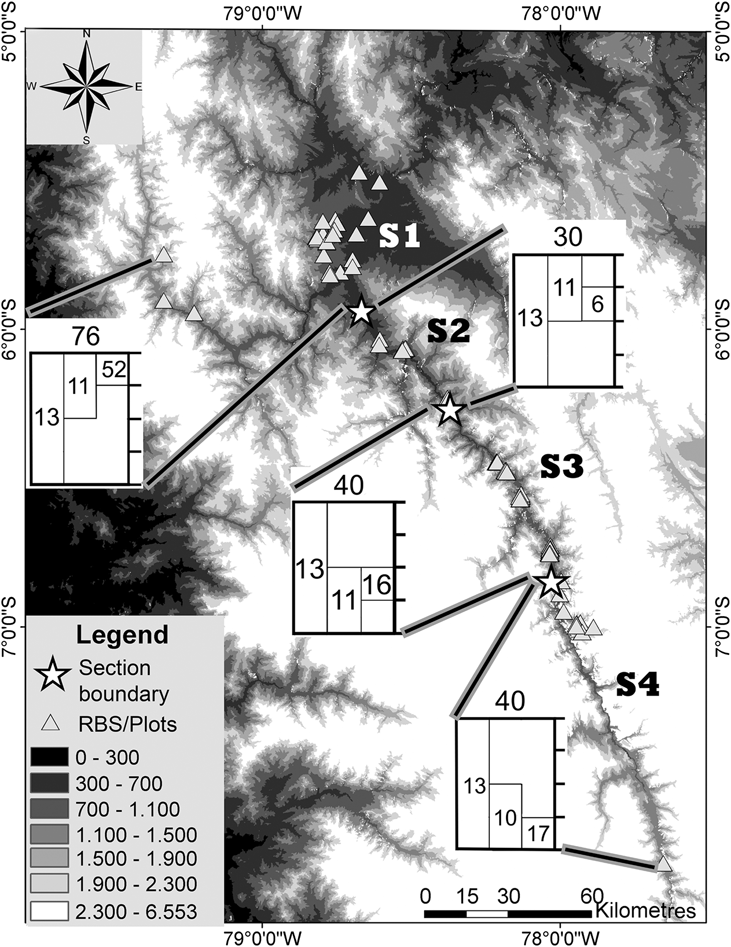
Analysis of the geographical distribution pattern of the endemic species indicates that the northernmost area of the river valley (S1) contains the highest number of endemic species (Fig. 5). Fifty-two endemic species are restricted to S1, whilst a further 24 endemics found in S1 occur across a wider area within the Marañón (Fig. 5). A set of 13 endemic species occurs across the entire valley from S1 to S4 (Fig. 5). Six species are restricted to S2, 16 to S3, and 17 to S4 (Fig. 5).
Geographical distribution of endemic species across the Marañón. The subgraphs show the number of endemic species found in each geographical section separated by grey lines (S1–S4). The total number of endemic species found within each section is shown at the top of the subgraph, while the number of endemics restricted to or shared between sections is shown below. For example, 76 endemic species are found in Section 1 (S1), of which 52 are restricted to S1, 11 species overlap with S2, and 13 are ecologically and geographically widespread endemic species found across all sections. RBS = Rapid Botanical Survey.
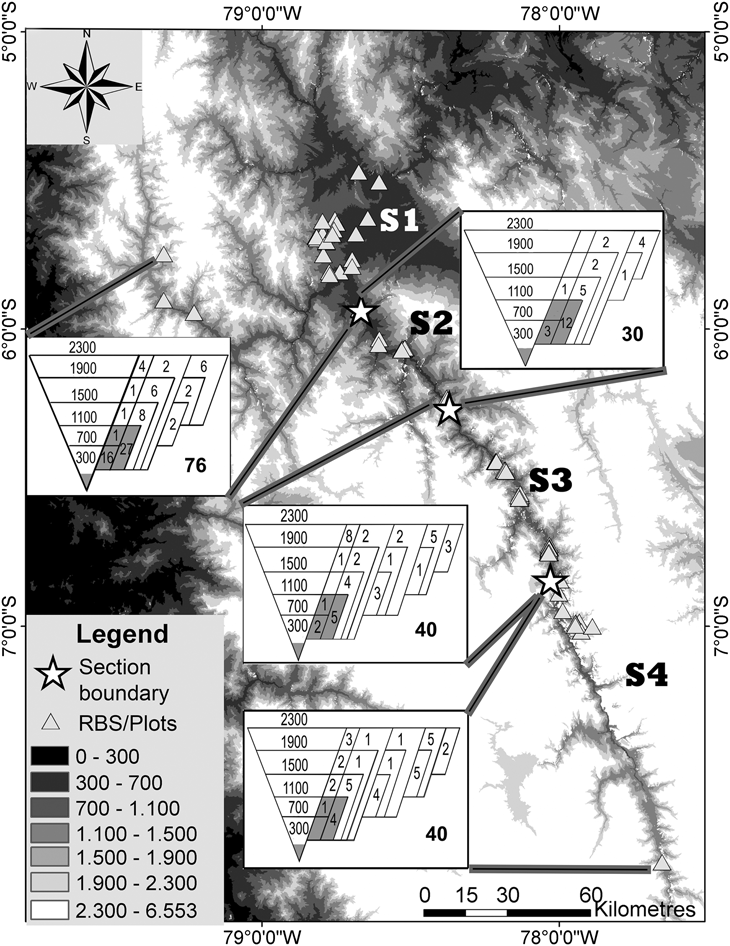
The analysis of the elevational distribution of endemic species shows that, within S1, most of the endemic species are confined to the lowest elevational zones below 1100 m (27 spp.; Fig. 6). Sixteen of these species are restricted to the lowest elevations, 300–700 m (Fig. 6). The elevational pattern of endemic diversity appears opposite in the southernmost parts of the valley in S3 and S4, where most endemic species are found in the highest elevational zone, 1900–2300 m (Fig. 6).
Elevational distribution of endemic species in the Marañón within the four study sectors (S1–S4). The total number of endemic species is shown to the right of the subgraph. The right diagonal indicates the number of species strictly restricted to the elevational zone, with further right-hand side columns showing the overlap between different elevational zones. Only the data from the eastern slopes of the river survey were analysed for each geographical section within each altitudinal level. RBS = Rapid Botanical Survey.
Our sampling in the southernmost areas of the valley in Pataz was poor, and further sampling of the southernmost limits of the Marañón SDTFs and their species composition will be needed to confirm the patterns observed here. The plot data from Chagual show floristic similarity with Balsas, with a similar set of dominant species including Acacia macracantha Willd., A. aroma, Parkinsonia praecox, Armatocereus rauhii, Browningia pilleifera, Espostoa blossfeldiorum (Werderm.) Buxb., E. mirabilis, Cnidoscolus basiacanthus (Pax & K.Hoffm.) J.F.Macbr. and Jatropha weberbaueri Pax & K.Hoffm. Further studies are needed, however, to confirm these patterns and discover whether a possible third centre of endemism might exist in the southernmost areas of the valley.
Discussion
Quantitative vegetation surveys of Neotropical SDTFs have been historically sparse but over the past decades studies have been gradually moving towards large-scale analyses of diversity patterns across SDTF nuclei (e.g. Gentry, Reference Gentry, Bullock, Mooney and Medina1995; Ratter et al., Reference Ratter2003; Giulietti et al., Reference Giulietti, Silva, Tabarelli, Fonseca and Lins2004; Aguirre et al., Reference Aguirre, Linares-Palomino and Kvist2006; Oliveira-Filho et al., Reference Oliveira-Filho, Pennington, Lewis and Ratter2006; Marcelo-Peña, Reference Marcelo-Peña2008; Oliveira-Filho, Reference Oliveira-Filho2010). Complete floristic checklists are still lacking in most areas but significant milestones have been reached in recent publications relating to particular areas, such as the checklist of vascular plants of the caatinga nucleus (Moro et al., Reference Moro2014).
Our study represents the first extensive study of the largest known inter-Andean SDTF fragments in the Marañón valley of northern Peru. Floristic composition, species richness and endemism of these forests reveal species diversity patterns that should be considered in conservation planning and management at both national and international level.
Species diversity and floristic composition
The updated checklist of the Marañón presented here includes 440 species of woody vascular plants, of which 143 (33%) are endemic. At the local level, the Marañón forests appear species-poor, with 3–29 species ≥5 cm DBH recorded within a 0.1 ha study area, compared with other Peruvian and Neotropical SDTFs where an average of 25–30 and 50–70 species can be found, respectively (Gentry, Reference Gentry1982, Reference Gentry1988, Reference Gentry, Bullock, Mooney and Medina1995; Bridgewater et al., Reference Bridgewater2003; Marcelo-Pena et al., Reference Marcelo-Peña2007). We emphasise, however, that plot-level species richness should be considered at a wider spatial scale, where species diversity is measured among plots rather than within plots. This is because studies focusing on beta-diversity have clearly shown that there is a large amount of species turnover across Andean SDTF nuclei over short geographical distances, implying high species diversity at regional rather than local scale. The high regional diversity only becomes apparent once species turnover between plots is analysed.
Floristically, the Marañón flora appears very similar to other Peruvian SDTFs and Neotropical SDTFs as a whole. For instance, the most species-rich plant families in the Marañón include Leguminosae, Euphorbiaceae, Cactaceae, Malvaceae and Compositae, as in Peruvian SDTFs generally (Reference Linares-Palomino and PenningtonLinares-Palomino & Pennington, 2007). The Marañón SDTF is most closely related to Ecuadorian SDTFs based on floristic similarity, sharing 114 trees and 34 endemic species (Aguirre & Kvist, Reference Aguirre and Kvist2005; Linares-Palomino et al., Reference Linares-Palomino2010; Marcelo-Peña et al., Reference Marcelo-Peña2010). As in all Neotropical SDTFs, Leguminosae is found to be the dominant family of the woody flora in terms of both species (77 species, 18%) and genera (30 genera, 14%) (Murphy & Lugo, Reference Murphy and Lugo1986; Gentry, Reference Gentry, Bullock, Mooney and Medina1995; Trejo & Dirzo, Reference Trejo and Dirzo2002; Linares-Palomino et al., Reference Linares-Palomino2010). Euphorbiaceae is the second most species-rich family, as in Mexican, Honduran and Antillean SDTFs (Trejo & Dirzo, Reference Trejo and Dirzo2002; Gordon et al., Reference Gordon2004) and the Brazilian caatingas (Queiroz, Reference Queiroz, Pennington, Lewis and Ratter2006).
Our results support the prediction that the Marañón valley is a good representative of Peruvian SDTF diversity as a whole, and should be considered as a primary conservation target at national level in Peru. A total of 56% of the families and 78% of the genera present in Peruvian SDTFs are found in the Marañón valley. In terms of species, the Marañón represents the Peruvian SDTF flora equally well, with 47% of Leguminosae, 63% of Euphorbiaceae, 80% of Compositae, and 68% of Cactaceae species found in the valley. Furthermore, the Marañón SDTFs host all known SDTF species of Verbesina, Espostoa, Acalypha, Buddleja, Caesalpinia, Ferreyranthus and Pappobolus. Together, these results confirm that the Marañón flora is a good representative of the Peruvian SDTF flora as a whole, and should be considered as a conservation priority at the national level to establish the first conservation areas within SDTF in the country.
Patterns of endemism
Our results support previous findings that the woody flora of the Marañón is extremely rich in endemic species (33%) and genera (2%). These values are comparable to other biodiversity hotspots such as the native vascular flora of Galápagos, which comprises 560 species (including herbs) and 50 infraspecific taxa, of which 180 species (32% of the total) and all infraspecific taxa are endemic (Porte, Reference Porte, Bowman, Berson and Leviton1983; Lawesson et al., Reference Lawesson1987; Tye, Reference Tye, Valencia, Pitman, Leon-Yanez and Jorgensen2000). The highest levels of endemism in Neotropical SDTFs have been found in the highly fragmented Mexican SDTFs with up to 60% endemism (Rzedowski, Reference Rzedowski1991), followed by the larger, more continuous Brazilian caatinga with 34% endemic species (Giulietti et al., Reference Giulietti, Silva, Tabarelli, Fonseca and Lins2004). Our data therefore rank the Marañón close to both Mexican and Brazilian SDTFs. Although our study did not include herbaceous species, several endemic herbaceous species are known, including the monotypic Rauhia (Amaryllidaceae, 4 endemic spp.), Matucana (Amaryllidaceae, 8 endemic spp.), 18 endemic species of Bromeliaceae (León et al., Reference León2006) and 20 endemic species of Peperomia (Pino et al., Reference Pino2003, Reference Pino2004, Reference Pino2005, Reference Pino2012; Pino, Reference Pino2008). This highlights the importance of continuing floristic studies within the Marañón, where many more endemic species are likely to be found (Lewis et al., Reference Lewis2010; Särkinen et al., Reference Särkinen2011b). Species accumulation curves from our study further confirm that more sampling is needed to record species diversity within the Marañón fully.
Our data indicate that Marañón SDTF is divided into two floristic subunits, the southern and northern forests, where much species turnover is focused in the narrow region between Ocalli (Amazonas) and Choropampa (Cajamarca) between 6°15′S and 6°18′S. For instance, 10 species restricted to the lowest elevational zones (e.g. Browningia altissima, Armatocereus rauhii subsp. rauhii, Croton adipatus Kunth, Tetrasida chachapoyensis and Jatropha humboldtiana McVaugh) show their distributional limits at Ocalli. Likewise, 17 species recorded between Chagual, Balsas and Ocalli (e.g. Browningia pilleifera, Armatocereus rauhii subsp. balsasensis (F.Ritter) Ostolaza, Clusia rigida M.Gustaffson and Jatropha weberbaueri) present their northern limits at Ocalli. The distributional patterns of plants observed in this study are similar to those observed for endemic birds and reptiles: three bird and four reptile species show their northern limits in Ocalli (birds – Incaspiza ortizi Zimmer, Incaspiza laeta Salvin and Forpus xanthops Salvin; reptiles – Ameiva nodam Koch, Venegas, Rödder, Flecks & Böhme, Amphisbaena pericensis Noble, Phyllodactylus interandinus Dixon & Huey and Phyllodactylus johnwrighti Dixon & Huey), whilst two birds and two reptiles have their southern limits in the same area (birds – Incaspiza watkinsi Chapman and Melanopareia maranonica Chapman: Statterfield et al., Reference Stattersfield1998; Angulo et al., 2007; reptiles – Phyllodactylus delsolari Venegas, Townsend, Koch & Böhme and Phyllodactylus thompsoni Venegas, Townsend, Koch & Böhme: Venegas et al., Reference Venegas2008; Koch & Beraun, Reference Koch and Beraún2011; Koch et al., Reference Koch2013).
Within the northern and southern centres of endemism, elevational zonation of endemism is apparent. Our data show that, within the northern centre, most endemics are restricted to the lowest elevations (300–1100 m), whilst in the southern parts of the valley, most endemics are found at higher elevations (1500–2300 m). Many endemics are found to be restricted to relatively narrow elevational zones (500–800 m), indicating high beta-diversity even within the Marañón itself.
Although a large fraction of endemic species is locally restricted to specific geographical areas and elevational zones, a set of ecologically and geographically widespread endemic species can also be identified. For example, Tecoma rosifolia Kunth has the widest distribution pattern amongst the endemic species, occurring throughout the valley across the entire elevational range (600–2000 m). Five other endemic species, namely Diplopterys leiocarpa (A.Juss.) W.R.Anderson & C.Davis, Caesalpinia pluviosa DC. var. maraniona G.P.Lewis & C.E.Hughes, Mimosa incarum Barneby, Espostoa blossfeldiorum and Espostoa mirabilis, are also relatively widely distributed along the valley at 1000–1500 m elevation. These species appear ecologically labile with high tolerance to different environmental conditions and should hence be considered as potential key species for SDTF restoration and conservation programmes.
Abundance of endemic species
Our plot data revealed interesting variation in the local abundance of endemic species. Results show that many of the dominating species found across the valley are in fact local endemics restricted to the Marañón. Such globally rare, but locally extremely abundant, species include Browningia pilleifera and Armatocereus rauhii. In terms of stem density, endemic species account for more than 50% of the standing diversity across the plots. These findings contrast with what has been found in neighbouring areas of SDTF, where most abundant species are widely distributed and do not include local endemics (Gentry, Reference Gentry1992; Prado & Gibbs, Reference Prado and Gibbs1993; Fajardo et al., Reference Fajardo2005). For example, the most abundant species of the SDTFs of coastal Peru are widespread species such as Libidibia glabrata Kunth, Handroanthus bilbergii (Bureau & K.Schum.) S.O.Grose and Terminalia valverdeae A.H.Gentry. Similarly, the dominant species in the SDTFs of northeastern Peru include the relatively widespread Alseis peruviana Standl., Eriotheca ruizii (K.Schum.) A.Robyns, Geoffroea spinosa Jacq. and Manilkara bidentata (A.DC.) A.Chev. (Linares-Palomino, Reference Linares-Palomino2002; Bridgewater et al., Reference Bridgewater2003).
The plot and survey data also show that a set of endemics has extremely low abundances, with 18% of the species found present only in a single plot, and a further 16% present in only two plots. This indicates that many species occur in low abundances in the Marañón. The distribution of these rare species may, however, also reflect modified distributions due to human activities, limitations by environmental factors, or simply sampling artefacts (Leal-Pinedo & Linares-Palomino, Reference Leal-Pinedo and Linares-Palomino2005). Although >15,400 surveyed individuals offer a solid dataset, more inventories are needed in sparsely explored areas of the valley to gather robust information on density, frequency and distribution of plants across the Marañón.
The distribution and abundance of endemic species in the Marañón fit recent predictions of species abundance patterns in highly isolated island-like communities (Rosindell & Phillimore, Reference Rosindell and Phillimore2011; Rosindell & Harmon, Reference Rosindell and Harmon2013). These models predict that endemic species occurring on islands or island-like systems become relatively abundant over time given strong geographical isolation and dispersal limitation (Rosindell & Phillimore, Reference Rosindell and Phillimore2011). Although not a true island, the Marañón has been identified as an island-like valley system based on evolutionary studies of endemic lineages, which show that the flora has evolved under strong isolation as on many oceanic islands over the past 10 million years (Pennington et al., Reference Pennington2010; Särkinen et al., Reference Särkinen2012). Empirical studies from the similarly fragmented and island-like Mexican SDTFs support our findings by showing that many locally abundant species have narrow geographical ranges (Williams et al., Reference Williams2010). This pattern of locally abundant but globally rare species is reflected in the fact that widespread and dominant species in Neotropical SDTFs are generally lacking due to the high beta-diversity across forest nuclei identified by previous studies (Pennington et al., Reference Pennington, Pennington, Lewis and Ratter2006; Linares-Palomino et al., Reference Linares-Palomino, Dirzo, Mooney, Ceballos and Young2011). Although a set of common species for the complete biome has been identified for the entire Neotropics, no hyperdominant set of species exists for the SDTF similar to lowland rainforest communities identified as oligarchies or hyperdominants (Pitman et al., Reference Pitman2013; ter Steege et al., Reference Ter Steege2013). These patterns indicate that the Neotropical SDTFs have had an extremely different evolutionary history and suffer distinct current-day dynamics compared with other biomes. Further studies are needed to fully explore abundance differences in relation to range size across biomes, including their significance under future climate change scenarios.
Threats and the importance of SDTF conservation
Despite the accumulating data showing that the Marañón valley hosts a wealth of unique plant and animal species, there are no protected areas within the valley (Servicio Nacional de Áreas Protegidas, 2014, 2015). Accelerated landscape fragmentation due to agriculture, livestock, road construction, population growth and land invasions, as well as increasing demand for fuel, pose a serious threat to Marañón forests. Although no quantitative study of these threats has been published, the effect of anthropogenic disturbance on forest degradation and loss is evident in the field. A further threat is posed by the recent and ongoing plans to establish 15 dams in the area, flooding several kilometres of riverine SDTF along the Rio Marañón (Finer & Jenkins, Reference Finer and Jenkins2012). The plans are now approved by the Ministry of Environment, and the new dams will flood 32.5 km2 up to 850 m elevation around several sites at El Inca, El Mango, El Paraíso, Santa Rosa, Montegrande, Salazar, Nuevo Rioja, El Cura, Saquilillo, Tupén, San Lucas Chico, San Lucas Grande, Nueva Arica, Choropampa, La Mushca, Mapish, San Francisco, Libián, Tuén and Mendán (Chadin II dam site; AMEC, 2011; Finer & Jenkins, Reference Finer and Jenkins2012).
Our analyses of endemism and species distribution patterns across the valley in terms of both geography and elevation can now be used to plan conservation areas in the lower elevation areas between 300 and 1100 m in the northern parts of the Marañón near Jaén and Utcubamba (Cumba and Pongo de Rentema), and in the higher elevation areas in the southern parts of the valley close to Balsas between 1500 and 2300 m elevation. As reflected in our data, protected areas are needed in both the northern and southern parts of the valley in order to preserve different types of SDTF community. The greatest priority should be given to the northern sections of the valley (S1–S2) between 300 and 1100 m, where the largest number of endemic species was recorded. These lower elevation zones are the most densely populated and farmed (e.g. towns of Jaén, Bagua and Balsas), however, and careful planning will be needed to find locations for conservation areas. Areas with the greatest potential for conservation are steeply sloping and difficult to access, where the potential for farming is low. If conservation areas are established, fencing should be erected in order to keep grazing pressure to a minimum.
Our results reveal that the Marañón valley is an excellent representative of the woody flora of Peruvian SDTFs, and merits increased conservation efforts at both the national and global level. The importance of the Marañón valley lies not only in its endemic species but also in the fact that it is an arid region surrounded by tropical mesic biomes. Thus, the Marañón can be seen as an important natural laboratory for the study of how plants, invertebrates and vertebrates have adapted – and will adapt – to highly variable and stressful moisture regimes both in the past and as climate changes in the future (Giulietti et al., Reference Giulietti, Silva, Tabarelli, Fonseca and Lins2004). The local endemic flora survived the upheaval of past climate changes during the Pleistocene several million years ago (Pennington et al., Reference Pennington2010), and should hence be considered as a resource and opportunity in the face of the anthropogenic climate change predicted in the coming decades and centuries.
Conclusions
This study shows that the Marañón valley SDTFs from northern Peru are rich in terms of their woody flora, with high levels of endemism (33%) compared with their Neotropical counterparts. Our results reveal that the SDTFs of the Marañón valley are excellent representatives of the woody flora of the Peruvian SDTFs as a whole, including c.78% of generic diversity in only 3750 km2. The Marañón valley requires greater attention in conservation agendas at both national and international level. Data presented here indicate that the valley consists of southern and northern centres of endemism, with wide variation in plant community composition across the valley. Within these centres, endemism and species diversity vary greatly across elevational zones. Interestingly, unlike in neighbouring SDTF areas, the Marañón flora is found to be dominated by endemic species at local level. The pattern of globally rare but locally abundant species appears a unique feature of the isolated island-like Marañón SDTFs, and requires further investigation. We strongly urge that governments at the national, regional and local levels, as well as NGOs, research institutes and universities, prioritise studies on the threats to the SDTF biome and its endemic species in the Marañón valley, and promote the creation of regional, municipal and private conservation areas. The valley is relatively small but substantial in terms of its biological heritage.
Acknowledgements
The authors would like to thank all students of the Universidad Nacional de Cajamarca and the Universidad Nacional Agraria La Molina who helped in the fieldwork, John Ortiz for providing logistic support in San Vicente, and Duber Elera, José Rubio, Vitoly Becerra, Luciano Troyes and Esequiel Huancas for their selfless support during fieldwork in Jaén. We thank Ximena Tagle for their support in preparing maps, Mariella Leo from Asociación Peruana para la conservación de la Naturaleza (APECO) and the regional governments of Cajamarca and Amazonas for their support during fieldwork, and the Dirección General de Flora y Fauna Silvestre, Lima for permission to collect plant material. Finally, we would like to thank Toby Pennington and Kyle Dexter for their advice and support in the study of the woody flora of Peruvian seasonally dry forests in a wider Neotropical context.