1 Introduction
The aim of this article is to shed some light on the status and development of so-called category-determining prefixes in English. The term category-determining prefixes refers to derivational prefixes that allegedly determine the category of the complex words that they form. Consider the following complex words that are cited in the literature as instances of category-determining prefixation (Lieber Reference Lieber1980, Reference Lieber1992: 57–8, Reference Lieber2005: 402–3; Namiki Reference Namiki1982: 27–8; Quirk et al. Reference Quirk, Greenbaum, Leech and Svartvik1985: 1546; Adams Reference Adams2001: 22–4, 42–3; Bauer & Huddleston Reference Bauer, Huddleston, Huddleston and Pullum2002: 1667–8, 1679, 1713–15; Plag Reference Plag2003: 183).
(1)


These prefixes, which are all verb-forming, constitute a small but perplexing problem for morphologists in that they appear to violate the Righthand Head Rule (RHR) (Williams Reference Williams1981: 248). A head in morphology is an element that determines the category of a complex word as a whole (Williams Reference Williams1981: 247; Zwicky Reference Zwicky1985: 15–20; Bauer Reference Bauer1990: 30). The RHR captures the generalization that such an element occurs in the rightmost position of a complex word. As predicted from this, English derivational suffixes and prefixes are asymmetric in that suffixation typically derives words of a single category, whereas prefixation typically derives words of multiple (more than one) categories. In fact, according to Plag (Reference Plag2004: section 3), only one out of 41 suffixes he investigated derives words of multiple categories,Footnote 2 and all the prefixes that derive words of a single category apart from those in (1) (4 out of 34 prefixes) maintain the category of their base (e.g. in-A > A). Namiki's (Reference Namiki1982: section 3) and Lieber's (Reference Lieber2005: section 3) results from similar investigations also verify this suffix–prefix asymmetry in the output category; Namiki, for example, argues that there is no suffix that derives words of multiple categories in the 100 English suffixes he investigated, whereas all the English prefixes except those in (1) maintain the category of their base.
Given these facts, the prefixation in (1) seems to be the only systematic exception to the RHR in English derivation and to have a marked status, deriving verbs from nouns and adjectives. Indeed, it is so treated in the literature (see, for example, Lieber Reference Lieber1980, Reference Lieber1992, 2004, Reference Štekauer and Lieber2005; Williams Reference Williams1981; Namiki Reference Namiki1982; Bauer Reference Bauer1983; Adams Reference Adams2001; Plag Reference Plag1999, Reference Plag2003, 2004); the prevalent view is that the prefixes in (1) are exceptions to the RHR, and each of them is ‘lexically marked as a head, allowing its category V to determine the category of the word as a whole’ (Carstairs-McCarthy Reference Carstairs-McCarthy1992: 104). We will call this view the left-headed analysis of the prefixation in (1).
A notable exception to this prevalent analysis is found in Marchand (Reference Marchand1969: 137–7) and Kastovsky (Reference Kastovsky1986, Reference Kastovsky and Britton1996, Reference Kastovsky, Hogg and Denison2006: 215). They argue for a right-headed analysis of the prefixation in (1), claiming that the prefixed verbs in (1) are based not on a noun or an adjective, but on a denominal or deadjectival converted verb, as shown below.Footnote 3, Footnote 4
(2)
This analysis is a consequence of Marchand's and Kastovsky's views that ‘[morphological syntagmas in] the Germanic languages consistently have the sequence determinant/determinatum, i.e. all morphological composites are right-hand-headed, and therefore prefixes are modifiers and do not act as heads’ (Kastovsky Reference Kastovsky and Britton1996: 94). Given the general validity of the RHR in English as we have seen above, the analysis in (2) is preferable to that in (1), but to the best of my knowledge, there seems to be no study that investigates its empirical adequacy in a systematic way.Footnote 5 Kastovsky's studies make several structural and semantic arguments, but this article will show that his and Marchand's analyses can be justified with more substantive synchronic and diachronic evidence.
Specifically, we will prove the right-headed analysis in (2) with mainly three types of evidence: (i) historical developments of the prefixes at issue; (ii) their input morphological properties; and (iii) their output semantic properties. Historically, we will argue that the development of so-called category-determining prefixation is based on the development of non-category-determining (V-to-V) prefixation and N/A-to-V conversion. Synchronically, we will show that input and output properties of so-called category-determining prefixation can be reduced to those of V-to-V prefixation and N/A-to-V conversion. After we elucidate problems of the left-headed analysis in the next section, we will probe into these three types of evidence in sections 3, 4, and 5, respectively. Section 6 will conclude that the right-headed analysis is valid both synchronically and diachronically: so-called category-determining prefixation develops as an extension of unmarked non-category-determining prefixation and thus is nothing but a descriptive artifact. The data source for this article is The Oxford English Dictionary, Second Edition on CD-ROM Version 3.1 (2004) (OED), unless otherwise specified.
2 Left-headed analysis and its problems
As we mentioned in the previous section, most, if not all, of the preceding studies treat denominal and deadjectival prefixed verbs as left-headed. This section will show that such an analysis causes much greater problems than mere violation of the RHR.
2.1 RHR as a typological property of Germanic languages
First, the left-headed analysis goes against the typological structure of Germanic morphology (Kastovsky Reference Kastovsky1986, Reference Kastovsky2005: 103 n. 4). The RHR might not be a universal rule (Lieber Reference Lieber1980, Reference Lieber2005: 402), but it seems to be valid as far as Germanic languages are concerned. Marchand (Reference Marchand1969) and Kastovsky (Reference Kastovsky1986, Reference Kastovsky and Britton1996, Reference Kastovsky, Hogg and Denison2006) capture this by claiming that the order of head and modifier in morphological composites is a matter of language type, and in the Germanic languages the modifier precedes the head. If right-headedness is a typological property of Germanic morphology, the right-headed analysis should be the default option, and as Kastovsky (Reference Kastovsky1986: 98) says, without really conclusive evidence we should be cautious about assuming the opposite order.
We have already seen in section 1 that so-called category-determining prefixes are the only possible exception to the RHR in English derivation. English has no category-neutral suffixes like the Romance evaluative suffixes that maintain the categorial variety of their bases and derive words of multiple categories (Scalise Reference Scalise, Booij and van Marle1988). As Namiki's (Reference Namiki1982: section 3), Plag's (2004: section 3) and Lieber's (Reference Lieber2005: section 3) search results show, English suffixes that do not change the category of their base all attach to only one input category (almost always N; e.g. N-ess > N, N-ling > N, N-ship > N), so they do not constitute problems for the RHR; they are still category-determining suffixes (Booij Reference Booij2005: 53). To the extent that so-called category-determining prefixes are the only candidate for deviance from the typologically based modifier-head order, we should pursue a right-headed analysis for them to eliminate such deviance.
2.2 The existence of deverbal prefixed verbs
The second drawback of the left-headed analysis is that it ignores the fact that the prefixes have a non-category-determining V-to-V usage besides the ‘category-determining’ N/A-to-V usage exemplified in (1). As the following examples show, the prefixes can derive verbs from verbs:
(3) bedrabble, bemoan, bestrew; deeducate, deconcentrate, deintegrate; disclose, disestablish, disown; enclose, enkindle, entwist; outachieve, outtalk, outwait; unfreeze, unwind, unwrap
Notice that the prefixes in (3) are semantically related to the prefixes in (1) to the extent that they cannot be treated as separate homophonous prefixes. In other words, semantic relatedness confirms our assumption that the prefixes be-, de-, dis-, en-, out-, and un- have N/A/V-to-V usages. The same reasoning also suggests that synchronically we should treat the out- in (1) and (3) distinctly from the N-to-N out- (e.g. outhouse, outpatient) and the A-to-A out- (e.g. outgoing) (Marchand Reference Marchand1969: 108–21; Lieber Reference Lieber2005: 395), whereas it may be possible to treat the un-/dis- in (1) and (3) in a uniform way with the N-to-N un-/dis- (e.g. unease, discomfort) and the A-to-A un-/dis- (e.g. unhappy, disloyal) (for such treatment see Horn Reference Horn2002; Lieber Reference Lieber2004: chapter 4; Plag Reference Plag2004: 213–14). In this article, we will concentrate on instances of the output category V.
The existence of deverbal prefixed verbs causes at least two major problems for the left-headed analysis, one concerning a categorial difference between verb-deriving prefixes and suffixes and the other concerning the prefixes’ dual roles as heads and modifiers.
2.2.1 Difference between verb-deriving prefixes and suffixes
A curious fact about verb derivation in English is that prefixation can derive verbs from verbs, as we have seen in (3), but suffixation cannot. The verb-deriving suffixes -ate, -en, -ify and -ize (Plag Reference Plag1999) all derive verbs from nouns and adjectives but not from verbs. This fact is curious in two senses. First, many languages derive deverbal verbs through suffixation (Bauer Reference Bauer, Bendjaballah, Dressler, Pfeiffer and Voeikova2002; Haspelmath Reference Haspelmath2002: section 4.2). Second, English has a few suffixes that derive nouns from nouns, as discussed in section 2.1. Although the ultimate reason for this special property of English verb-deriving suffixation is not clear to us, it seems safe to say that the difference between verb-deriving prefixes and suffixes in this respect, i.e. the possibility of V as an input category, cannot be captured by the left-headed analysis. The left-headed analysis treats the prefixes in befool, delouse, disbar, ennoble, outsmart and unbottle and the suffixes in methanate, darken, randomize and tubify equally as heads, and thus it incorrectly predicts that if the suffixes cannot attach to V, the prefixes cannot either.
Notice that the issue cannot be sidestepped by adopting a semantic, output-oriented approach to derivation along the lines of Plag (Reference Plag1999, 2004) and Lieber (Reference Lieber2004, Reference Lieber2006). The main claim of this approach is that the input category specification is unnecessary in morphological rules because it is predictable from the output semantics. For instance, Plag (Reference Plag1999: 137) argues that -ize verbs have the following semantics, described in terms of Jackendoff's (Reference Jackendoff1990) Lexical Conceptual Structure (LCS):
(4) LCS of -ize verbs (generalized) (The dotted underline indicates optional elements)
Plag (Reference Plag1999: 131–2) claims that this output LCS accounts for the input-category selection of -ize verbs in terms of the semantic specification ‘Property/Thing’ given to the arguments of the GO and TO functions. Bases of -ize verbs occupy either of these Property/Thing-type arguments as semantic constants, so they are restricted to adjectives and nouns. Verbal bases are excluded because the above LCS does not have an Event/Action/State-type argument.
Setting aside difficulties of defining categories in semantic terms (Baker Reference Baker2003: 14–16), we notice that our question still remains in the form of a semantic specification; it remains unclear why the argument positions of the LCS of -ize verbs are restricted to Thing and Property types, whereas the LCS of en-verbs, for instance, allow Event-type arguments as well.Footnote 6 On the other hand, many researchers’ assumptions that en-verbs express similar meanings (ornative, locative and causative) to those expressed by -ize verbs (Kageyama Reference Kageyama1997a; Plag Reference Plag1999: chapter 7; Kastovsky Reference Kastovsky, Fanego, López-Couso and Pérez-Guerra2002; Lieber Reference Lieber2004: chapter 3) can lead the output-oriented approach to incorrectly predict that en- attaches to N and A but not to V.Footnote 7
In sum, the issue of the prefix-suffix difference in categorial selection remains so long as the left-headed analysis is assumed.
2.2.2 Dual role as head and modifier
The existence of deverbal prefixed verbs forces the left-headed analysis to assign the prefixes at issue dual roles as heads and modifiers. Consider the headedness of the deverbal prefixed verbs in (3). In this case, the base verb should be analyzed as head and the prefix modifier, unless one adopts Lieber's (Reference Lieber1980) symmetric view of morphological headedness, which allows a lefthand head on a par with a righthand head (Namiki Reference Namiki1982: 23). As long as the RHR or some other asymmetric view of morphological structure is assumed, the left-headed analysis leads to the contradictory conclusion that the prefixes in (1) act as heads, but the same prefixes act as modifiers in (3). This conclusion is untenable from both structural and semantic points of view.
First, let us consider the fact that affixes differ from lexemes in having a structural restriction in morphological composition. As the following pairs show, an affix either precedes or follows another element in derivatives, whereas a lexeme can both precede and follow another element in compounds (see Di Sciullo Reference Di Sciullo2005: chapter 1):
- (5)
(a) re-write/ *write-re, write-er/ *er-write
(b) white-board/ milk-white, piano-player/ player-piano
Under the RHR, this positional difference between affixes and lexemes can be captured by assuming that the head/modifier status is inherent in affixes (but not in lexemes). If this assumption is on the right track, we cannot accept the dual roles of the prefixes in (1) as heads and modifiers. In other words, the strict bifurcation of affixes into prefixes and suffixes means that the same affix cannot act as both head and modifier, contrary to the view entailed by the left-headed analysis.
The second problem of the dual characterization of the verbal prefixes by the left-headed analysis is that it forces us to postulate two types of semantic rule for each prefix, one where it acts as head, and the other where it acts as modifier, although the output semantic structures are the same (Kastovsky Reference Kastovsky1986: 100). Consider, for instance, the semantics of de-/dis-/un-verbs. Under the left-headed analysis, one has to claim that the prefixes in denominal de-/dis-/un-verbs contribute the ‘negative’ verbal semantics (namely, the semantic predicates deprive of or remove from) to the output (e.g. [un-[saddle]N]V ‘deprive of saddle’ < un- ‘deprive of’ + saddle ‘saddle’), but when deverbal, the same prefixes contribute only an adverbial meaning (namely, not) to the output (e.g. [un-[freeze]V]V ‘cause to be not frozen’ < un- ‘not’ + freeze ‘cause to be frozen’). Thus one has to give up a unitary semantic analysis of denominal and deverbal de-/dis-/un-verbs despite the fact that their output semantics are closely related.Footnote 8 See Lieber's (2004: sections 4.2.1 and 6.1.5) semantic analysis of de-verbs (e.g. deice, degasify), which faces the same problem precisely because she regards de- as a head.
The same applies to the semantic interpretation of be-/en-/out-verbs. For instance, under the left-headed analysis, the prefix en- in encage contributes the causative meaning (‘cause to be at/in’) to the output semantics, but its semantic contribution in enwrap should be merely adverbial because the base verb wrap already has the causative meaning.
To recapitulate, the left-headed analysis is untenable because it leads to a dual characterization of verbal prefixes, contrary to a fundamental characteristic of affixes, and it makes it impossible to analyze the output semantics of prefixed verbs uniformly across base categories. We will show in section 5 that the right-headed analysis is a prerequisite for such a unitary semantic analysis.
3 Diachronic evidence for the right-headed analysis
This section will show that the right-headed analysis depicted in (2) has a diachronic foundation, by taking a macroscopic look at the historical developments of the word-formation processes concerned, namely, conversion and verbal prefixation. The right-headed analysis hypothesizes that N/A-to-V prefixation (e.g. befool) is a successive application of N/A-to-V conversion (e.g. to fool) and V-to-V prefixation (e.g. be- + to fool). This hypothesis makes a diachronic prediction that there should be no stage of grammar in which N/A-to-V prefixation is possible but N/A-to-V conversion or V-to-V prefixation is not. This prediction is borne out by historical data, as we will see shortly.
Before proceeding, let us note that the RHR, our primary motivation for the right-headed analysis, holds true throughout the history of English. As we saw in section 2.1, the determinant/determinatum sequence is a typological trait of Germanic morphology, and thus Old English (OE) exhibited right-headed morphology (Kastovsky Reference Kastovsky and Hogg1992: 355–7). Despite the massive lexical borrowing from Romance languages after the Norman Conquest, Middle English (ME) and Modern English (ModE) also maintained this Germanic word structure (Burnley Reference Burnley and Blake1992; Nevalainen Reference Nevalainen and Lass1999).
3.1 Verbal prefixation: main functions and development
The prefixes in (1) consist of Germanic prefixes (be-, out-, un-) and prefixes of Latinate origin (en-, de-, dis-). First, consider the following summary of the main functions and meanings of the Germanic prefixes distinguished in the literature cited. According to the same literature, each function/meaning is active in the period(s) given in brackets.
- (6)
(a) be- (Marchand Reference Marchand1969; de la Cruz Reference de la Cruz1975; Fraser Reference Fraser1985; Brinton Reference Brinton1988: chapter 5; Kastovsky Reference Kastovsky, Fanego, López-Couso and Pérez-Guerra2002; OED be- prefix)
(i) ‘about, around’ (bebugan ‘flow around’, benorth) [OE to ME]
(ii) intensive meaning (beceorfan ‘cut off/up’, bedaub), V-to-V [OE to PE]
(iii) transitivization (besprecan ‘speak against/about’, bemoan), V-to-V
[OE to ModE]
(iv) transposition (begyrdan ‘to girdle’, bebrave, benet), N/A-to-V
[Sporadic in OE, productive from the sixteenth and seventeenth centuries]
(b) un- (Marchand Reference Marchand1969; de la Cruz Reference de la Cruz1975; Kastovsky Reference Kastovsky and Hogg1992, Reference Kastovsky, Fanego, López-Couso and Pérez-Guerra2002; Nevalainen Reference Nevalainen and Lass1999; OED un- prefix2)
(i) ‘against, opposite’ (onsacan ‘contest’, andcwiss ‘answer’) [OE]
(ii) intensive meaning (oncnawan ‘recognize’, onliesan ‘redeem’), V-to-V [OE]
(iii) reversative meaning (onwindan ‘unwind’, untie, unfreeze), V-to-V
[OE to PE]
(iv) transposition (ongyrdan ‘unfasten’, unman, unkennel), N-to-V
[Sporadic in OE, productive from the sixteenth and seventeenth centuries]
(c) out- (Marchand Reference Marchand1969; Brinton Reference Brinton1988: chapter 5; Nevalainen Reference Nevalainen and Lass1999; OED out-)
(i) ‘out, outlying, outside, outward’ (outhouse, outflow, outgoing) [OE to PE]
(ii) intensive meaning (outbāken ‘bake thoroughly’, out-tire), V-to-V
[ME to ModE]
(iii) ‘surpassing, going beyond’ (outrennen ‘outrun’, outbid, outlive), V-to-V
[ME to PE]
(iv) transposition (outgun, outsubtle), N/A-to-V [the sixteenth century to PE]
The prefixes be-, un- and out- originated from prepositions or adverbs (bí/big, and, út), and the original meanings are observed in their OE formations (and also later formations in the case of out-), as shown in (6a–c) (i). In this type of meaning, the output category of the prefixes is not restricted to V (e.g. benorth, below, outhouse).
In the other meanings given in (6a–c) (ii–iv), however, the output category is uniformly V. This is because the prefixes developed as aspectual markers, which typically provide the base verb with a telic meaning (de la Cruz Reference de la Cruz1975; Brinton Reference Brinton1988). The intensive meanings in (6a–c) (ii), which are often glossed as ‘thoroughly’, ‘to excess’ or ‘to a finish’, are the default realization of this function. The meaning (iii) of each prefix can be seen as a development from this aspectual function. Transitivization by be- can be seen as providing an intransitive verb base with a telic meaning, whereas the reversative meaning of un- and the ‘surpassing’ meaning of out- are both semantic extensions of the intensive meaning (see Ralli Reference Ralli2004 for the connection between intensive and reversative meanings and Brinton Reference Brinton1988: 188, 213 for that between intensive out- and surpassing out-).Footnote 9
The transposition function given in (6a–c) (iv) is treated separately in the literature, but if the right-headed analysis is correct, this function should be a development of the V-to-V meanings in (ii) and (iii). One strong support for this developmental connection comes from the fact that the transposition function was established later than the meanings in (ii) and (iii) in each prefix. Although denominal/deadjectival be-verbs and denominal un-verbs were attested sporadically in OE, the literature shows that it was from the sixteenth and seventeenth centuries that new instances began to be attested in large numbers (e.g. bemonster, benumb, unbody, unkennel). Denominal out-verbs were attested from the sixteenth century (e.g. out-night), showing an increase in attestations in the seventeenth century (e.g. out-Herod, outnumber, out-swift). Because these periods are included in the periods during which functions (ii) and (iii) of the prefixes were active, there is no stage in the history of English in which N/A-to-V be-/un-/out-prefixation is possible without the possibility of V-to-V be-/un-/out-prefixation.
Next, the prefixes en-, de- and dis- are among a host of Romance prefixes that were introduced into ME and established as word-formation formatives in ModE (Burnley Reference Burnley and Blake1992: 446–7; Nevalainen Reference Nevalainen and Lass1999: 378). According to Marchand (Reference Marchand1969) and Kastovsky (Reference Kastovsky, Fanego, López-Couso and Pérez-Guerra2002), English formations of these prefixes began to be attested in the following meanings from the period noted in brackets (for details of their historical development, see Kastovsky Reference Kastovsky, Fanego, López-Couso and Pérez-Guerra2002: section 4):
- (7)
(a) en-
(i) intensive meaning (enkindle, enwrap), V-to-V [from the fourteenth century]
(ii) locative meaningsFootnote 10
‘put into N’ (embosom, endanger), N-to-V [from the fifteenth century, most productive in the sixteenth]
‘make (into) A/N’ (endark, enthrall), A/N-to-V [A-to-V: from the fifteenth century, N-to-V: from the sixteenth century]
(iii) ornative meaning ‘provide with N’ (enturf), N-to-V [from the fifteenth century]
(b) dis-
(i) purely negative meaning (distrust, discare, disloyal) [from the fifteenth century]
(ii) reversative meaning (discompose, dishearten), V-to-V
[from the fifteenth century, established by about 1500]
(iii) privative meaning ‘deprive of N’ (disburden), N-to-V [from the fifteenth century]
(iv) ablative meaning ‘remove from N’ (dishouse), N-to-V [from the sixteenth century]
(c) de-
(i) reversative meaning (demilitarize), de-N-ize/ify/ate [from the eighteenth century]
(ii) privative meaning (delouse, deoxidize), N-to-V [established in the nineteenth century]
(iii) ablative meaning (decart), N-to-V [established in the nineteenth century]
Distinguishing English formations from loans is sometimes difficult, but what is significant for us is the fact that V-to-V examples always coexist with N/A-to-V examples in these Romance prefixes as well. The survey in (7) shows that their transpositional functions, i.e. the locative and ornative meanings of en- and the privative and ablative meanings of dis- and de-, never occur independently but occur alongside the V-to-V functions, i.e. the intensive meaning of en- and the reversative meanings of dis- and de-. The importance of this fact is twofold. First, it confirms the prediction from the right-headed analysis that no N/A-to-V prefixation is possible without the possibility of V-to-V prefixation.
Second, the V-to-V examples of these Romance prefixes include those based on denominal or deadjectival suffixed verbs (Kastovsky Reference Kastovsky1986: section 2.4). Thus the intensive en- attaches to suffixed verbs in -en (e.g. enlengthen, enweaken), and the reversative dis- and de- attach to suffixed verbs in -ate/-ify/-ize (e.g. dishellenize, demilitarize, deoxidate). In the case of de-, verbal bases are predominantly in this complex form. Given these deverbal forms with an overt N/A-to-V suffix, the right-headed analysis of the N/A-to-V examples in (7a) (ii) (iii), (7b) (iii) (iv) and (7c) (ii) (iii) is only natural in that it simply replaces the overt suffix (e.g. en-weak-en) with the ‘zero suffix’ (e.g. en-dark-0).
It is by now clear that Germanic and Romance verbal prefixes always exhibit V-to-V functions when they develop N/A-to-V functions. This means that the arguments against the left-headed analysis given in section 2.2 apply not only to Present-day English (PE) but also to every stage of grammar with N/A-to-V prefixation, which seems to have been established by ModE.
3.2 N/A-to-V conversion: main functions and development
The diachronic prediction from the right-headed analysis is also borne out by the development of V-forming conversion. As Biese (Reference Biese1941: chapter 2), Marchand (Reference Marchand1969: chapter 5) and Kastovsky (Reference Kastovsky1985, Reference Kastovsky and Hogg1992, Reference Kastovsky and Britton1996) show, conversion was already active in OE (e.g. N-to-V: muncian ‘make a person into a monk’; A-to-V: brædan ‘broaden’; V-to-N: cyme ‘coming’). It began to develop on a larger scale at the beginning of the thirteenth century; according to Biese's (Reference Biese1941: chapter 3) count given in table 1, the number of new words produced by this process (N-to-V, A-to-V, V-to-N) in each century increased steeply from the thirteenth century onward, showing a drop only in the eighteenth century. In PE, ‘conversion is an extremely productive way of producing new words’ (Bauer Reference Bauer1983: 226).
The total number of new conversions attested in each century (Biese Reference Biese1941: ch. 3)

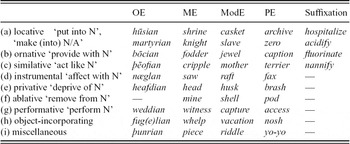
Equally significant for us is the finding that N/A-to-V conversion has been the most productive or profitable (Carstairs-McCarthy Reference Carstairs-McCarthy1992: 37; Bauer Reference Bauer2001: 49) among N/A-to-V derivational processes from OE to PE (Kastovsky Reference Kastovsky and Britton1996; Plag Reference Plag1999). The high profitability of V-forming conversion is closely related to another important finding that converted verbs are semantically sparse (Clark & Clark Reference Clark and Clark1979; Aronoff Reference Aronoff1980; Lieber Reference Lieber1992: section 5.2), and they can express much more diverse meanings than suffixed verbs can express (Plag Reference Plag1999; Lieber Reference Lieber2004: chapter 3). Table 2 shows the main meanings of converted verbs along with examples of each diachronic stage, which are taken from Marchand (Reference Marchand1969: 365–7), Clark & Clark (Reference Clark and Clark1979) and Plag (Reference Plag1999).
The main meanings of denominal and deadjectival converted verbsFootnote 11Footnote 12

We use the term ‘object-incorporating’ in table 2 (h) to group converted verbs that incorporate their base noun as a direct object; Clark & Clark's semantic groups ‘crop’ (to fish ‘catch fish’), ‘meal’ (to lunch ‘take lunch’), ‘duration’ (to night ‘spend the night’), and ‘production’ (to pup ‘produce a pup’) are of this type.
As shown in the rightmost column in table 2, the semantics of suffixed verbs (-ate/-en/-ify/-ize verbs) is fixed to the first three meanings, (a) locative, (b) ornative, and (c) similative. Converted verbs, on the other hand, can express not only these three but also (d) instrumental, (e) privative, (f) ablative, (g) performative and (h) object-incorporating meanings, and even other miscellaneous meanings that are hard to classify (e.g. to piece ‘make from pieces’, to riddle ‘speak in riddles’, to yo-yo ‘move up and down’). In a word, suffixation is semantically fixed, whereas conversion is semantically versatile. This makes conversion a default process in verb derivation (see also Lieber Reference Lieber2004: section 3.2).
3.3 Interim conclusion
This section has surveyed the main functions of verbal prefixation and conversion from a diachronic point of view and shown that the right-headed analysis has a diachronic foundation. As this analysis predicts, there is no stage of grammar in which V-to-V prefixation or N/A-to-V conversion is unavailable but N/A-to-V prefixation is possible. Because all the prefixes in (1) are originally of the V-to-V type, and because conversion has produced denominal and deadjectival verbs since OE, there should emerge the possibility that right-headed morphology produces verbs of the structure [Prefix + [[N/A]]V]V. In other words, so-called category-determining prefixation emerges from the combination of non-category-determining prefixation and conversion.
4 Derivational evidence for the right-headed analysis: input morphology
This and the following sections will provide evidence for the right-headed analysis in terms of synchronic derivation, focusing on input morphology and output semantics, respectively. Because the preceding section has revealed that N/A-to-V functions of the prefixes in (1) were established in ModE, we will use ModE data for this synchronic examination.
4.1 Input morphology (I): the existence of the converted base
The first and most straightforward derivational support for the right-headed analysis comes from the fact that the converted base assumed in this analysis almost always exists as an actual word. Witness the following pairs of denominal/deadjectival be-prefixed verbs and converted verbs with the year of first attestation:
- (8)
(a) N > V: bebloom 1585/ to bloom 1250, bebog 1662/ to bog 1641, bebrine 1652/ to brine 1552, bebrother 1881/ to brother 1573, bebutter 1611/ to butter 1496, becap 1821/ to cap 1483, bechalk 1800/ to chalk 1575, becivet 1805/ to civet 1601, beclown 1609/ to clown 1599, becomma 1881/ to comma 1664, becoom 1881/ to coom 1606, becoward 1831/ to coward 1300, bedinner 1837/ to dinner 1784, bedoctor 1806/ to doctor 1599, bedunce 1611/ to dunce 1611, befame 1574/ to fame 1303, befancy 1567/ to fancy 1646, befiddle 1759/ to fiddle 1377, befist 1718/ to fist 1300, beflea 1870/ to flea 1610, befop 1866/ to fop 1529, befume 1598/ to fume 1400, begall 1598/ to gall 1581
(b) A > V: bebrave 1576/ to brave 1546, bedirty 1623/ to dirty 1591, bedumb 1615/ to dumb 1000, befast 1674/ to fast 1220, begaudy 1640/ to gaudy 1482, begay 1648/ to gay 1581, beglad 1617/ to glad 825, begray 1624/ to gray 13.., begreen 1864/ to green 1000, begrim 1870/ to grim 1400, beshag 1868/ to shag 1596, beslow 1645/ to slow 1522, besmooth 1615/ to smooth 1440
These pairs are only a tiny portion of an innumerable number of ‘doublets’; in fact, among 201 denominal/deadjectival be-verbs listed in the OED entry of the prefix be- (sections 5 and 6), only 18 lack a converted counterpart. As is shown clearly by these pairs, not only does the base-converted verb assumed in the right-headed analysis exist as an actual word, it almost always precedes its be-counterpart in the year of first attestation. Thus the be-form is attested earlier than the converted form only in 23 out of 168 doublets (not counting 15 doublets whose be-form is not given a quotation). Although synchronic morphological analysis does not necessarily require the actual existence of a constituent word (Allen Reference Allen1978: 187–214; Plag Reference Plag1999: 45–6; cf. Aronoff Reference Aronoff1976: 21), the fact that the hypothesized base exists prior to the be-verb gives the right-headed analysis a strong empirical foundation.
The same applies to the other prefixes in (1), as the following pairs indicate:
- (9)
(a) en-: encap 1847/ to cap 1482, encup 1881/ to cup 1482, enearnest 1603/ to earnest 1602, enfree 1599/ to free 1000, enleaf 1789/ to leaf 1611, enshelter 1611/ to shelter 1590, ensoap 1598/ to soap 1585, enspangle 1648/ to spangle 1548, entame 1600/ to tame 1315
(b) out-: outbreast 1612/ to breast 1599, outdevil 1883/ to devil 1593, outfool 1638/ to fool 1593, outfriend 1615/ to friend 1387, outhymn 1704/ to hymn 1677, outmouth 1625/ to mouth 1300, outnight 1596/ to night 1303, outplot 1681/ to plot 1590, outtrap 1806/ to trap 1460
(c) un-: unbaronet 1867/ to baronet 1733, uncage 1602/ to cage 1577, uncork 1727/ to cork 1580, uncountess 1797/ to countess 1785, unfrill 1791/ to frill 1574, ungrand 1747/ to grand 1602, unhook 1611/ to hook 1250, unmask 1602/ to mask 1588, unthrone 1611/ to throne 1377
(d) dis-: disarchbishop 1875/ to archbishop 1692, discastle 1876/ to castle 1587, dischest 1579/ to chest 1473, discrest 1887/ to crest 1440, disennui 1829/ to ennui 1805, dispowder 1865/ to powder 1305, disprince 1847/ to prince 1590
(e) de-: decart 1860/ to cart 1440, deflesh 1837/ to flesh 1530, demiracle 1884/ to miracle 1611, deparliament 1648/ to parliament 1491, depetticoat 1892/ to petticoat 1850, deprivilege 1979/ to privilege 1386, detenant 1883/ to tenant 1634, detruth 1647/ to truth 1300
4.2 Input morphology (II): morphological restriction
The second piece of derivational evidence for the right-headed analysis is the fact that prefixed and converted verbs are subject to the same input morphological restriction. As observed by Hammond (Reference Hammond1993), the prefixes in (1) can attach to suffixed bases in their V-to-V functions, but they are restricted to simplex bases in their N/A-to-V functions. Compare the base forms of the following deverbal and denominal/deadjectival prefixed verbs:
- (10)
(a) bedarken, bequalify, beruffianize, besanctify, bewomanize; encapsulate, enlighten, enliven; deactivate, decentralize, dehumidify; disByronize, disdeify; outgastronomize, outthreaten
(b) becalm, befriend, beguile; enable, encamp, enturf; debark, decode, detrain; disanimal, discastle; outpoison, outsubtle
This contrast can be easily accounted for by the right-headed analysis because conversion does not permit suffixed bases either, as the following data show (Marchand Reference Marchand1969: 372–3; Bauer Reference Bauer1983: 226–7; Plag Reference Plag1999: 222; Farrell Reference Farrell2001: 118–20):
(11) *to Acadian, *to abandonee, *to arrival, *to banality, *to guidance, *to kindness, *to improvement, *to organization, *to owlish
Conversion is generally restriction-free, but it strongly resists a suffixed base. The right-headed analysis can attribute the lack of prefixed verbs based on suffixed nouns/adjectives to this input restriction on conversion.
Note that it is not that conversion resists morphologically complex words in general, and even suffixed words can be its input once they are lexicalized; the following converted verbs are based on compound nouns and lexicalized suffixed nouns:
- (12)
(a) to airmail, to chairman, to moonlight, to piggy-bank (Clark & Clark Reference Clark and Clark1979)
(b) to allowance, to pressure, to slipper, to supplement, to package (ibid.)
As predicted from this, we have prefixed verbs formed from the same types of word:
- (13)
(a) bebutterfly, beschoolmaster; depetticoat; disarchbishop; outrainbow
(b) beguilty, beslipper; enfreedom, enworthy; deprotestant; discommittee; outconfidence
In sum, the right-headed analysis correctly predicts the input properties of N/A-to-V prefixation. Nouns and adjectives that have a prefixed verb form also have a converted verb form, and they are subject to the same constraint as the conversion input.
5 Derivational evidence for the right-headed analysis: output semantics
The left-headed and right-headed analyses make opposite predictions about the output semantics of N/A-to-V prefixation. According to the left-headed analysis, it is the prefix that determines the core semantics of the output, whereas the right-headed analysis predicts that it is determined by the converted verb. This section will show that the latter prediction is correct; a denominal/deadjectival prefixed verb expresses the meaning of a converted verb modified by a V-to-V meaning of the prefix.
5.1 The semantics of V-to-V prefixation
Di Sciullo (Reference Di Sciullo and Sciullo1997) argues that verbal prefixes can be distinguished into two types, according to the semantic changes that they bring to the base. Internal prefixes are those which affect the argument structure (AS) and the internal event structure (Aktionsart) of the base verb, whereas external prefixes are those which modify the base verb as a whole adverbially and do not affect its AS or Aktionsart. For example, the French prefixes a- and en- (e.g. apporter ‘to bring to’/ emporter ‘to bring in’ < a-/en- + porter ‘to carry’) are of the former type, whereas the French prefixes dé- and re- (e.g. décomposer ‘to decompose’/ recomposer ‘to recompose’ < dé-/re- + composer ‘to compose’) belong to the latter type.
The V-to-V functions of the ModE prefixes we saw in section 3.1 (see (6) and (7)) also conform to this distinction. The intensive and transitivizing be- in (6a) (ii) (iii) and the intensive and ‘surpassing’ out- in (6c) (ii) (iii) are internal prefixes, whereas the reversative un-/dis-/de- in (6b) (iii), (7b) (ii) and (7c) (i) and the intensive en- in (7a) (i) are external prefixes. The first indication of this distinction concerns the ASs of the input and output verbs; be- and out- change the AS of the base verb, whereas un-, de-, dis- and en- do not. Be- attaches to intransitive and transitive verbs and produces transitive verbs (e.g. beshout, beblast). Out- attaches to unergative and unaccusative intransitive verbs and produces transitive verbs (e.g. outrun, outlast). On the other hand, un-, de-, dis- and en- attach to transitive verbs and produce transitive verbs (e.g. unbake, deeducate, disown, enkindle). Second, be-verbs and out-verbs may differ from the base verb in Aktionsart. Be-verbs are uniformly accomplishments even when based on an activity verb (e.g. bekick) or a state verb (e.g. belike ‘please’), and out-verbs are basically accomplishments whether based on an activity verb (e.g. outwork) or an achievement verb (e.g. outgrow) (see Yumoto Reference Yumoto1997: 194–5). In contrast, verbs in un-, de-, dis- and en- maintain the Aktionsart property of the base verb.
The distinction between be- and out- on the one hand and un-, de-, dis-, and en- on the other becomes especially clear when we look at the phenomenon of unselected objects, i.e. objects of complex verbs which do not correspond to the selectional restrictions of the simplex verb. The following pairs show that be-/out-verbs take an unselected object:
- (14)
(a) {besmile/*smile} someone, {bedwell/*dwell} the village,
{bestraddle/*straddle} the world, {bewhisper/*whisper} someone
(b) {outrun/*run}someone, {outlast/*last} someone, {outsing/*sing} someone,
{outspend/*spend} someone, {outtalk/*talk} someone
Verbs in un-, de-, dis- and en-, on the other hand, do not allow an unselected object.
Spencer & Zaretskaya (Reference Spencer and Zaretskaya1998), Kemenade & Los (Reference Kemenade and Los2003), McIntyre (Reference McIntyre2003), Hasebe (Reference Hasebe2004) and Los (Reference Los, Gotti, Dossena and Dury2008) show that the phenomenon of the unselected object is observed not only in prefixed verbs but also in resultatives (e.g. sing oneself hoarse, drink the pub dry) and particle verbs (e.g. work off a debt, chat someone up) and argue that it reflects a rather drastic change of the LCS caused by complex verb formation. The essential trait of the change is that the LCS of the simplex verb is ‘subordinated to’ (Spencer & Zaretskaya Reference Spencer and Zaretskaya1998) or ‘conflated with’ (McIntyre Reference McIntyre2003; Hasebe Reference Hasebe2004) the LCS newly introduced by the secondary predicate element (i.e. a resultative predicate, particle, or prefix). In the case of be-/out-prefixation, this can be captured by assuming the following output LCSs, where VERB represents the input verb:
- (15)
(a) the LCS of ‘intensive/transitivizing’ be-verbs:
[[x COMPLETELY AFFECT y] BY [x VERB (PREP) y]] (Booij Reference Booij and Roca1992: 56; Reference Booij2002: 192; Reference Booij2005: 210)
(b) the LCS of ‘surpassing’ out-verbs:
[[x SURPASS y] IN [x/y VERB]] (see Yumoto Reference Yumoto1997: 194)
In these LCSs, the first and second embedded brackets represent the LCS introduced by the prefix and the LCS of the input verb, respectively. That is, the input LCS is semantically subordinated in the output LCS. This is why be-/out-verbs can differ from their base verbs in AS, Aktionsart and object-selection. The following examples illustrate the linking between the AS and LCS levels in be-/out-prefixation:
- (16)
(a) x beshout y: [x COMPLETELY AFFECT y] BY [x SHOUT AT y]
x beblast y: [x COMPLETELY AFFECT y] BY [x BLAST y]
(b) x outlast y: [x SURPASS y] IN [x/y LAST]
x outrun y: [x SURPASS y] IN [x/y RUN]
x outsing y: [x SURPASS y] IN [x/y SING]
In contrast to the internal prefixes be- and out-, the external prefixes un-, de-, dis- and en- do not change the LCS of the base verb. They simply add a modificational semantic element to the input LCS; the reversative un-, de- and dis- add the negative function NOT to the resultant-state component (or ‘subordinate event’) of the input LCS, as in (17a) (see Yumoto Reference Yumoto1997: section 2 for the position of not; cf. Kastovsky Reference Kastovsky, Fanego, López-Couso and Pérez-Guerra2002: 99), whereas the intensive en- emphasizes the prepositional function in the resultant-state component of the input LCS, as in (17b). The bold in (17b) indicates the emphasis.
- (17)
(a) reversative un-/de-/dis-verbs:
x untie y: [x CAUSE [BECOME [y BE NOT AT/IN [TIED]]]]
x discompose y: [x CAUSE [BECOME [y BE NOT AT/IN [COMPOSED]]]]
x demilitarize y: [x CAUSE [BECOME [y BE NOT WITH [MILITARY]]]]
(b) intensive en-verbs:
x enwrap y: [x CAUSE [BECOME [y BE AT/IN [WRAPPED]]]]
Because neither the addition of NOT nor the emphasizing of AT/IN affects the core part of the input LCS, verbs in un-, de-, dis- and en- maintain the AS, Aktionsart and object-selection properties of the base verb.
5.2 The semantics of N/A-to-V prefixation
As we saw in (6) and (7), the functions of N/A-to-V prefixation have received separate treatment in the literature, but the right-headed analysis predicts that it can be analyzed in terms of the semantics of N/A-to-V conversion discussed in section 3.2 and the semantics of V-to-V prefixation elucidated in the previous section.
First, the output semantics of denominal/deadjectival be-/out-verbs results from inserting the LCS of a denominal/deadjectival converted verb into the LCSs of deverbal be-/out-verbs, as illustrated below. The conversion meanings listed in table 2 can be represented by the LCSs given in the entry (i) (Kageyama Reference Kageyama1997a),Footnote 13 and their insertion into the LCSs in (15a, b) is represented in the entry (ii).
- (18)
(a) locative: behearse ‘place in a hearse’, beknight ‘make a knight’, bebrave
i. x hearse y: [x CAUSE [BECOME [y BE IN HEARSE]]]
ii. x behearse y:
[x COMPLETELY AFFECT y] by [x CAUSE [BECOME [y BE IN HEARSE]]]
(b) ornative: bejewel ‘adorn with jewels’, behoney ‘smear with honey’
i. x jewel y: [x CAUSE [BECOME [y BE WITH JEWEL]]]
ii. x bejewel y:
[x COMPLETELY AFFECT y] BY [x CAUSE [BECOME [y BE WITH JEWEL]]]
(c) similative: bedevil ‘treat diabolically’, befriend ‘help as a friend’
i. x devil (y): [x ACT (ON y) LIKE DEVIL]
ii. x bedevil y: [x COMPLETELY AFFECT y] BY [x ACT ON y LIKE DEVIL]
(d) instrumental: betongue ‘assail with the tongue’, benet ‘catch in a net’, beglue
i. x tongue (y): [x ACT (ON y) WITH TONGUE]
ii. x betongue y:
[x COMPLETELY AFFECT y] BY [x ACT ON y WITH TONGUE]
(e) privative: betail ‘deprive of the tail’, besleeve ‘take the sleeves from’
i. x tail y: [x CAUSE [BECOME [y BE NOT WITH TAIL]]]
ii. x betail y:
[x COMPLETELY AFFECT y] BY [x CAUSE [BECOME [y BE NOT WITH TAIL]]]
(f) performative: bethump ‘thump soundly’, besort ‘assort’
i. x thump y: [x DO THUMP ON y]
ii. x bethump y: [x COMPLETELY AFFECT y] BY [x DO THUMP ON y]
- (19)
(a) similative: outdevil ‘outdo in deviling’, outfriend, outfool ‘outdo in fooling’
i. x devil (y): [x ACT (ON y) LIKE DEVIL] ( = (18c) (i))
ii. x outdevil z: [x SURPASS z] IN [x/z ACT LIKE DEVIL]
(b) instrumental: outtongue ‘excel with the tongue’, outgun, outtrap
i. x tongue (y): [x ACT (ON y) WITH TONGUE] ( = (18d) (i))
ii. x outtongue z: [x SURPASS z] IN [x/z ACT WITH TONGUE]
(c) object-incorporating: outsonnet ‘outdo in sonneting’, outcricket, outnight
i. x sonnet: [x PRODUCE SONNET]
ii. x outsonnet z: [x SURPASS z] IN [x/z PRODUCE SONNET]
This LCS insertion accounts for the input and output semantic properties of N/A-to-V be-/out-prefixation. Because the ‘intensive/transitivizing’ be- and the ‘surpassing’ out- are internal prefixes, the LCS of the base verb, the converted verb in this case, is subordinated to the LCS introduced by the prefix itself, as a result of which the output verb is always transitive. The out-verb differs from the base-converted verb in the ‘surpassing’ sense, whereas the be-verb differs from the base-converted verb in the ‘holistic interpretation’ stemming from the notion of complete affectedness (Blom & Booij Reference Blom and Booij2003). Thus, strictly, bejewel in (18b) should be glossed not just as ‘to adorn with jewels’, which is the meaning of to jewel, but rather as ‘to adorn all over with jewels’. Similarly, to tongue means to ‘assail with the tongue’, whereas betongue means to ‘assail with the tongue thoroughly’.Footnote 14
The two internal prefixes differ in the input verb selection: be- attaches to transitive verbs (or unergative verbs taking a prepositional object), whereas out- attaches to intransitive verbs (or intransitivized transitives). We attribute this difference to the difference between the prepositional functions BY and IN in (15a, b), which semantically restrict the subordinate LCS component they introduce. Thus, as we can observe in (18) and (19), be- attaches to transitive converted verbs, whereas out- attaches to intransitive converted verbs; the conversion meanings in table 2 (a, b) and (e–g) are predominantly transitive, whereas those in (c, d) can be both intransitive and transitive; (h) is intransitive. Notice that converted verbs such as to flower and to snow participate in be-prefixation not in their unaccusative reading (‘come into bloom’) but in their ornative reading (‘cover with flowers’), as the following sentences show:
- (20)
(a) 1594 She trimmes her selfe and golden hed Beflowers with Roses culd in Paradize.
(b) 1633 Foam besnows the trampled corn.
Next, the semantics of denominal/deadjectival prefixed verbs in un-, de-, dis-, and en- can also be reduced to the combination of the semantics of N/A-to-V conversion and the semantics of V-to-V prefixation, but the mode of combination is different from what we have seen for denominal/deadjectival be-/out-verbs. Because the reversative un-, de-, and dis- and the intensive en- are external prefixes, the LCS of the base-converted verb determines the core semantics of the output verb, the prefix merely adding an adverbial semantic element to the input LCS in the manner depicted in (17a, b):
- (21)
(a) locative: unhearse ‘remove from a hearse’, unchild ‘remove from the status/state of a child’, discastle, disanimal, decart, detrain
i. x hearse y: [x CAUSE [BECOME [y BE IN HEARSE]]] ( = (18a) (i))
ii. x unhearse y: [x CAUSE [BECOME [y BE NOT IN HEARSE]]]
(b) ornative: unjewel ‘deprive of jewel’, unfrill, disennui, disperiwig, defrost, demast
i. x jewel y: [x CAUSE [BECOME [y BE WITH JEWEL]]] ( = (18b) (i))
ii. x unjewel y: [x CAUSE [BECOME [y BE NOT WITH JEWEL]]]
- (22)
(a) locative: enhearse ‘put in a hearse’, enslave ‘put in the state of a slave’, endark
i. x hearse y: [x CAUSE [BECOME [y BE IN HEARSE]]] ( = (18a) (i))
ii. x enhearse y: [x CAUSE [BECOME [y BE IN HEARSE]]]
(b) ornative: enjewel ‘adorn with jewels’, encap
i. x jewel y: [x CAUSE [BECOME [y BE WITH JEWEL]]] ( = (18b) (i))
ii. x enjewel y: [x CAUSE [BECOME [y BE WITH JEWEL]]]
Both the reversative un-/de-/dis- and the intensive en- attach to the locative and ornative converted verbs because these types have the resultant-state component in their LCSs, as shown in (i). Because these external prefixes semantically target the resultant-state component of the input LCS, as depicted in (17a, b), converted verbs without it, including similative, instrumental, performative, and object-incorporating types, cannot be their input. Thus to undevil expresses not the reversal of acting like a devil but that of making someone devil-like.
Due to the merely emphatic semantic effect of the intensive en- on the input LCS, the output semantics of the en-verb does not differ conspicuously from that of the base-converted verb; as we saw in (7a) (ii) and (iii), denominal/deadjectival en-verbs also express locative and ornative meanings. Denominal un-/de-/dis-verbs are said to express privative and ablative meanings, as we saw in (6b) (iv), (7b) (iii) (iv) and (7c) (ii) (iii), but the analysis in (21a, b) indicates that the prefixal privative and ablative meanings should be subsumed under the reversative meaning: that is, they express the reversal of the pre-action expressed by the converted verb. For example, unjeweling a robe presupposes the pre-action of jeweling the robe, and uncaging a lion implies the pre-action of caging the lion. The genuine privative and ablative meanings do not presuppose a pre-action (Kastovsky Reference Kastovsky, Fanego, López-Couso and Pérez-Guerra2002: 100), and thus they are expressed without prefixes, i.e. with unprefixed converted verbs, as follows (see also Buck Reference Buck1997):
- (23)
(a) to feather a goose, to milk the cow, to tail the mouse, to bone the fish
(b) to mine the tin, to pod the peas, to quarry a white stone, to shell peas
The removal actions expressed by these verbs do not presuppose preceding attachment actions because the thing removed is inalienably possessed by its possessor. Behead a man ‘deprive a man of the head’ and betail the mouse are not counterexamples because, as shown in (18e), their privative meanings are expressed by the base-converted verbs to head a man and to tail the mouse, with be- functioning in its intensive meaning.Footnote 15
To summarize this section, the right-headed analysis can account for the semantics of N/A-to-V prefixation in terms of the semantics of V-to-V prefixation and N/A-to-V conversion. Internal and external verbal prefixes differ in how and to what extent their prefixation affects the LCS of the base-converted verb.
As we mentioned in section 2.2, the right-headed analysis is a prerequisite for a unitary semantic analysis of verbal prefixation even when one adopts the semantic, output-oriented approach (Plag Reference Plag1999, 2004; Lieber Reference Lieber2004, Reference Lieber2006). This might not be so apparent in the case of internal prefixation, for the internal prefixes themselves introduce a rather large amount of verbal semantics, i.e. the superordinate component of the LCSs in (15a, b). Thus one might claim that, irrespective of the input category, be-/out-prefixation can be dealt with by such output LCSs as [[x COMPLETELY AFFECT y] BY [Event/Entity/Property ]Base] and [[x SURPASS y] IN [[Event/Entity ]Base]. The output semantics of deverbal and denominal/deadjectival un-/de-/dis-/en-prefixation, however, cannot be unified by means of the semantic specifications ‘Event/Entity/Property’ because the external prefixes only add a modificational element to the input LCS. The LCS templates in (17a, b) are provided by the Event-type base. When the base is an Entity or Property, there is no LCS template for the prefixes to modify. This problem disappears once one adopts the right-headed analysis and assumes the intervention of N/A-to-V conversion.
6 Concluding remarks
The findings of this article can be summarized as follows. First, so-called category-determining prefixation in English developed from N/A-to-V conversion and V-to-V prefixation. It was established in the ModE period. Second, the derivational properties of so-called category-determining prefixation, particularly its input morphology and output semantics, can be reduced to those of N/A-to-V conversion and V-to-V prefixation. Third, these diachronic and synchronic facts enable us to conclude that so-called category-determining prefixes do not actually determine the category of their output derivatives and hence do not violate the RHR. So-called category-determining prefixation is nothing but a type of V-to-V prefixation.
This conclusion has two important consequences for theories of word formation. The first consequence is that we can restrict the derivational function of prefixes to the semantics. The fact that there is no derivational prefix that determines the output category in English means that each derivational prefix is specified for the output semantics but not for the output category. In this respect, our right-headed analysis is favorable to Plag's (Reference Plag1999, 2004) and Lieber's (2004, Reference Kastovsky, Hogg and Denison2006) semantic approaches to derivation, though we find too strong their fundamental claims that categorial selection can be replaced with semantic selection in derivation (Lieber Reference Lieber2006: sections 3 and 4).Footnote 16
The second consequence is that not only the prefixes in (1) but also other V-to-V prefixes (e.g. forebode, interaccuse, misread, premake, rewrite, trans-situate) can give rise to examples of so-called category-determining prefixation. Witness the following prefixed verbs:
- (24)
(a) fore-: forepicture, forepole, foreprophecy, foreshield, forespell
(b) inter-: interfinger, interlibel, interpage, interplait, intersoil, intersour
(c) mis-: miscipher, miscode, misenglish, misperson, misword, misyoke
(d) pre-: preclean, predevine, predoom, prefool, preplot, preprogram
(e) re-: recement, redistrict, rejigger, rejourney, reperiwig, reyoung
(f) trans-: transdialect, transparish, trans-spirit, transverse, transvillage
All of these prefixed verbs are based on a noun or an adjective, but unlike the prefixed verbs in (1), they are not cited in the literature as instances of so-called category-determining prefixation. Their existence is problematic for the left-headed analysis, but it is just as expected under the right-headed analysis; these instances also result from the interaction between N/A-to-V conversion and V-to-V prefixation.