Introduction
Neuroticism is a superordinate domain in all major theories of personality and temperament (John et al. Reference John, Robins and Pervin2008; Widiger, Reference Widiger, Leary and Hoyle2009). Eysenck & Eysenck (Reference Eysenck and Eysenck1985) defined neuroticism as the tendency to arouse quickly when emotionally stimulated and to inhibit emotions slowly, whereas Costa & McCrae (Reference Costa and McCrae1992) described neuroticism as a general tendency to experience negative affects such as fear, sadness, embarrassment, anger, guilt and disgust. High neuroticism scores indicate an enhanced sensitivity to environmental stress and a cautious vigilant outlook (Widiger, Reference Widiger, Leary and Hoyle2009). High neuroticism is prospectively associated with psychopathology (Ormel et al. 2004 b; Malouff et al. Reference Malouff, Thorsteinsson and Schutte2005; Lahey, Reference Lahey2009) and life-course outcomes across multiple domains, for example occupational attainment, divorce and mortality (Roberts et al. Reference Roberts, Kuncel, Shiner, Caspi and Goldberg2007). Moreover, the economic burden of high neuroticism to society as a whole is enormous and at least twice that of all common mental disorders combined (Cuijpers et al. 2010).
Although personality is conceptualized as a stable trait, the rank order stability of neuroticism as indexed by test–retest correlations from age 21 years falls steadily from 0.55 after 1 year to 0.41 over 20 years, to 0.25 after 40 years (Ormel & Rijsdijk, Reference Ormel and Rijsdijk2000; Roberts & DelVecchio, Reference Roberts and DelVecchio2000; Wray et al. Reference Wray, Birley, Sullivan, Visscher and Martin2007). Indeed, changes in neuroticism have been reported for all ages (Roberts et al. Reference Roberts, Caspi and Moffitt2001; Robins et al. Reference Robins, Fraley, Roberts and Trzesniewski2001; Mroczek & Spiro, Reference Mroczek and Spiro2003; Small et al. Reference Small, Hertzog, Hultsch and Dixon2003; Caspi et al. Reference Caspi, Roberts and Shiner2005; Scollon & Diener, Reference Scollon and Diener2006). In a study across 40 years, neuroticism scores decreased in 16% and increased in 13% of the individuals with more than half a standard deviation (Soto & John, Reference Soto and John2011). Both stability and change in neuroticism seem to be substantially influenced by environmental factors (Haan et al. Reference Haan, Millsap and Hartka1986; McCartney et al. Reference McCartney, Harris and Bernieri1990; Plomin & Nesselroade, Reference Plomin and Nesselroade1990; Asendorpf, Reference Asendorpf1992; McGue et al. Reference McGue, Bacon and Lykken1993; Ormel & Rijsdijk, Reference Ormel and Rijsdijk2000; Bleidorn et al. Reference Bleidorn, Kandler, Riemann, Angleitner and Spinath2009). However, only a few studies have examined the effects of specific environmental factors (e.g. Koskenvuo et al. Reference Koskenvuo, Langinvainio, Kaprio and Sarna1984; Neyer & Lehnart, Reference Neyer and Lehnart2007; Lüdtke et al. Reference Lüdtke, Roberts, Trautwein and Nagy2011; Specht et al. Reference Specht, Egloff and Schmukle2011).
Prospective evidence indicates that life events (LEs) influence neuroticism, especially those LEs involving romantic relationships and work. For example, greater prestige, work satisfaction, financial security (Roberts et al. Reference Roberts, Caspi and Moffitt2003; Scollon & Diener, Reference Scollon and Diener2006; Sutin & Costa, Reference Sutin and Costa2010), promotion, the beginning of regular work (Lüdtke et al. Reference Lüdtke, Roberts, Trautwein and Nagy2011), greater relationship security, attachment and partner satisfaction (Roberts & Chapman, Reference Roberts and Chapman2000; Lehnart & Neyer, Reference Lehnart and Neyer2006; Scollon & Diener, Reference Scollon and Diener2006) have been associated with decreases in neuroticism. Unemployment, heavy physical work, night- and shift-work schedules (Koskenvuo et al. Reference Koskenvuo, Langinvainio, Kaprio and Sarna1984), starting a new job, change in university studies, increased working hours (Lüdtke et al. Reference Lüdtke, Roberts, Trautwein and Nagy2011), more relationship conflicts, partner abuse, marital tension (Roberts & Chapman, Reference Roberts and Chapman2000; Robins et al. Reference Robins, Caspi and Moffitt2002), illness, self-harm, divorce/break-up, accidents, robbery, violent assault, failing an important examination and financial problems (Suh et al. Reference Suh, Diener and Fujita1996; Middeldorp et al. Reference Middeldorp, Cath, Beem, Willemsen and Boomsma2008; Löckenhoff et al. Reference Löckenhoff, Terracciano and Costa2009; Lüdtke et al. Reference Lüdtke, Roberts, Trautwein and Nagy2011) have been associated with increases in neuroticism.
However, it remains unclear whether such observations reflect temporary shifts or a lasting change in neuroticism. Prior research distinguishes three possible sources of variance for neuroticism: an allegedly stable set-point neuroticism component representing the general trait level of neuroticism, a transient state-deviation component that changes in response to LEs and current psychopathology, and an error component (Fleeson, Reference Fleeson2001; Clark et al. Reference Clark, Vittengl, Kraft and Jarrett2003; Costa et al. Reference Costa, Bagby, Herbst and McCrae2005; Courvoisier et al. Reference Courvoisier, Nussbeck, Eid, Geiser and Cole2008). Individuals often rate themselves as more neurotic during depressive/anxious episodes (Ormel et al. Reference Ormel, Oldehinkel and Vollebergh2004; Costa et al. Reference Costa, Bagby, Herbst and McCrae2005; Kotov et al. Reference Kotov, Gamez, Schmidt and Watson2010). This phenomenon has typically been interpreted as a transient state-deviation in self-perception due to the state effects of the patient's current psychopathology rather than real change in set-point neuroticism (Jorm, Reference Jorm1989; Bagby et al. Reference Bagby, Joffe, Parker, Kalemba and Harkness1995; Du et al. Reference Du, Bakish, Ravindran and Hrdina2002; Ormel et al. Reference Ormel, Oldehinkel and Vollebergh2004; Tang et al. Reference Tang, DeRubeis, Hollon, Amsterdam, Shelton and Schalet2009).
Others, however, argued that this ‘state deviation’ may reflect a true change in set-point neuroticism (Costa et al. Reference Costa, Bagby, Herbst and McCrae2005; Quilty et al. Reference Quilty, de Fruyt, Rolland, Kennedy, Rouillon and Bagby2008; Tang et al. Reference Tang, DeRubeis, Hollon, Amsterdam, Shelton and Schalet2009). Hence, when neuroticism scores change after the experience of positive/negative LEs (PLEs/NLEs), this may reflect a transient state-deviation in neuroticism as a consequence of altered self-perception due to changes in anxiety/depression. Moreover, this change in neuroticism may be short term, and levels may return to set-point neuroticism when the effects of LEs on anxiety/depression decay. Therefore, it is important to examine LE effects on neuroticism both unadjusted and adjusted for possible state deviations related to change in anxiety/depression.
Previous studies indicate that stressful LEs may trigger an anxious/depressive episode typically within maximal 3 months (Suh et al. Reference Suh, Diener and Fujita1996; Kendler et al. Reference Kendler, Karkowski and Prescott1999; Brilman & Ormel, Reference Brilman and Ormel2001; Faravelli et al. Reference Faravelli, Catena, Scarpato and Ricca2007), which indicates that taking timing of experienced LEs into account is important. In the current study we distinguished between recent LEs, which occurred up to 3 months before T 2, and distant LEs, which occurred 4–24 months prior to T 2. Changes in neuroticism explained by recent LEs mark the ‘short-term effects’ and by distant LEs the ‘long-lasting effects’, which may indicate a persistent change in set-point neuroticism.
Finally, early life adversities, such as sexual, physical or emotional maltreatment, trigger persistent changes in neurobiological systems, in this way increasing sensitivity to LEs later in adult life (Sanchez et al. Reference Sanchez, Ladd and Plotsky2001; Kendler et al. Reference Kendler, Gardner and Prescott2002; Penza et al. Reference Penza, Heim and Nemeroff2003; Heim et al. Reference Heim, Plotsky and Nemeroff2004). In the current study this developmental perspective was studied by testing whether childhood adversity (CA) moderates the impact of LEs on neuroticism in adult life.
To summarize, in the current study we tested four hypotheses: (1) positive LEs decrease and negative LEs increase neuroticism scores; (2) LE-driven change in neuroticism is partly long-lasting; (3) part of LE-driven change in neuroticism is independent of short-term LE-driven changes in anxiety/depression; and (4) CA moderates the influence of LEs on neuroticism scores in adult life.
Method
Study sample
The data for this study were derived from the Netherlands Study of Depression and Anxiety (NESDA). The NESDA study design, sampling procedures and non-response are described in detail elsewhere (Penninx et al. Reference Penninx, Beekman, Smit, Zitman, Nolen, Spinhoven, Cuijpers, de Jong, van Marwijk, Assendelft, van der Meer, Verhaak, Wensing, de Graaf, Hoogendijk, Ormel and van Dyck2008; Lamers et al. Reference Lamers, Hoogendoorn, Smit, van Dyck, Zitman, Nolen and Penninx2012). For this study, we used data from the baseline measurement wave (T 1, 2004–2006) and the follow-up wave (T 2, n = 2596, 87.1% response), 2 years later. As this study focused on the influence of LEs on change in neuroticism, all participants with more than three missing items on the neuroticism scale (n = 38 at T 1, n = 67 at T 2) or LE measure (n = 135) were excluded. This left a final sample of 2356 participants (89% of the T 2 sample, 79% of the T 1 sample), with a mean age of 41.99 years (s.d. = 13.08) at T 1, and 66.6% women, comparable to the age and gender distribution of the original sample. Participants who did not participate at T 2 (n = 385) did not score significantly higher on neuroticism at T 1. However, when we imputed the missing items for participants who were excluded because they had more than three missing items (n = 38 at T 1 and n = 202 at T 2), the results suggested that the excluded participants scored higher on neuroticism (d = 0.29 and 0.17 respectively), reported more anxiety (d = 0.44 and 0.36 respectively) and depression (d = 0.43 and 0.23 respectively) symptoms and a higher childhood trauma score (d = 0.20). The NESDA was approved by the Ethical Committees of the participating universities, and all participants provided written informed consent.
Neuroticism
Neuroticism was measured at T 1 and T 2 with the validated Dutch version of the Neuroticism–Extroversion–Openness Five Factor Inventory (NEO-FFI; Costa & McCrae, Reference Costa and McCrae1992; Hoekstra et al. Reference Hoekstra, Ormel and Fruyt1996). The 12 neuroticism items were scored on five-point scales ranging from (1) strongly disagree to (5) strongly agree, and aggregated into a neuroticism score. Cronbach's α was 0.87.
Life events
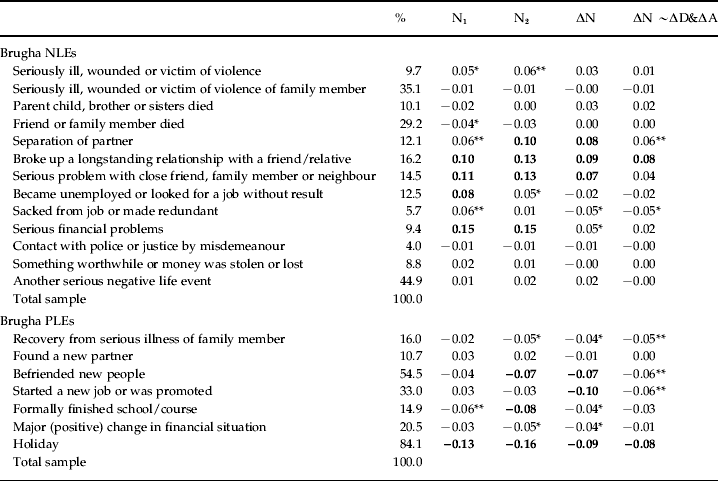
LEs were assessed at T 2 with the 20-item List of Threatening Experiences (LTE; Brugha & Cragg, Reference Brugha and Cragg1990), which contains seven PLEs and 13 NLEs (Table 1). κ values for 6-month sensitivity and specificity were 0.89 and 0.74 respectively, with an inter-rater agreement of 0.70 (Brugha & Cragg, Reference Brugha and Cragg1990). Each LE was scored dichotomously (yes/no) with the exact month of the year in which it occurred. PLEs and NLEs were aggregated in separate measures. As there is no consensus on the optimal way to calculate aggregated LE measures (Monroe, Reference Monroe2008), we tested the robustness of our findings through aggregation over simple counts of reported LEs and the calculation of weighted PLE and NLE measures. This latter measure was based on earlier findings on social readjustment after experiencing LEs (Holmes & Rahe, Reference Holmes and Rahe1967), in which it was shown that the impact of infrequent LEs was significantly larger than that of the more common LEs (Masuda & Holmes, Reference Masuda and Holmes1978). By analogy, the inverse of the prevalence of the LE was used to weight its impact. For example, when 5.7% of the participants were ‘sacked from their job’, the weight of this item was 0.943 [(100–5.7)/100)].
The prevalence (%) among the 2356 participants (67% women) of the negative (NLEs) and positive life events (PLEs) scored on the List of Threatening Experiences (LTE), Pearson's correlations with neuroticism at baseline (N1) or follow-up (N2), and partial correlations with neuroticism at follow-up corrected for baseline neuroticism (ΔN, reflecting change in neuroticism) and additional corrections for change in depression (ΔD) and anxiety (ΔA) between baseline (T1) and follow-up (T2)

N1, Neuroticism at baseline (T 1); N2, neuroticism at follow-up (T 2); ΔN∼ΔD&ΔA are partial correlations with ΔN (N2 at T 2 after correction for N1 at T 1) and change in depression and change in anxiety between T 1 and T 2; ΔN change in neuroticism (N2 – N1).
p < 0.001 in bold (highly significant), ** p < 0.01, * p < 0.05 (two-tailed).
To test LE-driven change in neuroticism uncontaminated by state deviations due to recent LE-prompted acute changes in anxiety/depression, the timing of the LEs was taken into account. Previous studies indicated that the impact of LEs on anxiety/depression typically decays after 3 months (Suh et al. Reference Suh, Diener and Fujita1996; Kendler et al. Reference Kendler, Karkowski and Prescott1999; Brilman & Ormel, Reference Brilman and Ormel2001; Faravelli et al. Reference Faravelli, Catena, Scarpato and Ricca2007). Therefore, to take timing of the experienced LEs into account, the 24-month follow-up time between T 1 and T 2 was used to categorize the LEs into recent LEs, which occurred within the 3 months before T 2, and distant LEs, which occurred 3–24 months before T 2. Using this algorithm, distant LEs occurred on average 13.5 months before T 2 [(21/2) + 3=13.5].
Depressive symptoms
Symptoms of depression (hereafter ‘depression’) were measured at T 1 and T 2 with the self-rated version of the 30-item Inventory of Depressive Symptomatology (IDS-SR30; Rush et al. Reference Rush, Gullion, Basco, Jarrett and Trivedi1996), which was designed to assess the self-reported severity of depression over the past week. Responses were aggregated whereby appetite increase/decrease and weight increase/decrease were each treated as one item, and high scores indicate greater severity. Cronbach's α was 0.83.
Anxiety symptoms
Symptoms of anxiety (hereafter ‘anxiety’) were measured at T 1 and T 2 with the 21-item self-report Beck Anxiety Inventory (BAI; Beck et al. Reference Beck, Brown, Epstein and Steer1988). The BAI was designed to distinguish anxiety from depression while retaining convergent validity (Steer et al. Reference Steer, Rissmiller, Ranieri and Beck1993) and has high internal consistency (α = 0.92) and 1-week test–retest reliability (r = 0.75) (Beck et al. Reference Beck, Brown, Epstein and Steer1988). Participants rated how much each of the symptoms bothered them over the past week on a four-point scale (0–3) that ran from ‘not at all’ to ‘could barely stand it’, and scores were aggregated. Cronbach's α was 0.81.
Childhood adversity
The experience of the following childhood adversities before age 16 was assessed at T 1: ‘emotional neglect’ (38.9%), ‘psychological abuse’ (24.8%), ‘physical abuse’ (13.8%), and ‘approached in a sexual way against your will’ (18.5%). Participants were asked to indicate if an adversity had occurred (yes/no) and how often it occurred (not/once/sometimes/regularly/often/very often). Scores were recoded into 0 = never, 1 = once/sometimes and 2 = regularly/often/very often. Following prior studies (Wiersma et al. Reference Wiersma, Hovens, van Oppen, Giltay, van Schaik, Beekman and Penninx2009; Hovens et al. Reference Hovens, Wiersma, Giltay, van Oppen, Spinhoven, Penninx and Zitman2010), a sum score of experienced number (0–4) and frequency (0–2) of the CA was calculated for each participant (range = 0–8). This sum score was recoded into a five-category variable reflecting their level of exposure to CA: 0 (no adversity, n = 1264, 53.8%), 1 (1–2, n = 482, 20.5%), 2 (3–4, n = 333, 14.2%), 3 (5–6, n = 208, 8.9%) and 4 (7–8, n = 62, 2.6%), totaling 1085 individuals (46.2%) who had experienced some form of CA.
Statistical analysis
All variables approached a normal distribution and were analyzed in SPSS version 18.0 (SPSS Inc., USA). We used Pearson correlations to test the associations between the variables. Effect size is given as Cohen's d. As a heuristic, we indicate effect sizes of 0.20 as small, 0.50 as medium, and 0.80 as large (for correlations 0.10/0.30/0.50) (Cohen Reference Cohen1992). The models are examined with multiple linear regression analyses (forced entry method), with separate parameter estimates for each block of predictors. To focus on within-subject changes in our analyses, T 2 measures of neuroticism, depression and anxiety (N2/D2/A2) were predicted from T 1 measures (N1/D1/A1). We present standardized regression coefficients (β weights), which enable comparison of predictors because they indicate the change in outcome per standard deviation change in the predictor (when the other independent variables are held constant). Intercepts and slopes of the regression analysis were used to interpret possible differences in baseline neuroticism and change in neuroticism respectively.
To test our hypotheses about the influence of LEs on neuroticism, we fitted seven different models to the data, each numbered and fully described in Tables 4 and 5. First, we fitted a baseline model 1, in which T 2 neuroticism (N2) was predicted by T 1 neuroticism (N1). We then examined differences and similarities between this baseline model 1 and the other models that were fitted based on our hypotheses. The first hypothesis was tested in model 2 (the ‘life events model’), in which recent NLEs/PLEs and distant NLEs/PLEs were entered as predictors of change in neuroticism (ΔN = N2 – N1). Model 2 also allowed us to test hypothesis 2, that LE-driven ΔN is partly long-lasting. If distant NLEs/PLEs were not associated with ΔN, this hypothesis should be rejected.
Moreover, the relationship between LEs and ΔN may be mediated by another variable (Kraemer et al. Reference Kraemer, Stice, Kazdin, Offord and Kupfer2001), arguably the symptom level of depression/anxiety. In models 3–5 the third hypothesis was tested, that distant LE-driven ΔN is independent of changes in symptom levels of anxiety/depression. The ΔA model tested change in anxiety (ΔA = A2 – A1) as an additional predictor, the ΔD model tested change in depression (ΔD = D2 – D1), and model 5 tested both. If the variance predicted by LEs ceased when these models were applied, this suggests mediation. The robustness of these mediation effects was tested with Preacher–Hayes bootstrap tests [n = 2348, 5000 resamples, 95% confidence intervals (CIs); Preacher & Hayes, Reference Preacher and Hayes2004; Zhao et al. Reference Zhao, Lynch and Chen2010].
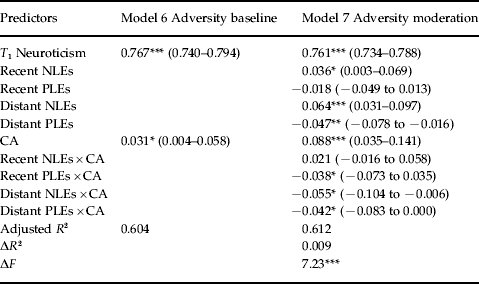
Model 6 serves as a baseline for model 7, to test the fourth hypothesis, that the association between LEs and ΔN is moderated by CA. Model 7 consisted of baseline neuroticism, recent NLEs/PLEs and distant NLEs/PLEs, CA, and four interaction terms as predictors (each a function of an LE measure multiplied by CA). Significant interaction terms indicate that CA moderated the impact of LEs on ΔN. Finally, we repeated analyses after imputation of missing data with the means of the relevant variables. As the results were highly comparable, only the analyses on the non-imputed data (n=2356) are presented. Because the amount of correlations shown in the descriptives may inflate family-wise α, we present only highly significant associations in bold (p < 0.01 for Table 1 and p < 0.001 for Table 3).
Results
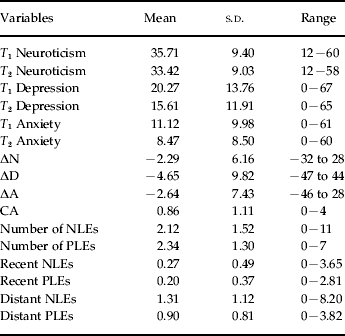
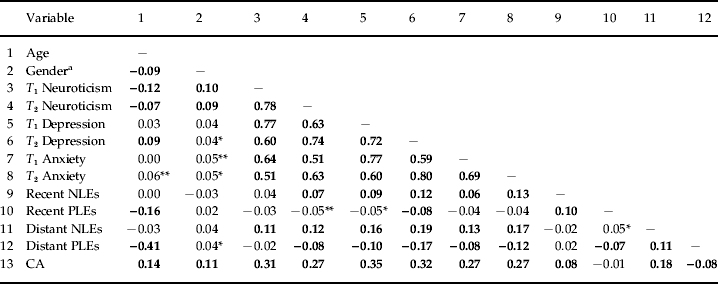
Descriptives and correlations between our variables are given in Tables 2 and 3 respectively. Neuroticism, anxiety and depression decreased somewhat over time (d = 0.25, 0.29 and 0.36 respectively). Older participants reported lower neuroticism and fewer distant PLEs than younger participants, but age was not associated with the experience of distant NLEs. CA was associated with higher neuroticism, anxiety and depression at both waves. Given the high test–retest correlations of all constructs, individual differences in neuroticism, anxiety and depression were largely retained at follow-up, despite the fall in mean scores. Anxiety and depression scores were highly correlated, both cross-sectionally and longitudinally.
Descriptives of the variables used from the NESDA cohort (n = 2356, 67% women)
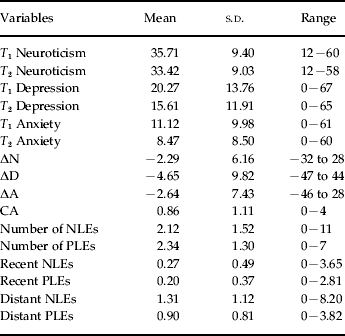
NESDA, Netherlands Study of Depression and Anxiety; T 1, baseline; T 2, follow-up; ΔN, ΔD, ΔA, change in neuroticism, depression and anxiety respectively, reflecting follow-up scores corrected for baseline scores; CA, childhood adversity; PLE, positive life event; NLE, negative life event; s.d., standard deviation.
n = 2356 with a maximum deviation of 5 because of the exclusion criteria as formulated in the Method section, where details of the definition of recent versus distant LEs are also given.
Bivariate Pearson correlations between age, gender, neuroticism, symptoms of depression/anxiety, recent and distant life events (LEs), and childhood adversity (CA) among 2356 participants (67% women)
T 1, Baseline measure; T 2, follow-up measure; NLE, negative life event; PLE, positive life event.
Details of the definition of recent versus distant LE measures are given in the Method section.
a Men = 1, women = 2.
p < 0.001 in bold (highly significant), ** p < 0.01, * p < 0.05 (two-tailed).
Distant NLEs showed a positive association with neuroticism, anxiety and depression at both waves, although associations with the T 2 outcomes were slightly stronger (d = 0.25, 0.34 and 0.38 respectively). Distant PLEs correlated negatively with neuroticism, anxiety and depression at T 2 (d = − 0.15, −0.24 and −0.33 respectively), and also weakly, negatively with anxiety and depression at T 1. Neuroticism at T 1 predicted the occurrence of distant NLEs (d = 0.24) but not distant PLEs whereas anxiety and depression at T 1 (weakly) predicted both more distant NLEs (d = 0.29 and 0.35 respectively) and fewer distant PLEs (d = − 0.18 and −0.22 respectively).
Life events and change in neuroticism
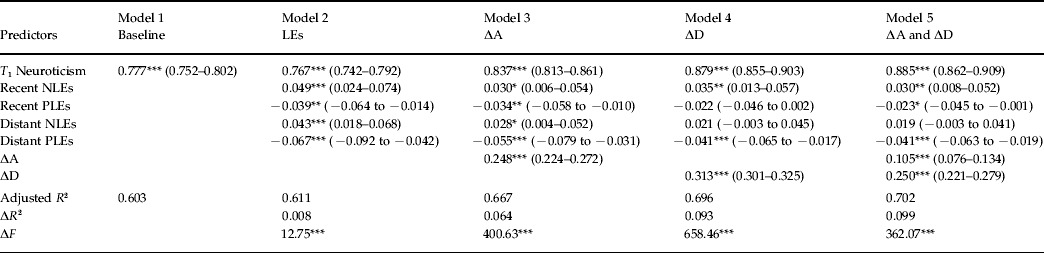
The results of our regression analyses are presented in Tables 4 and 5. Model 1 is the baseline model. Model 2 is the LEs model and indicated that distant NLEs predicted an increase and distant PLEs a decrease in neuroticism (d = 0.19 and −0.23 respectively). Although both effects were weak, the β values for the distant PLEs were slightly higher than those for the distant NLEs. However, both distant effects were significant and thus indicated that distant LEs [occurring on average a year before follow-up (361.6 days, s.d. = 2.84)] still affected neuroticism.
The regression results for models 2–5 indicate that the magnitude of association between distant NLEs and ΔN decreased when ΔA (model 3) was added, but even more when ΔD (model 4) was added or ΔA and ΔD (model 5) were added simultaneously to the model. This suggests mediation, especially by ΔD, because the decrease in the β values in these models was larger, and the predictive effect of distant NLEs lost statistical significance. Nevertheless, model 3 suggests that the association between recent and distant LEs and ΔN is also partially mediated by ΔA. The robustness of these mediation effects of ΔA and ΔD on the associations between distant LEs and neuroticism was tested with Preacher–Hayes bootstrap tests (k=5000). The results confirm that the positive association between distant NLEs and ΔN was mediated by ΔD [for 0.017 or 40% of the β of 0.043 in model 2 in Table 4 (95% CI 0.008–0.027)] and ΔA [for 0.007 or 16% of the β of 0.043 (95% CI 0.002–0.012)], and suggest a non-significant independent path [for 0.019 or 44% of the β of 0.043 (95% CI 0.008–0.027), but p = 0.09]. The negative association between distant PLEs and ΔN was also mediated by ΔD [for −0.021 or 32% of the β of −0.067 in model 2 in Table 4 (95% CI −0.031 to −0.012)] and ΔA [–0.005 or 7% of the β of −0.067 (95% CI −0.010 to −0.001)], but was mainly independent [–0.041 or 61% of the β of −0.067 (95% CI −0.053 to −0.030), p < 0.0005].
Regression models with standardized regression coefficients (β) for effects of recent and distant negative (NLEs) and positive life events (PLEs) on change in neuroticism and the mediation thereof by change in anxiety (ΔA) and change in depression (ΔD). Outcome is neuroticism at follow-up, n = 2356 in all models
ΔA, change in anxiety between T 1 (baseline) and T 2 (follow-up); ΔD, change in depression between T 1 and T 2; ΔR 2 and ΔF reflect changes from the baseline model 1; ΔR 2 is the proportion of variation in the response variable that can be accounted for by the predictors, adjusted for the number of explanatory terms in the model (always⩽R 2); ΔF is the statistic of the F test.
Details of the definition of recent versus distant LE measures are given in the Method section.
Values given as β (95% confidence interval).
*** p < 0.001, ** p < 0.01, * p < 0.05 (two-tailed).
Moderation by childhood adversity
Model 6 in Table 5 served as a baseline for model 7. The results for model 7 indicate that CA moderated the associations between LEs and ΔN. Compared to participants without such experiences, those who experienced CA had higher baseline neuroticism (intercept = 0.85 v. 0.76), less increase in neuroticism after distant NLEs (slopes of 0.01 v. 0.06) but more decrease in neuroticism after distant PLEs (slopes of −0.09 v. −0.05). However, CA (models 6 and 7) explained little additional variance in ΔN not already covered by models 1 and 2 (+0.1%, see Table 4). Moreover, part of the association between CA and ΔN is mediated by the experience of LEs; the more CA participants reported the more NLEs and the fewer PLEs they reported.
Regression models with standardized regression coefficients (β) for effects of recent and distant negative (NLEs) and positive life events (PLEs) on change in neuroticism and moderation thereof by childhood adversity (CA). Outcome is neuroticism at follow-up, n = 2356 in all models
Values given as β (95% confidence interval).
ΔR 2 and ΔF reflect changes from the CA baseline reported in model 6; ΔR 2 is proportion of variation in the response variable that can be accounted for by the predictors, adjusted for the number of explanatory terms in the model (always⩽R 2); ΔF is the statistic of the F test.
Details on the definition of recent versus distant LEs measures and CA are given in the Method section.
*** p < 0.001, ** p < 0.01, * p < 0.05 (two-tailed).
Repeating the analyses in Tables 4 and 5 with simple counts of PLEs/NLEs as predictors of ΔN revealed only minor changes from the results reported above. The effects of distant PLEs were slightly stronger (e.g. β −0.079 in model 2, p < 0.001), the interaction term for the recent PLEs (recent PLE × CA) in model 6 lost statistical significance whereas distant PLEs became more predictive for ΔN. Nevertheless, the magnitudes of the long-lasting effects of distant LEs were highly comparable. Moreover, model 2, with LE predictors that were not partitioned over distant LEs and recent LEs, gave highly comparable results (β = 0.055 for NLEs and −0.085 for PLEs; both p's < 0.001).
Post-hoc analysis
To determine the possible influence of gender and age on ΔN, analyses were repeated with these covariates and the interactions between them and the four LE measures as additional predictors (e.g. gender × distant PLEs). All predictors were non-significant and the estimates were highly comparable to those given in Tables 4 and 5. This suggests that influences of gender and age on neuroticism are already represented in baseline neuroticism and that gender and age do not affect change in neuroticism or modify the effect of PLEs/NLEs on neuroticism.
Finally, because our results suggest that distant LE-driven ΔN is partly independent from ΔA and ΔD, we examined the extent to which LE-driven ΔA and ΔD are independent of ΔN (statistical results available on request). Although the effects of LEs, in particular distant NLEs, on ΔA and ΔD are somewhat stronger than on ΔN, the pattern is similar. When adjusted for ΔN, the effects of distant PLEs/NLEs on ΔA and ΔD weaken but remain statistically significant (p < 0.001), which indicates that the effects of distant LEs on ΔA and ΔD are fairly independent of concomitant ΔN.
Discussion
Four main findings emerge from this study: (1) PLEs predict small decreases and NLEs increases in neuroticism; (2) part of the LE-driven change in neuroticism is long-lasting (at least 1 year); (3) the effect of PLEs on change in neuroticism is relatively independent of reductions in depression/anxiety whereas the effect of NLEs on change in neuroticism seems to be largely mediated by increases in depression and, to a lesser extent, anxiety. These findings suggest that only the effect of distant PLEs on neuroticism, and not that of distant NLEs, is independent from the individuals’ ‘current’ psychopathology. The effects of LEs on change in neuroticism and depression/anxiety seem to overlap, both cross-sectionally and longitudinally. Finally, (4) CA weakens the impact of distant NLEs on neuroticism but enhances that of distant PLEs.
Strengths of our design include the large sample size, the longitudinal approach and the examination of both recent and distant NLEs/PLEs. This categorization allows the timing of LE effects to be studied (Riese et al., unpublished manuscript), which is a relatively new approach, and is helpful for studying the underlying mechanism causing fluctuations in neuroticism. We could therefore disentangle state deviations in neuroticism as a consequence of recent LE-driven change in depression/anxiety from long-lasting distant LE-driven change in the set-point of neuroticism.
The reported findings should be viewed in light of the following limitations: retrospective self-reports of LEs inherently incorporate response components such as cognition, appraisal, interpretation and recall, which may be influenced by current mental state (Dohrenwend, Reference Dohrenwend2006; Schwarz, Reference Schwarz2007; Monroe, Reference Monroe2008). Furthermore, the focus on the number of LEs rather than their ecological context is a simplification. The stress and impact of various events depend on a variety of non-assessed factors regarding resources, age, skills, social support, unpredictability, magnitude of change/disruption produced, or potential to exhaust the individual physically (Holmes & Rahe, Reference Holmes and Rahe1967; Ormel & Wohlfarth, Reference Ormel and Wohlfarth1991; Hobson et al. Reference Hobson, Kamen, Szostek, Nethercut, Tiedmann and Wojnarowicz1998; Dohrenwend, Reference Dohrenwend2006; Monroe, Reference Monroe2008; Weisberg et al. Reference Weisberg, DeYoung and Hirsh2011). Moreover, ongoing difficulties were not assessed in this study but may also impact on neuroticism (Ormel & Wohlfarth, Reference Ormel and Wohlfarth1991). Finally, some LEs (e.g. moving house) may elicit mixed emotional responses, NLEs/PLEs may have complementary longitudinal relationships (e.g. divorce and remarriage; Overbeek et al. Reference Overbeek, Vermulst, de Graaf, ten Have, Engels and Scholte2010), and PLEs may buffer the impact of NLEs (Dohrenwend, Reference Dohrenwend1978; Rutter, Reference Rutter1987; Baumeister et al. Reference Baumeister, Bratslavsky, Finkenauer and Vohs2001; Dohrenwend, Reference Dohrenwend2006).
Future research could take these limitations into account by using measures of ‘life change’ or ‘context ratings’ in a life-chart interview such as the Life Events and Difficulties Schedule (LEDS) of Brown & Harris (Reference Brown and Harris1978) . This may also enable a better distinction between the positive and negative valence of an experience. However, conducting interviews is more time-consuming and costly than assessing questionnaires and may consequently lead to smaller samples and fewer studies (Schwarz, Reference Schwarz2007). Additionally, participants may be less likely to report embarrassing information or information that may have negative consequences if reported (e.g. physical or sexual abuse) (Grant et al. Reference Grant, Compas, Thurm, McMahon and Gipson2004).
Explanations for the mechanism behind the observed stronger effects of distant PLEs compared to distant NLEs on neuroticism remain speculative. PLEs may elicit change in positive biases, which are reported for never-depressed high-neurotic individuals (Chan et al. Reference Chan, Goodwin and Harmer2007), and lead to more favorable cognitions (Fredrickson & Losada, Reference Fredrickson and Losada2005; Garland et al. Reference Garland, Fredrickson, Kring, Johnson, Meyer and Penn2010). Moreover, PLEs seem more central to an individual's life story and identity than NLEs (Berntsen et al. Reference Berntsen, Rubin and Siegler2011) and might therefore have more potential for lasting change. However, it is also possible that the composition of our sample partially explains the effects of distant PLEs, as most participants were included because of their depression/anxiety symptoms (see Method). This may have created a ceiling effect that made decreases in neuroticism more likely when individuals experience the natural course of symptoms, that is towards recovery. Change in neuroticism may be partly due to antidepressant medication or cognitive treatment (Jorm, Reference Jorm1989; Harmer et al. Reference Harmer, Goodwin and Cowen2009), which was not controlled. However, note that we did control for change in anxiety/depression symptoms in our analyses.
LEs explained 2% of change in neuroticism (distant NLEs d = 0.19, distant PLEs d = − 0.23). This is a fairly small effect, but similar to that reported in the literature (Kendler & Gardner, Reference Kendler and Gardner2011). However, in the current study we assessed only 20 specific LEs whereas participants must have experienced many others as well. Hence, it is likely that we report an underestimation of the magnitude of LE-driven change in neuroticism. The key observation, that part of the lasting change in neuroticism, and especially that of distant PLEs, is independent of change in anxiety/depression, corresponds with other findings in the field (De Fruyt et al. Reference De Fruyt, Van Leeuwen, Bagby, Rolland and Rouillon2006; Jacobs et al. Reference Jacobs, van Os, Derom, Thiery, Delespaul and Wichers2011). Hence, our results suggest that LE-driven change in neuroticism is more than a transient state-deviation of self-perception due to current psychopathology (Jorm, Reference Jorm1989; Bagby et al. Reference Bagby, Joffe, Parker, Kalemba and Harkness1995; Du et al. Reference Du, Bakish, Ravindran and Hrdina2002), and may indeed be interpreted as a true change in the set-point of neuroticism (Costa et al. Reference Costa, Bagby, Herbst and McCrae2005; Quilty et al. Reference Quilty, de Fruyt, Rolland, Kennedy, Rouillon and Bagby2008; Tang et al. Reference Tang, DeRubeis, Hollon, Amsterdam, Shelton and Schalet2009; Ormel et al. Reference Ormel, Riese and Rosmalen2012).
Our findings may be relevant to the interpretation of intervention studies of depression (Jorm, Reference Jorm1989; Bagby et al. Reference Bagby, Joffe, Parker, Kalemba and Harkness1995; Du et al. Reference Du, Bakish, Ravindran and Hrdina2002; Tang et al. Reference Tang, DeRubeis, Hollon, Amsterdam, Shelton and Schalet2009). For example, level of neuroticism is reported to moderate the impact of PLEs on depression, that is PLEs have a greater impact on high-neurotic depressed individuals (Lewinsohn & Graf, Reference Lewinsohn and Graf1973; Isen et al. Reference Isen, Shalker, Clark and Karp1978; Oldehinkel et al. Reference Oldehinkel, Ormel and Neeleman2000; Neeleman et al. Reference Neeleman, Oldehinkel and Ormel2003; Peeters et al. Reference Peeters, Nicolson, Berkhof, Delespaul and deVries2003; Spinhoven et al. Reference Spinhoven, Roelofs, Hovens, Elzinga, van Oppen, Zitman and Penninx2011), whereas high neuroticism is reported to exacerbate the impact of NLEs on depressive mood (Ormel et al. Reference Ormel, Stewart and Sanderman1989; Ruiz-Caballero & Bermudez, Reference Ruiz-Caballero and Bermudez1995). Additionally, interventions that elicit a decrease in neuroticism may not only reduce the risk of a relapse of depression but also help to cut back the societal costs of neuroticism itself (Cuijpers et al. 2010).
In line with previous research, CA was associated positively with neuroticism in adults. However, in contrast to reports thus far (Kendler et al. Reference Kendler, Kuhn and Prescott2004; Glaser et al. Reference Glaser, van Os, Portegijs and Myin-Germeys2006), adult individuals who experienced CA increased less in neuroticism after distant NLEs and decreased more after distant PLEs. In general, researchers argue that early life adversity enhances hypothalamic–pituitary–adrenal (HPA) axis activity and emotional reactivity (Heim et al. Reference Heim, Plotsky and Nemeroff2004; Glaser et al. Reference Glaser, van Os, Portegijs and Myin-Germeys2006; Bosch et al. Reference Bosch, Riese, Reijneveld, Bakker, Verhulst, Ormel and Oldehinkel2012). In contrast with the literature, participants who experienced CA did not show an enhanced acute reaction after recent NLEs in this study (see model 7, Table 5). In addition, our observation that the lasting effect of distant NLEs on neuroticism seems to be blunted for individuals who experienced CA suggests a temporal difference, and requires replication.
Although some changes in neuroticism must be persistent, given the steady fall in differential stability with time, most changes in neuroticism will tend to regress to baseline (set-point neuroticism) after an adaptation period, a process known as the dynamic equilibrium hypothesis (Brickman et al. Reference Brickman, Coates and Janoff-Bulman1978; Headey & Wearing, Reference Headey and Wearing1989; Ormel & Schaufeli, Reference Ormel and Schaufeli1991; Lucas, Reference Lucas2007; Headey, Reference Headey2010; Ormel et al. Reference Ormel, Riese and Rosmalen2012). However, some experiences may elicit persistent shifts in neuroticism in some individuals (e.g. through changed personality–environment feedback loops). As this study lasted only 24 months, additional waves would be needed to examine such conjectures.
To conclude, high neuroticism is an important indicator of risk for the full development of psychological disorders and can, to some extent, be viewed as subthreshold psychopathology. The independent relationships between PLEs and neuroticism in this study indicate that neuroticism does not fully overlap with anxiety/depression. Thus, as a relatively stable personality trait, neuroticism is of interest in its own right, and cannot be substituted by measures of anxiety/depression. Finally, this study shows that experiences can elicit long-lasting change in neuroticism and thereby influence, potentially, the risk for development of psychopathology. Future studies that focus on the mechanisms behind PLE-driven long-lasting change in neuroticism and demonstrate such effects in intervention studies may confluence into prevention strategies focused on decreases in neuroticism.
Acknowledgments
The NESDA infrastructure is funded through the Geestkracht program of the Netherlands Organization for Health Research and Development (Zon-Mw, grant no. 10-000-1002) and supported by participating universities and mental health care organizations, the VU University Medical Center, GGZ inGeest, Arkin, Leiden University Medical Center, GGZ Rivierduinen, University Medical Center Groningen, Lentis, GGZ Friesland, GGZ Drenthe, Scientific Institute for Quality of Healthcare (IQ Healthcare), the Netherlands Institute for Health Services Research (NIVEL) and the Netherlands Institute of Mental Health and Addiction (Trimbos Institute).
Declaration of Interest
None.