Introduction
A systematic review by McGrath et al. (Reference McGrath, Saha, Welham, El Saadi, MacCauley and Chant2004a ) found that reported incidence rates (IRs) for schizophrenia fell within the range 7.7–43.0 per 100 000, with a fivefold variation. Other studies have shown that the incidence is higher among those brought up in urban areas, and that the larger the town and the longer the individual has lived in the city, the greater the risk (Mortensen et al. Reference Mortensen, Pedersen, Westergaard, Wohlfahrt, Ewald, Mors, Andersen and Melbye1999; Pedersen & Mortensen, Reference Pedersen and Mortensen2001). Risk is also elevated among migrant and minority ethnic groups (Cantor-Graae & Selten, Reference Cantor-Graae and Selten2005). The Aetiology and Ethnicity in Schizophrenia and Other Psychoses (AESOP) study examined both of these effects and found that, in the UK, the incidence of all psychoses in South East London was double that in Nottingham and Bristol, and that the incidence in the black Caribbean and black African populations was around four to six times higher than in the white British population (Fearon et al. Reference Fearon, Kirkbride, Morgan, Dazzan, Morgan, Lloyd, Hutchinson, Tarrant, Fung, Holloway, Mallett, Harrison, Leff, Jones and Murray2006). Boydell et al. (Reference Boydell, van Os, Lambri, Castle, Allardyce and Murray2003) further demonstrated that the operationally defined incidence of schizophrenia in South London had doubled between 1965 and 1997 and pointed to migration and drug use as possible contributing factors. Those of black ethnicity were especially vulnerable if relatively isolated in localities where their own ethnic group was in a small minority (Boydell et al. Reference Boydell, van Os, Lambri, Castle, Allardyce and Murray2003). van Os et al. (Reference van Os, Kenis and Rutten2010) recently argued that the evidence of substantial variation in the incidence across places and minority groups suggests environmental factors have an important role in the development of psychotic disorders. Given that urbanicity, drug use and migration are increasing in many countries, these reported epidemiological findings are of significant public health importance (Morgan et al. Reference Morgan, Charalambides, Hutchinson and Murray2010). Research that has found associations between psychosis and urbanicity, ethnicity, early trauma, cannabis use, social cohesion and psychotic disorders has been conducted mostly in the UK and northern Europe (Pedersen & Mortensen, Reference Pedersen and Mortensen2001; Arseneault et al. Reference Arsenault, Cannon, Poulton, Murray and Caspi2002; van Os et al. Reference van Os, Bak, Hanssen, Bijl, De Graaf and Verdoux2002; Cantor-Grae & Selten, Reference Cantor-Graae and Selten2005; Morgan & Fisher, Reference Morgan and Fisher2007; Kirkbride et al. Reference Kirkbride, Boydell, Ploubidis, Morgan, Dazzan, McKenzie, Murray and Jones2008; Di Forti et al. Reference Di Forti, Morgan, Dazzan, Pariante, Mondelli, Marques, Handley, Luzi, Russo, Paparelli, Butt, Stilo, Wiffen, Powell and Murray2009). A significant contribution to our understanding of the major environmental factors behind first-episode psychosis (FEP) could come from studies conducted in other parts of the world. Our paper has two aims: (a) to provide an introduction to, and an overview of, the design and methods of the Bologna FEP (BoFEP) study; and (b) to summarize the data collected to date, focusing on the incidence of FEP and the distribution of several risk factors (e.g. age, ethnicity and substance abuse) in the sample.
Method
The BoFEP study is an ongoing incidence study of FEP cases conducted since January 2002 in the three Community Mental Health Centres (CMHCs; Nani, Scalo and Tiarini) covering the West Bologna population. These three units constitute the West Bologna CMHC, coordinated by D.B. In this combined CMHC, special FEP programmes have been in place for several years; in particular, a consultation–liaison programme with general practitioners (GPs) and other agencies was developed in the late 1990s and this may facilitate better identification of new cases of FEP (Berardi et al. Reference Berardi, Leggieri, Menchetti and Ferrari1999).
The West Bologna area is exclusively urban, according to the UN (1980) criteria. The BoFEP study includes an assessment of all new cases of psychosis at their first contact with the CMHC and after 3 and 12 months. Following the AESOP study of Kirkbride et al. (Reference Kirkbride, Fearon, Morgan, Tarrant, Lloyd, Holloway, Hutchinson, Leff, Mallet, Harrison, Murray and Jones2006), we present data collected during the study period at baseline. Ethical approval was obtained from the local research ethics committee.
Population at risk
The West Bologna catchment area includes around half the total Bologna inhabitants. The study catchment areas were defined in terms of the Census Area covered by participating mental health services. Denominators for the population at risk of psychosis were derived for each year from the Municipality Registry and ranged from 118 239 in 2002 to 116 499 in 2009.
Case ascertainment
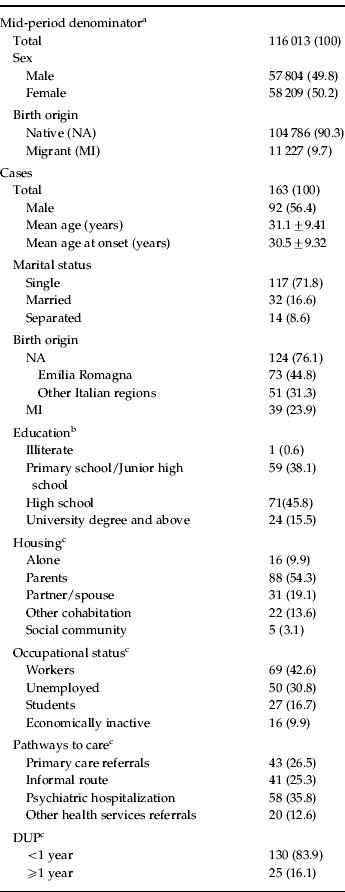
Patients aged between 18 and 64 years with a first episode of psychosis (coding F10–F29 and F30–F33 in ICD-10) were identified among those presenting for the first time to the three CMHCs within tightly defined catchment areas in West Bologna, Italy, over an 8-year period (January 2002–December 2009). The inclusion criteria are based on those used in the World Health Organization (WHO) study (Jablensky et al. Reference Jablensky, Sartorius, Ernberg, Anker, Korten, Cooper, Day and Bertelsen1992): that is, the presence of hallucinations, delusions, thought disorder, bizarre or disturbed behaviour, negative symptoms, mania, or clinical suspicion of psychosis; absence of an organic cause or profound learning disability; and no previous contact with psychiatric services for psychotic symptoms. A team of researchers was involved in checking weekly all patient contacts with the three CMHCs (Nani, Scalo and Tiarini) in the West Bologna catchment area. In Italy, CMHCs are services devoted to treating severe mental disorders and, in the Bologna Mental Health Department (MHD), almost all the patients with FEP are referred to CMHCs. Patients can be referred by many different agencies and self-referred (as described in Table 1). There were regular training events for staff. Each patient meeting inclusion criteria for the study was approached and informed consent sought.
Denominator population and sample characteristics of the FEP patients in the West Bologna catchment area

FEP, First-episode psychosis; DUP, duration of untreated psychosis.
Values given as n (%) or mean ± standard deviation.
a Values refer to year 2005.
b Eight missing.
c One missing.
Based on the methods used by Cooper et al. (Reference Cooper, Goodhead, Craig, Harris, Howat and Korer1987), we conducted a leakage study after the survey period to identify any subjects missed by checking the list of patients recorded at the Bologna MHD in the study areas. We reviewed all new mental health service registration forms held in the Bologna MHD and interrogated the computerized information systems.
Case-notes were used to complete the Item Group Checklist (IGC), part of the Schedule for Clinical Assessment of Neuropsychiatry, Version 2.1 (SCAN; WHO, 1998), to collect symptom-related data at the time of presentation and 1 month later to ensure that cases met ICD-10 criteria for psychotic disorders. Diagnoses were allocated by consensus agreement from a panel of psychiatrists at each study centre, including the principal investigator (I.T.) and the clinical researcher who completed the ICG-SCAN. For the analyses, we considered five diagnostic groups: (1) all psychoses, (2) affective psychoses (ICD-10 F30–F33), (3) non-affective psychoses (ICD-10 F20–F29), (4) schizophrenia (ICD-10 F20, including schizo-affective disorder F25), and (5) substance-induced psychoses (SIPs) (ICD-10 F10–F19).
We coded ethnicity along with place of birth of the patient and their parents. We created a dichotomous ethnicity variable [Migrant (MI) versus Native (NA)] using the Municipality Registry. This classification includes the white non-Italian (predominantly East European) group in the MI category. In assigning patients to ethnic groups and in collecting other sociodemographic (age, marital status, education, housing, occupational status) and migration history information (birth origin, reason for migration, length of stay in Italy), we used a form developed specifically for the study (Bologna Migration History and Social Integration Interview). Age of onset was obtained by asking the patients and/or key informants about when they experienced the first psychotic symptoms as defined above. Date of first contact with services was defined as the date when the patients referred for the first time to the West Bologna CMHC for their first episode of psychosis.
Statistical analysis
The variables examined included gender, age, age at FEP onset, marital status, place of birth, education, housing, occupational status, psychiatric diagnosis, pathways to care and substance abuse. To identify the potential confounding effect of demographic and clinical variables in the relationship between MI, substance abuse and duration of untreated psychosis (DUP), we used the χ2 test, Fisher's exact test or the Wilcoxon signed rank test. A multivariable regression model was used to analyse the relationship between MI, marital status, pathways to care and DUP, after adjusting for all the significant effects identified in univariable analyses. Median IR with interquartile range (IQR) and incidence rate ratios (IRRs) with 95% confidence intervals (CIs) were calculated. Rates are presented per 100 000 inhabitants at risk per year. Data were analysed by SAS 9.1.3 for Windows (SAS Institute Inc., USA).
Results
At mid-period the denominator population aged 18–64 in the catchment area was 116 013 (male: n=57.804, 49.8%; MI: n=1227, 9.7%) (see Table 1). Africans constituted 22.9% of the MI population, Europeans 32.7%, Asians 38.2%, Americans 6.1%, and others (i.e. Oceania and persons without citizenship) 0.1%.
Two hundred and six people passed the initial screen and 14 were identified by the leakage study. We excluded 57 on the basis of further information: likelihood of ICD-10 organic psychotic disorder (n=7); probable non-psychotic disorder (n=2); FEP prior to the study period (n=44); no information or notes (n=1); outside study area (n=1); without residence permit (n=1); and aged >65 years (n=1). A total of 163 cases from the three CMHCs met the inclusion criteria during the study period.
The majority of patients were men (n=92, 56%), and the mean age at onset was 30.5±9.32 years and at first contact was 31.1±9.41 years. Most were single and living with their parental family; more than half had a high school certificate or more, and 59% had a job or were students. MI comprised 24% of the sample (Table 1).
Pathways to care and DUP
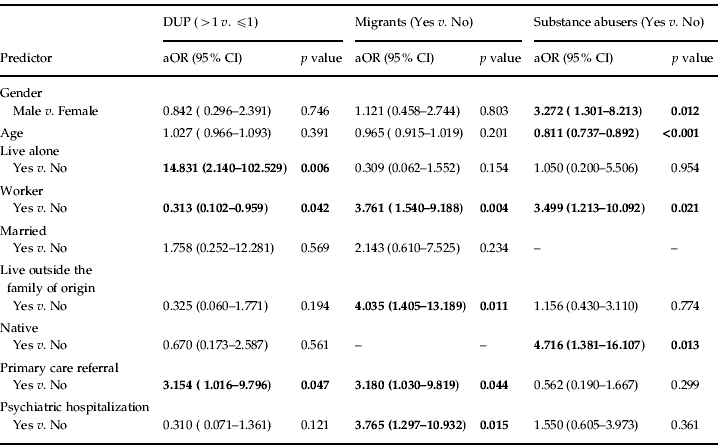
Access to CMHCs after psychiatric hospitalization was the most frequent pathway to care and accounted for one-third of referrals. The second most important source of referral was primary care, followed by informal pathways (self-referral, family or friends) and other health services (Table 1). The majority of the sample (84%) had a DUP <1 year. In a logistic regression model, after adjusting for gender and age at first contact, living alone and primary care referral (yes/no) were respectively associated with a five- and threefold increased odds of a DUP >1 year (Table 3).
Diagnoses
The majority of patients received a diagnosis of non-affective psychosis (n=120, 74%), of whom 48% (n=77) received a diagnosis of schizophrenia, 16% (n=26) brief psychotic disorder and 10% (n=17) other non-affective psychosis. Affective psychoses accounted for 12% (n=20), of whom 7% (n=12) were bipolar disorder and 5% (n=8) depression with psychotic features. SIPs accounted for 14% (n=23). Twenty-seven patients (16%) received a dual diagnosis (substance-related+other psychosis).
Age at onset and at first contact
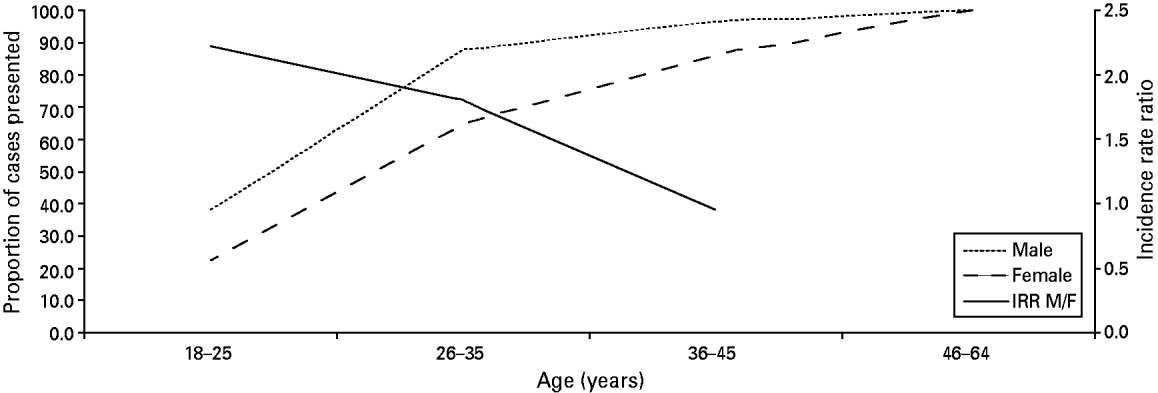
More than 80% of men and 60% of women in the sample had a first contact with mental health services before 36 years of age (Fig. 1). For all psychoses, the mean age at first contact was significantly lower for men [28.9 years (95% CI 27.2–30.5); median age 28 years (IQR 24–33)] than for women [33.8 years (95% CI 31.4–36.2); median age 34 years (IQR 31–36)]. As with the age at first contact, the mean age at onset for all psychoses was significantly lower for men [28.6 years (95% CI 26.9–30.3); median age 28 years (IQR 23–33)] than for women [32.9 years (95% CI 30.5–35.3); median age 30 years (IQR 26–38)]. Similar patterns were observed separately for non-affective psychosis but not for affective or substance-related psychosis. For these diagnostic groups we did not find any age differences at first contact between men and women.
Cumulative proportion of all psychoses by sex and age and incidence rate ratios (IRRs) for males (M) and females (F).

Median annual incidence rates
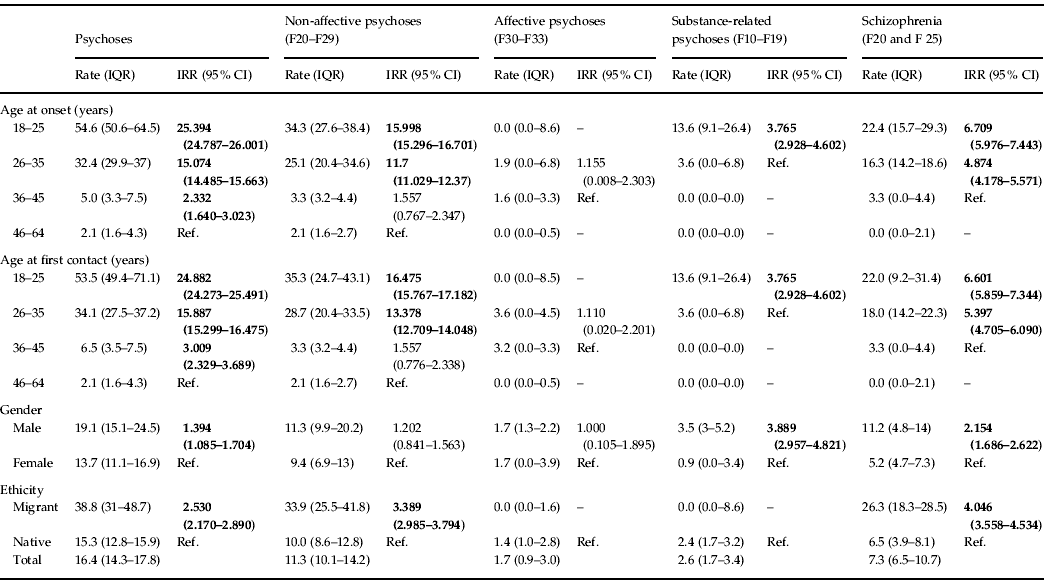
The overall median IR for all psychotic disorders was 16.4 per 100 000 inhabitants per year (IQR 14.3–17.8). The median IR for non-affective and affective psychoses was respectively 11.3 and 1.7 per 100 000 per year. The median IR for SIPs was 2.6 per 100 000 per year and that for schizophrenia was 7.3 per 100 000 per year.
The incidence of psychosis was significantly increased in younger age groups compared with the reference category (age 46–64 years). In particular, it was 25 times higher among those aged 18–25, 15 times higher among those aged 30–35 and two times higher among those aged 36–45. Similar IRRs were found when considering age at first contact. These associations were specific to non-affective psychoses (and schizophrenia) and to SIPs; no association was observed between age and affective psychoses (Table 2).
Median annual incidence rate of various psychoses×100 000

IQR, Interquartile range; IRR, incidence rate ratio; CI, confidence interval.
Statistically significant results appear in bold.
IRRs for all psychoses, for schizophrenia and for SIPs were higher for men than women. Sixty-five per cent of patients with schizophrenia and 70% of those with SIPs were men. Other non-affective psychoses and affective psychoses were more frequent among women (58% and 60% respectively). The incidence for men was higher than for women at younger ages, but as age increased, the difference disappeared. As shown in Fig. 1, the highest IRRs for all psychoses for men versus women occurred in the 18–25-year age group [IRR 2.2 (95% CI 1.6–2.8)]. The IRR decreased beyond age 25 years, and at 35–45 years it was close to 1. A similar pattern was observed for non-affective psychoses.
All MI were first-generation. For all psychoses, the IRR for the MI population was 2.530 (95% CI 2.170–2.890). Compared with NA, in MI the incidence was higher for non-affective psychoses (IRR 3.4, 95% CI 3.0–3.8) and in particular for schizophrenia (IRR 4.1, 95% CI 3.6–4.5).
Ethnicity
We found several significant differences between the MI group and NA. Using logistic regression and controlling for age and gender, patients in the MI group were significantly more likely to be working, married and live outside the family of origin. MI are more frequently referred to our CMHC after psychiatric hospitalization or by GPs (Table 3). There was no age difference between male and female MI at the time of psychotic onset and at first contact.
Predictors of DUP, migrants' status and substance abuse. Results from logistic regression modelsFootnote a

DUP, Duration of untreated psychosis; aOR, adjusted odd ratio; CI, confidence interval.
a Adjusted for all the variables in the table.
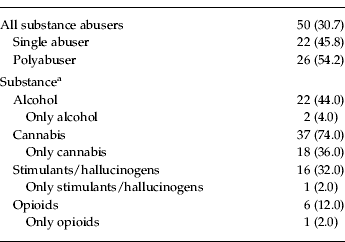
The BoFEP substance abusers
About one in three of the sample were current substance abusers. All FEP abusers are aged <35 years. Table 4 describes the distribution of substances used in the sample: cannabis was the most common, with three-quarters of multi-abusers smoking cannabis. Among users, 23 received a simple diagnosis of SIPs (F10–F19); 27 received a dual diagnosis of non-affective psychosis (F20–F29, n=22) or affective psychosis (F30–33, n=5) and substance-related disorder (abuse or dependence). Abusers were significantly younger at the onset of psychosis (24.8±4.7 v. 33.0±9.8 years, p<0.0001) and at first contact with psychiatric services (25.3±4.6 v. 33.6±9.9 years, p<0.0001).
Substance abuse

Values given as n (%).
a Two missing.
FEP substance abusers were more frequently male. After adjusting for age and gender, patients with substance abuse were 2.8 times more likely to be NA (Table 3).
The previously observed difference between females and males in age at first contact with a CMHC disappeared when only FEP abusers were included in the analysis (males 25.7±4.8 years, females 22.7±3.9 years, p=0.1391).
Discussion
Principal findings
This is the first incidence study carried out in Italy on prospectively identified and evaluated individuals with an FEP. We found an overall IR of psychosis of 16.4 per 100 000. Other psychosis incidence studies already available in Italy are based on case-registers or data concerning admission to general psychiatric hospitals (Thornicroft et al. Reference Thornicroft, Bisoffi, De Salvia and Tansella1993; Preti & Miotto, Reference Preti and Miotto2000). Of note, our finding of an overall schizophrenia IR of 7.3 per 100 000 is very similar to the mean rate of first admission to general hospital psychiatric services for schizophrenia found by Preti & Miotto (Reference Preti and Miotto2000). We also found an increased incidence of psychosis in young people, men and migrants. In particular, the incidence of psychosis was more than three times the overall rate in those aged 18–25 years (54.6 per 100 000).
Comparison with other FEP studies
Overall, the IR of FEP we found is lower than the IR found previously by other studies carried out in the UK (Kirkbride et al. Reference Kirkbride, Fearon, Morgan, Tarrant, Lloyd, Holloway, Hutchinson, Leff, Mallet, Harrison, Murray and Jones2006; Coid et al. Reference Coid, Kirkbride, Barker, Cowden, Stamps, Yang and Jones2008; Cheng et al. Reference Cheng, Kirkbride, Lennox, Perez, Masson, Lawrence, Hill, Feeley, Painter, Murray, Gallagher, Bullmore and Jones2011) and in other northern European countries (Cantor-Grae & Selten, Reference Cantor-Graae and Selten2005; Lao et al. Reference Lao, Sundquist, Frank, Johansson, Johansson and Sundquist2006; Veling et al. Reference Veling, Selten, Veen, Laan, Blom and Hoek2006). Even though we did not perform a direct statistical comparison between the results of our study and previous studies, the incidence we found seems to be near the incidence found in Bristol (Kirkbride et al. Reference Kirkbride, Fearon, Morgan, Tarrant, Lloyd, Holloway, Hutchinson, Leff, Mallet, Harrison, Murray and Jones2006) and in South Cambridgeshire (Cheng et al. Reference Cheng, Kirkbride, Lennox, Perez, Masson, Lawrence, Hill, Feeley, Painter, Murray, Gallagher, Bullmore and Jones2011), both overall and for the youngest groups (18–36 years old), particularly for schizophrenia. Overall, Bologna is less deprived and less ethnically heterogeneous than many European areas where other studies have been conducted. For instance, Bologna is an urban area with a high degree of social cohesion and low population mobility. The distribution of putative social risk factors for psychosis varies with the different population groups. Although the Bologna population is among the oldest in the world, with one in four citizens older than 65, migrants and students are two younger groups characterized by much greater economic instability and lower social cohesion than is found among Bologna's other inhabitants (Provincia di Bologna, 2007). Thus, the low overall rates mask higher rates in these groups. Bologna is a recent focus of immigration and most of the migrants living in this area are first-generation young migrants at the beginning of their adaptation process to the host society. Of note, we found an IR similar to the IR found in Brazil, Sao Paolo (Menezes et al. Reference Menezes, Scazufca, Busatto, Coutinho, McGuire and Murray2007). The incidence found in the Sao Paolo study was in fact lower than expected in such a vast urban area. In this regard, Kirkbride & Scoriels (Reference Kirkbride and Scoriels2009) stated that socio-environmental processes involved in the aetiology of schizophrenia seem to be more complex than simple linear associations with urbanicity. Social organization, for example the prevalence of people living with families and the level of social cohesion, should be evaluated by further studies to explain the similarities in psychosis rates among those studies.
However, within the context of an overall lower incidence of psychoses, we found the same sociodemographic correlates of incidence, such as age, gender and ethnicity, as found in northern European studies. We confirmed the age-at-first-contact pattern previously observed for schizophrenia (Hafner et al. Reference Häfner, Riecher-Rössler, an der Heiden, Maurer, Fätkenheuer and Löffler1993; Kirkbride et al. Reference Kirkbride, Fearon, Morgan, Tarrant, Lloyd, Holloway, Hutchinson, Leff, Mallet, Harrison, Murray and Jones2006); we show the classic excess for men at younger ages, followed by a later decline, with a non-significant rise in the incidence of psychoses for women older than 40. We found a greater incidence of schizophrenia and SIP for men than for women, as found by previous studies (Aleman et al. Reference Aleman, Kahn and Selten2003; Kirkbride et al. Reference Kirkbride, Fearon, Morgan, Tarrant, Lloyd, Holloway, Hutchinson, Leff, Mallet, Harrison, Murray and Jones2006). Like Kirkbride et al. (Reference Kirkbride, Fearon, Morgan, Tarrant, Lloyd, Holloway, Hutchinson, Leff, Mallet, Harrison, Murray and Jones2006), we confirmed that the most usual time of onset for affective psychosis is in early adulthood, as in schizophrenia, but the pattern for men and women is much more similar. The higher risk for FEP we found among MI is consistent with the mean weighted IRR (2.3, 95% CI 2.0–2.7) found in the recent meta-analysis of Bourque et al. (Reference Bourque, van der Ven and Malla2011).
Pathway to care and DUP
We found some sociodemographic factors associated with a DUP of ⩾1 year: in particular, living alone and being referred by a primary care. Living alone has previously been demonstrated in Italy to be associated with problems with psychiatric services utilization (Thornicroft et al. Reference Thornicroft, Bisoffi, De Salvia and Tansella1993). Paradoxically, for those with severe mental disorders, the most appropriate pathway to care is from GPs to CMHCs. However, in Italy, CMHCs can also be accessed directly, without a GP's referral. It is possible that to live alone and to be referred by a GP could be proxy variables for higher functioning and a lower severity of psychopathology that could lead, in several cases, to a delay of specialized psychiatric treatment and referrals to CMHCs. At the other end of the spectrum, patients living with others and with a good social network may access the CMHC directly with a shorter DUP. As shown in previous studies, the absence of family involvement in seeking help is related to a longer DUP (Morgan et al. Reference Morgan, Dazzan, Morgan, Jones, Harrison, Leff, Murray and Fearon2006).
The MI group
We observed a 2.5 times increased incidence of psychoses in the MI group compared with the NA group, consistent with the result of the meta-analyses of Bourque et al. (Reference Bourque, van der Ven and Malla2011). In our BoFEP sample, FEP MI seem to have a higher level of social functioning; a higher proportion are workers and live outside the parental family, in contrast to NA. These findings could indicate that socio-environmental risk factors not included here (e.g. individual social class and social capital; psychological effects such as life events, achievements and expectations; and neighbourhood deprivation) (Broome et al. Reference Broome, Woolley, Tabraham, Johns, Bramon, Murray, Pariante, McGuire and Murray2005; Morgan et al. Reference Morgan, Burns, Fitzpatrick, Pinfold and Priebe2007) could be relevant. It is also possible that different exposure to biological factors (e.g. unknown environmental contaminants, diet or infectious agents) (Brown et al. Reference Brown, Begg, Gravenstein, Schaefer, Wyatt, Bresnahan, Babulas and Susser2004; McGrath et al. Reference McGrath, Saari, Hakko, Jokelainen, Jones, Järvelin, Chant and Isohanni2004b ) may be aetiologically relevant in explaining the differences in IRs we observed between MI and NA, following the sociodevelopmental model of Morgan et al. (Reference Morgan, Charalambides, Hutchinson and Murray2010). Further studies with population-based control groups for comparison, such as the recently started pan-European EUGEI (European Network of National Schizophrenia Networks Studying Gene–Environment Interactions), will allow a deeper understanding of the nature of the sociodemographic differences found among FEP NA and FEP MI (van Os et al. Reference van Os, Rutten and Poulton2008).
In line with the AESOP study (Morgan et al. Reference Morgan, Dazzan, Morgan, Jones, Harrison, Leff, Murray and Fearon2006), we did not find any evidence that the DUP was longer for MI patients than for NA patients. In the UK, research has consistently shown that black Caribbeans are not only at greater risk of developing psychosis but also more likely to access mental health care through adversarial routes, often involving the police and compulsory admission, and are more likely to be treated in secure and forensic settings (Morgan et al. Reference Morgan, Dazzan, Morgan, Jones, Harrison, Leff, Murray and Fearon2006). Our study showed evidence for a more frequent pathway to CMHC care after psychiatric hospital admission and after GP referral; direct access to the West Bologna CMHC is less frequent among MI compared to NA. This could be due to different factors, related to MI patients and also to our psychiatric services, such as different attitudes towards mental health services among MI, and residual low cultural attractiveness of psychiatric services. The authors of the AESOP study (Morgan et al. Reference Morgan, Dazzan, Morgan, Jones, Harrison, Leff, Murray and Fearon2006) conjecture that there are ethnic differences at first contact, and consequently that processes within these communities might increase the risk of an adverse pathway to care prior to contact with services. This hypothesis needs further clarification in future studies.
Substance abuse
Our findings also show that substance use, particularly cannabis use, is associated with FEP; around one in three of our BoFEP cases are currently substance abusers, a markedly higher proportion than among young people in the general population (8%; Dipartimento Politiche Antidroga, 2010). At onset, substance abusers are significantly younger than non-abusers. We know that early onset is associated with worst outcomes (McGorry et al. Reference McGorry, Purcell, Goldstone and Amminger2011). Further longitudinal studies are needed to better clarify the causal relationship between cannabis use and psychosis onset and course. However, the evidence of an earlier psychosis onset in cannabis abusers could be considered as further evidence for the causal relationship between cannabis use and psychosis onset, as Large et al. (Reference Large, Sharma, Compton, Slade and Nielssen2011) concluded in their recent meta-analysis.
Methodological considerations and limitations
To our knowledge, this study is one of the first investigations of prospectively ascertained and clinically assessed FEP in Italy. This is a CMHC-based incidence study capturing all potential cases who made contact with mental health services within the catchment area and leakage studies were conducted to minimize underascertainment.
Some cases completely covered by the private sector (probably milder cases) may not have been included in the study. In Bologna, the public service is widespread across the territory and involves partnerships with private psychiatry practices. It should also be noted that, as stipulated by the organization of Italian CMHCs, patients with psychosis are not seen solely by their GP but always in collaboration with a CMHC psychiatrist. We know that FEP patients are not usually treated at only primary care level; however, we might have missed some cases, particularly those with less severe psychopathology and a higher socio-economic position, who tried to avoid the public health services and seek care in the private sector. Although a great effort was made to identify all potential cases of FEP, we could not rule out some possible underestimation of FEP incidence in the West Bologna catchment area. However, cases that did not access the CMHC directly or by referral through GPs or other services could be underestimated because we only performed a post-hoc linkage study based on data available in the Bologna MHD.
Consensus diagnoses were performed blind to the ethnic status of the case. Acknowledging that the true dynamic population at risk over the survey period may have varied slightly, denominators for the population at risk of psychosis were derived for each year from the Municipality Registry. Thus, we have no reason to believe that there was any systematic bias or under-enumeration of minority ethnic groups, males and younger people. We minimized any misclassification of ethnic status in our denominator and our numerator populations by using a dichotomous ethnicity variable with a very broad MI group and an easily definable comparator group.
Conclusions
In the current study we found that the incidence of schizophrenia and other psychotic syndromes varied according to age, gender and ethnic group. Thus, we consider that this study adds a contribution to our understating of the role of the major environmental candidates in FEP, such as gender, age, ethnicity, substance use and social organization, which seem to be pathogenetic in Italy and in northern Europe in general. These findings have implications for policy and mental health service development because it seems possible to develop targeted prevention intervention for risk groups, such as youth, MI and substance abusers. This also sets the scene for future investigation using more detailed assessments of individual and geographical characteristics with a view to examining causation. We agree with the conclusion of the AESOP study that genetic factors alone are not sufficient to explain the pathogenesis for the majority of psychoses (Kirkbride et al. Reference Kirkbride, Fearon, Morgan, Tarrant, Lloyd, Holloway, Hutchinson, Leff, Mallet, Harrison, Murray and Jones2006); research on gene–environment interactions, such as the EUGEI project (van Os et al. Reference van Os, Kenis and Rutten2010) funded by the European Commission within the Seventh Framework Programme (FP7), is promising as a means to explain the psychosis causation mechanisms.
Acknowledgements
We acknowledge the contribution of the entire West Bologna FEP Study team. We thank the patients and clinical staff of the West Bologna CMHC.
Declaration of Interest
None.