1. Introduction
Seafarers play an essential role in the shipping industry operation, but there exists an acute shortage of seafarer supply. According to Drewry's study (Drewry, 2014), the shortage of ship officers has reached up to 15,000 and the shortfall remains in 2019. China ranks first among the leading seafarer-supply nations and is capable of providing the global shipping industry with a large number of seafarers (BIMCO and ICS, 2015). Some 740,000 competent Chinese seafarers have entered the national and international maritime labour markets, 310,000 of whom are still active at sea today (CMOT, 2019). These seafarers have contributed enormously to the four decades of Chinese economic booming and are the backbone of the international maritime workforce for the steady development of the world seaborne trade (UNCTAD, 2018). In addition, the sustainable growth of Chinese seafarer stock will play a vital role in relieving the burden of global ship officer shortage (Zhang and Zhao, Reference Zhang and Zhao2014).
However, the steady provision of qualified seafarers cannot have been achieved without an effective Maritime Education and Training (MET) system. Since 1997, the China Maritime Authority has established a monitoring scheme named the Quality Management Systems (QMS) which is implemented by all MET institutions in China to ensure that seafarer training complies with the requirements of STCW (Wu, Reference Wu1996; EMSA, 2012). Over the years, a multi-tier MET system, including a four-year undergraduate program, three-year higher vocational education project, secondary vocational education program, two-year vocational programs and 18-month programs for cadets with a nonmaritime background (EMSA, 2012), has been shaped to cater to cadets from diverse educational backgrounds and with different work experience joining the seafarer occupation, and has greatly accelerated the growth of shipping manpower (CMOT, 2019).
However, previous studies unfold a number of deficiencies regarding this system inter alia, deficient onboard training (OBT), poor skills of instructors and inappropriate curricula (Ng and Yip, Reference Ng and Yip2009; BIMCO and ICS, 2015; Nazir et al., Reference Nazir, Øvergård and Yang2015; Guan, Reference Guan2019). Major challenges worldwide regarding the quality of OBT include a lapse of administration efforts to monitor OBT activities, a shortage of training berths and the inadequate involvement of shipboard senior officers in the OBT process, as well as the lack of collaboration among MET institutions, maritime authorities and the shipping industry (IMO, 2018a). Guan (Reference Guan2019) reviewed the effectiveness of government monitoring schemes for the OBT of Chinese cadets and found numerous deficiencies, such as indefinite responsibility division, nonstandard assessment criteria and short of supervision.
A large body of literature worldwide pointed at the importance of adequate MET and problems regarding the quality of the MET. One survey carried out by the Baltic and International Maritime Council (BIMCO) in 2015 revealed that current challenges facing the MET institutions included deficient funding, insufficient and inadequate faculty, incomplete training facilities and deficient government support (BIMCO and ICS, 2015). Ng and Yip (Reference Ng and Yip2009) insisted that the quality of the maritime curriculum offered in educational institutions in Hong Kong had great impact on the quality of future officer capability training, and argued that the curriculum of maritime education developed by an engineering-oriented department of a Hong Kong-based university could have failed to comply with the requirements of the STCW Convention. Davy and Noh (Reference Davy and Noh2011) highlighted the vital role of MET in preserving the safety of life at sea and advocated a review of the existing maritime education and training program in MET institutions in Korea. Nguyen et al. (Reference Nguyen, Ghaderi, Caesar and Cahoon2014) argued that the poor quality of graduates and trained seafarers were prominent challenges to seafarer recruitment in Vietnam. Yu (Reference Yu2014) studied the performance of instructors in MET institutions and argued that among 30 higher vocational institutions, 40% instructors were unskillful in practical training. Wang and Yeo (Reference Wang and Yeo2016) identified four major factors affecting foreign seafarer recruitment by Korean shipowners, such as ‘quality of seafarers’ education and training’ and supply ability for well-trained seafarers’.
Serious marine accidents caused by human factors, in particular the misconduct of incompetent officers, also sounded the alarm that MET quality is deteriorating. The appalling collision accident between MV SANCHI and MV CF CRYSTAL in January 2018 is one case in point. According to the report on the Investigation of the Collision between M.T. SANCHI and M.V. CF CRYSTAL in the East China Sea (CMSA, 2018), several factors attributed to the disaster. The major cause was that the officer of watch (OOW) aboard the give-way vessel SANCHI did not comply with COLREG Rules 15 and 16 regarding collision-avoiding actions in the crossing situation. The second cause was that the OOW on the stand-on vessel CF CRYSTAL failed to comply with COLREG Rule 17. Negligence of the OOW on CF CRYSTAL and inadequate bridge shift-change procedure were also contributory factors leading to the collision. It is evident that the accident had a direct connection with the incompetence of watchkeeping officers (CMSA, 2018). Since a third mate certificate is the first certificate of competency issued to the qualified holder right after successful completion of cadet education and training courses, this lack of following proper procedures implies that the education and training system for cadets might fail to ensure that prospective officers have received systemic, well-programmed and supervised campus and onboard training. This case, in fact, has increased concerns among stakeholders who are eager to find the major factors affecting cadets’ training quality.
This paper answers the following three key questions:
1. Is the quality of Chinese MET satisfactory to the maritime stakeholders?
2. What are the major factors affecting the quality of cadet training?
3. Are there feasible solutions to improve the quality of MET?
The paper consists of four parts. In the first part, based on the results of the literature review as well as semi-structured interviews, the authors develop a measuring instrument and then validate it by a typical social statistical tool, eg exploratory factor analysis. The findings are the four critical factors affecting the quality of cadet training. In the second part, the data collected from an online survey are analysed and the opinions of respondents are described from a statistical perspective. In the third part, this study further discusses the root causes for the inadequate capability of MET instructors and deterioration of the OBT quality, as well as the rationale for developing competence-based curricula. The last part comprises the suggestions for enhancing the quality of MET.
Three key concepts, namely discipline-centred curriculum, competence-oriented education and cchool-enterprise cooperation, are explained for clarification. Discipline-centred curriculum (DCC) aims to convey the cultural and scientific knowledge accumulated by human beings in the long process of historical development. Starting from the scientific category and subject knowledge system, DCC emphasises the systematisation of knowledge and logic of curriculum (Xu et al., Reference Xu, Zuo and Hu2011), and this type of curriculum has been dominant in MET institutions in China since the mid-1950s (Liu, Wu and Dong, Reference Liu, Wu and Dong2002).
Competence-oriented education (COE) emerged in the 1970s when the curriculum was designed with explicit linkage to professional skills (Parson et al., Reference Parson, Childs and Elzie2018). It was introduced into STCW 1995 amendments with the objective of developing seafarers’ competencies required for shipboard jobs (Morrison, Reference Morrison1998). The minimum standards of competence for officers are clearly defined as knowledge, understanding and proficiency (KUP) in the STCW, and it is made mandatory that the KUP be incorporated into the training courses and programs of MET.
School-enterprise cooperation (SEC) is a recently established training mode for the cultivation of cadets in China. In this mode, two parties are actively involved in the development of training courses and programs. MET institutions are responsible for on-campus training, while shipping enterprises are in charge of onboard training so as to achieve ‘customisation on demand’ as per the provisions of agreements (Zhu et al., Reference Zhu, Zhang and Bao2011).
2. Methodology
2.1. Survey procedure
Both quantitative and qualitative methods are used to investigate the views on the quality of MET from stakeholders. First, a semi-structured interview of 24 professionals representing all the stakeholders was held in the second half of 2018. Their opinions on the key issues of the quality of MET were collected. The grounded analysis method was used to extract the critical factors from the collected data, on the basis of which a preliminary questionnaire was designed. The questionnaire contains 15 questions, covering such areas as funding, instructors and facilities in the MET institutions, reform of MET curriculum, onboard training and MET supervision.
Secondly, the online presurvey was made through wjx.cn, a Chinese online survey tool (Exarchopoulos et al., Reference Exarchopoulos, Zhang, Pryce-Roberts and Zhao2018). In the pr-survey, the questionnaire was sent to 50 individuals, with 46 valid feedbacks received, the validity of which has been proved against the defined criteria. Finally, the link of the final questionnaire survey was sent to respondents through emails or WeChat.
2.2. Respondents
The respondents were selected on the basis of regions and identities. The questionnaires were sent to individuals from Shanghai, Guangdong, Jiangsu, Shandong, Zhejiang, Liaoning and Tianjin. These provinces are the major seafarer-supplying regions, and are estimated to have contributed about 53.2% of Chinese seafarers (CMOT, 2019).
The identities of respondents represent four groups: the MET institutions, the seafarer employers, the maritime authorities and the management-level seafarers. The MET institutions under investigation cover all tiers, ranging from universities and colleges and vocational schools to training centers. The employers are those that are directly involved in the recruitment of seafarers. Maritime authorities are responsible for the supervision of MET, examination and certification of seafarers. Therefore, their officials have authoritative evaluation of the quality of MET. Masters and officers at the management levels are in charge of monitoring and conducting OBT, hence they are also sensitive to the quality of OBT.
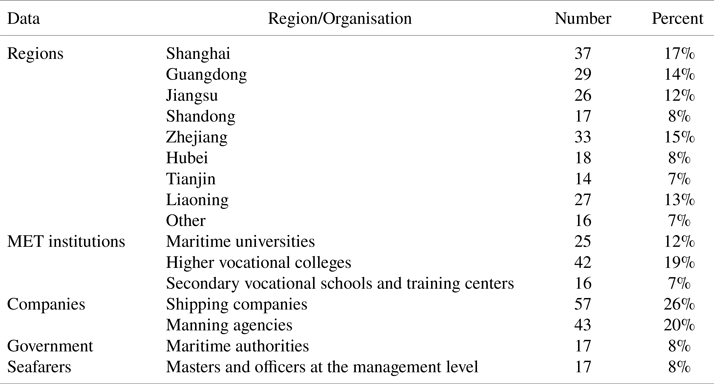
In the end of the survey, 229 feedbacks were received, 12 of which were discarded because seven were incomplete and five expressed highly extreme opinions. The remaining 217 responses were used for data analysis, making a 95% response rate and satisfying the requirements of the analysis (Fan et al., Reference Fan, Fei, Schriever and Fan2018) (see Table 1).
General information of the questionnaire respondents

2.3. Exploratory factor analysis
A statistical packages for social science (SPSS) was adopted for data analysis. Cronbach's alpha was used to test the reliability of the internal consistency of the questionnaire. The Cronbach's alpha score reaches 0⋅800, therefore the questionnaire meets the reliability criteria for internal consistency (Pallant, Reference Pallant2013).
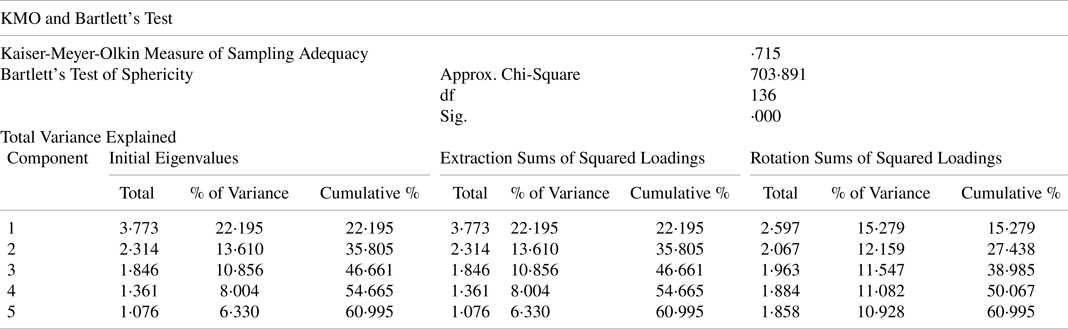
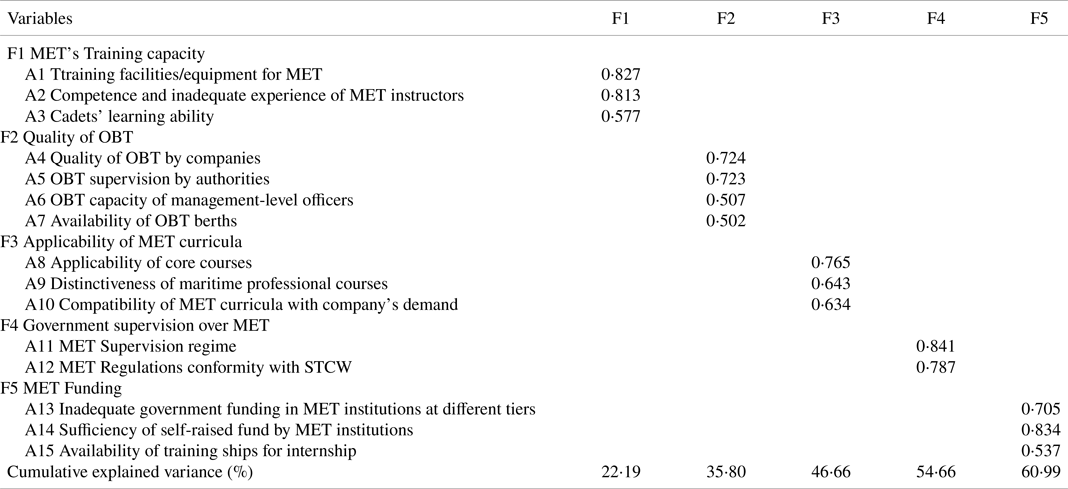
In order to verify the correlation between the items in the questionnaire, exploratory factor analysis (EFA) was conducted. The authors calculated the total variance explained in order to acquire the percentage of the total variance of the original variables explained by the extracted common factors (IBM, 2019). It was found that the cumulative rate is statistically significant (cumulative rate = 60⋅99%) (see Table 2), which was supported by the factor, the ability of satisfactory for EFA (Pallant, Reference Pallant2013). Among these items, the smallest factor loading was 0⋅502 (A7) and all of the items conform to the criteria that the factor loading should exceed 0⋅3 (Pallant, Reference Pallant2013). As the items in F4 number fewer than three, it was disregarded (Fan et al., Reference Fan, Fei, Schriever and Fan2018). The details are presented in Table 3.
Summary of exploratory factor analysis

Results of exploratory factor analysis by factors

Each factor was then named to summarise the items included, F1 as MET's training capacity, F2 as quality of OBT, F3 as applicability of MET curricula, and F5 as MET funding. According to the result of EFA, four factors remained in the questionnaire covering 13 items.
3. Data analysis and findings
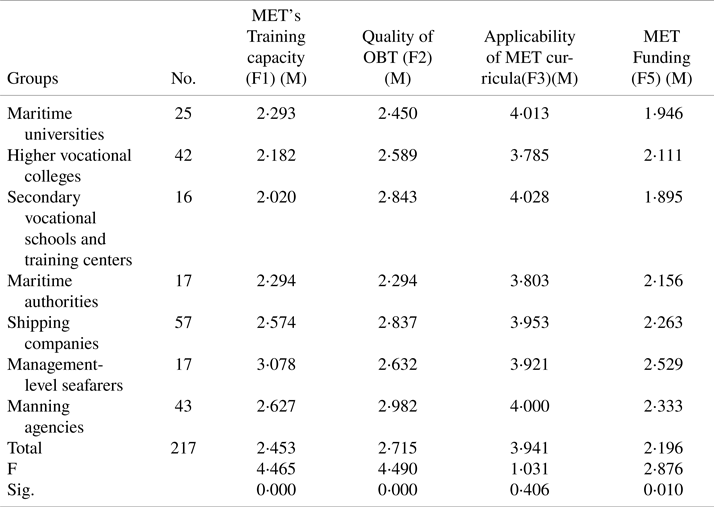
To test the existence of possible significant differences across different groups, ANOVA was conducted based on the data collected in the questionnaire survey. The authors adopted the five-point Likert Scale for scoring from 1 to 5. With respect to F1, F2 and F5, the lower the mean score, the higher the respondents’ expectation to change the current situations. With respect to F3, the higher the mean score, the higher the expectation to support reforming curriculum. As is shown in Table 4, the mean scores of F1, F2 and F5 are 2⋅453, 2⋅715 and 2⋅196, respectively, which are all lower than 3. This shows the respondents’ desire to improve Chinese MET in these three factors is strong. This table also shows that the mean score of F3 is 3⋅941, indicating that the respondents basically agree with reforming the existing MET curriculum.
ANOVA test of Factors on Quality of Chinese MET

3.1. Training capacity of MET institutions
The training capacity of MET institutions is embodied in various ways, such as adequate skillful instructors, sufficient training facilities (simulators or lab equipment) etc.
As is shown in Table 4, there was a statistically significant difference in MET's training capacity across seven groups ( $P = 0 \cdot 010 \lt 0 \cdot 05$). The mean (M) score (2⋅453) for this factor means that the training capacity is at a moderate level. Compared to other groups, the respondents from secondary vocational schools and training centres (M=2⋅020) were less satisfied with training facilities and the competence of instructors.
For A2 ‘Competence and inadequate experience of MET instructors’, 79% of respondents believed that MET institutions are facing the shortage of qualified instructors.
A director of the academic affairs office in a maritime college stated in an interview:
Most of the officers (seafarers) engaged in education lacked teaching skills and experience and were not proficient in instruction. They did not have a deep understanding of the relevant theoretical knowledge, therefore their performance in education was poor. For the same reason, these officers were merely employed for short courses. Few officers are competent for teaching CoC courses.
3.2. Quality of OBT
It is argued that OBT is a crucial step for transforming cadets into competent maritime manpower by linking theoretical knowledge with practices (IMO, 2018a; Guan, Reference Guan2019). However, recently maritime stakeholders showed their concerns over the quality of OBT (IMO, 2018b).
According to Table 4, there is a statistically significant difference in the quality of OBT across the seven groups ( $P = 0 \cdot 000 \lt 0 \cdot 05$). The mean score for F2 is 2⋅715, indicating that the quality of OBT is at a moderate level. It is worth noting that the mean score given by the officials from maritime authorities was the lowest (2⋅294). Maritime authorities are responsible for issuance of certificates of competency (CoC) for seafarers, and officials must verify the OBT Record Book before they grant the certificate. They are conversant with the effectiveness of OBT supervision. Therefore, the officials’ opinion on A5 ‘OBT supervision by authorities’ is representative. For example, one government official commented:
Maritime authorities have taken no alternative ways to supervise and assess OBT, merely depending on a mere paper review of the OBT Record Book. The effectiveness of OBT supervision needs to be improved further.
The capacity of masters and officers in organising and carrying out OBT for cadets has a significant influence on the outcome of the training onboard. In terms of A6 ‘OBT capacity of management-level officers’, 44% of respondents held that the competence of masters and officers in OBT is at a moderate level, while 22% of respondents rated it as relatively poor or poor level. A general manager of a manning agency stated in an interview:
Officers at management level should be trained in a formal and consistent manner with instructional techniques in accordance with IMO model courses so that they can acquire the capacity of conducting OBT and onboard assessment.
With respect to A4 ‘Quality of OBT by companies,’ approximately 40% of respondents disagreed that OBT conducted by companies is effective.
Some companies are reluctant to take the responsibility for cadets because of a high wastage rate of OBT, and it is common for cadets to terminate the internship deliberately; therefore, the companies may be concerned that the investment into OBT is less rewarded. For example, a senior manager of a ship-owning company explained in an interview:
Owners treat cadets in different ways. Some owners might employ cadets as manpower favorable for the future development of the company. They believe that after completion of the training plan, the cadets will become prospective officers in compliance with the safety culture of the company. However, some other owners take the training and employment of cadets as part of the operating costs. In these companies, cadets tend to be treated as a cheap labor force who might be contracted as ordinary sailors instead of being assigned as prospective officer trainees in the course of onboard training. With different attitudes towards OBT, shipping companies act differently, and this results in an enormous difference in the quality of OBT among companies.
3.3. Establishment of existing MET curriculum
Traditionally, the curricula of Chinese METs are featured as discipline-centred (as noted in Section 1) (Zheng, Reference Zheng1997). MET at the undergraduate level has undergone six decades of utilising complete discipline-centred courses and programs. Fifteen years ago, a number of secondary vocational schools were upgraded to higher vocational MET colleges (Bao and Xu, Reference Bao and Xu2008). The MET courses and programs they are using now were actually a reproduction of those from a few leading universities (as noted in Section 1), disregarding the fact that higher vocational colleges generally have three academic years, whereas universities normally have four academic years. Consequently, the content of their courses and programs is diminished and the emphasis is laid on theoretical teaching rather than competence development for the purpose of adapting to their shortened academic years (Hong, Reference Hong2014). There is a lack of practice courses specifically designed for the development of seafarers’ competence (Liu, Reference Liu2013).
Table 4 shows that there is no significant difference in the applicability of MET curricula across seven groups( $P = 0\cdot 406 > 0\cdot 05$). The MET institutions at all tiers believed that it is necessary to reform the existing MET courses and programs. In respect of A8 ‘Applicability of core courses’, 84% of respondents held that the existing training courses and programs can barely guarantee cadets’ competence for specific onboard capacity. In respect of A9 ‘Distinctiveness of maritime professional courses’ (as noted in Section 1), 89% of respondents agreed or highly agreed that a competence-oriented curriculum plays an important role in building seafarers’ competence. For example, in an interview, one head of the training center of a maritime college reasoned:
In order to improve the quality of maritime vocational education, hands-on training should be conducted. The approved in-service experience or simulator training can be the methods for demonstrating competence.
He also holds that shipping companies should be encouraged to take part in the training and assessment of competence of cadets.
3.4. Funding of MET
Chinese MET institutions are funded by diverse sources, including the central government, local governments, and public and private companies. Therefore, the capital source for education and training differs from one institution to another (Zhang, Reference Zhang2016). In some provinces with higher fiscal revenue, the local governments can provide more funds for MET. In provinces of poor financial condition, the governments invests less in MET (CMOE and CMOT, 2012) or even grants no support for private MET institutions.
MET is capitalintensive and traditional maritime countries offer great support, usually special supporting funds for MET, which has proved an effective way to maintain sustainable development of seafarers (UK DOT, 2015; MPA, 2017). China also grants funds for maritime education (CMOE and CMOT, 2012). Nevertheless, the authors observed that five out of six interviewees from MET institutions complained about inadequate funding. Table 4 indicates that there is a statistically significant difference in MET funding across the seven groups ( $P = 0 \cdot 010 \lt 0 \cdot 05$). The lowest mean score (1⋅895) is for secondary vocational schools and training centers, which demonstrates they are unsatisfied with the funding. MET institutions at all tiers agree that funding is insufficient.
In respect of A14 ‘Sufficiency of self-raised fund by MET institutions’, around three-quarters of respondents from institutions hold that MET institutions are short of education funds, especially higher vocational and secondary vocational schools. As one dean of a higher vocational college stated:
There is barely governmental funding for nautical schools in underdeveloped provinces. Those MET institutions which lack funding tend to be commercialised and are in a serious shortage of qualified faculty and training equipment/facilities. Hence, the quality of their graduates is deteriorating.
The amount of investment in MET is largely dependent on the fiscal status of local governments, and this adds difficulty for increasing the funding for MET institutions in the underdeveloped provinces in the near future.
4. Recommendations
4.1. Improvement of instructor capacity
As per STCW(A-I/6), parties must ensure that those persons responsible for the training and assessment of competency of seafarers are appropriately qualified and experienced with proper training in instructional techniques and assessment methods and practice (Morrison, Reference Morrison1998). Therefore, parties are responsible for establishing appropriate standards for instructors engaged in the training and assessment for cadets (IMO, 1997).
In China, MET instructors are required to have proper qualifications (CMOE and CMOT, 2012). The maritime authority has stipulated minimum requirements for MET instructors, such as the length of seagoing services, and the level of CoC in conformity with training types and levels. In addition, passing the national exam organised by maritime authorities, a theoretic test whose syllabus is the same as that for testing seafarers’ competency, is another benchmark for becoming qualified MET instructors (CMOT, 2013). Currently, this test is given twice every year. There is at present no practical assessment available for the evaluation of practical instruction skills (CMSA, 2019).
As per STCW(A-I/8) and national QMS for MET (CMOT, 2013), qualifications and experiences of instructors are incorporated in the QSS implemented in each individual institution. National QMS for MET requires that specialised training for MET instructors should be organised by each individual MET institution.
Currently, training courses and plans for MET instructors vary at different MET institutions.The instructors training activities monitoring is absent from maritime authorities. Completion of training for trainee instructors is not per condition to the test of national exams. When trainee instructors successfully pass the test of the national exams, they are recognised as qualified MET instructors (CMSA, 2019). Neither national training syllabus designed for MET instructors nor assessment criteria for instructors’ practical instruction skills exists. Considering the sizeable MET institutions of different tiers in China, the training quality might not be homogeneous across the country.
A national training syllabus for training and assessment of instructors should be drafted to harmonise instructors’ training activities among more than 70 MET institutions (Yu, Gao, Li, Liu and Zhang, Reference Yu, Gao, Liu, Liu and Zhang2016). It is proposed that the IMOs’ model courses, 6⋅09 (Training Course for Instructors) are referenced for composing the national syllabus. When developing the syllabus, a few principles should be observed. First, the capacity for ‘knowledge transmission’ should be prioritised, rather than the mastery of professional knowledge. Second, the trainee instructor should have full comprehension of the competency requirements for each individual capacity on board. Third, the ability to develop courses and organise classroom teaching should be cultivated. Fourth, the trainer instructors’ capability of using a range of teaching methods and appropriate training aids should be stressed. Fifth, the trainee instructors should be competent in evaluating both teaching and learning. The maritime authority can approve the training courses and training plans developed by individual institutions according to the proposed national training syllabus for MET instructors. Once approved, these courses and plans can be accepted as the evidence of qualification of MET instructors who can be exempt from the mandatory exam for MET instructors.
The rapid enrollment expansion in MET institutions has rendered the shortage of skillful instructors a grave problem. As is revealed by the government-launched MET project (SMSA, 2014), the ratio of instructors to cadets for MET institutions across the country roughly has reached 1:30, much lower than that is required by the Ministry of Education in China (CMOE, 2004), the gap being 25% (referred ratio of 1:18), 43% (referred ratio of 1:16) and 33% (referred ratio of 1:20) in maritime universities, higher vocational colleges and secondary vocational schools, and training centers, respectively.
4.2. Enhancement of quality OBT based on SEC
From 2014, SEC mode (as noted in Section 1) has been introduced into the cadets’ training scheme, where cadets need to serve for those shipping companies for several contract years after obtaining the initial CoCs. It is an effective measure to improve the retention of seafarers and their sense of belonging. However, only two maritime universities, Dalian Maritime University (DMU) and Wuhan University of Technology, are authorised to implement the SEC mode on a trial basis. Maritime authorities are advised to promote the SEC training arrangements to enhance seafarer training from shipping companies.
A representative of owners held that:
SEC training may make a shipping company realise that the cadets can serve for the company in the near future; hence, the owner will make its best to train them into prospective officers for the company.
A trainee who had received SEC training said, ‘such training scheme made me know the company I was going to serve and encouraged me to try hard to meet standards for the development of the company.’
In addition to the verification of completed training record books, on-site supervision of OBT can act as a feasible solution regarding F5‘Effective OBT supervision by authorities’. Flag State Control (FSC) officials should embark on running spot checks to verify the authenticity and effectiveness of OBT program implementation. For the purpose of improving the training skills of officers at the management level, appropriate guidance of instructional techniques, training methods and practice, and in-service assessment methods and practice (STCW B-I/6) should be incorporated into in-service training for masters, chief mates, chief engineers and second engineers.
4.3. Development of competence-based curricula
STCW clearly defines the minimum standards of competence for seafarers (Morrison, Reference Morrison1998). The ability to deal with complex shipboard scenarios may be effectively accumulated if cadets are trained according to competence tables in the STCW Code (IMO, 2010).The core courses (A8) should be reformed to present the distinctiveness of maritime professional courses (A9) and develop training courses and programs pertaining to shipboard routine operations, such as conducting a passage plan, determining ship's position and maintaining a navigational/engineering watch. Thereby, cadets will be trained for performance competence meeting the requirements for shipboard capacities (CMOE and CMOT, 2016). In respect of specific reform measures, one option is to train cadets in detailed operations or procedures for each capacity described in the safety management system (SMS) formulated by the leading shipping companies. It is posited that the competence-oriented curricula can improve conformity between training programs and shipboard capacities.
5. Conclusion
In this empirical study, by employing a mixed method of both quantitative and qualitative analysis of the data collected from semi-structured interviews and questionnaire surveys, four main factors damaging the quality of MET in China were revealed, namely: 1. shortage of qualified instructors (F1), 2. lack of supervision of OBT (F2), 3. inadequate practical training in MET institutions (F3) and 4. inadequate funding (F5). It also suggests that Chinese stakeholders disagree that the current quality of MET is acceptable.
The shortage of skillful instructors is eminent, the worst case being around 40% less than what is required of higher vocational colleges. Further, without a national training syllabus for MET instructors, the training quality for instructors cannot be secured. Therefore, five principles for establishing national training syllabus are proposed and institutions are recommended to seek maritime authorities’ approval of their instructor training plans for cultivating qualified MET instructors.
The absence of effective measures for maritime authorities to supervise and evaluate OBT can contribute to incompetent officers entering the markets. So stricter supervision should be conducted to verify the authenticity of OBT courses. Meanwhile, stronger collaboration in the form of SEC training arrangement currently at a trail state should be extended to higher vocational institutions (IMO, 2019a, 2019b).
The existing curricula used in most MET institutions are theoretical knowledge-oriented, lacking practical training and practice contents essential for work on ships. Therefore, it is advisable to establish competence-oriented programs in line with international standards for MET courses.
The potential limitations of the paper are acknowledged. First, the respondents from the government are too limited to make their views representative, especially regarding OBT quality. The questionnaires were sent only to those maritime officials in charge of issuing COCs, with one or two officials chosen from each regional MSA within China, which inevitably makes this group a relatively marginal. Secondly, regardless of the authors’ efforts to discard the respondents with extreme opinions, bias may still exist because the criteria determining extreme opinions itself presents the ambiguity. In addition, the root causes which deteriorate the quality of OBT recently might be at the policy level. For example, cadets are encouraged to apply for rating certificates to form part of a watch in order to ease the tension of training berth shortages. Therefore, further research must be conducted.