INTRODUCTION
Despite significant recent advances in the use of cognitive behavioural treatment of panic disorder (PD), research has failed to identify consistent prognostic indices (Keijsers et al. Reference Keijsers, Hoogduin and Schaap1994; Steketee & Shapiro, Reference Steketee and Shapiro1995). Baseline frequency and duration of panic episodes and self-rated anxiety have been shown to be predictive of post-treatment or follow-up outcome in some studies (Ronalds et al. Reference Ronalds, Creed, Stone, Webb and Tomenson1997; Scheibe & Albus, Reference Scheibe and Albus1997; Sharp & Power, Reference Sharp and Power1999), but not others (e.g. Keijsers et al. Reference Keijsers, Hoogduin and Schaap1994; O'Rourke et al. Reference O'Rourke, Fahy, Brophy and Prescott1996; Katschnig & Amering, Reference Katschnig and Amering1998). A higher degree of consistency has been reported for psychological co-morbidity as a negative correlate of outcome (Liebowitz, Reference Liebowitz1997; Lecrubier, Reference Lecrubier1998), including severity of associated agoraphobic avoidance (Hafner & Ross, Reference Hafner and Ross1983; Mavissakali an & Michelson, Reference Mavissakalian and Michelson1986; Fischer et al. Reference Fischer, Hand, Angenendt, Büttner-Westphal, Manecke, Hand and Wittchen1988; Emmelkamp et al. Reference Emmelkamp, van Dyck, Bitter, Heins, Onstein and Eisen1992; Steketee & Shapiro, Reference Steketee and Shapiro1995; Liebowitz, Reference Liebowitz1997; Scheibe & Albus, Reference Scheibe and Albus1997; Sharp & Power, Reference Sharp and Power1999; Shinoda et al. Reference Shinoda, Kodama, Sakamoto, Yamanouchi, Takahashi, Okada, Noda, Komatsu and Sato1999; Ramnerö & Öst, Reference Ramnerö and Öst2004); co-morbid generalized anxiety disorder (Scheibe & Albus, Reference Scheibe and Albus1997); concomitant depression (Keijsers et al. Reference Keijsers, Hoogduin and Schaap1994; Ronalds et al. Reference Ronalds, Creed, Stone, Webb and Tomenson1997; Sharp & Power, Reference Sharp and Power1999; Fava et al. Reference Fava, Rafanelli, Grandi, Conti, Ruini, Mangelli and Bellvardo2001); marital dissatisfaction (Dewey & Hunsley, Reference Dewey and Hunsley1990; Emmelkamp & Gerlsma, Reference Emmelkamp and Gerlsma1994); and personality disorder (Keijsers et al. Reference Keijsers, Hoogduin and Schaap1994; Liebowitz, Reference Liebowitz1997; Shinoda et al. Reference Shinoda, Kodama, Sakamoto, Yamanouchi, Takahashi, Okada, Noda, Komatsu and Sato1999). Low motivation for treatment and expectation of improvement (Keijsers et al. Reference Keijsers, Hoogduin and Schaap1994; Clark et al. Reference Clark, Salkovskis, Hackmann, Wells, Ludgate and Gelder1999), dysfunctional interpretations about bodily sensations and agoraphobic cognitions (Clark et al. Reference Clark, Salkovskis, Hackmann, Middleton, Anastasiades and Gelder1994, Reference Clark, Salkovskis, Hackmann, Wells, Ludgate and Gelder1999; Schmidt et al. Reference Schmidt, Lerew and Jackson1997; Norton et al. Reference Norton, Pidlubny and Norton1999) have also been shown to predict poorer outcome. Sociodemographic variables have the weakest relationship with outcome (Keijsers et al. Reference Keijsers, Hoogduin and Schaap1994; O'Rourke et al. Reference O'Rourke, Fahy, Brophy and Prescott1996; McCusker et al. Reference McCusker, Boiulenger, Bellavance, Boyer and Miller2000).
In terms of post-treatment prediction of long-term outcome, several variables have been shown to be significant, including degree of residual anxiety and agoraphobic avoidance (Fava et al. Reference Fava, Rafanelli, Grandi, Conti, Ruini, Mangelli and Bellvardo2001) and the persistence of key dysfunctional cognitions, particularly the misattribution of bodily sensations (Clark et al. Reference Clark, Salkovskis, Hackmann, Middleton, Anastasiades and Gelder1994, Reference Clark, Salkovskis, Hackmann, Wells, Ludgate and Gelder1999). Such findings mirror similar relationships between post-treatment residual symptoms and sustained improvement in the management of mood disorders (Fava, Reference Fava1999) and phobic states (O'Sullivan & Marks, Reference O'Sullivan, Marks, Noyes, Roth and Burrows1990). Concomitant drug treatment at the time of remission of anxiety with cognitive behavioural therapy (CBT) has also been associated with higher rates of relapse compared to CBT alone (Marks et al. Reference Marks, Swinson, Basoglu, Kuch, Noshirvani, O'Sullivan, Lelliott, Kirby, McNamee, Sengun and Wickwire1993; Brown & Barlow, Reference Brown and Barlow1995; Van Balkom et al. Reference Van Balkom, de Beurs, Koele, Lange and Van Dyck1996; Otto et al. Reference Otto, Pollack and Sabatino1996; Fava et al. Reference Fava, Rafanelli, Grandi, Conti, Ruini, Mangelli and Bellvardo2001), although Oei et al. (Reference Oei, Llamams and Evans1997) failed to obtain similar findings.
There are numerous reasons for such inconsistencies, including cross-study differences among measures of both predictor and outcome variables; sample specific, non-replicable findings due to variable subject entry criteria; and inadequate sample size for the number of postulated prognostic variables (Steketee & Chambless, Reference Steketee and Chambless1992; Keijsers et al. Reference Keijsers, Hoogduin and Schaap1994; Durham et al. Reference Durham, Allan and Hackett1997; Sharp & Power, Reference Sharp and Power1999). Moreover, the collective influence of multiple variables on outcome and their differential relationship to specific treatments have not, in general, been adequately investigated. In addition, much research in this area, as observed by Steketee & Chambless (Reference Steketee and Chambless1992), has involved a ‘haphazard approach to prediction’, unguided by specific hypotheses, and based on clinical trials and outcome measures of limited ecological validity.
The aim of the present study was to address such difficulties using data from a recent clinical effectiveness trial conducted by Kenardy et al. (Reference Kenardy, Dow, Johnston, Newman, Thomson and Taylor2003a), in which three forms of CBT delivery for patients with PD and PD and agoraphobia (PDA) were compared. Patients were randomly allocated to (a) ‘standard’ 12-session therapist-directed CBT (CBT12); (b) six sessions of therapist-delivered CBT (CBT6); (c) six sessions of computer-assisted CBT (CBT6-CA); or (d) a waiting-list control condition. The results showed all three treatments to be effective, with CBT12 being significantly superior to CBT6 on a composite panic/anxiety measure at post-treatment. Outcome with CBT6-CA occupied an intermediate position between standard (CBT12) and brief (CBT6) therapist-directed treatments, but was not significantly different from either. A higher degree of variability of response to CBT6 compared to the standard approach was apparent on most measures. No differences were found between the active treatments at follow-up.
The trial's design provided an opportunity not only to examine in more detail factors predictive of outcome generally with CBT for PD but also to help identify moderators of outcome in relation to brief and standard forms of CBT with this patient group. This report and the subsequent one are concerned with each of these aims respectively.
Hypotheses
On the basis of the previous research, we hypothesized that:
(a) baseline level of severity of panic disorder and associated anxiety, as determined by panic frequency and severity of panic-related distress, duration of disorder, degree of agoraphobic avoidance and expectations about the likely effectiveness of therapy, will predict post-treatment outcome;
(b) baseline level of secondary associated disability, as determined by degree of co-morbidity and impairment of social, occupational and family life, will predict post-treatment outcome;
(c) the degree to which patients retain, at the end of active treatment, dysfunctional cognitions involving the catastrophic misinterpretation of bodily sensations will predict outcome at follow-up;
(d) the degree of residual panic/anxiety symptoms and agoraphobic avoidance at the end of active treatment will also predict outcome at follow-up;
(e) the continuing use of anxiolytics, and in particular benzodiazepines, on completion of CBT will predict the maintenance of treatment gains at follow-up.
METHOD
Data for the present study were derived from a randomized controlled trial of three forms of CBT delivery for PD with and without agoraphobia, the results of which, summarized above, have been reported fully elsewhere (Kenardy et al. Reference Kenardy, Dow, Johnston, Newman, Thomson and Taylor2003a).
Treatments
Therapy was conducted by registered clinical psychologists, all of whom had extensive CBT experience. The two brief forms of CBT delivery involved six 1-hour weekly sessions and were identical condensed versions of the standard format comprising 12× 1-hour weekly sessions. Detailed treatment protocols were prepared based on now well-established cognitive and behavioural theories of panic and its treatment (Clark, Reference Clark1986; Barlow & Craske, Reference Barlow and Craske2000). CBT6-CA involved the adjunctive use of a palmtop computer to prompt and encourage practice of the main cognitive and behavioural elements of treatment.
Sample
The sample comprised 186 patients with PD and PDA, recruited from two sites (Australia and Scotland), who were randomly allocated to 12 sessions of therapist-delivered CBT (CBT12), six sessions of therapist-delivered CBT (CBT6), computer-assisted CBT (CBT6-CA) or a waiting-list control condition. Full details of the entry criteria are described in the original outcome study report (Kenardy et al. Reference Kenardy, Dow, Johnston, Newman, Thomson and Taylor2003a). In summary, the sample comprised patients meeting DSM-IV (APA, 1994) criteria for PD, with or without agoraphobia; had a current episode duration of at least 3 months; were between 18 and 60 years of age; considered panic their main problem; and had no depressive disorder severe enough to require urgent treatment. All patients taking medication at the time of entry were on a stable dose for at least 3 months and were willing and able to remain on a stable regime for the 3-month duration of treatment.
Waiting-list subjects (n=46) showed no evidence of significant change on any of the dependent measures in the original trial and were not included in the present analysis; nor were drop-outs (i.e. those who failed to attend on more than two occasions or who failed to provide adequate pretreatment and endpoint data; n=19).
Measures
As in the original outcome study (Kenardy et al. Reference Kenardy, Dow, Johnston, Newman, Thomson and Taylor2003a), there were two principal dependent measures. The first was a single unweighted composite panic-anxiety measure to control for experimental error (Clark et al. Reference Clark, Salkovskis, Hackmann, Middleton, Anastasiades and Gelder1994) in view of the large number of anxiety scales. This was calculated using the procedure recommended by Conners et al. (Reference Conners, Epstein, March, Angold, Wells, Klaric, Swanson, Abikoff, Arnold, Elliott, Greenhill, Hechtman, Hinshaw, Hoza, Jensen, Kraemer, Newcorn, Pelham, Severe, Vitiello and Wigal2001). The composite measure comprised data from each of 11 panic/anxiety measures: panic frequency; patient and clinician-assessed panic severity/disability; State-Trait Anxiety Inventory (STAI; Spielberger et al. Reference Spielberger, Gorsuch and Lushene1970); Fear Questionnaire subscales: Agoraphobia; Social; Blood/Injury (Marks & Mathews, Reference Marks and Mathews1979); Mobility Inventory for Agoraphobia: ‘Alone’ and ‘Accompanied’ (Chambless et al. Reference Chambless, Caputo, Jasin, Gracely and Williams1985); the Body Sensations Questionnaire (BSQ) and the Agoraphobic Cognitions Questionnaire (ACQ) (Chambless et al. Reference Chambless, Caputo, Bright and Gallagher1984).
The other main dependent variable was a measure of clinically significant outcome adopted by Craske et al. (Reference Craske, Brown and Barlow1991) and Clark et al. (Reference Clark, Salkovskis, Hackmann, Middleton, Anastasiades and Gelder1994), with high end-state functioning (ESF) defined as the absence of panic attacks over the preceding 2 weeks and an assessor panic-related distress/disability rating ⩽2 (maximum 8), i.e. ‘slight’.
Assessments in the original study were undertaken at baseline, immediately after the 3-month active treatment period, and at the 6-month follow-up. The following outcome measures provided additional independent variables pre- and post-treatment: the Beck Depression Inventory (BDI; Beck et al. Reference Beck, Steer and Garbin1988); the Medical Outcomes Study 36-item Short Form Health Survey (SF-36; Ware & Sherbourne, Reference Ware and Sherbourne1992); and the Sheehan Disability Scale (SDS; Sheehan, Reference Sheehan1986).
Statistical analyses
An examination of prognostic indices was conducted in relation to all three treatment groups combined. The pooling of subjects across treatments in the first instance was justified on the grounds that all three treatments involved CBT and followed the same content, the only differences being duration of treatment programme, frequency of therapist contact and form of delivery. In view of the large number of potential predictors, preliminary bivariate analyses were conducted to identify smaller subsets of potential predictors for inclusion in subsequent regression analyses. The relationship of each variable with each of the two main outcome measures was examined using bivariate Pearson correlations or a series of univariate logistic regression analyses, depending on whether the outcome measure was continuous or categorical. Predictors shown to be significant in relation to both dependent measures were included in subsequent multivariate regression analyses. Stepwise multiple regression analysis was conducted in which the post-test or follow-up score was the criterion and the prior test score on that same measure was forced to enter the equation before the predictor(s) of interest. The resulting change in R 2 when the predictors are entered is thus readily interpreted as a measure of change or maintenance (Steketee & Chambless, Reference Steketee and Chambless1992). The strengths of associations identified were estimated from the proportion of the variance in the dependent variable accounted for by the combination of independent (predictor) variables that entered each regression equation. In line with the recommendations of Steketee & Chambless (Reference Steketee and Chambless1992) that the results encompass both degree of change and determination of recovery, an analysis of predictors of high and low ESF was also conducted by means of stepwise logistic regression.
RESULTS
Preliminary bivariate analyses revealed a number of significant results for both outcome measures, providing varying degrees of support for all of the above hypotheses. Despite the risk of Type I error, a normal α level of 0·05 was retained to help to identify those variables that might contribute some explanatory variance from subsequent regression analysis.
Pretreatment associations with post-treatment outcome
Hypothesis (a): Baseline symptom severity and outcome expectations
Five variables relating to baseline severity of panic and anxiety were found to be significantly associated with both measures of clinical improvement. These were the Fear Questionnaire's Agoraphobia (r=0·46, p<0·001) and Blood-Injury (r=0·45, p<0·001) subscales; Mobility Inventory – Alone (r=0·49, p<0·001) and Accompanied (r=0·34, p<0·001); and the Trait measure of STAI (r=0·35, p<0·001). Age of first onset of panic also distinguished those with high and low ESF (exp β=1·06, p<0·05), with those experiencing panic attacks for the first time at a younger age having a poorer outcome. A similarly consistent trend on both dependent measures was also found for interviewer ratings of panic severity (r=0·21, p=0·05). Patients' expectations of the likely effectiveness of treatment and their confidence in the treatment rationale were each significantly correlated with the post-treatment composite score (r=−0·23 and r=−0·25, p<0·05, respectively), although these relationships did not reach significance in distinguishing those with high and low post-treatment ESF.
Hypothesis (b): Secondary associated disability/co-morbidity
The presence of associated agoraphobia, depression, social anxiety and impairment of social, occupational and family relationship functioning from the SDS were included in the preliminary analyses. Two variables showed a significant correlation in the predicted direction with both dependent measures: an additional diagnosis of social anxiety (r=0·28, p<0·01) and the SDS rating of secondary impairment of family life (r=0·22, p<0·05). The only other significant results were bivariate correlations with the post-treatment composite measure only and included the other two aspects of impaired functioning from the SDS (i.e. work and social life: r=0·20, p<0·05 and r=0·30, p<0·01 respectively) and self- and interviewer ratings of depression (BDI: r=0·28, p<0·01 and HAMD: r=0·23, p<0·05). Having a co-morbid diagnosis of depression, generalized anxiety or obsessional-compulsive disorder was not shown to be associated with a poorer outcome. As predicted, associated agoraphobia was, but only in relation to the post-treatment composite score (r=0·24, p<0·05). Whether or not concomitant anxiolytics or antidepressant medication were being taken and the duration of their use, if relevant, were also unrelated to post-treatment outcome.
Post-treatment associations with follow-up outcome
Hypothesis (c): Agoraphobic cognitions
With respect to the relationship between the persistence of dysfunctional agoraphobic cognitions at post-treatment and long-term outcome, there was a significant correlation with the follow-up composite score (r=0·56, p<0·001). This relationship was further supported by the results from the comparison between the high/low ESF groups (exp β=0·36, p<0·05).
Hypothesis (d): Residual anxiety and agoraphobic avoidance
As hypothesized, significant associations with both measures of long-term outcome, all in the predicted direction, were found for post-treatment patient and interviewer ratings of residual panic severity (r=0·50, p<0·001 and r=0·49, p<0·001, respectively), degree of agoraphobic avoidance, when unaccompanied (r=0·55, p<0·001), Fear Questionnaire – Agoraphobia subscale (r=0·57, p<0·001), SF-36 – Mental (r=−0·53, p<0·001) and Physical factors (r=−0·52, p<0·001), and degree of associated impairment of social (r=0·60, p<0·001), work (r=0·56, p<0·001) and family life (r=0·52, p<0·001).
Hypothesis (e): Anxiolytic use
Support was also found on both outcome measures for the hypothesis that those continuing to take anxiolytics at the end of CBT treatment would experience poorer outcome at follow-up compared to those who were not taking anxiolytic medication (r=0·36, p<0·01).
Prediction of post-treatment outcome
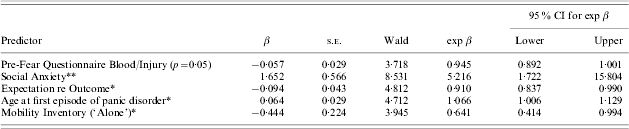
The above subset of variables, where a significant bivariate relationship with outcome was found, was entered into a series of stepwise multiple regression analyses, ensuring that the ratio of predictor variables to subjects was within appropriate limits (Green, Reference Green1991). Confirmatory analyses using stepwise logistic regression, using high/low ESF as the dependent variable, were also conducted. The results of pretreatment predictor analysis, summarized in Tables 1 and 2, show that only four variables emerged as collectively significant. These were patients' expectations of outcome effectiveness; Fear Questionnaire – Blood/Injury; concomitant social anxiety; and degree of agoraphobic avoidance when alone. Collectively, these variables accounted for about 14% of the variance in the post-treatment composite score, although the last of these (agoraphobic avoidance) showed unacceptably high collinearity due to correlation with the precomposite measure that was entered first in the equation as a control for baseline differences on the dependent measure. However, subsequent logistic regression analysis, using high/low ESF as the binary outcome measure, provides additional evidence of the predictive value of this variable. In addition, age at first onset of panic disorder also emerged as significant, mirroring the results of the initial bivariate analyses, with all five variables correctly predicting 63% of the low-ESF group and 82% of the significantly recovered or high-ESF group.
Results of stepwise multiple regression analyses of pretreatment predictors of post-treatment composite panic/anxiety measures


s.e., Standard error.
a High collinearity: Pearson correlation coefficient of 0·73 between Pretreatment Composite and Mobility Inventory (‘Alone’) scores.
* p<0·05, ** p<0·01, *** p<0·001.
Final model (Step 5) of stepwise logistic regression analysis of pretreatment predictors of clinically significant post-treatment outcome (high end-state functioning)

s.e., Standard error; CI, confidence interval.
* p<0·05, ** p<0·01.
Post-treatment predictors of follow-up outcome
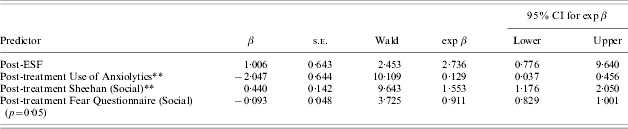
Post-treatment predictors of outcome at follow-up were subject to the same analyses, the results of which are detailed in Tables 3 and 4. Two post-treatment measures were shown to be predictive of follow-up outcome from both multiple and logistic regression: the post-treatment use of anxiolytics and degree of impairment of social relationships. The Social subscale of the Fear Questionnaire just failed to reach significance (p=0·052). Nevertheless, in conjunction with the social impairment measure from the SDS, it may be considered to be consistent with the predictive importance of social support and ease of social functioning in determining the maintenance of treatment gains, being rather more influential in the prediction of high ESF at follow-up (82% correct) compared to low ESF (52% correct). The hypothesis that the persistence of dysfunctional agoraphobic cognitions at the end of active treatment would have a bearing on the maintenance of treatment gains was not supported from the analysis applied to all treatment groups combined.
Results of stepwise multiple regression analyses of post-treatment predictors of follow-up composite panic/anxiety measures


s.e., Standard error.
* p<0·05, *** p<0·001.
Final model (Step 3) of stepwise logistic regression analysisFootnote a post-treatment predictors of clinically significant outcome at follow-up (high end-state functioning)

s.e., Standard error; CI, confidence interval.
a Post-treatment end-state functioning (ESF) status entered first as control for prior level on dependent measure.
** p<0·01.
DISCUSSION
Multivariate analysis of predictors of outcome at immediate post-treatment and at the 6-month follow-up, across all CBT treatment groups from the Kenardy et al. (Reference Kenardy, Dow, Johnston, Newman, Thomson and Taylor2003a) study, revealed only a small number of prognostic indices. Post-treatment outcome was predicted by baseline scores on the Fear Questionnaire – Blood/Injury scale; concomitant social anxiety; degree of agoraphobic avoidance when unaccompanied; patients' general expectations of outcome; and age at first onset of panic attacks. In each case greater baseline severity was predictive of poorer outcome.
The blood/injury scale comprises a measure of the degree of phobic avoidance of injections/minor surgery, hospitals, sight of blood and the thought of injury or illness. It is possible that such items may tap into more general, primary health-related fears, commonly associated with panic disorder (Clark, Reference Clark1986; Salkovskis, Reference Salkovskis, Rachman and Maser1988; Hackmann, Reference Hackmann, Bennett-Levy, Butler, Fennell, Hackmann, Mueller and Westbrook2004). While such fears may be considered central to a cognitive model of panic, it may be that it is those automatic thoughts associated more directly with anxiety-mediated somatic arousal (palpitations, light-headedness, etc.) that are most accessible to change with CBT. If so, this may have some bearing on how we might ensure that more general underlying fears and vulnerability factors in the maintenance of panic are adequately addressed.
The hypothesis that patients' expectations of improvement would be predictive of outcome is also borne out by the results of this study, thus providing additional support for the findings of Clark et al. (Reference Clark, Salkovskis, Hackmann, Wells, Ludgate and Gelder1999). Patients with lower expectations that therapy will be effective in changing not only the frequency and severity of their panic attacks but also their irrational cognitions and phobic avoidance experience poorer outcome compared to those with higher levels of pretreatment optimism. The predictive significance of this variable from at least two independent studies highlights the need for it to be given due recognition in routine initial clinical assessment and treatment planning.
Age of first experience of panic attacks was also found to contribute significantly to the prediction of clinically significant outcome and clearly did so independently of expectations regarding outcome, with which an inverse relationship might have been considered. However, age of onset of panic symptoms did correlate significantly with pretreatment ACQ and BSQ scores (in each case r=−0·20, p<0·05), suggesting that the earlier a panic attack is experienced, the stronger the dysfunctional beliefs and fears central to panic are in later years. As such, this finding is consistent with the reported importance of early intervention following initial experience of panic symptoms, even as limited symptom attacks, in preventing the subsequent development of panic disorder of clinical severity (Reed & Wittchen, Reference Reed and Wittchen1998; Kenardy et al. Reference Kenardy, McCafferty and Rosa2003b).
Previous research has shown degree of agoraphobic avoidance to be significantly predictive of outcome and the present results provide further support for this relationship. This is apparent here, however, only for degree of avoidance ‘when unaccompanied’. At a clinical level, a regular ability to confront formerly feared situations while unaccompanied is implicit in the concept of clinically significant change for the majority of those with associated agoraphobia. The prognostic significance of this variable, however, underscores the importance of its being adequately addressed in treatment. Regular exposure when alone, as opposed to accompanied, may be expected to have much greater benefits in terms of the emotional processing of anxiety and in targeting and modifying core dysfunctional beliefs relating to personal safety (Foa & Kozak, Reference Foa and Kozak1986).
A degree of caution, however, is warranted in interpreting the results of stepwise multiple regression involving this variable because of fairly high collinearity. Thus, degree of agoraphobic avoidance, as measured by the Mobility Inventory, being a constituent of the composite measure, correlates highly, as expected, with the pretreatment composite score and clearly shares common variance in predicting outcome. Nevertheless, the results from logistic regression provide additional support for the predictive significance of agoraphobic avoidance in relation to an independent measure of clinically significant improvement.
Finally, co-morbidity, as hypothesized, was also found to be predictive of post-treatment outcome. Contrary to expectation, the coexistence of agoraphobia, as distinct from PD alone, was not found to be a significant predictor in this study, but the presence of additional social anxiety was. Thus, the presence of co-morbid social anxiety, based on fears of anxiety symptoms being perceptible to others and of resultant negative evaluation, is associated with less improvement in this trial. It is acknowledged, however, that both situational and interoceptive exposure for PD aim to reduce anxiety in relation to somatic arousal, in which cognitive reappraisal is primarily concerned with the perceived physical consequences of anxiety. Where the perceived consequences are largely social, however, additional targeted cognitive restructuring is also indicated, but may have been given insufficient weight in the present study.
Contrary to our hypothesis based on a central element of the cognitive model of panic (Clark, Reference Clark1986), and contrary also to the results of Clark et al. (Reference Clark, Salkovskis, Hackmann, Middleton, Anastasiades and Gelder1994, Reference Clark, Salkovskis, Hackmann, Wells, Ludgate and Gelder1999), no significant association was found between the persistence of dysfunctional thoughts relating to physical sensations at the end of active treatment and subsequent relapse at the 6-month follow-up, as measured by the BSQ and ACQ. Clark et al. (Reference Clark, Salkovskis, Hackmann, Middleton, Anastasiades and Gelder1994, Reference Clark, Salkovskis, Hackmann, Wells, Ludgate and Gelder1999) observed this relationship only for the Body Sensations Interpretations Questionnaire – Panic (Clark et al. Reference Clark, Salkovskis, Öst, Breitholtz, Koehler, Westling, Jeavons and Gelder1997), a schema-based measure designed to assess a general disposition to misinterpret bodily sensations even in the absence of such sensations and symptoms. The ACQ, however, was designed as a measure of automatic thoughts occurring at the time of an anxiety episode. Complete data on the former measure of core underlying beliefs, representing a vulnerability to PD according to cognitive theory, were not available in this study. In addition, not all treatments in the present study allowed equal time to address such cognitive factors in preparation for follow-up and the examination of the differential effects of treatments in modifying such central dysfunctional cognitions, addressed in the subsequent paper, may prove more useful than an analysis involving all treatment groups combined.
Clear support, however, was found for the hypothesis that patients continuing to take anxiolytic drugs post-treatment would be less likely to maintain treatment gains compared to those who were psychotropic drug free. Such results from both multiple and logistic regression essentially replicate the findings of Otto et al. (Reference Otto, Pollack and Sabatino1996) and cannot be explained by differences in baseline severity, as the analyses controlled for such a potential effect. The most commonly prescribed anxiolytics in the present study were benzodiazepines and, as Otto et al. (Reference Otto, Pollack and Sabatino1996) also acknowledged, this negative relationship with the maintenance of remission may be specific to this class of anxiolytics. Marks et al. (Reference Marks, Swinson, Basoglu, Kuch, Noshirvani, O'Sullivan, Lelliott, Kirby, McNamee, Sengun and Wickwire1993) also found that even short-term use of benzodiazepines seemed to impair the maintenance of improvement following exposure treatment. As in the latter study, those in the present sample taking medication were required to remain on a stable drug regime throughout the active treatment period only and so it is possible that the present results may be attributed, at least in part, to the effects of state-dependent learning and ‘rebound’ anxiety. Moreover, the presence of safety cues during situational and interoceptive exposure and drug-related attributions of improvement may have impaired adaptive cognitive reappraisal (Basoglu et al. Reference Basoglu, Marks, Kilic, Brewin and Swinson1994; Wells et al. Reference Wells, Clark, Salkovskis, Ludgate, Hackmann and Gelder1995; Otto & Gould, Reference Otto, Gould, Pollack, Otto and Rosenbaum1996). It is also possible that anxiolytic treatment may interfere with the activation of fear structures during exposure, a hypothesized prerequisite for effective emotional processing (Foa et al. Reference Foa, Franklin and Moser2002).
Finally, and consistent with one of the pretreatment predictors of post-treatment outcome, degree of continuing social disability, as a result of residual anxiety symptoms, is a significant determinant of follow-up outcome. This is also supported by the near significant coefficient for the Fear Questionnaire (Social) subscale (p=0·05). Such evidence suggests the need to ensure that treatment encompasses the social sequelae of PD and agoraphobia in preventing relapse and parallels related findings on the role of interpersonal factors in the maintenance and remission of generalized anxiety (Durham et al. Reference Durham, Allan and Hackett1997; Newman, Reference Newman2000).
In conclusion, the results of the present study provide a useful endorsement of the predictive significance of a number of key pre- and post-treatment variables in relation to CBT outcome for PD. These findings apply only to outcome to CBT in general, and do not inform choice of CBT format despite increasing interest in brief and other ‘non-standard’ forms of its delivery. The second part of this study aims to address this issue.
DECLARATION OF INTEREST
None.