Introduction
The majority of residents in assisted living and nursing homes in the U.S.A. have some form of dementia or cognitive impairment, and their number is increasing every day (Alzheimer's Association, 2006). Studies indicate that most nursing home residents with dementia are not in special care units, or units explicitly intended for residents with cognitive impairment. Even though the number of special care units has grown considerably since the 1980s, they represent only 5.26% of all nursing home beds (Alzheimer's Association, 2008). Nearly 75% of all people with dementia live at home and approximately 92% of them receive assistance from family, friends or paid workers (Alzheimer's Association, 2008).
Although direct care workers and licensed practical nurses are the professionals who provide the most hands-on care to people with dementia in nursing homes and residential care facilities, they do not receive adequate training in dementia care. In the U.S.A., direct care workers provide an estimated 70–80% of daily personal care (including bathing, dressing, eating and other tasks) to older adults or persons living with disabilities or other chronic conditions. According to the National Clearinghouse on the Direct Care Workforce (2006), direct care workers fall into three categories: nursing assistants (CNAs), home health aides and personal and home care aides. However, training is only required for nursing assistants and home health aides who work in Medicare and Medicaid certified nursing homes and home health agencies. The demand for direct care workers is increasing. By 2014, personal and home care aide positions are expected to increase by 41%. Certified nursing assistants and home health aide positions are expected to increase by 22% (National Clearinghouse on the Direct Care Workforce, 2006).
Licensed practical nurses (LPNs) are the largest group of licensed nursing care providers in long-term care, outnumbering registered nurses (RN) 3 to 2 (Hyer and Ragan, Reference Hyer and Ragan2002). On a daily basis, LPNs average 0.9 hours of care per resident compared to 0.6 hours of care per resident for an RN. On average, an LPN has received 1–2 years of formal training. In addition to emphasizing the importance of ongoing training in dementia care, studies indicate the importance of nurse competencies to improve dementia care and the need for competency-based education as a state mandated requirement (Williams et al., Reference Williams, Hyer, Kelly, Leger-Krall and Tappen2005).
In the above context, properly delivered dementia training is vital to enable adequate quality of care for people living in long-term care in the U.S.A.
Components of dementia training
Dementia care training needs to be universal with all disciplines at all levels of care (Splaine, Reference Splaine2008). Even though there is variability with regard to recommended hours and content, most studies emphasize the importance of dementia care training as a distinct component of required training for any professional or paraprofessional working in long-term care.
Generally, studies recommend that staff receive training on the philosophy of dementia care management with emphasis on holistic assessment, individualized goals, person-centered care, communication, environmental modification and the importance of family involvement in care. Many emphasize the importance of identifying behavioral symptoms and appropriate interventions, normal aging and age-related changes in health and function, causes of dementia, intervention strategies, end-of-life care and staff stress management.
Grant and colleagues (1996) examined different modalities of training including workshops, seminars, videos, outside consultants, workbooks, classroom training, role play, online modules, university or technical college instruction, train-the-trainer models, intensive staff training, and in-service training. The findings indicated greater benefit from a diversity of training methods (Grant et al., Reference Grant, Kane, Potthoff and Ryden1996). Kovach and Krejci (Reference Kovach and Krejci1998) examined factors that facilitated positive changes in dementia care including facility factors such as teamwork, administrative support, staff attitude, knowledge and personal characteristics such as genuinely liking people with dementia, being flexible, showing kindness and calmness, and having a positive attitude.
Hyer and Ragan (Reference Hyer and Ragan2002) noted that nursing assistants often feel isolated, neglected, ignored and unsupported even though they are heavily involved in daily care with residents. A hierarchical model in staffing where a direct care worker has less opportunity to communicate with professional staff can have a negative impact on the residents' quality of life from a person-centered point of view. Any staff training needs to be interdisciplinary with emphasis on team interaction, cohesiveness, communication and team building.
Alzheimer's Association Quality Care Campaign
In 2005, the Alzheimer's Association launched its Quality Care Campaign to improve dementia care through state and federal advocacy, consumer education and empowerment, and staff training. The research evidence underlying the campaign came from several sources including an Association-funded research study (Zimmerman et al., 2005) examining dementia care and quality of life in nursing homes and assisted living residences, and comprehensive reviews of the literature on identified interventions likely to be effective in delivering quality care (Reed and Tilly, Reference Reed and Tilly2008; Tilly and Reed, Reference Tilly and Reed2008; Volicer, Reference Volicer2008). The research evidence addressed prevalence and risk factors for various care domains, as well as providing an understanding of core dementia care concepts and tested interventions.
The overall campaign used a consultative, comprehensive process to develop the phases of the dementia care practice recommendations, targeting multiple influences on quality across seven areas of care: food and fluid intake, pain management, social isolation, wandering, falls, physical restraints and end-of-life care (Reed and Tilly, Reference Reed and Tilly2008; Gould et al., Reference Gould, Tilly and Reed2008). A consensus-building process included internal and external key stakeholders from over 30 national health and long-term care organizations, the 78 chapters of the Alzheimer's Association, as well as the Alzheimer's Association Early Stage Advisory Group (Gould et al., Reference Gould, Tilly and Reed2008). A consensus-building approach is often used in public health campaigns and has been identified as an optimal method for exchange of knowledge between researchers and practitioners.
In an effort to stay abreast of the latest research and innovations in practice, the Alzheimer's Association decided to focus on specific areas of care rather than develop recommendations for all aspects of care in nursing homes and assisted living settings. These practice recommendations serve as the basis for the Alzheimer's Association residential care staff training programs.
Alzheimer's Association dementia training requirements
The state and federal advocacy efforts of the Association's Quality Care Campaign focus on sufficient staffing, adequate compensation and training in dementia care so that direct care workers get the training and support they need to provide good dementia care (Morrison-Bluethmann and Reed, Reference Morrison-Bluethmann and Reed2008).
In an article discussing the Alzheimer's Association advocacy efforts, Splaine (Reference Splaine2008) defined the necessary dementia training requirements as:
• Training for all staff in dementia care issues and practices. At least 8 hours of pre-employment training for all nurses, certified nurse aides and direct care staff with an additional 8 hours of annual continuing education.
• At least 4 hours of pre-employment training for all other staff (including administrators) and 2 hours of annual continuing education.
• A monitoring mechanism to ensure compliance, such as a registry for CNAs.
• Portability of completed training among long-term care employment sectors.
• A formal certification of training programs by a lead state agency for licensing or its designate.
The author points to the success of public policy and provider advocacy efforts that are leading to awareness about quality dementia care and creating a regulatory structure that supports this goal.
Alzheimer's Association “Foundations of Dementia Care” training
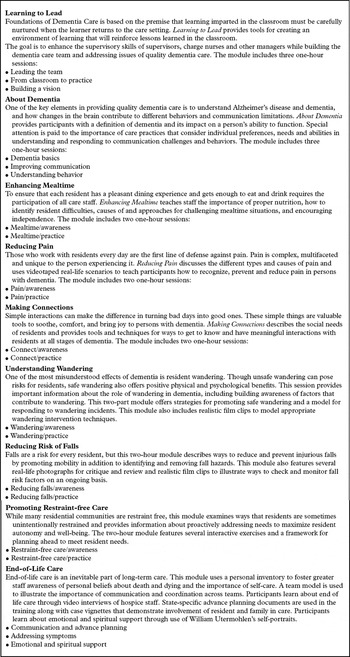
As part of the Quality Care Campaign, the Alzheimer's Association created a professional training series for long-term care workers based on the Dementia Care Practice Recommendations, entitled Foundations of Dementia Care: Enhancing Skills, Enriching Lives (FDC). The original curriculum, including content from the Phase 1 Practice Recommendations, was released in July 2005. The first phase of the curriculum included five primary modules with a total of 12 hours of training: “Learning to lead,” “About dementia,” “Enhancing mealtime,” “Reducing pain” and “Making connections.” The second series of trainings based on the Phase 2 Practice Recommendations was released in August 2007 (Alzheimer's Association, 2007) and consisted of six hours of training on “Understanding wandering,” “Reducing risk of falls” and “Promoting restraint-free care.” An additional three-hour module on end-of-life care released in August 2008 covered “Communication and advance planning,” “Addressing symptoms at the end of life” and “Emotional and spiritual support.” In total, FDC involves 21 hours of training, segmented into individual one-hour sessions across nine different substantive modules. A more complete description of the training is presented in Table 1.
Foundations of Dementia Care – module descriptions

Source: adapted from Morrison-Bluethmann and Reed, Reference Morrison-Bluethmann and Reed2008.
The FDC curriculum places a particular emphasis on leadership, coaching and mentoring of direct care staff. “Learning to lead” teaches supervisors to recognize staff accomplishments and provides strategies for giving constructive feedback. The first two sessions are intended for a supervisor-only audience while the final session of the Leadership module brings together all team members stressing the importance of team building with clear roles and expectations, trust and effective communication.
“About dementia” discusses the disease process and changes in thinking and cognition; understanding behavioral symptoms; and communication techniques with residents. Every module that addresses a particular care domain (“Enhancing mealtime,” “Reducing pain,” “Making connections,” “Understanding wandering,” “Reducing risk of falls” and “Promoting restraint-free care”) includes a session on awareness and a session on practice. Although some of these, such as risk for falls and under-detected pain, are common geriatric conditions, we discuss these conditions in the context of caring for someone with dementia.
The core dementia care principle of person-centered care is woven throughout the entire curriculum. Person-centered care respects a person's life history, recognizes their daily routine and preferences, honors their identity, engages them in meaningful activity and encourages an overall sense of well-being (Fazio, Reference Fazio2008). Staff are taught to apply what they know about the resident in their daily approaches to care. The importance of family involvement in all aspects of care and decision making is also emphasized throughout the curriculum.
The FDC program offers some unique design features. The curriculum can be customized based on an organization's training needs and interests, with a module presented in its entirety or by the hour and with various options of topics available. Providing sessions that are an hour in length allows for flexibility in scheduling.
The curriculum is designed to draw on the participants' experiences. Participants are engaged in the learning process through the use of case studies, group problem-solving exercises, video clips and team-building activities.
The Alzheimer's Association received accreditation from key professional organizations to offer national continuing education credit to social workers, nurses and administrators, which provides an added incentive to attend the trainings (Morrison-Bluethmann and Reed, Reference Morrison-Bluethmann and Reed2008).
Format and curriculum design
With a diverse audience of direct care workers and professionals, issues of literacy were considered when developing this curriculum. According to National Clearinghouse for the Direct Care Workforce (2006), the majority of direct care workers have completed their formal education with a high school diploma or a GED. However, a significant number of nurses' aides have English as their second language. In response to those needs, the training is scripted at an eighth-grade reading level and includes both visual and auditory exercises. (Morrison-Bluethmann and Reed, Reference Morrison-Bluethmann and Reed2008)
At the end of a session, each participant receives a laminated pocket-sized card that provides tips tied to the key points and learning objectives. These tip cards were developed as a way to reinforce the learning from classroom to practice. The participants are given key rings on which to collect the cards and they are encouraged to carry the cards with them on the job.
Pilot testing methods
The Foundations of Dementia Care modules went through a series of pilot tests in order to critique and improve the program during the development process. Each training module is based on a particular phase of the Dementia Care Practice Recommendations and development generally took several months to complete. Each newly developed module was piloted using two separate rounds of formal feedback in at least two different locations. The intent of the pilot tests was to understand the trainee experience and to identify any needed revisions to the curricula to best meet the program's objectives. Each pilot test involved a formal debrief focus group or survey immediately after delivery of the entire module to gather trainee impressions and responses to what they had just experienced.
Prior to the first field test of the entire Phase 1 training, a series of focus groups was conducted by a professional facilitator with the intended audience of direct care staff and care supervisors including directors of nursing, CNA team leaders, dementia directors, and other staff involved in planning and delivery of care. Of the six focus groups conducted, four were with direct care providers and two were with care supervisors. Each group was asked to respond to the content, format and instructional design of a single module of the FDC. Each focus group of direct care staff responded to one of the four modules addressing a specific care area: “Basics of dementia care,” “Enhancing mealtime,” “Pain management” and “Social engagement.” The two care supervisor focus groups were asked to respond to the “Learning to lead” module specifically designed to teach effective leadership skills including coaching, mentoring of staff and team building (Morrison-Bluethmann and Reed, Reference Morrison-Bluethmann and Reed2008).
Phase 1 results
Focus group feedback
Several themes emerged from the initial focus group testing that included six focus groups – four with direct care staff and two with care supervisors. Issues of hierarchy and role clarification were significant for direct care staff and care supervisors. The direct care staff reported that they did not feel empowered by their supervisors (Morrison-Bluethmann and Reed, Reference Morrison-Bluethmann and Reed2008). Care supervisors expressed frustration with training direct care staff and reporting lack of impact on knowledge or practice. The definition of assessment and the responsibility for conducting assessment varied between direct care staff and care supervisors.
The focus groups also provided more practical comments. With the “Basics of dementia care” module, participants demonstrated significant confusion over the differentiation between dementia and Alzheimer's disease. Participants had difficulty participating in some of the interactive exercises and commented that some of the information was too complicated to understand. For example, participants had difficulty understanding the section that explores the effects of Alzheimer's disease on the brain. They wanted to have more practical, hands-on training. Revisions were made before the training was field tested.
Field testing
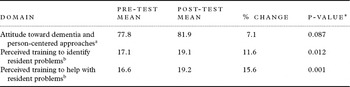
The complete 12-hour Phase 1 program was delivered to 71 staff in six different facilities, including nursing homes and assisted living residences. Pre- and post-survey results showed an increase in all of the survey domains: staff understanding of dementia care, person-centered approaches and perception of training in assessment and treatment where staff reported how well trained they feel across various aspects of dementia care. Attitudes relative to person-centered approaches to dementia care improved positively at a level approaching statistical significance at p ≤ 0.05 (p = 0.087). There was a statistically significant increase in both perceived training to assess residents (p < 0.05) and perceived training in treating residents (p < 0.001) (Morrison-Bluethmann and Reed, Reference Morrison-Bluethmann and Reed2008). See Table 2 for complete results. These pilot results indicate that the Phase 1 FDC training program was successful in impacting staff attitudes toward dementia care, and increasing staff confidence in delivering effective assessment and care. Reported results are expected in Spring 2009 from a multi-state intervention-control designed study of six of the original 12 sessions of the Phase 1 FDC training.
FDC Phase 1 pilot testing, domain-specific pre (n = 62) and post (n = 71) survey results

*analyzed using independent t-test comparison of means.
a 20-item measure with possible range of 20–100.
b 6-item measure with possible range of 0–24; items derived from Dementia Care Study.
FDC = Foundations of Dementia Care.
Adapted from Zimmerman et al., 2005 and Morrison-Bluethmann and Reed, Reference Morrison-Bluethmann and Reed2008.
Phase 2 results
Field testing
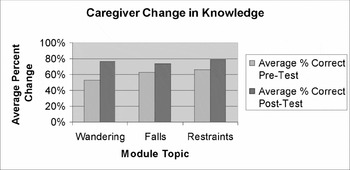
Phase 2 of FDC covered awareness and practice in three care areas: “Wandering,” “Falls” and “Physical restraints.” A total of 52 professional caregivers, including direct care workers, nurses, activity professionals, administrators, social workers and others, participated in the two pilot tests conducted during the program's development. The results of those pilot tests are shown in Figure 1.
Source: Morrison-Bluethmann and Reed, Reference Morrison-Bluethmann and Reed2008.

Respondents stated that the learning objectives were met “well” or “very well” for the sessions on wandering and physical restraints. The lowest rating received for any of the Phase 2 modules was for the “Falls” sessions with only 2% of respondents reporting that it did not adequately meet the learning objectives for individual and environmental risk factors.
Direct care workers were the most satisfied of any tested audience with the training content, format and instructional design. The nursing assistants and direct care workers rated the training as “very good” or “excellent” as appropriate to their level of experience.
Phase 3 results
“End-of-life care” was the area covered in Phase 3 of the FDC training. The module comprised three one-hour sessions: “Communication and advance planning,” “Addressing symptoms” and “Spiritual and emotional support.” A total of 36 direct care staff, unit directors, nurses, administrators, hospice professionals and chapter staff participated in the first and second pilot tests. Significant changes were made to the first session of the module so it was decided to do a third pilot test just on that session. The third pilot test consisted of 11 participants including nurses, CNAs, administrators and one trainer.
Overall response to the topic of end-of-life care was positive and participants said that they would recommend the classes to others. Many expressed their own personal fears or concerns about death and dying and, as a result, a personal inventory was added to the first session and tested in the third pilot.
Participants appreciated learning about advance directives and suggested that the POLST form (Physician Orders for Life Sustaining Treatment) was not the best example as a teaching tool and instead recommended using the advance directive form specific to their facility or state.
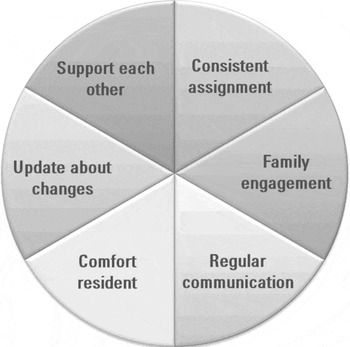
Respondents preferred a visual representation of the Care Team Model; Figure 2 illustrates the model created for the final version of the training. Emphasizing team communication and coordination, participants stated they had a greater appreciation of the roles and skills that each team (long-term care staff team and the hospice team) brought to the end of life care experience.
Team model for end-of-life care.

Extending the reach with online training
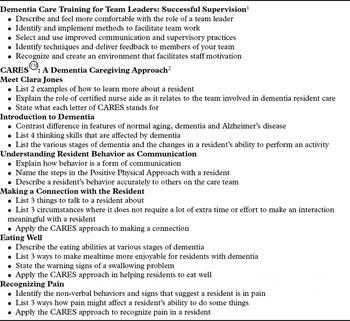
The Alzheimer's Association is currently extending the reach of its training by offering online courses that directly map the content of the Alzheimer's Association Dementia Care Practice Recommendations as a way to reinforce the learning. The online training programs were developed in collaboration with two different firms with expertise in interactive web-based learning (HealthCare Interactive and Health Media Lab). The two training programs are Dementia Care Training for Team Leaders: Successful Supervision and CARES: A Dementia Caregiving Approach. Both offer an interactive experience for the participant through use of video clips, customized personal action plan, clickable icons, case scenarios, interactive worksheets and activities. A description of these online training programs are presented in Tables 3 and 4.
Alzheimer's Association online training programs: learning objectives

Notes: 1Health Media Lab.; 2HealthCare Interactive, Inc.
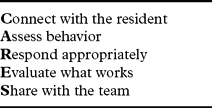
CARES™ approach
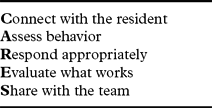
CARES™ approach developed by HealthCare Interactive, Inc.
The strengths of online training include geographic reach and product distribution. The internet is widely used and it is a successful means of getting training products out to professionals.
Through these online offerings, training is available 24 hours a day, seven days a week, allowing for newly hired staff, night-time and evening staff to be trained in a timely manner. Staff can use the program on their own and at their own pace. It can also be used to reinforce what staff have learned in the classroom and they can revisit the program at any time to renew their skills. In addition, the online video clips and interactive exercises can be used in the classroom.
Discussion
Long-term care staff need dementia-specific training in order to meet the unique needs of residents in assisted living residences and nursing homes. The response to the Foundations of Dementia Care curriculum during pilot training was generally positive.
One of the strengths of the Foundations curriculum is the focus on the team that is working together to deliver dementia care. This approach to training also poses some challenges in meeting the learning needs of each discipline and level of care provider (direct care, supervisor, administrator). In pilot debrief sessions, some participants shared that they had learned new information and skills that they could apply immediately in their current roles, while others described it as meeting basic needs or as a review of skills already gained. Next steps would be to explore approaches to increase engagement of the participants with various levels and experience across the diverse group.
Most research demonstrates that the effectiveness of training lasts only for duration of the intervention. However, the Alzheimer's Association Quality Care Campaign training has unique features that may actually extend the learning and impact on practice including a focus on leadership that reinforces learning, the tip cards and online training programs. Effective sustainability is an area in need of further exploration.
Another area for further evaluation is the impact of attending FDC training on changing staff practice and organizational culture/readiness for change. As the population of older adults with dementia continues to grow, there is a great need for a qualified and well-trained long-term care workforce. It will impact not only on quality of care but also on quality of life.
Conclusion
We were able to assess the effectiveness of Alzheimer's Association training by obtaining feedback on the content, format and instructional design. Revisions were made during the pilot testing process for each phase of the Foundations curriculum. The effectiveness was measured by knowledge gained and provider intention to change their behavior immediately after attending the training.
Overall, findings indicated that the participants responded positively to receiving evidence-based training in dementia care that emphasizes the importance of leadership; team communication and collaboration; support and empowerment of direct care staff; awareness and practice of specific dementia care issues; resident and family involvement in care; and professional self-care.
Conflict of interest
None.
Description of authors' roles
E. Gould was the lead author, with P. Reed contributing to the writing. Both authors reviewed and approved the manuscript prior to submission. P. Reed was working for the Alzheimer's Association when this study was completed.