Introduction
Wheat grain still has the potential to be a significant energy source in poultry nutrition in many regions because it is the closest to corn in terms of energy content. It is also superior to corn in terms of concentrations of proteins, minerals and amino acids. However, its nutritional value is restricted because wheat contains non-starch soluble polysaccharides (NSP) and additionally phytate, which are indigestible and inhibit the digestion of other nutrients. The use of enzyme combinations, particularly those containing the enzymes xylanase, glucanase and phytase, has become widespread and its benefits are well-documented to increase the use of grains such as wheat in the nutrition of poultry (Abdollahi et al., Reference Abdollahi, Zaefarian, Hunt, Anwar, Thomas and Ravindran2019; Al-Qahtani et al., Reference Al-Qahtani, Ahiwe, Abdallh, Chang’a, Gausi, Bedford and Iji2021).
The broiler producers’ ability to influence the meal’s particle size is restricted since soybean meal is processed in oil extraction facilities (Kareem et al., Reference Kareem, Amos, Idowu, Egbeyale, Sobayo, Adeniran, Akinlade, Ojebode, Olaniyi, Iyaomolere, Abdulsalam and Idowu2022). The particle size of cereal grains can differ from mill to mill (Amerah et al., Reference Amerah, Ravindran, Lentle and Thomas2007). Particle size determination has practical limitations since birds may have difficulty consuming particles that are too fine or coarse (Kareem et al., Reference Kareem, Amos, Idowu, Egbeyale, Sobayo, Adeniran, Akinlade, Ojebode, Olaniyi, Iyaomolere, Abdulsalam and Idowu2022), and mills typically have a sieve diameter of 3.0–4.5 mm (Svihus et al., Reference Svihus, Kløvstad, Perez, Zimonja, Sahlström, Schüller, Jeksrud and Prestløkken2004). As a result, the diets of poultry, especially broilers, are quite fine in particulate matter. By reducing particle size, the aim is to increase the surface area of dietary components, enhancing digestive enzyme interactions and ultimately improving growth efficiency (Amerah et al., Reference Amerah, Ravindran, Lentle and Thomas2007; Downs et al., Reference Downs, Gulizia, Stafford and Pacheco2022). However, excessive reduction in feed particle size increases the speed of feed passage through the digestive system, negatively affects intestinal health and may limit the digestibility of nutrients, whereas it is well documented that increasing particle size has a positive effect on intestinal health and physiological functions of birds and therefore on organic matter digestibility (Svihus, Reference Svihus2011, Reference Svihus2014; Zaefarian et al., Reference Zaefarian, Abdollahi and Ravindran2016). Increasing particle size also lowers the gizzard’s pH and improves the solubility of minerals, particularly calcium, which makes up the majority of bone (Abdollahi et al., Reference Abdollahi, Zaefarian, Hunt, Anwar, Thomas and Ravindran2019).
The efficiency of exogenous enzymes added to diets and the digestibility of nutrients are both affected by changes in the feed’s particle size (Amerah et al., Reference Amerah, Ravindran, Lentle and Thomas2008a). However, the number of studies examining the effects of grinding wheat-based diets with different sieve diameters and enzyme addition is limited. This study has been conducted on the hypothesis that enzyme addition to diets based on wheat milled with different sieve pore sizes may have different effects on broilers productivity and health markers. Therefore, the aim of the present study is to evaluate the effects of feeding broilers with wheat-based diets milled with different mesh diameters, without or with multi-enzyme supplementation, on the growth performance, intestinal development, pancreatic enzyme secretion and bone development of broilers. The findings obtained from this study are expected to provide valuable information on enzyme supplementation to broiler diets with wheat-based diets of different particle sizes and to help poultry breeders in determining the effects on growth performance, digestive physiology and animal health.
Materials and methods
Ethical approval
This study was approved by the Selcuk University Faculty of Agriculture Dean’s Office that involves activities relating to raising farm animals and complying with animal welfare guidelines (EU regulation 2010). The European policy (EPCEU, 2010) for the safety of animals used for scientific research and other scientific purposes has been followed during all experiment, which conform to the ethical standards outlined in the 1964 Declaration of Helsinki and its subsequent amendments.
Birds and design
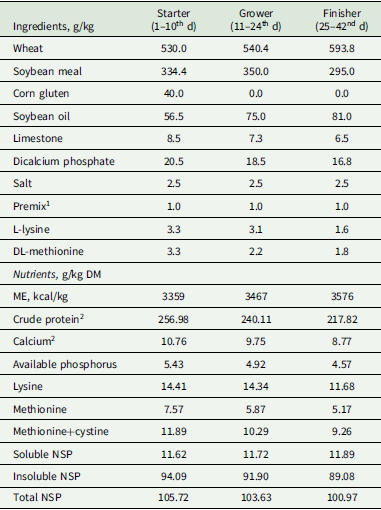
In the trial, 480-day-old mixed sex Ross-308 broiler chicks have been used. The study has been carried out in 6 treatment groups consisting of three different sieve pore sizes of ground feed (fine (4000 µm), medium (5000 µm) and coarse (6000 µm)) and two enzyme levels (0 and 300 g/ton), in 5 replications with 16 birds in each, totalling 30 subgroups. A total of 480 broilers have been used, 80 in each treatment group. The wheat-based diet used in the study was designed to meet the nutritional needs of broilers at recommended levels for 1–10, 11–24 and 25–42 day periods (Aviagen, 2022; Table 1). This diet has been ground in a hammer mill with pore diameters of 4000, 5000 or 6000 µm. Six treatment diets have been created by dividing the feeds that have been processed in sieves with varying pore diameters into two groups: one group received no enzyme added, and the other group received a 300 g/ton enzyme mix (endo xylanase (1500 U), endo beta-glucanase (2000 U), and phytase (2000 FTU), and endo 1-4 beta xylanase, endo 1.3(4) beta-glucanase, alpha-amylase, protease as side activity). The trial lasted 42 days, and water and feed have been provided ad libitum throughout the trial.
Treatment diets and nutrient contents

1 Supplied per kg diet: 13000 IU vitamin A, 5000 IU vitamin D3, 80 mg vitamin E, 5 mg vitamin B1, 9 mg vitamin B2, 5 mg vitamin B6, 0.020 mg vitamin B12, 4 mg vitamin K3, 25 mg pantothenic acid, 70 mg niacin, 0.35 mg biotin, 2.5 mg folic acid, 110 mg zinc, 120 mg manganese, 16 mg copper, 20 mg iron, 0.3 mg selenium,1.25 mg iodine. 2 Analysed values.
Determination of particle distribution
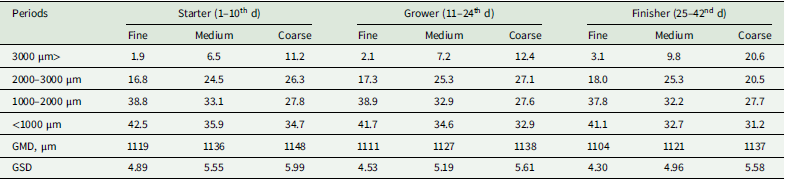
Particle distribution of treatment diets has been determined by passing milled feed samples (1000 g) through a set of triples (3000, 2000 and 1000 µm) steel sieves to ISO-3310/ASTME11 (DIN 3310) standards on a shaker for 5 min (Table 2). The geometric mean diameter (GMD) and geometric standard deviation (GSD) values for each sieve diameter have been calculated using the following formulas in Microsoft Excel.
 $${{\rm{d}}_i} = {\rm{\;}}{\left( {{{\rm{d}}_{\rm{u}}}{\rm{\;x\;}}{{\rm{d}}_{\rm{o}}}} \right)^{0.5}}$$
 $${\rm{GM}}{{\rm{D}}} = {{\rm{log}}^{ - 1}}\left[ {{{\sum {({W_i}\log {d_i})} } \over {\sum {{W_i}} }}} \right]$$
 $${\rm{GSD}} = {\log ^{ - 1}}{\left[ {{{\sum {{W_i}} \left( {\log {d_i} - \log GMD} \right)} \over {\sum {{W_i}} }}} \right]^{0.5}}$$
where di: diameter of ith sieve on stack, du: diameter opening through which particles have been passed (sieve preceding ith) as µm, do: diameter opening through which particles have not been passed (ith sieve) as µm Wi= mass of particles on the ith sieve as g.
Particle distribution of treatment diets (g/100 g diet)

Fine; 4000 µm, medium: 5000 µm and coarse: 6000 µm sieve diameter has been ground in a hammer mill. GMD: geometric mean diameter, GSD: geometric standard deviation.
Determination of performance parameters
The body weight and feed consumption of the chickens have been determined as g/chick by group weighing on the 1st, 10th, 24th and 42nd day of the experiment. From these measurements, the body weight gain of the chickens and the feed conversion ratio have been calculated as g feed/g body weight gain using the formula feed consumption/body weight gain.
Determination of slaughtering characteristics
At the end of the experiment, two broilers at 6 weeks of age from each subgroup have been euthanized by cervical dislocation. Slaughtering characteristics have been determined using the report of Gül et al. (Reference Gül, Olgun, Yıldız, Tüzün and Sarmiento-García2022).
Determination of tibia characteristics
Left tibia of two broilers randomly selected from each replicate have been taken to determine the mechanical properties and after cleaning they have been stored in the freezer at −20oC until analysis. Length and diameter measurements of the bones have been made with a calliper, and weight has been measured with a scale sensitive to 0.01 g. Afterwards, tibia breaking strength has been determined as described by Wilson and Ruszler (Reference Wilson and Ruszler1996) and Gül et al. (Reference Gül, Olgun, Yıldız, Tüzün and Sarmiento-García2022).
To examine the ash weight, the right tibia of two broilers randomly selected from each replicate was taken, the tibia was separated and adhering tissue was removed and dried at 100 °C for 24 h. The fat has been removed from the tibias by Soxhlet extraction using 100% ethyl ether. Then fat-extracted tibias have been dried for 24 h at 100 °C and subsequently ashed for 24 h at 600 °C. Ash weight (g/kg) has been determined following formula: Ash weight (g/kg) = (ash weight/sample weight) × 1000.
Determination of pancreatic enzyme activities
Within 5 min after the death of the chicks, the pancreases have been harvested, placed in aluminium foil and snap-frozen in liquid nitrogen. The pancreases have been stored at −80 °C until enzyme analysis. The following procedures are according to the method described by Chen et al. (Reference Chen, Nakthong, Chen and Buddington2005). Amylase activity has been determined according to Bernfeld’s (Reference Bernfeld, Coowick and Kaplan1955) method, chymotrypsin activity according to Hummel’s (Reference Hummel1959) report and lipase activity according to the method of Sigurgísladóttir et al. (Reference Sigurgísladóttir, Kanarosdottir, Jonsson, Kristjansson and Mathiasson1993).
Determination of jejunum histomorphology parameters
For histomorphological measurements of jejunum, samples taken from chickens have been immediately buffered with 10% formalin and gently shaken to remove adherent intestinal contents. Jejunum samples have been kept in this solution for 72 h. After the trimming, the intact crypt-villus units of each jejunum sample have been divided into three cross-sectional areas. Preparation and fixation for crypt and villus measurements have been performed according to the protocol described by Xu et al. (Reference Xu, Hu, Xia, Zhan and Wang2003). The determination process of villus height, width, surface area and crypt depth have been studied according to Sakamoto et al. (Reference Sakamoto, Hirose, Onizuka, Hayashi, Futamura, Kawamura and Ezaki2000) and Gül et al. (Reference Gül, Olgun, Yıldız, Tüzün and Sarmiento-García2022).
Statistical analysis
The experiment was designed as 3 sieve pore size (fine, medium and coarse) × 2 enzyme levels (0 and 300 g/ton) factorial within a randomized complete design. Data were used untransformed. A general linear model (GLM) was used for the analysis of variance of the data in the SPSS Statistics 22’ package programme. Each pen for performance parameters and each bird for other parameters were considered as the experimental units, and values presented in the tables are displayed as means with standard error means (SEM). Duncan’s multiple range tests have been applied for separate means, and statistical significance statements between means are based on the probability of P < 0.01 or P < 0.05.
Results
As shown in Table 2, the GMD values of ground broiler feeds with 4000-, 5000- and 6000-µm sieve sizes according to the growing periods are in the range of fine 1104.1 and 1119.2, medium 1120.9 and 1136.4 and coarse 1137.1 and 1147.9 µm, respectively. GSD values of the diets have been calculated as 4.30–4.89 for fine, 4.96–5.55 for medium and 5.59–5.99 for coarse.
Performance
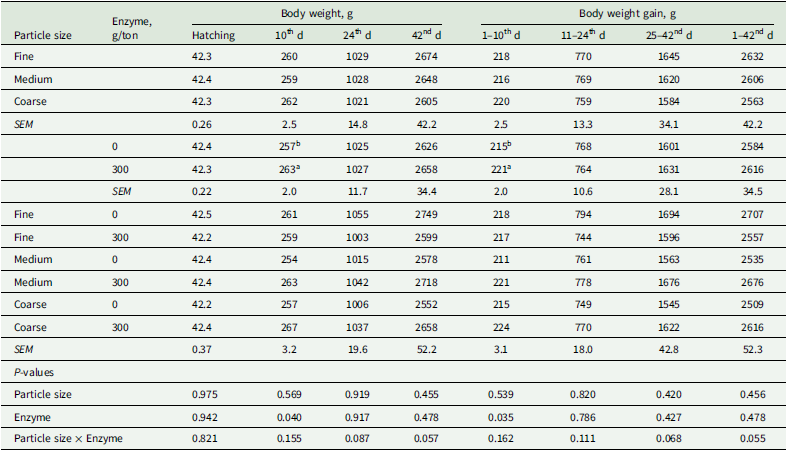
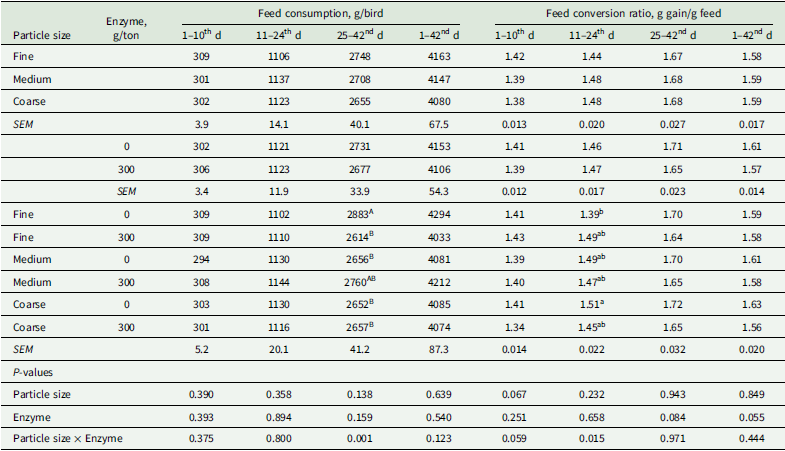
The effects of grinding wheat-based diets with different sieve diameters and enzyme addition on the body weight and body weight gain of broilers are demonstrated in Table 3, and the effects on feed consumption and feed conversion ratio are shown in Table 4. Mortality was not affected by treatment groups (not shown in Tables). The particle size of the diet did not affect body weight or body weight gain (P > 0.05). Enzyme administration to wheat-based diets significantly increased body weight and body weight gain in the first 10d (P < 0.05) but was not significant in the subsequent periods (P > 0.05). There was no statistical difference in body weight among the interaction groups created by dietary particle size and enzyme addition (P > 0.05). Feed consumption and feed conversion ratio of broilers were not affected by particle size and enzyme addition as the main factors (P > 0.05). The effects of interactions on these parameters were considerably significant only in the 25–42nd day period (P < 0.01 and P < 0.05). In the 25–42nd day period, feed consumption of the fine group without enzyme was significantly higher than the other interaction groups except the medium group without enzyme (P < 0.01), and in addition, the feed conversion ratio of the fine group without enzyme was significantly lower than the coarse group without enzyme (P < 0.05).
Effect of enzyme addition on body weight and body weight gain in wheat-based diets with different particle sizes

Fine; 4000 µm, medium: 5000 µm and coarse: 6000 µm sieve diameter has been ground in a hammer mill. SEM: standard error means.
a,b Differences between means shown with different letters in the same column are statistically significant (P < 0.05). Results are based on ANOVA results, following the Duncan test.
Effect of enzyme addition on feed consumption and feed conversion ratio in wheat-based diets with different particle sizes

Fine; 4000 µm, medium: 5000 µm and coarse: 6000 µm sieve diameter has been ground in a hammer mill. SEM: Standard error means.
A,B Differences between means shown with different letters in the same column are statistically significant (P < 0.01).
a,b Differences between means shown with different letters in the same column are statistically significant (P < 0.05). Results are based on ANOVA results, following the Duncan test.
Slaughtering characteristics
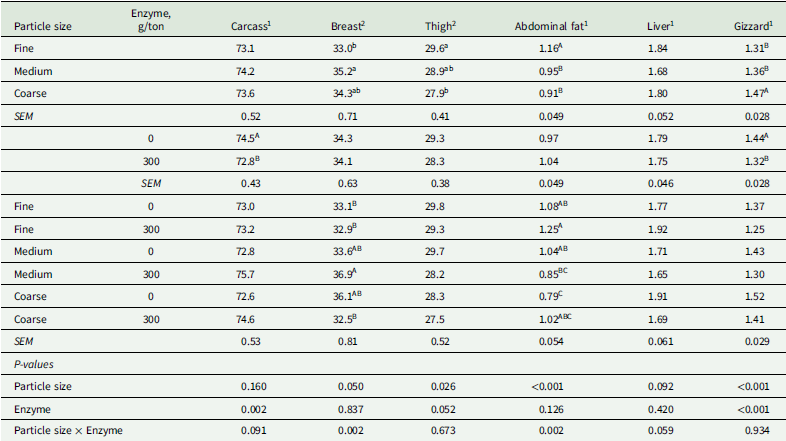
Table 5 lists the slaughtering characteristics of broilers. Diet particle size as the main factor did not affect carcass (g/100 g body weight) and liver (g/100 g body weight) weights (P > 0.05), but statistically affected breast (g/100 g carcass weight) (P = 0.050), thigh (g/100 g carcass weight) (P < 0.05), abdominal fat (g/100 g body weight) (P < 0.01) and gizzard (g/100 g body weight) weights (P < 0.01). The breast weight of the medium group was found to be higher than the fine group. The thigh weight increased with particle size and the difference between the fine and coarse groups was significant. Abdominal fat weight was found to be higher in the fine group than in the other groups. The gizzard weight was substantially higher in the coarse group compared to other groups. Enzyme supplementation to wheat-based broiler diets considerably decreased carcass and gizzard weights (P < 0.01) but did not affect breast, thigh, abdominal fat and liver weights (P > 0.05). There was no statistical difference in carcass, thigh, liver and gizzard weights among the interaction groups (P > 0.05). The breast weight of the enzyme-added (300 g/ton) medium group was significantly higher than the with and without enzyme fine groups and the enzyme-added (300 g/ton) coarse groups (P < 0.01). Liver weight was considerably higher in the fine group with 300 g/ton enzyme addition compared to the medium group with enzyme (300 g/ton) and coarse group without enzyme (P < 0.01).
Effect of enzyme addition on slaughtering characteristics in wheat-based diets with different particle sizes

Fine; 4000 µm, Medium: 5000 µm and Coarse: 6000 µm sieve diameter has been ground in a hammer mill. SEM: Standard error means.
A,B,C Differences between means shown with different letters in the same column are statistically significant (P < 0.01).
a,b Differences between means shown with different letters in the same column are statistically significant (P < 0.05). Results are based on ANOVA results, following the Duncan test.
1 g/100 g body weight.
2 g/100 g carcass weight.
Tibia traits
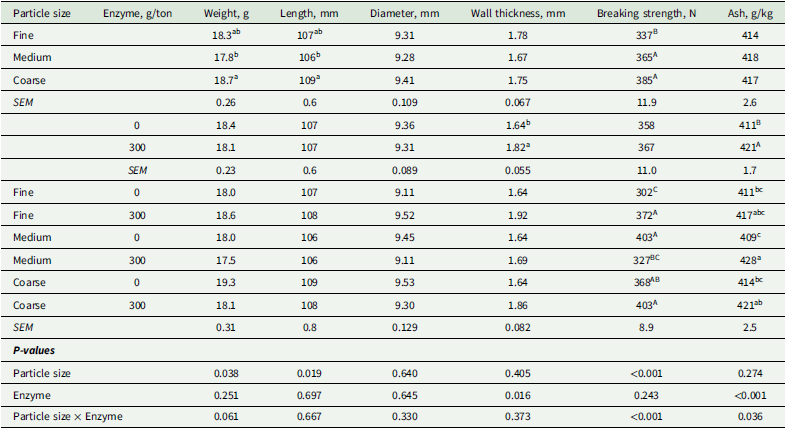
As presented in Table 6, the tibia diameter, wall thickness and ash content have not been affected by feed particle size (P > 0.05). Tibia weight and length improved significantly in the coarse group compared to the medium group (P < 0.05). The tibia breaking strength increased with feed particle size, and this increase was significant in the medium and coarse groups compared to the fine group (P < 0.01). Enzyme administration to wheat-based diets significantly increased tibia wall thickness (P < 0.05) and ash content (P < 0.01), but no effect was observed on other tibia parameters (P > 0.05). Interactions had no effect on tibia weight, length, diameter and wall thickness (P > 0.05) but the effect was significant on breaking strength (P < 0.01) and ash content (P < 0.05). The highest tibia breaking strength was obtained in the 300 g/ton enzyme-added coarse group, and the difference between this group and the fine group without enzyme and enzyme-added (300 g/ton) medium group was significant. The tibia ash of the enzyme-added (300 g/ton) medium group was significantly higher than the interaction groups without enzymes.
Effect of enzyme addition on tibia traits in wheat-based diets with different particle sizes

Fine: 4000 µm, medium: 5000 µm and coarse: 6000 µm sieve diameter has been ground in a hammer mill. SEM: Standard error means.
A,B,C Differences between means shown with different letters in the same column are statistically significant (P < 0.01).
a,b,c Differences between means shown with different letters in the same column are statistically significant (P < 0.05). Results are based on ANOVA results, following the Duncan test.
Pancreatic enzyme secretions
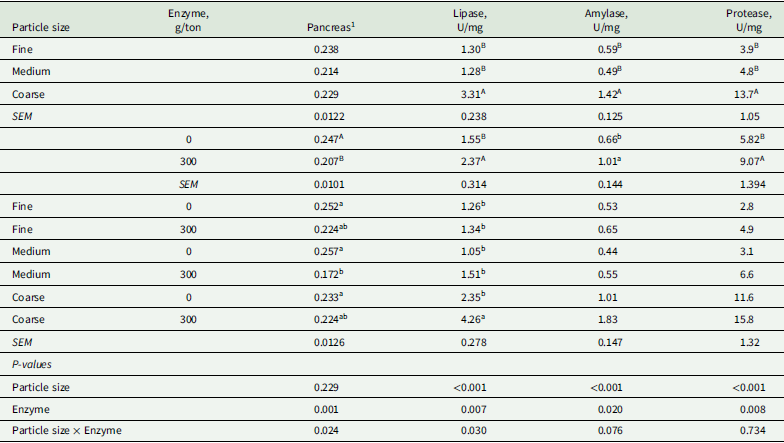
The effects of grinding wheat-based diets with different sieve diameters and enzyme addition on the pancreas weight and enzyme secretions are given in Table 7. Pancreas weight (g/100 g body weight) was not affected by feed particle size (P > 0.05). Pancreatic lipase, amylase and protease activities were significantly higher in the coarse group than in the fine and medium groups (P < 0.01). In the study, enzyme addition to the diet significantly reduced the pancreas weight (P < 0.01), on the contrary, it substantially increased the activities of pancreatic lipase (P < 0.01), amylase (P < 0.05) and protease (P < 0.01). The effects of the interactions on pancreas weight and pancreatic lipase were significant (P < 0.05), but this effect was not observed on pancreatic amylase and protease activities (P > 0.05). The pancreas weight was considerably lower in the medium group with 300 g/ton enzyme addition than in the interaction groups without enzymes. Pancreatic lipase activity of the enzyme-added (300 g/ton) coarse group is significantly higher than the other interaction groups.
Effect of enzyme addition on pancreas weight (g/100 g body weight) and pancreas enzymes in wheat-based diets with different particle sizes

Fine: 4000 µm, medium: 5000 µm and coarse: 6000 µm sieve diameter has been ground in a hammer mill. SEM: standard error means.
A,B Differences between means shown with different letters in the same column are statistically significant (P < 0.01).
a,b Differences between means shown with different letters in the same column are statistically significant (P < 0.05). Results are based on ANOVA results, following the Duncan test.
1 g/100 g body weight.
Jejunum histomorphology
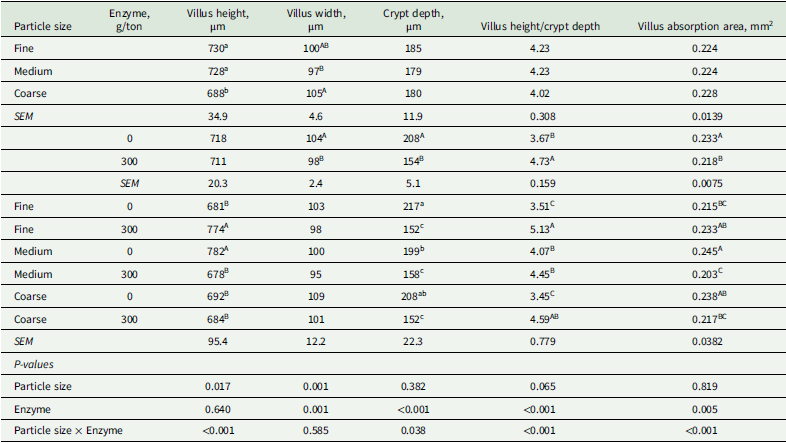
Data in Table 8 demonstrated the effects of wheat-based diets with different particle sizes and enzyme supplementation on the jejunum histomorphology of broilers. The effect of dietary particle size on the jejunum villus height (P < 0.05) and villus width (P < 0.01) was significant, but this effect was not seen for crypt depth, villus height/crypt depth ratio and villus surface area (P > 0.05). Villus height was substantially lower in the coarse group compared to the other groups. The jejunum villus width of broilers consuming the feeds of the medium group was statistically lower than that of the coarse group. The effect of enzyme addition to wheat-based diets on jejunum parameters such as villus height was not significant (P > 0.05), but it significantly affected the other parameters (P < 0.01). With the addition of enzyme to the diet, there was a significant decrease in villus width, crypt depth and villus surface area and a significant increase in the villus height/crypt depth ratio. The effects of the interactions on villus height (P < 0.01), crypt depth (P < 0.05), villus height/crypt depth ratio (P < 0.01) and villus surface area (P < 0.01) parameters were statistically significant, while villus width was not affected (P > 0.05). The villus height of the fine group with 300 g/ton enzyme addition and the medium group without enzyme was higher than the other interaction groups. The crypt depth of enzyme-added (300 g/ton) fine and coarse groups was higher than the particle groups without enzyme addition. The villus height/crypt depth ratio of the enzyme-added (300 g/ton) fine group was higher than the other interaction groups except the enzyme-added (300 g/ton) coarse group, and the crypt depth of the coarse group without enzyme was lower than the other groups except the fine group without enzyme. The villus surface area of the medium group without enzyme addition was higher than the fine without enzyme, medium with enzyme (300 g/ton) and coarse with enzyme (300 g/ton) groups.
Effect of enzyme addition on jejunum histomorphology in wheat-based diets with different particle sizes

Fine: 4000 µm, medium: 5000 µm and coarse: 6000 µm sieve diameter has been ground in a hammer mill. SEM: standard error means.
A,B,C Differences between means shown with different letters in the same column are statistically significant (P < 0.01).
a,b,c Differences between means shown with different letters in the same column are statistically significant (P < 0.05). Results are based on ANOVA results, following the Duncan test.
Discussion
Performance
The performance of broilers has been unaffected by grinding wheat-based diets in hammer mills with different sieve diameters. In fact, the study predicted that particle size distribution and GMD would cause differences in broiler performance. Nevertheless, it was shown that grinding wheat-based meals to diameters of 4000, 5000 and 6000 µm does not result in particle size and particle size distribution that are significant enough to affect the birds’ performance. This outcome confirms the findings of Amerah et al. (Reference Amerah, Ravindran, Lentle and Thomas2008a), who studied the effect of diets ground with different sieve diameters (3 and 7 mm) and stated that particle distribution and GMD had no effect on performance. Again, these results are consistent with Abdollahi et al. (Reference Abdollahi, Zaefarian, Hunt, Anwar, Thomas and Ravindran2019) and Novotný et al. (Reference Novotný, Horáková, Rihácek, Zálešáková, Štastník, Mrkvicová, Kumbár and Pavlata2023). However, Amerah et al. (Reference Amerah, Ravindran, Lentle and Thomas2008b) reported that feed consumption and feed conversion ratio decreased with increasing particle size. Amerah et al. (Reference Amerah, Ravindran, Lentle and Thomas2007), on the other hand, indicated that body weight increased despite the decrease in feed consumption with increasing particle size of feed. According to Lv et al. (Reference Lv, Yan, Wang, An, Wu and Lv2015), throughout the 1–40 day period, medium and coarse particle sizes provided a significant improvement in body weight and feed consumption in mash feeds compared to fine particle sizes. On the contrary, Arun et al. (Reference Arun, Chacko, Anitha, Harikrishnan, Prasoon and Antony2014) found that 7 mm sieve pore negatively affected the performance compared to 3- and 5-mm sieve diameters. There is a clear view that water-soluble NSPs contained in wheat may promote intestinal viscosity, impairing the digestion and absorption of nutrients and consequently worsening the performance of broilers, and it is well documented that the performance of broilers can be improved by adding NSPase enzymes to wheat-based diets (Kalmendal and Tauson, Reference Kalmendal and Tauson2012; Masey-O’Neill et al., Reference Masey-O Neill, Singh and Cowieson2014; Liu and Kim, Reference Liu and Kim2017; Bromfield et al., Reference Bromfield, Hoffman, Horyanto and Soumeh2021; Kubiś et al., Reference Kubiś, Kołodziejski, Pruszyńska, Sassek, Konieczka, Górka, Flaga, Katarzy´nska-Banasik, Hejdysz, Szumacher, Cieślak and Kaczmarek2022). Enzyme addition to wheat-based diets increased broiler body weight in the current study without affecting feed consumption during the 1–10th day; however, this effect has not been assessed in subsequent periods. These findings partially corroborate those of research conducted by Liu and Kim (Reference Liu and Kim2017), Bromfield et al. (Reference Bromfield, Hoffman, Horyanto and Soumeh2021) and Kubiś et al. (Reference Kubiś, Kołodziejski, Pruszyńska, Sassek, Konieczka, Górka, Flaga, Katarzy´nska-Banasik, Hejdysz, Szumacher, Cieślak and Kaczmarek2022), which found that adding enzymes to wheat-based diets improved performance without changing feed consumption. Amerah et al. (Reference Amerah, Ravindran, Lentle and Thomas2008a) demonstrated that the addition of xylanase enzyme to broiler diets improved feed efficiency at 1–21 days of age. However, according to Al-Qahtani et al. (Reference Al-Qahtani, Ahiwe, Abdallh, Chang’a, Gausi, Bedford and Iji2021), broiler performance has been unaffected by adding a combination of phytase, xylanase and β-glucanase to wheat-based diets. In the interaction groups, body weight over days 1–42 tended to decline in the fine group with enzyme supplementation in the diet (P = 0.057), and this decrease is probably due to a numerical decrease of approximately 250 g in feed consumption. Unlike the fine group, there is a tendency for improvement in body weight (P = 0.057) with enzyme addition to the medium and coarse groups. This improvement trend in body weight provided by enzyme supplementation is reflected as a numerical increase in feed efficiency. However, it is statistically insignificant. This result is partially similar to the result reported by Amerah et al. (Reference Amerah, Ravindran, Lentle and Thomas2008a) that adding enzymes to diets with coarse particle sizes produced better outcomes. In addition, the same work (Amerah et al., Reference Amerah, Ravindran, Lentle and Thomas2008a) emphasized that further studies are needed to understand the reasons for the improvement provided by enzyme addition to coarse particle feeds.
Slaughtering characteristics
Reducing carcass fat and increasing marketable carcasses are the primary purposes of broiler breeding (Fouad and El-Senousey, Reference Fouad and El-Senousey2014). This can be achieved by reducing abdominal fat accumulation to avoid the expenditure of diet energy on this low-return product and increasing the amount of breast meat relative to the carcass. The current investigation found that fine particles increased the thigh weight and medium particles increased the breast weight. Lv et al. (Reference Lv, Yan, Wang, An, Wu and Lv2015), Abdollahi et al (Reference Abdollahi, Zaefarian, Hunt, Anwar, Thomas and Ravindran2019), Bromfield et al. (Reference Bromfield, Hoffman, Horyanto and Soumeh2021) and Novotný et al. (Reference Novotný, Horáková, Rihácek, Zálešáková, Štastník, Mrkvicová, Kumbár and Pavlata2023) contrarily noted that feed particle size in wheat-based diets does not affect slaughtering characteristics. These findings disagree with the current study. Moderately increasing the protein level in the diet is effective in increasing the breast ratio in broilers (Bartov and Plavnik, Reference Bartov and Plavnik1998). In this study, an increase in pancreatic protease enzyme occurred with particle size. One may argue that the bird’s increased intake of protein as a result of the increase in pancreatic protease has led to an improvement in breast weight. Additionally, it is thought that the thigh weight decreased proportionally due to the increase in the breast weight. Particle size and thigh weight have a linear connection, however, there is a nonlinear relationship with the breast thigh. Fatty carcasses are less preferred by consumers (Adamski et al., Reference Adamski, Ku´zniacka and Milczewska2017). Therefore, the tissue that stores surplus energy – abdominal fat – is removed from the carcass after slaughter. Lv et al. (Reference Lv, Yan, Wang, An, Wu and Lv2015) clarified that the particle size of feed does not affect abdominal fat weight. In the current study, abdominal fat weight was higher in the fine group. The increase in the abdominal fat weight of birds receiving the fine group may be associated with the rapid and high digestion of sources such as starch due to the excessive grinding of the feed. Indeed, Péron et al. (Reference Péron, Bastianelli, Oury, Gomez and Carré2005) determined that finely grinding feeds increases starch digestibility. In the gizzard, particularly large particle feeds are ground and prepared for the small intestine’s final digesting (Svihus, Reference Svihus2011). It has been predicted that the gizzard weight will increase with increasing feed particle size. However, some particle-based studies (Amerah et al., Reference Amerah, Ravindran, Lentle and Thomas2007, Reference Amerah, Ravindran, Lentle and Thomas2008a, Reference Amerah, Ravindran, Lentle and Thomas2008b; Lv et al., Reference Lv, Yan, Wang, An, Wu and Lv2015; Svihus et al., Reference Svihus, Ahmad, Rinttilä, Apajalahti and Hetland2024) conducted with wheat-based diets indicate that gizzard weight has been unaffected. In the current experiment, the gizzard weight increased in the coarse group. This result supports Péron et al. (Reference Péron, Bastianelli, Oury, Gomez and Carré2005), Abdollahi et al. (Reference Abdollahi, Zaefarian, Hunt, Anwar, Thomas and Ravindran2019) and Novotný et al. (Reference Novotný, Horáková, Rihácek, Zálešáková, Štastník, Mrkvicová, Kumbár and Pavlata2023), who declared that gizzard weight increases with feed particle size. It may be concluded that the variations in feed particle size and distribution in the experiments are the cause of this difference. Carcass weight decreased with enzyme addition to wheat-based diets. Hosseini and Afshar (Reference Hosseini and Afshar2017a), Roofchaei et al. (Reference Roofchaei, Rezaeipour, Vatandour and Zaefarian2019) and Bromfield et al. (Reference Bromfield, Hoffman, Horyanto and Soumeh2021) reported that enzyme addition to wheat-based diets did not affect carcass weight. In the current study, enzyme use reduced the gizzard weight. On the other hand, Engberg et al. (Reference Engberg, Hedemann, Steenfeldt and Jensen2004), Hosseini and Afshar (Reference Hosseini and Afshar2017a) and Veluri et al. (Reference Veluri, González-Ortiz, Bedford and Olukosi2024) stated that enzyme use did not affect gizzard weight. These reports are inconsistent with the decreasing effect of enzymes on both carcass and gizzard weights in the present study.
Tibia traits
Strengthening the bone structure reduces the rate of bone fractures during procedures such as raising, catching and transport, and consequently, mortality and carcass defects due to bone weakness (Sun et al., Reference Sun, Fan, Wang, Guo, Wang and Dong2018). The bone’s ability to resist stress and fracture is indicated as the breaking strength of bone (Rath et al., Reference Rath, Huff, Huff and Balog2000), and the ash ratio is one of the most effective indicators of bone resistance (Shim et al., Reference Shim, Karnuah, Mitchell, Anthony, Pesti and Aggrey2012). Increasing particle size in wheat-based diets increases calcium efficiency in broilers (Abdollahi et al., Reference Abdollahi, Zaefarian, Hunt, Anwar, Thomas and Ravindran2019). According to the present results, breaking strength increased with particle size, and tibia weight and length were higher in the coarse group without affecting ash content. This situation demonstrated that the increase in tibia breaking strength in the current study occurs independently of bone mineralization. According to Al-Qahtani et al. (Reference Al-Qahtani, Ahiwe, Abdallh, Chang’a, Gausi, Bedford and Iji2021), the bone-breaking strength may be attributed to matrix enhancement rather than mineralization. The results of the current study also confirm this report. To fully comprehend the impact of increasing particle size on enhancing tibia breaking strength, more research on bone mineral composition and matrix structure is necessary. In this trial, tibia wall thickness and ash content increased with enzyme addition to a wheat-based diet. These results agree with those reported by Hosseini and Afshar (Reference Hosseini and Afshar2017a, Reference Hosseini and Afshar2017b), Liu and Kim (Reference Liu and Kim2017), Bromfield et al. (Reference Bromfield, Hoffman, Horyanto and Soumeh2021) and Bello et al. (Reference Bello, Giménez-Rico, Gilani, Hillen, Venter, Plumstead and Dersjant-Li2023). However, there are also studies reporting that enzyme addition to wheat-based diets does not affect bone ash content (Al-Qahtani et al., Reference Al-Qahtani, Ahiwe, Abdallh, Chang’a, Gausi, Bedford and Iji2021; Kubiś et al., Reference Kubiś, Kołodziejski, Pruszyńska, Sassek, Konieczka, Górka, Flaga, Katarzy´nska-Banasik, Hejdysz, Szumacher, Cieślak and Kaczmarek2022). Using enzymes such as xylanase enhances bone mineralization and declines the anti-nutritional effects of NSPs (Karimi et al., Reference Karimi, Coto, Mussini, Goodgame, Lu, Yuan, Bedford and Waldroup2013). Although it has been reported by Hosseini and Afshar (Reference Hosseini and Afshar2017a, Reference Hosseini and Afshar2017b), Bromfield et al. (Reference Bromfield, Hoffman, Horyanto and Soumeh2021) and Bello et al. (Reference Bello, Giménez-Rico, Gilani, Hillen, Venter, Plumstead and Dersjant-Li2023) that the use of NSPase enzymes in wheat-based diets improved mineral efficiency or accumulation, there are also studies (Liu and Kim, Reference Liu and Kim2017; Al-Qahtani et al., Reference Al-Qahtani, Ahiwe, Abdallh, Chang’a, Gausi, Bedford and Iji2021) reporting that it had no effect. In the present study, in the coarse group, the addition of enzymes tended to improve the breaking strength; in the fine group, this increase is more noticeable. Nevertheless, it was unexpected that the medium group’s tibia breaking strength decreased with enzymes. The addition of enzymes to diets with varying particle sizes resulted in a rise in tibia ash, although this increase was significant in the medium group. The contradiction between the increase in bone ash and the decrease in tibia breaking strength with enzyme addition to the broiler diets fed with medium particle size feeds in the current study requires future investigation under different feeding and breeding conditions.
Pancreatic enzyme secretions
Growing gizzard size and function with increased feed particle size can promote pancreatic enzyme activity (Svihus, Reference Svihus2011). In the current study, according to Tables 5 and 7, it is seen that both the gizzard weight and the activities of pancreatic enzymes increase together in coarse particles. The number of studies examining the effect of particle size on pancreatic enzyme activity is limited and the results are variable. Although feed particle size has been found to have no effect on laying hens’ pancreatic enzyme activity (Ege et al., Reference Ege, Bozkurt, Koçer, Tüzün, Uygun and Alkan2019), crumble-form corn-based broiler feeds have been found to concentrate pancreatic amylase and protease activity in comparison to mash form, but not pancreatic lipase activity (Mahdavi et al., Reference Mahdavi, Osmanyan, Fisinin, Ghazi Harsini, Arkhipova, Shevyakov, Kovalchuk and Kosovsky2018). Additionally, Engberg et al. (Reference Engberg, Hedemann, Steenfeldt and Jensen2004) revealed that pancreatic amylase activity decreased with whole-wheat feeding. It is possible that the concentrate in pancreatic enzyme activity in the coarse group in the present study is due to the stimulating effect of coarse particles on the growth of the gizzard, as reported by Svihus (Reference Svihus2011). However, further studies are needed to clarify this issue. The pancreas weight of broilers fed with enzyme-added wheat-based diets decreased. This outcome contradicts the findings of Engberg et al. (Reference Engberg, Hedemann, Steenfeldt and Jensen2004), Amerah et al. (Reference Amerah, Ravindran, Lentle and Thomas2008a), Hosseini and Afshar (Reference Hosseini and Afshar2017b), Roofchaei et al. (Reference Roofchaei, Rezaeipour, Vatandour and Zaefarian2019), Bromfield et al. (Reference Bromfield, Hoffman, Horyanto and Soumeh2021), who found that the pancreas weight has been unaffected by the addition of NSPase enzymes, either alone or in combination, to wheat-based diets. In the present study, enzymes secreted by the pancreas weight increased with enzyme addition to wheat-based diets. Al-Qahtani et al. (Reference Al-Qahtani, Ahiwe, Abdallh, Chang’a, Gausi, Bedford and Iji2021) stated that the addition of a mixture of phytase, xylanase and beta-glucanase to wheat-based diets improved the pancreatic chymotrypsin activity of broilers. Engberg et al. (Reference Engberg, Hedemann, Steenfeldt and Jensen2004), on the other hand, expressed that adding xylanase to wheat-based diets that contain whole wheat increased the activities of lipase and chymotrypsin. Although these results support the current study, there are also findings reporting that the use of enzymes in wheat-based diets does not affect pancreatic trypsin, amylase and lipase activities (Kubiś et al., Reference Kubiś, Kołodziejski, Pruszyńska, Sassek, Konieczka, Górka, Flaga, Katarzy´nska-Banasik, Hejdysz, Szumacher, Cieślak and Kaczmarek2022) or endogenous enzyme activity (Liu and Kim, Reference Liu and Kim2017) in the small intestine. Contrary to the current outputs, Yaghobfar and Kalantar (Reference Yaghobfar and Kalantar2017) indicated that the activities of pancreatic enzymes decreased with the addition of enzymes in wheat- or barley-based diets. The decrease in the water-soluble NSP contained in wheat with the addition of enzymes and the availability of nutrients may be the reason for the increase in pancreatic enzyme activities in the current study. Interactions between particle size and enzyme addition affected pancreas weight and pancreatic lipase. Although there is a numerical increase in lipase activity and a numerical decrease in the pancreas weight in medium and fine particle sizes with the addition of the enzyme, there is a significant increase in pancreatic lipase activity in coarse particle size and a decrease in the pancreas weight in medium particles. Amerah et al. (Reference Amerah, Ravindran, Lentle and Thomas2008a) reported that interactions between feed particle size and xylanase enzyme do not affect the pancreas weight.
Jejunum histomorphology
The absorption capacity of enterocytes is correlated with villus height, and absorption efficiency improves with villus height (Parsaie et al., Reference Parsaie, Shariatmadari, Zamiri and Khajeh2007). In the current study, villus height decreased in birds fed with coarse group feeds, while villus width decreased. Therefore, in this study, it has been determined that coarse particles negatively affected the jejunum histomorphology. Similarly, Novotný et al. (Reference Novotný, Horáková, Rihácek, Zálešáková, Štastník, Mrkvicová, Kumbár and Pavlata2023) found that villus height decreased with coarse particle size feeds, while the villus height/crypt depth ratio increased with reducing particle size. However, according to Amerah et al. (Reference Amerah, Ravindran, Lentle and Thomas2007, Reference Amerah, Ravindran, Lentle and Thomas2008a, Reference Amerah, Ravindran, Lentle and Thomas2008b) and Abdollahi et al. (Reference Abdollahi, Zaefarian, Hunt, Anwar, Thomas and Ravindran2019) particle size does not affect small intestine morphology in wheat-based diets. Wheat’s NSP content has the ability to encapsulate nutrients and produce a viscous environment in the digestive tract, which inhibits the interaction between nutrients and villi and weakens intestinal growth and structure (Spector, Reference Spector1976). These negative effects on intestinal morphology can be compensated by reducing viscosity by adding NSPase enzymes to the diet (Liu and Kim, Reference Liu and Kim2017). In the present study, the added enzyme reduced crypt depth, villus width and villus surface area and increased the villus height/crypt depth ratio, thus improving the overall jejunum histomorphology. Similar findings have been reported by Liu and Kim (Reference Liu and Kim2017), who found that adding xylanase to wheat-based diets improved the height of the villus and the villus height/crypt depth ratio linearly while having no effect on crypt depth. However, Hosseini and Afshar (Reference Hosseini and Afshar2017a) and Amerah et al. (Reference Amerah, Ravindran, Lentle and Thomas2007, Reference Amerah, Ravindran, Lentle and Thomas2008a, Reference Amerah, Ravindran, Lentle and Thomas2008b) found no change in small intestine histomorphology when NSPase enzymes were added to wheat-based diets. Furthermore, adding xylanase, beta-glucanase and phytase to wheat-based diets raised the jejunum villus height while having no effect on other characteristics, according to Roofchaei et al. (Reference Roofchaei, Rezaeipour, Vatandour and Zaefarian2019). Veluri et al. (Reference Veluri, González-Ortiz, Bedford and Olukosi2024) noted that whereas enzyme supplementation had no effect on other morphological characteristics, it decreased the small intestine’s villus height/crypt depth ratio on day 42. The results obtained from this trial support previous studies (Liu and Kim, Reference Liu and Kim2017) reporting that the use of enzymes in wheat/containing diets improves small intestinal morphology. Interactions of particle size and enzyme addition affected crypt depth, villus height, villus height/crypt depth and villus surface area of jejunum. Villus height increased in the enzyme-added (300 g/ton) fine group and decreased in the medium group. Crypt depth has been clearly reduced by enzyme addition to diet at all particle sizes. Villus height/crypt depth ratio increased in the enzyme-added fine and coarse groups. Villus surface area declined with the enzyme-added (300 g/ton) medium group. These results disagree with the results of the studies by Amerah et al. (Reference Amerah, Ravindran, Lentle and Thomas2007, Reference Amerah, Ravindran, Lentle and Thomas2008a, Reference Amerah, Ravindran, Lentle and Thomas2008b) and Hosseini and Afshar (Reference Hosseini and Afshar2017a), who reported that the interaction groups formed by particle size and use of enzyme do not affect the jejunum morphology.
Conclusions
In conclusion, feed particle size does not affect performance, and enzyme addition demonstrated a positive effect in the 1–10th day period. Increasing feed particle size improved breast and gizzard size and reduced thigh and abdominal fat. Carcass and gizzard weights decreased with enzyme addition to the feed. Bone development has been improved especially with coarse particle size and enzyme supplementation. Coarse particle size negatively affected intestinal morphology and concentrated pancreatic enzyme activity. The use of multi-enzyme in wheat-based diets improved both jejunum morphology and pancreatic enzyme activity of broilers.
Acknowledgements
We would like to thank the Selçuk University Faculty of Agriculture Dean’s Office.
Author contributions
ETG, SAG, OO, YC and AET contributed to the conceptualization, methodology, investigation, writing – original draft and writing – review and editing. AET contributed to jejunum histomorphology and pancreatic enzyme analyses. ETG, OO and YC contributed to supervision, review and editing. All authors have read and approved the final version of the manuscript.
Funding statement
This research received no specific grant from any funding agency, commercial or not-for-profit sectors.
Competing interests
The authors declare no conflicts of interest exist.
Ethical standards
The authors confirm that the ethical policies of the journal, as noted on the journal’s author guidelines page, and the European National Research Council’s guidelines for the Care and Use of Laboratory Animals (EU regulation 2010) were followed.