INTRODUCTION
In recent years, policy regarding the medical care of cancer patients has changed in Japan from an emphasis on hospitalization to the promotion of treatment at home.
However, a national enquiry by the Japanese Ministry of Health, Labour and Welfare in 2003 found that only 11% of respondents would, if a patient, “hope to die at home if suffering terminal cancer accompanied by pain.” About 80% gave as their reason that “it would be too great a burden on the family,” about 60% feared that “sudden symptom changes would cause anxiety,” and nearly 70% found “the thought of remaining at home to the very end difficult to entertain” (Ministry of Health, Labour and Welfare, 2004). In fact, the rate for deaths from cancer at home in Japan is less than 10% (Yang et al., Reference Yang, Sakamoto and Marui2006). However, other research has reported that most Japanese, when terminally ill, would prefer to die at home or in a homelike setting (Ministry of Health and Welfare, 1995; Minister's secretariat, 2000).
The family that cares for a patient with terminal cancer takes responsibility for the maintenance of daily life and the immediate care of the patient and also must witness the pain suffered by the patient as the condition worsens and attend at the deathbed. Most research on home care emphasizes the magnitude of the mental and physical stress imposed on the family in whose midst caring takes place (Given et al., Reference Given, Wyatt and Given2004; Goldstein et al., Reference Goldstein, Concato and Fried2004). It has been pointed out that excessive load and stress on the family are risk factors for psychosocial maladjustment with longer term implications for handling the subsequent bereavement caused by the death (Rossi Ferrario et al., Reference Rossi Ferrario, Cardillo and Vicario2004).
Since the 1970s, palliative care services have been developed in many countries to provide for the needs of patients with terminal cancer and their families, and the provision of home palliative care services is a part of this movement (Doyle, Reference Doyle, Doyle, Hanks and Cherny2004). In countries where such programs are most advanced, bereaved families who were recipients of home palliative care services are reported to be more satisfied with the care patients received and the experiences of the period leading up to their death than families where the patient was cared for and died in a general hospital or in a nursing home (Teno et al., Reference Teno, Clarridge and Casey2004). Family members where home palliative care was received found positive meaning in the experience, describing it as a good experience that deepened their own appreciation of life (Stajduhar, Reference Stajduhar2003).
In Japan, too, consciousness of the importance of home palliative care has grown, and the service is provided by about 55 institutions nationwide (Ida, Reference Ida2004). This is, however, a recent development in Japan, and evaluations of the experience of families, and of the primary caregiver, of home palliative care services received for terminal cancer in a family member are not documented. More needs to be known of the attitudes of family members to the experience in order to work toward improving and enriching the assistance delivered by home palliative care services.
It is shown to be important how the primary caregiver recognize his or her experience of bereavement in order to maintain his or her well-being and adopt the death of family member (Folkman, Reference Folkman1997). To clarify the caring experience of the primary family caregiver, it is important to think of family care from the initiation of palliative care for terminal cancer patients while also anticipating bereavement.
Therefore, in this article, we aim to describe family caregivers' experiences in caring for a terminal cancer patient at home.
In this study, “care experience of the terminal patient” is defined as follows: the recognition and evaluation of experiences during the process of caring for dying people (Akimoto et al., Reference Akimoto, Oshima and Shibano2003) and the experience of bereavement.
METHODS
Subjects
The subjects were adult primary caregivers of cancer patients who died at home and who had received the home palliative care service provided by Okabe Clinic in Miyagi prefecture, Japan. This clinic specializes in the provision of home palliative care for terminal cancer patients and offers both medical and nursing care. Since its establishment in 1998, it has provided home care services and medical treatment for about 700 terminal cancer patients, about 90% of whom died at home. It is a leading facility in the provision of home palliative care in Japan.
A condition of selection for the study was that between 6 and 24 months had elapsed since bereavement, so that the period of greatest grief would be over at the time of answering the questionnaire, but no so long a period as to compromise recall of the caring experience.
Out of 167 suitable primary caregivers, 14 who participated in exploratory interviews were excluded. A further 37 who received the home palliative care service for less than 2 weeks and four who would have had difficulty answering the questionnaire because of mental illness were also excluded. The questionnaire was mailed to the remaining 112 primary caregivers.
Procedure
Creating the Questionnaire: Preliminary Investigation
The study began with a preliminary investigation in the form of semistructured interviews with nine primary caregivers (three wives, two husbands, three daughters, one daughter-in-law) from whom written informed consent was obtained. The caregivers were encouraged to talk about their experience of providing care for a terminal cancer patient at home. The contents of the interviews were analyzed and used, with reference to prior research materials, to create an original questionnaire suitable for investigating this caring experience.
The questionnaire was peer reviewed by five palliative care experts, one hospice chief doctor, one hospice head nurse, one home palliative care nurse, one nurse counselor, and one chaplain. To test the feasibility of the questionnaire in action, 10 primary caregivers who had cared for a terminal cancer patient up to the time of death answered the questionnaire. After making necessary revisions, the final form of the questionnaire was reached.
Data Collection
An anonymous questionnaire survey was conducted by mail from November to December 2004.
The study protocol was approved by the Institutional Review Board of Okabe Clinic.
Questionnaire
The questionnaire sought information in the following areas:
1. Respondent characteristics: Information requested included gender, age, occupation, number of family members living with the respondent, relationship to the deceased, period elapsed since the patient's death, and the age and gender of the deceased. Respondents were informed that the researcher could not identify the respondent or the deceased.
2. Care experience: Items relating to the caring experience were classified into three categories: background situational and emotional factors, awareness of the primary caregiver during caregiving, and present evaluation of the care given.
Background situational and emotional factors
There were 10 items as follows: period from first visit from the palliative care service to the patient's death, importance of the patient to the primary caregiver before care began, whether or not home palliative care was desired by both the primary caregiver and the patient, whether or not the prognosis was understood by the primary caregiver and/or the patient during home palliative care, whether or not it was intended to provide care at home up to the patient's death at the time home palliative care was chosen, sharing of caregiving and housework by other household family members, whether or not there was cooperation in caregiving other than between the family and the visiting palliative care staff, the condition of patient during home palliative care, and the condition of the patient at the time of death.
Where appropriate, the form in which questions were asked provided for a positive or negative response, on a 4-point Likert type scale ranging from it was not to it was. Three alternatives were provided for the last question relating to the patient's condition at the time of death: peaceful, it seemed painful, and uncertain.
Awareness of the primary caregiver during caregiving
There were four items as follows: distressed by caregiving (burdened feeling), whether or not the caregiver's feelings of a bond with the patient were deepened, whether or not the bond of the whole family was deepened, and degree of satisfaction with the home palliative care service received.
Degree of satisfaction with the home palliative care service was scored on a 6-point Likert scale from very unsatisfactory to very satisfactory and the other items on a 4-point Likert type scale ranging from did not feel to did feel.
Present evaluation of the care given
There were five items as follows: I think I did my best in caregiving; I think that the patient retained his/her personal qualities up to the time of death; I think home care was good for the patient; I think home care was good for me as primary caregiver; and I think home care was good for the other family members.
These items were scored on a 4-point Likert type scale ranging from I do not think so to I think so.
Data Analysis
Descriptive statistics were obtained by tabulating the responses to the questionnaire, using the statistical package SAS for Windows ver.9.1. (SAS Institute, Cary, NC).
RESULTS
Of the 112 questionnaires mailed, 76 were returned (67.9%); as 2 questionnaires were not completed, a total of 74 were the subject of the analysis (response rate 66.1%).
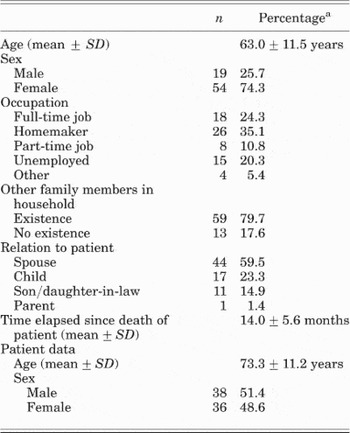
As regards demographic data of the participants, mean age was 63.0 (±11.5) years, 74% were women, 55% were full-time homemakers or unemployed, and 80% were living with other family members at the time of the investigation. Sixty percent of caregivers were spouses of the patient, 23% were a child of the patient, 15% were the spouses of a child of the patient, and one was a parent. The mean time period since the death of the patient was 14.0 (±5.6) months (Table 1).
Background and characteristics of the primary caregiver (N = 74)

aPercentage calculated on total number of subjects, not on number of responses.
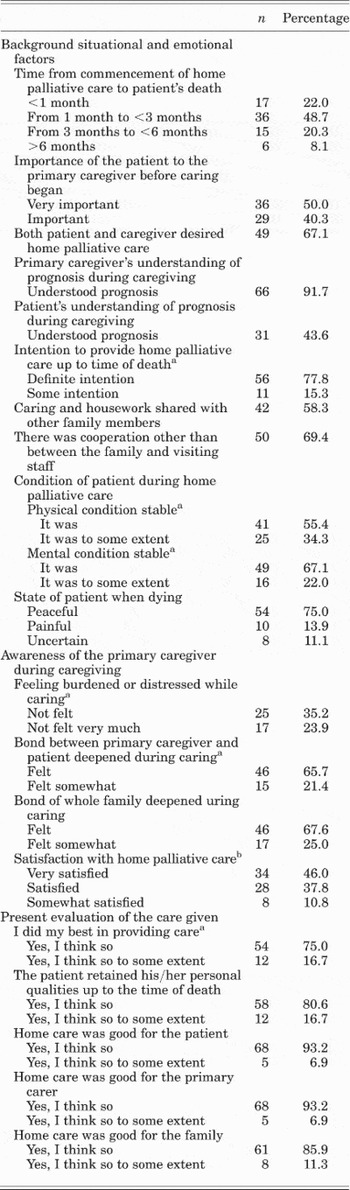
Details of the care experience at home (Table 2)
Background Situational and Emotional Factors
For 71% of caregivers, it was less than 3 months from the first visit by the palliative care service to the death of the patient. For 90% of caregivers, their relationship with the patient before caregiving began was “very important” or “important.” At the time of caregiving, 92% of caregivers, but only 44% of patients, understood the prognosis. Seventy-eight percent of caregivers intended to care for the patient at home up to the time of death at the time the choice of home palliative care was made. Fifty-eight percent of caregivers shared role of caregiving and housework with other members of the family, and for 69% there was cooperation between the family and the visiting palliative care staff. Ninety percent and 89% of caregivers felt that the condition of the deceased during home palliative care “was” or “was to some extent” both physically and mentally stable, respectively. Seventy-five percent of caregivers felt that the condition of the patient at the time of death was “peaceful.”
Caregiver's care experience at home (N = 74)

aSources for the top two positions only on the 4-point Likert scale.
bScores for the top three positions only on the 6-point Likert scale.
Awareness of the Primary Caregiver during Caregiving
Fifty-nine percent of primary caregivers “did not feel” or “did not feel much” distress (burden) from caregiving. Eighty-seven percent and 93% of primary caregivers both felt “their bond with the patient deepened” and “the bond of the whole family deepened” in the period of home care, respectively. Forty-six percent of respondents were “very satisfied” with the home palliative care service, and more than 90% were “somewhat satisfied,” “satisfied,” or “very satisfied.”
The Primary Caregiver's Present Evaluation of the Care Given and of Home Palliative Care
To the question “I think I did my best in caregiving,” 92% of caregivers checked the responses “Yes, I think so” or “Yes, I think so to some extent (I did close to my best).” Eighty-one percent of caregivers felt strongly that the patient retained his or her personal qualities up to the time of death. Ninety-three percent of caregivers felt that it was good for the patient to have been cared for at home, 93% that it was good for the primary caregiver, and 86% that it was good for the rest of the family. Overall, the evaluation of palliative home care was good.
DISCUSSION
This study collected data of the situation and experience of family care of patients with terminal cancer, especially of the primary caregiver, maintained with the assistance of a home palliative care service, in Japan. Primary caregivers gave positive evaluations of home palliative care services based on their experiences in caring for terminal cancer patients at home.
It was found that both the patient and the primary caregiver preferred home palliative care in about 70% of cases. To spend the last days of life in one's own choice of environment is an issue for quality of life (Cantwell et al., Reference Cantwell, Turco and Brenneis2000; Thomas, Reference Thomas and Thomas2003; Gomes & Higginson, Reference Gomes and Higginson2006), and home palliative care contributes to the achievement of this goal through the provision of medical treatment in the home, allowing the patient to remain there in reasonable comfort.
At the time home palliative care was initiated, about 90% of primary caregivers understood the patient's prognosis and intended to continue caring for the patient in the home up to the time of death. Contributing factors to this intention may have been that the primary caregiver was aware of the limited number of days of life remaining to the patient and the personal importance of the patient to the caregiver.
It is generally considered that caring for a terminally ill loved one is a source of burden and distress because of the need to balance caring and other tasks, the emotional cost of the prolonged period involved, and the knowledge that the period of caring will end in death. However, about 60% of primary caregivers did not feel distressed or burdened by their caregiving responsibilities, and this finding is similar to that of an earlier study (Cho et al., Reference Cho, Kounuma and Ito2003). It is possible that the availability of an appropriate palliative care service assists in preventing a feeling of being overburdened. However, it is also possible that in retrospect, some time after the death, feelings of burden and distress at the time are no longer vividly recalled. About 60% of primary caregivers were able to share caring and housework with other members of the household, and about 70% felt that access to others with whom they could consult and cooperate might have contributed to reducing the burden of care.
Regarding the implications for patients of home palliative care, most primary caregivers considered that pain was successfully managed, that the patient was comfortable at home and was stable mentally, and that the death itself was peaceful. Improvements in palliative technology to relieve symptoms (Payne & Gonzales, Reference Payne, Gonzales, Doyle, Hanks and Cherny2004) have made it possible for terminally ill cancer patients to be comfortable at home (Kiba, Reference Kiba1998) and to die peacefully in familiar surroundings. And it is suggested that witnessing a peaceful death at home leads to a positive evaluation of home caring by the primary caregiver (Phipps & Braitman, Reference Phipps and Braitman2004). Primary caregivers felt there was a deepening of their bond with the patient and of that of the family also. These positive aspects of caring in the home would enable its continuation without feelings of excessive burden (Yamamoto-Mitani et al., Reference Yamamoto-Mitani, Ishigaki and Kuniyoshi2002).
The sense of achievement expressed by primary caregivers, of having done well in the provision of care, was high, and the evaluation by primary caregivers, that the patient retained his or her personal qualities to the end, would also be rewarding. Primary caregivers judged that it was good not only for the patient, but also for themselves and for other family members to have cared for the patient at home. It can be concluded that, for most primary caregivers, the decision to care for a loved one to the end at home resulted in a sense of achievement and a high evaluation of home palliative care.
The finding that, for most primary caregivers, the experience of caring in the home was positive confirms previous research (Singer et al., Reference Singer, Bachner and Shvartzman2005), which has also found that the primary caregiver who cares for a patient who is important as a family member, when the patient retains his or her identity to the end and dies peacefully and there is a deepening bond with the whole family, experiences a sense of achievement at having done well, which is a support both during care and after bereavement.
Home palliative care services have now begun in Japan and can be expected to spread in the future, given that home palliative care services benefit not only the patient, but also the family providing care at home.
Limitations
The number of subjects in the present research was small, and the sample was limited to primary caregivers who received home palliative care assistance from only one facility in Japan. Investigations of outcomes of the services of a variety of home palliative care facilities in different regions and in relation to different client views of life and death are needed.
A questionnaire is a relatively restricted methodology for the exploration of the experience of caring for a terminal cancer patient at home, and future research, perhaps with face-to-face interviews, is needed to provide more detailed information and to verify the reliability and validity of these questionnaire results.
A possible source of bias in the results is the nonreturn of some questionnaires, as the caregivers involved may have differed in their experience from those who returned them.
This was a retrospective study, with possibilities of inaccurate and imperfect recall. Longitudinal studies are also needed, following the family from when care is instituted to after bereavement, as a means of extending our understanding of the impact of home palliative care on all those involved.
CONCLUSION
Primary caregivers' evaluations, from their experience of caring for terminal cancer patients at home with the assistance of a home palliative care service, were high and positive. Our findings indicate that it is important to maintain the patient's personal qualities up to the time of death through appropriate symptom management, to respect the family bond of the household, and to provide professional support in order to reduce the load on the family. If appropriate care is provided, peaceful home death will be possible, resulting in significant benefits for patients and their families in Japan.
ACKNOWLEDGMENTS
We sincerely thank the family caregivers who willingly participated in this research. We also appreciate the kind support of Ms. Mariko Hino, Ms. Terue Tamai, and all the staff of Okabe Clinic and acknowledge the assistance of Dr. Taketosi Ozawa, director of Megumi Home Care Clinic, Ms. Noriko Hutami, head nurse at Peace House Hospital, Ms. Hiroko Hirose, nurse counselor at Toda Central Hospital, Ms. Yumi Hurusawa, assistant at 21st century COE Construction of Death and Life Studies, and Ms. Megumi Suzuki, staff nurse at Okabe Clinic, who kindly guided this research.