“I don't think I am good enough” was more than one student's response when invited to participate in civic engagement activities or to articulate their own original scholarly ideas. The insecurities underlying comments like this one are probably much more complex when put into the context of a student's academic life and its normal expectations. Students may have heard about previous civic engagement ventures from classmates who preceded them, and admittedly, many of those students had similar reservations in previous American Democracy Project (ADP) ventures; however, the America's Future Initiative was different. This initiative aspires to engage students' critical and analytical thinking on issues related to deficits and debt, especially in the public sector; furthermore, America's Future is a call to action without a prepared script.
PERSPECTIVE AND BACKGROUND
Other universities were especially creative and inspiring in their campuswide approaches to the America's Future Initiative. Emporia State University's (ESU) venture was unique in some respects by its immersion of the project in economics courses; however, almost everything we did could have been done in other disciplines, especially political science. The cross-disciplinary nature of the essential material compelled us to embrace the richness of other social sciences much more explicitly in classes than had we covered a narrower scope of economic principles, and it facilitated a much higher level of accomplishment, which should become evident later.
The learning process is often abstract, and a good deal of the subject matter in economics can be as well. In economics, as in most academic disciplines, students are accustomed to refined assessments (e.g., exams, assignments, quizzes) that provide a seemingly constant flow of feedback to the student. Most students know when they are doing well or adapt if they seek a higher grade. Many students seek to maximize their final grade with different strategies. Some employ the strategy of “learn (for an exam) and forget.” While others may have more lasting approaches, few students expect to use what they are learning in a course either immediately or in other courses. Perhaps this inclusion of elements from other disciplines created a refreshing approach and encouraged greater student effort.
The risk of embarrassment was high in several phases of our project, especially because the scrutiny of the students' work extended well beyond the professor, classroom, and even the campus. Students knew they would be dealing with accomplished professionals from a variety of academic backgrounds. Perhaps more important, there seemed to be the cognition that some of this really mattered for a variety of reasons, not the least of which was public officials' inclusion of students in real projects (e.g., Homeless Count and the KansasWorks stimulus package collaboration, which will be mentioned later) with significant consequences.
ESU is a predominantly residential campus of four thousand undergraduates a little over an hour away from most of the major metropolitan areas of Kansas; the two thousand graduate students are mostly nonresidential and were not involved in this project. The university population deliberately has a generous share of undergraduate residential international students, and many participated in the project. The courses involved in the America's Future Initiative include a comprehensive beginning economics course with approximately 60 students per section, an honors section complementing it with about 10 students per semester, and the fall and spring sequence of intermediate micro- and macroeconomic theory courses with approximately 30 students each. The largest number of students came from the lower-level courses that had students from a broad spectrum of the campus. Students from every major on campus participated.
ELEMENTS OF THE AMERICA'S FUTURE INITIATIVE AT ESU
The campus ADP steering committee had planned a campuswide essay contest, and it changed the theme to stimulate thoughts about the Constitution and public debt following our university's selection as part of the America's Future Initiative. The timing of the contest was associated with Constitution Day, September 17, as mandated by congressional legislation (Federal Register 2005). This date was quite early in the semester, so no class time had been devoted to the topic. Participation was voluntary for faculty and students, and professors in political science and history were the judges. We received 21 entries, 20 of which were from students in classes involving the America's Future Initiative. At this point, we heard the comment “I don't think I am good enough” for the first time. Other students expressed a lack of time or interest. These sentiments should be no surprise to any college professor; receiving over 20 voluntary entries might be. In serendipitous ways, the essay contest provided something resembling a pretest by providing a glimpse of any scholarly thought process, or absence thereof, that students brought to the course. It was interesting, and somewhat embarrassing, to read some of the shallow attempts at constructing an argument along with slogans and rhetorical embellishments about the virtues of being debt-free.
After the September meeting in Washington, DC, to start the Initiative, ESU quickly created a survey that would serve as a pretest to gauge changes in students' initial attitudes toward deficits, debt, and other public sector concerns. Anyone who recalls the dramatic challenges to the financial markets in September 2008 will recognize the importance of having students complete the preliminary survey before the vast media coverage that may have directly, or certainly indirectly, influenced perceptions of deficits and debt. In some ways, we were already too late, because on September 7, 2008, the government announced what was then the largest bailout in history by taking control of failing mortgage giants Fannie Mae and Freddie Mac. We created and distributed the preliminary survey on paper in classes prior to the September 19 announcements of the bailout of several other financial giants.
Then, we began focusing on the voter registration and education campaign with an emphasis on issues related to economics and deficits. The extraordinary economic events in the fall combined with the campaign created unique opportunities and challenges, because one of the main purposes of the Initiative is to engage students in the democratic process. Although students usually perceive deficits and debt to be boring topics, the economic and financial events catapulted these issues to high levels of importance. On the other hand, no one knew if this distinctly nonpartisan initiative might accidentally align with one of the candidates' major themes and be perceived as a partisan endeavor. Regardless, the anticipation heightened awareness and engagement in the election.
It is impossible to measure the exact effect of the initiative on student participation in the electoral process, because ESU has had considerable success over the last four years in voting projects on our campus. Students found far fewer classmates who were not already registered to vote than in previous years. Part of this outcome was attributable to work we did on another ADP initiative called the Young Voter Strategies Project under the direction of Elizabeth Bennion of Indiana University, South Bend, which explored new ways to engage students in the democratic process. Although our approach is featured in her work (Bennion Reference Bennion2006), we learned even more from other innovative approaches and implemented some of them. We did not have to work to inspire students in the 2008 election cycle. Thus, the perception that students seemed energized could have been attributable as much to the adoption of new ways to reach younger voters as to the America's Future Initiative or even the dramatic events in the economy, taxes, deficits, and the campaign. It would be speculation to suggest that one of these areas was the reason why the campus culture tended toward higher levels of voter registration.
INTERGENERATIONAL DIALOGUE
Our plans quickly changed after the Concord Coalition canceled its participation in an innovative, intergenerational dialogue for the fall 2008 semester at ESU. We hastily developed another style of intergenerational dialogue intended for the Thanksgiving break. Inspired by Andrew Yarrow's exploration of intergenerational transfers (Yarrow Reference Yarrow2008), the intent was for students to interact with and especially listen to people from different generations. Knowing that it could be awkward to find a convenient segue into the topic, students and faculty developed a printed survey for the students to orally administer over the Thanksgiving break, when multiple generations might be gathered. The nonscientific survey was designed to provide insight into attitudes, knowledge, and concern on the topics of deficits and the national debt. The hope was to facilitate discussion on the topic so that students could have a broad-based exposure to multiple generations and listen to the personal interests of different generations. The most controversial questions were adapted from Public Agenda's Students Face Up to the Nation's Finance Web site about potential modification to Social Security, Medicare, and other federal programs.
Ideally, we would have participating students complete a survey prior to and after the intergenerational dialogue. We later used this approach in the spring semester; however, we do not have the preliminary survey data from the fall semester. The students also submitted the results of the surveys they administered to kindle the intergenerational dialogue. The purpose of the survey was not to create a scientific poll; instead, it was to facilitate discussion on the key topics. The number of nonstudent participants (n = 232) in the fall was not nearly as important as what happened. The students began to realize that their education put them in a position to listen and critically evaluate the discussions taking place about topics that few had considered important (to them) before.
Student feedback was strongly positive, with many wide-ranging comments. Several expressed surprise at the lack of depth of their relatives' understanding of the issues. Others correctly anticipated the responses of people they knew well. A sample comment from one student is illustrated here:
It was interesting to see all of my family's different opinions, especially from one generation to another. When it came to education, my grandfather thought there should be no change in the amount the government should spend on it. However, I believe that that is definitely one area our government would benefit from if it spent more (on education). If more kids make it through high school and can afford to go to college, they will be able to get better jobs and be able to contribute more to the economy. In addition, most of my relatives thought that the budget deficits would have slight to little impact on children and young adults, but as they grow and have to eventually start paying taxes I see the deficit growing right along with them, and they will have higher taxes as a result. Our parents and grandparents have paid into Social Security all of their working lives and to just take that away is not fair to them. I hope that in the end our new administration can come up with better ways to do Social Security, (health) insurance, and so on.
A variety of projects were part of the ESU activities; however, we planned another intergenerational dialogue in the spring semester, which came to fruition in proximity with Easter. This time, there were 223 nonstudent participants, which was almost identical to the fall semester turnout. The surprising part of this number was that there were far fewer students enrolled in participating classes because of the way courses were scheduled; thus, the higher level of participation suggests that interest did not diminish as we had anticipated. Perhaps the experiences and success from the fall semester helped as well.
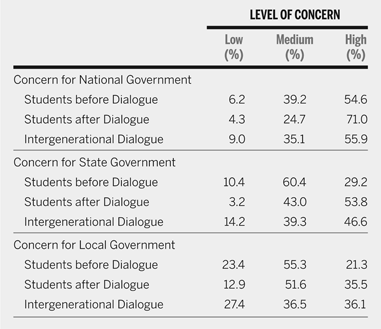
Table 1 presents the results from the survey of students prior to and immediately after the spring intergenerational dialogue. The table also presents the results from the survey of nonstudent participants. Note the increases in “high” levels of concern after the students experienced the intergenerational dialogue and the other course-related activities associated with the Initiative. Moreover, the higher level of concern was prevalent for all three levels of government, with the greatest increase occurring at the national level, where the percentage of students expressing a high level of concern increased from 54.6% to 71%.
Student and Nonstudent Participant Concerns about Public Finance, by Level of Government

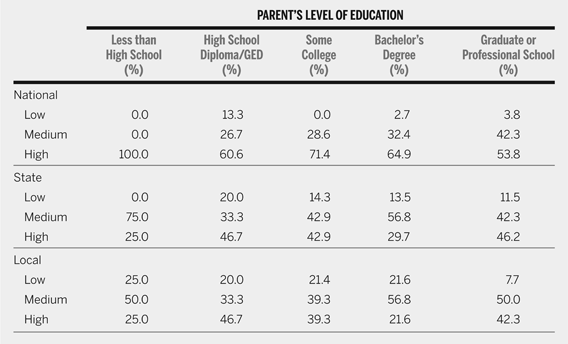
The data presented in table 2 are similar to the data presented in table 1; however, they are from the end of the first semester and only feature student responses. The interesting finding is the difference in attitude of students from less educated families; they express the greatest concern about the financial challenges facing the federal government. In addition, they do not express as much high-level concern about the financial situation of state and local governments compared with students from more educated households. These data were collected after the intergenerational dialogue and have similar overall patterns as the data from the spring semester.
Student Concern about Public Sector Financial Challenges, by Education of Parent—Fall 2008

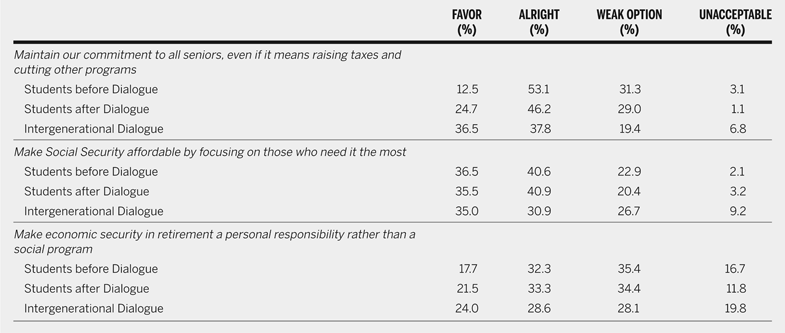
Table 3 focuses on options for Social Security. It contrasts changing attitudes and perceptions of students after encountering responses from the intergenerational dialogue. Notice the changes between opinions before and after experiencing the intergenerational dialogue, especially when students favor specific policy proposals about Social Security. This change is interesting, because many students are skeptical about the viability of programs like Social Security in the distant future, when they theoretically will become eligible. We suspect that they began to understand the challenges of broad-based fiscal reform after listening to others, especially their parents and grandparents.
Student and Nonstudent Participant Attitudes toward Social Security Options

As one student remarked:
The answers I received from my older, younger, and less educated family members weren't so much surprising as they were explanatory in why the general public has such a hard time understanding the economic situations of our country. It also shone light on why it is hard to get the general public to listen and understand possible strategies for improving the overall situation.
In class discussions, other students seemed to reveal a deeper understanding of the legislative process. The intergenerational dialogue added a measure of realism that would have been difficult to capture in a normal classroom. Students began to understand the challenges of reduced Social Security benefits for their parents or older relatives who might soon become eligible.
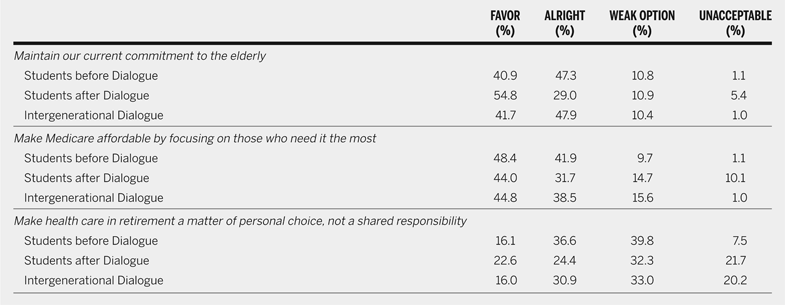
Attitudes toward Medicare are featured in table 4. Notice the changes in the “favor” and “unacceptable” categories before and after student exposure to the intergenerational dialogue. The increase in the “unacceptable” category suggests that students began to recognize the implications of some of these alternatives. We are not making statistical inferences based on these data, because our design did not employ a random sample from which we might make inferences about the population. Our intent was to foster dialogue with a variety of generations, and these questions provided the impetus for this intergenerational dialogue.
Student and Nonstudent Participant Attitudes toward Medicare Options

Some factors beyond the intergenerational dialogue are likely to have had an impact. More detailed, cross-tabulated analysis yielded some expected demographics along with a surprising result. It was not surprising that approximately one-third of the students came from communities with less than 10,000 residents and that another 20% came from communities with populations between 10,000 and 50,000 people.
The most surprising result was the difference by student gender and educational background of the most educated parent or guardian. Women disproportionately came from more educated households. For example, over 80% of the students who had a parent with an education beyond a bachelor's degree were female (84.6% in the fall and 81.8% in the spring). In the spring, 84.8% of students coming from a home where a parent had a bachelor's degree were female. Comparable with national trends, ESU has a larger proportion of undergraduate women, and more women were involved in this project; however, the lopsided results far exceeded any expected distribution. Beyond potential selection bias, this finding provides some insight into several issues that may (or may not) be unique with our institution. Although our objective is not statistical inference to a larger population, it still raises questions about the types of students who volunteer and gain from civic engagement and other activities.
Students reported that some highly intelligent and accomplished relatives did not grasp the issues in anything other than a superficial way. This became obvious to the students as the conversation in the intergenerational dialogue evolved; it surprised some students. Student discussion in class suggested that they began to understand about the personal interests of certain groups, especially their older relatives. Some noted: “There are no easy solutions” to these fiscal issues.
CIVIC ENGAGEMENT PROJECTS
Although many of the events and activities remained the same in the spring, an unexpected ADP civic engagement opportunity surfaced in January. Our county was selected for an intensive and systematic search for homeless individuals. Twenty-two students from the America's Future Initiative at ESU volunteered to pair with members of the community to conduct the search. In spite of exceptionally heavy publicity, few from the community were willing to brave the winter weather, and the 22 students carried out the program along with only six community volunteers. This exercise reinforced the challenges of the distribution of income created by a market system and added perspective on some of the challenges facing the public sector. Cutting the budget sounds easier when one does not have much understanding of the implications. The students who participated expressed concern about those who are less fortunate. One student commented: “I cannot imagine living like that” after learning that a homeless woman typically ventured into an all-night bus station between midnight and 3 A.M. to regain warmth. Others learned that the homeless sometimes were in the public library, ostensibly reading or browsing the material.
The massive federal stimulus package brought another dimension to the America's Future Initiative. KansasWorks, which is the employment arm of the Kansas Department of Commerce, asked the students to use their intellectual and creative talents to suggest ways to use funds on a summer youth employment program. Although the rules established by the federal government changed throughout the project as stimulus guidelines were seemingly being drafted on the fly, students adhered to the ideals of the project; the best projects would provide labor market skills for youth ages 14 to 24, have lasting value for the community, and stimulate economic activity. The program was designed to target a specific spectrum of youth (e.g., dropouts; youthful offenders; pregnant or parenting teens; runaway, homeless, and foster children; and low-income youth).
This partnership with KansasWorks involved real money and real people's lives, along with the recognition that student ideas would likely be criticized by many in the community who seemed disaffected with the public sector. The students knew that without their creative suggestions, the project would likely fail to achieve its targets. To our surprise, the only region of KansasWorks even to come close to the target objectives was the one in which America's Future Initiative students developed creative ideas, suggestions, and details for implementation. The KansasWorks project coordinated nicely with public finance, unemployment, and other macroeconomic issues in our economics classes.
From class and assignments, students knew that the unemployment rate of teenage workers was approximately 2.5 times the national average.Footnote 1 The rapidly escalating recession exacerbated unemployment issues even for experienced workers. The added disadvantages of the target group implied that their opportunities for summer jobs would be heavily compromised in competitive labor markets. A wide range of ideas generated by the students were implemented by KansasWorks; proposals ranged from recycling endeavors to having specific groups work in areas to help them and the community (e.g., offenders working to clean graffiti and pregnant teens working to enhance child care).
STUDENT ESSAYS AND MULTIMEDIA PROJECTS
One of the most remarkable parts of the America's Future Initiative at ESU was a series of national competitions featuring student work. Public Agenda created a dedicated website called Facing Up to the Nation's Finances that is specifically designed for the intent of the America's Future Initiative. This Web site, designed for students, provides information and curriculum materials about deficits, debt, and related policy issues. One of the highlights is a national competition encouraging students to write essays or submit innovative multimedia projects. In addition to nationally prominent judges and students from all across the country, professors and others read or viewed the students' work. When the competition began, we heard variations of “I don't think I am good enough” once again. However, by the fall and spring deadlines in each competition, students involved in the America's Future Initiative on the ESU campus voluntarily submitted more essays than any other campus. Additional students created multimedia submissions. Students from ESU won the essay contest's national awards in both the fall and spring semesters and the multimedia awards in the spring semester. This momentum carried though to the 2009–10 academic year, when ESU once again had more submissions than other campuses and was yet another winner in the multimedia category.
For many, this was their first academic submission to someone other than a course instructor. The intergenerational dialogue added perspective that we could not have captured well in a traditional classroom setting, and it helped immeasurably. Students listened and learned from these discussions with relatives and friends. As a result, students learned even more after reading other students' work, having far more impact then we would have ever guessed. Beyond educating each other through peer review, the students reinforced critical thinking in a positive way. The tone was especially positive and encouraging. Surprisingly, the peer review process continued with tolerance and virtually no personal attacks, in spite of the diversity of opinion that surfaced.
The fall semester concluding survey revealed that 55% of students anticipated they would “enter into discussions with friends, relatives, and future colleagues.” This percentage grew by 19 percentage points to 74% in the spring semester. Moreover, 66% thought they would “be more critical of fiscal promises (i.e., government spending and taxes)” in the fall, while 63% expressed the same sentiment in the spring. Finally, 20% of students in the fall planned to be “in as much of a leadership role as possible to change the direction we are heading in the future.” The spring semester results were slightly higher, with 24% aspiring to assume a leadership role on issues related to the America's Future Initiative.
The level of change was dramatic in some students. For example, one premedical student responded in the preliminary assessment to the item “In future elections and civic engagement, I expect my thoughts and actions about deficits and the national debt will be …” with the answer, “to shift the burden forward because ‘others passed it on to us.’” The same student planned to be in as much of a leadership role as possible in response to the same item on the final assessment. Instead of “I don't think I am good enough,” students began to understand the economic and political challenges associated with issues like deficits and the national debt in ways we could not capture in a theoretical presentation of the material.
CONCLUSIONS
Perhaps the best indicator of the analytical- and critical-thinking skills that we try to emphasize in economics is the transformation to more scholarly inquiry and polite discourse that occurred. Uniformity of thought did not evolve; however, the substantially deeper understanding of what it will take to address the issues of public debt and deficits was unmistakable. Students seemed to respect differences in opinion.
The students' overall academic performance seemed to improve over the course, perhaps as a result of increased realism or sense of purpose. This relevancy seemed to have a positive impact on the learning process. The intergenerational dialogue, multidisciplinary nature of our approach, or the myriad activities associated with the America's Future Initiative may also have contributed to this improvement. However, ESU introduced so many modifications that it is inappropriate to infer that certain factors produced such dramatic results, because the factors are not easily isolated.
Twelve students were national award winners for their work related to the America's Future Initiative. (Six shared one of the multimedia awards as a group submission.) The vast majority of participants and award winners were beginning students with a variety of majors. The number of students who first expressed the notion that “I don't think I am good enough…” (to participate in civic engagement activities or articulate my own scholarly ideas) seemed to fade with each endeavor.
Students learn incredibly well from each other and from civic engagement, and they value these experiences highly. As one student replied, “Now that I am aware of it, it is not something I can ignore or pretend I don't care,” when writing about deficits and debt. America's future depends on the type of critical thinking and action that began to emerge in this endeavor; ignoring our fiscal challenges no longer seems an acceptable course.