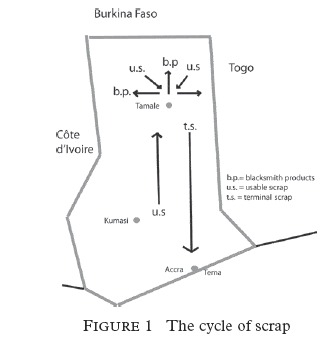
Blacksmithing was probably practised in what is now northern Ghana as early as 500 BC, but in the last twenty years the number of smiths and the range of their activity have greatly increased in Tamale, the principal city of the north.Footnote 1 New workshops spread ever further down the main roads from the city centre, and the sound of hammer on metal rings out from morning till night. The evolution of the national economy and the particular situation of Tamale in the geography of Ghana explain this development and the contribution that the city's smiths make to the economy, national as well as local.2
Tamale is reputed to be growing faster than any other city in West Africa. According to the census, the population was 83,653 in 1970; 135,952 in 1984; 202,317 in 2000. City officials offered the estimate of 350,000 in 2007 but indicated that that was probably too low. Tamale is a market town, collecting agricultural produce and sending it south. It is also a transportation centre; heavy vehicles bring imported and manufactured goods from the southern ports for distribution not only throughout the north but to neighbouring countries, especially Burkina Faso. Above all, it is the most important northern administrative and commercial centre, crowded with government offices, banks, businesses and non-governmental organizations both local and foreign. All this activity requires metal goods and motor vehicles in large numbers, generating business for blacksmiths.
Perhaps half of all the blacksmiths in Tamale are motor mechanics, ‘fitters’. In this article I pay little attention to them because the work of their counterparts in the southern city of Kumasi has been described by John Powell in his The Survival of the Fitter (1995). The other work of blacksmiths is the recycling of metals, derived from dead vehicles and other machinery, which are made into consumer goods or sent south as scrap to be exported or re-smelted in Accra, the capital. The trash heaps of Tamale contain little but the remains of plastic shopping bags and ash from cooking fires. Everything organic is eaten by people or by the goats that roam everywhere; everything metallic is acquired and reworked by blacksmiths. In this respect Tamale trash differs from trash in Accra, where the standard of living is higher and more junk of all kinds is abandoned, often enough clogging streams and causing flooding. There are of course blacksmiths and fitters all over Ghana, but as we will see the concentration of them in Tamale has a particular role to play.
Blacksmiths traditionally made hoes and other farm tools and weapons such as javelins. In modern times smiths still make hoes, traps, adzes and butcher knives; the weapons are mostly guns, needed for honorific explosions at funerals and festivals but also sometimes put to deadly use. The product line and economic role of the smith changed in the 1970s; between 1966 and 1986 a series of military coups, the disastrous policies associated with them, the vagaries of international markets, the misguided policies of the International Monetary Fund, and a drought in the mid-1970s combined to destroy the national economy (Chazan Reference Chazan1983; Herbst Reference Herbst1993; Kraus Reference Kraus2002: 401–9). By the early 1970s, there was no foreign exchange with which to buy manufactured imports, especially automobiles and their spare parts. Oral traditions differ as to which smith in the blacksmith district (machelefong) in the heart of Tamale was the first to begin recycling cars.
TRADITION
The traditional equipment of the blacksmith all over Africa centres on a charcoal fire into which air is introduced from a double bellows worked by hand. Until very recently the material of the bellows was goatskin, each part made with a valve that the operator opened and closed; nowadays it is more likely to be motor inner tube, our first example of recycling. The bellows is now often replaced by a manufactured fan, turned by a belt running around an adapted bicycle wheel. The charcoal, different from that used by housewives, is made from hardwoods by villagers who specialize in this product. This equipment is used, as it is by blacksmiths everywhere, for heating and forging iron and steel.3
In Dagbani, the predominant language in Tamale, a smith is machele (pl. machelenima), but this is in fact a Hausa word introduced from northern Nigeria, as are all the words used to describe the craft except three: zali, the special blacksmith's hammer; savigu, the terracotta cone that channels air from the bellows to the fire; and gbabo, the tongs needed to handle hot iron. These three items, but not the anvil, are the essential components of the shrine kept in the compound of the head of every true blacksmith family, to which sacrifices and prayers are offered for the benefit of family members. Smithing is one of the traditional, hereditary occupations in Dagbon, the ancient kingdom whose people, the Dagomba (Dagbamba), speak Dagbani, and whose traditional territory includes Tamale; other such occupations include drummers, butchers, barbers and warriors. Their production of weapons and butcher knives created a special relationship, celebrated in the praise-songs and dances of the drummers, between blacksmiths and both butchers and warriors.
The prevalence of Hausa words suggests that the craft was subject to very strong Hausa influence at some time in the past, probably the period in the early eighteenth century when the kingdom was re-founded by Na Zangina (Ferguson Reference Ferguson1972). Drummers, who are the historians and praise-singers of Dagbon, say that blacksmiths, like earth priests, were indigenous to Dagbon before the kingdom itself was founded by the ancestors of the present dynasty, but they were killed off during the sixteenth century by one of the kings, Na Dariziegu, in the course of war with the neighbouring Gonja people. Dariziegu himself was also killed, but his successor, Na Luro, summoned new blacksmiths, who helped him to victory (Locke Reference Locke2003: 70). Then, because of pressure from Gonja or because of the increasing importance of the trade route that ran from northern Nigeria to Salaga, Na Luro moved the capital of Dagbon to Yendi, in the east. The trade route, dominated by Muslim Hausa traders and scholars, ran through the important Bassar ironworking district in what is now Togo; among other commodities, the route conveyed iron and iron goods to the forests of the south in exchange for gold and kola nuts. In about 1700 Zanjina, an ambitious man who had become wealthy as a trader and who had Hausa allies, bought his way to the throne (the ‘skin’ of Yendi). He reorganized the royal court, became a Muslim, and is said by the drummers to have introduced clothing to the Dagomba (Staniland Reference Staniland1975: 20).
All the hereditary occupations have a traditional relationship with the local chief, whose elders include sub-chiefs whom he appoints, as necessary, to represent and lead each one. Depending on the size of the chieftaincy, there may be a hierarchy of drummer chiefs or warrior chiefs, for example, but for blacksmiths there is only one, the So Na. The meaning of this title is the subject of folk etymologies and sharp but inconclusive controversy. In Tamale, both the Dakpema and the Gulkpe Na, the leading chiefs, have a So Na, but none of the other chiefs do. A So Na is ‘enskinned’ (installed) with all the ceremony of any other chief, great or small, but he has little to do; he attends the appointing chief's court on occasion, and may be called upon to settle a dispute among smiths. Smith families, like all others in Dagbon, are bilateral descending kindreds with a patrilateral bias, meaning that they include the descendants in the male line of a grandfather or great-grandfather, but may also include the children of female members who have chosen to affiliate themselves with the mother's family instead of the father's. Even without such affiliation, the son of a woman member of a blacksmith family may take up the craft if he chooses, and formerly might experience a spiritual call to do so which he would refuse at his peril. In fact, as the opportunities open to smiths increase in Tamale, the hereditary qualification is no longer required.
RURAL–URBAN: TAMALE, 1907–2007
In 2004, Tamale became a metropolitan district, only the third such in the country, in recognition of its increasing size and importance. Its status as a ‘city’, however, can be misleading. In 1907, when the British chose Tamale as the site of their administrative headquarters for the Northern Territories, it was no more than a cluster of small villages variously ruled by chiefs and tendaanas (earth priests). The British presence transformed it into the fairly small, dusty town that it remained until the mid-1990s, when the World Bank funded the construction of a four-lane boulevard to carry the main north–south traffic, with a corresponding expansion of feeder roads. This programme is still continuing. Meanwhile, with a few exceptions displaced by urban planners, the villages still exist, not only as sites but as distinct social units with their own histories and social organization; behind the urban façade of banks and businesses, this is the Tamale to which its native citizens (tinbihi) belong, although at least half of the population were born elsewhere.4
As a metropolitan district some 24 miles across, Tamale includes at least 160 villages, some buried in the centre of town but many others that are still entirely rural. In town there is hardly any arable land left, so villagers must travel to find land, often at a considerable distance. The inhabitants of rural villages within the metropolitan boundary, on the other hand, have ready access to town to sell their products in exchange for what they need. This symbiosis is illustrated by the farmer's hoe, the ordinary kind called ga: a smith in town makes the blade, but the charcoal he needs comes from a rural village, as does the handle, or at least the branch from which it is made. Many blacksmiths, like many others in all walks of life, plant a field of maize somewhere if they can afford the cost of seed, fertilizer and village labour.
As time passes, besides simply expanding, Tamale is becoming more ‘urban’. Although some of its central villages are ‘villages’ only in a social sense, as yet there are no real slums such as characterize the older cities of the south. Yet a younger generation is growing up who have no knowledge of village life and traditional ways; schools now try to provide instruction in the traditional culture of Dagbon. At the biggest store selling local blacksmith products even the owner did not know how to assemble the traditional Dagomba yam hoe called kuli, whose components he was selling, and had to ask an older man for help.
The rusticity of Tamale protected its inhabitants when the Ghanaian economy began to decline in the mid-1960s. In old-established cities such as Accra and Kumasi, many thousands of holders of regular jobs lost them and were reduced to shifting for themselves. In the early 1970s, Keith Hart drew attention to the many innovative and productive enterprises in which the ‘unemployed’ engaged, making up what he was the first to call ‘the informal sector’ of the economy (Hart Reference Hart1973). The absence of corporate organizations and formal accounting in this sector rendered it invisible to economists at the time, but it has been much studied since then, in Ghana and elsewhere. Initial enthusiasm for the subject led at first to the reification as a universal category of a term originally intended to describe a particular situation. Later, it became apparent that informality was often to be found in rural as well as urban areas and among the regularly employed as well as the poor. Since no city and no country has the same economic history or the same social structure as any other, it now seems doubtful that ‘the informal sector’ has universal analytical value (Boer Reference Boer and Southall1985). In Tamale most of those engaged in it, that is, artisans, and specifically the blacksmiths, are not rejects from the corporate sector; they have never been able to enter it. They are instead immigrants from villages both urban and rural who, along with immigrants from elsewhere, compose the expanding population of the metropolis. On the other hand, the forms of ‘crime’ that Hart described as pervasive in the informal sector – private use of official resources, embezzlement, fraud, corruption both serious and petty – are more commonly found in the ‘formal’ sector, among civil servants and the employees of banks, public utilities and other service providers.5
Many smiths have some education, but not such as promises them access to employment. Formal education in Ghana still emphasizes rote learning, with inadequate opportunities for practical experience, despite the stated intention of politicians from Kwame Nkrumah onwards to add technical training to what Nkrumah called ‘grammar school’ (Haizel Reference Haizel and Arhin1991).Footnote 6 With the failure of hasty industrialization projects and ‘the crisis of the state’ in Ghana, as elsewhere in Africa, international agencies came to believe that small-scale ‘informal’ enterprises offered promising development alternatives; or, as they say in Tamale, byela byela, nabra, ‘small things lead to big’. The University of Science and Technology (KNUST) in Kumasi founded a Technology Consultancy Centre in Reference Ferguson1972; three years later, it opened a Technology Transfer Unit (ITTU) in the Kumasi industrial area known as Suame Magazine (Powell Reference Powell1995: xi). The ITTU, inspired by developments in Nairobi, was intended to introduce, in the one-owner shops of the informal sector, small-scale production units for such items as screws, bolts, saw benches, and machine services such as precision grinding; these shops were provided with the necessary finance, machines and training.
In 1987 the task of extending the ITTU idea to all the regions was taken on by a new parastatal foundation called GRATIS (Ghana Regional Appropriate Technology Industrial Service). The Tamale branch, the GRATIS Institute, still popularly known as ITTU, was among the first to be set up, in 1988 (Powell Reference Powell1995: 62–4). It was sub-sequently aided by the Canadian government and the EU, but is now on its own. It specializes in agricultural equipment for processing groundnuts, manioc, shea butter and rice, but also supplies on demand items such as storage tanks. The foundation's headquarters in Tema produces designs for Tamale to follow. Individual farmers in the north cannot afford these products, which sell to companies in the ‘formal’ sector, NGOs, and what the Tamale manager calls ‘philanthropists’. The range of activities successfully undertaken at first has narrowed considerably; the factory finds it difficult to collect on sales, so is only just scraping by. Though it has some permanent employees, like the smiths it has much of its work done by unpaid apprentices. The Magazine in Tamale in 2007 remains much as Suame was in 1985, a sprawling, oily mess of vehicles and machines in various stages of breakdown, worked on by mechanics equipped mostly with hand tools and improvised knowledge.
John Powell described many of the successes of this project, but also the failures attributable to some combination of economic policy, dumping of shoddy manufactures from abroad, corruption and official incompetence (Powell Reference Powell1995; Arthur 2007). Since then the optimism he expresses has been betrayed by the resilience, in Ghana as in much of Africa, of an economy of pervasive disjunctures which is resistant to the formal regularity that ‘development’ requires, which is subject to unanticipated shocks, and in which no condition can be counted on for stability (Guyer Reference Guyer2004: 155–64); improvisation rules. The devaluation of the cedi by the Provisional National Defence Council (PNDC) government of J. J. Rawlings in 1988, the year the Tamale ITTU opened, raised the price of food, fuel and imports, affecting the towns more severely than the rural areas. By 1991 the economy was growing again at about 6 per cent per annum, but the average Ghanaian's income was 125 per cent lower than it had been in 1971 (Herbst Reference Herbst1993: 154–71). Five years later, the combination of inflation and interest on loans lifted the cost of capital to 40 per cent per annum. By 2007 the national economy was relatively prosperous, but continuing political strife in the kingdom of Dagbon deterred investors (MacGaffey Reference MacGaffey2006). Blacksmithing in Tamale remains a matter of hard manual labour and low productivity. Even Suame in Kumasi remains a problem; in October 2007, candidates for election to the presidency were promising, if they won, ‘to establish a technical institute in the area to prepare the local artisans to undergo the transformation that would turn the magazine into a modern industrial estate in the medium term’.
All secondary education, including technical training at the Tamale Polytechnic, costs more money than many families feel they can afford. Apprenticeship to a blacksmith provides training in exchange for labour and offers the possibility of self-employment in an urban economy that increasingly demands goods that would not be needed in rural villages. A welder's apprentices are often schoolboys working after school hours. A grown man, however, with adult responsibilities, cannot go on ‘eating small-small’ for ever, so he sets up on his own as one more maker of stoves, hinges or bed-frames. The continuing expansion of the city means both an expansion of the population in need of blacksmith products and a growing number of the potentially unemployed who are absorbed by the metal industry.
Despite these positive features, it remains the case that metalworking and even ‘fittering’ in Tamale are so limited, technologically and economically, that the level they represent falls beneath the notice of most studies of the so-called informal economy. Kenneth King, for example, in his study of the development potential of informality in Nairobi, pays only passing attention to the Kamukunji District, where the artisanal situation was similar to that in Tamale today (King Reference King1996). Elsewhere in Nairobi metalworkers relied on electricity and used machinery, some of which they invented themselves. Their level of capital investment, productivity and potential for ‘development’ was much higher, attracting the attention and support of the Kenya government and of international development agencies such as the International Labour Organization. In Tamale the consumer base is still inadequate to support the good intentions of GRATIS.
TECHNIQUES
It costs little to set up in business as a metalworker. Technology is almost entirely limited to hand tools, except for welding equipment and the occasional hand-operated machine. Workshops vary from the simplest roof on poles to a well-built shed or sometimes the verandah of a house. Electricity is available everywhere, except during hours (and sometimes days) of ‘load-shedding’, but it is regarded as expensive and, for most smiths, unnecessary. I found only one man who had wired his site and therefore was able to operate a powered fan, a grinder and his boombox.
Every blacksmith shop is run by one owner. As in all forms of business in Tamale, even major contracting for roads and buildings, the owner trusts no one else. ‘Everybody wants to be his own managing director.’ The owner may take on one, two or three apprentices who do most of the work in exchange for training. Labour, the major input to the production process, is extremely cheap. The national minimum wage is US$1.15 (10,500 cedis) a day, but the apprentices are not paid, though they may receive some small ‘chop money’. The owner's responsibilities, besides training (if he has apprentices) include rent and tax for the site and the cost of raw materials, which consist either of scrap or of new metal stock which he buys from a local or southern dealer. Depending on the nature of his work, he may also have to pay for charcoal, welding equipment and tools not made in his own shop.
Besides regular, forged work, blacksmithing includes tinkering, that is, small-scale repair of kerosene lanterns, kitchen bowls and similar items whose bottoms have worn out. Repair is effected by soldering, using a small fire and low temperature; it is carried on in the market for the benefit of visiting housewives, and needs no special shop or forge. Far more important is the work of cold-hammering soft steel into household goods such as buckets, hinges, latches and the cheaper sorts of stove. Pieces of suitable scrap are cut to size using a chisel, itself forged from a car spring. Ragged strips trimmed from the edge of the sheet are put aside for sale to people who make fences, an alternative to the withies that villagers bring into town for this purpose. Lapped joints are hammered tight, but others are clipped or riveted. Some buckets, called buketi, conical and equipped with handles, copy European manufactures. They are not as widely used as those called garawa, simple cylinders without handles, which girls carry on their heads to fetch water from the local tap or stream. The hammered seams do not leak, ‘and last for five years’. An entirely modern technique is welding, which requires expensive equipment and considerable training. Such training is provided by the GRATIS Institute and by two or three private metal works in the industrial area.
If they can scrape together some money for tools and rent, apprentices go on to own their own shops in Tamale, with apprentices of their own. Automobile repair often requires welding, as does furniture such as beds made out of rebar (ribbed steel rods used to reinforce concrete), but one of the principal uses of the technique is in the manufacture of buildings modelled on shipping containers. A few original containers are to be seen here and there in town, but they are very heavy, costly to transport, and difficult to modify; it is cheaper to make them locally. Sheet two millimetre steel purchased in the south is corrugated by the use of a bending machine, itself forged from heavy pieces of scrap; if the container-maker does not own such a machine himself he will pay someone who does to do the work. The metal has to rust before it is painted, otherwise the oil on it forbids the paint to adhere. After the container/store has been welded, Abdul-Somad gets the buyer to paint his name on it so that he will not be able to claim, later, that the smith has substituted an inferior one. After it rusts somewhat, it is sanded down and spray painted. The completed container is transported to the owner's site on a rubber-tired handcart to serve as a store or boutique, in which goods can be safely locked at night. Usually the owner adds a roof and a patio to make the box less like an oven.
A technique almost unrelated to the other activities of blacksmiths creates aluminium cooking pots by casting them in moulds. The introduction of the technique, which is related to the brass-casting that is very old in West Africa, is vaguely credited to Wangara traders from the north-west. It is certain, however, that aluminium casting in Tamale did not take off until aluminium became available from the VALCO smelter initiated by President Nkrumah in 1960, and after it became necessary to cast pots from scrap in the 1970s. The charcoal fire used by aluminium casters is larger and hotter than the usual blacksmith's forge. It is contained in a recycled lorry wheel rim bedded in clay; air is introduced from below using a fan and a bicycle wheel operated at a cool distance from the fire. Scrap metal is melted in an iron cooking pot which the smiths obtain ‘from old ladies in the villages’. Such pots, dating from before the availability of aluminium, burn through in time and are becoming scarce; smiths say that when the supply runs out they will be in trouble, but they have approached the GRATIS Institute about making substitutes.
An aluminium pot or cauldron is used as a model for the casting mould, which is made of fine earth obtained from termite hills and contained in a wooden frame. Because the pot has a waist and a flared mouth, the frame is in three parts and the model has been cut in half from top to bottom. When the mould has been filled in, the apprentices carefully open it, remove the model, smooth the inner surfaces of the mould and dust them before reassembling the frame and tying it together. Using tongs, they carry melted aluminium in the iron pot, red-hot from the fire, and pour it into the opening at the top of the mould; the work is skilled and dangerous, requiring careful teamwork. After a few minutes the assistants remove the frame, break the mould and carry away the pot for further finishing. A large cauldron, holding probably 35 gallons, sells for about US$55; the team can make four or five in a day, or ten or twelve smaller pots.
The limitations of this kind of micro-enterprise are obvious. In 2006 Tamale, like several other cities, contracted with a Chinese company, Zoomlion, to collect part of its trash. Zoomlion brought in tricycle garbage haulers, both pedalled and powered, and set up foot-operated, covered trash cans on the main streets. The trash cans and possibly the tricycles were well within the technical ability of the blacksmiths to make, but it would have been impossible to coordinate large-scale production by them of a standard product. The equipment was produced at the GRATIS Institute.
MODERNITY AND THE CYCLE OF SCRAP
Blacksmiths list the materials they use as original, home-used and scrap. ‘Original’ manufactures and materials are new, unused products made in southern Ghana or imported from abroad. They include tools and iron stock such as sheet metal, angle iron, and rebar. ‘Home-used’ products are imported second-hand items ranging from clothing to auto parts; they are more expensive and presumed to be of better quality than those that have been ‘used’ locally. Usable scrap (iron and aluminium) is generated in Tamale, collected elsewhere in the north, or purchased in the south, usually in Kumasi.7
Southern Ghana has been in direct contact with the Atlantic world for centuries. Families with wealth and education have existed there for generations, whereas the north is relatively impoverished; British colonial rule treated the north as a labour reserve for the mines and plantations of the south, and deliberately limited the level and availability of education (Bening Reference Bening1971; Brukum Reference Brukum1998; Sutton 1989). The south is self-consciously ‘modern’ and disposes of much greater resources in capital, skilled labour and international connections than the north. ‘The south’ in the present story is essentially Accra, the capital, with its industrial port of Tema, but includes Kumasi, a little further north, which is also a centre of wealth, power and ‘modernity’, and the neighbouring goldfield town of Obuasi.
Southern scrap consists of oil and chemical drums, cars, car parts, air-conditioning ducts and other machine parts and sheet metal that are not worth repairing or recycling in the south, where the cost of the work, including labour, is higher, as are the standard of living and the expectations of consumers regarding the quality of goods. Scrap that is useless in Kumasi may be usable in Tamale for conversion into consumer goods acceptable not only in Tamale itself but in the towns and villages of the north where there may be few stores, no smiths, and a standard of living often little better than subsistence.
‘Terminal scrap’, consisting of metal for which Tamale can find no further use, is sent south to Accra to be re-smelted or exported. Preparing scrap for shipment is labour-intensive and may therefore be done more cheaply in Tamale, although the city is certainly not the principal supplier. In Accra competition for scrap is intense. It is estimated that capital goods manufactured in Ghana contain as much as 70 per cent scrap. The world market price is about US$300 per tonne ‘free on board’ (f.o.b.); in the international scrap market fraud is endemic. In 2007 the Steel Manufacturers’ Association, organ of the four foundries, called for a government ban on scrap exports. Wahome Steel Ltd in Tema, ‘West Africa's largest steel manufacturing plant’, declared itself unable to operate at full capacity; it needed to purchase 200 tonnes daily, but was unable to find more than 90 tonnes. The Daily Graphic asserted that Ghana exports between 600 and 1,000 tonnes of scrap metal daily, ‘under the guise of transit goods’, but a news release by the Scrap Metal Exporters’ Association debunked allegations that their exports hurt local industries, saying that if the manufacturers offered competitive prices there would be no problem. The exporters said they paid US$160 per tonne, with additional costs of about US$65. In response, the steel manufacturers raised their price to US$110.Footnote 8 An article in the Daily Graphic (2 December 2007), reviewing the story and advocating free trade, alleged that the foundries used their ‘monopoly’ to pay scrap suppliers ‘a pittance’, and moreover treated them with contempt as illiterates lacking political clout. It said that although the steel manufacturers employed 2,000 people, a total of some 25,000 were directly or indirectly engaged in the scrap industry.9
Taxis, which provide all public transportation in Tamale, have an important place in the circulation of scrap. From the efficiently organized central taxi park, streams of taxis, most of them amazing in their decrepitude, apparently held together by faith, carry passengers to the far suburbs. It is said that no taxi in Tamale is ever new; taxis that were new once, ‘original’ or more likely ‘home-used’, serve their time in the prosperous south until at a certain point it is not worthwhile to repair them. They are shipped north to Tamale, where it is also said that no taxi is ever terminally dead. Every one, no matter how decrepit and rusty, how lacking in seats and sheet metal, wheels or windows, can be repaired, if the owner wants to pay the cost. If he does not, he sells it to a dealer who has a few more of similar description; the going price for a moribund taxi is US$850. Fitters in need of parts will prey on the carcass. South of built-up central Tamale, beyond the industrial area, fields of yams and maize are giving way to scattered houses, in one of which lives Issaka, said to be the leading buyer of dead cars. He takes them apart, selling usable parts, making use of others, and selling the rest for scrap. He specializes in car glass and has stacks of windshields lying about; a taxi man with a broken window would know to come here for a replacement.
SCRAP, SHEET METAL AND USABLE PARTS
In one way or another, all blacksmiths are concerned with scrap metal. Those who make cold-hammered stoves, buckets and hinges from usable soft steel generate useless small pieces which are baled in canisters or makeshift drums for eventual shipment, together with other useless material which must be hammered flat so that it takes up as little space as possible. Five years ago the small pieces would have been thrown away. Children make a little money by bringing in metal cans to add to the pile that accumulates beside most workshops; the owner hopes it will attract offers, for the whole pile or for separate pieces that some other smith can use. Scrap sells locally for a little over one dollar per kilo. Abdul-Rashid says he likes to keep a noticeable pile so that people will remember it when they need to find something. He is also saving his money to buy engine blocks and other very heavy pieces. Large rusty objects litter the city, but every one of them is owned by somebody who hopes to sell it or make use of it some day.
Some smiths are full-time scrap-dealers, collecting scrap from other sites in Tamale or touring the north in a pick-up truck looking for abandoned vehicles, machines and junk. A few dealers specialize in copper, automotive batteries and radiators for export; these are highly valued. A man who describes himself as a pioneer in scrap dealing says he began in 1993, when someone came up from Accra looking for scrap. It seems, however, that the real pioneer, though he operated from Accra, was a Tamale man called Abdulai Abdul-Rahman, known by the name of his firm, Sabari. He began business life in Tamale in 1971 as a tailor, branching out into textiles in the worst years of the economic depression. In 1982 he went south and began exporting plywood to Nigeria and elsewhere. Although he was illiterate, he became a major car dealer in Accra, importing cars from Nigeria for the benefit of the political elite. In 1986 he began to export scrap copper, brass and aluminium, letting it be known all over the country that he was buying. Later, he branched into shea-nut butter and then became the country's biggest exporter of coffee, travelling widely to Europe and the USA. He died in a car accident in 1996. As is so often the case in Africa, the business died with him.10
Transport is paid per trip, so the scrap dealer's aim is to load as much weight as possible. When he has accumulated enough to fill a heavy truck, he contracts with a transport owner who will take it to Accra. A transport owner employs collectors to canvass smiths in a given area for suitable loads; there are also freelance collectors who negotiate deals between transporters and smiths. If one load is not quite enough, another dealer may contribute the difference. The owner of the scrap pays for the run; he will not know how big the load is until it is weighed at the foundry. He may have to pay between US$1,000 and US$1,500, depending on the bargain and the size of the vehicle. In Accra the vehicle and contents are weighed; he is paid by the kilo, hoping that the whole load amounts to, say, forty-five tonnes. At the new price of US$110 that the steel manufacturers are said to be offering, he might make US$5,000, from which to subtract his costs. A really good load, said one dealer, his eyes lighting up, would pay for a return load of cement, much in demand in Tamale's sprawling residential districts.
For his own production, a smith buys scrap from another smith or in bulk from a dealer in Accra, Kumasi or Obuasi. Iddris, who makes garawa buckets, may buy forty or fifty flattened drums from Obuasi or a like number of car hoods from Accra; the price is the same. The dealer extends credit to him. He buys hoods in Accra because in Tamale the demand is great relative to the supply, and the price is high. One hood for about US$3 makes two complete garawa, or three without lids. Iddris, who has only one apprentice and does most of the work himself, will sell a dozen buckets on order to a woman who sells each at retail for about US$3.50.
In another shop specializing in hinges and bolts, the metal used for the hinges appears once to have been casing for machinery of some kind, but parts of the door bolts are cut from what were obviously locker doors, as at a school or work site. A pile of metal strips, long, rusty and new, will become hinges when the next order comes in. Cutting from the sheet is done with hammer and chisel. The chisel is bought from a specialist, but sharpened by the worker; files for sharpening, like wood saws, must be imported. Rectangular pieces are cut to size and then scored for further cutting. Measurement is precise; a piece that is a little small will be beaten to enlarge it. Hammering seems at first to be just brute force but is in fact skilled work. Very heavy metal pieces from dead machines, sometimes truck parts, may be used as anvils, as supports, or as weights to hold down a bellows or other equipment. Metre lengths of railway, imported from the south, are widely used as anvils because they offer both an edge and a flat surface on which to work metal.
Abdul-Somed, who makes container-stores, learned welding at Kwamena Metal Works in the Tamale industrial area. At Mid-West, the wholesalers in Accra where he usually does business, he will buy, say, 40 flat steel sheets. If he has only one order, it would not be worth it to pay the retail price of at least US$20 per flat sheet, because of the transport. He pays truck-boys probably about fifty cents per sheet to load them onto a rubber-tyred handcart and take them to the transport station, where he will have to pay other boys to load the lorry and pay the transport at US$2.70 per sheet. If, however, his friend in Accra who has a bending machine is not too busy, Abdul-Somed will warn him that he is buying forty sheets which the handcart boys will deliver directly, picking up an equivalent in sheets already bent to take to the station. This saves him time. Bending a sheet in Tamale costs a little over a dollar. A single sheet already bent may cost US$25 in Tamale, a price which suggests a very small margin of profit. Abdul-Somed is fussy about quality. If you are buying from someone you do not know, you test the stiffness of the metal by bending it by hand, but that is not all; poor quality metal rusts more easily. Customers will complain and your business will get a bad reputation. He buys at Mid-West because he has confidence in the quality of their goods. Besides sheet metal, he also buys angle iron and square tubes. To transfer money for large purchases he makes use of banks, but does not keep his money in them; he does not trust them, and inflation eats into his reserves.
The constant need to repair ancient taxis and other vehicles means that in Tamale the price of parts is higher than in the south. Al-Husein's products clearly show the constraints that shape the flow of metal. He makes rubber-tyred handcarts for sale here, though he says that currently business is not good. He makes the frame with angle iron which he used to buy in Kumasi but now buys from a dealer in Tamale, a southerner. He uses axles from taxis and other small cars scrapped in Tamale, but the wheels and tyres (used) have to come from Kumasi, because the demand for them from fitters in Tamale is so high. Rear differential axles find a use as stands for his carts while they are painted. The model for this kind of wagon was developed in Kumasi. Al-Husein also makes groundnut shelling mills, moulds for cement blocks, and donkey carts for farm use, all based on designs adopted by the GRATIS Institute.
MARKETING
Some blacksmiths assert that they can make anything but most of them specialize to some degree, for technical reasons, because routine makes for more efficient production, or so that they may become known as a source for particular products. Hammers and chisels, made from car parts such as axles and springs, require exceptionally high temperatures; a man who works with soft metal scrap may need no fire at all. Specialized makers of the modern drums used by bands performing in churches and nightclubs congregate on a particular street in the middle of town. The drums are cold-hammered but also have forged parts; they have goatskin membranes and are usually painted blue because that's what musicians prefer. Smiths who make spiked iron gates locate their works closer to their customers, owners of villas in the expanding suburbs. Most smiths are to be found on the main roads, for the sake of visibility and ease of transportation.
Usually a smith works to order, making a batch of some item such as hoes or buckets for a dealer, who intends to sell them either in the market or in other towns and villages where blacksmiths are few or absent. A hoe (ga) sells for less than three dollars. The buyer orders fifty or one hundred hoes, or as many as she can afford, paying the smith in advance for the metal (always ‘original’), bought from a dealer. The smith similarly commissions hoe handles from a villager who cuts naturally shaped pieces of branch in the bush. The yam hoe (kuli) is more complicated: its parts include a round steel plate, cut with a chisel and sharpened; a sort of fork carved in a thick, squarish piece of wood, into which the disc can be inserted; a long wooden handle; a forged collar to link the handle and the fork; and a wooden brace to fix the angle between them. The buyer selects these things separately to suit his personal physique and pays the equivalent of four dollars for the lot. The design allows the user to rotate the blade to a new edge as necessary.
Women dealers mostly sell women's goods, that is, household equipment, while men sell tools and agricultural implements, which men use. Normally dealers make a down payment to cover the cost of materials and pick up the product when they have assembled the rest of the money. Usually a dealer is a regular partner of the smith; asked how the partnership came about, she will shrug, saying she does not know, but some family or neighbourhood connection is to be presumed. It is considered very bad form to order or buy from any but regular suppliers. There is little variation in price for a given commodity from one supplier to another but, given the uncertainties of credit, supply and demand, a partnership requires some mutual trust – something that is apparently not possible between co-owners!
In Tamale itself, in town, hardware is sold from stalls in the market or simply from sidewalks nearby. A partial list of locally made tools includes hoes of different kinds, traps, oil cans, security devices (latches, hinges, bolts), funnels, double bells (a musical instrument), replacement carriers and stands for shoddy imported bicycles, butcher knives, crowbars, hammers and axes. Among household goods: charcoal stoves (called krookpoti, from ‘cookpot’), either the cheap, cold-hammered kind or more expensive welded ones; wood stoves (danga), both those made from car wheels and the cold-hammered kind; ash shovels; iron bars used in pairs to stabilize cooking pots; sieves, basins, and colanders. Some of these products are made necessary by urbanization; villagers sell charcoal to town while they themselves cook on three stones and do not need krookpoti.
Smiths also make one-of-a-kind special orders, often with great ingenuity. Here the list is endless: a swivelling ‘office chair’, made from scrap; a free-standing bread oven; a rain-harvesting system made from recycled aluminium roofing sheets; licence plates for motorcycles; repair of a water-tanker; transformation of a pick-up body into a handcart. Alhaji Yakubu, a relatively elderly smith admired for his craftsmanship, makes faithful copies in steel to replace damaged plastic panels for cars and motorcycles; in Manhattan, this work would be called Art.
Both buyers and sellers insist that quality is what matters in a purchase, though it sometimes appears that quality is perhaps defined by one's friendship with the seller. It is considered anti-social to advertise lower prices, although a friend or regular customer may get a small discount. In truth there is little room for price competition. Labour costs are already minimal, and most buyers are living hand-to-mouth. If something seems too expensive, one can always do without, reverting to something like a village level of subsistence. In the years since 1970, northerners have learned to make do.
CONCLUSION
As the national economy improves, prosperity moves north, bringing with it an increasing flow of manufactured goods from the south. Ten years ago, the tools one could buy in Tamale were shoddy in the extreme: pliers whose jaws did not meet, for example, or screwdrivers that bent in the hand. Now there are more hardware stores, selling ‘original’ tools of reasonable quality; original mason's trowels have entirely replaced the local product. Manufactured buckets and cooking pots now compete with locally made ones, but buyers say that they are not necessarily better. As the supply of industrial manufactures increases, the unemployed young men of Tamale who presently give away their labour for the sake of training may have to find other jobs, for which better education may well be necessary. Certain businessmen indicate that they are thinking of opening factories in Tamale but so far that has not happened. Meanwhile, by hard work, blacksmiths provide the north with metal products it needs and can afford, and contribute pounded scrap to the national economy.
The cycle of scrap