


Introduction
Emotional disorders are common in children and adolescents in the UK; at any one time 3.9% of children aged 13–15 will suffer from an anxiety disorder, and 1.9% will be experiencing major depression (Ford, Goodman and Meltzer, Reference Ford, Goodman and Meltzer2003a). For such disorders, cognitive behaviour therapy (CBT) has been found to be an effective treatment (Compton et al., Reference Compton, March, Brent, Albano, Weersing and Curry2004; Merry, McDowell, Wild, Bir and Cunliffe, Reference Merry, McDowell, Wild, Bir and Cunliffe2004; Soler and Weatherall, Reference Soler and Weatherall2007). However, the number of children who might receive CBT is currently limited by two key factors. First, a recent national survey of child mental health specialists in the UK suggests that the availability of appropriately trained CBT therapists may be limited (Stallard, Udwin, Goddard and Hibbert, Reference Stallard, Udwin, Goddard and Hibbert2007). This indicates a specific need to increase the number of highly skilled CBT therapists but also a general need to increase the capacity of more limited CBT expertise within the workforce. There is some evidence that limited training and supervision of non-mental health specialists in the delivery of manualized CBT programmes with children can be effective (Stallard, Simpson, Anderson, Hibbert and Osborn, Reference Stallard, Simpson, Anderson, Hibbert and Osborn2007; Stallard, Simpson, Anderson and Goddard, Reference Stallard, Simpson, Anderson and Goddard2008). The delivery of manualized programmes by non-mental health specialists through computers would therefore be a development worth exploring.
A second issue relates to accessibility, and at present very few children and adolescents in the UK with emotional problems receive help from specialist mental health services (Ford, Goodman and Meltzer, Reference Ford, Goodman and Meltzer2003b). In order to improve access to effective specialist interventions such as CBT, there is a need to consider how these methods can be adapted and provided in different settings through different media. The use of self-help technologies, school based prevention programmes, and computerized interventions all offer the potential to increase the availability of CBT.
For adults, computerized CBT (cCBT) has been able to effectively address problems of availability (Griffiths and Christensen, Reference Griffiths and Christensen2007) and provide a practical solution to the lack of trained CBT therapists (Van Den Berg, Shapiro, Bickerstaffe and Cavanagh, Reference Van Den Berg, Shapiro, Bickerstaffe and Cavanagh2004). For adult depression, computerized CBT has been found to nearly half the amount of therapist time required compared to face-to-face CBT, whilst retaining effectiveness (Wright et al., Reference Wright, Wright, Albano, Basco, Goldsmith, Raffield and Otto2005). Computerized CBT can also be provided by a range of different professionals such as graduate mental health workers and assistant psychologists (Department of Health, 2007), which will reduce pressure on CBT therapists. Thus, for a number of reasons, cCBT may help provide CBT to children and adolescents who otherwise might not gain access to treatment.
Computerized CBT
Computerized CBT refers to the delivery of interventions based on CBT via computer technology. This can be conducted with or without supervision and can be accessed via a CD-ROM or over the internet. Most software packages are interactive with exercises, quizzes and videos as well as text. A number of different areas are covered depending on the packages, such as the link between thoughts, feelings and behaviour, identifying and challenging negative thinking patterns, and relaxation techniques. In adults, cCBT has been shown to be an effective treatment for a number of emotional disorders such as anxiety and depression (Andersson et al., Reference Andersson, Bergstrom, Hollandare, Carlbring, Kaldo and Ekselius2005; Learmonth, Trosh, Rai, Sewell and Cavanagh, Reference Learmonth, Trosh, Rai, Sewell and Cavanagh2008; MacKinnon, Griffiths and Christensen, Reference MacKinnon, Griffiths and Christensen2008; Proudfoot et al., Reference Proudfoot, Ryden, Everitt, Shapiro, Goldberg, Mann, Mann, Tylee, Marks and Gray2004), panic disorder (Bergstrom et al., Reference Bergstrom, Andersson, Karlsson, Andreewitch, Ruck, Carlbring and Lindefors2008), agoraphobia (Kiropoulos et al., Reference Kiropoulos, Klein, Austin, Gilson, Pier, Mitchell and Ciechomski2008), obsessive-compulsive disorder (Kenwright, Marks, Graham, Franses and Mataix-Coles, Reference Kenwright, Marks, Graham, Franses and Mataix-Cols2005; Marks et al., Reference Marks, Mataix-Cols, Kenwright, Cameron, Hirsch and Gega2003), and post-traumatic stress disorder (Litz, Engel, Bryant and Papa, Reference Litz, Engel, Bryant and Papa2007). Consequently cCBT is now recommended by the National Institute for Health and Clinical Excellence for the treatment of mild to moderate depression and anxiety in adults (NICE, 2008). Computerized CBT is now also part of the UK's Improving Access to Psychological Therapies Initiative (Department of Health, 2007).
Computerized CBT with children and adolescents
The current literature has not examined the use of cCBT with children and adolescents to the same extent, although initial results are encouraging. Abeles et al. (Reference Abeles, Verduyn, Robinson, Smith, Yule and Proudfoot2009) conducted a case series of the program Stressbusters with adolescents aged 12–16 with depression and found significant reductions in depression and anxiety, with improvements in global functioning and cognitions. O'Kearney, Gibson, Christensen and Griffiths (Reference O'Kearney, Gibson, Christensen and Griffiths2006) and O'Kearney, Kang, Christensen and Griffiths (Reference O'Kearney, Kang, Christensen and Griffiths2009) used the program MoodGym with a non-clinical population of adolescents age 15–16 and found that the program reduced the number of those classed as high risk for depression. Cunningham et al. (Reference Cunningham, Wuthrich, Rapee, Lyneham, Schniering and Hudson2009) reported a case series of the program Cool Teens, which appeared to be clinically effective when used with adolescents aged 14–16 with anxiety disorders. March, Spence and Donovan (Reference March, Spence and Donovan2009) and Spence, Holmes, March and Lipp (Reference Spence, Holmes, March and Lipp2006) reported randomized controlled trials of the program BRAVE Online when used with children aged 7–12 with anxiety disorders, showing significant improvements compared to those in a control group on diagnostic status, anxiety and depression symptoms, global functioning, and behaviour. Finally, research has examined the use of cCBT for the treatment of chronic pain in children and adolescents (Palermo, Wilson, Peters, Lewandowski and Somhegyi, Reference Palermo, Wilson, Peters, Lewandowski and Somhegyi2009). Thus whilst these studies have demonstrated the potential efficacy of cCBT with children and adolescents, there are relatively few programmes developed specifically for children and young people and only limited research has yet been undertaken.
Clinicians’ attitudes towards cCBT
An important factor in determining whether cCBT programmes are used with patients may be the attitudes of clinicians. For example, Whitfield and Williams (Reference Whitfield and Williams2004) found that clinicians reported a number of concerns that would need to be addressed before they began using cCBT, such as receiving appropriate training and additional research demonstrating effectiveness. This survey of CBT therapists in the UK found that just over 2% of those surveyed used cCBT, and only 1% were using this instead of face-to-face therapy. A number also expressed concerns that satisfaction and outcomes would be poor compared to face-to-face CBT (Whitfield and Williams, Reference Whitfield and Williams2004). A more recent survey (MacLeod, Martinez and Williams, Reference MacLeod, Martinez and Williams2009) found that just over 10% of UK based CBT therapists had used cCBT with their patients. Once again a number of concerns about cCBT were identified, including a lack of technological knowledge, lack of availability of software, absence of a therapeutic relationship, and poor motivation from the patient (MacLeod et al., Reference MacLeod, Martinez and Williams2009).
These studies surveyed clinicians working in a range of different settings, and therefore some respondents may have worked with children and adolescents. However, no work has yet looked at attitudes towards cCBT amongst clinicians who specifically work with children and adolescents. The aim of this study was to examine the attitudes of mental health professionals towards the use of cCBT for the treatment of mental health problems in children and adolescents aged 7–18.
Method
Participants
Participants were an opportunistic sample attending a UK national conference: the 2009 annual meeting of the British Association of Behavioural and Cognitive Psychotherapy. Forty-three mental health professionals completed the survey. The majority were from the UK (90%, n = 26), with clinical psychologists constituting the largest professional group (56%, n = 24), followed by researchers (9%, n = 4), social workers (7%, n = 3), nursing staff (7%, n = 3), other professionals (7%, n = 3), counsellors/therapists (5%, n = 2), psychiatrists (2%, n = 1), and 7% (n = 3) who belonged to more than one professional group.
Measures
A self-report questionnaire was developed based upon findings in previous literature on cCBT with adults. For example, previous research has demonstrated that participants may find cCBT too demanding (Andersson et al., Reference Andersson, Bergstrom, Hollandare, Carlbring, Kaldo and Ekselius2005), and/or have problems with computer or internet access (Carlbring, Westling, Ljungstrand, Ekselius and Andersson, Reference Carlbring, Westling, Ljungstrand, Ekselius and Andersson2001; Kiropoulos et al., Reference Kiropoulos, Klein, Austin, Gilson, Pier, Mitchell and Ciechomski2008). Perhaps as a result of these problems it has been found that cCBT has a high drop out rate (Waller and Gilbody, Reference Waller and Gilbody2009). However, other literature suggests that it may be easier to share personal information with a computer than in face-to-face meetings (Gega, Marks and Mataix-Cols, Reference Gega, Marks and Mataix-Cols2004; MacGregor, Hayward, Peck and Wilkes, Reference MacGregor, Hayward, Peck and Wilkes2009), and that patients like the way they can access cCBT at home (Graham, Franses, Kenwright and Marks, Reference Graham, Franses, Kenwright and Marks2000; MacGregor et al., Reference MacGregor, Hayward, Peck and Wilkes2009). In terms of accessibility, cCBT may be useful for those in rural areas (Griffiths and Christensen, Reference Griffiths and Christensen2007), and in terms of availability it has the potential to be available 24 hours a day 7 days a week (Kaltenthaler et al., Reference Kaltenthaler, Brazier, DeNigris, Tumur, Ferriter, Beverley, Parry, Rooney and Sutcliffe2006). Additionally, CBT can be readily adapted to a computerized format (Kenardy and Adams, Reference Kenardy and Adams1993), and offers the potential to provide earlier access to treatment (Marks, Shaw and Parkin, Reference Marks, Shaw and Parkin1998). Finally, it has been noted that cCBT offers a solution to the lack of trained CBT therapists (Van Den Berg et al., Reference Van Den Berg, Shapiro, Bickerstaffe and Cavanagh2004).
The questionnaire addressed the above issues and included a total of 11 questions, 2 of which were open-ended and 9 were fixed choice. This allowed both qualitative and quantitative responses. General areas covered included details on the clinicians’ work with children and adolescents, views about potential uses for cCBT in clinical practice, and perceived therapeutic outcomes. Also examined were whether clinicians’ would use cCBT, where and with whom cCBT should be used, and perceived problems/concerns and benefits/advantages of cCBT. A copy of the questionnaire is included in the online Appendix at Journals.cambridge.org/BCP.
Procedure
Questionnaires were handed to all those attending a symposium on the use of CBT with children and adolescents. No attendees declined and the vast majority of questionnaires were completed before the symposium began.
Data analysis
Quantitative data were analyzed via descriptive statistics, and qualitative data were subjected to a thematic analysis.
Results
Thirty-seven percent (n = 15) of respondents reported using CBT with children and adolescents 80–100% of the time, whilst 22% (n = 9) used it none of the time. The remaining 42% (n = 17) reported using CBT 20–80% of the time.Footnote 1
Potential use and effectiveness of cCBT
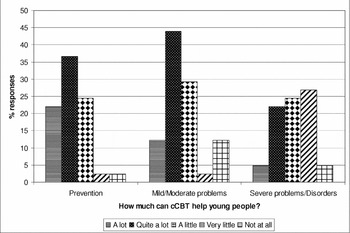
A total of 59% (n = 24) of respondents rated cCBT as able to help “quite a lot” or “a lot” as a prevention programme and 56% (n = 23) as an intervention for mild/moderate problems. However, clinicians were less positive about the use of cCBT to treat more severe disorders with just over a quarter (27%, n = 11) reporting that it could help quite a lot or a lot. The results are summarized in Figure 1.
Ratings on potential of cCBT to help children and adolescents

Twenty-nine percent of respondents (n = 12) would definitely use cCBT, if available, with children and adolescents. Fifty percent (n = 21) would “possibly” do so, no respondents reported they would definitely not, and 9.5% (n = 4) were unsure. However, they were less positive about the effectiveness of cCBT compared to face-to-face CBT, with no respondents rating cCBT as “much better” or “better”. A small percentage thought that cCBT would be equally effective (17%, n = 7) but most (59%, n = 24) believed that outcomes would be worse or much worse. The remaining 24% (n = 10) were unsure.
Delivery of cCBT
In terms of where cCBT should be offered (more than one choice could be given), 86% (n = 36) felt it should be available within specialist CAMHS settings, 79% (n = 33) in schools and 67% (n = 29) in GP surgeries. Only 37% (n = 15) felt it should be freely available online, whilst 49% (n = 20) were unsure about this. Very few (8%, n = 3) felt that cCBT should be offered without any professional support, with 44% (n = 18) feeling that this support should be provided by a Tier 2 worker, 25% (n = 10) by a Tier 3 worker, and only 8% (n = 3) by a teacher.
Perceived advantages and disadvantages of cCBT
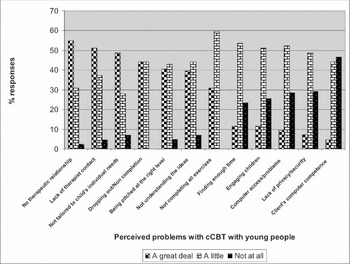
Figure 2 summarizes the extent to which respondents endorsed a list of issues as potential problems/disadvantages in using cCBT with children and adolescents. The greatest concerns related to the potential absence of a therapeutic relationship and the lack of therapist contact, followed by programmes not being tailored to individual needs. Issues that were endorsed less often related to computer problems or lack of access, lack of privacy/security, and the computer competence of the child.
Ratings of potential problems with using cCBT with children and adolescents

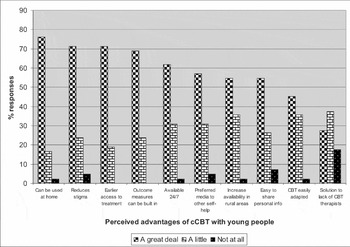
Participants were also asked to rate potential advantages of cCBT with children and adolescents and these are summarized in Figure 3. The greatest perceived benefits/advantages were that cCBT could be used at home, would reduce stigma, and could provide earlier access to treatment. Those issues least endorsed were that personal information could be more easily shared with a computer, CBT being easily adapted to a computerized format, and cCBT being a solution to the lack of CBT therapists. Nonetheless, all the advantages were endorsed relatively highly, with a minimum of a quarter of participants responding “a great deal” for all issues.
Ratings of potential advantages of using cCBT with children and adolescents

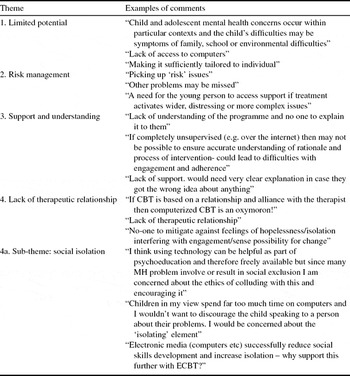
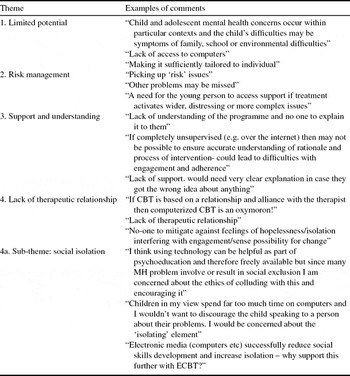
The majority (49%, n = 20) of respondents were unsure whether they had any concerns about using cCBT with children and adolescents, whilst 32% (n = 13) reported that they had concerns, and 20% (n = 8) reported having no such concerns. Qualitative descriptions of these concerns were then subjected to a thematic analysis that revealed four themes. The first, “limited potential”, reflected the concerns of clinicians that cCBT is limited in how much it can help children and adolescents. The second theme, “risk management”, reflected those comments about whether computer programmes are able to adequately detect risk factors that may arise during therapy. The third, “support and understanding” reflected clinicians’ concerns that children and adolescents would not understand the theoretical concepts of the programme. Additionally, this theme reflected the view that children and adolescents would not get sufficient support from a mental health professional to facilitate such learning. The final theme, “lack of a therapeutic relationship” reflected worries that cCBT would occur in the absence of a supportive therapeutic relationship. A sub-theme within this, labelled “social isolation”, reflected specific concerns that cCBT could exacerbate the social isolation of some children and adolescents. Table 1 provides examples of quotes within each theme.
Themes relating to professionals concerns with use of cCBT with children and adolescents
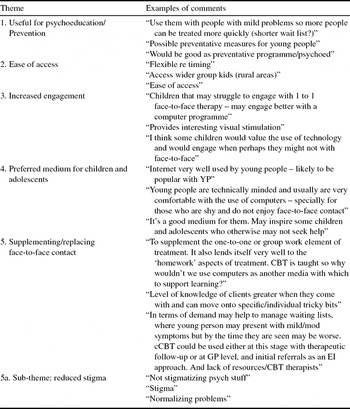
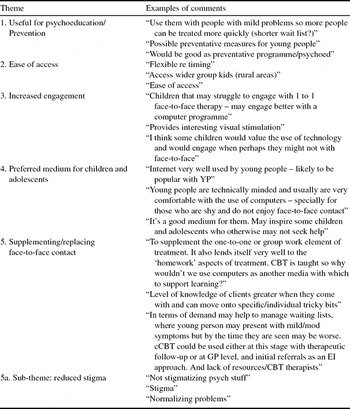
A total of 88% (n = 36) of respondents believed that there would be benefits of using cCBT with children and adolescents, with the remaining 12% (n = 5) being unsure. Qualitative descriptions of these benefits were then subjected to a thematic analysis that revealed five themes. The first theme, “useful for psychoeducation/prevention”, reflected comments that cCBT could be very useful for psychoeducation and prevention. The second theme, “ease of access”, reflected the view that cCBT would allow a wider range of children and adolescents to access CBT than face-to-face therapy would be able to achieve. The third theme, “increased engagement”, reflected comments that computers could make therapy “fun” and increase engagement, particularly for those who would be hard to engage in a traditional face-to-face context. The fourth, “preferred medium for children and adolescents”, reflected comments that computers are a familiar medium that children and adolescents enjoy and understand. The final theme, “supplementing/replacing face-to-face contact”, reflected views that cCBT would work well in both supplementing face-to-face work, for example through homework, but also possibly replace face-to-face therapies in some circumstances. A sub theme of this, labelled “stigma”, reflected the feeling that cCBT could be a good way to reduce the stigma of mental health problems in children and adolescents. Table 2 gives examples of the quotes that are within these themes.
Themes relating to professionals perceived benefits of the use of cCBT with children and adolescents
Discussion
Potential use and effectiveness of cCBT
The majority of respondents reported that they would definitely or possibly use cCBT with children and adolescents. Whilst this is encouraging, it does not necessarily imply that this positive attitude would be reflected in actual practice. For example, MacLeod et al. (Reference MacLeod, Martinez and Williams2009) noted that although the majority of clinicians who worked with adults had favourable attitudes towards self-help, only 10% had actually used cCBT. The majority of clinicians viewed cCBT as having good potential for use as a preventative tool as well as an intervention for use with those who have mild to moderate problems. This view has been endorsed in small scale studies that have found cCBT to be effective in the prevention of depression in adolescents (O'Kearney et al., Reference O'Kearney, Gibson, Christensen and Griffiths2006, Reference O'Kearney, Kang, Christensen and Griffiths2009). This interest in the use of cCBT for prevention in children and adolescents suggests that cCBT could be developed as a key part of a stepped care approach and could be made widely available as a psychoeducational preventive intervention in schools. In terms of treatment, cCBT was seen as a less effective option than face-to-face CBT for children and adolescents. The majority of clinicians believed that cCBT would have worse outcomes compared to face-to-face CBT, indicating they would not see it as an adequate alternative. Such scepticism about the potential of cCBT compared to face-to-face CBT has been identified in previous research on clinicians’ views about cCBT with adults (Whitfield and Williams, Reference Whitfield and Williams2004). However, work with children and adolescents suggests that the outcomes of cCBT and face-to-face CBT may be similar (Spence et al., Reference Spence, Holmes, March and Lipp2006), although research in this area is currently limited.
Delivery of cCBT
Clinicians expressed strong views that cCBT should not be freely available for children and adolescents online. They were also clear that cCBT should not be provided without any professional support and that this support would best be provided by a trained mental health professional rather than a teacher. This concern is consistent with the results of research with adults that has documented that a lack of support whilst using cCBT is associated with low uptake and poorer outcomes (Gellatly et al., Reference Gellatly, Bower, Hennessy, Richards, Gilbody and Lovell2007; Spek et al., Reference Spek, Cuikpers, Nykli, Riper, Keyzer and Pop2007; Murray et al., Reference Murray, Pombo-Carril, Bara-Carril, Grover, Reid, Langham, Birchall, Williams, Treasure and Schmidt2003). However, the results are not consistent with Murray et al. (Reference Murray, Schmidt, Pombo-Carril, Grover, Alenya, Treasure and Williams2007) which shows that improvements in clinical symptoms can be achieved without therapist support. Future research needs to explore whether outcomes differ with varying levels of therapist support when cCBT is used with children and adolescents. This is one of a number of issues that have been previously identified as needing further research in the field of cCBT for adults (Murray et al., Reference Murray, Schmidt, Pombo-Carril, Grover, Alenya, Treasure and Williams2007; NICE, 2008).
Perceived advantages and disadvantages of cCBT
Issues relating to the importance of the therapeutic relationship were highlighted as a major concern about the use of cCBT with children and adolescents. The most highly endorsed problems were all related to the lack of support that the clinicians felt cCBT would provide. Clinicians worried about both the lack of a therapeutic relationship and therapist contact. Related to this was the belief that the lack of support would mean the young person would not understand the concepts and that the programme would not be responsive to an individual's needs. Once again these perceived problems are similar to those found in the adult literature, where the absence of a therapeutic relationship is seen by both service users and clinicians to be a major problem (Lange, Van De Ven and Schrieken, Reference Lange, Van de Ven and Schrieken2003; Marks et al., Reference Marks, Mataix-Cols, Kenwright, Cameron, Hirsch and Gega2003; MacLeod et al., Reference MacLeod, Martinez and Williams2009).
Many clinicians in this current survey also expressed concerns that standardized cCBT might not be pitched at the right developmental level. This raises important questions about the suitability of cCBT programmes initially developed for adults being used with children and adolescents. It would therefore appear important that cCBT software is developed specifically for this younger age group. Currently there are few child specific cCBT programmes compared to the number available for adults. Most packages available specifically for children and adolescents have been developed for the treatment of anxiety disorders (Khanna and Kendall, Reference Khanna and Kendall2008; Cunningham, Rapee and Lyneham, Reference Cunningham, Rapee and Lyneham2006; Spence et al., Reference Spence, Holmes, March and Lipp2006), with only one cCBT programme being targeted at depression (Abeles et al., Reference Abeles, Verduyn, Robinson, Smith, Yule and Proudfoot2009) and one for general emotional problems (McCusker, Reference McCusker2008). Further, it may be necessary to develop different software packages for children and adolescents of different ages to ensure that they are pitched at the right level.
This survey found that few clinicians believed that computer competence would be an issue with children and adolescents. This is in contrast to work with adults, which has found that many clinicians are concerned over the technical ability of service users (MacLeod et al., Reference MacLeod, Martinez and Williams2009). In addition, issues such as engagement, computer access and lack of privacy and security can be problematic when cCBT is used with adults (Carlbring et al., Reference Carlbring, Westling, Ljungstrand, Ekselius and Andersson2001; Kiropoulos et al., Reference Kiropoulos, Klein, Austin, Gilson, Pier, Mitchell and Ciechomski2008; Beattie, Shaw, Kaur and Kessler, Reference Beattie, Shaw, Kaur and Kessler2009; Whitfield and Williams Reference Whitfield and Williams2004). In the current study these issues were not frequently seen as problematic by clinicians in relation to cCBT with children and adolescents. Indeed, the qualitative analysis suggested that clinicians thought that children and adolescents might be more engaged with cCBT compared to face-to-face CBT. This is consistent with previous research that has shown that children and adolescents attending CAMHS are very familiar with computers (Stallard, Velleman and Richardson, Reference Stallard, Velleman and Richardson2010).
Clinicians perceived cCBT to offer some benefits, including use at home, reduced stigma, and earlier access to treatment. Additionally, the fact that outcome measures can be built into cCBT software packages, and that it is available 24/7, were rated favourably. These perceived advantages are in line with work concerning cCBT with adults, where a number benefits, such as ability to use at home, earlier access to treatment and 24/7 access, have been identified by both clinicians and service users (Beattie et al., Reference Beattie, Shaw, Kaur and Kessler2009; Graham et al., Reference Graham, Franses, Kenwright and Marks2000; MacGregor et al., Reference MacGregor, Hayward, Peck and Wilkes2009; Gega et al., Reference Gega, Marks and Mataix-Cols2004; Marks et al., Reference Marks, Shaw and Parkin1998; Peck, Reference Peck2007; Kaltenthaler et al., Reference Kaltenthaler, Brazier, DeNigris, Tumur, Ferriter, Beverley, Parry, Rooney and Sutcliffe2006). Other potential advantages, such as facilitating the sharing of personal information, increased availability in rural areas, and being a solution to the lack of CBT therapists, were not so frequently endorsed, but were nonetheless relatively high.
Implications
The issues identified have implications for how cCBT would be widely adopted. First, clinicians are concerned whether cCBT is supported by a mental health professional. Previous studies have offered such support using a range of media, such as text messages, telephone calls and e-mails (Cunningham et al., Reference Cunningham, Wuthrich, Rapee, Lyneham, Schniering and Hudson2009; March et al., Reference March, Spence and Donovan2009; Spence et al., Reference Spence, Holmes, March and Lipp2006; Gerrits, van der Zanden, Visscher and Conijn, Reference Gerrits, Van Der Zanden, Visscher and Conijn2007). Such methods of providing professional support may help address this concern, whilst also being convenient for the clinician. Second, this survey suggests that clinicians may be more likely to suggest cCBT if it is offered in addition to, rather than as a replacement for, face-to-face contact. The use of cCBT programmes that run alongside, or are provided as a precursor to, individualized face-to-face therapy may be viewed by many clinicians as preferable. Finally, clinicians’ concerns about the potential failure of cCBT to identify risks such as suicidal ideation is an important issue. Ensuring that all children and adolescents offered cCBT are appropriately screened, assessed and monitored, with support being provided at regular periods throughout the programme, will help identify and address such risk factors. In addition, standardized measures to assess mental health could be built into software packages. This has previously been implemented within the cCBT package FearFighter (Kenwright, Liness and Marks, Reference Kenwright, Liness and Marks2001) designed to treat phobia and panic in adults, which has standardized measures of fear and adjustment built-in.
Limitations and future directions
The findings of this study are limited by the small sample size, and it is unclear whether the respondents here are representative of the wider population of CAMHS therapists. Indeed, it should be noted that 21% of those surveyed had never used CBT and thus their attitudes may be different to those who regularly use this approach. Future research should use a larger sample with a wider range of mental health professionals. Whilst a number of open-ended questions were used, most were closed questions, which means that some of the issues raised here cannot be examined in detail. Future research studies could address this through the use of semi-structured interviews. This study did not examine whether clinicians had actually used cCBT with children and adolescents, which would have been useful information in interpreting the results. However, as previously mentioned, there are few software packages available for this age group, and thus it was deemed unnecessary to examine the actual use at this stage. When additional software packages have been trialled such an examination may prove useful.
Conclusions
This is the first survey to assess clinicians’ attitudes to the use of cCBT with children and adolescents. Despite certain limitations, the findings add to and extend previous work examining attitudes towards cCBT with adults. This study suggests that whilst clinicians have a number of concerns, they are generally positive about the use of cCBT with children and adolescents. In particular, clinicians see potential for cCBT as a prevention programme and an intervention for mild to moderate problems. Whilst a number of issues previously identified in relation to cCBT with adults were highlighted, some issues appear to be unique to children and adolescents. Such issues can help in the development and implementation of cCBT packages for this age group, and subsequently help improve access to effective treatments for mental health problems.
Acknowledgements
Thank you to all those who took the time to complete the survey. This research was funded by the National Institute for Health Research (NIHR) under its Research for Patient Benefit programme. The views expressed are those of the author(s) and not necessarily those of the NHS, the NIHR or the Department of Health.




Comments
No Comments have been published for this article.