Introduction
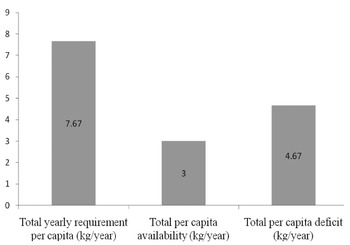
The economic growth and development of Bangladesh largely depends on the performance of the agricultural sector in which livestock plays a significant role. Livestock contributes approximately 2.95% to the country's gross domestic product (GDP) and 17.5% to the agricultural GDP. Approximately 25% of the labour force is directly and 50% is indirectly engaged in this sector (BBS, Reference BBS2006). Of the livestock sector, the poultry industry has considerable potential for generating income, reducing malnutrition, offering employment opportunities and alleviating poverty. This is especially true for small farmers. Poultry farming offers certain advantages over other agricultural farming such as crops, fisheries and agro-forestry. Specifically it requires less land, it is relatively less influenced by the seasons and requires a low investment compared to other livestock farming (e.g. dairy and beef). Poultry farming in Bangladesh can be broadly divided into two categories; traditional rural backyard farming and commercial farming. Commercial farming began in the early 1980s. The government's poultry development policy undertaken in the 1990s then augmented commercial poultry production favourably, which in turn resulted in a spectacular increase in the number of poultry farms. The production growth rate was only 0.7% per annum during the period of 1970 to 1980 but after this time it increased significantly. In fact during the period of 1980 to 1990 and 1990 to 2000 the growth rate was 6 and 8% per year respectively (Begum, Reference BEGUM2008). However, until recently 66% of all poultry meat consumption has come from commercial poultry farms (Dolberg, Reference DOLBERG2008). Despite poultry meat production increasing significantly during the decades of the 1990s and 2000s, it has still not been sufficient to meet the domestic requirement (Figure 1). As this shows the per capita meat availability in Bangladesh still needs to be more than doubled to satisfy the current meat demand of 7.67 kg per year.
Meat requirements, availability and deficits in Bangladesh (FAO, Reference FAO2008).

Research has been carried out on commercial poultry production however there is a dearth of information on the efficiency of commercial poultry farms in Bangladesh. In 1995 Alam presented the existing status and future potential of the poultry sector in Bangladesh however this information is now more than a decade old and many structural changes have taken place in this time. Following this Mitchell (Reference MITCHELL1997) showed the consumption and marketing aspects of poultry products in Bangladesh. Other research conducted by Karim and Mainuddin (Reference KARIM and MAINUDDIN1983), Ahmed (Reference AHMED1985), Haque (Reference HAQUE1985), Islam and Shahidullah (Reference ISLAM and SHAHIDULLAH1989), Ukil and Paul (Reference UKIL M.A. and PAUL1992), Bhuiyan (Reference BHUIYAN1999), Uddin (Reference UDDIN1999) and Begum et al. (Reference BEGUM, FUMIO and TAKUMI2005) provides important information relating to commercial poultry farms in Bangladesh. All of these studies have indicated that commercial poultry farming in Bangladesh faces many problems, namely lack of capital, inadequate knowledge of poultry rearing, outbreak of diseases, less availability and higher prices of inputs (e.g. feed, day old chicks, vaccines and medicines), inadequate institutional credit and a lack of guaranteed and profitable markets for their output. Despite all of these studies, none of them have dealt the efficiency estimation and the factors associated with it.
Under the circumstances of the higher meat demand than availability, one can rationally advocate that the commercial poultry production must be increased to meet the requirements. However the logical question arises, how production can be increased given the constraints of the resources available to poor farmers in Bangladesh? One of the alternatives may therefore be to examine the efficiency level of the commercial farms in Bangladesh and determine the factors responsible for producing varying efficiency levels. This type of information would help farmers and policy makers to formulate policies on whether the commercial poultry farms in Bangladesh should be expanded horizontally by investing scarce resources, given the resources constraints, or whether they can save resources from the current production technology. This would mean it would be possible to expand production with the cost savings from saved resources. Therefore to do this, the farms’ efficiency must be measured and the utilization of resources of examined. Thus, the measurement of farm-level technical, allocative and economic efficiency in commercial poultry production in Bangladesh is the first aim of this paper. Following this the efficiency differentials across farms are explained. To fulfil the aims of the study, data envelopment analysis (DEA) was used to measure the efficiency of the commercial poultry farms. Following this farm specific variables such as a farmer's age, education, experience, total landholdings, poultry farm size, training participating were used in a Tobit regression framework to explain the variations in the measured inefficiencies seen.
There are many studies in the literature (Charnes et al., Reference CHARNES, COOPER and RHODES1978; Manos and Psychoudakis, Reference MANOS and PSYCHOUDAKIS1997; Anderson et al., Reference ANDERSON, FOK, SPRINGER and WEBB2002; Thiam et al., Reference THIAM, BRAVO-URETA and RIVAS2001; Alene and Zeller, Reference ALENE and ZELLER2005) that have measured the efficiency of various enterprises. However, only a few studies (Sharif and Dar, Reference SHARIF and DAR1996, Wadud and White, Reference WADUD and WHITE2000, Coelli et al., Reference COELLI, RAHMAN and THIRTLE2002, Rahman, Reference RAHMAN2003, Kamruzzaman et al., Reference KAMRUZZAMAN, MANOS and BEGUM2006) have estimated the efficiency of rice, wheat and agriculture (as aggregate) in Bangladesh and none of these studies have analyzed commercial poultry production efficiency. Therefore, the present study is unique in the sense that the study measures the commercial poultry production efficiency for the first time. The study also differs from the research previously conducted on the efficiency of other enterprises in terms of the state of the art methodology used and the identification of the factors responsible for the differences in efficiency seen.
Model specification
Efficiency is the widely used concept in economics, particularly in managerial and production economics. Efficiency is expressed by summing up the technical and allocative efficiencies. Technical efficiency is the ability of the farmers to produce the maximum output from a given level of inputs, while allocative efficiency measures the ability of the farmers to use inputs in optimal proportions, given input prices. There are two widely used efficiency estimation methods; the non-parametric method data envelopment analysis (DEA) and parametric stochastic frontier analysis (SFA). The stochastic frontier approach was proposed by Aigner et al. (Reference AIGNER, LOVELLl and SCHMIDT1977) and Meeusen and Van den Broeck (Reference MEEUSEN and VAN DEN BROECK1977). The framework for the non-parametric method DEA was initiated by Farrell in 1957 and re-formulated as a mathematical programming problem by Charnes et al. in 1978. Comprehensive reviews of these two methodologies have been conducted by academics including Lovell (Reference LOVELL1993), Ali and Seiford (Reference ALI and SEIFORD1993), Coelli (Reference COELLI1995), Bauer (Reference BAUER1990), Fried et al. (Reference FRIED, LOVELL and SCHMIDT1993) and Bravo-Ureta and Pinheiro (Reference BRAVO-URETA and PINHEIRO1993).
DEA is a systematic approach widely used in management science and economics, in which the relationships between all inputs and outputs are taken into account simultaneously (Yusuf and Malomo, Reference YUSUF and MALOMO2007). The main advantage of the DEA approach over SFA is that the former is a deterministic approach not requiring parametric specification of a functional form to form the frontier but the latter is not. This is the reason why this study used the data envelopment analysis (DEA) to estimate the farms’ efficiency.
A poultry producing unit (a farm) is defined as a Decision Making Unit (DMU). DEA calculates the efficiency and efficiency gap (if any) of each farm from their best practices, based on actual inputs used and outputs produced. DMUs on the efficiency frontier will have an efficiency score equal to 1 and are said to be efficient. DMUs that are not on the frontier have an efficiency score less than one and are said to be inefficient. Thus, this method allows the relative efficiency of a farm and its position in relation to the optimal situation to be determined.
One of the options in DEA is a choice between constant returns to scale (CRS) and variable returns to scale (VRS). CRS assumes that all DMUs are operating at the optimal scale. Thus, it is assumed that large poultry farms are just as efficient as small ones in converting inputs to outputs. The main criticism of the CRS assumption is that in reality it is unlikely that all farms run their production activities optimally, especially in developing countries due to their heterogeneous farms conditions. Therefore VRS overcomes this problem and the specifications of VRS can permit the calculation of efficiency scores devoid of scale efficiency effects as VRS does not assume like CRS. In 1984 Banker et al. suggested changing from using the CRS DEA model to using the VRS DEA model. The VRS specification allows the calculation of technical efficiency (TE), allocative efficiency (AE) and economic efficiency (EE) without the scale efficiency (SE) effects (Coelli, Reference COELLI1996). In this study the efficiency values using both the CRS and VRS techniques for DEA were determined so the values produced could be compared.
Another consideration to make is the choice between input-oriented and output-oriented DEA models. The difference between these is whether the objectives are to continue using the same amount of inputs while producing more outputs (which is called output-oriented DEA) or to produce the same amount of output by using fewer inputs (input-oriented DEA). This choice ultimately depends on the country's resources and therefore this choice will vary from country to country and possibly even region to region within a country. Bangladesh is one of the least developing countries, therefore it is logical to use input-oriented DEA rather than output-oriented DEA so scarce resources can be saved and these resources can be used more efficiently to produce the same output. Subsequently the input-oriented DEA model was utilized in this study using both CRS and VRS specifications to estimate the technical, allocative and economic efficiency of the poultry farmers.
A number of multiple-input, single-output production units (the poultry farms) were evaluated, with the individual farms being referred to as individual Decision Making Unit (DMU). Each DMU used varying quantities of inputs to produce different levels of output (poultry meat). Assuming that i-th farm uses x¡ = (xki) of inputs (k = 1, 2, 3) and produces a single output y¡. The (k x n) input matrix is denoted by X and the (n x 1) output vector is denoted by Y for all n farms, where n is 100. The technical efficiency (TE) can then be estimated solving the following linear programming (LP) based DEA model:
Minimise φil, CRS; subject to -yi + Yω ≥ 0, φ il, CRS xi - Xω ≥ 0, ω≥0 (1)
φ il, CRS, ω
Here, the TE score for the i-th farm is a scalar, φiI,CRS (φiI,CRS≤ 1 ). The VRS DEA frontier can then be formulated by including the convexity constraint, Ω′w= 1, in (1), where Ω is an (n x l) vector of ones:
Minimise pixi ; subject to -yi + Yω ≥ 0, xi-Xω ≥ 0, Ω′ω =1, ω≥0 (2)
x i, ω
Where pi stands for the vector of input prices for the i-th farm and the solution vector x*¡ is the cost-minimizing input vector, given the prices of the inputs and the levels of output yi. The economic efficiency (EE) of the i-th farm is then calculated using the equation
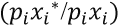
that is the ratio of minimum cost to observed cost. Finally the allocative efficiency (AE) can be estimated using AE = EE/TE.
A comparison of both the CRS and VRS scores can then provide information on scale efficiency (SE). Therefore the scale efficiency (SE) index for the poultry farm is estimated using the equation, SE

because the efficiency scores estimated under the VRS DEA frontier are equal to or greater than those calculated under the CRS DEA. SE=1 implies scale efficiency and SE < 1 implies scale inefficiency. Scale inefficiency can be either increasing returns to scale (IRS) or decreasing returns to scale (DRS). If this sum is equal to one, it would be then called constant returns to scale (optimal scale), if it is less than one then increasing returns to scale (sub-optimal scale) and if it is greater than one then decreasing returns to scale (super-optimal scale).
Data and field survey
The analysis in this study was based primarily on the data collected through a comprehensive field survey of 100 commercial farms. Secondary data was also used where it was required. The data was compiled in Excel and then analyzed using a DEA-Solver, e.g. Win4DEAP and LIMDEP.
The Gazipur district was selected as the study area because it was declared ‘poultry region’ by the government of Bangladesh and subsequently has a high concentration of commercial poultry farms. The sample farms were selected randomly from Kaliakoir and Sripur Thanas (small administrative area) under Gazipur district. The period of investigation covered one calendar year from January 2007 to December 2007 but the data was collected during the period of February 2008 to April 2008.
Efficiency measurement
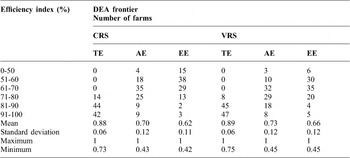
The main variable costs of poultry farms in Bangladesh are the cost of day-old chicks, feed, labour, vaccines and medicines, transportation, litter, equipment and housing. Therefore, to estimate the technical, allocative and economic efficiencies, the following variables costs were used as inputs: i) human labour (in man-days) and wage rate (Taka/man-day), ii) day-old chicks (in cumulative weight) and price, and iii) poultry feed (in kilograms) and price of manufactured or readymade poultry feed (Taka/kilogram). These 3 variables were used because it was decided these are the main variable costs and they cover 75 to 80% of the total cost (Begum et al., Reference BEGUM, FUMIO and TAKUMI2005; Ukil and Paul, Reference UKIL M.A. and PAUL1992; Bhuiyan, Reference BHUIYAN2003; Uddin, Reference UDDIN1999). The other variable costs including medicine, litter, polythene, transportation and depreciation were reported at the aggregate basis but not at the disaggregate basis, therefore neither by volume nor quantity. Output data was reported on the basis of the cumulative weight of the birds sold. The frequency distribution of the efficiency estimates obtained from the DEA frontier and their summary statistics are presented in Table 1. Given the large variability in the computed efficiency (lowest efficiency score of 0.42 and highest score of 1.00), efficiency scores were clustered into six groups; 0.00–0.50, 0.51-0.60, 0.61-0.70, 0.71- 0.80, 0.81–0.90, and 0.91–1.00 to explain their relative position from the highest efficiency frontier 1.
Frequency distribution of efficiency estimates from the DEA models.

The estimated mean values of technical, allocative and economic efficiency were 88, 70, and 62% for CRS DEA frontier respectively and 89, 73, and 66% for VRS DEA frontier respectively. Therefore the results of the DEA reveal substantial inefficiencies in commercial poultry production in Bangladesh when both the CRS and VRS assumptions are used. Subsequently there is real need to improve the efficiency of poultry production in Bangladesh by reducing the costs of production whilst obtaining the same level of output.
In terms of the economics of scale, 68 farms were characterized by increasing return to scale (IRS), 19 farms had constant return to scale (CRS) and 13 farms were characterized by decreasing return to scale (DRS) (Table 2).
Optimal, sub-optimal and super-optimal outputs for poultry farms studied.

Constant return to scale is expected for farms with an output level equal to mean output (Silberberg, Reference SILBERBERG1990). Therefore one would expect returns to scale to be increasing for farms with a relatively low output and decreasing for farms with a relatively high output using the same technology. The mean output at the optimum scale is larger than that at the super-optimal scale (Table 2). These results indicate that the optimal output levels overlap greatly with the sub-optimal and super-optimal output values. Given our sample size, such a result may indicate that the farms with the largest output operate at the optimal scale.
Identifying factors of efficiency using the Tobit model
Technical, allocative and economic efficiency scores obtained using both the CRS and VRS DEA models only have a partial use for policy and management purposes if empirical studies do not investigate the factors affecting efficiency. A relevant research question then arises what factors appear to be associated with inefficiency? The variables most often used in the literature (Wadud and White, Reference WADUD and WHITE2000, Coelli et al., Reference COELLI, RAHMAN and THIRTLE2002, Kamruzzaman et al., Reference KAMRUZZAMAN, MANOS and BEGUM2006; Kalirajan and Shand, Reference KALIRAJAN and SHAND1989; Bravo-Ureta and Evenson, Reference BRAVO-URETA and EVENSON1994; Parikh et al., Reference PARIKH, ALI and SHAH1995; Amara et al., Reference AMARA, TRAORE´, LABDRY and ROMAIN1999; Sharma et al., Reference SHARMA, LEUNG and ZALESKI1999; Wilson et al., Reference WILSON, HADLEY and ASBY2001) to explain the varying efficiency are the age of the farmer, educational status and experience of the farmer, farm size and the use of training and extension services. The factors used in this study to identify the variables influencing the farms’ efficiency using the Tobit regression model consisted mainly of the farm's human variables; namely the farmer's age, educational background or schooling (number of years), experience and training received. However, other farm characteristics such as poultry farm size, total farm size and other resource endowments were also studied.
The Tobit model was used for this research because the dependent variable ‘efficiency’ is a censored variable with an upper limit of one (Lockheed et al., Reference LOCKHEED, JAMISON and LAU1981). This model is employed to estimate factors associated with efficiency with the help of LIMDEP statistical software. The dependent variable in this model is the initial IEi calculated using the CRS and VRS DEA model. Three separate models were estimated for three different efficiency scores obtained from the CRS and VRS DEA. The basic model used was:
IEi = α0 + α 1AG + α 2ED + α 3FS + α 4PFS + α 5Tr + α 6Exp + ε
where:
IEi is the estimated technical, allocative and economic efficiency of the poultry farms
AG is the age of the farmer (years)
ED is the education of the farmer (years)
FS is the total land holdings (decimal)
PFS is the poultry farm size dummy; the value 1 is if more than 1500 birds in each batch and the value 0 is for others
Tr is the training on poultry farming dummy; 1 is if farmers received, 0 if not received
Exp is the experience the farmer has in poultry farming (years)
ε is the error term which follows Gaussian iid
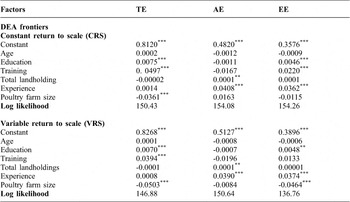
The results of the Tobit regression are presented in Table 3 below.
Tobit regression analysis of factors associated with efficiency.

Note: ***, ** indicates 1%, 5% level of significance respectively
The estimated model showed good explanatory power. The coefficients of age are positive in explaining TE and negative in AE and EE, implying older farmers are technically more efficient than younger farmers but in the case of AE and EE, older farmers are less efficient than younger farmers. However this parameter was not significantly different from zero in any of the models.
Education is used as a proxy for managerial input and a higher level of education may lead to better assessment of issues and better farming decisions. Overall the educational level of the people engaged in poultry farming activities in Bangladesh is low. Therefore the level of education is one of the major constraints which could impede the adoption of new technologies and the farmers’ education may be one of the most important factors for explaining a farms` efficiency. As expected, the results showed that education was positively and significantly related to a farm's TE and EE. This may be a result of the more educated farmers’ better skills, access to information and good farm planning. The negative sign of the education coefficient for farms in AE is surprising, however, the parameter is not significantly different from zero.
Training on aspects of poultry farming contributes significantly to a higher level of efficiency. Poultry farmers should have sound technical knowledge, however in Bangladesh most of the poultry farmers have not been properly trained. The results indicate that training had a positive and significant effect on the poultry farm's TE and EE. Therefore the level of TE can be increased by improving farm management through training. The experience dummy is significant and positive in both in allocative and economic efficiency and in both the CRS and VRS approaches. A possible explanation is that experienced farmers have more knowledge of their resource management and practices, which enables them to utilize the resources more efficiently and effectively.
The production efficiency may also be related to the farmers’ total landholdings because owned land is the proxy of access to credit and therefore poultry farmers who own land can obtain a bank loan with the collateral ‘land or house’. The results indicated that the amount of land owned is positively and significantly associated with the farm's allocative efficiency and therefore the more land owned, the greater ability to access credit which in turn influences the efficiency level. The actual size of the poultry farm is also an important variable in explaining varying efficiency. It was discovered that farm size negatively influences efficiency. In the CRS, the poultry farm size contributes negatively to the technical efficiency but in the VRS, it contributes the same both to the technical and economic efficiency. This implies that on average, small size farms are more efficient than large farms. This result is not surprising but it is interesting for the semi labour-intensive Bangladesh poultry sector. Presumably the observed higher efficiency of the small farms is due to the extensive use of family labour.
Conclusions
Measuring efficiency in agricultural production activities has important implications in designing policies that foster agricultural production. This study used data envelopment analysis (DEA) to estimate the technical, allocative and economic efficiency of commercial poultry farms in Bangladesh. One hundred commercial poultry farms located in the Gazipur district (a declared ‘poultry region’) were surveyed. The results of the efficiency estimate imply that a considerable amount of technical, allocative and economic inefficiency exists among the sample farms. Under the constant return to scale (CRS) and the variable returns to scale (VRS) specifications, technical, allocative and economic efficiencies were 88, 70, 62 and 89, 73, 66% respectively, meaning that the sample farms were 12, 30, 38% and 11, 27, 34% below efficient respectively. The results also show that the poultry farms appear to be dominantly increasing returns to scale. The farmers could increase their poultry production if they were to operate at full technical, allocative and economic efficiency levels, given the existing production technology and resource constraints.
Tobit regression models were estimated to determine the factors contributing to the varying efficiency levels seen. Statistically significant factors identified as being associated with efficiency in this study were educational background, experience, training, land holding size and farm size. Working with the existing technology, the sample farmers could attempt to enhance production substantially if they could produce on the efficient frontier. Based on the outcomes of this study it is recommended that the level of education and training poultry farmers in Bangladesh receive needs to be improved significantly so higher efficiency levels can be achieved in this industry.