Introduction
The topic of identity maintenance or loss in people with dementia is the subject of much debate amongst researchers. Initial reports claimed that the self of people with dementia was lost as the disease progressed, and these reports were often accompanied by descriptions of the unwelcome effects of this deterioration in the self, such as horror, anxiety, fearfulness, and isolation (e.g. Cohen and Eisdorfer, Reference Cohen and Eisdorfer1986). However, recent literature regarding identity in people with dementia contradicts earlier research and suggests that self and identity are often maintained through to the later stages of disease (for a review, see Caddell and Clare, Reference Caddell and Clare2010). Although a number of researchers have suggested that it might be important to support the identity of people with dementia due to the potential impact on different aspects of their lives, such as quality of life (QoL) and mental health (e.g. Dröes et al., Reference Dröes2006), there is little empirical research to highlight the associations between identity and such variables. In light of this gap in the literature, the aim of this study is to gain an understanding of how different aspects of identity are related to mood and QoL in people with early-stage dementia.
A major difficulty with existing studies focusing on identity in people with dementia is that studies tend to rely on different definitions or frameworks of identity (for a review, see Caddell and Clare, in press). These include studies that investigate the self qualitatively, for example from a social constructionist standpoint (e.g. Sabat and Harre, Reference Sabat and Harre1992) or an interactionist perspective (e.g. Saunders, Reference Saunders1998), and studies that measure proposed aspects of the self quantitatively such as self-knowledge (e.g. Rankin et al., Reference Rankin, Baldwin, Pace-Savitsky, Kramer and Miller2005) or role-identities (e.g. Cohen-Mansfield et al., Reference Cohen-Mansfield, Golander and Arnheim2000).
This makes it difficult to draw firm conclusions from existing studies, since the variety of definitions and frameworks used means that many studies, including those focusing on interventions, are aiming to explore or support different aspects of identity. It is therefore difficult to deduce whether identity might consist of more than one component, and if so, how these components might be related. For this reason, several researchers have suggested that it might be beneficial to view identity as being made up of several components (Caddell and Clare, in press). For this study, as suggested by Caddell and Clare, the definition of identity adopted was based on Neisser's (Reference Neisser1988) framework of the self. Neisser's view of the self is that it consists of a number of components, which can be considered to be hierarchical. These include the “ecological self,” which represents the self with respect to the physical environment, and can be determined directly through a person's perceptions. The “interpersonal self” represents the self as engaged in social interaction with others, and can also be perceived on the basis of objectively existing information which signals that the self is involved in such an interaction. The “extended self” is the self as experienced across time, based on memories of our past self and anticipation of our future self, and is thought to enable a person to experience a sense of continuity. The “private self” consists of conscious experiences that are not available to anyone else, including aspects of perception and action, in addition to thoughts, feelings, and dreams. The final component, the “conceptual self” draws on the other four components, which interact to form several aspects of identity. These include abstract and symbolic representations of oneself such as self-concept, role-identities, self-knowledge of personality, and autobiographical memory, which were all measured in the current study.
Much attention has also been paid to possible changes in mood and QoL in people with dementia. Existing literature relating to anxiety and depression in people with dementia is extensive. A recent review of the literature reported that prevalence estimates for anxiety range from 5% to 21% for anxiety disorders and from 8% to 71% for symptoms of anxiety in people with dementia, and that prevalence is elevated in comparison to people without dementia (Seignourel et al., Reference Seignourel, Kunik, Snow, Wilson and Stanley2008). Teri and Wagner (Reference Teri and Wagner1992) reported that most studies gave a prevalence rate of between 20% and 63% for symptoms of depression in people with dementia, which varied according to the informant, and a range of 0% to 86% for depressive disorders, although many studies reported a much smaller range of around 20%–30%. Studies have also reported that people with Alzheimer's disease (AD) are more likely to show symptoms of depression than older people without dementia (Rovner and Morriss, Reference Rovner, Morriss, Robinson and Rabins1989). QoL in people with dementia has also been the subject of much interest for researchers, and has become increasingly common as an outcome measure when assessing the course of the illness or the effect of an intervention (Thorgrimsen et al., Reference Thorgrimsen2003). Lawton (Reference Lawton1997) described a conceptual framework of QoL for older people that consisted of four domains that are generally considered to be salient for people with dementia (Logsdon et al., Reference Logsdon and Teri2002): behavioral competence, the objective environment, psychological well-being and perceived QoL. The QoL-AD measure was developed from this literature, and was deemed to be reliable and valid for people with Mini-Mental State Examination (MMSE) scores greater than 10, i.e. for people in the mild and moderate stages of dementia (Logsdon et al., Reference Logsdon and Teri2002; Thorgrimsen et al., Reference Thorgrimsen2003). Studies have suggested that maintaining identity might be a crucial factor in determining QoL (e.g. Dröes et al., Reference Dröes2006).
Given the extensive theoretical literature on the benefits of maintaining a sense of self and identity in people with dementia, it is surprising that there is little in the way of empirical evidence supporting this work. Some researchers have suggested that there is a link between mood, well-being, and aspects of identity in people without dementia. Berzonsky (Reference Berzonsky2009) and Vleioras and Bosma (Reference Vleioras and Bosma2005) argue that different identity processing styles may influence well-being, whilst Higgins (Reference Higgins1987) considers how discrepancies between “actual” and “ideal”, or “actual” and “ought”, selves might lead to emotions such as sadness or fear. Thoits (Reference Thoits1983) also reports that a person's social identities may impact upon symptoms of anxiety and depression. However, the association between identity, mood, and well-being in people with dementia remains relatively understudied. Kitwood (Reference Kitwood1997) highlights the importance of supporting the self in dementia through person-centered care, explaining that one of the key needs of people with dementia is to “have an identity.” Although there is very little existing empirical work specifically relating to the relationships between identity and mood and QoL, other literature exists that indicates more indirectly that some of these aspects of identity might be related to mood and QoL. While reports relating to the relationship between identity and levels of anxiety are scarce, some work related to possible aspects of identity and depression or QoL has been undertaken. Lower levels of depression have been found in people with dementia with improved family and social contacts (e.g. Cohen-Mansfield, Reference Cohen-Mansfield2005) and leisure activities (e.g. Arkin, Reference Arkin2003), which might reflect the strength of role-identities in people with dementia. The salience of family support for QoL, which might also be reflected in a family role-identity, has also previously been documented (Dröes et al., Reference Dröes2006). There is also a proposed relationship between aspects of memory functioning and QoL, whereby several studies have observed an improvement in QoL alongside an improvement in memory functioning or cognitive functioning in general (e.g. Woods et al., Reference Woods, Thorgrimsen, Spector, Royan and Orrell2006). While this literature does not refer specifically to autobiographical memory, it is possible that this relationship might extend to different aspects of memory functioning. Although not extensive, this existing work does suggest that aspects of identity might be related to depression and QoL.
Thus, the specific research questions for this study are:
1. Are aspects of identity, as defined by Neisser's “self-concept,” associated with anxiety, depression, and QoL?
2. If so, is it possible to predict the variance in anxiety, depression, and QoL from these aspects of identity?
Method
Design
This was a cross-sectional questionnaire-based study, examining the relationships between identity, mood, and aspects of well-being. Ethical approval was granted by the Bangor University Ethics Committee and by the North-West Wales NHS Research Ethics Committee.
Participants
Participants with dementia were recruited through two local memory clinics and also through a patient research participation register (NEURODEM) in North Wales. Inclusion criteria were a medical diagnosis of AD, vascular dementia, or mixed Alzheimer's and vascular dementia using ICD-10 criteria (WHO, 1992). Participants had to be aged 60 years or over, in the early stages of dementia as defined by an MMSE score of 18 or over, and fluent in English. Participants also had to have a close relative or friend who was willing to complete several questionnaire measures which required informant ratings.
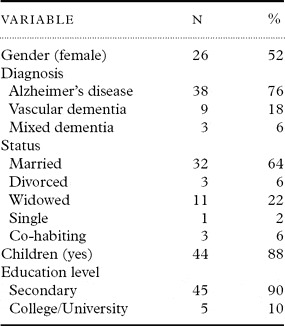
Characteristics of the sample are given in Table 1. The mean age of people with dementia was 77.8 years (SD = 7.4, range = 60–91) and the mean MMSE score for people with dementia was 23.7 (SD = 2.7, range = 18–29), indicating that participants were in the early stages of dementia. There were no significant differences on measures of identity, mood, or QoL between male and female participants, between married/co-habiting participants and those living alone, or between participants with different dementia diagnoses.
Characteristics of participants

Measures
Measures of identity
Aspects of the self-concept
Tennessee Self-Concept Scale (2nd ed) (TSCS-II; Fitts and Warren, Reference Fitts and Warren1996). Self-concept was assessed using the 21-item identity subscale of the TSCS and the five domains within this scale that represented different aspects of identity: personal, family, social, moral, and physical. Each item is rated on a five-point scale for self-descriptiveness from “always false” to “always true.” An example item is “I am an honest person,” which would then be rated 1–5 according to how accurately the respondent felt that this reflected him/herself. The adult scale has been standardized with people from 13–90 years of age, making it suitable for use with the participants from this study, and raw scores can be converted to T-scores for comparison with normative data. The TSCS-II scale also has good internal consistency, test–retest reliability, and construct validity (Fitts and Warren, Reference Fitts and Warren1996), and the scale has been used successfully with people with dementia (e.g. Naylor and Clare, Reference Naylor and Clare2008).
Role-identities
Self-Identity in Dementia Questionnaire (SID; Cohen-Mansfield et al., Reference Cohen-Mansfield, Golander and Arnheim2000). This questionnaire explores four types of self-identity roles in people with dementia: occupational roles, family roles, leisure activities, and attributes. There are separate versions for the person with dementia, a close family member, and a staff caregiver. Only some of the items from the version for the person with dementia were used in this study. The four items used ask about how important each of the four roles are currently, on a scale of 1 (not at all) to 5 (very important). For example, after describing their previous job/profession to the researcher (since participants were all retired) the respondent would be asked “how important is this job/occupation to you today?”, and would rate this on the scale from 1–5 points.
Autobiographical memory
Autobiographical Memory Interview (AMI; Kopelman et al., Reference Kopelman, Wilson and Baddeley1990). The AMI is a structured interview which measures both personal semantic and personal incident memory across three lifetime periods: childhood, early adult life, and recent adult life. Personal semantic memory assesses a participant's recall of personal facts such as the name and date of birth of his/her children, whereas personal incident memory assesses the recall of specific incidents and requires access to episodic memory. Example items include “can you tell me the name of the first school you attended?” for personal semantic memory, and “can you recall an incident that occurred while at primary school?” for the autobiographical incident memory. This measure provides a total semantic memory score and a total incident memory score, in addition to semantic and incident memory scores for each of the three lifetime periods. The AMI is suitable for use with older people (Kopelman et al., Reference Kopelman, Wilson and Baddeley1990), and has been successfully used with people with dementia in previous studies (e.g. Naylor and Clare, Reference Naylor and Clare2008).
Self-knowledge of personality traits
Self- and informant ratings of personality traits to measure self-knowledge (40 trait words selected from norms by Anderson, Reference Anderson1968; Kirby and Gardner, Reference Kirby and Gardner1972). Although this method of measuring self-knowledge of personality traits has been used previously with people at all stages of dementia (e.g. Klein et al., Reference Klein, Cosmides and Costabile2003), the list of traits used here was selected specifically for this study. Traits have been selected from norms to ensure that the adjectives cover a range of social desirability, and all score highly on familiarity and meaningfulness. The participant is asked to rate a list of 40 personality traits (e.g “cheerful”) for how well the adjective describes their own current personality on a scale of 1 (not at all) to 4 (totally). The relative is also asked to rate the list of adjectives for how well they describe the participant's current personality. For each item, the difference between the participant's own score and the informant's score was calculated, and then these were totalled to give an overall discrepancy score for all 40 traits. The lower the discrepancy score, the more accurate the participant's self-knowledge is said to be.
Measures of mood and QoL
Hospital Anxiety and Depression Scale (HADS; Snaith and Zigmond, Reference Snaith and Zigmond1994). This is a 14-item self-report measure that consists of two scales, one for anxiety and one for depression. Each item consists of a statement that must be rated 0–3, according to how often the statement applies to the respondent. For example, the respondent would rate the item “worrying thoughts go through my mind” 0–3, depending upon how well this described him/herself over the past week. For both scales, raw scores of between 8 and 10 identify mild cases, 11–15 moderate cases, and 16 or above, severe cases. This measure is reliable and valid across all age groups (Spinhoven et al., Reference Spinhoven, Ormel, Sloekers, Kempen, Speckens and Hemert1997).
Quality of Life-AD Scale (QoL-AD; Logsdon et al., Reference Logsdon, Gibbons, McCurry and Teri2002). This is a 13-item self-report scale that assesses physical health, mental health, social, and financial domains of functioning in people with AD. Each item asks about a specific aspect of one of these domains and the respondent is asked to rate how he/she feels about this aspect of his/her own life on a four-point scale, from “poor” to “excellent.” For example, participants would be asked to rate the item “how do you feel about your energy level?” from “poor” to “excellent,” according to their current situation. Responses are summed across items to give an overall score for QoL.
Procedure
Participants and informants completed the questionnaires at home, with help from the researcher, as part of a broader study that included further measures in addition to those described above. Measures were completed in the same order for each participant, with identity-related measures being completed first, to reduce the possibility that answering the other questionnaires might influence how participants rated their identity. Participants were usually able to complete all measures in two visits, but several participants took three visits, one took four visits, and one took five.
Data analysis
Pearson correlations were performed to identify associations between aspects of identity and mood and QoL. Backward regressions were then conducted to determine whether mood and QoL could be predicted from models containing aspects of identity. Backward regression with the removal probability of p >0.10 was used in SPSS version 15, with the predictors selected according to the variables that were most highly correlated with each aspect of identity. The stopping criterion used was the model with the highest adjusted Ra 2 value. In line with recommendations that suggest there should be at least ten participants per predictor variable (e.g. Stevens, Reference Stevens1986), no more than four predictor variables were entered into each regression (although there were 50 participants, a small amount of missing data meant that the number of complete data sets in each analysis was slightly less than 50).
Results
Are aspects of identity associated with anxiety, depression, and QoL?
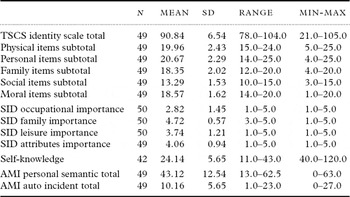
Scores on the identity-related measures are given in Table 2. The mean raw score on the TSCS represented a t-score of 48 and fell within the 42nd percentile with respect to the normative data (Fitts and Warren, Reference Fitts and Warren1996), suggesting that the scores were possibly slightly lower than might have been expected for people of the same age without dementia. The role-identity with the highest score was the family role, with the occupational role scoring the lowest. The self-knowledge total discrepancy score suggested that participants showed a relatively accurate appraisal of their traits, with an average discrepancy of about 0.5 points per trait. Mean scores on both the personal semantic total and the autobiographical incident total of the AMI fell into the “definitely abnormal” range according to the provided norms (Kopelman et al., Reference Kopelman, Wilson and Baddeley1990), which is in line with participants having a diagnosis of dementia.
Scores on measures of identity

TSCS = Tennessee Self-Concept Scale; SID = Self-Identity in Dementia questionnaire; AMI = Autobiographical Memory Interview
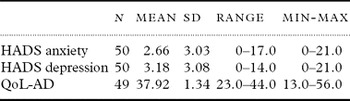
Table 3 shows scores on the measures of mood and QoL. The mean scores for anxiety and depression fell below the cut-off for clinical “case-ness,” but three participants fell into the mild category for anxiety, with one in the severe category, and two participants fell into each of the mild and moderate categories for depression (Snaith and Zigmond, Reference Snaith and Zigmond1994). The mean score for QoL was in close agreement with scores reported by Logsdon et al. (Reference Logsdon and Teri2002) for people within the MMSE range found in the current study.
Scores on measures of mood and quality of life (QoL)

HADS = Hospital Anxiety and Depression Scale; QoL-AD = Quality of Life – Alzheimer's Disease Scale
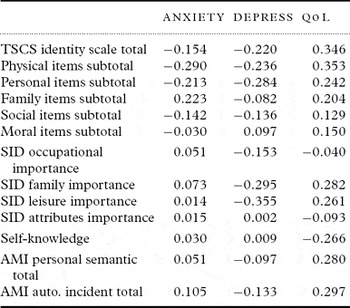
Pearson correlations between the mood and QoL variables and potential predictor variables are shown in Table 4. Numerous identity variables were associated with the mood and well being variables, many with moderate-sized correlations that would have been significant at p <0.05 or p <0.01, but all of these lost statistical significance after the Bonferroni correction was applied.
Bivariate correlations between the measures of identity and measures of mood and quality of life (QoL)

A Bonferroni correction was made for multiple comparisons, with the result that the p-value required to indicate a significant correlation was p < 0.0013.
*Significant at p < 0.0013
TSCS = Tennessee Self-Concept Scale; SID = Self-Identity in Dementia questionnaire; AMI = Autobiographical Memory Interview
Is it possible to predict the variance in anxiety, depression, and QoL from aspects of identity?
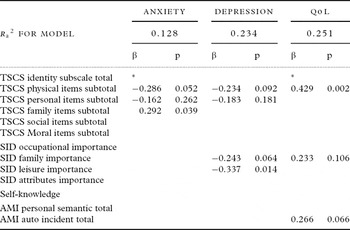
Backward regression analyses were performed, with anxiety, depression, and QoL being entered as dependent variables, to see whether these variables could be predicted from aspects of identity. The predictors entered were based on the correlation size between the variables as given in Table 4, such that the identity variables with the highest correlations with anxiety, depression, and QoL were entered as predictors. The stop criterion was the model with the greatest Ra 2 value. The results are shown in Table 5.
Backward regression analyses, predicting mood and quality of life (QoL) from aspects of identity

*Indicates that the variable was entered into the regression but was not part of the final model.
TSCS = Tennessee Self-Concept Scale; SID = Self-Identity in Dementia questionnaire; AMI = Autobiographical Memory Interview
Regression analyses
For anxiety, all variables entered into the regression remained in the model, which was significant. The model contained the TSCS family items subtotal, TSCS physical items subtotal, and TSCS personal items subtotal (F 3.45 = 3.35, p < 0.05, Ra 2 = 0.128) with just the TSCS family items subtotal being individually significant. Lower levels of anxiety were associated with greater scores on the TSCS physical and personal items subtotals, whereas higher levels of anxiety were predicted by greater scores on the TSCS family items subtotal. The TSCS identity subscale total was entered into the regression but did not remain in the model.
Depression was significantly predicted by a model containing TSCS physical and personal items subtotals, and SID family and leisure subscales (F 4.44 = 4.66, p < 0.01, Ra 2 = 0.234), with just the SID leisure subscale being individually significant. Lower levels of depression were associated with higher scores on all of the predictors.
QoL was significantly predicted by a model containing the TSCS physical items subtotal, SID family importance, and AMI autobiographical incident total scores (F 3.43 = 6.145, p < 0.01, Ra 2 = 0.251), with just the TSCS physical items subtotal being individually significant. A better QoL was associated with higher scores on the TSCS physical items total and the AMI autobiographical incident total. The TSCS identity subscale total was entered into the regression but did not remain in the model.
Discussion
The aim of this study was to explore the relationships between aspects of identity, mood, and QoL in people with early-stage dementia. Although much of the theoretical literature has implied a positive relationship between identity and aspects of mood and well-being, this is the first study to address the precise nature of this relationship.
While none of the correlations was statistically significant, mainly due to the adjusted p-value (0.0013) which resulted from the Bonferroni correction, anxiety, depression, and QoL were significantly predicted from models containing aspects of identity, to differing extents (accounting for 12.8%, 23.4%, and 25.1% of the variance, respectively). All of the relationships were in the expected direction, with one exception, whereby the TSCS family items subtotal predicted higher levels of anxiety. That is, with the above exception, higher scores on the identity-related variables (or a lower score that represented better performance, as with personality self-knowledge) were related to lower levels of anxiety and depression, and a better QoL. This is in agreement with previous literature, which has suggested that a retained sense of identity in general should support mood and aspects of well-being (Dröes et al., Reference Dröes2006) and QoL (Cohen-Mansfield et al., Reference Cohen-Mansfield, Golander and Arnheim2000).
The only significant predictor for a lower level of anxiety was a lower score on the TSCS family items subtotal. However, the TSCS physical items subtotal was also borderline significant at p = 0.052. The TSCS family items subtotal was positively associated with anxiety. This is surprising, since one might expect that better relationships and support from family members might reduce anxiety in the person with dementia. However, this result supports findings from Orrell and Bebbington (Reference Orrell and Bebbington1996), who also found a relationship between anxiety and aspects of social support and relationships with relatives in people with dementia. Their study found associations between anxiety and high social contact, and anxiety and dominance in close relationships. The authors attributed this to a possible relationship between high social contact and increased dependency, and possible negative communication styles. A further possibility is that since caring for a relative with dementia is known to increase symptoms of anxiety and depression in caregivers (e.g. Mahoney et al., Reference Mahoney, Katona and Livingston2005), it could be that the person with dementia is aware of this change in his/her relative, which in turn is influencing his/her own level of anxiety about the carer. Higher scores on the TSCS physical items subtotal might reflect an absence of pain that might accompany poor physical health, or the ability to participate in desired activities that might reduce anxiety, such as physical exercise (De Moor et al., Reference De Moor, Beem, Stubbe, Boomsma and De Geus2006), or other activities with friends and family, which might also reduce anxiety.
The only individually significant predictor for a lower level of depression was a higher score on the SID leisure subscale, although the SID family subscale almost reached significance at p = 0.064. The relationship between these aspects of identity and depression supports theoretical literature, specifically the positive effects of improved family support, social contacts, and leisure activities on identity. Lower levels of depression in people with dementia have previously been associated with family and social contacts (e.g. Cohen-Mansfield, Reference Cohen-Mansfield2005) and leisure activities (e.g. Arkin, Reference Arkin2003), which supports the associations found between these variables in the current study.
The final dependent variable was QoL, for which only the TSCS physical items subtotal was significant. The advantages of physical health for lower levels of anxiety have already been discussed, and the relationship between physical health and QoL may well occur for the same reasons. The AMI autobiographical incident total almost reached significance as a predictor at p = 0.066. The potential relationship between various aspects of memory functioning and QoL has previously been recognized. Although there are few studies that have directly examined the association between autobiographical memory functioning and QoL, several studies have reported an increase in QoL alongside improved memory functioning following some sort of intervention such as cognitive stimulation (e.g. Woods et al., Reference Woods, Thorgrimsen, Spector, Royan and Orrell2006). One could speculate that an intact autobiographical memory might enable the person with dementia to reflect on his/her memories and share these with other people, thus leading to more satisfying social engagements involving reminiscing about past events. Alternatively, better memory functioning could be associated with less performance-related distress, which in turn might predict a better QoL. Without further research the precise reason for this relationship remains unclear. With respect to self-knowledge of personality, it might be valuable to see oneself in the same way as a spouse or another close informant does, since discrepancies in this area could potentially cause disagreements affecting the quality of close relationships.
It is interesting that higher scores on the TSCS family items subtotal predicted higher levels of anxiety in participants, whereas on the SID, importance of the family role predicted lower levels of depression and a better QoL. It is possible that the two different subscales might be tapping into slightly different concepts. The SID role identity refers to the importance of the family role to the participant, whereas the TSCS measures whether the family-related aspect of identity is actually experienced as positive or not. It is theoretically possible that the role of the family might be considered important, even though the experience of that role might cause anxiety. Further research could explore exactly what it is about relationships with family members that might cause anxiety, in order to explain this finding and to make recommendations about how this might be addressed in interventions for people with dementia.
Thus, overall, a retained sense of identity in people with early-stage dementia can contribute toward lower levels of anxiety and depression and a better QoL, although there must also be a number of other contributing factors that are not identity-related, since the identity-related variables only explained up to a quarter of the variance in the dependent variables. In general, the results agree with the previous literature, and also support the notion that it might therefore be valuable to support identity in people with dementia where relevant, with the aim of also maintaining or improving mood and QoL. While a number of studies have already attempted to support identity through interventions aimed at people with dementia, these have had limited success and results are mixed (see Caddell and Clare, Reference Caddell and Clare2011). These existing interventions have mainly identified memory as a target for improvement and relied heavily on reminiscence techniques, but the current study suggests that other factors might also be important for supporting mood and QoL. This might include supporting physical and leisure activities where possible, as well as maintaining positive relationships with families and other social contacts (although the implications of the association between anxiety and family relationships needs to be explored further with respect to this), as suggested by the predictors of mood and QoL in this study. Such factors have already been associated with improvements in aspects of mood and well-being (e.g. Logsdon and Teri, Reference Logsdon, Gibbons, McCurry and Teri1997) and two recent reviews highlight the variety and potential impact of such interventions for both the person with dementia and informal carers (Smits et al., Reference Smits, de Lange, Dröes, Meiland, Vernooij-Dassen and Pot2007; Van Mierlo et al., Reference van Mierlo, van der Roest, Meiland and Dröes2010).
Limitations of this study include the fact that participants who volunteered to participate may represent a select group of individuals, who could be more confident or socially active than those who declined to take part. Obviously, the results cannot be generalized to people in the more severe stages of dementia, and further work in this area would be of value. Of course, the sample size in this study was relatively small in relation to the number of variables included in the analysis, and this also limits the generalizability of the results. This study was also quite limited with respect to the dependent variables; it might also be valuable to consider how aspects of identity are related to other salient aspects of well-being, such as self-esteem and quality of relationships with friends and relatives. Another point for consideration is how well the measures used reflect Neisser's theoretical framework (Neisser, Reference Neisser1988). The measures were selected to tap into the different aspects of identity described by Neisser, but these measures were not designed specifically for use alongside Neisser's framework. It is therefore possible that the measures used are not perfect reflections of the aspects of identity described by Neisser. In addition, there may be some overlap between the measures of identity used. For example, autobiographical memory, while described as an aspect of identity, might also be required for a person to value past role-identities such as the occupational role. It is not possible at present to determine whether different aspects of identity are independent of each other or whether some degree of overlap may occur. It is also worth bearing in mind that participants’ answers on some questionnaires might influence their answers on items from other measures. For example, a participant who struggled to respond on many of the items from the AMI might be disheartened and reminded of the effects of their illness, which in turn might affect their answers on other measures of identity, mood, or QoL. It might be advisable to complete such measures in a random order to avoid any such sequence effect in future studies.
In summary, this study is the first of its kind to explore whether aspects of identity serve as predictors of mood and QoL in people with early-stage dementia. The results mostly concur with the theoretical literature, and also provide support for the development and implementation of interventions designed to support identity in people with dementia who are experiencing problems in this domain, which to date have been based on little empirical work. Although further work is required to understand more precisely how aspects of identity are related to mood, QoL, and other potential variables, this study has provided a useful starting point for future work.
Conflict of interest
None.
Description of authors’ roles
Lisa Caddell was involved in designing the study, and collected the data and wrote the paper. Linda Clare was involved in designing and supervising the study, and made comments on several drafts of the paper.
Acknowledgments
The authors would like to thanks Mr Christopher Whitaker for his advice on the statistical aspects of this paper. This study was jointly funded by the School of Psychology, Bangor University, and a Price-Davies Scholarship, for which the authors are very grateful.