1. INTRODUCTION
Of the hundreds of Greek common nouns and adjectives preserved in our MSS of Cicero, about three dozen are found written in the Latin alphabet as well as in the Greek. So we find, alongside συμπάθεια, also sympathia, and ἱστορικός as well as historicus. This sort of variation has been termed alphabet-switching;Footnote 1 it has received little attention in connection with Cicero,Footnote 2 even though it is relevant to subjects of current interest such as his bilingualism and the role of code-switching and loanwords in his works.Footnote 3 Rather than addressing these issues directly, this discussion sets out information about the way in which the words are written in our surviving MSS of Cicero and takes further some recent work on the presentation of Greek words in Latin texts.Footnote 4 It argues that, for the most part, coherent patterns and explanations can be found in the alphabetic choices exhibited by them, or at least by the earliest of them when there is conflict in the paradosis,Footnote 5 and that this coherence is evidence for a generally reliable transmission of Cicero's original choices. While a lack of coherence might indicate unreliable transmission, or even an indifference on Cicero's part, a consistent pattern can only really be explained as an accurate record of coherent alphabet choice made by Cicero when writing Greek words.
Although our earliest complete MSS of Cicero were written centuries after the end of the ancient world, many documents surviving from antiquity show just the same sort of alphabetic mixing which they contain. In these early texts a change of language is unmistakably marked by a change of writing system. Among the inscriptions found in Rome itself which show this mixing of alphabets is the impressive marble cippus from the first century a.d. now in the Vatican:Footnote 6
This writing convention presents as Latin the long-assimilated παιδαγωγός, but the exclusively Greek word retains the foreign alphabet.Footnote 7
All ancient texts transmitted through medieval copies were subject to corruption, but there were particular problems with Greek words in texts copied in those parts of Europe which saw (to understate the problem) ‘a decline in the knowledge of Greek’.Footnote 8 Indeed, scholars have in some passages of Cicero thought the scribal ignorance of Greek so profound that it has disappeared entirely in the paradosis, to be replaced by banal or nonsensical Latin.Footnote 9 Error not only ousted Greek but sometimes introduced it: the Greek alphabet was widely known,Footnote 10 and there seem to be some clear instances of scribes’ rewriting in Greek characters what their exemplars had as Latin transliterations.Footnote 11
Modern editors often exercise a similar licence by printing in Greek letters words our MSS show as transliterated, so the main texts of their editions cannot be relied on for our purposes, and reference must always be made to the apparatus critici. Accordingly, some words are excluded from this study because the best evidence does not support their presence in Cicero's works in both alphabets, despite what editors choose to print.Footnote 12
This study seeks above all to present the evidence for the appearance of Greek words which are sometimes written in our MSS of Cicero in Greek letters, and at other times in Latin script. It does not start from the assumption that these MSS accurately reflect the choices Cicero made centuries before they were transcribed, although it argues that patterns of coherence can be found in them, and that these patterns are in themselves generally suggestive of an accurate reproduction of the author's original choice. In the absence of the author's autograph, of course, we can never be sure of what he wrote, when it comes to the Greek alphabet or anything else. But physical evidence of alphabet-switching in Cicero's work is almost as early as any such evidence could be. His earliest surviving MSS (excluding papyri and palimpsests) date to the first half of the ninth century,Footnote 13 and they include a complete version of Ad familiares, which already demonstrates Greek words written in both alphabets.Footnote 14 Ad familiares in fact is, after Ad Atticum, our chief source for Cicero's Greek, and features repeatedly in this study. We might note too that Cicero's MSS are far from unique in their preservation of Greek material in Latin works through the Middle Ages;Footnote 15 an interesting detail is that these Western MSS continue to preserve Greek in a fossilized majuscule script for centuries after that style had been largely displaced by minuscule in the East.Footnote 16
A study of choice in the use of alphabets needs to focus only on those instances where a choice really existed. Cicero was not at liberty to choose transliteration in every case where he wrote a Greek word in his works, even when he transliterated the word elsewhere. When Cicero is using a set Greek phrase, for instance, he can hardly transliterate one component of it and keep another in the original alphabet. An instructive example is the phrase παρὰ τὴν ἱστορίαν in Att. 13.10.1, which is the only time ἱστορία appears as a Greek word in our MSS of Cicero.Footnote 17 In contrast, the Latinized historia, established since Plautus and Cato, is found 94 times.Footnote 18 Although first attested here, the phrase must have been an established one in the scholarly jargon of Hellenistic Greek with which Cicero was so familiar,Footnote 19 and it is found frequently in surviving commentaries and scholia—and virtually nowhere else.Footnote 20 There are further instances of the Greek alphabet used for words in phrases where the word, when used in isolation, is presented in Latin characters.Footnote 21 The same observation can be made of the few passages of continuous Greek in Cicero's surviving works. Our MSS show the following words in Greek characters only when in a Greek passage, and otherwise in Latin letters: ἄστυ,Footnote 22 μνᾶ,Footnote 23 πρόνοια,Footnote 24 τυραννίς,Footnote 25 τυραννοκτόνος,Footnote 26 φιλόσοφοςFootnote 27 and φυσικός.Footnote 28
As indicated in its title, there is one more category of words excluded from this study. The exclusion of Greek proper names and adjectives was due to the length restrictions of journal publication, but was also justified because their alphabetic presentation in Cicero's MSS is quite different from that found with common nouns and adjectives. My study of alphabet-switching with proper nouns and adjectives in Cicero is summarized at the end of this paper and planned for publication elsewhere.
2. ANALYSIS AND CLASSIFICATION
Most Greek words in our MSS of Cicero occur in isolation, not in continuous passages, and yet they are still written in Greek characters. Some of these individual words also appear on other occasions in the Roman alphabet, and we now turn to these words occurring in both forms to see what patterns, if any, can be detected in this switch.
We begin with considering chronology, and in particular with what we may call the ‘natural’, or at least the ‘expected’, order: words which appear first in Greek, and then later in Latin characters. This development is one which we can see over the history of Latin,Footnote 29 and in other languages also: in English, for example, we no longer write rôle with a foreign accent.Footnote 30 Within Cicero's own work, at least to judge by the MSS, there is some evidence of a switch from Greek to Latin writing over time, as we can deduce from our unusually precise knowledge of the chronology of his writings.Footnote 31 The words which show this transition are, however, surprisingly few in comparison with those which show a more complex pattern and which are listed in the next section of this study: with these our MSS show Latin forms preceding the Greek, and sometimes reappearing in later works. Each example is considered, and reasons are suggested for the unexpected order. From this the comparative unimportance of chronology as a factor emerges, and the examples are then considered on the basis of whether or not they are from published works. This, it will be shown, is more consistently related to alphabetic choice than is chronology. Finally, it will be argued that, given that these alphabetic choices appear largely explicable, it makes most sense to suggest that our medieval copies of Cicero's works largely reflect his decisions on the script used for writing Greek words.
2 a) ‘Expected’ chronology: Greek precedes Latin
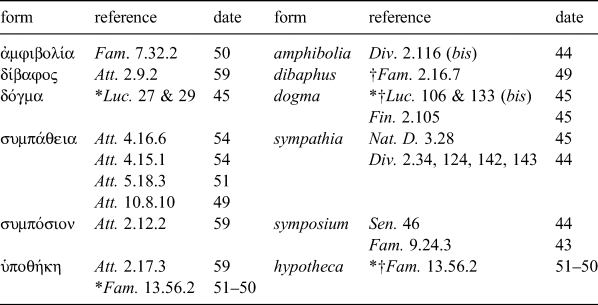
In the following tables the Greek and Latin forms given are those that appear in our MSS or at least in the oldest of them (details are given in the discussion of individual words following each table). We start with examples of the order we might expect in this context, with a Greek word being written first in Greek letters, then in Latin:
Greek words appearing first in Greek, then only in Latin scripts.

* means both forms in same work.
† means probably first-attested use in Latin. Footnote 32
These are the only occurrences of these words in Cicero, and prima facie they show Greek words becoming Latin over time. δόγμα appears to show a particular variation on this: on extant evidence, Lucullus was probably the first Latin text to feature the word,Footnote 33 which appears initially in Greek letters, then in Latin dress later in the work. De finibus was written in the same year, but immediately after the Lucullus,Footnote 34 so it is not surprising to find it using the word in Latin letters only.
συμπάθεια/sympathia appears to be a clear example of acceptance of a Greek word into Latin over time,Footnote 35 and in the final example (Div. 2.143) Cicero uses it without explaining it as Greek, although he was not the first to use the word in a Latin text.Footnote 36 In contrast, symposium only appears in Latin letters as the title of Xenophon's work, or when glossed as Greek.
hypotheca first appears in an early letter to Atticus written as Greek.Footnote 37 Cicero used the word again—twice—some years later in writing to Thermus. The MSS show that in this letter the first occurrence is in Greek characters, and the second is a thoroughgoing Latin adaptation (de hypothecis).
2 b) Defiance of ‘expected’ chronology: Latin precedes Greek
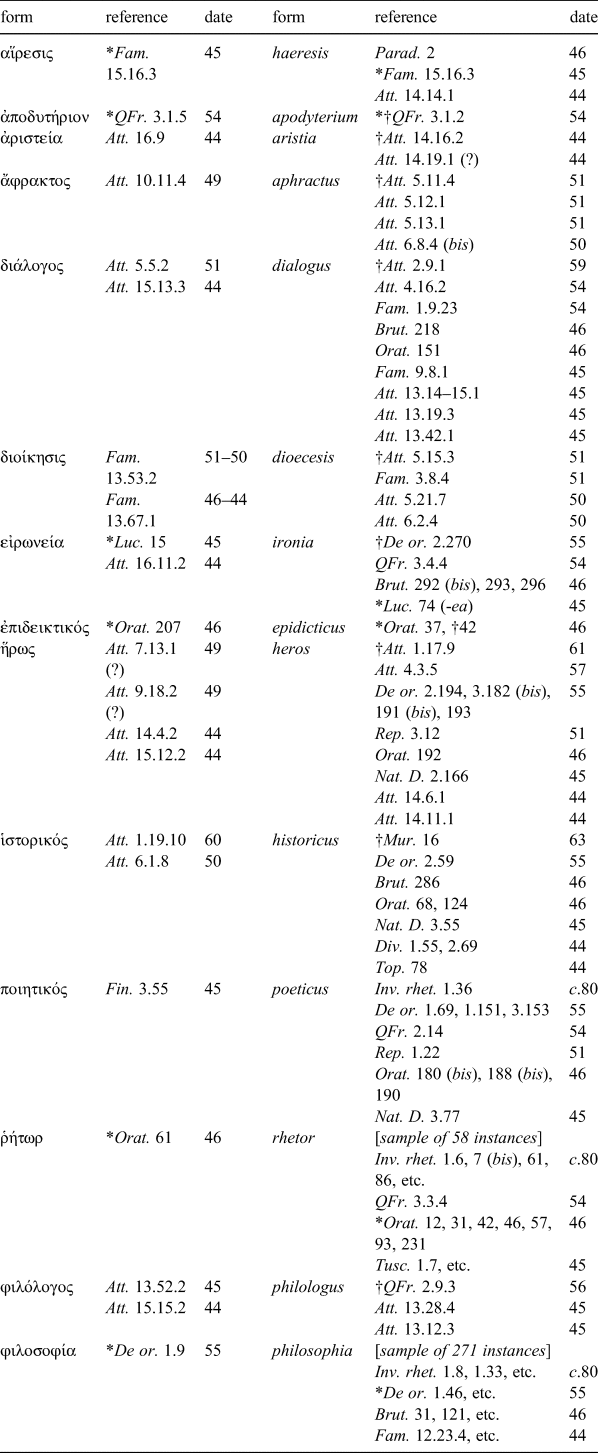
The examples presented so far show a clear pattern, demonstrating a chronological development towards Latin transliteration across Cicero's career, as well as within individual works. However, they represent only a fraction of those words which appear in both Greek and Roman alphabets, and when we expand our view (see Table 2) we find that this pattern is the exception, rather than the rule.
The first occurrence of haeresis in Cicero is in Latin form in the MSS, and earlier use of the word suggests that it can be seen as naturalized in his time.Footnote 38 Fam. 15.16 is written to Cassius after his recent conversion to Epicureanism, and uses the word twice in quick succession. T&P and SB print the word in Greek characters both times, although both acknowledge that the first occurrence is in all MSS written in Latin letters (heresi) and was changed, like so many transliterated words, into Greek by Orelli. The paradosis here reverses the pattern we have seen so far by having the word first appear in Latin letters, and only then in Greek. Here, for the first time, we see the reverse. If this is a reflection of Cicero's choice, why might he have changed his usual practice? Why might he have written here ex qua haeresi in a letter otherwise full of Greek tags when his editors want him to have written ex qua αἱρέσει?
The key perhaps lies in the awkwardness in which the writing of the word in Greek results. McCall and, more recently, Adams have examined Cicero's use of Latin prepositions with Greek nouns, and both have pointed to the problem which Latin prepositions governing the true ablative have when they are paired with Greek substantives.Footnote 39 For while the Latin ablative coincides with the Greek dative in combining instrumental and locative uses, the original ablative—expressing separation—should be conveyed by a Greek genitive. Indeed, McCall points out that this phrase—ex qua αἱρέσει—is the only one in which a Greek dative is governed by ex in Cicero's letters.Footnote 40 If, however, we follow the MSS and regard the noun as a Latin word, the difficulty disappears: ex qua h(a)eresi can be seen as a true Latin ablative governed by a preposition which naturally goes with it.Footnote 41 This may have given sufficient justification to Cicero for reversing his normal order when writing a word in both Greek and Latin forms in a single work.
From the avoidance of awkward grammar we move on to more clearly rhetorical motives for the disruption of the expected order. In September 54, with Quintus absent in Britain, Marcus wrote a letter to his brother about a visit to the latter's two estates in the vicinity of their native Arpinum.Footnote 42 At Arcanum work was being carried out and Marcus ordered a number of changes to be made. This action could have been seen as high-handed; perhaps to counter this impression, he spells out in plodding detail exactly what minor modification he has made (QFr. 3.1.2):
in balneariis assa in alterum apodyteri angulum promoui propterea quod ita erant posita ut eorum uaporarium [ex quo ignis erumpit] esset subiectum cubiculi<s>.
In the baths I moved the hot chamber into another corner of the dressing room, because it was so placed that its steam pipe [from which the heat comes out] was below the bedrooms.
Scaliger may have been right to bracket the phrase ex quo ignis erumpit, but this unnecessary detail is not out of place here.
A few days later Marcus moved on to Laterium. Full of admiration this time, he waxes fancifulFootnote 43 about the carefully cultivated ivy he saw (QFr. 3.1.5):
topiarium laudaui; ita omnia conuestiuit hedera, qua basim uillae, qua intercolumnia ambulationis, ut denique illi palliati topiariam facere uideantur et hederam uendere. iam ἀποδυτηρίῳ nihil alsius, nihil muscosius.
I praised the gardener; he has so clothed everything in ivy, as far as the foundation of the villa and the spaces between columns in the walkway are concerned, that those (Greek) statues seem to be gardening and putting the ivy on show. Finally nothing is cooler or mossier than the dressing room.
The tone could hardly be more different: the statues are imagined as doing the work themselves! The fancy gardening is Greek in origin and in etymology, the foundation of the villa is given a Greek word, but most significant is that the statues are described as in Greek dress.Footnote 44 The structure they adjoin is then described unambiguously as a Greek one, as these gardening statues themselves might have referred to it. There is thus a literary reason for the change of script, even though the change of language is less than complete.Footnote 45
Our next word, ἀριστεία, appears to be quoted twice with reference to Dolabella from a letter by Atticus.Footnote 46 The alphabet he used originally can only be guessed at, but our MSS of Cicero in quoting him overwhelmingly use a transliterated form at Att. 14.16.2.Footnote 47 At Att. 14.19.1 no MS has Greek and the tradition has aritia with an equally meaningless variant aricia. To introduce the Greek version here by printing with SB ex Dolabellae ἀριστείᾳ again forces an awkward use of ex with the Greek dative,Footnote 48 a problem which the old conjecture ex Dolabellae aristia would avoid. In Cicero's MSS ἀριστεία is convincingly attested in Greek only at Att. 16.9.
aphractus (pl. aphracta) of an open ship occurs in Latin only in Cicero. He used the word in several letters written in transit to, and from, his province of Cilicia while he was making use of these vessels. The only time our MSS show the word in Greek is when, months after his return, he looks back on the experience while contemplating a hazardous flight from the Civil War in Italy. The circumstances of writing are very different, and there seems to be a slightly different tone evoked by the change in alphabet. Perhaps we can understand it by noting the ‘distancing’ effect of some code-switching in Cicero's letters.Footnote 49
A different sort of distancing can be seen in the next word. dialogus appears first in Latin in Cicero, and the MSS show it preceding the Greek form in his works. The use of Greek script, then, does not seem to indicate that the word had not been naturalized, but it may carry a different nuance. The MSS show Latin characters three times—of general conversation and of Cicero's own compositions—before he promises to report to Atticus his cum Pompeio διαλόγους de re publica (Att. 5.5.2). The rather arch tone, with its incongruous suggestion of Pompey as a Platonic interlocutor,Footnote 50 seems unmistakable. A similar, if more respectful, nuance may be detected in another letter to Atticus (15.13), in which an awaited work of Varro is referred to as a διάλογος, and also as a Ἡρακλείδειον.
διοίκησις, an administrative district, is one of the few Greek words to appear in Fam. 13, apart from the extensive quotations in 13.15. The book is essentially a collection of testimonials, and the absence of Greek, with the exception of a few technical terms, has been taken as proof that the formal commendatory letter did not admit that language, inasmuch as the genre belonged to the realm of public-political documents.Footnote 51 The exceptional appearance—twice—of this word in Greek here (53.2 and 67.1), when the Latinized form was clearly available and preferred by the MSS in at least one earlierFootnote 52 and less formal letter, should be seen as confirming the technical status of the word, to which the original alphabet draws attention, just as it sometimes does in Cicero's philosophical works.Footnote 53
ironia is first found in Latin in 55,Footnote 54 and subsequently made use of as an apparently naturalized word. But ten years after its introduction it occurs as both a Greek and a Latin word in the same text—and, significantly, in that order (Luc. 15 and 74). This forms part of a pattern (albeit not invariable) we have already observed: if a word occurs in both alphabets in a single work, it is usually written in our MSS as Greek first, and subsequently in Latin. Here we see this happening even where the word had apparently already been accepted into Latin.
An exception to the pattern is epidicticus, another word first found in Cicero. It occurs at Orat. 37 and 42, yet it is curiously written as ἐπιδεικτικός much later in the work at 207.Footnote 55 Ambivalence about Latinizing the word is reflected in its subsequent history: Cicero used it nowhere else, and it appears that both Quintilian and Fronto write the word just once as Latin, otherwise preferring the Greek form.Footnote 56
Cicero's use and transformation of the Greek word ἥρως is a subject which could be explored more deeply than the present paper allows.Footnote 57 He introduced the word into Latin,Footnote 58 and he applies it, uniquely (it seems) among ancient writers, to contemporary living men, although there may still be a hint of the ἥρως as a figure from the distant past. Cicero's first use of the word is in this extended meaning of heros applied to the living. In late 61 at Att. 1.17.9 he writes of heros ille noster Cato, and he uses it again with reference to living men frequently, but only in the letters (where it occurs exclusively in this sense), whether written as heros or ἥρως.Footnote 59 In contrast, the nine appearances in the published works are transliterated in our MSS, and in the sense, well established in Greek, of a mythical or Homeric person.
A similar contrast between the letters and the published works is present with the pair ἱστορικός/historicus. Footnote 60 Again, the word seems to have been introduced into Latin by Cicero,Footnote 61 and this Latinized form precedes his uses of ἱστορικός. The context of his earliest Greek use suggests an obvious stylistic justification (Att. 1.19.10):
non ἐγκωμιαστικὰ sunt haec sed ἱστορικὰ quae scribimus.
Cicero needs a contrast to the first Greek word, which is almost never found in Latin transcription.Footnote 62 At the same time, a distinction between the letters and the published works emerges once more.
The appearance of ποιητικός under both alphabets presents a new phenomenon, although the use of the original Greek lettering to convey a technical sense has been noticed before. What is different in this case is that this technical sense is completely different from that found in the transliterated form. poeta was one of the earliest loanwords in Latin, and from as early as Cato the Elder, it seems, the easily formed adjective poeticus appears in the literary sense.Footnote 63 The Greek ποιητικός, however, while retaining this meaning, acquired especially in Aristotle and later philosophers the more literal sense of ‘productive’, and only when used in this sense does it appear in Greek in our MSS, no doubt to separate it from the established literary meaning of the Latin form.Footnote 64
The changing meanings of the word ῥήτωρ are reflected in the way it and the transliteration rhetor appear in Cicero's MSS. In classical Greek, ῥήτωρ meant simply a public speaker or orator and, although in later times it acquired the additional meaning of ‘teacher of eloquence’, it retained the primary reference to practice rather than theory.Footnote 65 So the one appearance of the word in our MSS as Greek (Orat. 61) is linked with the perfectus orator and glossed with the Latin eloquens in a passage strongly emphasizing the power of actual speech. rhetor, however, which first appears in Latin as the chosen name of the Latini rhetores in the edict closing down their schools in 92 b.c.,Footnote 66 from the start most commonly designates a teacher of rhetoric, and most usages in Cicero conform to this.Footnote 67 Indeed, later theory explicitly distinguished the rhetor as teacher from the orator as practitioner.Footnote 68 But he also makes much use of the other main Latin sense of ‘one trained in the techniques of public speaking’, usually with a trace of contempt.Footnote 69 Both meanings had developed the wrong connotations for Cicero's purpose here, which the ‘denativization’Footnote 70 of the word in Orat. 61 suppresses. Writing the word as Greek also brings out the etymological basis of the word's meaning ‘speaker’,Footnote 71 which is precisely his point. All these factors can explain why Cicero in the Orator changes his usual habit of writing the word first as Greek and then in transliteration: in that work rhetor occurs five times before, and twice after, the solitary ῥήτωρ.
philologus may have been an early import into Latin, but the first clear appearance is in QFr. 2.9.3.Footnote 72 This and Att. 13.28.4Footnote 73 precede the word's first occurrence as Greek in our MSS of Cicero, at Att. 13.12.3. That letter actually shows the word in both languages, in the regular order, but the first (Greek) occurrence is a comparative and excluded from Table 2, since its form did not offer the option of Latin naturalization. After that letter, Cicero wrote the word only as Greek.
philosophia is very common in CiceroFootnote 74 and, as he tells us himself thrice, it was one of those Greek words which had been thoroughly accepted into the Latin language.Footnote 75 It occurs as a Latin word from his earliest work; the one occasion he writes it in Greek, long after this, conforms to the pattern of an initial Greek form of a word subsequently written in the Roman script in the MSS of the same work.
2 c) Miscellaneous
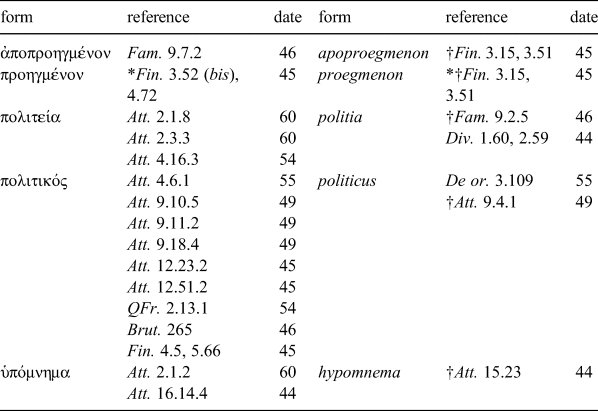
The words in this section fall into one or both of two categories: a) they appear in our MSS first as Greek, then as Latin, then as Greek again (and so will not fit into Table 1), and/or b) they are cognates more helpfully considered together than separated according to the criteria of Tables 1 and 2.
Greek words appearing first in Latin, then in Greek scripts.

* means both forms in same work.
† means probably first-attested use (see n. 32 above) in Latin.
The Stoic technical term προηγμένον appears twice in Latin letters (along with its antonym ἀποπροηγμένον), again in apparent defiance of the regular pattern of the Greek version preceding the Roman version within the same work. However, the exception is more apparent than real. The first passage from Fin. 3.15 is of particular interest for the whole question of Cicero's use of Greek words:
et tamen puto concedi nobis oportere ut Graeco uerbo utamur, si quando minus occurret Latinum, ne hoc ephippiis et acratophoris potius quam proegmenis et apoproegmenis concedatur; quamquam haec quidem praeposita recte et reiecta dicere licebit.
And yet I think it should be allowed to us to use a Greek word, if a Latin one is missing, so that this freedom is not granted more to ephippia [‘saddle-cloths’] and acratophora [‘containers for unmixed wine’] than to proegmena [‘preferred things’] and apoproegmena [‘not preferred things’]; although we could properly call these praeposita and reiecta.
Cicero is saying that it should be possible to adopt the words into the Latin language if necessary, and to illustrate this our paradosis has them as adopted words in the Latin alphabet. But his claim implies that they are currently not part of Latin, and they never became so: they appear again as a Latin pair at Fin. 3.51, but later occurrences of προηγμένον in that work revert to Greek.Footnote 76 No later Latin author attempted to import the words.
We move on to our second pair of cognates, which can be considered sequentially. The three occurrences of πολιτεία as an isolated word (Att. 2.1.8, 2.3.3, 4.16.3) are all, explicitly or implicitly, references to Plato's work. In the first and last instances, this is unambiguous, while the middle example plays with the senses of ‘course of policy’Footnote 77 and title of the philosophical book:
uenio nunc … ad ὑπόστασιν nostram ac πολιτείαν, in qua Σωκρατικῶς εἰς ἑκάτερον, sed tamen ad extremum, ut illi solebant, τὴν ἀρέσκουσαν.
I come now … to my ὑπόστασιςFootnote 78 and πολιτεία, in which, like the Socratics, I will argue for both sides, but in the end (as they used to) for the one I support.
Plato's work is also referred to, but in transliterated form, in two places in De Divinatione (1.60, 2.59), probably because of the preference in the transmission of the published works which we have already noted.
In all cases so far, then, whatever the alphabet, πολιτεία/politia refers directly or obliquely to Plato's Republic. One instance remains to be considered. In Fam. 9.2.5, a letter from April 46, Cicero writes to Varro that, if they are excluded from public life, they will decide instead scribere et legere politias, choosing a scholarly and literary life rather than an active one. That, at least, is how the main MSS preserve Cicero's retirement plan, although our editions follow the deteriores in printing πολιτείας. But, as usual, the change here in late codices can only have an editorial basis, and carries no authority, especially where the chief MSS have two separate and rarer Greek words (ἕωλος, λεληθότως) earlier in this letter. But can any sense be extracted from the choice of the transliterated form politias here?
Another way to look at the evidence is to ask why πολιτεία rather than politia appears in the letters to Atticus. The special status of book titles in this context has been glanced at already and will be investigated further in another study, but here we can note that the use of the word as a specific title marks it as different from the generic plural in the letter to Varro. Plato's particular work is designated, at least in those circumstances where Cicero knows that the recipient reads Greek, by its own name and as it appears on the book itself; the as yet unwritten works in the years ahead have only a common, not a proper, noun to designate them.
πολιτικός is one of the few words which has already been discussed in this context of Ciceronian alphabet-switching. Swain has written:
The Greek root πολιτ- is virtually never found naturalized in Latin. Indeed, Cicero uses politicus just once … But πολιτικ- occurs in him thirty-one times.Footnote 79
It is true that Cicero prefers to write πολιτικός to politicus, even against his own usual practice in transliterating Greek terms, but the bare statistics are misleading. Of these thirty-one occurrences of πολιτικ-, 11 are in Greek phrases or continuous passages,Footnote 80 6 are separate words but in comparative forms,Footnote 81 and 3 are positive adverbs.Footnote 82 That leaves eleven occurrences where a form of politicus would have been stylistically acceptable, and in one of those places the MSS actually show the Latinized form: at Att. 9.4.1 all MSS have politic(a)e or something similar, not the πολιτικαί which Orelli and modern editors choose to print,Footnote 83 while there is no dispute that De or. 3.109 refers to those a Graecis politici philosophi appellati.
We find, then, just ten occurrences of πολιτικός against two of politicus where Cicero could have used either form. But, as Swain says, the word never found a real home in Latin, and the reason for this may be Cicero's clear avoidance of the transliteration, even where (as in Fin. 5.66, the second occurrence of the word in this work) this would have been his normal practice. There is no sign of politicus in Latin before Cicero, and his failure to make more use of it may have doomed its acceptance in the language. The corresponding pure Latin ciuilis, given by Cicero and others as the equivalent,Footnote 84 was the word he preferred;Footnote 85 it is significant that he uses politicus only to describe Greek nouns, whether already accepted into Latin (philosophus), or still presented as Greek (θέσις).
Our last word appears to show a unique linguistic sensitivity. In Cicero's MSS the Greek and Latin forms ὑπόμνημα and hypomnema correspond to the language in which the referenced document is written. At Att. 2.1.2 the former is used of Cicero's own account, explicitly written in Greek, of his consulship, while at Att. 16.14.4 it refers to the summary by a Greek of a Greek philosophical work.Footnote 86 Between these two instances, at Att. 15.23 occurs the only example of hypomnema, used of a legal document which must have been in Latin.Footnote 87
3. THE INFLUENCE OF PUBLICATION
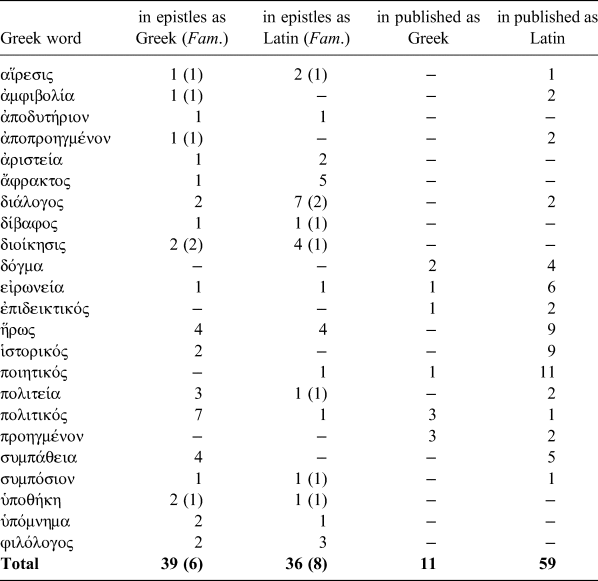
At last we can move on to examine more closely the question of publication and its influence, to which some reference has already been made. It is well known that Cicero uses Greek in his letters to a far greater extent than elsewhere in his writing, and that within these letters much more Greek is found in the letters to Atticus than in the Ad familiares. Footnote 88 A difference between the representation of Greek in the letters and in other writings would therefore not be surprising. For the distinction between the epistles and the other writings corresponds to a real difference of intended audience. In simple terms, the letters were not written for publication, and can thus be divided from all of Cicero's other Latin writings, for which the readers’ knowledge of even elementary Greek could never be assumed.Footnote 89 In Table 4 we display all the words presented in Section 2 of the paper, this time dividing between those appearing in published and in unpublished works, and adding the further refinement of distinguishing letters in Fam. from those to his closest correspondents in Att. and QFr.
Further Greek words appearing in both Latin and Greek scripts.

* means both forms in same work.
† means probably first-attested use (see n. 32 above) in Latin.
Rarer words from Tables 1–3, with occurrences classified according to publication status.

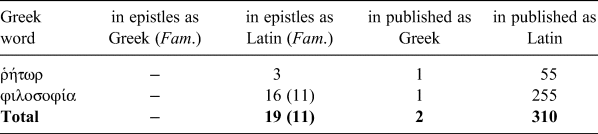
I relegate to another table two words, both established in Latin before Cicero, and both occurring just once in his works as Greek forms, because their very high incidence risks distorting the general picture:
Remaining words from Tables 1–3, with occurrences classified according to publication status.

From Table 4, we can deduce that, when Greek words appear under both alphabets in Cicero's MSS, there is an overall tendency for them to appear in the epistles more often written as Greek than as Latin. However, that relation is reversed when we look just at Fam., which has not only a much smaller number of these particular Greek words than the rest of the collection (just as it has many fewer Greek words tout court), but also shows a slight tendency to write them as Latin. That tendency appears to be much stronger in the published works, which show an overall ratio of over 5:1 in favour of writing them in the Roman alphabet. When it comes to individual words, only πολιτικός and προηγμένον, which were never really naturalized at any point, appear more often as Greek than as Latin in the published works. In contrast, the letters have eight words which are written more often as Greek.
If we add Table 5’s figures to Table 4, as we have done in Table 6, the tendency to write Greek words as Latin is even more evident in the published works and in Fam., to the extent that the ratio for the letters overall is now in favour of Latin transliteration; but even in Table 6 Att. and QFr. show an almost equal split between Greek and Roman scripts (33:36), and the essential difference between published and unpublished is still very evident.

In general, this much higher incidence of Greek words in their native characters in the letters than in the published works can be explained by the former's much greater use of Greek overall: Cicero knew the competence in Greek of his addressees, and does not make the same use of Greek with all of them,Footnote 90 but had no way of knowing how much Greek the readers of his published works would have had, and so generally avoided using the language.Footnote 91 On a number of occasions when he does introduce a Greek word, he glosses it for his readers, as if they know no Greek at all, and it then appears later in the work in Latinized form.Footnote 92 Cicero had no need of such dull caution when he came to write to his friends, particularly those close confidants whose knowledge of the language was at least comparable to his own.Footnote 93
4. CONCLUSION
This study has made a first attempt to find some rationale for the different scripts in which Greek words, some of great significance and some trivial, are preserved in our most direct sources for the writings of a supremely important cultural figure in world history. The reliability of these sources in their representation of Cicero's Greek words has been an underlying question throughout the investigation, and it cannot be divorced from the seeking of explanations for writing these words sometimes in Greek characters, and sometimes in Roman. An axiom has been that a coherent account of these choices, if found, will show that Cicero made his selections with care, and that the selections have been preserved by our MSS. On the other hand, selections that seem random will show either that Cicero was indifferent, or else that subsequent scribes were careless, or possibly both of these things; where exactly the problem lies could hardly be determined in this situation.
Clearly, no universal explanation has been found which can account for the choice of alphabet in every circumstance in Cicero's MSS. But it was never likely, given the complexity of issues at play in these texts, that such a panacea would be discovered. Instead, the influence of a variety of factors has been suggested, and in many individual cases different issues seem to be involved. Chronological development from Greek to Latin plays some part, but more significant is a general preference for Greek characters in the letters vis-à-vis the published works, and the letters themselves show different tendencies according to recipient. Such tendencies may combine with or counter-balance other preferences, such as a word appearing in Greek characters early in a work and in Roman characters later. We have also seen examples where alphabet-switching avoids grammatical awkwardness, conveys technical meanings, provides effective ‘distancing’ and preserves the significance of original Greek words where this differs from that found in Latin descendants.
But beyond the reach of any general rules is Cicero's wonderful power as a writer to make use of a switch of alphabets for his own rhetorical or literary ends. He can write established Latin words like dialogus or historicus as Greek again to suit the nuance of the moment or to balance a phrase, just as he can introduce heros into the language and write it as a Latin word to praise a true Roman statesman, only to revert to Greek to suggest the villainous suitors of the Odyssey. It can truly be said that Cicero added alphabet-switching to the great arsenal of rhetorical weapons he inherited and strengthened.
Alphabet-switching can also add a special vividness to writing which may, I believe, be illustrated more clearly by Cicero's use of it with Greek proper nouns and adjectives, and a study of these would complement the current one. The MSS evidence for those words seems of a different nature: they are almost entirely restricted to the epistles, and in most cases they refer to Greek authors. Consistently, the MSS show Greek characters being used when Cicero is explicitly talking about books, and suggest the visual experience of reading a text in that language.
The material for these studies, restricted to words appearing in both scripts, is extensive enough, but only covers part of the visual representation of Greek in Cicero's works, and a fuller analysis would look at those Greek words in Cicero which appear only in Roman characters in the MSS.Footnote 94 The way in which Cicero wrote the Greek in his works, as we have seen, has been largely neglected so far, but it touches on aspects of his expansion of the Latin language, and on his practice of code-switching. More fundamentally, our understanding of his knowledge of Greek, a topic in need of a thorough re-examination, needs to be based in the first instance on how he wrote the language, for this is one important indicator of whether he regarded himself as writing Greek or Latin at any particular point. The current study opens up this area and points to evidence for the reliability of our textual transmission, as well as for the skill demonstrated even in this small detail of Cicero's literary output.