

Introduction
Emergence of antimicrobial-resistant bacteria has become a crucial issue in the world. In particular, emergence and rapid spread of extended-spectrum β-lactamase (ESBL)-producing bacteria have posed threat to the people not only in developing countries but also in developed countries, because ESBL can degrade not only penicillin but also other classes of β-lactams. Furthermore, most of the ESBL-producing bacteria are multi-drug resistant. Thus, it is a serious problem in clinical settings.
ESBL-producing Enterobacteriaceae were first reported in the early 1980s (Knothe et al., Reference Knothe, Shah, Krcmery, Antal and Mitsuhashi1983), soon after the broad-spectrum cepharosporins were introduced into clinical settings. ESBLs can be generally divided into three groups, the TEM, SHV, and CTX-M types. In the 1980s and 1990s, the TEM and SHV types were most prevalent and were involved in hospital-associated infections caused by ESBL-producing Enterobacteriaceae. However, since the late 1990s, when third generation of β-lactams were widely introduced into the clinical settings, CTX-M types have become predominant and replaced TEM and SHV types very rapidly. Recent studies have revealed that widespread ESBL-producing bacteria, including Escherichia coli, were observed not only in the nosocomial settings but also in the community. It is of interest to note that CTX-M-type ESBL-producing Enterobacteriaceae were mostly E. coli.
Although at least 168 subtypes were reported for CTX-M types (as of 16 July 2017; http://www.lahey.org/studies/other.asp), the CTX-M type is divided into five subgroups, CTX-M-1, -2, -8, -9, and -25, based on the homology of amino acid sequences (D'Andrea et al., Reference D'Andrea, Arena, Pallecchi and Rossolini2015). In the early 2000s, carriage of CTX-M-type ESBL-producing E. coli in healthy people was still <10% of the community. However, in 2008, the carriage rate suddenly increased up to 60% in Thailand (Sasaki et al., Reference Sasaki, Hirai, Niki, Nakamura, Komalamisra, Maipanich, Kusolsuk, Sa-Nguankiat, Pubampen and Yamamoto2010). After 2008, the highest prevalence of ESBL-producing E. coli has been reported from Southeast Asia, followed by the Eastern Mediterranean and Western Pacific (Woerther et al., Reference Woerther, Burdet, Chachaty and Andremont2013). Furthermore, the carriage rate of ESBL-producing E. coli in healthy individuals has been increasing year by year all over the world. The prevalence of ESBL-producing E. coli in Vietnam was not clear until recent initiation of a collaborative project between Vietnam and Japan (Woerther et al., Reference Woerther, Burdet, Chachaty and Andremont2013; Le et al., Reference Le, Ueda, Nguyen, Dao, Hoang, Tran, Hirai, Nakayama, Kawahara, Do, Vien and Yamamoto2015; Nakayama et al., Reference Nakayama, Ueda, Huong, Tuyen le, Komalamisra, Kusolsuk, Hirai and Yamamoto2015).
It has been suggested that the spread of ESBL-producing E. coli from animals to people is strongly associated with animal-originated food (Ewers et al., Reference Ewers, Bethe, Semmler, Guenther and Wieler2012). Therefore, a two-country research collaborative project, titled ‘Determining the outbreak mechanisms and development of a surveillance model for multi-drug resistant bacteria’, was conducted in Vietnam with the support of the Japan International Cooperation Agency (JICA)/Japan Agency for Medical Research and Development (AMED) under the program of Science and Technology Research Partnership for Sustainable Developments (SATREPS). The SATREPS project focused on the prevalence of ESBL-producing E. coli from livestock to human beings, including animal-originated foods and residual antimicrobials in foods and environmental water. This review mostly summarizes the situation of the prevalence of ESBL-producing E. coli and antimicrobial residues in the environment, based on the results of the SATREPS project conducted in Vietnam between 2012 and 2017. The authors also reviewed recent Vietnamese studies of antimicrobial residues in meat and the environment.
Prevalence of ESBL-producing bacteria in livestock and fish in Vietnam
Chicken and pig production are among the most important agricultural industries in Vietnam. It has been suggested that overuse and improper use of antimicrobials in animal-originated food production could be one of the possible reasons why antimicrobial-resistant bacteria, including ESBL-producing E. coli, have emerged and spread. However, little is known about the prevalence of ESBL-producing E. coli in the livestock in Vietnam. Recently, Hinenoya et al. (Reference Hinenoya, Tran, Nguyen, Nguyen, Nguyen, Hoang, Awasthi, Hassan, Sumimura, Yamamoto and Yamasaki2017) investigated the prevalence of ESBL-producing E. coli in apparently healthy broiler chickens and pigs and their environment in Can Tho, the largest city in the southern part of Vietnam. ESBL-producing E. coli was isolated from 86.7% of cloacal swabs of chickens (13/15), 55.0% of rectal swabs of pigs (11/20), and 100% of their surrounding environments (4/4). All these isolates were multi-drug resistant, which was defined as resistant against more than three different classes of antimicrobials. Most of the chicken isolates carried both CTX-M-1- and TEM-type genes, while most pig isolates carried both CTX-M-9- and TEM-type genes. Furthermore, some of the ESBL-producing E. coli harbored virulence genes for diarrheagenic E. coli, such as eae and astA, suggesting that these E. coli isolates have a human pathogenic potential. It is of interest to note that 94.7 and 97.4% of chicken isolates were resistant to ciprofloxacin and were mcr-1 gene-positive, which is responsible for colistin resistance, while only 13% of pig isolates were resistant to ciprofloxacin and none were mcr-1 positive.
Aquaculture is also one of the most important agricultural industries in Vietnam. Therefore, the prevalence of ESBL-producing E. coli was also investigated for 16 wild fish and 32 cultured fish (16 each of Pangasianodon hypophthalmus and Oreochromis spp.). Hon et al. (Reference Hon, Hoa, Thinh, Hinenoya, Nakayama, Harada, Asayama, Warisaya, Hirata, Phuong and Yamamoto2016) isolated ESBL-producing E. coli from 44.4 and 36.1% of wild (8/18) and cultured (13/36) fish, respectively. In total, 42 ESBL-producing E. coli were isolated from 54 fish and most of them were multi-drug resistant. Among 12 antimicrobials tested, 95.1, 92.9, 88.3, 88.1, 88.1, 78.6, 78.6, 76.2, 69.0, and 38.1% of the ESBL-producing E. coli were resistant to trimethoprim-sulfamethoxazole, nalidixic acid, gentamicin, tetracycline, streptomycin, chloramphenicol, ciprofloxacin, kanamycin, ceftazime, and cefoxitin, respectively, while 100% were resistant to ampicillin and cefotaxime. It should be noted that the ESBL-producing E. coli obtained from cultured fish were more resistant to antimicrobials than those from wild fish.
Prevalence of ESBL-producing bacteria in various retail meats in Vietnam
Because it was demonstrated that chickens and pigs were highly contaminated with ESBL-producing E. coli (Hinenoya et al., Reference Hinenoya, Tran, Nguyen, Nguyen, Nguyen, Hoang, Awasthi, Hassan, Sumimura, Yamamoto and Yamasaki2017), the prevalence of ESBL-producing E. coli in not only those meats but also in shrimp was investigated. Le et al. (Reference Le, Ueda, Nguyen, Dao, Hoang, Tran, Hirai, Nakayama, Kawahara, Do, Vien and Yamamoto2015) reported that the prevalence of ESBL-producing E. coli in retail poultry, pork, and shrimp was 58.7 (84/143), 32.0 (47/147), and 18.3% (11/60), respectively. Among 142 ESBL-producing E. coli isolated, 131, 85, and four isolates carried genes for CTX-M (92.3%), TEM (59.9%), and SHV (2.82%), respectively. The prevalence of CTX-M type in the isolates was 55.0 and 45.0% in CTX-M-1 and CTX-M-9, respectively, but no other CTX-M type was detected.
Prevalence and characteristics of ESBL-producing bacteria in healthy people in Vietnam
Carriage of CTX-M-type ESBL-producing E. coli was examined in healthy individuals in the northern part of Vietnam (Bui et al., Reference Bui, Hirai, Ueda, Bui, Hamamoto, Toyosato, Le and Yamamoto2015). A total of 597 stool specimens were collected from 199 healthy individuals every 6 months, and the prevalence of ESBL-producing E. coli was determined to be 46.7, 52.8, and 46.3% at each sampling time, respectively. The CTX-M-9 type was predominant throughout the experimental period, such as 71.0, 86.7, and 85.9% in June 2013, November 2013, and June 2014, respectively. Furthermore, ESBL-producing E. coli were detected at least once in 175 individuals during the experimental periods at the individual level, regardless of CTX-M type. PFGE analysis revealed that none of the identical PFGE patterns of CTX-M-type ESBL-producing E. coli were observed in the same person, indicating a short carriage period of CTX-M-type ESBL-producing E. coli in healthy Vietnamese people (Bui et al., Reference Bui, Hirai, Ueda, Bui, Hamamoto, Toyosato, Le and Yamamoto2015). These data suggested that CTX-M-type ESBL-producing E. coli was carried no more than 6 months in healthy individuals in a rural area in Vietnam. Hoang et al. (Reference Hoang, Awasthi, Nguyen, Nguyen, Nguyen, Le, Dang, Hinenoya and Yamasaki2017b) also reported isolation and characterization of CTX-M-type ESBL-producing E. coli from healthy adults in Ho Chi Minh city. Among ESBL-producing E. coli isolates from healthy adults, CTX-M-9 was the most prevalent, followed by CTX-M-1, and some of them carried virulence genes for diarrheagenic E. coli such as astA, EAF, eae, elt, and eagg, suggesting that healthy adults carried an E. coli potentially pathogenic to human beings.
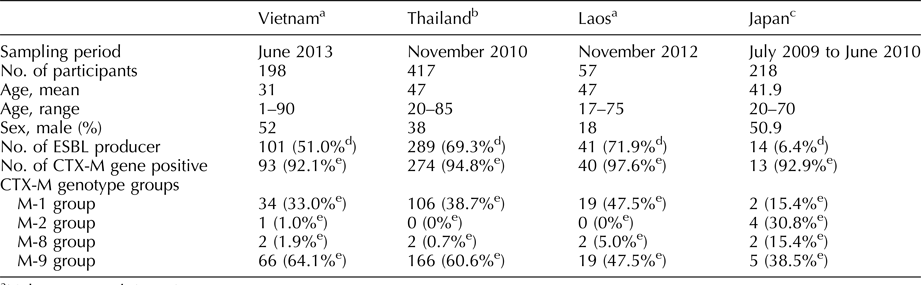
The high positive rate of healthy carriage of ESBL-producing E. coli in Vietnam was comparable to that in other Southeast Asian countries such as Thailand and Laos (Table 1). Luvsansharav et al. (Reference Luvsansharav, Hirai, Nakata, Imura, Yamauchi, Niki, Komalamisra, Kusolsuk and Yamamoto2012) reported that of 417 healthy residents in the community in Thailand, 69.3% carried ESBL-producing Enterobacteriacea. Similarly, Nakayama et al. (Reference Nakayama, Ueda, Huong, Tuyen le, Komalamisra, Kusolsuk, Hirai and Yamamoto2015) reported that among 198 and 57 healthy residents in Vietnam and Laos, 51.0 and 71.9% were positive for ESBL-producing Enterobacteriacea, respectively, and all of them were identified to be ESBL-producing E. coli. Similar surveillance was also conducted in Japan and the results indicated, however, that out of 218 individuals, only 6.4% of healthy residents were positive for ESBL-producing Enterobacteriacea (Luvsansharav et al., Reference Luvsansharav, Hirai, Niki, Arisa, Aya Yoshinaga, Moriyama and Yamamoto2011). Among those identified with ESBL-producing Enterobacteriacea, 92.1, 94.8, 97.6, and 92.9% were CTX-M gene-positive in Vietnam, Thailand, Laos, and Japan, respectively (Table 1). Interestingly, among CTX-M types, in Southeast Asian countries, CTX-M-1 and CTX-M-9 were predominant and CTX-M-2 and CTX-M-9 were moderately high, while CTX-M-1 and CTX-M-8 were relatively high in Japan. These data indicate that the prevalence of CTX-M-1 and CTX-M-9 types in Southeast Asian countries may be common, and most probably CTX-M-1 could have originated from chicken, while CTX-M-9 could have originated from pigs.
Prevalence of extended-spectrum β-lactamase-producing Enterobacteriaceae in residents of Japan and Southeast Asia

a Nakayama et al. (Reference Nakayama, Ueda, Huong, Tuyen le, Komalamisra, Kusolsuk, Hirai and Yamamoto2015).
b Luvsansharav et al. (Reference Luvsansharav, Hirai, Nakata, Imura, Yamauchi, Niki, Komalamisra, Kusolsuk and Yamamoto2012).
c Luvsansharav et al. (Reference Luvsansharav, Hirai, Niki, Arisa, Aya Yoshinaga, Moriyama and Yamamoto2011).
d The value was calculated by No. of participants in each country as a denominator.
e The value was calculated by No. of ESBL producers in each country as a denominator.
Possible transmission route of ESBL-producing E. coli between animals, meats, and people
It has been suggested that the transmission of ESBL-producing E. coli occurs between people and animals, including poultry (Kluytmans et al., Reference Kluytmans, Overdevest, Willemsen, Kluytmans-van den Bergh, van der Zwaluw, Heck, Rijnsburger, Vandenbroucke-Grauls, Savelkoul, Johnston, Gordon and Johnson2013). Ueda et al. (Reference Ueda, Ngan, Huong, Hirai, Tuyen and Yamamoto2015) examined if transmission of ESBL-producing E. coli between chickens and human beings occurred by comparing phylogeny, sequence typing of various house-keeping genes, antimicrobial susceptibility profile, and plasmid replicon type of ESBL-producing E. coli isolated from people and chickens. However, it was found that none of the E. coli isolated from people and chickens showed same characteristics, indicating that the transmission of CTX-M-9-type ESBL-producing E. coli between people and poultry may be limited.
On the other hand, Hoang et al. (Reference Hoang, Nguyen, Ueda, Le, Tran, Nguyen, Dao, Tran, Le, Le, Nakayama, Hirai, Do, Vien and Yamamoto2017a) conducted a study to compare the association between E. coli isolates carrying CTX-M-55-type plasmid from pork meats, wholesale market workers, and patients with urinary tract infection, because increasing prevalence of CTX-M-55 in human patient isolates has been reported (Zhang et al., Reference Zhang, Zheng, Zhao, Wei, Ji, Li and Xiao2014). It was shown that E. coli harboring plasmid carrying bla CTX-M-55 genes found among pork, food seller, and patient isolates seemed to be clonally different, but these strains contained almost the same size of plasmid carrying bla CTX-M-55 genes with 104–139 kb. There is a report stating that the bla CTX-M-55 gene was transferred from Shigella sonnei, isolated from a hospitalized patient showing abdominal pain, diarrhea, and fever, to an E. coli J53 recipient by conjugation (Lee et al., Reference Lee, Chung, Lee, Yum, Yong, Jeong, Lee and Chong2013). Taken together, these observations suggest that clonal ESBL-producing E. coli might not be spread from meats to people, but that horizontal transfer of ESBL plasmid carrying bla CTX-M-55 gene could also be associated with the dissemination of ESBL-producing E. coli from meat to people.
Residual antimicrobial in various foods and environmental water in Vietnam
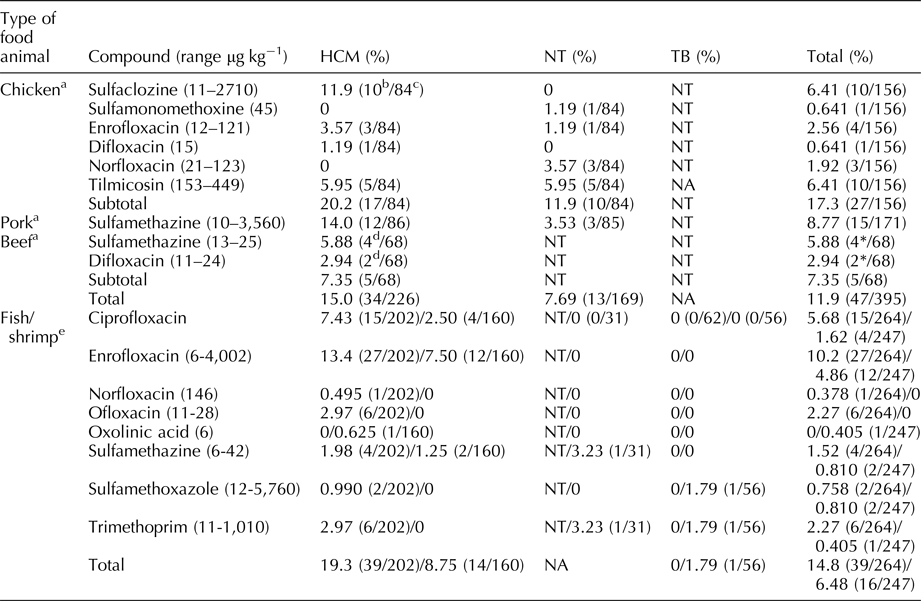
Residual antimicrobials in various food samples were examined by LC-MS/MS. Yamaguchi et al. (Reference Yamaguchi, Okihashi, Harada, Konishi, Uchida, Do, Bui, Nguyen, Nguyen, Chau, Dao, Nguyen, Kajimura, Kumeda, Bui, Vien, Le, Hirata and Yamamoto2015) reported that among 28 different antimicrobials tested, six (sulfaclozine, sulfamonomethoxine, enrofloxacin, difloxacin, norfloxacin, tilmicosin), one (sulfamethazine) and two (sulfamethazine, difloxacin) antimicrobials were detected in chicken, pork, and beef, respectively. As shown in Table 2, 17.3, 8.77, and 11.9% of chicken, pork, and beef, respectively, were contaminated with one of the antimicrobials tested. The contamination rate and tendency were different in geographic locations in Vietnam. In general, the contamination rate was higher in Ho Chi Minh city than that in Nha Trang. For example, 11.9% of chicken was contaminated with sulfaclozine in Ho Chi Minh city, while none in Nha Trang. On the other hand, 3.57% of chicken in Nha Trang was contaminated with norfloxacin but none in Ho Chi Minh city.
Analysis of antimicrobial residues in food animals in Vietnam

a Modified from the data described in Yamaguchi et al (Reference Yamaguchi, Okihashi, Harada, Konishi, Uchida, Do, Bui, Nguyen, Nguyen, Chau, Dao, Nguyen, Kajimura, Kumeda, Bui, Vien, Le, Hirata and Yamamoto2015).
b Positive number.
c Total number tested.
d Both sulfamethazine and difloxacin were detected in one sample.
e Modified by the data described in Uchida et al. (Reference Uchida, Konishi, Harada, Okihashi, Yamaguchi, Do, Bui, Nguyen, Nguyen, Khong, Tran, Nguyen, Chau, Dao, Nguyen, kajimura, Kumeda, Pham, Pham, Bui, Vien, Le, Dang, Hirata and Yamamoto2016). Chicken, pork, and beef include meat and internal organs such as heart, river, etc.
HCM, Ho Chi Minh city; NT, Nha Trang; TB, Thai Binh; NT, not tested; NA, not applicable.
Similarly, among 32 antimicrobials tested, eight antimicrobial agents (ciprofloxacin, enrofloxacin, norfloxacin, ofloxacin, oxolinic acid, sulfamethazine, sulfamethoxazole, trimethoprim) were detected in fish and shrimp in Ho Chi Minh city, Nha Trang, and Thai Binh as shown in Table 2 (Uchida et al., Reference Uchida, Konishi, Harada, Okihashi, Yamaguchi, Do, Bui, Nguyen, Nguyen, Khong, Tran, Nguyen, Chau, Dao, Nguyen, kajimura, Kumeda, Pham, Pham, Bui, Vien, Le, Dang, Hirata and Yamamoto2016). Fish was more contaminated with antimicrobials than shrimp in Ho Chi Minh city. Enrofloxacin was most prevalent antimicrobial, which was detected in 13.4 and 7.5% of fish and shrimp in Ho Chi Minh city, respectively. Fish was not contaminated with oxolinic acid, while shrimp was not contaminated with norfloxacin and ofloxacin, regardless of origin. Although β-lactams are often used in Vietnam, and the highest penicillin resistance was reported in Vietnam among Asian countries, β-lactams were not detected in their study. It cannot be excluded, however, that β-lactams might be degraded in the environment.
Although ampicillin is a commonly used antibiotic, it is rarely detected in the environment as described above, because it is easily degraded in water containing Ca2+ and Mg2+. Sy et al. (Reference Sy, Harada, Asayama, Warisaya, Dung, Sumimura, Diep, Ha, Thang, Hoa, Phu, Khai, Phuong, Tuyen, Yamamoto and Hirata2017), therefore, attempted to detect 2-hydroxy-3 phenylpyrazine (HPP), one of the degraded products of ampicillin and β-lactam antibiotics, from 98 environmental water samples including rivers, household ponds, and aquaculture ponds in Ha Noi, Thai Binh, and Can Tho. HPP residues were detected in 60 samples (11 from 26 rivers, 49 from 62 household pond, none from 10 aquaculture pond samples). The range of HHP residue concentrations was 1.3–410 ng l−1. These data suggest that β-lactams used in medical settings or the veterinary field might contaminate environmental water.
Similarly, research was also conducted with other food such as eggs. Various antibiotics were detected in chicken eggs sold in supermarkets in Ho Chi Minh city (Yamaguchi et al., Reference Yamaguchi, Okihashi, Harada, Konishi, Uchida, Hoang Ngoc Do, Thi Bui, Nguyen, Phan, Dang Thien Bui, Nguyen, Kajimura, Kumeda, Van Dang, Hirata and Yamamoto2017). A total of 111 egg packages from 11 different companies were examined for 28 different antimicrobials, and 16 samples were positive for any of eight compounds (enrofloxacin, ciprofloxacin, norfloxacin, sulfadimethoxine, sulfamethazine, sulfamonomethoxine, tilmicosin, and tripthoprim). Enrofloxacin was most prevalent and was detected in eight samples, in which two showed more than 1000 µg kg−1 concentrations. Among 11 companies, five showed positive for any of eight antimicrobials, while six were not. In one company, more than 50% were positive for any of these antimicrobials.
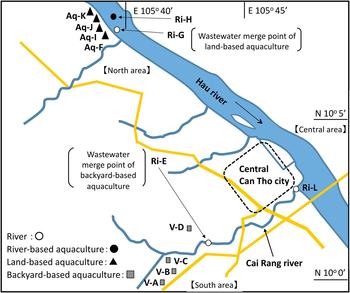
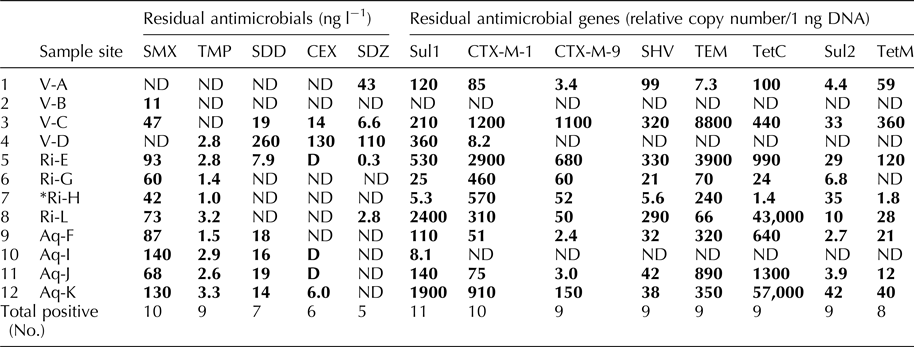
Nakayama et al. (Reference Nakayama, Hoa, Harada, Warisaya, Asayama, Hinenoya, Lee, Phu, Ueda, Sumimura, Hirata, Phuong and Yamamoto2017) investigated antimicrobial residues, antimicrobial resistance genes (ARGs), and microbiota in 12 freshwater sites from three different aquaculture systems, such as traditional backyard-based (V-A, V-B, V-C, and V-D), river-based (Ri-H), and land-based (Aq-F, Aq-I, Aq-J, and Aq-K) aquacultures and rivers (Ri-E, Ri-G, and Ri-L), in Can Tho city (shown in Fig. 1). Among 45 antimicrobials tested, only sulfamethoxazole, trimethoprim, sulfadimidine, cephalexin, and sulfadiazine were detected in 10, nine, seven, six, and five sites, respectively (Table 3). Only sulfadiazine and sulfamethoxazole were detected in V-A and V-B, respectively. However, four antimicrobials were detected in V-C and V-D. It should be noted that all five antimicrobials were detected in Ri-E, although two or three antimicrobials were detected in Ri-G, Ri-H, and Ri-L. However, three to four antimicrobials were detected in land-based aquaculture places. It should be noted that sulfamethoxazole, trimethoprim, and sulfadiazine were detected in all land-based aquaculture places and that highest concentrations of sulfadimidine, cephalexin, and sulfadiazine were detected in V-D.
Sampling sites in Can Tho city and its suburbs. Four backyard-based aquaculture sites (V-A, V-B, V-C, and V-D), four land-based aquaculture sites (Aq-F, Aq-I, Aq-J, and Aq-K), and four river sites (Ri-E, Ri-G, Ri-K) including one river-based aquaculture site (Ri-H). Modified by Fig. 1 described in Nakayama et al. (Reference Nakayama, Hoa, Harada, Warisaya, Asayama, Hinenoya, Lee, Phu, Ueda, Sumimura, Hirata, Phuong and Yamamoto2017).

Detection of antimicrobial residue and antimicrobial resistance genes in 12 freshwater sites in Can Tho

Modified from the data described in Nakayama et al. (Reference Nakayama, Hoa, Harada, Warisaya, Asayama, Hinenoya, Lee, Phu, Ueda, Sumimura, Hirata, Phuong and Yamamoto2017).
V, household backyard-based aquaculture; Ri, river; *Ri, river-based aquaculture; Aq, land-based aquaculture; ND, not detected; D, detected but exact value is unknown; SMX, sulfamethoxazole; TMP, trimethoprim; SDD, sulfadimidine; CEX, cephalexin; SDZ, sulfadiazine.
On the other hand, sul1, bla CTX-M-1, bla CTX-M-9, bla SHV, bla TEM, tetC, sul2, and tetM genes were detected in 11, 10, nine, nine, nine, nine, and eight sites, respectively (Table 3). It is striking that all eight ARGs examined were detected in V-A, V-C, Ri-E, Aq-Ri-H, Ri-L, Aq-F, Aq-J, and Aq-K sites. It should be emphasized that none of the genes were detected in a V-B site, and only one and two genes were detected in Aq-I and V-D sites, respectively. It is also specially mentioned that very high copy number of bla CTX-M-1, bla CTX-M-9, bla SHV, bla TEM, and tetM were detected in V-C sites. Remarkably high copy numbers of tetC and sul1 genes were detected in both Ri-L and Aq-K sites. It should be emphasized that V-B was not contaminated with antimicrobials (only SMX was detected) and those genes, while V-C, Ri-E, Aq-J, and Aq-K places were highly contaminated with both antimicrobials and those genes. Although it is not known why V-B was not contaminated with antimicrobials and related genes, it is most likely that the use of antimicrobials might be well controlled. One of the most possible reasons could be that V-B had the least fish density at 0.79 fish/m3 (range 0.79–69.4 fish m−3). Alternatively, V-B is a little bit further from a residential area in comparison to other places, indicating that the contamination of antimicrobials from people could be limited. It is of interest to note that the V-A site was highly contaminated with antimicrobial genes, but only sulfadiazine was detected, while only a small copy of sul1 was detected with a high concentration of sulfamethoxazole and low concentrations of trimethoprim, sulfadimidine, and cephalexin in the Aq-I site. Nevertheless, these data indicated that the improper use of antimicrobials in aquaculture systems might occur in Can Tho, resulting in the contamination of residual antimicrobials, which could be used for the veterinary field and most probably for medical settings, in environmental water in Can Tho. Furthermore, Managaki et al. (Reference Managaki, Murata, Takada, Tuyen and Chiem2007) detected sulfamethazine in the water of the region of Mekong Delta, and sulfamethazine was also detected in a pig farm pond in northern Vietnam (Hoa et al., Reference Hoa, Managaki, Nakada, Takada, Shimizu, Anh, Viet and Suzuki2011), indicating that this compound could also be often used in Vietnam.
Although β-lactam antibiotics were not always detected in animal-originated food and environmental water, related genes such as bla CTX-M, bla SHV, bla TEM were often detected with even high copy number (Table 3). Taken together, these results indicated that β-lactam antibiotics might be widely used in the agricultural field and might contribute to the emergence and spread of ESBL-producing E. coli, most probably through horizontal gene transfer of ESBL plasmid carrying bla CTX-M. Alternatively, co-selection of ESBL-producing E. coli is also possible by other antimicrobials, such as sulfa drugs, tetracycline, etc., because most of the ESBL-producing E. coli isolated in Vietnam are multi-drug resistant.
Consumption of antimicrobials in Vietnam
Although exact statistical data regarding the consumption of antimicrobials used in medical and veterinary settings in Vietnam are not available, some literature or reports described the use of antimicrobials in Vietnam. For example, a report from the Ministry of Health of the Socialist Republic of Vietnam in collaboration with the global antibiotic resistance partnership and the Oxford University clinical research unit described that most commonly used antimicrobial classes in 15 representative hospitals in Vietnam were cephalosporins, followed by penicillins, macrolides, and quinolones. Although the sum of each antimicrobial consumption is not clear, β-lactam antibiotics are most frequently used in clinical settings in Vietnam, indicating that the emergence of ESBL-producing E. coli might occur.
To estimate the consumption of antimicrobials in chicken and pig production (Nguyen et al., Reference Nguyen, Nguyen, Nguyen, Nguyen, Nguyen, Thwaites and Carrique-Mas2016), a total of 1462 commercial feed formulations were examined. Overall, it was estimated that 77 and 290 mg of in-feed antimicrobials were used to raise 1 kg of live chickens and pigs, respectively. It was calculated that bacitracin (16%), chlortetracycline (11%), and enramycin (11%) were the most common antimicrobials used in chicken feed formulations, while bacitracin (25%), chlortetracycline (24%), and florfenicol (17%) were the most common antimicrobials used in pig feed formulations. The overall estimated amount of antimicrobials used for chicken and pig production in Vietnam was 42 and 980 tons, respectively. The most used antimicrobials were florfenicol (220 tons), chlortetracycline (210 tons), colistin (190 tons), bacitracin (150 tons), and tylosin (86 tons). However, about 57% of total usage of antimicrobials such as amoxicillin, colistin, chlortetracycline, neomycin, oxytetracycline, and bacitracin are considered as of critical importance or of high importance for human medicine. Therefore, it is important to reduce the use of antimicrobials, or at least these six antimicrobials, in the veterinary field in Vietnam.
Conclusions
Recent studies conducted in Vietnam indicated that the CTX-M plasmid might play a critical role on the dissemination of ESBL-producing E. coli among communities as well as animal-originated foods, rather than an association with particular clones of ESBL-producing E. coli. Use of antimicrobials contributes to not only multiplication of AMR bacteria, but also multiplication of AMR genes, which are relatively stable in the environment and could be utilized for horizontal gene transfer. Indeed, high levels of residual antimicrobials were detected in foods, and antimicrobials and ARGs were detected in the environment, including animal-originated foods in Vietnam. In Vietnam, farmers can purchase antibiotics easily without a prescription, and many farmers have insufficient information about appropriate use of the drugs. Nevertheless, risk factors for the dissemination of ESBL-producing E. coli could be animal-originated food and food animals, pets and healthy people, as well as patients, in particular those with UTI. Even among human beings, aging populations may also be particularly at risk. Poor access to drinking water, poverty, and a high population density are heavily associated with the dissemination of ESBL-producing bacteria. Therefore, it is important to limit the use of antimicrobials, not only to the agricultural sector but also to medical settings. Improved hygiene, such as encouragement of hand washing, also warrants more attention.
Acknowledgments
The authors would like to deeply thank Drs Kazuo Harada (Osaka University, Japan), Tatsuya Nakayama (Osaka University), Kazuto Uchida (Osaka Institute of Public Health), and Takahiro Yamaguchi (Osaka Institute of Public Health) for providing useful information and comments on this review article. The works described in this review article were supported in part by the Japan Agency for Medical Research and Development (AMED)/Japan International Cooperation Agency (JICA) as part of the Science and Technology Research Partnership for Sustainable Development (SATREPS).