


“But one of the weightiest objections to a plurality in the executive … is that it tends to conceal faults and destroy responsibility… . The circumstances which may have led to any national miscarriage or misfortune are sometimes so complicated that there are a number of actors who have different degrees and kinds of agency, though we may clearly see upon the whole that there has been mismanagement, yet it may be impracticable to pronounce to whose account the evil which may have been incurred is truly chargeable.”
—Alexander Hamilton, Federalist Number 70 (Reference Hamilton1788)Political theorists have long doubted the possibility of democratic accountability in systems of representation where many different political actors “have different degrees and kinds of agency” over policy. The problem, that Hamilton was but one of many to point out (e.g., Bagehot Reference Bagehot1867; Downs Reference Downs1957; Sartori Reference Sartori1994), is that in such complex systems voters cannot possibly understand the policy-making process in sufficient detail to accurately attribute responsibility for its outcomes. The consequence of this attributional failure, Powell and Whitten (Reference Powell and Whitten1993) famously argued, is that voters in such systems are less likely than their counterparts in simpler systems to condition their support for incumbent governments on performance. Downs (Reference Downs1957) expressed a similar sentiment about the likelihood of policy-oriented prospective voting in these systems, pointing out, skeptically, that such votes require well-formed expectations about the potential coalitions that may form and the policies they would produce. Indeed, even Lijphart (Reference Lijphart1977), who argued that consensual systems of governance can deliver peaceful stability, understood that this was due in large part to a designed lack of policy-making transparency.
Despite this long tradition of skepticism, a recent wave of work in comparative electoral behavior is much more optimistic about the ability of voters to attribute responsibility for policy making (e.g., Bowler Bowler, Gschwend, and Indridason Reference Bowler, Gschwend and Indridason2018; Duch and Stevenson Reference Duch and Stevenson2008; Kedar Reference Kedar2005). This research has proposed various models of voting in complex coalitional systems in which voters are assumed to understand the relative influence that different parties have (or will likely have) on policy making. Unlike their purely theoretical predecessors, which often made very similar assumptions (e.g., Austen-Smith and Banks Reference Austen-Smith and Banks1988; Baron and Diermeier Reference Baron and Diermeier2001), these recent studies have provided the first empirical evidence for such predictions, finding that, regardless of whether voters actually can attribute or forecast influence sensibly, at least some seem to behave “as if” they do.
Of course, the finding that voters vote “as if” they attribute responsibility sensibly is not a demonstration that they actually do.Footnote 1 Certainly, none of the scholars contributing to this literature would argue that the average voter knows all the relevant details of the policy-making process. Instead, most of these scholars argue (more or less formally) that voters make sense of coalitional systems by using heuristics—subconscious, effort-reducing cognitive strategies that use simple rules to map cheaply obtained information into relatively accurate inferences.
In this article, we present a theoretical framework informed by the work of Gigerenzer and colleagues’ (e.g., Goldstein and Gigerenzer Reference Goldstein and Gigerenzer2002; Todd and Gigerenzer Reference Todd and Gerd2007) theory of ecologically rational heuristics (described in detail below) to argue that coalitional voters combine (in a quite simple way) a small set of readily observable cues about parties to make inferences about the relative influence that each party has on policy. In so doing, such voters ignore other information that, while predictive of real policy-making influence, is either difficult to obtain or difficult to include simply in the information aggregation process that leads to an inference. Most importantly, voters favor cues that are easily observable characteristics of individual parties (e.g., their role in government or size) over those that require integration of information across parties (e.g., median status or bargaining power).
After laying out the theoretical framework that motivates our argument and the specific hypotheses we attempt to test, we present two different empirical analyses. The first relies on a set of five original surveys in Denmark, Germany, Italy, the Netherlands, and the United Kingdom that (for the first time) ask voters directly how much influence they think each party in these countries had on general policy outputs over the life of the previous government. In addition, these surveys (unusually) also ask respondents their perceptions of a number of characteristics that might contribute to their inferences about partisan policy influence (e.g., perceived party sizes, perceived cabinet roles, and perceived policy positions). This allows us to test our hypotheses about the kinds of cues that should and should not contribute to voters’ inferences about policy-making influence.
Our second empirical analysis relies on two additional surveys, conducted in Denmark and the UK, that probe prospective attributions of policy-making responsibility for specific policies. These analyses both complement the earlier ones (allowing us to test some of the same hypotheses in this quite different design) and also extend the analysis to several hypotheses that were not easily testable under the first design. Specifically, it allows us to examine the impact of issue salience on attributions of influence as well as to understand attribution of influence for opposition parties that lend outside support to the cabinet.
The results of these analyses are largely consistent with our theoretical expectations and identify a simple set of cues that voters appear to use to make sensible, but imperfect, attributions of policy-making responsibility to parties that are broadly consistent with our academic understanding of multiparty policy making. We find voters favor cues that are readily observable characteristics of parties and seem to combine these in a simple (e.g., linear) way to produce inferences. More complex cues, like those that depend on integrating information about all parties in complex ways, are less likely to be used.
In addition, while our central focus is not cross-country comparison (we examine just five countries), the evidence we present is consistent with the idea that voters in different contexts also weight the cues they use appropriately for the context they are in—for example, attaching more influence to opposition parties in countries with strong legislatures and/or a history of minority government. These suggestive findings set the agenda for future efforts that should ask these questions to voters in a larger sample of countries with more institutional variability.
In sum, by providing important details of the mechanism that voters may use to navigate the complexities of coalitional politics, this work helps justify the “as if” assumptions upon which contemporary models of rational voting in coalitional systems rely and provides an answer to those skeptical of coalitional voters’ abilities. That said, our data also shine a light on the compromises that the heuristic voter makes in simplifying his or her political environment. Voters clearly have systematic blind spots and do not incorporate into their attributions of influence all the information that might help them produce the most accurate or satisfying inferences.
Theoretical Framework
Our theoretical approach draws from modern theories of heuristics and especially Goldstein and Gigerenzer (Reference Goldstein and Gigerenzer2002). Most generally, this literature defines a heuristic as a process of decision, inference, or judgment that uses “principles of effort-reduction and simplification,” as compared to full information rationality, an inferential process that integrates all relevant information (Shah and Oppenheimer Reference Shah and Oppenheimer2008, 207). As Duch, Przepiorka, and Stevenson (Reference Duch, Przepiorka and Stevenson2015) have pointed out, this is a useful starting point because attributions of policy-making responsibility are just the sort of complex cognitions for which it is likely useful heuristics would emerge. First, attribution via direct knowledge of policy making requires levels of political attention that are prohibitive to most citizens and so heuristics are often needed.Footnote 2 Second, attributions of responsibility remain central to most accounts of satisfying democratic participation and so heuristics should be valuable. Third, periodic elections produce just the kind of limited, cheaply obtainable, and predictive cues about partisan policy-making influence that useful heuristics require as inputs. Specifically, elections produce shares of legislative seats for each party, designated roles for each party in government or opposition, and, via the campaign, a reiteration and updating of the parties’ policy positions as well as the relative salience they place on different policy domains.
Such information has the great benefit (to the voter needing a substitute for constant surveillance of the policy-making process) that it is both cheap to obtain (especially in the rich information environment surrounding elections) and stable in the medium term, which means that one need not monitor day-to-day political news to keep it current—paying attention at election time is enough.Footnote 3 If, in addition, these cues are strongly predictive of real policy-making influence, then they may be a useful part of an effective heuristic that allows voters to make sensible, if imperfect, inferences about the partisan distribution of policy-making influence.
The particular heuristic strategy that we think voters use to infer the policy-making influence of parties relies on a limited set of readily observable cues that describe each party. Further, we argue that voters integrate these cues to form an inference about policy-making influence in a similarly simple way: they weight each cue in proportion to (and in the direction of) its long-term association with policy-making influence in the political context in which they vote and then simply add these resulting values together to produce an inference about the extent of each party’s policy-making influence. Of course, this theory will only be useful if we can identify (1) which cues are used and (2) the direction and relative size of their weights. We construct a theoretical framework based on ecological rationality to answer these questions, deriving hypotheses about which cues will and will not be used as well as the size and direction of the weights voters will assign them. The empirical analyses are then aimed at testing whether these hypotheses are consistent with our original survey data on perceived cue values and attributions of influence.
In Appendix A.1, we provide a detailed explanation of the theory of ecological rationality, but the main points relevant to our theoretical task are summarized here. The theory tells us that individuals will come to use a given cue as part of a heuristic inference about policy-making influence when the value of the cue is strongly associated with real-world influence (in the relevant context). Further, a cue’s weight in the heuristic inference will reflect the direction and strength of that long-term association.Footnote 4 Importantly, however, not all cues that are associated (even strongly associated) with policy-making influence will be used as part of the heuristic. First, cues for which the value of the cue itself is not easily and cheaply (in terms of physical and mental resources) available will not be used. In addition, if the values of a cue are associated with policy-making influence in a complex, nonlinear way, the cue will either not be used or will be used while ignoring these complexities (e.g., as a simple linear function of the cue). More concisely, individuals will only integrate cues into a heuristic decision strategy if they are cheap, integrated simply, and are accurate. Footnote 5
In the next sections (and more thoroughly in Appendix A.2) we describe the cues that political scientists have found to be predictive of real world policy-making influence across parliamentary contexts. These include various conceptions of party size, party roles in government (e.g., prime ministerial party, junior partner, support party, or opposition), policy salience, voting power, and ideological centrality (including median party status). Further, we also interrogate the literature for information about the relative importance of these different cues in driving policy-making influence both across cues and for the same cue in different parliamentary contexts. This is important because the theory of ecological rationality tells us that voters should come to weight cues in proportion to their real long-term association with influence in a given context. For some cues (e.g., different cabinet roles), the literature speaks quite clearly about the expected differences in these weights across cues and/or contexts and so we can produce clear hypotheses about them. However, for other cues the literature provides no such guidance, so in these cases we do not produce contextual hypotheses.
Finally, while all the cues reviewed below (and in Appendix A.2) plausibly confer real policy influence, only those whose values are cheap to acquire and that can be simply integrated into a heuristic inference will be used by voters. Indeed, there is a quite natural division in the list of potential cues we have identified from the literature between those which meet this standard and those which do not. Specifically, some of the cues are readily observable characteristics of individual parties (e.g., government role or legislative seat share) that are widely reported by the media. Other cues, however, are more complex concepts that are either not directly observable and/or require voters to calculate (or at least intuit) their values by integrating information about all parties in complex ways. For example, assigning a value for a median party cue requires that voters integrate information about all parties’ legislative seat shares and ideological positions. Similarly, a party’s voting power is an unobservable, complex function of the whole distribution of legislative seats.
Thus, we organize our summary review of the cues identified in the literature by first discussing those that we think are ecologically rational and so generate positive hypotheses about the direction (and sometimes the relative size) of their impact on attributions of influence. Next we consider those cues that, while predictive of real world influence, are not suitable for inclusion in an ecologically rational heuristic.
Cheap and Simple Cues: Government Roles, Party Size, and Issue Salience
To conserve space and unburden the reader, we have relegated a fairly exhaustive review of the literature on policy-making influence to Appendix A.2. Here, we simply summarize the conclusions of that review.
There is a very broad consensus that roles in government—whether a party provides the prime minister, is a junior cabinet partner, supports the cabinet from the outside, or is in the opposition—are important institutional sources of policy influence. Though there is debate over some details, the general rank-ordering of relative influence as PM > Junior Partner > Support Party > Opposition Party has consistent theoretical and empirical support in the literature. Further, knowledge of these cues is widespread in the western democracies (see the data in Appendix A.4 and Lin et al. Reference Lin, Stevenson, Tromborg and Fortunato2017) and so we hypothesize that each of these cues will impact attribution of policy influence across countries (H1) and the relative size of these effects will conform to the above ordering (H2).
We note there is a small cross-national literature attempting to distinguish between the relative policy-making influence of prime ministers versus junior partners across different countries, but no real consensus has emerged. We therefore posit no hypotheses regarding the relative strength of prime ministerial and junior partner cues in different countries. In contrast, many scholars have observed that the influence of opposition parties should depend very much on the context in which they operate. Specifically, many scholars (but by no means all) suggest that opposition parties should have more influence in “strong” parliaments that provide them with institutional tools (like committee chairmanships and amendment rights) to influence government legislation. Similarly, scholars studying minority government argue that, by making issue-by-issue deals with the government, opposition parties may be able to exert more influence under minority cabinets.Footnote 6 Thus, we take from this literature the hypothesis that the weight voters will put on opposition party cues should be larger (more positive) in strong parliaments relative to weak parliaments and/or larger in systems that have a history of minority cabinets (H3).Footnote 7 Of course, we realize this hypothesis conflates these two contexts, but this is an appropriate ambiguity since we cannot clearly distinguish between such cases in the countries we examine here.
Another set of cues that are easily acquired and widely known are the parties’ relative sizes, including shares of legislative and cabinet seats—that is, the number or proportion of ministerial portfolios held by a party. Media coverage of parliamentary electoral campaigns publish regular polls of citizens’ vote intentions and use them to forecast the likely seat share of all parties following the election. And, in the days (or weeks) following the election, parties’ actual seat shares remain a focal point of the media narrative. As a result, the average voter seems to know the relative sizes of the parties and even has a fairly good idea of the cardinal values (Lee , Haime, and Stevenson Reference Lee, Haime and Stevenson2019 and the data in Appendix A.4).
That said, the literature on the relationship between party size and real policy-making influence in parliamentary democracies is complex because of the various conceptions of party size that are used, the way these concepts overlap, and the way they interact with government role. The clearest consensus is the expectation that parties with a larger share of cabinet seats will exert more influence on policy outcomes. For example, both the ministerial autonomy model (Laver and Shepsle Reference Laver and Shepsle1996) of coalition policy making and the coalition compromise model (Martin and Vanberg Reference Martin and Vanberg2011) predict that, in aggregate, outcomes reflect the size-weighted preferences of members. Further, this consensus exists across the parliamentary democracies with no suggestion that it is different across contexts. Thus, the hypothesis that voters will attribute greater policy influence to parties they perceive to have a larger share of cabinet seats (H4). There is little guidance in the literature, however, that would tell us the relative weight of cabinet seats versus other cues in real world policy making.
There is less consensus about the effect of opposition party size (almost always conceptualized as legislative seat share) on influence, but the debate mirrors the distinction between strong and weak parliaments discussed above. If opposition parties have little influence overall (as is posited for weak legislatures), there is little reason that more opposition seats would confer more influence. However, if opposition parties obtain institutional tools of influence (like committee membership or chairs) proportionately to their size (as they do in many strong legislatures), we would expect their policy-making influence to be proportional to size. This leads to two hypotheses: the legislative seat shares of opposition parties will be positively related to attributions of policy influence (H5) and this relationship will be stronger for parties in strong legislatures (H6).
One caveat, however, is that there is substantial overlap in the information that legislative seats, government roles, and cabinets seats can provide the voter about policy-making influence. Indeed, if Gamson’s Law holds, one can use a party’s role along with its legislative seat share to directly infer its cabinet seat share. Thus, any relationship between cabinet seat shares and policy-making influence (e.g., that in H4) can alternatively be expressed as a relationship between legislative seat shares, government role, and influence—without directly referencing cabinet seat shares.Footnote 8 Thus, it seems clear that an effort-reducing heuristic should take advantage of the opportunity afforded by Gamson’s Law to reduce the number of cues needed as inputs to the influence heuristic, as long as this can be done without substantial losses in accuracy.
One way to do this is to use a simple additive heuristic for inferring policy influence that includes cues about cabinet roles and legislative seat shares but not cabinet seat shares. This is an efficient way for voters to economize on the informational requirements of the heuristic in exchange for a small reduction in accuracy (i.e., reflecting the extent to which Gamson’s Law does not hold precisely). Thus, we hypothesize that voters will use a legislative seat share cue as part of their heuristic for inferring the policy-making influence of all parties (H7) rather than only for opposition parties (as hypothesized in H5). In contrast, given this use legislative seat shares and roles, voters will be less likely to also use cabinet seat shares in this way (H4a).
Another potential cue that has been identified in the literature on policy influence is policy salience. We do not expect, however, that voters can cheaply acquire detailed information about the relative salience of a wide range of issues over all parties. Instead, to the extent that a policy salience cue is used by voters to infer influence, it should be confined to cases in which the relevant information is particularly easy to acquire: those in which a specific issue is central to the party’s identity—its raison d’être. Such parties usually pursue a distinct (often relatively extreme) position on their issue such that the voters can (relatively) easily identify the party with the issue and readily recall its position. This confluence of policy salience and an easily identifiable position (relative to other parties in the system) greatly reduces the voter’s difficulty in acquiring this information.Footnote 9 Niche or “single-issue” parties (e.g., environmental parties, regional-autonomy parties) are a clear example. Since the political science literature suggests that niche parties can often use their single-minded focus to achieve policy influence (e.g., by trading support on other issues), we expect that a “strong salience” cue will be used by voters to infer the policy influence of such parties (and only such parties) on the corresponding policy dimensions (H8). Finally, we offer no hypotheses about the weight voters put on the salience cue relative to other cues or across contexts because the literature lacks guidance here.Footnote 10
Complex Cues: Ideological Centrality and Voting Power
Theorists have often pointed to a party’s “bargaining power” as the key to its policy influence. In most models of multiparty bargaining, such power ultimately derives from a party being a member of many (or all) winning coalitions. Such models come in two main varieties. One type examines spatial bargaining over policy and concludes that if this policy space is unidimensional, the policy position of the median party is always preferred by some majority coalition and so this party should be able to control policy making.Footnote 11
The other type ignores ideology and instead observes that parties derive influence over majority rule decisions (including policy decisions) from being a pivotal member of many different winning coalitions. Such parties are said to have high “voting power” because if unsatisfied with a potential bargaining outcome, they can always threaten to form a different winning coalition with parties that will give them a better deal (e.g., Banzhaf Reference Banzhaf1965; Shapley and Shubik Reference Shapley and Shubik1954).
As we explain in Appendix A.2, while there has long been a strong theoretical literature arguing that ideological centrality and voting power should confer policy-making influence, direct empirical tests of these claims on policy outcomes (or proxies for policy outcomes) in parliamentary democracies have been slow in coming and produced mixed results. That said, recent work that has brought to bear innovative measures and research designs has, on balance, confirmed the positive impact of both cues on policy-making influence.
Despite this conclusion, however, the theory of ecological rationality casts doubt on the usefulness of these cues as part of a simple heuristic strategy for inferring policy influence. The problem, as suggested above, is that voters are unlikely to be able to cheaply acquire information about median status and voting power. This hardly seems controversial in the latter case and in the former is confirmed by the data reported in Appendix A.4, which shows that fewer than half of the respondents in each country except the UK correctly identified the median party. Thus, we hypothesize that neither median party status (H9) nor voting power (H10) will be strongly related to voters’ inferences about policy-making influence.
Enumeration of Hypotheses
To summarize, from the rich literature on real world policy making and the theory of ecologically rational heuristics, we derive the following hypotheses, which we will test below: Ceteris paribus...
H1 Voters will attribute more policy-making influence to parties that play a role in government (PM, Junior Partner, or Support Party) than those that do not.
H2 The relative size of the effects in H1 will be: PM > Junior Partner > Support Party > Opposition Party.
H3 Voters will attribute more policy-making influence to opposition parties in contexts with strong parliaments and/or a history of minority cabinets than in contexts with weak parliaments and/or a history of mainly majority cabinets.
H4 Voters will attribute more policy-making influence to government parties that hold a larger share of cabinet seats.
H4a Voters will not attribute more policy-making influence to government parties that hold a larger share of cabinet seats (because they use roles and legislative seat shares [additively] instead).
H5 Voters will attribute more policy-making influence to opposition parties that hold a larger share of legislative seats.
H6 The relationship in H5 will be stronger in contexts with strong parliaments than in contexts with weak parliaments.
H7 Voters will attribute more policy-making influence to parties that hold a larger share of legislative seats (not just for opposition parties as in H5).
H8 Voters will attribute more policy-making influence to parties on issues that are “strongly salient” to the party than on other issues.
H9 Voters will not attribute more policy-making influence to median parties than to other parties.
H10 Voters will not attribute more policy-making influence to parties that have more voting power.
Empirical Analyses
To test the above hypotheses, we conduct two sets of empirical analyses using data from seven surveys. The first focuses on voters’ retrospective attributions of general policy-making influence for parties playing particular roles in the previous cabinet and legislature. In contrast, the second study focuses on voters’ prospective attributions of influence for specific policies given different hypothetical (but plausible) future cabinets. This latter analysis is an important complement to the first because it allows us to ask how much policy-making influence voters attribute to external support parties, whether voters attribute disproportionate influence to parties in the policy areas that are strongly salient to those parties, and whether the impact of party roles on prospective attributions mirrors the results for retrospective attributions.
Retrospective Attributions of General Policy Influence
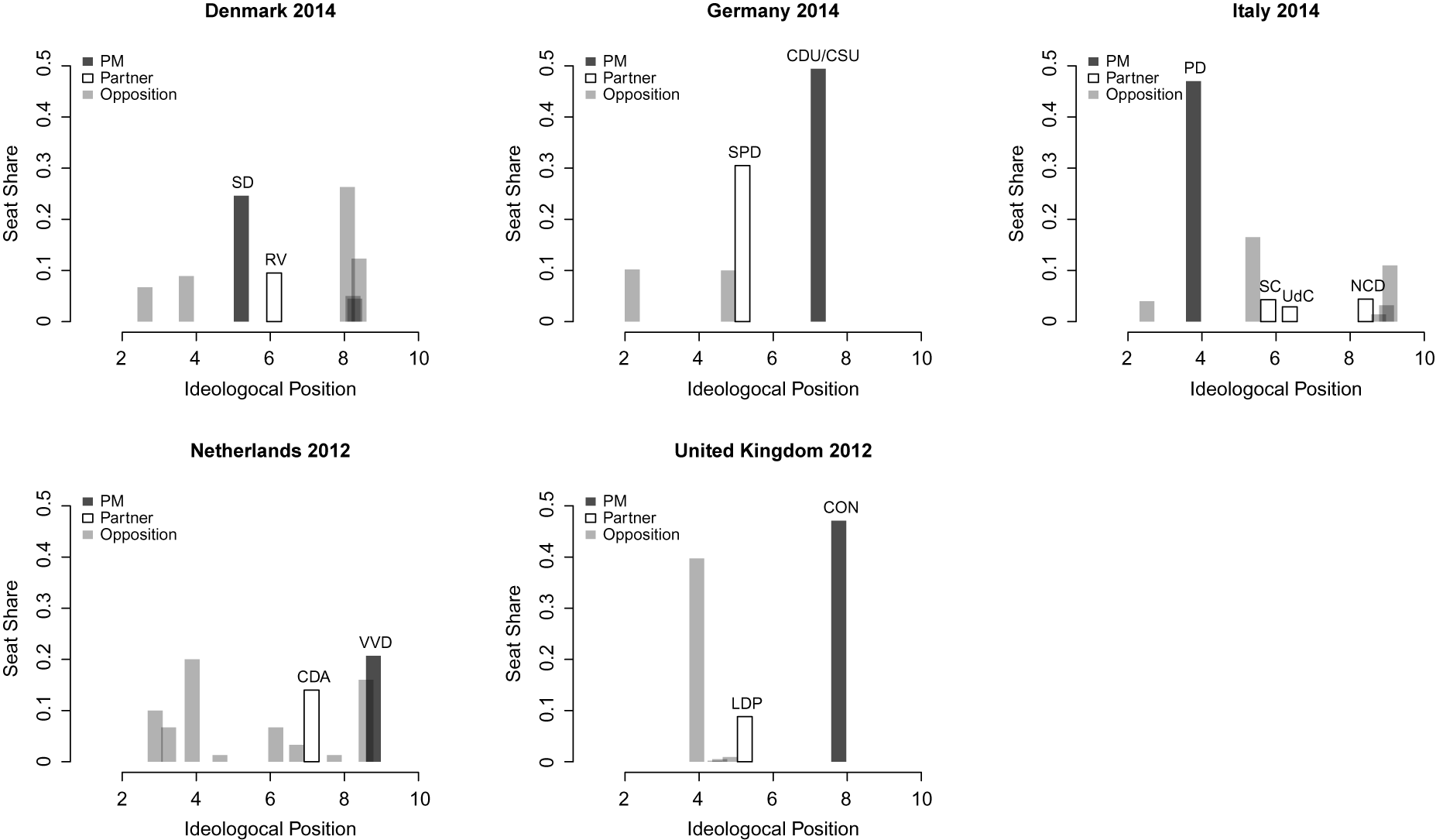
Testing our hypotheses requires information on voters’ perceptions of the cues reviewed above as well as their assessment of how much influence each party had on the policy-making process. No publicly available survey with which we are familiar includes this information, so we therefore administered five original surveys through Survey Sampling International (SSI) and YouGov. Conducted in 2012 in the Netherlands and the United Kingdom and in 2014 in Denmark, Germany, and Italy, the surveys were administered via internet panels and balanced to be demographically representative of the voting age population.Footnote 12 Section A.5 in the Appendix provides detailed information about the political context of each of these surveys, but Figure 1 summarizes the most important information for our purposes. These cases were chosen because each had an incumbent coalition cabinet, and, while our main empirical goal is not a cross-national comparison, these cases also have interesting variation in power-sharing institutions and other government characteristics. Most importantly, Germany, Italy, and the United Kingdom had majority governments at the time of our surveys, while Denmark and the Netherlands had minority governments. Likewise, Denmark, Germany, and the Netherlands have strong parliaments, while the UK and Italy (to a lesser extent) have weak parliaments. Finally, the most recent elections yield, according to Laver and Benoit (Reference Laver and Benoit2015), a “strongly dominant party” bargaining environment in Germany, Italy, and the UK and a “top two” environment in Denmark and the Netherlands.
Party Characteristics at Time of Survey

The dependent variables for this analysis are respondents’ perceptions of each party’s policy-making influence—a first to our reading of the literature. Our measure of perceived policy-making influence pays careful attention to the way the concept is defined and used in the theoretical literature. Specifically, the theoretical concept we wish to measure is not about one specific means of policy influence, but general influence. Thus, we built a question that encourages respondents to think about all the various ways that parties might influence policy outcomes, whether these rely on formal mechanisms (like votes) or informal ones (like private persuasion). We also wanted an aggregate measure of responsibility for policy outcomes across all of the different policy domains on which governments and legislatures take action. Thus, we asked respondents about their views on responsibility for all policy outcomes over a specific period of time (the life of the current government). Finally, our theoretical concerns explicitly equate policy-making responsibility with perceptions of influence over policy outcomes and not broader notions of responsibility for policy (e.g., moral responsibility). Consequently, we couched the question in terms of “influence” rather than the word “responsibility.”Footnote 13 The question wording was as follows:
The “legislative process” consists of legislators proposing, modifying, and voting on legislation. Ultimately, this process produces a set of new laws and modifications to old laws. Taking into account all of the various means parties may use to influence the legislative process, how much influence do you think each of the parties below ultimately had on the outcomes of the legislative process in [NAME OF COUNTRY] during the most recent government?
Respondents were asked to place each party on a 1–5 scale, where a “1” corresponded to “No influence at all” and a “5” corresponded to “A great deal of influence.” Responses to this question serve as dependent variable in this section’s analyses, and the relevant modeled covariates are listed in Table 1. Details on measurement and the specific question formats as well as summary statistics are included in Appendix A.6; however, it is important to keep in mind that all variables are either perceived characteristics elicited directly from the respondents or values calculated from those perceived characteristics.
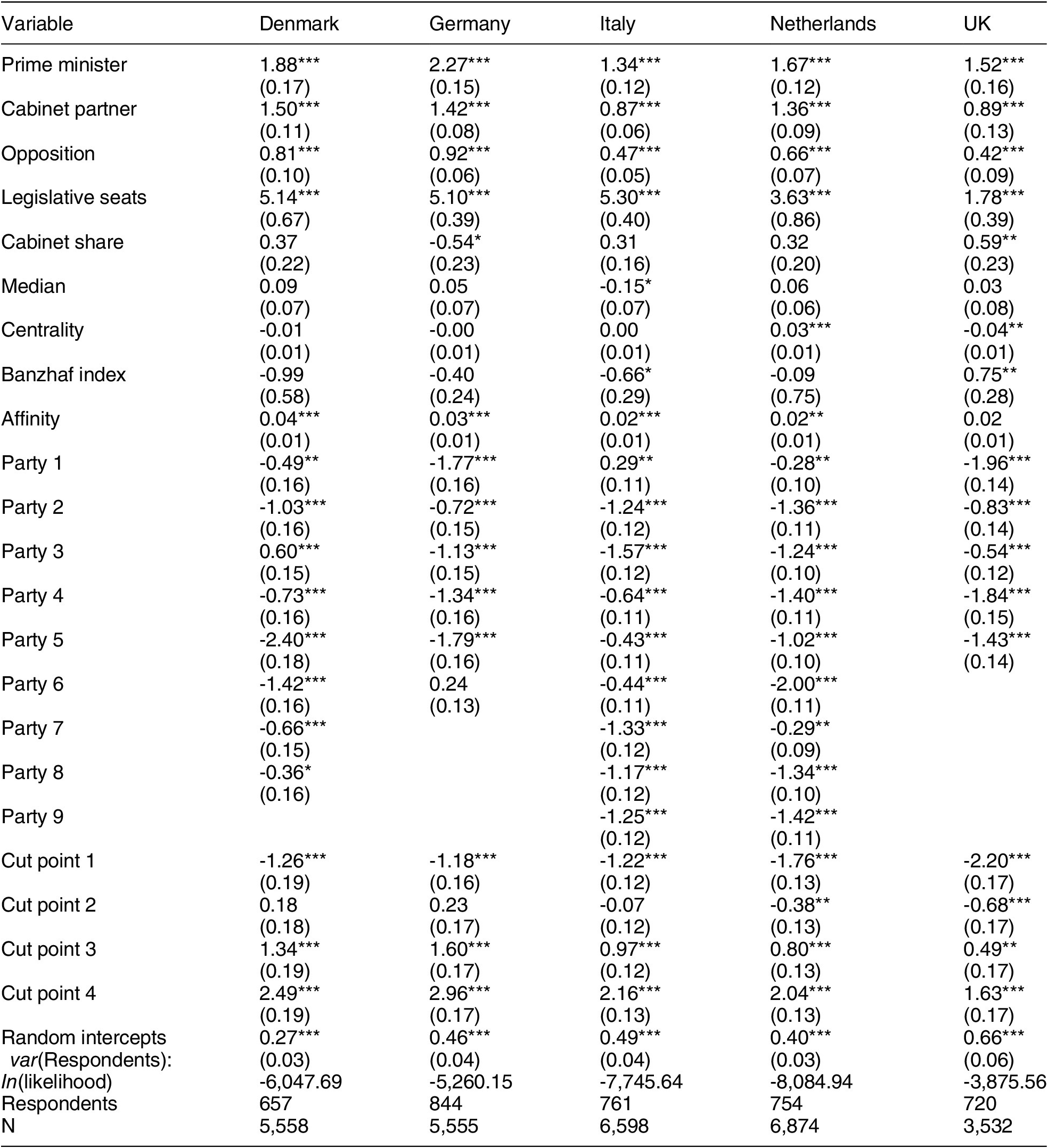
Within-Unit Hierarchical Ordered Probit Models of Perceived Party Characteristics and Responsibility Attribution

Note: Reference party = DK: SD; DE: CDU/CSU; IT: PD; NL: VVD; UK: Con
Party 1 = DK: DPP; DE: AfD; IT: FI-PdL; NL: CDA; UK: Greens
Party 2 = DK: K; DE: The Greens; IT: FdI; NL: CU; UK: Lab
Party 3 = DK: RV; DE: DL; IT: IdV; NL: D66; UK: LDP
Party 4 = DK: Unity List; DE: FDP; IT: LN; NL: GL; UK: PC
Party 5 = DK: CD; DE: Pirates; IT: M5S; NL: PvdA; UK: SNP
Party 6 = DK: LA; DE: SPD; IT: NCD; NL: PVD
Party 7 = DK: SPP; IT: SC; NL: PVV
Party 8 = DK: V; IT: SEL; NL: SP
Party 9 = IT: UdC; NL: SGP
***p < 0.001, **p < 0.01, *p < 0.05, two-tailed test.
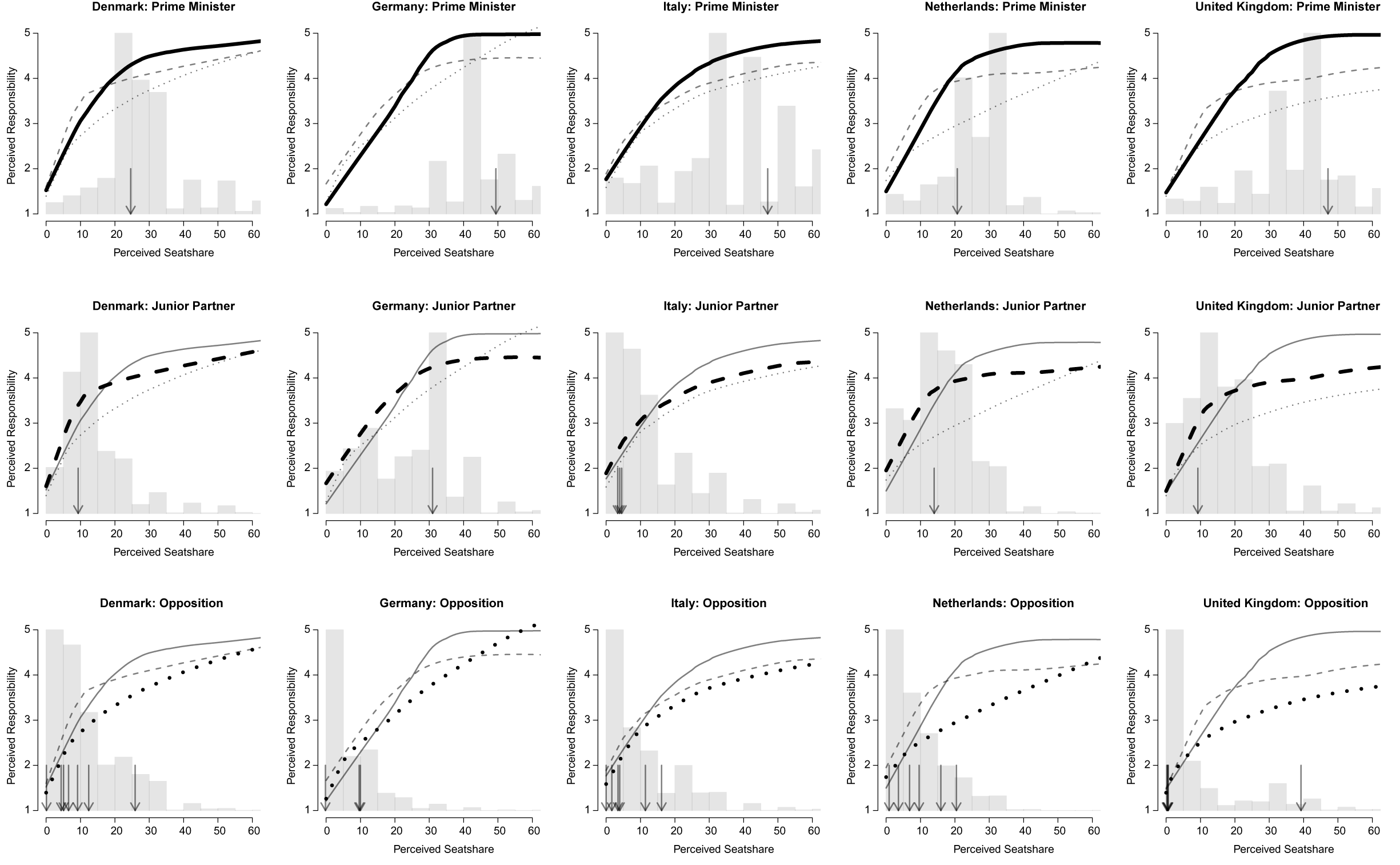
These data are organized such that the unit of analysis is a “respondent-party”—a particular respondent’s perceptions of the influence and attributes of a particular party. We begin our empirical analysis by examining the raw distributions of retrospective attributions of general policy-making influence against perceived party roles and sizes, broken down by country and perceived role, in Figure 2. The LOWESS lines indicate average perceived influence for PM, junior partner, and opposition parties using solid, dashed, and dotted lines, respectively. The bolded line in each row corresponds to the focal party. The histograms plot the distribution of perceived seat shares for the focal party type (e.g., all junior partner parties in Italy), and the arrows indicate the true seat share for the party types in each context.
Perceived Party Characteristics and Responsibility Attribution

When using this figure to compare attributions for different roles, given some perceived party size, it is important to look down the relevant column and notice the areas in which the histograms do and do not overlap. The strongest inferences can be made where there is substantial overlap (e.g., small partners vs. small opposition parties in Italy or mid-sized PMs vs. partners in the Netherlands). We also note that readers should not read too much into nonlinearities in these relationships as they are primarily a function of the bounds of our ordinal scale and smoothing over areas of the distribution with differing densities.
Figure 2 clearly shows that voters attribute more responsibility to parties they believe to be in government than parties they believe to be in the opposition. At nearly every perceived size, cabinet parties are attributed more responsibility than opposition parties—with the only exceptions occurring where the LOWESS line is smoothing over areas with little or no relevant data. Furthermore, there is an additional attribution bonus for providing the prime minister: the solid line is highest in every country for perceived PM sizes with a reasonable density of data. Indeed, 70% of our respondents gave the highest evaluation (5) to the prime minster and over 90% assign at least the next highest (4). It is also clear that perceived influence is monotonically increasing with perceived legislative seat share across all samples and roles.
Overall, the nonparametric relationships depicted in Figure 2 strongly support the notion that voters use perceived party roles and sizes to attribute policy-making influence in each of the countries in our sample. Of course, these kinds of uncontrolled comparisons, while essential to understanding whether these relationships are strongly “in the data,” need to be supplemented with carefully controlled statistical models that will allow us to both make stronger inferences about these relationships and explore the impact of variables not amenable to the nonparametric approach.
Most importantly, the parametric models presented below will allow us to distinguish whether voters are using heuristics to attribute policy-making responsibility from the most likely alternative explanation—that they are simply reporting direct knowledge of influence gleaned, for example, by monitoring news about the ongoing policy-making process. To do this successfully, it is necessary to demonstrate that the relationships between perceived party characteristics and attributions of influence that are apparent in Figure 2 persist when controlling for the parties’ true characteristics and influence. That is, there must be variability in voter’s perceptions of the observable characteristics of a party, and voters must attribute more or less influence according to these perceptions, even when controlling for that party’s true characteristics as well as any other unmeasured party characteristics that may (on average) impact perceived influence. If this is not the case, then the patterns uncovered above may not be a result of heuristic use. Instead, it may be that true differences in party sizes and roles cause real differences in policy influence across parties and these differences are directly or indirectly observed by voters. In contrast, if the relationship between perceived party characteristics and responsibility attribution persists after controlling for true party characteristics then at least some of our respondents must be acting consistently with the heuristic rules, even though they are applying them to incorrect inputs. That is, in a world where party characteristics like size and role really do confer policy-making influence and all voters possess perfect knowledge of these party characteristics, we could never distinguish heuristic use from direct knowledge of policy-making influence—both processes would attribute influence identically. However, if some heuristic users have imperfect knowledge of the cue values (mistaking, for example, a junior partner for a prime minister), and integrate them into an inference in the way we predict, we can use this variance to differentiate between heuristic application and direct knowledge of policy influence.Footnote 14
Thus, we estimate a series of ordered probit models (one for each country) in which the dependent variable is a respondent’s attributed policy-making influence for a particular party (i.e., one row of data for every party-respondent). To test the hypotheses above, we include a series of dummies capturing perceived party roles (H1–H3) including “Prime minister,” “cabinet partner,” and “opposition party,” where the omitted category is a party with no seats in the legislature. Second, we include the perceived share of cabinet seats controlled by each party (H4 and H4a).Footnote 15 Third, we include the proportion of legislative seats the respondent perceives each party holds, which allows us to test H5–H7.Footnote 16
Next, we specify two variables pertaining to ideological centrality: an indicator for the party the respondent perceives to control the median legislator and a measure of centrality—the perceived ideological distance between each party and the median party, multiplied by -1 (H9). The latter measure is included for measurement rather than theoretical purposes (i.e., given that median status is a discrete category, we want to allow for the possibility that respondents may treat parties that are not strictly median but still ideologically central as influential for much the same reasons). We also include the perceived Banzhaf Index as our measure of voting power (H10).Footnote 17 Finally, we want to control for the respondents’ affinity for the different parties in their system, as people may have a tendency to attribute more influence to parties that they prefer. Thus, we include a measure of “affinity”—the perceived ideological distance between each respondent and each of the parties they evaluate (multiplied by -1).
In each model, we also include a dummy variable for each individual party. The estimates on these dummy variables capture all the influences on attributions of responsibility to each party due to unmeasured variables associated with the party. This includes any influence that true party characteristics might have on perceived influence, independent of perceived characteristics (and the other measured variables in the model). Equivalently, these party dummy variables act as party fixed effects in the estimation and so restrict the variation used to produce the estimates to that occurring within parties. Thus, we will only estimate a positive effect of, for example, being a cabinet partner, when individuals who perceive a given party as being a partner systematically attribute more influence to the party than those who perceive that same party as being in another role. In each model, the baseline (omitted) party is the prime ministerial party; thus, one would expect negative values for all specified fixed effects estimates.Footnote 18 Finally, we allow random intercepts for respondents to account for correlations across rows within individuals due to unmeasured factors.
The first message from Table 1 is simply that our conclusions from Figure 2 hold in this multivariate model. In every country, the coefficients on the PM, partner, and opposition dummy variables are all positive relative to the baseline of not being in parliament, with estimates for PMs greater than partners and partners greater than opposition. Each of these differences is statistically significant and robust—and the probability of recovering this rank-ordering by chance across five models is effectively 0. This strongly supports H1 and H2. In terms of magnitude, recall that the seats variable ranges from 0 to 1, so the parameters lend themselves to simple comparison. For example, in Germany the effect of a change from opposition to prime minister (1.35) is comparable to an increase in seats of 25% of the parliament.
H3 suggested that voters in countries with strong parliaments should attribute relatively more influence to opposition parties than those in countries with weak parliaments. Our results support this expectation. Specifically, we find that the effect of perceived opposition status on attributions of policy-making influence in the strong parliaments of Denmark and Germany is about twice the size of the effect in the relatively weaker parliaments of the UK and Italy. Likewise, the effect in the strong Dutch parliament is a third larger than for the weak parliaments.Footnote 19
In every country, legislative seat share is positively correlated with responsibility and the effect is both substantively large and statistically significant, which strongly supports H7.Footnote 20 Support for H5, which posited the same relationship, for different reasons, for only opposition parties, can be qualitatively inferred from the table; however, both are formally tested in Appendix A.3 by interacting all roles with seat shares. This analysis reveals strong support for both hypotheses. The results also support H4a over H4, since the estimates on the perceived cabinet share are largely insignificant, sometimes in the wrong direction, and are an order of magnitude smaller than the effects of legislative seat share. Finally, the results for H6, which suggested that the relationship between perceived legislative seat shares and attributions of influence for opposition parties should be stronger for strong legislatures than weak legislatures, are mixed. The relationship between legislative seat shares and attributions of influence for opposition parties (as shown in Table A.3.3 in Appendix A.3) is much flatter in the UK—the clearest case of a weak legislature—than it is for the other countries, which is consistent with the hypothesis.Footnote 21 However, the results for Italy (usually thought of as a moderate to weak legislature) and the Netherlands (usually thought of as strong) are not in the order the hypothesis predicts (though see the discussion in Appendix A.3.2 for an argument that may explain this deviation from expectations).
Our theoretical expectation that median status and centrality (H9) and voting power (H10) would not be consistently used as part of an influence heuristic is also supported. Median status and centrality estimates are all quite small and sometimes statistically significant in the wrong direction. Estimates of the impact of the Banzhaf Index of voting power are similarly inconsistent. Only in the UK do we see a significantly positive estimate, though even this result (as well as the significant negative result in Italy) is fragile and flips sign or loses strength under different specifications. In contrast, the estimated effects of different government roles and legislative seat shares are truly “bullet-proof,” no remotely reasonable specification washes them out.
Finally, our control for ideological affinity (the respondent’s ideological compatibility with the party) is, as expected, positive in all models (and significant in all but the UK, where the estimate just misses the threshold). Though the effect sizes are quite small, this implies that voters ascribe slightly more influence to parties to which they are ideologically close.
In sum, the results presented above suggest that voters in complex coalitional systems retrospectively attribute general policy-making influence to parties by leveraging two readily observable party characteristics: legislative seat shares and government roles—the cues that the literature suggests are the two most important correlates of real policy influence. Further, our data suggest that voters do not incorporate ideological centrality or voting power cues, nor do they, once legislative seat share and roles are accounted for, further consider a party’s cabinet share. In addition, where the theory predicted clear differences in the weight voters should place on cues across contexts—that is, greater influence for opposition parties in strong legislatures—we find such differences.
Prospective Attributions of Policy Influence for Specific Policies
In this section, we examine voters’ prospective attributions of policy-making influence using a different research design that not only adds nuance to the results reported in the last section but also allows us to examine the importance of external support parties and policy salience. To do this we rely on data from two surveys conducted in the week before the 2015 elections in Denmark and the UK. These surveys were administered online by SSI and balanced to be representative of the voting-age populations (see Appendix A.6.1). In these surveys we measure respondents’ expectations about which policies different hypothetical cabinets would pursue if they were to form after the election. By pairing these data with respondents’ perceptions of the policy positions of each party, we can estimate the policy-making influence that each respondent expects each party to exert—expectations which we can then compare with various potential cues like roles in cabinet. In addition, since we asked respondents about several different policies, we can explore how expected influence varies by policy domain. Our approach here is similar to that of Bowler, Gschwend, and Indridason (Reference Bowler, Gschwend and Indridason2018), who estimate the distribution of influence over parties within coalition cabinets, with three key differences: (1) our design differentiates between formal cabinet members and support parties; (2) we vary policy type, allowing identification of policy salience effects; (3) we include opposition parties and so can explore attributions of influence over all parties in the legislature rather than just cabinet parties.
Both surveys asked respondents to place all contesting parties on three different (seven-point) issue scales. Both surveys included taxes and social spending and European Union integration. For the UK, the third policy concerned Scottish independence and for Denmark it concerned granting asylum to refugees (see Appendix A.7.3). Later in the survey, respondents were presented with a series of hypothetical cabinets and asked which policy positions they expected each to pursue.Footnote 22 For example, in the UK survey, the question for one hypothetical cabinet was
Now, we are interested in your opinion about the kinds of policies you think would result if different combinations of parties were to form a cabinet.
…
Below, we describe three policy issues. Please indicate the policies that you think the new government would pursue if it was supported by the following parties (whom together controlled a majority of seats in the House of Commons):
-
• Prime Minister: Labour
-
• Cabinet Partner: The Scottish National Party
The issue scales for each policy were the same as the ones on which respondents had previously placed the parties. The full set of hypothetical governments is listed in Appendix A.7.3. Each respondent was presented with all hypothetical cabinets included in their survey.
Our primary goal in analyzing these data is to produce estimates of the implied policy influence that the average respondent expects each party to exert in each policy domain, given the stipulated hypothetical government composition and the issue at hand. To do that, for each issue dimension and each hypothetical government, we regress the respondents’ expected government policy on their perception of each party’s policy position on that same policy dimension. Further, we constrain the effect parameters in this regression to be between zero and one and to collectively sum to one.Footnote 23 Thus, for example, if our respondents assign more influence to prime-ministerial than partner parties, we should see higher estimated weights for prime ministers than partner parties (indicating expected policy is, on average, weighted toward the PM’s position). Further, since we have data in this section on specific policy dimensions, we can examine whether voters attribute more policy influence to parties who are closely identified with particular policy domains (e.g., the Scottish National Party [SNP] with Scottish independence).
This research design differs from the last in several ways that are important for understanding what we can and cannot learn from it. First, rather than ask respondents directly about the policy-making influence of parties in real contexts, it infers this influence from their perceptions of parties’ policy positions and the policy expected if certain hypothetical cabinets form. This has the advantage of allowing us to specify hypothetical cabinet compositions that, while remaining plausible, systematically vary cabinet roles in ways that make up for gaps in the record of real world cabinets.Footnote 24 For example, we are able to include sets of hypothetical cabinets that hold roles of most parties constant, while changing the role of one party from cabinet partner to outside support party. This allows us to understand much more precisely than we could in the previous analysis how (or whether) respondents distinguish between different roles. Second, this design focuses on narrow policy domains rather than an overall assessment of influence, which allows us to explore the importance of policy salience on attributions of influence. Third, because this design focuses on hypothetical cabinets that might form after the election, rather than actual cabinets that have already formed, we faced a dilemma about how thoroughly to specify the characteristics of the hypothetical cabinets. Specifically, while it was straightforward to specify hypothetical roles of each party within the cabinet and opposition, it would have been quite artificial (and cumbersome) to also stipulate party sizes for each party. Thus, we simply stipulated in the question stem that the parties in the hypothetical cabinet (along with any support parties) “together controlled a majority of seats” in the legislature. This choice complicates the analysis of how party size might affect policy influence in this design and so makes it less useful than the previous study for exploring such questions.Footnote 25
Given the strengths and weakness of this design, we focus our interpretation of the results of this section fairly narrowly on the two issues that are unresolved form the previous one: the role of support parties relative to partners and the impact of issue salience. That said, we recognize that there is a wealth of other fascinating detail in the full set of estimated weights and so we provide all the estimates in Appendix A.7.3. We also note when this detail reinforces or contradicts the conclusions of the last section.
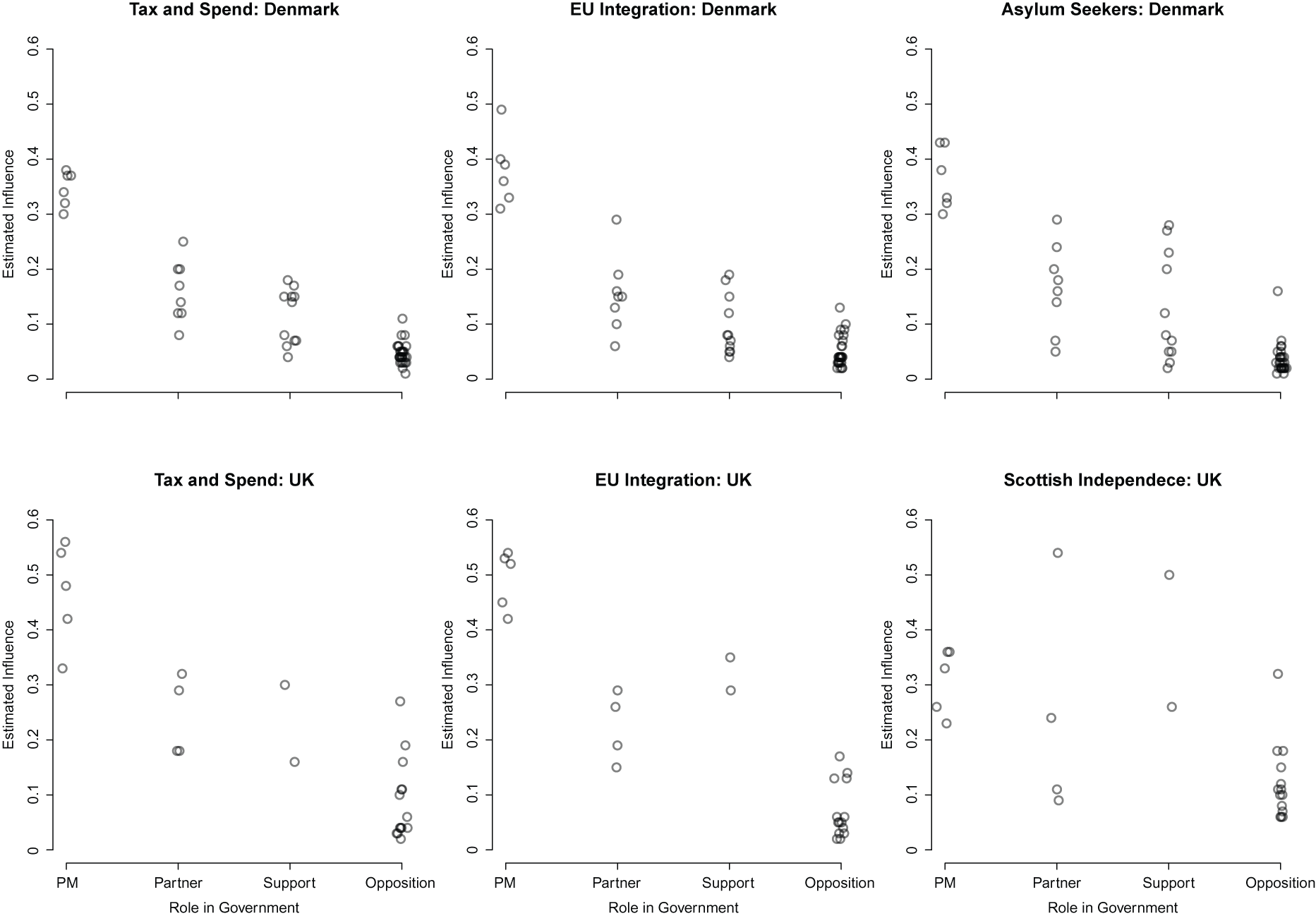
Figure 3 summarizes the large number of estimates produced by the models described above (one for each government and opposition party for 11 different hypothetical cabinets for three policies). This figure plots the estimated influence weights for each party by the role they were assigned in each hypothetical government, omitting standard errors to ease interpretation. Before turning to our main focus, we note that Figure 3 clearly demonstrates two patterns very much in keeping with the results of the last section. First, respondents consistently attribute the most policy influence to prime ministerial parties. Second, respondents generally privilege cabinet partners and support parties over opposition parties. Thus, while the impact of roles is sometimes disrupted due to the impact of policy salience (as we discuss below), our earlier findings about attributions based on formal policy-making roles extend to this very different research design.
Estimated Prospective Policy Influence by Role and Issue

Support Parties
How do voters attribute policy-making influence to parties that give formal support to the cabinet while not actually joining it? In both the Danish and UK surveys, we included various support parties in the hypothetical cabinets presented to respondents, allowing us to separate out the effects of this cabinet role. Figure 3 shows a striking difference between the Danish and UK cases in the way our respondents attributed influence to hypothetical support parties. In each pane of the top panel of the figure (the Danish case) there is a clear, almost linear relationship between perceived role and influence—in which support parties fit snuggly between cabinet partners and opposition parties.
In contrast, the bottom panel reveals that UK voters make no clear distinctions between outside support parties and cabinet partners in attributing policy influence, although they do give both more influence than opposition parties. This conclusion is also confirmed via regression analysis reported in Appendix A.7.2, which controls for the interaction of policy type and party.
This difference is important because it reinforces a theme of this paper: voters come to subconsciously rely on heuristics that “work” in that they are reasonably accurate ex post (or, more generally, do not produce ex post regret). Specifically, given UK voters’ rather limited direct experience with coalition government, it is no wonder that they (in contrast to the Danes) do not distinguish between external support parties and junior partners. Indeed, not making this distinction is consistent with an effort-reducing heuristic inference—why collect and use information that has been (up till now) irrelevant to one’s context? Likewise, the most plausible alternative explanation for this result is equally compatible with our heuristic theory. Specifically, by the time this survey was conducted, there was a widespread perception that the Liberal Democrats had been very ineffectual during its time in coalition (e.g., Cutts and Russell Reference Cutts and Russell2015; Fortunato Reference Fortunato2019). Thus, it is also possible that UK voters, with little experience of coalition on which to ground their beliefs about the long-term association between cabinet partnership and policy influence, instead used the Liberal Democrat’s recent (limited) experience as a cabinet partner to conclude that junior partners in general (including those non-Lib-Dem partners in our hypothetical cabinets) are generally not very influential.
Issue Salience
How does issue salience impact voters’ attributions of policy-making influence? Recall from our theoretical discussion, that we do not expect issue salience to be generally related to attributions of responsibility across parties, since this would require voters to collect a great deal of policy-specific information, which is inconsistent with our general theoretical understanding of voters as heuristic users. Instead, we suggested that policy salience would be useful to voters only in extreme cases in which the pursuit of a distinct (often extreme) position on the issue provides a party’s raison d’être—so that the party becomes indelibly associated with the position (e.g., voters come to think of the party as “the anti-immigration party” or “the pro-independence” party).
The issues we included for each country reflect this theoretical position. First, Scottish independence in the UK and asylum for refugees in Denmark are issues in which this kind of “strong” issue salience varies dramatically among the parties. Specifically, it is well understood that the SNP is the party in the UK for which the Scottish independence issue is (by far) the most salient (and on which it has the most clearly pro-independence position). Likewise, the Danish People’s Party (DPP) is the Danish party for which the asylum issue is most salient (and on which it has the most uncompromising anti-asylum position).Footnote 26 In addition to these obvious cases of strong issue salience, relevant data suggests that, to the extent the Scottish independence issue invokes questions of British nationalism, it has been a highly salient issue to the UK Independence Party (UKIP), which stresses nationalistic themes and preservation of the United Kingdom to a much greater extent in its manifesto than other parties. UKIP was, for example, a vocal opponent of the referendum on Scottish independence, going so far as to suggest the queen should intervene to persuade Britons to vote “no” (BBC 2014).
In contrast to these issues, Taxes and Spending and EU integration are, in contemporary European politics, examples of generic issues that are necessarily salient to all parties and, at least in our sample of countries, do not represent the raison d’être of any major party.Footnote 27
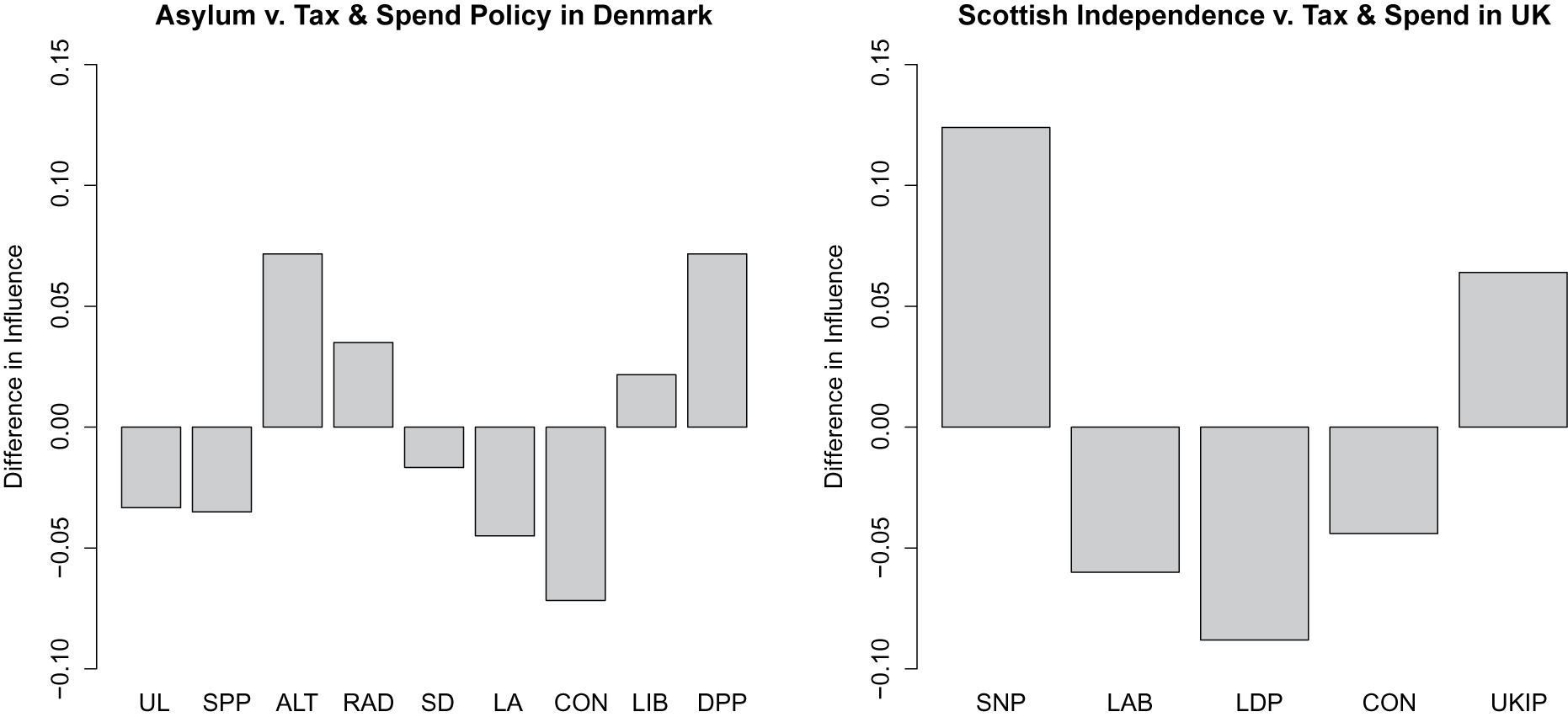
Given this, our initial task is simply to determine whether or not voters attribute more policy influence to the DPP on the Asylum issue and to the SNP (and perhaps UKIP) on the Scottish independence issue, holding government role constant. Figure 4 does this. This figure shows how much more (or less) policy-making influence our respondents attribute (on average) to each Danish and UK party on the asylum issue and the Scottish independence issue relative to taxes and spending. Importantly, these differences are calculated between issues for each party in each hypothetical government, so they hold constant all other possible differences between cases. The estimate here is thus a pure issue effect.
Difference in Attributions of Policy-Making Influence across Issues

Clearly, the results in the left panel are consistent with the expectation that Danes attribute more policy-making responsibility to the DPP on the asylum issue than on taxes and spending. Likewise, UK respondents attribute more policy-making responsibility to the SNP and UKIP on Scottish independence than on taxes and spending. The noted differences in the estimated influence weights between these policies are statistically significant and positive in both cases. Together, these estimates support H8. However, in the Danish case there is one party, the Alternative (ALT), for which there is little evidence that the asylum issue is strongly salient but to which respondents attribute more responsibility for the asylum issue compared with taxes and spending. It is not clear why we see this result; however, it may simply be an artifact of the party’s rather ambiguous policy platform. Specifically, the party was only formed in 2013 and quite specifically rejected the idea of strict adherence to a manifesto, in favor of an open process of debating ideas and coming to a reasoned consensus on policy substance—indeed, it went so far as to crowdsource its initial policy platform. Thus, while we included it in the results for purposes of transparency, the party is simply too new, too unstable, and insufficiently understood to draw any meaningful conclusions from these findings.
To look more broadly at all the relevant data (i.e., also for the EU policy) and test whether any other parties show evidence of “overattributions” for some issue (which would weaken our argument that it is strong policy salience that explains the overattributions for the DPP, SNP, and UKIP described above), we can simply estimate a regression for each country in which we make the dependent variable the estimated influence weight for each party for each policy in each hypothetical cabinet. If on the right hand side we include dummy variables for assigned role, issue, party, and the interactions between issue and party (taking tax and spending as the baseline policy), then a significant positive coefficient on one of the party-issue dummies will indicate that our respondents attribute more influence (relative to taxes and spending) to that party than we would expect given its assigned role. We provide these results in Appendix A.7.2. The only parties to which respondents attribute significantly more influence on any policy relative to the tax and spend issue are those we have already identified: DPP and ALT on asylum and SNP and UKIP on Scottish independence. Likewise, no parties show any significant differences in attributions between the EU issue and taxes and spending (indeed one can reject the hypothesis of joint statistical significance of all the EU policy-party interactions in both models).
Readers may be surprised that UKIP was not allocated more responsibility on EU integration relative to tax and spending. It should be kept in mind, however, that given that the Conservatives wrote a referendum on leaving the EU into their 2015 manifesto and that each hypothetical cabinet in which UKIP was a member was led by the Conservatives, UKIP’s position and emphasis on the issue was no longer distinguishing.
Conclusion
Democratic accountability demands that voters are able to attribute responsibility for policy outcomes to elected representatives, but democratic theorists have long argued that voters are unable to do so when power is shared across multiple parties. This view is common in normative democratic theory (Bagehot Reference Bagehot1867; Hamilton Reference Hamilton1788, Sartori Reference Sartori1994) and also in canonical works on prospective and retrospective voting (Downs Reference Downs1957; Powell and Whitten Reference Powell and Whitten1993). But the degree to which this supposition actually holds has never been directly tested; it has merely been inferred or prodded at indirectly. More vexingly, the discipline has recently seemed to change its mind about voters: modern theories of coalition-directed voting now assume capability rather than inability—while continuing to forego a rigorous empirical examination of whether and how voters attribute policy responsibility to individual actors in multiparty government. In this paper we have begun to remedy this by proposing and testing the idea that coalitional voters use a heuristic (effort reducing) strategy to infer policy-making responsibility—one that relies on a few inexpensive cues and integrates them quite simply.
Our results are consistent with the idea that voters infer a party’s policy influence using a simple additive function of cues about the party’s role in government, its size, and the salience of the issue at stake (though only in cases in which the issue is central to the party’s identity). Further, voters do not integrate into this heuristic cues like median party status and voting power that, while likely predictive of real policy influence, are expensive to collect and/or difficult to infer from less expensive cues. Likewise, we provide some preliminary evidence that heuristic voters also economize on the set of informational inputs they use to infer influence by ignoring cues that are partially redundant with others that are easier to collect and/or easier to apply to a wide variety of parties. Specifically, they appear to prefer to integrate legislative seat shares (along with information about government roles) into their inferences about all parties rather than integrating additional information about cabinet seat shares.Footnote 28
We also find evidence that the relative weights that voters put on different cues (for those they use at all) correspond to the real long-term empirical association between the cues and real policy influence. We see this most clearly in the consistent ordering of estimated cue weights for government roles: PM > Junior Partner > Support Party > Opposition Party. Footnote 29 However, we also see it in the ordering of cue weights across some contexts—for example, the weight voters give to opposition parties in strong legislatures is consistently larger than in weak legislatures.
Given these empirical results, can we conclude that coalitional voters’ attributions are sensible and so normatively encouraging? The answer is mixed, as our theory implies it must be. On one hand, it is quite encouraging that the strongest predictors of voters’ attributions of policy-making influence to parties are their roles in government and legislative seat shares. In combination, the academic literature on multiparty policy making reveals that these are by far the variables most strongly associated with real policy-making influence and voters clearly get this.Footnote 30 On the other hand, the whole point of a heuristic strategy is to reduce effort by focusing on some relevant aspects of a situation and not others and we certainly see this in our data as well, with voters ignoring relevant information on ideological centrality (including median status) and voting power. Further, the fact that respondents’ attributions of responsibility increase almost linearly as legislative seat share increases, regardless of party role, almost certainly results in overattribution to large opposition parties and underattribution to large cabinet parties (especially those not the PM).Footnote 31 Likewise, while there are certainly arguments in the political science literature testifying to the real policy impact of issue salience, our results suggest that voters may overestimate the real policy influence of niche or single-issue parties on their identifying policy dimension. Finally, the small but consistent impact of ideological affinity on attributions of influence surely leads to some misattribution.
An important caveat for all these conclusions is that this work is just beginning. Indeed, we have not even been able to test every important aspect of the heuristic we propose. First, the existing literature is often silent about the relative size (as opposed to the direction) of the long-term associations between potential cues and policy influence across both cues and contexts, so the theory of ecologically rational heuristics cannot generate hypotheses in these cases. Second, we do not yet have data from a sufficiently variable set of contexts (strong vs. weak parliaments, majority vs. minority cabinets, etc.) to thoroughly explore the contextual differences in cue weights the literature does imply (though the ones we have been able to examine conform to our expectations). Third, the heuristic we proposed assumes a linear additive integration of cues, and we have tested hypotheses about the impact of different perceived cues given that assumption. Having identified the cues that seem to be used, however, future work could be designed to test whether this set of cues is actually integrated into an inference with a linear additive function or some other (simple) function like an appropriately modified version of a simple stopping rule (i.e., a “take-the-best” rule that discriminates on a single cue).
Supplementary Materials
To view supplementary material for this article, please visit http://dx.doi.org/10.1017/S0003055420000763.
Replication materials can be found on Dataverse at: https://doi.org/10.7910/DVN/MOL5B3.




Comments
No Comments have been published for this article.