Introduction
With more than 260 described species, the genus Hypotrachyna (Vain.) Hale belongs to Parmeliaceae, a hyperdiverse family of lichenized fungi (Lücking et al. Reference Lücking, Hodkinson and Leavitt2017). Phylogenetic reconstructions indicate a probable generic origin in the neotropical region, where the split of the major Hypotrachyna clades occurred between the Eocene and Oligocene, with South America being the main centre of diversification, represented by c. 120 species (Sipman et al. Reference Sipman, Elix and Nash2009; Cubas et al. Reference Cubas, Lumbsch, Del Prado, Ferencova, Hladun, Victor and Divakar2018). The Hypotrachyna clade includes a sensu stricto group and several well-supported clades recognized as the subgenera Cetrariastrum (Sipman) Divakar et al., Everniastrum (Hale ex Sipman) Divakar et al., Longilobae Divakar et al., Parmelinopsis (Elix & Hale) Divakar et al. and Sinuosae Divakar et al. (Divakar et al. Reference Divakar, Crespo, Núñez-Zapata, Flakus, Sipman, Elix and Lumbsch2013).
Currently considered a subgenus of Hypotrachyna, Parmelinopsis is represented by 28 species, 10 of which occur in Brazil: Hypotrachyna cryptochlora (Vain.) D. Hawksw. & A. Crespo, H. damaziana (Zahlbr.) Krog & Swinscow, H. heteroloba (Zahlbr.) Divakar et al., H. horrescens (Taylor) Krog & Swinscow, H. jamesii (Hale) Divakar et al., H. minarum (Vain.) Krog & Swinscow, H. schindleri (Hale) Divakar et al., H. spathulata (Kurok.) Krog & Swinscow, H. spumosa (Asahina) Krog & Swinscow, and H. subfatiscens (Kurok.) Swinscow & Krog (Canêz Reference Canêz2005; Martins et al. Reference Martins, Käffer and Lemos2008; Benatti Reference Benatti2012; Lendemer & Allen Reference Lendemer and Allen2020). Parmelinopsis is a genus that was previously segregated from Parmelina Hale by Elix & Hale (Reference Elix and Hale1987), encompassing species with a white medulla, emaculated thallus, narrow and apically truncated laciniae, simple marginal cilia, simple to dichotomous rhizines, cylindrical to bifusiform conidia (c. 3–5 μm) and commonly orcinol tridepsides as the main medullary chemical group (Elix & Hale Reference Elix and Hale1987; Benatti Reference Benatti2012). However, this circumscription of Parmelinopsis proved to be polyphyletic in molecular phylogenies, indicating multiple origins of these morphological and chemical characters in the Hypotrachyna clade (Divakar et al. Reference Divakar, Crespo, Blanco and Lumbsch2006, Reference Divakar, Crespo, Núñez-Zapata, Flakus, Sipman, Elix and Lumbsch2013). Thus, the subgenus Parmelinopsis currently encompasses species with eciliate laciniae up to 6 mm wide, mostly dichotomous rhizines, and depsides derived from β-orcinol and (or) orcinol as main chemical compounds. These characteristics are not exclusive and can also be found in other subgenera (Divakar et al. Reference Divakar, Crespo, Núñez-Zapata, Flakus, Sipman, Elix and Lumbsch2013; Lendemer & Allen Reference Lendemer and Allen2015, Reference Lendemer and Allen2020).
In Brazil, species of Hypotrachyna subgenus Parmelinopsis are common in the Cerrado ecoregion or province, including open areas of savannah and seasonal forests, as well as urban environments (Marcelli Reference Marcelli1993). The Cerrado is a biodiversity hotspot characterized by different landscapes, ranging from tropical grasslands to seasonal forests, with numerous species adapted to the frequent fires that occur during the six-month dry season (Batalha Reference Batalha2011; Strassburg et al. Reference Strassburg, Brooks, Feltran-Barbieri, Iribarrem, Crouzeilles, Loyola, Latawiec, Oliveira Filho, Scaramuzza and Scarano2017; Oliveira et al. Reference Oliveira, Soares-Filho, Souza Costa, Gomes, Bustamante and Miranda2021). However, studies of widespread lichenized fungi from this highly seasonal region are still scarce (Jungbluth Reference Jungbluth2006).
This study introduces Hypotrachyna neohorrescens Jungbluth, Marcelli & Lorenz, a new species from the south-eastern Cerrado, provides a detailed description and infers its phylogenetic position.
Material and Methods
Morphological data: study location, sampling and identification
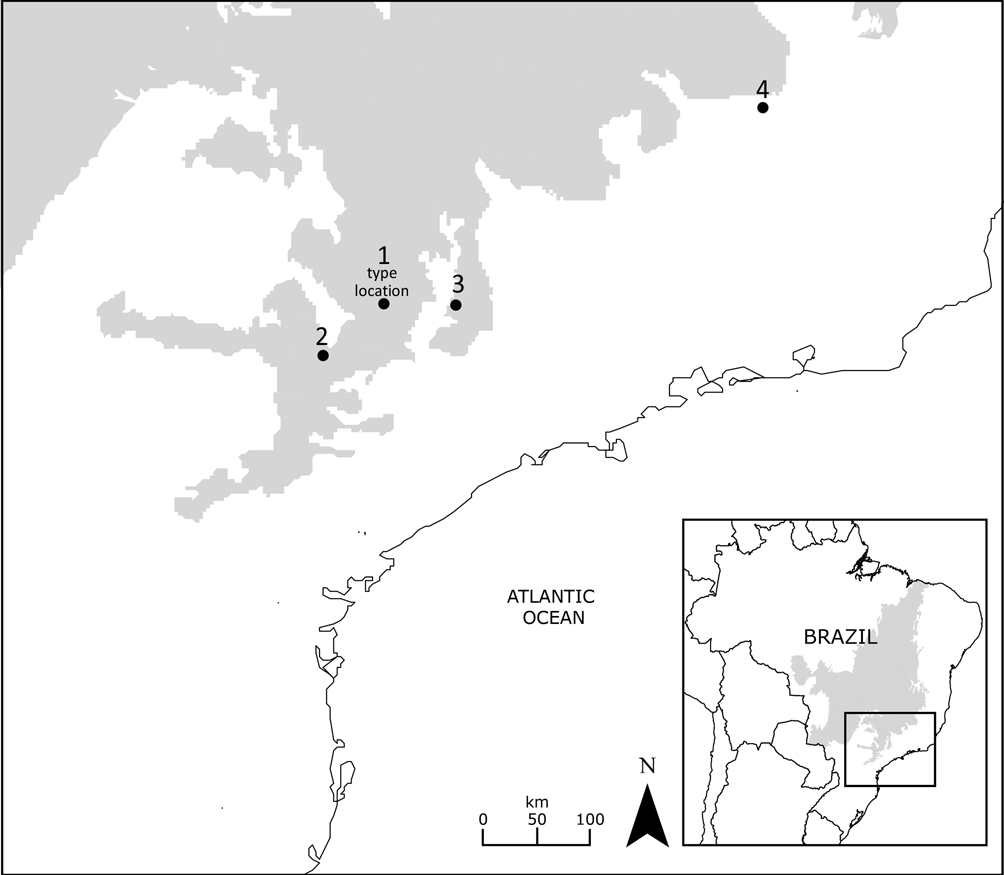
Specimens of Hypotrachyna neohorrescens sp. nov. were collected on trees of forest fragments in southern Cerrado (Fig. 1). Furthermore, specimens of Hypotrachyna minarum, a species that morphologically resembles H. horrescens, were collected in restingas (Atlantic forests adapted to coastal plains) in southern Brazil. Morphological descriptions are based on all specimens examined, using a Nikon SMZ645 stereomicroscope (Nikon Corporation, Japan) and an Olympus CX22LED optical microscope (Olympus Corporation, Japan). Chemical compounds were identified by spot tests (K, C, KC and P) and thin-layer chromatography (TLC), using solvents A and C (Orange et al. Reference Orange, James and White2010).
Sampling points of Hypotrachyna neohorrescens in the south-eastern Cerrado ecoregion of Brazil. 1, P. Jungbluth 3160, 3317 (type), 3161, 3264 and 3266. 2, P. Jungbluth 2690 and 2709. 3, P. Jungbluth 2642 and 2647. 4, P. Jungbluth 2294. The Cerrado distribution is shown in grey.

The specimens of H. neohorrescens examined were deposited in the herbaria of the Universidade Federal de Santa Maria (PALM) and the Instituto de Botânica (SP), and the specimens of H. minarum were deposited in the herbarium of the Universidade Federal de Mato Grosso do Sul (CGMS). In addition, we undertook morphological studies of the lectotype of Parmelia [Hypotrachyna] horrescens (Taylor) Krog & Swinscow (FH-TAYL), kindly loaned to us by the curator of herbarium FH (Farlow Herbarium, Harvard University).
Phylogenetic analyses
Prior to DNA extraction, thallus fragments were immersed in acetone for 20 min to remove the secondary compounds. The fragments were then dried in the open air until the acetone evaporated completely. DNA extraction was performed using the Wizard® Genomic DNA Purification Kit (Promega) following the manufacturer's protocol. The nuITS region was amplified using the universal primers ITS1F (Gardes & Bruns Reference Gardes and Bruns1993) and ITS4 (White et al. Reference White, Bruns, Lee, Taylor, Innis, Gelfand, Sninsky and White1990). To amplify the mtSSU and nuLSU regions, we used the primers mrSSU1 and mrSSU3R (Zoller et al. Reference Zoller, Scheidegger and Sperisen1999), and LR1R (Döring et al. Reference Döring, Clerc, Grube and Wedin2000) and LR6 (Vilgalys & Hester Reference Vilgalys and Hester1990), respectively. The 25 μl PCR reactions contained the following: 1× buffer, 0.2 mM dNTPs, 0.2 μM of each primer, 3.0 mM MgCl2, 1U Taq DNA polymerase (Promega) and c. 20 ng of DNA template. The PCR conditions for the amplification of the nuITS region were as follows: initial denaturation for 2 min at 95 °C, followed by 30 cycles of denaturation at 95 °C for 30 s, annealing between 54–56 °C for 30 s, extension at 72 °C for 1 min 10 s and a final extension at 72 °C for 5 min. For the mtSSU and nuLSU regions, we applied the following: initial denaturation for 5 min at 95 °C, followed by 35 cycles of denaturation at 95 °C for 1 min, annealing at 54 °C for 1 min, extension at 72 °C for 1 min 30 s and a final extension at 72 °C for 10 min. The PCR reactions were performed in an Eppendorf Mastercycler® Gradient thermal cycler. The amplification products were visualized in 1% agarose gel stained with GelRed® (Biotium). Macrogen Korea performed DNA purification and sequencing.
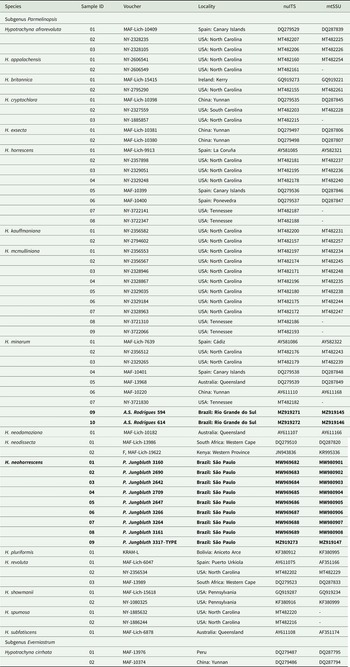
For assembly and quality evaluation of the DNA sequences generated, we used Geneious® 9.1.6 (Kearse et al. Reference Kearse, Moir, Wilson, Stones-Havas, Cheung, Sturrock, Buxton, Cooper, Markowitz and Duran2012). Sequences from GenBank were selected to encompass the main clades of the Hypotrachyna clade (details in Table 1). Hypotrachyna cirrhata (Fr.) Divakar et al. (subgenus Everniastrum) was chosen as outgroup due to its close phylogenetic relationship with Hypotrachyna subgenus Parmelinopsis (Divakar et al. Reference Divakar, Crespo, Núñez-Zapata, Flakus, Sipman, Elix and Lumbsch2013). Multiple sequence alignments for each locus were performed using MAFFT v.7 (Katoh & Standley Reference Katoh and Standley2013), with the auto option and subsequent manual inspection. We removed the ambiguous sites from the alignments with Gblocks 0.97b (http://molevol.cmima.csic.es/castresana/Gblocks_server.html), selecting all less stringent options (Talavera & Castresana Reference Talavera and Castresana2007).
Sequences of Hypotrachyna used in the phylogenetic analyses with voucher information and GenBank Accession numbers. New sequences are shown in bold.

Exploratory analyses using BLAST tools revealed that the nuLSU sequences obtained were up to 85% identical to mtDNA of the green algal genus Trebouxia Puymaly, the associated photobiont. Therefore, the nuLSU sequences were excluded from subsequent analyses. Two datasets were used, one with the sequences of the nuITS and mtSSU regions concatenated and one with only the nuITS region, the universal DNA barcode for fungi (Schoch et al. Reference Schoch, Seifert, Huhndorf, Robert, Spouge, Levesque and Chen2012). Phylogenetic analyses were based on maximum likelihood (ML) and Bayesian (B/MCMC) approaches, performed on the Cipres Science Gateway webserver (https://www.phylo.org/). The ML analysis was performed using RAxML v.8 (Stamatakis Reference Stamatakis2014), with the GTRGAMMA model and 1000 bootstrap pseudoreplicates. We used jModelTest 2.1.6 (Darriba et al. Reference Darriba, Taboada, Doallo and Posada2012) to verify the best nucleotide substitution model, using the Akaike information criterion (Akaike Reference Akaike1974). The model GTR + G was selected for the nuITS region, and HKY + I + G for mtSSU. For the tree reconstruction based on Bayesian inference, the program MrBayes 3.2.7 (Ronquist et al. Reference Ronquist, Teslenko, van der Mark, Ayres, Darling, Höhna, Larget, Liu, Suchard and Huelsenbeck2012) was used with two parallel Markov chain Monte Carlo (MCMC) chains with 10 million generations, saving every 1000th tree. The first 25% of the sampled trees was discarded as burn-in. The convergence of the Bayesian analysis chains was verified using Tracer v.1.7 (Rambaut et al. Reference Rambaut, Drummond, Xie, Baele and Suchard2018), with the effective sample size (ESS) ≥ 200 considered as indicative. Branches with bootstrap values ≥ 70% for ML, and posterior probabilities ≥ 0.95 for Bayesian inference were considered to be supported. These values were also used to compare maximum likelihood and Bayesian analyses to check for conflicts in the resulting topologies.
Additionally, pairwise genetic distances were calculated for the nuITS region (using the alignment with the ambiguous sites removed) with PAUP v.4.0b10 (Swofford & Sullivan Reference Swofford, Sullivan, Salemi and Vandamme2003), using ML as a distance measure, while pairwise distances between different sequences are given as the number of nucleotide substitutions per site (s/s). We used the barcode gap values (a threshold close to 0.015–0.017 s/s) proposed for Parmeliaceae (Del-Prado et al. Reference Del-Prado, Cubas, Lumbsch, Divakar, Blanco, Amo de Paz, Molina and Crespo2010) to distinguish H. neohorrescens from the phylogenetically closest species.
Results
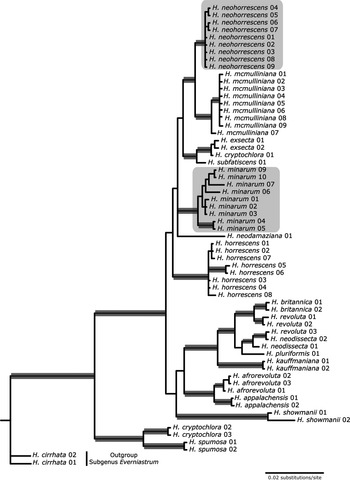
Novel sequences from nuITS and mtSSU regions were obtained for nine specimens of H. neohorrescens (collected from sampling points 1, 2 and 3 in Fig. 1), and two specimens of H. minarum (Table 1). The final data matrix contained 63 concatenated sequences of the markers nuITS and mtSSU with a length of 1271 characters (see Supplementary Material File S1, available online). There were no conflicts between the phylogenies based on maximum likelihood and Bayesian inference of the concatenated matrix, so only the Bayesian tree is shown in Fig. 2. Hypotrachyna neohorrescens sp. nov. formed a new clade, closely related to the North American H. mcmulliniana Lendemer & J. L. Allen. The single marker matrix containing 63 nuITS sequences with 472 characters resulted in trees with a similar topology, but they did not recover complete reciprocal monophyly of H. neohorrescens and H. mcmulliniana (Supplementary Material Fig. S1, available online). This lack of resolution reflects the low divergence among the nuITS sequences. The mean genetic distance between H. neohorrescens and H. mcmulliniana was 0.0185 s/s, ranging from 0.0142 to 0.0205 s/s.
Phylogenetic relationships of Hypotrachyna subgenus Parmelinopsis based on maximum likelihood (ML) and Bayesian inference analyses from nuITS and mtSSU sequences. The Bayesian tree is shown here. Thickened branches indicate ML bootstrap values ≥ 70% and posterior probabilities ≥ 0.95. Grey boxes indicate the species for which novel sequences have been generated in this study.

In addition, we also verified the phylogenetic position of H. minarum, a widely distributed species with its type specimen from Brazil. The H. minarum clade included sequences from Australia, Brazil, China, the United States and Spain (Fig. 2). Interestingly, nuITS distances up to 0.017 s/s indicated that more than one species might be in this clade. The Brazilian specimens analyzed in this study were characterized by laminal isidia without cilia (as described for North American populations in Lendemer & Allen (Reference Lendemer and Allen2020)), marginal lobes with rare cilia, and the presence of atranorin and gyrophoric acid, together with an unidentified compound (migrated above gyrophoric acid in solvent C in the TLC profile).
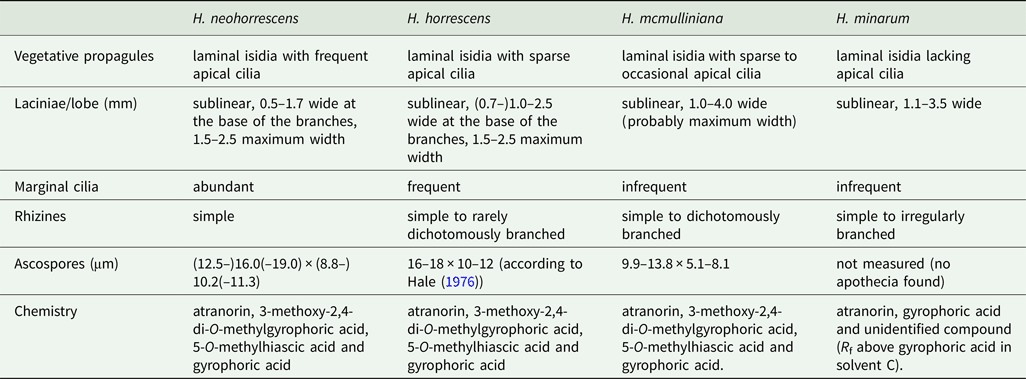
Thus, based on its morphology, phylogenetic relationships (inferred with concatenated markers) and geographical distribution, we consider H. neohorrescens to be a new species and highlight its main diagnostic characteristics below and in Table 2.
Comparison of the morphological characters of Hypotrachyna neohorrescens, H. horrescens, H. mcmulliniana and H. minarum. Information for H. mcmulliniana is based on Lendemer & Allen (Reference Lendemer and Allen2020) and for H. horrescens on the lectotype (FH-TAYL).

Taxonomy
Hypotrachyna neohorrescens Jungbluth, Marcelli & Lorenz sp. nov.
MycoBank No.: MB 841994
Morphologically similar to Hypotrachyna horrescens but differs by its phylogenetic position (based on concatenated nuITS and mtSSU regions). Additionally, H. neohorrescens is phylogenetically close to H. mcmulliniana, differing in lacinia size (0.5–1.7 mm vs 1.0–4.0 mm wide), ascospore size (12.5–19.0 × 8.8–11.3 μm vs 9.9–13.8 × 5.1–8.1 μm) and geographical distribution (South America vs North America).
Type: Brazil, São Paulo State, municipality of Itirapina, Estação Experimental de Itirapina, Instituto Florestal, corticolous, tree in a well-preserved area of Cerrado seasonal forest, named Valério, c. 818 m alt., 22°13ʹ10.0ʺS, 47°51′05.7″W, 10 December 2012, P. Jungbluth, M. J. Kitaura & S. A. Adachi 3317 (PALM—holotype). GenBank Accession nos: MZ919273 (nuITS) and MZ919147 (mtSSU).
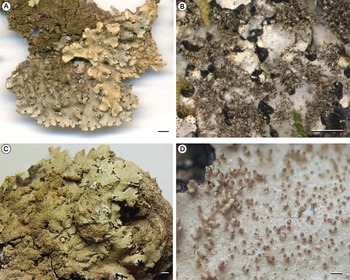
Morphological features of selected Hypotrachyna species in Brazil. A & B, Hypotrachyna neohorrescens. A, thallus of the holotype (P. Jungbluth 3317). B, distribution and abundance of ciliated isidia on the upper surface (P. Jungbluth 3316). C & D, Hypotrachyna minarum. C, thallus (A. S. Rodrigues 614). D, laminal isidia lacking cilia (A. S. Rodrigues 594). Scales: A = 2 mm; B & C = 1 mm; D = 0.2 mm. In colour online.

Thallus corticolous, greenish grey, laciniate, 2–7 cm diam., adnate. Proximal upper surface continuous, densely isidiate. Distal upper surface continuous, smooth, becoming densely covered by young isidia, shiny, with a darker line near the tips, evidently thicker at the sinuses of the laciniae. Laciniae sublinear, mainly dichotomously branched, contiguous to slightly overlapping laterally, 0.5–1.7(–2.0) mm wide at the base of the branches, 1.5–2.5 mm maximum width; lateral margin smooth to crenate, slightly canaliculated; axils oval; apices subtruncate, flat with an involute tendency, procumbent. Pruina absent. Maculae absent. Cilia black, marginal, shiny, with acute ends, simple, abundant, mainly restricted in the axils and sinuses and in the isidia, up to 0.4 mm long. Isidia with pale to dark brown apices, mainly cylindrical, simple becoming very branched and coralloid in old thalli, erect, apices frequently ciliate, including the apices of the lateral branches; laminal, up to 0.5 mm. Soralia absent. Medulla white. Distal lower surface brown, shiny, smooth near the margins becoming papillate (small rhizines). Proximal lower surface black, shiny, slightly rugose, and veined. Rhizines black, simple, rarely irregularly branched, abundant, evenly distributed, up to 0.75 mm long.
Apothecia rare, concave, adnate, laminal, up to 2.5 mm diam.; margin smooth becoming isidiate; disc brown, shiny, without pruina. Epithecium 12.5–17.5 μm high; hymenium 50.0–62.5 μm high; subhymenium 50.0–62.5 μm high. Ascospores ellipsoid, (12.5–)16.0(–19.0) × (8.8–)10.2(–11.3) μm, episporium 1.0–2.0 μm (apothecia and ascospores found only in P. Jungbluth 2294).
Pycnidia rare, laminal to submarginal. Conidia bacilliform to bifusiform, (3.0–)4.0–6.0 μm.
Chemistry
Upper cortex K+ yellow, UV−; medulla K−, C−, KC+ pink, P−, UV−. Atranorin, 3-methoxy-2,4-di-O-methylgyrophoric acid (‘horrescens complex’), 5-O-methylhiascic acid and gyrophoric acid.
Etymology
The specific epithet refers to the morphological similarity to H. horrescens and its known distribution in the neotropical region.
Distribution and habitat
The species is commonly found in south-eastern Cerrado, mainly in the states of São Paulo and Minas Gerais, Brazil.
Intraspecific morphological variation
There is a conspicuous presence of ciliate isidia in some specimens of this species, although there are exceptions. Populations of H. neohorrescens from Itirapina (collection point 1 in Fig. 1), for example, show abundantly ramified isidia with conspicuous apical cilia (Fig. 3B) whereas other specimens do not have ciliate isidia, instead resembling Hypotrachyna minarum, a species common in Brazil (Fig. 3C & D). This populational variation was also observed in H. horrescens by Hale (Reference Hale1971). However, H. horrescens and H. neohorrescens can be distinguished from H. minarum by the presence of the 3-methoxy-2,4-di-O-methylgyrophoric acid.
Additional specimens examined
Brazil: Minas Gerais State: Catas Altas, Parque Natural do Caraça (Sanctuary of Caraça), tree from the forest between Atlantic and Cerrado seasonal forests, trail to ‘Piscina’, corticolous, 1365 m, 20°06′08.2″S, 43°30′04.1″W, 2010, P. Jungbluth 2294 (PALM). São Paulo State: Itirapina, Estação Experimental de Itirapina, Instituto Florestal, corticolous, tree in a well-preserved area of Cerrado seasonal forest, named Valério, c. 818 m, 22°13′10.0″S, 47°51′05.7″W, 2012, P. Jungbluth, M. J. Kitaura & S. A. Adachi 3160, 3161 (PALM); ibid., on tree singed by fire in savannah (Cerrado s. str.), 757 m, 22°12′23″S, 47°54′26″W, 2012, P. Jungbluth, M. J. Kitaura & S. A. Adachi 3264, 3266 (PALM). Mogi-Guaçu: Martinho Prado District, Reserva Biológica de Mogi-Guaçu, Fazenda Campininha, corticolous, on Cerrado seasonal forest, 620 m alt., 22°15′19″S, 47°09′17″W, 2011, P. Jungbluth, M. M. Marcelli & B. R. da Hora 2642, 2647 (PALM). Pratânia: Fazenda Palmeira da Serra, private reserve area of Cerrado, on seasonal forest inside sugar cane crops, corticolous, 710 m, 22°48′55″S, 48°44′36″W, 2011, P. Jungbluth & S. B. Bissacot 2690, 2709 (PALM).
Discussion
The Cerrado is characterized by a patchy landscape with frequently burned areas which have poor or absent lichenized mycobiota, since it takes c. 20 years for significant coverage and diversity to develop again (Marcelli et al. Reference Marcelli, Pereira, Iacomini, Marcelli and Seaward1998). Species of Hypotrachyna subgenus Parmelinopsis are especially frequent in these environments (Jungbluth Reference Jungbluth2006); however, their diversity may be underestimated due to the lack of studies based on morphology and molecular tools (Lendemer & Allen Reference Lendemer and Allen2020).
Using the nuITS and mtSSU regions, specimens phenotypically similar to H. horrescens and H. mcmulliniana collected in south-eastern Cerrado were recovered as new species of the Parmelinopsis subgenus. Hypotrachyna neohorrescens sp. nov. and H. horrescens produce frequent ciliated isidia on the upper surface, laciniae 0.5–1.7 mm wide, ellipsoid spores 12.5–19 × 8.8–11.3 μm in H. neohorrescens and 16–19 × 10–12 μm in H. horrescens according to Hale (Reference Hale1976) (the studied lectotype did not have apothecia), and the same chemistry (atranorin, 3-methoxy-2,4-di-O-methylgyrophoric acid, 5-O-methylhiascic acid and gyrophoric acid) (Table 2). Thus, morphological and chemical characters did not distinguish these species, although they belong to different clades and accumulate significant genetic divergence (0.0359–0.0551 s/s in the nuITS; Fig. 2). Phenotypically cryptic or ‘near-cryptic’ species are commonly found in molecular studies of Parmeliaceae, which have revealed higher levels of undescribed diversity among the lichenized fungi in recent decades (Crespo & Lumbsch Reference Crespo and Lumbsch2010; Altermann et al. Reference Altermann, Leavitt, Goward, Nelsen and Lumbsch2014; Singh et al. Reference Singh, Dal Grande, Divakar, Otte, Leavitt, Szczepanska, Crespo, Rico, Aptroot and Cáceres2015; Leavitt et al. Reference Leavitt, Esslinger, Divakar, Crespo and Lumbsch2016; Lutsak et al. Reference Lutsak, Fernández-Mendoza, Kirika, Wondafrash and Printzen2020). Hypotrachyna neohorrescens and H. mcmulliniana also share many morphological features; however, they can be distinguished by the lacinia size (0.5–1.7 mm vs 1.0–4.0 mm wide) and the size of the ascospores ((12.5–)16.0(–19.0) × (8.8–)10.2(–11.3) μm vs 9.9–13.8 × 5.1–8.1 μm). Furthermore, the known geographical distribution of H. neohorrescens is the south-eastern Cerrado (South America), while H. mcmulliniana is widespread throughout south-eastern North America (Table 2; Lendemer & Allen Reference Lendemer and Allen2020).
Phylogenetic reconstructions based solely on the nuITS marker did not recover reciprocal monophyly of H. neohorrescens and H. mcmulliniana (Supplementary Material Fig. S1, available online). Conversely, the two species were separated in distinct clades with the nuITS and mtSSU regions concatenated (Fig. 2). The nuITS genetic distances, widely used as a tool for taxon delimitation in Parmeliaceae (Leavitt et al. Reference Leavitt, Esslinger, Hansen, Divakar, Crespo, Loomis and Lumbsch2014; Divakar et al. Reference Divakar, Leavitt, Molina, Del-Prado, Lumbsch and Crespo2016; Del-Prado et al. Reference Del-Prado, Buaruang, Lumbsch, Crespo and Divakar2019), do not appear to be universally efficient in discriminating species of the subgenus Parmelinopsis. The mean genetic distance between H. neohorrescens and H. mcmulliniana was 0.018 s/s, ranging from 0.014–0.020 s/s, at the threshold between intra- and interspecific distances of Parmeliaceae (0.015–0.017 s/s; Del-Prado et al. Reference Del-Prado, Cubas, Lumbsch, Divakar, Blanco, Amo de Paz, Molina and Crespo2010). Similarly, H. afrorevoluta (Krog & Swinscow) Krog & Swinscow and H. appalachensis Lendemer & J. L. Allen present nuITS distances between 0.016–0.018 s/s, indicating that some species of the subgenus Parmelinopsis may have a recent origin and cannot be differentiated using only the nuITS region.
Considering the different datasets collected in this study, we propose Hypotrachyna neohorrescens as a new species and reinforce the need for more taxonomic and molecular studies to unveil the diversity of Hypotrachyna subgenus Parmelinopsis in the neotropical region, especially in threatened biodiversity hotspots such as the Cerrado.
Acknowledgements
This study was financed in part by the Coordenação de Aperfeiçoamento de Pessoal de Nível Superior – Brazil (CAPES) – Finance Code 001, CAPES Proc.02749/09-2 PNPD 2205/2009, and FINEP. We thank Ana Letícia S. Dourado for laboratory assistance and Dr Neli Honda for support with the chemical studies. We are also grateful to the curator of FH for the loan of the lectotype of Parmelia horrescens.
Author ORCIDs
Andressa S. Rodrigues, 0000-0001-5602-1474; Priscila C. da Costa, 0000-0002-2192-5796; Aline P. Lorenz, 0000-0002-2810-2282; Patrícia Jungbluth, 0000-0002-6657-9540.
Supplementary Material
To view Supplementary Material for this article, please visit https://doi.org/10.1017/S0024282922000020.