Introduction
Understanding the nature of the association between use of cannabis, the most widely used illicit drug worldwide (UNODC, 2015), and depressive disorders is important while considering health policies involving cannabis, because depressive disorders are the leading contributor to the global burden of disease attributable to mental and substance use disorders(Whiteford et al. Reference Whiteford, Degenhardt, Rehm, Baxter, Ferrari and Erskine2013). While evidence is fairly consistent in support of cannabis use as a risk factor for the development of psychosis (Moore et al. Reference Moore, Zammit, Lingford-Hughes, Barnes, Jones and Burke2007) and its relapse (Patel et al. Reference Patel, Wilson, Jackson, Ball, Shetty and Broadbent2016; Schoeler et al. Reference Schoeler, Petros, Di Forti, Klamerus, Foglia and Ajnakina2016b; Reference Schoeler, Petros, Di Forti, Pingault, Klamerus and Fogliac), little consensus exists regarding its association with depressive disorders. This is particularly important in light of marked shifts in public attitudes to cannabis use and its legal standing in society in many countries (Benac & Caldwell, Reference Benac and Caldwell2013). Although studies have reported feelings of depression, tiredness, lack of motivation, low energy and anxiety as the most commonly reported negative experiences in cannabis users (Reilly et al. Reference Reilly, Didcott, Swift and Hall1998) and cross-sectional evidence suggests that higher levels of depressive symptoms may be associated with cannabis use (Schoeler et al. Reference Schoeler, Kambeitz, Behlke, Murray and Bhattacharyya2016a), uncertainty remains regarding the precise nature of this relationship. For instance, integrating data from four different cohorts, Horwood et al. (Reference Horwood, Fergusson, Coffey, Patton, Tait and Smart2012) reported that two of the cohorts suggested that cannabis use leads to the development of depression, a third cohort suggested that depression leads to cannabis use, while the fourth one did not find that either of those relationships were significant when employing longitudinal modelling. Another integrative analysis (Silins et al. Reference Silins, Horwood, Patton, Fergusson, Olsson and Hutchinson2014) using participant-level data from three of these cohorts did not find any association with depression by age 25, when they adjusted for potential confounders.
Other investigations that have tested the direction of this association (whether cannabis use leads to depression or vice versa) in the same sample yielded similarly contradictory results. Some suggest that cannabis use leads to depression (Hayatbakhsh et al. Reference Hayatbakhsh, Najman, Jamrozik, Mamun, Alati and Bor2007), while others suggest that depression leads to increase (Feingold et al. Reference Feingold, Weiser, Rehm and Lev-Ran2015) or even decreases (Womack et al. Reference Womack, Shaw, Weaver and Forbes2016) in cannabis use. One study did not find any significant association (Repetto et al. Reference Repetto, Zimmerman and Caldwell2008) and another one reported a bi-directional relationship between cannabis use and depression severity (Baggio et al. Reference Baggio, N'goran, Deline, Studer, Dupuis and Henchoz2014). Similarly, results from investigations which tested a unidirectional hypothesis about the nature of this association in their sample are equivocal, with some suggesting that depression is a risk factor of subsequent cannabis use (Wittchen et al. Reference Wittchen, Fröhlich, Behrendt, Günther, Rehm and Zimmermann2007), while a larger number suggest that cannabis use is a risk factor for subsequent depression (Brook et al. Reference Brook, Brook, Zhang, Cohen and Whiteman2002; Gage et al. Reference Gage, Hickman, Heron, Munafò, Lewis and Macleod2015) (for a summary of observational studies see online Supplementary Table S1).
A recent meta-analysis of longitudinal studies suggest moderate effects of cannabis use on the risk of development of depression (Lev-Ran et al. Reference Lev-Ran, Roerecke, Le Foll, George, Mckenzie and Rehm2014), though confidence in these effects was offset by large variability across studies as well as methodological concerns. On balance, this suggests that the possibility of other unobserved sources of confounding, such as a common genetic liability influencing both cannabis use and depression cannot be ruled out (Lynskey et al. Reference Lynskey, Glowinski, Todorov, Bucholz, Madden and Nelson2004). Studies that have explored dose–response relationships either did not find a significant effect of frequency of cannabis use on depression (Repetto et al. Reference Repetto, Zimmerman and Caldwell2008; Feingold et al. Reference Feingold, Weiser, Rehm and Lev-Ran2015) or found evidence in support of a dose–response relationship (Brook et al. Reference Brook, Brook, Zhang, Cohen and Whiteman2002; Gage et al. Reference Gage, Hickman, Heron, Munafò, Lewis and Macleod2015). Other evidence reported that the ratio between δ-9-tetrahydrocannabinol (THC), the main psychoactive ingredient in the cannabis plant, and cannabidiol (CBD), the other main cannabinoid present in the extract of cannabis (i.e. the THC:CBD ratio), was not linked to depression scores in users (Schubart et al. Reference Schubart, Sommer, Van Gastel, Goetgebuer, Kahn and Boks2011). This is supported by experimental studies that did not find that the administration of THC increased depressive symptoms in healthy subjects (Englund et al. Reference Englund, Atakan, Kralj, Tunstall, Murray and Morrison2015). Another important determinant of the effect of cannabis, i.e. use during a sensitive developmental period (Pope et al. Reference Pope, Gruber, Hudson, Cohane, Huestis and Yurgelun-Todd2003), was not considered by a majority of the studies. Among the few studies that included age of onset of cannabis use in their analyses, some found more adverse effects if started at a younger age (Hayatbakhsh et al. Reference Hayatbakhsh, Najman, Jamrozik, Mamun, Alati and Bor2007; Horwood et al. Reference Horwood, Fergusson, Coffey, Patton, Tait and Smart2012), while most were not indicative of moderating effects of age of onset of cannabis use on risk of depression (Horwood et al. Reference Horwood, Fergusson, Coffey, Patton, Tait and Smart2012; Lev-Ran et al. Reference Lev-Ran, Roerecke, Le Foll, George, Mckenzie and Rehm2014).
The main limitation of evidence to date is the lack of a life-span prospective design, combined with multi-wave assessments to follow-up a cohort of individuals. Such an approach makes it possible to investigate the question of whether later life depression results from early-onset cannabis use. This is particularly crucial as although cannabis use commonly starts in early or mid-adolescence (Wagner & Anthony, Reference Wagner and Anthony2002), a diagnosis of depressive disorder typically manifests in middle or later life (Kessler et al. Reference Kessler, Angermeyer, Anthony, De Graaf, Demyttenaere and Gasquet2007). However, most studies to date have examined cohorts comprising only adolescents or young adults, with a maximum follow-up age of 34 years (cf. online Supplementary Table S1), thus limiting their ability to detect the incidence of depression, a substantial proportion of which is likely to have onset beyond the follow-up period of these studies. This may largely explain the conflicting nature of association observed in previous studies. In the present study, we have addressed these limitations by employing a prospective, multi-wave, life-span cohort design (including more than 40 years of follow-up, to age 48). Specifically, we investigated the effects of cannabis use on the risk of developing a major depression disorder (MDD) (First et al. Reference First, Spitzer, Gibbon and Williams1998) by age 48, by:
(1) assessing the magnitude of the association between cannabis use and depression;
(2) exploring whether the effects vary across different developmental stages;
(3) controlling for important observed confounders (other illicit drug use, comorbid mental disorder, employment status) and unobserved time-invariant sources of confounding in multiple fixed-effects (FE) analyses;
(4) investigating the directionality of the association between cannabis use and depression.
Methods
Study sample
The Cambridge Study in Delinquent Development (CSDD) is a prospective longitudinal study of the development of offending and antisocial behaviour in a cohort of 411 boys born mostly in 1953 and living in an ethnically homogeneous, working-class urban area of London (Farrington et al. Reference Farrington, Coid, Harnett, Jolliffe, Soteriou and Turner2006). They represented the complete population of boys who were 8 years old at that time (1961/62) and were attending one of six primary schools in a deprived area in London. Multiple waves (T1–T7) of data collection, which included participant interviews [at ages 8 (T1), 10 (T2), 14 (T3), 16 (T4), 18 (T5), 32 (T6) and 48 (T7)] complemented information obtained from parents (annually) and teachers (bi-annually) between ages 8 and 15 years. Ninety-seven per cent of the sample was white and most were raised in two-parent working class households. A detailed description of the methods is included as supplementary material (cf. online Supplementary Appendix S1). The study was approved by the Ethics Committee of the Institute of Psychiatry, Psychology & Neuroscience.
Measures
Lifetime diagnosis of MDD and age of onset of MDD were assessed by a psychiatrist using the Structured Clinical Interview for DSM-IV (Diagnostic and Statistical Manual of Mental Disorders, Fourth Edition) Axis I Disorders (SCID I) (First et al. Reference First, Spitzer, Gibbon and Williams1998) as part of a psychiatric interview at T7. Frequency of cannabis use was assessed at T3, T5, T6 and T7. The cannabis use predictor was coded as a categorical variable that took into account age of first reported use [early-onset user (reported use at age 18 or before) v. late-onset user (reported use subsequent to age 18)] and frequency of use [high-frequency user (⩾450 times used across T3, T5, T6, T7) v. low-frequency user (<450 times used)]. This cut-off was chosen to generate a ‘high-frequency’ cannabis group based on cannabis use pattern reported by our sample, here defined as greater than twice the third quantile (Q 3) for number of times used (Q 3 = 200 times used in those who used it at least once in their lifetime). Covariates included in the simple analysis were chosen based on previous research, including alcohol, cigarette and other illicit drug use, socioeconomic status, other psychiatric illness, behavioural and emotional problems in childhood, childhood anxiety and childhood conduct problems (for details, see online Supplementary Appendix S1). Those variables were included as binary variables, for which the higher category was indicative of disadvantage (e.g. low socioeconomic status, presence of childhood anxiety).
Statistical methods
Data were analysed using R3.1.3 comprising three main statistical approaches, which are described in more detail in the online Supplementary Appendix S1: First, simple logistic regression analysis to estimate the effect of cannabis use group on risk of subsequent diagnosis of MDD (presence v. absence of MDD by age 48). Multiple regression analysis was carried out including those co-variates that were significantly (p ⩽ 0.05) associated with risk of MDD in χ2 tests (online Supplementary Table S4). Second, simple and multiple Cox proportional hazard regression analysis was employed to test whether the time until diagnosis of MDD was significantly different between the different cannabis use groups. The proportional hazards assumption was checked, confirming that the assumption of proportionality was not violated for any of the variables included. Third, FE logistic regression models were fitted in order to extend the ordinary logistic regression by adjusting for time-invariant, non-observed, fixed factors that vary across individuals. In order to investigate the potential moderating effect of age of onset and frequency of use, we set up two developmental dependent models, including one that assessed the effect of changes in cannabis frequency on risk of development of MDD within the age range of 14–18 years, one within the age range of 18–32 years and one within the age range of 32–48 years. We ran a second set of FE models, in order to investigate any effect that may have occurred in the reverse direction. In the multiple regression models, we included other illicit drug use, presence of other mental illness and employment status at age 48 as random effects.
Results
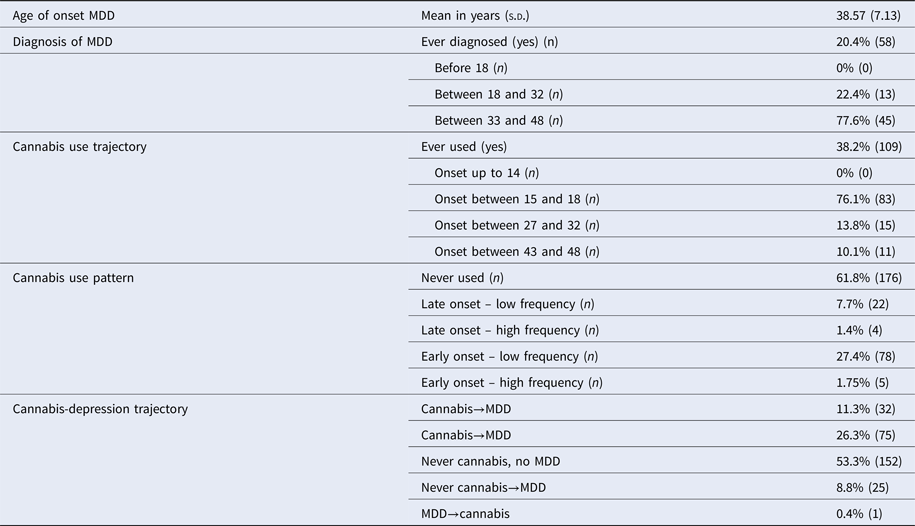
Out of the 411 boys assessed at baseline, complete multi-wave cannabis use and depression data (T1–T7) at follow-up (age 48) was available for a total number of N = 285 (for follow-up flow chart see online Supplementary Fig. S1). Comparison of subjects with and those without complete data, who were not included in the present analyses carried out, revealed that there were no significant differences between the two groups in early life demographic variables (substance use, antisocial behaviour, conduct problems, social class, anxiety), later life outcomes [substance use and mental health outcomes (DSM-IV based) including depression, anxiety disorders, substance use disorders] and cannabis use across the life span (age 18, 32 and 48) (online Supplementary Table S3). As shown in Table 1, cannabis use was common in this sample, comprising a proportion of 38.2% of subjects who used the substance at least once up to age 48. The majority of subjects who had ever used cannabis started using the substance between ages 14 and 18 (76%). Although most of the early-onset cannabis users used the substance only around this age (51.8%) and did not continue subsequently, a quarter continued to use the substance subsequently (i.e. 24.1% reported use also at ages 32 and 48). A total of 58 subjects (20.4%) received a diagnosis of MDD by the age of 48, with an estimated mean age of onset of illness of 38.57 (s.d. 7.13). Significant (p ⩽ 0.05) associations with risk of depression in exploratory analyses were found for cannabis use (ever used), other illicit drug use (ever used by age 32), other diagnosis of mental illness at age 48 and employment status at age 48 (cf. online Supplementary Table S4).
Cannabis and depression trajectories (N = 285)

Note. MDD = diagnosis of major depression disorder based on Structured Clinical Interview for DSM-IV Axis I Disorders (SCID-I).
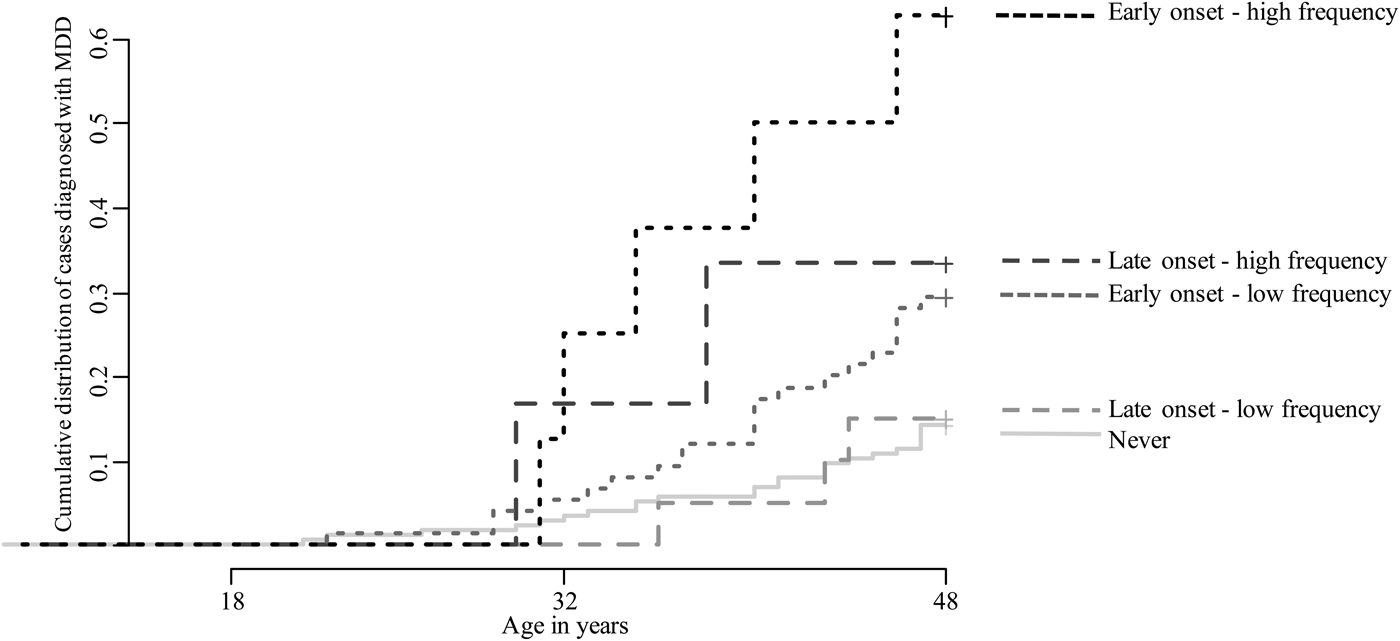
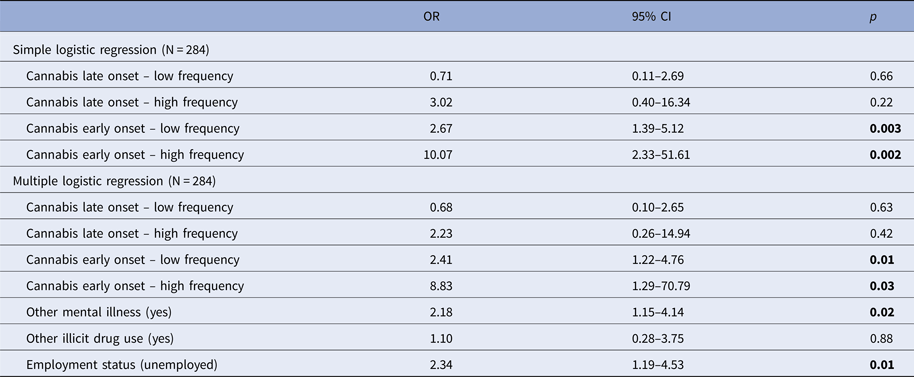
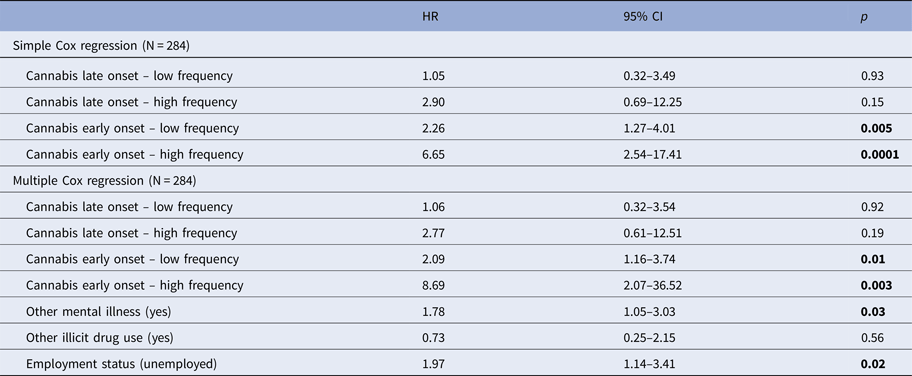
Simple logistic regression analysis (Table 2) revealed that those who had never used cannabis had the lowest risk for developing a depressive disorder, whilst the highest risk estimates were found for those who had an early onset of cannabis use (age 18 or before) and continued to use the substance throughout their life (cumulative use endorsed more than 450 times) [odds ratio (OR) 10.07 (95% confidence interval (CI) 2.33–51.61), p = 0.002]. The risk was reduced in magnitude but still significant for early-onset users who used cannabis less frequently throughout their life [OR 2.67 (95% CI 1.39–5.12), p = 0.003]. Alternative specifications of cut-off for defining low-frequency and high-frequency use for the early-onset and late-onset users did not change the direction of these results (data available on request). After controlling for potential confounders that were significantly associated with depression in simple analyses, including other illicit drug use, presence of other mental health illness and employment status, the effects of cannabis use remained significant for early-onset, high-frequency users [OR 8.83 (95% CI 1.29–70.79), p = 0.03; Table 2] as well as for early-onset, low-frequency users [OR 2.41 (95% CI 1.22–4.76), p = 0.01]. Including anxiety reported at age 14 and presence of a lifetime diagnosis of anxiety or other stress disorders in this model did not alter the results (cf. online Supplementary Tables S5 and S6). In line with these results, Cox regression models (cf. Table 3; Fig. 1) showed that early-onset cannabis use was associated with a shorter time to onset of MDD for both low-frequency [HR = 2.09 (95% CI 1.16–3.74), p = 0.01] and high-frequency cannabis users [HR = 8.69 (95% CI 2.07–36.52), p = 0.003].
Survival curves of cannabis use pattern and time until diagnosis of MDD.

Cannabis profiles and risk of subsequent MDD: logistic regression analysesa

Note. Reference group = never cannabis users; early onset = cannabis use at age 18 or before; high frequency = ⩾450 cumulative number of times used across time points (ages 18, 32, 48).
a n = 1 cases excluded since MDD was diagnosed prior to cannabis use.
Bold indicate ‘p’ values that are statistically significant.
Cannabis profiles and time until subsequent MDD: hazard ratios (HR)a

Note. Reference group = never cannabis users; early onset = cannabis use at age 18 or before; high frequency = ⩾450 cumulative number of times used across time points (ages 18, 32, 48).
a n = 1 cases excluded since MDD was diagnosed prior to cannabis use.
Bold indicate ‘p’ values that are statistically significant.
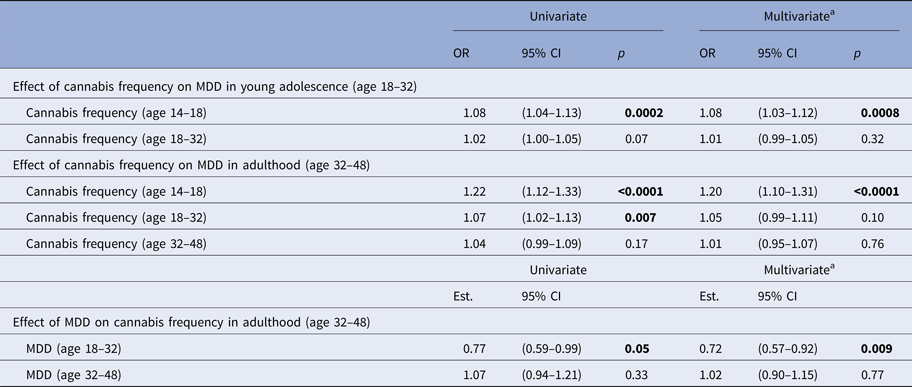
As shown in Table 4, the results from the multiple, cross-lagged, FE models suggest that an increase in cannabis use frequency between ages 14 and 18 was associated with increased odds for the development of MDD in both early adulthood (age 18–32) by 1.08 (95% CI 1.03–1.12) (p = 0.0008) and subsequently (age 33–48) by 1.20 (95% CI 1.10–1.31) (p ⩽ 0.0001). Changes in cannabis use frequency at later life stages were not significantly associated with the development of subsequent depression. For instance, a change in cannabis frequency between ages 18 and 32 was not a predictor for the development of MDD between ages 33 and 48 [1.05 (95% CI 0.99–1.11), p = 0.10]. To explore the issue of reverse causation (i.e. whether cannabis use predicts outcome and vice versa, in the form of a two-way causal relationship), we also tested whether the development of MDD was associated with subsequent changes in the frequency of cannabis use. A diagnosis of MDD between ages 18 and 32 was linked to a reduction in frequency of cannabis use between ages 32 and 48 by 0.72 (95% CI 0.57–0.92) (p = 0.009).
Fixed-effects regression analysis

Note. Increase in frequency = increase in one unit [(0) non-user; (1) low-frequency user; (2) high-frequency user].
a Controlled for random effects, including (1) other psychiatric illness and (2) other illicit drug use, (3) employment status at age 48.
Bold indicate ‘p’ values that are statistically significant.
Discussion
These results provide for the first time evidence suggesting early but not late-onset cannabis use may be a risk factor for the subsequent development of MDD. We observed an effect that was not confounded by other observed and unobserved time-invariant risk factors such as shared genetic or environmental influences or factors that change over time such as the use of other substances or the presence of comorbid psychiatric illness. Adverse effects of cannabis use on the risk of development of MDD and on time until MDD diagnosis were present only in those who had used it at a younger age (before age 18) with the effects being greater in high-frequency user (OR 8.83/HR 8.69, p ⩽ 0.05) than in low-frequency users (OR 2.41/HR 2.09, p ⩽ 0.05), while no significant adverse effects were present if cannabis use was initiated at an older age (age 27 onwards) (cf. Tables 2 and 3). Early-onset, high-frequency cannabis users experienced depression more than 5 years earlier compared with never users (41 v. 46.65 years). This is consistent with the idea of developmental sensitivity to the adverse effects of cannabis (Pope et al. Reference Pope, Gruber, Hudson, Cohane, Huestis and Yurgelun-Todd2003), as well as with the results of our FE analysis. The risk of developing subsequent depression was predicted only by an increase in cannabis use during adolescence (between ages 14 and 18) but not early adulthood (between ages 18 and 32) or subsequently (use between ages 32 and 48). In addition, the results suggest that the effect of early-onset cannabis use cannot be explained by unobserved time-invariant sources of confounding such as shared genetic or stable environmental factors. This may also explain why previous longitudinal analyses of panel data in younger cohorts (up to the maximum age of 34, cf. online Supplementary Table S1) have been inconclusive as to whether an increase of cannabis use leads to an increase in risk of depression over time (Horwood et al. Reference Horwood, Fergusson, Coffey, Patton, Tait and Smart2012; Silins et al. Reference Silins, Horwood, Patton, Fergusson, Olsson and Hutchinson2014), even when dose–response patterns were tested (Repetto et al. Reference Repetto, Zimmerman and Caldwell2008; Womack et al. Reference Womack, Shaw, Weaver and Forbes2016). Since cigarette use across the life span was not significantly linked to the risk of MDD, our results were not confounded by smoking, consistent with previous studies (Hayatbakhsh et al. Reference Hayatbakhsh, Najman, Jamrozik, Mamun, Alati and Bor2007). These findings are also consistent with evidence from animal research, in which long-term exposure of cannabinoids resulted in depression-like symptoms only in adolescent but not adult rats (Bambico et al. Reference Bambico, Nguyen, Katz and Gobbi2010). Interestingly, cross-lagged, FE analysis revealed that a diagnosis of MDD in adulthood (age 18–32) was predictive of reduction in cannabis use subsequently, which is consistent with evidence from a recent longitudinal study (Womack et al. Reference Womack, Shaw, Weaver and Forbes2016). While subsequent reduction in cannabis use may have been a result of depressed individuals receiving specific therapeutic input following contact with health services as a result of their depression, this was not specifically examined. While these results cannot completely rule out the possibility that depression may also lead to cannabis use (Wittchen et al. Reference Wittchen, Fröhlich, Behrendt, Günther, Rehm and Zimmermann2007; Horwood et al. Reference Horwood, Fergusson, Coffey, Patton, Tait and Smart2012), e.g. as a form of self-medicating behaviour, this seems less likely. This is also in line with a previous meta-analysis reporting overall significant adverse effects of cannabis use on depression outcome (OR 1.17), with more pronounced effects being present in heavier users (OR 1.62) (Lev-Ran et al. Reference Lev-Ran, Roerecke, Le Foll, George, Mckenzie and Rehm2014). As we cannot completely rule out the possibility that depression occurring early on in life led to subsequent initiation or continuation of cannabis use, these results should be treated with caution and future studies should investigate more thoroughly the bi-directional pathways between cannabis use and depression in order to definitively rule out the possibility of reverse causation, as in previous longitudinal studies examining causal nature of associations with cannabis use (Schoeler et al. Reference Schoeler, Petros, Di Forti, Pingault, Klamerus and Foglia2016c, Reference Schoeler, Theobald, Pingault, Farrington, Jennings and Piquerod). Since we investigated different groups of cannabis-using subjects based on their usage pattern, future studies may also evaluate continuous measures of cannabis use, such as the number of joints smoked over specified life periods. These results are to be considered against certain limitations of this study, such as comprising a select group of predominantly white males who grew up in a working class urban environment in the 1960s and 1970s. Therefore, the results may not generalize to the wider population and in particular to females, those from other ethnicities, individuals brought up in rural environments or children from different socio-economic status. Future studies should therefore expand on this and include individuals from more heterogeneous backgrounds. Another limitation is the use of self-report measures of cannabis and other substance use leading to potential under-reporting and the inclusion of only modestly sized cannabis-user groups. The relatively modest size of our sample limits our ability to conclude with certainty that late-onset cannabis use does not increase the risk of depression over the long term. However, sensitivity analysis carried out by combining the two late-onset groups in order to increase sample power did not change the conclusion (ORlate-onset = 1.15, p = 0.81). Although attrition in this sample was relatively low (Rocque et al. Reference Rocque, Jennings, Piquero, Ozkan and Farrington2017), only the subsample for whom complete information on SCID I was available was included in our study. This reduced the sample size for the present analyses and may have induced bias in our estimates. However, non-assessed subjects were not strictly drop-outs, and hence, it is unlikely that this reflects a systematic bias linked to individual characteristics that would have confounded the association between cannabis use and risk of development of depression. This is also supported by the FE analysis, which has the advantage of controlling for all unobserved time-invariant individual factors and confirmed the results from our multivariate models. Future studies should therefore include larger samples to assess the association between different trajectories of cannabis use and the risk of depression. Although we assessed a range of covariates at various time points, we cannot draw firm conclusions on whether or when other mediating or modifying factors impact on the relationship between cannabis use and risk of development. The lack of consideration of other potential unmeasured time-variant factors that cannot be accounted for in FE models (e.g. epigenetic phenomena) could have also affected the results. For instance, despite the use of longitudinal panel data, this design does not allow us to make definitive conclusions regarding causality since FE models can neither account for individual unmeasured factors that vary over time nor do they address sufficiently the possibility of reverse causality. However, as discussed in greater detail as part of online Supplementary Appendix S3, these factors are unlikely to have affected the direction of results presented here. Regarding the assessment of cannabis use, it is worth noting at the outset that the present cohort study was initiated several decades ago, much before the population-level effects of cannabis and other drug use began to be systematically measured. Hence, assessments of exposure were perhaps less optimal than if one were to initiate such a cohort now. Finally, it should be pointed out that MDD was only assessed at the last follow-up assessment (at age 48), which may have resulted in under-reporting. However, this is unlikely to have systematically affected either the cannabis unexposed or exposed groups or the early-onset or late-onset subgroups of cannabis users. Similarly, if self-reported cannabis use had been under-reported by users, which is usually not the case as data from studies that validated self-report information with biological tests suggest (Basurto et al. Reference Basurto, Montes, Cubos, Santed, Ríos and Moreno2009; Denis et al. Reference Denis, Fatséas, Beltran, Bonnet, Picard and Combourieu2012; Di Forti et al. Reference Di Forti, Iyegbe, Sallis, Kolliakou, Falcone and Paparelli2012), this is likely to have resulted in an underestimation of effect size. Hence, it is unlikely that under-reporting as a result of recall bias would have affected the direction of relationship that we have observed. It should also be pointed out that we included only a relatively conservative outcome measure (presence of DSM-based diagnosis of MDD), for which reason we could not estimate the effect of cannabis use on more subtle depressive symptomatology across the life span. Furthermore, we were not able to control for the effect of early life sub-clinical depressive or other affective symptomatology that predate the first onset of depression in our models. However, we attempted to address the possibility that early emotional disturbance or dysregulation may have in turn led to early-onset cannabis use, we examined whether anxiety at age 14 was predictive of subsequent cannabis use, which was not the case when we tested the association for cannabis use reported at age 16 (p = 0.29), age 18 (p = 0.74), age 32 (p = 0.74) or age 48 (p = 0.21). Hence, future studies should use multi-point assessments across the life span to prospectively assess depressive outcomes both in terms of syndromal disorder as well as depressive symptoms as done in previous studies in young adults (Horwood et al. Reference Horwood, Fergusson, Coffey, Patton, Tait and Smart2012) as well as include biological validation of the predictor of interest, i.e. cannabis use. Future studies should also investigate other potential risk factors such as poor coping or emotional dysregulation that may influence or mediate the effects of cannabis use on risk of depression. Since the THC levels in the cannabis have increased in recent years (Mehmedic et al. Reference Mehmedic, Chandra, Slade, Denham, Foster and Patel2010; ElSohly et al. Reference Elsohly, Mehmedic, Foster, Gon, Chandra and Church2016), with THC being only one of the more than 80 different cannabinoids identified to date (ElSohly & Gul, Reference Elsohly and Gul2014), future investigations should also distinguish between different types of cannabis that differ in their potency and cannabinoid constituents.
In summary, we found that cannabis use, especially during a developmentally sensitive period of life is associated with subsequent risk of developing major depression after controlling for potential confounders, suggestive of a potential causal relationship, although future investigations on this topic are necessary in order to draw more definite conclusions. These results have important public health implications given that depressive disorders are one of the top 10 causes of disability in the world (Whiteford et al. Reference Whiteford, Degenhardt, Rehm, Baxter, Ferrari and Erskine2013).
Supplementary material
The supplementary material for this article can be found at https://doi.org/10.1017/S0033291717003658
Acknowledgements
The CSDD data collection was supported by the Home Office and the Department of Health. Sagnik Bhattacharyya was supported by the NIHR (NIHR Clinician Scientist Award; NIHR CS-11-001) and the UK MRC (MR/J012149/1) and from the NIHR Mental Health Biomedical Research Centre at South London and Maudsley NHS Foundation Trust and King's College London.
Disclaimer
The views expressed here are those of the authors and not necessarily those of the National Health Service, National Institute for Health Research, or UK Department of Health.
Contributors
DPF provided the data. SB, DT and DPF designed the study and supervised the analyses. TS and DT carried out the data analysis and wrote the first draft together with SB. J-BP and JWC provided data, reviewed the results and contributed to the final draft of the manuscript.
Declaration of interest
None.