I. Introduction
Philosophers have traditionally lent great weight to the function of emotions in supporting moral behavior. Different philosophers have placed differing emphasis on the roles of specific emotions in this process. Some have focused on the role of empathy. For example, Michael Slote has argued that empathy is the “cement of the moral universe.” Footnote 1 This position is consistent with other neo-Humean accounts that place similar emphasis on the role of empathy in motivating moral behavior. Footnote 2
Other philosophers have instead pointed out the role of anger as a central emotion in sustaining moral behavior. Gerald Gaus, for example, has argued that anger and resentment allow for third parties to engage in the costly enforcement of social norms. Footnote 3 Similarly, Jesse Prinz has claimed that the role of empathy has been overstated relative to the importance of anger and disgust. Footnote 4 Even Adam Smith, who surely did not discount the role of empathy (or sympathy), recognized the importance of anger, arguing that it helped to maintain rules of justice. Footnote 5
It is important to recognize that these broad philosophical claims about the role of particular emotions are empirical. Although our intuition can give us some insight as to the effects of these emotions, intuition does not constitute evidence. To better understand the role of emotions such as empathy or anger, we must collect and analyze empirical data. This essay will focus on one area that intuition would suggest is driven by empathy: the compensation of victims. Past research, primarily in psychology and behavioral economics, has made great strides in showing the relationship between helping behavior and empathy. This essay will show that this seemingly intuitive relationship is actually far more complex, pointing to the need for empirical investigation to shine a more nuanced light on the roles of various emotions in moral behavior.
Much of the past experimental research on helping behavior has focused on empathic concern. Empathic concern is defined as an “other oriented emotion elicited by and congruent with the perceived welfare of someone in need.” This congruence does not require the empathizer to have the same specific emotion as the individual with whom he or she is concerned, but rather requires only the same valence. Empathic concern is not a single emotion, but rather a constellation of feelings of sympathy, compassion, and tenderness. Despite “empathic” being in the name of the term, empathic concern is perhaps most closely related to concepts which others have called pity, compassion, or simply sympathy. Footnote 6 Across a number of contexts, experiments have shown that high levels of empathic concern lead people to help. This includes paying to compensate someone who received an unequal allocation in an economic game, Footnote 7 volunteering time to help a sick student, Footnote 8 and even taking electric shocks to prevent a stranger from having to do so. Footnote 9
In contrast, anger often pushes people to feel an aggressive impulse. Footnote 10 Anger leads to feeling tension, agitation, losing control, and then lashing out. Footnote 11 However, the behavioral consequence of anger need not always be antisocial. Anger has been associated with people’s willingness to punish someone who free rides on a public good, or someone who offers an unfair allocation in an ultimatum game. Footnote 12 People even become angry by just observing a social norm violation, leading them to punish the violator in the dictator game despite not being victims themselves, a phenomenon known as altruistic punishment. Footnote 13
There are a number of proposed motivators for this kind of punishment behavior. One such proposal is that the punisher desires to give norm violators their “just desert.” Footnote 14 The goal of punishment in this case is to restore a moral balance by giving norm violators what they deserve. Alternatively, it has been shown that people also punish in order to restore community values. Footnote 15 In this case, people see the offense as infringing the community’s social norms, and punishment serves to reassert those norms.
Despite past work on helping that focuses on feelings of empathic concern, in the case of a social norm violation, victim compensation may also be driven by either a desire for justice or social norm restoration. Just as punishment restores the moral balance by taking away from the perpetrator, victim compensation restores the moral balance by bringing victims back to what they would have got without the action of the norm violator. Similarly, just as punishment reasserts the social norms of a group through costly signaling of the punisher’s beliefs, so does the costly signal of compensating the victim of the violation.
Since moral outrage has been shown to be the proximate emotional motivator for acting on these concerns in the case of punishment, we propose that it may also be the emotion driving compensation of the victim of a social norm violation, a behavior observed in recent papers. Footnote 16 The following studies were designed to test the hypothesis that moral outrage drives the compensation of victims, but only in the case when the loss is due to the violation of a social norm.
We ran two studies to investigate this hypothesis. The first study tests the hypothesis at the trait level, whereas the second tests it at the state level. The trait versus state distinction has long been made by psychologists studying personality as well as emotional states. Footnote 17 Traits make up the personality of an individual. Their defining feature is their stability over time. In contrast, emotional states can and are expected to change, both in the short term, moment to moment, as well as over longer periods such as days or weeks. In this way, the relationship between personality traits and emotional states can be seen as analogous to that between climate and weather. Footnote 18 Finding the proposed effect at only one level would qualify the generality of the claim, whereas finding it at both would be the strongest support.
In Study 1, all subjects played a modified version of a hypothetical third party trust game. Footnote 19 The trust game was chosen because past research has demonstrated that in its normal configuration, a strong norm of reciprocity exists. Footnote 20 Manipulating different elements of the game allows the experimenter to change whether or not behavior in the game is subject to this social norm, allowing us to test the hypothesis that compensation is driven by moral outrage when reciprocity is violated, but in other cases that are similar but without a social norm, moral outrage plays no role. In our version of the trust game, participants were assigned to the role of a disinterested observer and were told that another player (called Person A) lost his or her funds due to either the violation of a social norm (reciprocity in this case), his or her investment faring poorly, or random chance. Participants were then given the opportunity to compensate the investor’s loss. More information on the details of the game can be found in the next section. In this study, our hypothesis is that trait-level moral outrage will predict compensation above and beyond empathic concern when the loss is due to a social norm violation, but will not predict compensation in the case of the investment gone awry or random chance.
In Study 2, we aimed to make a stronger causal claim for the role of moral outrage driving victim compensation in the case of a social norm violation. In this study, we experimentally manipulated empathic concern and moral outrage while participants took part in the modified trust games used in Study 1, and then measured their willingness to compensate. For this study, our hypothesis is that increasing moral outrage will increase compensation when the loss is due to a social norm violation, but not when it is due to a bad investment or random chance. Furthermore, we predict that a measure of state moral outrage, controlling for the effect of empathic concern, will mediate the effect of the moral outrage manipulation on compensation of the victim of the social norm violation, giving evidence that change in moral outrage is the mechanism underlying the effect.
II. Study 1
Participants
241 participants (108 men, mean age of 32.85) were recruited from Amazon’s Mechanical Turk to participate in this study. Each subject was paid 50 cents for his or her participation. Mechanical Turk has been shown to yield significantly more diverse samples than typical university samples, and data that are at least as reliable as traditional methods. Footnote 21
Design
To examine the degree to which moral outrage and empathic concern influence compensation across a variety of contexts, we used a series of modified hypothetical trust games. Each game included a Person A with an initial endowment of $10, Person B with $0, and Person C with $10. The participant was always assigned the role of Person C. The participant was told that Person A’s endowment of $10 was transferred to Person B, either by Person A’s choice or by random chance, depending on condition. This $10 transfer was multiplied by 4 by the experimenter, leaving Person A with $0 and Person B with $40. Participants were then told that half of Person B’s endowment could have been returned to Person A (resulting in them both ending with $20) but that it was not returned, either by Person B’s choice or due to random chance, depending on condition. The participant, as Person C, is then given an incentive compatible elicitation of their maximum willingness to pay to restore Person A back to their original $10.
There were three conditions in this study. In the Social Norm Violation condition, Person A chose to transfer his or her funds to Person B and Person B chose not to return half of the resulting sum. In the Bad Investment condition, Person A chose to transfer his or her funds but a randomizing device, with 80 percent probability of returning half of the sum and 20 percent probability of returning nothing, selected to return nothing. An 80 percent return rate was chosen to closely mimic the actual return rate in trust games of this type, thereby keeping the return rate similar across all conditions. Footnote 22 Finally, in the Random Chance condition, whether Person A’s funds were transferred to Person B was determined by a randomizing device which transferred the funds with 50 percent probability and let Person A keep them with 50 percent probability. If the initial transfer occurs, whether half the funds are returned from Person B to Person A is also determined by a randomizing device, with the same probabilities as in the Random Chance condition.
After completing the game, each subject took a short survey that measured his or her trait propensity to feel moral outrage, and his or her trait propensity to feel empathic concern. Footnote 23
Trait Moral Outrage Measure
A four-item measure of trait moral outrage was adapted from a scale developed by Wakslak et al. Footnote 24 For each item, participants were asked to what extent they agreed with the item on a seven-point scale from Strongly Disagree to Strongly Agree. Example items included “I feel angry when I learn about people suffering from unfairness” and “I think it’s shameful when injustice is allowed to occur.”
Trait Empathic Concern Measure
The seven-item Empathic Concern subscale of the Interpersonal Reactivity Index was used to measure trait empathic concern. Footnote 25 For each item, participants were asked how well it described them, on a five-point scale of “does not describe me well” to “describes me very well.” Items included “Sometimes, I don’t feel very sorry for other people when they are having problems” and “I often have tender, concerned feelings for people less fortunate than me.”
Results
188 participants (78 percent of the sample) correctly responded to at least 9 of the 10 comprehension questions asked throughout the explanation of the game. In order to ensure the highest quality data, this subset was used for further analysis.
The four-item trait moral outrage scale and seven-item trait empathic concern scale were found to be highly reliable (α=.907 and α=.904, respectively). The alpha statistic describes the degree to which a set of items measures a single latent variable. The statistic can range from 0 to 1, where α ≥ 0.9 is commonly designated “excellent,” and 0.7 ≤ α < 0.9 described as “good.” Trait level empathic concern and moral outrage were highly correlated r(186)=.618, p<.001. An r value of .618 implies that 61.8 percent of the variance in one measure is explained by the other. This degree of correlation suggests that all analysis of either of these variables should be conducted controlling for the other in order to isolate the unique contribution of each.
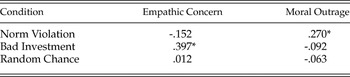
For each condition, we measured the partial correlation between compensation and trait moral outrage and trait empathic concern, controlling for the other predictor. These results can be found in Table 1.
Partial Correlations Between Compensation in Each Condition and Empathic Concern Controlling For Moral Outrage and Moral Outrage Controlling for Empathic Concern

Note: All values are partial Pearson correlation coefficients. *p<.05
Controlling for empathic concern, moral outrage accounted for 27 percent of the variance in compensation in the Norm Violation condition r(65)=.270, p=.027. Moral outrage accounted for a statistically insignificant 6.3 percent of the variance in compensation in the Random Chance condition r(56)=-.063, p=.636 and a statistically insignificant 9.2 percent of the variance in the Bad Investment condition r(58)=-.092, p=.486. Importantly, this correlation was negative, meaning even if it was significant it would mean that moral outrage was negatively related to compensation in the Bad Investment condition.
Controlling for moral outrage, empathic concern accounted for a significant 39.7 percent of the variance in the bad investment condition r(58)=.397, p=.002. However, empathic concern only accounted for insignificant variance in the other two conditions: 15.2 percent in the Norm Violation condition r(65)=-.152, p=.221, and 1.2 percent in the Random Chance condition r(56)=.012, p=.928. Again importantly, the correlation between empathic concern and compensation in the Norm Violation condition was negative, suggesting that even if it was significant, it would imply that those who experience high levels of empathic concern compensate the victims of social norm violations less, controlling for the effect of moral outrage.
Discussion
The correlation between compensation and trait moral outrage in the Social Norm Violation condition, controlling for the effect of empathic concern, supports the hypothesis that moral outrage contributes to compensation above and beyond empathic concern. The fact that its effect was found only in the Social Norm Violation condition and in neither the Random Chance condition nor the Bad Investment condition further supports the hypothesis that moral outrage is a motivator for compensation only when a social norm has been violated, rather than being a universal motivator.
The correlation between compensation and trait empathic concern in the Bad Investment condition, controlling for the effect of moral outrage, is consistent with past work showing that empathic concern correlates with helping behavior. Footnote 26 This result adds to that body of work, showing that in this situation, the effect of empathic concern on compensation exists beyond the highly confounded effect of moral outrage. However, controlling for moral outrage, we found no correlation between compensation in the Random Chance condition and empathic concern, suggesting that some other factor may be responsible for compensation in that context. Finally, the fact that we found no evidence for empathic concern correlating with compensation in the Social Norm Violation condition when controlling for Moral Outrage, and in fact the point estimate of the effect is negative, suggests that in the case of a norm violation, empathic concern is not relevant to compensation.
III. Study 2
In the second study we investigated the causal role of both moral outrage and empathic concern by experimentally manipulating these states and observing their effect on compensation in the three contexts investigated in Study 1.
A. Study 2.a
Participants
990 subjects (471 men, mean age 32.84) were recruited from Amazon’s Mechanical Turk to participate in this study. Each subject was paid 50 cents for his or her participation.
Design
This study experimentally manipulated moral outrage to measure its effect on compensation. Each participant was assigned to one of the three situations presented in Study 1: Social Norm Violation, Bad Investment, or Random Chance. After having the game described to them but before knowing which role they were assigned to or the result of the game, each participant was shown a short video. The video was either of a boy being attacked by a bully, which past research has shown to evoke moral anger while having minimal effect on other emotions, or a control video of a series of abstract line patterns, which previous work has shown to be emotionally neutral. Footnote 27 After watching the assigned video, each participant was assigned to the role of Person C and was told that Person A’s funds were transferred to Person B but none were returned to A. They were then given the willingness to pay to restore Person A to $10 elicitation as used in Study 1, as well as state measures of empathic concern and moral outrage.
State Moral Outrage Measure
The four item state moral outrage scale has previously been used to measure feelings of moral anger. Footnote 28 For each item, participants rated their agreement on a five-point scale from Strongly Agree to Strongly Disagree. Items included “I feel angry” and “I feel outraged.”
State Empathic Concern Measure
Three items from the Empathic Concern Subscale of the Interpersonal Reactivity Index used in Study 1 were adapted to measure state empathic concern. For each item, participants rated how much they agree on a five-point scale from Strongly Disagree to Strongly Agree. Items included “I feel sorry for Person A” and “I was disturbed by what happened to Person A.”
Results
754 (76 percent) of participants correctly responded to at least 9 of the 10 comprehension questions and were used for further analysis. Both the four-item state moral outrage scale and the three-item state empathic concern scale were shown to be highly reliable (α=.958 and α=.847, respectively).
In order to ensure that the video properly affected moral outrage, we used the moral outrage scale as a manipulation check, and found that the bully video significantly increased moral outrage relative to the control video in the Norm Violation situation t(230)=5.175, p<.001, Random Chance situation t(262)=4.514, p<.001, and the Bad Investment situation t(256)=3.271, p=.001. These results give high confidence that the moral outrage video — rather than the control video — induced moral outrage.
Those who watched the moral outrage video compensated significantly more than those who saw the control video in the Norm Violation situation t(230)=2.412, p=.017. We tested whether this effect was mediated by the subject’s feeling of moral outrage. A mediation analysis tests the hypothesis that the independent variable influences the mediating variable which in turn influences the dependent variable, rather than the independent variable directly affecting the dependent variable. In this and all following mediation analyses, we ran non-parametric (bias-corrected) bootstrap mediation analysis with 10,000 resamples. Footnote 29 Including empathic concern as a covariate, moral outrage significantly mediated the effect of the video condition on compensation in the Norm Violation situation, 95 percent CI=[.0800, .6491]. This gives high confidence that when controlling for empathic concern, the video had a significant effect on feelings of moral outrage, which in turn affected the level of compensation.
Participants who watched the Moral Outrage video also compensated significantly more in the Random Chance situation t(262)=.042, p=.042 and the Bad Investment situation t(256)=2.393, p=.017. In the Random Chance situation, empathic concern also differed significantly between the Moral Outrage video and the control video conditions t(262)=2.404, p=.017. Mediation analysis showed that the effect of the video on compensation in the Random Chance situation was significantly mediated by empathic concern, 95 percent CI=[.0208, .3777], but was not significantly mediated by moral outrage, 90 percent CI=[-.2187, .2136]. This implies that although those who watched the Moral Outrage video did indeed compensate more, the effect of the video seems not to have been through a change in moral outrage, but rather a change in empathic concern. Similarly, In the Bad Investment situation, the effect of the video on compensation was not mediated by moral outrage, controlling for Empathic Concern as a covariate, 95 percent CI=[-.2455, .0702]. Again, this implies that although those who saw the moral outrage video compensated more, it was not due to a change in moral outrage.
Discussion
The effect of the moral outrage video on compensation in the Norm Violation situation provides evidence for the causal role of moral outrage in compensating the victims of norm violations. This evidence is further bolstered by the fact that even when controlling for the effect of empathic concern, feelings of moral outrage mediated the effect of the video on compensation, suggesting it as a causal mechanism.
The difference in compensation after watching the moral outrage video relative to the control video in the Bad Investment situation was not predicted. However, these subjects experienced a significant change in empathic concern as well, making it plausible that the change in empathic concern, rather than a change in moral outrage, led them to compensate more. To test this hypothesis, we ran a mediation analysis with both empathic concern and moral outrage as mediators of the effect of the video condition on compensation in the Bad Investment situation. The fact that empathic concern significantly mediated the effect, whereas moral outrage did not, suggests that moral outrage is not driving compensation in the bad investment situation, but rather that it is driven by empathic concern.
Similarly, the difference in compensation after watching the moral outrage video relative to the control video in the Random Chance situation was not predicted. However, this effect was also shown not to be mediated by the change in moral outrage induced by the video. This provides support for the claim that moral outrage is not a determining factor in compensation in the Random Chance situation. However, similarly to Study 1, the data does not speak to what may in fact be motivating compensation in the Random Chance situation.
B. Study 2.b
Participants
998 subjects (472 men, mean age of 34.21) were recruited from Amazon’s Mechanical Turk to participate in this study. Each subject was paid 50 cents for his or her participation.
Design
The design in Study 2.b was very similar to 2.a, except that empathic concern was manipulated instead of moral outrage. Instead of watching a video, participants were either asked to “describe the feelings and emotions Person A may be feeling right now,” which has been shown to evoke empathic concern, or instead were asked to “objectively describe what has happened in the interaction so far.” In all other ways, the design was the same as in Study 2.a.
Results
769 of participants (77 percent) correctly responded to at least 9 of the 10 comprehension questions and were used for further analysis.
The four-item state moral outrage scale and the three item empathic concern scale were both found to have high validity (α=.955 and α=.832, respectively).
Using the empathic concern scale as a manipulation check, the empathic concern prompt led to higher empathic concern relative to the control in the Norm Violation situation t(269)=2.917, p=.004, the Investment Situation t(244)=3.344, p=.001, and the Random Chance situation t(250)=3.402, p=.001.
Those in the Bad Investment situation who received the empathic concern prompt compensated significantly more than those who received the control prompt t(244)=3.237, p=.001. Controlling for moral outrage as a covariate, the participant’s empathic concern significantly mediated the effect of the condition on compensation in the Bad Investment situation 95 percent CI=[.1634, .7010]. There was no significant effect of the empathic concern prompt relative to the control prompt on compensation in either the Random Chance situation t(250)=.822, p=.412 or the Norm Violation situation t(269)=.132, p=.895.
Discussion
The effect of the empathic concern prompt on compensation in the Bad Investment situation supports the hypothesis that empathic concern can be the motivating factor for compensation in some situations. This is further supported by the mediation analysis, which showed that, controlling for moral outrage as a covariate, empathic concern significantly mediated the effect of the prompt on compensation in the Bad Investment condition.
Similar to Study 1, the lack of an effect of the empathic concern prompt on compensation in the random chance situation suggests that some other factor may be motivating compensation in that context. Also similar to Study 1, the empathic concern prompt had no effect on compensation in the norm violation condition, providing more evidence that empathic concern does not contribute to the compensation of victims of social norm violations.
IV. General Discussion
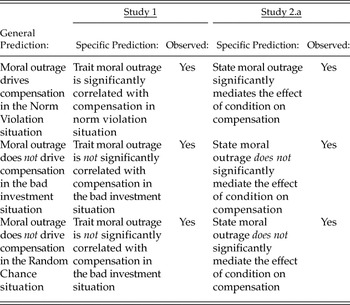
The studies presented here show that at both the trait and state level, moral outrage is associated with compensating the victim of a social norm violation above and beyond the effect of empathic concern. In fact, when moral outrage is controlled for, or empathic concern is directly manipulated, empathic concern shows no relationship with compensating victims of social norm violations. A summary of our key hypotheses and results can be found in Table 2.
Summary of the predictions and results for the moral outrage compensation hypothesis.

Note: All predictions and observations include controlling for empathic concern as a covariate.
Also as predicted, the scope of the relationship between compensation and moral outrage appears to be domain specific. In Study 1, no relationship was found between moral outrage and compensation in either of the two other contexts that did not involve a social norm violation. In Study 2.a, despite there being differences in the levels of compensation in the Random Chance and Bad Investment conditions, neither of these effects were mediated by moral outrage, which, consistent with Study 1, suggests that moral outrage was not involved in compensation in these contexts.
An unexpected yet interesting pattern of results emerged when evaluating the impact of empathic concern on compensation. In both Study 1 and Study 2.b, empathic concern was shown to relate to compensation in the Bad Investment situation, both through association with trait empathic concern and by manipulating empathic concern and observing its mediated effect on compensation. However, also in both Study 1 and Study 2.b, no relationship was found between empathic concern and compensation in the Random Chance situation. Further work is required to understand what distinguishes these two cases, and what other factors may be involved that lead to compensation in the Random Chance situation.
These results may appear in conflict with those showing a correlation between empathic concern and third party compensation of those who receive a low offer in a dictator game. Footnote 30 However, there are two possible reconciliations with these findings. First, as reported in Study 1, empathic concern and moral outrage are highly correlated. Therefore, the association between empathic concern and compensation observed in the dictator game may be due to the strong confounding effect of moral outrage when it is not properly controlled for. Second, past research has shown that people do not have strong normative expectations for how a dictator should act in a dictator game, which is a critical component for something to be a social norm. Footnote 31 It is therefore possible that empathic concern is driving compensation in the dictator game and that moral outrage drives compensation when a social norm is violated, as people do not consider unequal splits in dictator games to be a violation of a social norm.
Our results provide empirical evidence that might be useful to clarify the role of specific emotions in supporting moral behavior. We show that although one may have strong intuitions about the importance of a particular emotion for a particular behavior (such as empathy driving people to help), the empirical data suggest a much richer and fine-tuned interaction between emotion and situation than our intuitions may allow for. In the case of the present study, we do find some support for those who point to the importance of empathic concern for helping behavior. However, we show that, perhaps counterintuitively, anger, an emotion mostly associated with aggression, can also lead to compensation. In that way, anger, and moral outrage in particular, might be seen as a general response to social norm violations, resulting in a variety of behaviors, some destructive, such as punishment, and others charitable, such as helping a victim.
This result has practical implications for those soliciting charitable donations. Past studies have shown that empathic concern drives people to volunteer and engage in charitable giving. Footnote 32 Our result qualifies the interpretation and application of those studies, suggesting that, although appealing to empathy may result in greater helping behavior in some contexts, when the loss is due to the violation of a social norm, solicitors may do better by appealing to the moral outrage of the donor.
Future work on this topic may wish to generalize this finding by using situations other than behavioral games, such as charitable giving in the field. Although previous research has shown that participants in hypothetical trust games on Amazon’s Mechanical Turk act no differently than those in the physical lab with real stakes, more support may be found by replicating these results for real stakes in a lab. Footnote 33