As the other articles in this symposium demonstrate, a country's level of economic inequality is a function of a complex set of historical, geographic, economic, and political factors. Given this complexity, it is unsurprising that a country's regime type by itself does not tell us much about its level of economic inequality. The predictions of the linear tax model aside (Meltzer and Richard Reference Meltzer and Richard1981), democracies and non-democracies do not differ greatly in terms of their level and variation in inequality. Research focusing on democracies has helped identify some the sources of this variation, but inequality in authoritarian states remains relatively understudied. The growing body of work on authoritarian politics, however, provides a foundation for research in this area.
After some general observations about inequality across democracies and non-democracies, this article examines some of the theoretical frameworks that can be useful for explaining variation in inequality in the authoritarian context. An analysis of authoritarian regimes in East Asia during the post-war era helps illustrate which theoretical perspectives are useful and highlights the significant complexity inherent to devising any systematic explanation of inequality.
GENERAL OBSERVATIONS ON REGIMES AND INEQUALITY
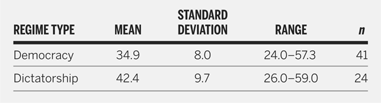
The importance of paying greater attention to the authoritarian context is supported by the fact that regime type alone is not a powerful predictor of the level of inequality. We used the regime classification system, described in Przeworski et al. (Reference Przeworski, Alvarez, Cheibub and Limongi2000) and updated in Vreeland (Reference Vreeland2003), to identify countries that were coded as “democracy” or “dictatorship” at least 80% of the time between 1960–2000. In comparing the distribution of the Gini coefficients in the year 2000, or the closest available year, between these two categories (see Table 1), we find that the democracies have lower levels of economic inequality on average (p < .01), but the difference is not stark and the overall range of Gini coefficient variation in the two categories is very similar (United Nations 2009). If we limit the comparison to countries with GDP/worker below $10,000,Footnote 1 moreover, the difference disappears. These illustrative data are consistent with past research based on much more thorough analysis. For example, Sirowy and Inkeles (Reference Sirowy and Inkeles1990) examined 12 studies on the relationship between democracy and inequality and concluded that it was impossible to draw any generalizations.
Distribution of Gini Coefficient by Regime Type

Of course, the similar distribution of Gini coefficients between predominantly democratic and predominantly authoritarian countries does not necessarily mean that the outcomes are qualitatively similar. We simply contend that variation in inequality in non-democratic contexts is considerable, and study of this variation is relatively neglected. Perhaps the power of the linear tax model has contributed to this neglect, for its parsimony lies in the assumed existence of a median voter, thus orienting research toward democratic polities. Yet, authoritarian rulers can face incentives similar to those facing democratically elected rulers. They are not immune to redistributive pressures, and, like democratically elected rulers, their survival can be threatened by bad economic outcomes. On the other hand, authoritarian rulers have a larger repertoire of coercive tools to repress dissent and preserve their power. Thus, while authoritarian regimes may not face electoral competition, the nature of authoritarian politics nevertheless influences economic policymaking and thus inequality outcomes.
INSIGHTS ARISING FROM RECENT RESEARCH
We examine recent work that has contributed to the understanding of authoritarian politics in search of insight regarding variation in levels of inequality across authoritarian regimes. One strand of research (Wintrobe Reference Wintrobe1998; Geddes Reference Geddes1999; Gandhi Reference Gandhi2008) examines different types of authoritarian regimes and describes characteristic patterns in their supporting constituencies and their responses to social pressures. These generalizations provide a basis for explaining differences in economic outcomes across authoritarian types. A second strand focuses on the role of redistributive conflict in fostering regime change (Boix Reference Boix2003; Acemoglu and Robinson Reference Acemoglu and Robinson2006). In this work, the level of economic inequality both affects the policy decisions of authoritarian rulers and is affected by these decisions. Lastly, the selectorate theory of Bueno de Mesquita et al. (Reference Bueno de Mesquita, Smith, Siverson and Morrow2003) breaks down the democratic-authoritarian distinction altogether, focusing instead upon two factors present in regimes of all stripes—the size of the selectorate and the size of the winning coalition—to explain a ruler's policy output.
Most of these approaches describe dictators as using some combination of carrots and sticks in order to maintain power. The carrots, measures that build support or acceptance of the ruler, range from the distribution of rents and patronage to programmatic redistribution and broad-based economic growth. Sticks are coercive or repressive measures that raise the costs of collective action for opponents of the regime. The relative costs of carrots and sticks vary across contexts based upon historical, geographic, economic, and institutional factors, as well as the international environment. The mixture of carrots and sticks that is optimal for rulers is linked, endogenously, with the form of authoritarianism regime present in a country as well as the nature of its economic policies. The level of inequality can both affect the ruler's optimal mix of carrots and sticks and be affected by it.
As Geddes argues, authoritarian politics “involves factionalism, competition, and struggle” that takes different forms in different kinds of authoritarian regimes (Reference Geddes1999, 121). Geddes classifies authoritarian regimes into personalist, military, single-party regimes, and hybrids of these forms, identifying the interests typical of each type of rulers. Wintrobe (Reference Wintrobe1998) identifies the governance patterns of dictatorships in terms of their chosen mixture of repression and loyalty-building measures, yielding four different types of dictators: tyrants, tinpots, totalitarians, and timocrats. Gandhi (Reference Gandhi2008, 76) describes the two basic challenges of dictatorial governance as thwarting rebellion and soliciting cooperation, finding that monarchs, military, and civilian regimes tend to adopt different kinds of institutional arrangements to maintain an intricate balance involving “repressing some and co-opting others.”
From these works come some general predictions that may be useful in helping explain variation in inequality. First, regimes with a broader institutional base, such as single-party regimes, are likely to distribute goods more widely and achieve higher levels of overall economic performance. They offer an institutional space for dispute resolution, create higher levels of policy stability, and improve the flow of information into policymaking circles (Gandhi Reference Gandhi2008, 141). Boix (Reference Boix2003) adds that such regimes are more likely to constrain expropriation of property. Second, where the costs of building loyalty are high relative to the costs of repression, tyranny tends to form. For instance, in countries where promoting general economic growth is difficult but rulers can generate immediate revenue through expropriation, incentives exist to immiserate the general population and rule through repression (Wintrobe Reference Wintrobe1998, 83). High levels of natural-resource wealth may provide rulers easy revenue, paying for repression without requiring widespread expropriation from the populace (Ross Reference Ross2001). Either way, the likely result is high levels of inequality between those connected with the regime and those excluded.
In the second strand of literature, Boix (Reference Boix2003) and Acemoglu and Robinson (Reference Acemoglu and Robinson2006) depict the choice of regime as a function of redistributive conflict. In both cases, the outcome of this conflict depends upon the level of inequality, the costs of revolution, and the costs of repression. The higher the level of inequality, the worse off the wealthy will be under democracy, and the higher the likelihood that they will employ repression. The two models differ in other respects, leading to slightly different predictions. One important difference, in our estimation, is that Acemoglu and Robinson model rulers as being able to choose a combination of concessions and repression in order to maintain the dictatorship when the threat to their rule is moderate. We find that a combination of performance-based loyalty and repression is useful in understanding the East Asian cases discussed below.
As the above work indicates, the nature of the constituencies to which rulers are sensitive matters in authoritarian as well as democratic contexts. In this vein, the selectorate theory of Bueno de Mesquita et al. (Reference Bueno de Mesquita, Smith, Siverson and Morrow2003) presents a general model of the polity that connects the policy choices rulers make to the nature of selection institutions broadly defined.Footnote 2 Regimes of all types have a selectorate of some size S, which consists of members of the polity who possess the “characteristics institutionally required to choose the government's leadership” (42). To maintain power, rulers must maintain the support of a subset of the selectorate, a “winning coalition” of size W. Members of the polity not in S are unenfranchised.
The composition of the policy mix supplied by the ruler is a function of relative sizes of W and S. When W is large, the least costly method of buying the support of the coalition is with public goods.Footnote 3 Since public goods by nature flow to all members of the polity, large W produces greater overall welfare. Inequality should be lower under these conditions. Conversely, citizens do poorly when W is small relative to S. In this scenario, members of W are the fortunate few who receive private goods, and few if any public goods are supplied. The likely outcome is high levels of inequality with wealth highly concentrated in a narrow clique. Finally, when S is small but W is large relative to S, rulers face greater competitive pressure and thus spend a greater portion of their revenues to retain power, but the mix of goods is skewed toward private goods, enriching members of W but doing little to help the general population. Inequality is still expected to be high, but wealth at the top end of the distribution is spread more widely.
Two aspects of the model raise questions about these predictions, however. First, the unenfranchised members of the polity do not enter into the ruler's calculus concerning the level and mixture of public vs. private goods. Rulers can afford to neglect public goods when W is small because they care only about satisfying the members of W. Second, public goods are defined such that they include both core public goods, which are political liberties, and regular public goods like education, health care, and infrastructure. Rulers cannot supply one type without supplying the other. Bueno de Mesquita and Smith (Reference Bueno de Mesquita and Smith2009) amend the model to address the first concern by adding a revolutionary constraint into the ruler's calculus. Yet, the revised theory retains the linkage between core and other public goods. Accordingly, rulers cannot use a mixture of carrots and sticks that involves non-core public goods combined with repression to both reduce the expected welfare gains from revolution as well as raise the costs of revolting.
These key contributions to the growing literature on authoritarianism are useful in examining patterns of growth and inequality in East Asia, a region well known for decades of rapid growth and authoritarian resilience. We draw attention to three points in particular. First, when seeking to predict what kind of economic outcomes will emerge from authoritarian politics it is critical to consider the survival constraints on rulers. Like democratically elected rulers, authoritarian rulers are sensitive to the preferences of those whose loyalty or acquiescence is needed to maintain power, and they act strategically to build a supporting coalition. While the ideas of a winning coalition and selectorate are useful abstractions when examining leadership selection, it is important to recognize that membership in these groups is fluid, blurred, and fundamentally unknowable to the dictator himself. When leadership selection is opaque and reliance on informal institutions high, dictators themselves are unclear about who supports them and how much.
Second, unlike democratically elected rulers, dictators possess sticks, as well as carrots, to win cooperation and repress dissent. The particular combination of carrots and sticks they employ, and thus the distributional consequences of their policies, depends upon the relative costs of these approaches, and these costs in turn are a function of a variety of historical, geographic, economic, and social factors. In the cases below, we highlight the importance of state institutional capacity to deliver carrots and sticks effectively.
Third, models of authoritarian politics that reduce policy outcomes to a function of the size or proportion of elite coalitions are not able to explain radical changes in policy without prior shifts in these proportions. More attention should be given to the composition of these coalitions and how changes in their composition can occur without significant changes to the formal institutions of the polity.
EAST ASIAN GROWTH AND INEQUALITY PATTERNS
East Asia, which contains some of the fastest-growing economies in the post-World War II era, provides an illuminating context in which to assess the usefulness of these theoretical perspectives. What is especially striking, given the rapid growth rates of capitalist developmental states such as Taiwan, South Korea, and Singapore, is their ability to maintain relative equality, and in some cases even to reduce inequality, over the period of high growth. This pattern of growth did not accord with theories that posited high levels of inequality as a prerequisite for rapid growth (Birdsall, Ross, and Sabot Reference Birdsall, Ross and Sabot1995).
Since the 1980s, the capitalist developmental states have been joined by reforming Asian socialist states, China and Vietnam, with both achieving high levels of economic growth, large reductions in poverty, and vastly increased integration into the global economy. Inequality patterns in China are complex, as the previous period of rigid state socialism reduced income inequality even as it marginalized certain sectors of society through unequal welfare policies and limits on rural-to-urban migration. Thus, despite substantial reductions of poverty in China, increasing inequality has become a pressing problem for the government.
In all these cases, regime leaders made performance-based legitimacy a key part of their ruling ideology, targeting economic growth and development as a means to maintain their monopoly on political power. Complementing this strategy have been significant levels of repression.
East Asian Capitalist Developmental States
Characterized by a “narrow elite alliance between the state and capital,” with centralized politics and tight control over labor, countries like Japan, South Korea, and Taiwan are archetypical of the cohesive-capitalist states described in Kohli (Reference Kohli2004). Their stunning rates of economic growth during the post-war period were fostered in large part by a strategy that made economic transformation an overriding national objective. Repression of the popular sector, especially labor, turned these states into “a paradise for big industrialists” (Woo-Cumings Reference Woo-Cumings1999, 17). Yet, worker welfare did improve as these economies grew, and the project of industrialization received widespread support.
Mobilization for industrial development was a rational choice for leaders who faced myriad threats amid relative resource scarcity and territorial limitations. Doner, Ritchie, and Slater (Reference Doner, Ritchie and Slater2005) label this condition as “systemic vulnerability.” These constraints shaped the incentives and choices of political elites, in particular by increasing the threat of political unrest and upheaval. These threats were not wholly internal. The communist regimes of North Korea and the People's Republic of China (PRC) ruled over peoples and territories claimed by South Korea and Taiwan. In these countries, the communist-capitalist competition made famous by Krushchev's exhortation that “we will bury you” was an intimate race between brethren. These constraints increased the importance of the unenfranchised to the elite. Politically, the threats of rebellion and invasion were front and center. Economically, the resource scarcity limited other options available to states with large resource endowments such as oil. Like a hard budget constraint, the geographic and geological challenges of Northeast Asia produced a gritty developmental success story of smart policies, delayed gratification, and resilient autocracy.
As Doner, Ritchie, and Slater (Reference Doner, Ritchie and Slater2005) find, institutions that link the state to social actors is an important part of the story. The ability of these states to build and support institutions that facilitated repression and extraction (of labor) reduced the ability of social actors to organize autonomously, raising the cost of fomenting revolution. Provision of rapid economic growth with investment in education and infrastructure also reduced the benefits of political upheaval to those outside the formal political system (almost everyone).
The descriptions in Wintrobe (Reference Wintrobe1998) and Gandhi (Reference Gandhi2008) of rulers finding the optimal mix of loyalty-building measures and repression, given their relative costs, offer a compelling explanation of the rulers' strategies in these capitalist developmental states. The increased threat of revolution driven by the political and economic constraints noted above, in all likelihood combined with external invasion, meant that policies that merely extracted existing resources would have been short lived and meager for a self-centered elite. Instead, rulers tied developmental goals and nationalist sentiments together, sustaining their rule through rising prosperity as well as repression. Acemoglu and Robinson (Reference Acemoglu and Robinson2006), which shares the logic of a “revolution constraint” on elite preferences, is also useful, but high levels of inequality were not the ultimate source of political instability in these contexts.
Conversely, the argument in Bueno de Mesquita et al. (Reference Bueno de Mesquita, Smith, Siverson and Morrow2003) that rulers with small winning coalitions will focus on provision of private goods to key supporters does not fit the capitalist developmental-state story. In these countries, small ruling coalitions with developmental preferences rulers reduced core public goods (political liberties), while increasing provision of other public goods. The consequences for inequality were considerable as this emphasis on industrialization and growth resulted in substantial investments in education and infrastructure. As Birdsall, Ross, and Sabot (Reference Birdsall, Ross and Sabot1995, 477) note, these policies created a “virtuous circle” between high-quality basic education and growth, maintaining relatively low levels of inequality even as these economies took off. This mixture of sticks and carrots was facilitated by “Janus-faced” institutions that could deliver both.
The Chinese Case: Growth and Changing Patterns of Inequality
The reform program of 1978 began a 30-year period of unprecedented growth with an impressive drop in the number of Chinese living under poverty. The Chinese economy grew 8.5% on average annually from 1979–2006, while the ratio of people living in poverty declined from 64% to 10% in 2005 (Lin et al. Reference Lin, Zhuang, Tang and Lin2008; Dollar Reference Dollar2007). Nearly half a billion people were lifted out of poverty during this period. During the same period, however, there has been a significant increase in levels of inequality. China's Gini coefficient increased from about .29 at the beginning of the reform period to .45 in 2004 (Dollar Reference Dollar2007; Kanbur and Zhang Reference Kanbur and Zhang2005). Especially worrisome are regional inequalities. The ratio of per capita GDP between coastal and inland provinces is 2.4, and the ratio of per capita GDP between the wealthiest and the poorest province is now 8.65, compared to a ratio of 4.5 between Indian provinces (Fleisher, Li, and Zhao Reference Fleisher, Li and Zhao2009).
China's growth and inequality patterns are the consequences of policies developed in the late 1970s to regain the Chinese Communist Party's (CCP) legitimacy in the aftermath of the Cultural Revolution. These patterns underline our main points in this article that authoritarian regimes adopt policies of carrots and sticks to build coalitions of support and acquiescence. Given that the threat of revolution blurs the boundaries between winning coalitions, selectorates, and unenfranchised masses, dictators have incentives to insure that the carrots placate and the sticks discipline the broadest possible spectrum of subjects. Secondly, single-party regimes often have the institutions and the state capacity to deliver nutritious carrots and disciplining sticks. Finally, in order to understand the distinct bundle of sticks and carrots, analysts must contextualize the composition of the selectorate and the winning coalition beyond a focus on size or proportion alone.
While the political survival of the Chinese regime fits the logic of Bueno de Mesquita et al. (Reference Bueno de Mesquita, Smith, Siverson and Morrow2003)—tiny winning coalition and large selectorate—it is more difficult to explain the increases in public goods that have accompanied CCP rule within the confines of the theory. To do so, we need again to take into account the role of the unenfranchised and how the state is institutionally linked to social actors. These links allow the state to do what Acemoglu and Robinson (Reference Acemoglu and Robinson2006) predict under the “revolution constraint”—provide public goods and repress. The state increased the benefits of the status quo while raising the costs of anti-regime mobilization.
As Geddes notes, “single-party regimes survive in part because their institutional structures make it relatively easy for them to allow greater participation and popular influence on policy without giving up their dominant role in the political system” (Reference Geddes1999, 135). While Geddes points mainly to electoral devices like legalized opposition parties, single-party regimes can also develop other effective institutions, including mass organizations like trade unions, corporatist business associations, government-owned NGOs (GONGOs), and parastatal organizations in neighborhoods, workplaces, and schools. These are not coalitions of broad-based support as Doner, Ritchie, and Slater (Reference Doner, Ritchie and Slater2005) argue for the earlier cases of Korea, Taiwan, and Singapore; rather, they are efficient channels of goods provision and, when needed, strategic repression.
How these institutions delayed the revolutionary crises laid out in Acemoglu and Robinson (Reference Acemoglu and Robinson2006) can be illustrated by one example. From 1997 to 2001, Chinese state-owned enterprises laid off over 30 million people and employment figures for the urban public sector dropped dramatically. Many scholars and onlookers predicted a rising tide of unrest, labor mobilization, and political upheaval. It was not only the scale of the layoffs but also that urban state workers were privileged members of society, enjoying lifetime employment, extensive welfare benefits, and high ideological status. While strikes, labor disputes, and mass demonstrations did occur and continue to occur, we have seen only a handful of protests that have joined workers across workplaces and not a single incidence of labor mobilization that has crossed regional boundaries. Institutions including the socialist workplace (danwei), the Communist-run trade union, workplace-level Communist Party cells, local-level neighborhood committees, and street-level committees have all served dual functions of repression and compensation. In many cases of mass unrest, striking workers have been compensated monetarily, with back wages and pension arrears, while labor activists and leaders have been arrested and imprisoned. Broad-based welfare programs including the minimum-income guarantee (dibao), unemployment insurance, and socialized pension funds have all been expanded, with massive increases in the number of urban citizens receiving income subsidies (Frazier, Reference Frazierforthcoming). The state's efficient use of these institutions to monitor and repress Chinese workers has been matched with a more benevolent form of cooptation and compensation.
Alongside the maintenance of significant repressive capacity, the Chinese regime has bolstered its strength through economic policies that have produced significant material benefits. In the early 1980s, as Deng Xiaoping began to implement the shift away from Maoist autarky and the planned economy, he sent dozens of Communist Party officials to nearby East Asian capitalist economies, including South Korea, Japan, Hong Kong, and Singapore. The point was to notice how far China had fallen behind and how successful these smaller neighbors had become. But Deng's reformist strategy did not attempt a frontal assault on socialism; rather, reformist leaders at the top gradually shifted the composition of the selectorate to reflect those who benefited from reform and globalization. The formal political institutions have become more routinized and systematic, but with the exception of the expansion of the Standing Committee of the Politburo from seven people to nine in 2002, there have been no dramatic changes in the size of the selectorate, only its composition.Footnote 4
Any attempt to accurately estimate the selectorate in an authoritarian regime is thwarted by the opaqueness of leadership selection and the heavy reliance on informal institutions to maintain political power. Research on China has focused on the composition of the Central Committee of the CCP as a key institution connecting the top leaders with their base of support in the party. Shirk (Reference Shirk1993) found as early as the 1980s changing patterns of membership in the Central Committee toward provincial leaders and away from the military and the central bureaucracies. As key leaders, such as Deng, began to adopt polices of decentralization and economic liberalization in the early 1980s, they also began to fill the Central Committee with party members who would benefit from these policies. These lower-level officials provided a counterweight to opposition from hardliners and the central bureaucracy to some of the reform measures. A virtuous cycle developed, where economic reforms generated supporters for their perpetuation.Footnote 5
Institutionally, the central CCP leadership was able to sustain reform-building efforts by building reformist goals into the cadre evaluation system and the nomenclature system of elite appointment. During the reform era, the two main criteria for measuring local cadre success have been rates of local economic growth and inward flows of foreign direct investment (Whiting Reference Whiting, Naughton and Yang2004). By incentivizing the reform program into the system of cadre evaluation, reformist leaders also strengthened the bond between local officials and foreign investors. Foreign investors, eager to take advantage of China's low labor costs and large internal markets, were met by equally eager local officials willing to bargain and compete for foreign investment into their region (Zweig Reference Zweig2002; Gallagher Reference Gallagher2005). These reformist policies not only strengthened the reformist faction at the top, it also grew new reformist coalitions below as provincial leaders jumped onto the reform bandwagon (Yang Reference Yang1997). The key was not changing the mechanisms of leadership selection or changing the size of the formal political elite, but rather changing the composition of the selectorate.
The Chinese case fits the portrayal of autocratic survival as a complicated balancing act between measures that make opposing the ruler more costly and measures that reduce the expected gains of a successful overthrow. Dictators respond to threats of revolutionary overthrow or social unrest because they do not know the true level of regime support nor can they accurately calculate the boundaries between the selectorate and those who only vote through rebellion. Effective delivery of carrots and sticks, however, requires institutions that link the state effectively to society. State capacity is critical to the ability to repress effectively while delivering other goods. The changing composition of the selectorate at the highest echelons of the CCP help us account for the dramatic shift in the CCP's economic policymaking that began in 1978, as it moved away from a commitment to socialism and the planned economy to capitalism and markets.
The patterns of inequality that have been produced during the reform period are the bitter fruits of this successful transition. Openness to trade and investment, and the relative ease with which coastal provinces have exploited their comparative advantages in infrastructure, low-cost labor, and historical and cultural linkages to external Chinese communities in Hong Kong and Taiwan have exacerbated inland-coastal inequality. Decentralization of political and economic decision making has made it more difficult for the central government to redistribute resources away from wealthier areas to impoverished ones. Finally, the continued barriers to rural-to-urban migration through the household registration system (hukou) have held back rural China's ability to keep up with the cities.
Unlike the virtuous circle of growth with equality that was seen in capitalist East Asia, in China we now observe a potentially destabilizing combination of rapid growth with high and increasing levels of inequality. China's current leaders are faced with the legacies of the past 30 years, which have achieved enormously successful economic growth while exacerbating old patterns of inequality.
SUMMARY
Growth and inequality patterns in East Asia demonstrate the importance of contextual factors in determining policy outputs of authoritarian regimes. Some of these factors are specific to the region, for example, early land reform by colonial powers or Communist revolutionaries; U.S. security protection for Korea, Taiwan, and Japan; and open U.S. markets for the PRC. On the other hand, examining dictatorial regimes that pursue broad-based economic growth and other public goods uncovers more general propositions about the nature of modern authoritarianism. Internal and external threats to the regime's existence, and a dictator's fundamental insecurity regarding loyalty and support, can create incentives for broad-based public goods combined with strategic repression. These policies are more effective when there are institutional linkages between the state and social actors. To reduce these factors to the size or proportion of the elite coalition that ostensibly supports the regime is to ignore the most basic concern of dictators—the possibility of rebellion. As China's leaders confront worsening inequality, growing mass unrest, and slowing economic growth, we may see the use of more sticks as their ability to supply carrots diminishes.