On September 20, 2017, Puerto Rico (PR) was devastated by Hurricane Maria, 1 the worst natural disaster in the Island’s modern history. This high-end category 4 tropical cyclone reached wind speeds of nearly 135 knots, produced rainfall of more than 37 inches, and caused inundation levels as high as 9 feet. 2 The electric infrastructure, telecommunications networks, buildings, houses, and roads were extremely damaged. Furthermore, access to potable water, food, and medical care was significantly limited. 3 Maria ranks as the third costliest hurricane in the United States (US) since 1990, with an estimated $90 billion in damages. 4
The hazardous environmental conditions created by this powerful hurricane, not only during its passage over PR, but also in the aftermath, posed a significant threat to people’s safety, health, and life. A study commissioned by the PR government estimated the total excess deaths for the 6 mo following Maria at 2975, 5 and another independent investigation determined that the death toll might reach 4645. Reference Kishore, Marqués and Mahmum6 Mortality represents the most serious event that can occur because of an atmospheric phenomenon. Indeed, for every person who dies, many more face injuries, illnesses, or the worsening of their pre-existing medical conditions. 7
In this context, injuries become particularly important, as their risk increases dramatically with the passage of a hurricane. 8 The literature reveals that, although a significant decline of emergency department (ED) visits on the day of landfall is observed, a rise of up to 41% occurs immediately after weather conditions improve. Reference Smith and Graffeo9-Reference Miller, Kearney and Proescholdbell12 Injuries constitute the greatest complaint category of patients presenting not only to EDs, but also to other care facilities, with an occurrence of up to 86%. Reference Greenstein, Chacko and Ardolic13,Reference Kelso, Wilson and McFarland14 The incidence of injuries treated at primary and emergency care facilities after a hurricane is almost 7 times greater than the risk of injuries before such hazardous environmental conditions. Reference Hendrickson, Vogt and Goebert15
Cuts/lacerations/puncture wounds, strains/sprains/fractures, and contusions are the injury types more frequently related to these phenomena, with the upper and lower extremities being the most commonly affected body parts. Reference Quinn, Baker and Pratt11,Reference Greenstein, Chacko and Ardolic13,Reference Kelso, Wilson and McFarland14,Reference Faul, Weller and Jones16-Reference Brewer, Morris and Cole18 When we look at the storm-related statistics, falls are one of the injury mechanisms with the highest incidence. Reference Miller, Kearney and Proescholdbell12,Reference Sullivent, West and Noe19 Likewise, burns usually follow a different pattern after a natural disaster, with an increase in scalds. Reference Kalina, Malyutin and Cooper20 Additionally, the vast majority of injuries are associated with evacuations from high-risk areas, clean-up activities, and works related to recovery and rebuilding. Reference Platz, Cooper and Silvestri10,Reference Faul, Weller and Jones16,Reference Sullivent, West and Noe19,Reference Marshall, Lu and Shi21,Reference Brackbill, Caramanica and Maliniak22
Previous studies have focused on rates of ED visits and types of presentations, with relative short observation periods. However, there is a paucity of works carried out in level-1 and level-2 trauma centers with polytraumatized patients. Additionally, the scientific literature is limited in terms of the hospital course of patients and in-hospital mortality. To our knowledge, Curran et al. (2017) conducted the only study assessing changes in morbidity and mortality patterns in a level-1 trauma center following a storm. Reference Curran, Bogdanovski and Hicks23 The referenced study did not find any difference in the severity of injuries or in-hospital mortality of patients after Hurricane Sandy compared with a control period. Looking specifically at mortality, studies have relied on death certificates as a source of data, Reference Seil, Spira-Cohen and Marcum24 thereby leaving the characteristics of hospital decedents undescribed.
The particular characteristics of Hurricane Maria in terms of its intensity, simultaneous heavy rain, and direct landfall in PR, combined with the socioeconomic context of the Island, make evident the need to explore the impact of this atmospheric phenomenon on the trauma epidemiology. Lin et al. (2013) demonstrated that the 3 above-mentioned factors of a storm are the strongest predictors of a pattern change in ED visits. Reference Lin, Hou and Shih25 Furthermore, Oxfam (2018) described the socioeconomic characteristics that make PR disproportionately vulnerable to hazardous events, such as the poverty rate (43.5%), median household income ($19,606), unemployment (10.1%), population with a disability (15.3%), and population older than 65 y (18.9%). 26 Therefore, this study sought to determine whether morbidity and mortality patterns of injury in PR changed following Hurricane Maria.
The findings of this research may be useful in developing awareness campaigns aimed at preventing hurricane-related injuries and disaster preparedness plans for immediate and long-term responses not only in hospital settings, but also at community levels. This issue has become increasingly important, as climate scientists have identified an “upward trend in tropical cyclone destructive potential” owing to global warming since the mid-1970s. Reference Emanuel27 Indeed, the 2019 Global Climate Risk Index report, which indicates a level of exposure and vulnerability to extreme weather events, placed PR at the top of the list of the most affected countries in 20 y since 1998, Reference Eckstein, Hutfils and Winges28 which directly translates into increased risk of injuries for the Island.
METHODS
A retrospective cohort study was performed aiming to compare the incidence of injuries per week, sociodemographic characteristics, clinical profile, hospital course, and risk of death of trauma patients after the hit of Hurricane Maria through PR compared with an equivalent control period.
Population
All patients admitted to the Puerto Rico Trauma Hospital (PRTH), a tertiary level-2 trauma center at the Puerto Rico Medical Center in San Juan, from September 20, 2017, through January 20, 2018, constituted our post-Maria cohort. On the other hand, all the admissions registered from September 20, 2016, through January 20, 2017, comprised the pre-Maria cohort. This particular control period was selected to adjust for seasonal variability in the profile patterns of trauma patients before and after the experience of a natural disaster.
Patients whose discharge status (alive or dead) was unknown at the time we retrieved the data were excluded from the study (n = 25). All patients excluded were members of the post-Maria cohort. They represent only 5% of the total post-Maria cohort, and do not differ significantly in terms of sociodemographic profile to those included in the study.
Furthermore, we evaluated the likelihood of multiple hospitalizations associated to the same injury to include only the patient’s first admission. However, we did not identify any cases with multiple hospitalizations during the periods under evaluation.
Variables
We retrieved admission and discharge data from the Trauma Registry of the hospital, which is part of the US National Trauma Registry System. We obtained data from the following domains: sociodemographic, clinical and hospital course factors, and the risk of death of our trauma patients.
For the sociodemographic characteristics, we considered sex, age, health insurance, and health region (based on the 8 Puerto Rico Government Health Plan regions). 29 With regard to the trauma clinical profile, we categorized the mechanism of injury using the International Classification of Diseases, 10th revision (ICD-10) codes. These mechanisms were grouped as follows: pedestrians (V00.131A, V03.90XA, V09.1XXA, V09.3XXA); road traffic injuries (RTIs) ([motor vehicle collisions, pedal cycle riders, motorcyclists], V13.0XXA, V13.4XXA, V18.0XXA, V19.00XA, V29.9XXA, V39.9XXA, V47.0XXA, V48.0XXA, V48.4XXA, V49.49XA, V49.50XA, V49.60XA, V49.9XXA, V58.1XXA, X81.0XXA, X82.8XXA); falls (W00.1XXA, W01.0XXA, W01.10XA, W01.118A, W06.XXXA, W10.8XXA, W10.9XXA, W11.XXXA, W12.XXXA, W13.1XXA, W13.2XXA, W13.8XXA, W13.9XXA, W14.XXXA, W15.XXXA, W17.89XA, W18.01XA, W18.30XA, W18.39XA, W19.XXXA, W25.XXXA, Y31.XXXA); burns (W36.8XXA, W40.8XXA, W85.XXXA, W86.1XXA, W86.8XXA, X00.0XXA, X04.XXXA, X08.8XXA, X14.1XXA); gunshot wounds (GSWs) (X72.XXXA, X95.9XXA); and others ([stab wound, assault, nontraffic transport accidents, among others injuries], V80.010A, V80.41XA, V85.2XXA, V89.2XXA, V92.09XA, V95.31XA, V97.32XA, W20.1XXA, W20.8XXA, W22.09XA, W22.8XXA, W29.2XXA, W29.3XXA, W31.83XA, W31.89XA, W31.9XXA, W54.0XXA, W55.12XA, W56.81XA, X74.09XA, X78.1XXA, X80.XXXA, X83.8XXA, X99.1XXA, Y04.0XXA, Y08.89XA, Y09, Y28.0XXA, Y29.XXXA).
As to trauma prognosis, we used the Abbreviated Injury Scale (AIS) that classifies injuries based on 6 body regions (head & neck, face, chest, abdomen, extremity, and external), by using a 6-point scale. An AIS value ≥ 1 was defined as an injury in the specified body region. Other prognostic factors included were the Injury Severity Score (ISS), evaluated as a continuous variable and by categories, and the Glasgow Coma Scale (GCS). The time parameters measured were days in the intensive care unit (ICU), days of mechanical ventilation (MV), and hospital length of stay (LOS). In-hospital mortality was defined as the rate of death during the hospital stay.
Statistical Analysis
Univariate analysis was done using the median (25th and 75th percentiles) for continuous data, while frequencies and percentages were used for categorical ones. The primary independent variable was the study period (pre-Maria and post-Maria). Comparisons between the cohorts with the other study covariates were performed using the Wilcoxon rank-sum test for continuous data, whereas the Pearson’s chi-square test statistic was used for categorical variables. A sub-analysis comparing deceased trauma patients of both periods was done using the above-mentioned statistics, with the exception of mechanism of injury and GCS, in which the Fisher’s extended test was used.
To evaluate the risk factors associated to trauma mortality, odds ratios (ORs) with 95% CIs were calculated. Finally, a multivariate unconditional logistic regression analysis was performed to assess the association between the risk of death and the study period, adjusting for confounders (age, health insurance coverage, mechanism of injury, ISS, GCS, ICU, and MV). The covariates were set into the model through mechanical methods, with the exception of the mechanism of injury, which was incorporated based on its theoretical relevance. Furthermore, the variance inflation factor (VIF) was used to measure multicollinearity for each independent variable. A VIF > 10 was observed for ICU days; thus, this parameter was removed from the model. An analysis of interaction between the primary predictor (study period) and the study covariates was done using the likelihood ratio test, and no interaction was identified. After performing the proper model diagnostics, the adjusted model included the following covariates: age, health insurance coverage, mechanism of injury, ISS, GCS, and MV. This model showed a good fit using the Hosmer-Lemeshow goodness-of-fit statistic.
Statistical significance for all analyses, including the test for goodness-of-fit of the multivariate model, was set at P < 0.05. The statistical software STATA version 14 (STATA Corp, College Station, TX, USA) was used to perform the analysis. Approval for this study was obtained from the Institutional Review Board of the Medical Sciences Campus of the University of Puerto Rico.
RESULTS
Sociodemographic Characteristics, Injury Profile, and Hospital Course of Trauma Patients
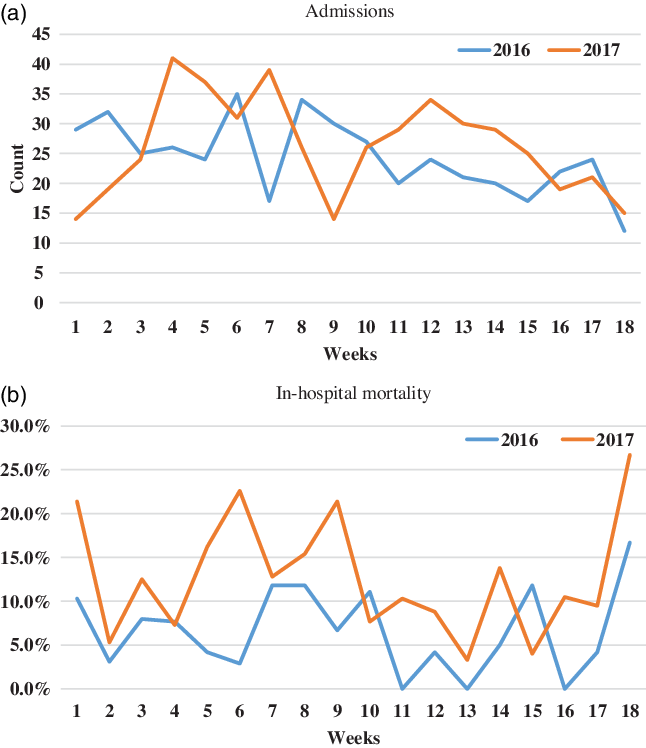
Four hundred seventy-three patients were admitted to the hospital following Maria, while 439 were identified for the control period. Looking at the number of admissions per week, there was a substantial drop in the week of landfall compared with the same week of the previous year. This number thereafter increased until reaching its maximum value in the fourth wk, with 41 admissions. During the ninth wk, however, admissions reached its minimum value with 14 patients. Finally, poststorm admissions were higher from the 11th wk to the 15th when compared with the control period. Trend analyses for admissions per week are presented in Figure 1A.
Weekly Trends Comparison for Admissions and In-Hospital Mortality Before and After the Hit of Hurricane Maria (N = 912).

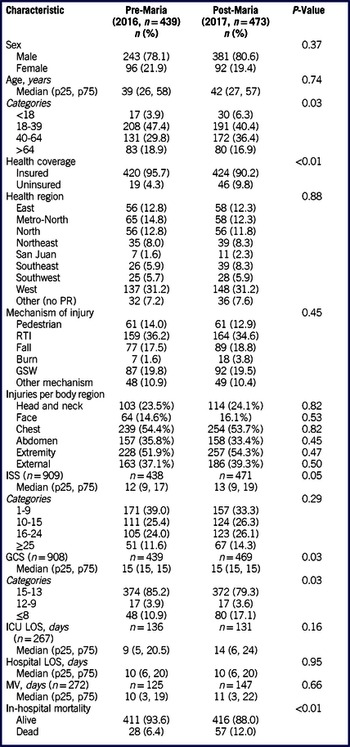
As to the sociodemographic profile, roughly 80% of the cases were males in both study periods (P = 0.37); however, the distribution of age was different (P = 0.03). After the storm, the frequency of admissions among patients aged 40-64 y increased from 29.8% to 36.4%, whereas among subjects between ages 18 and 39 y frequency dropped from 47.4% to 40.4%. Furthermore, the proportion of patients admitted to our hospital without health insurance coverage was significantly greater following Maria (4.3% vs 9.8%; P < 0.01). On the other hand, most patients came from the West region (31.2%), regardless of the study period (P = 0.88). Southeast (5.9% vs 8.3%) and Metro-North regions (14.8% vs 12.3%), however, showed an increase and a decrease in posthurricane admissions, respectively, although these differences were not statistically significant.
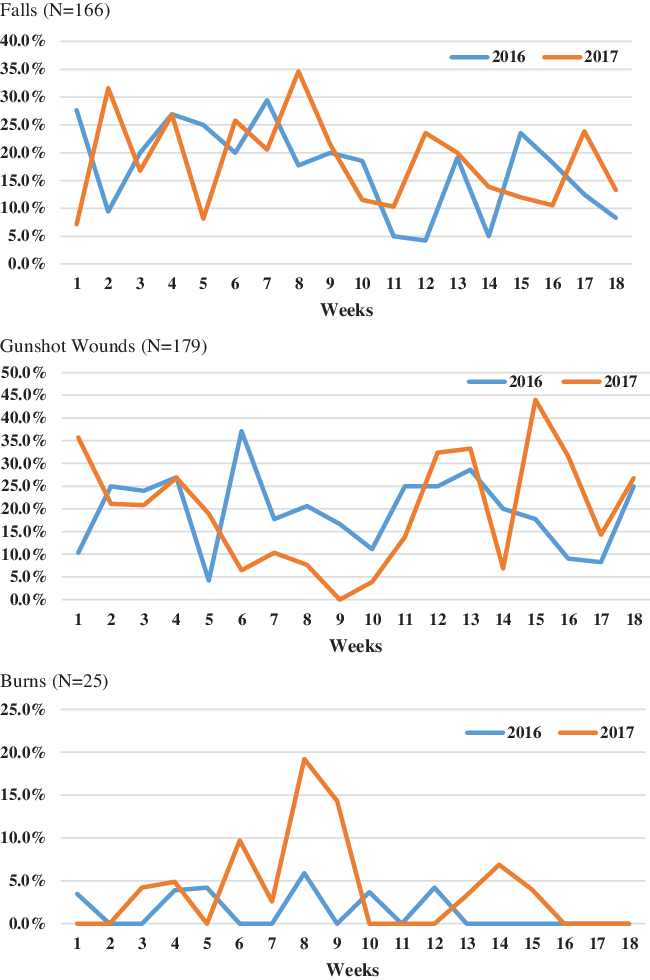
The mechanisms of injury exhibited comparable frequencies between the two study periods (P = 0.45). The only marked difference occurred among burn patients, for whom admissions doubled after Maria (1.6% vs 3.8%). Of interest, however, other variations in the mechanisms can be noted for specific segments of the period through trend analyses (Figure 2). For instance, falls registered considerable increases in the second and eighth wk, accounting for 31.6% (vs 9.4% in 2016) and 34.6% (vs 17.7% in 2016) of the total admissions, respectively. GSWs decreased from landfall through ninth wk, when no cases were reported. Thereafter, the proportion of GSW-related admissions began raising until they peaked in the 15th wk, with 44.0% (vs 17.7% the previous year). Meanwhile, burn-related traumas mostly occurred between the sixth and ninth wk, reaching their peak during the eighth wk (19.2% vs 5.9% in 2016).
Weekly Trends Comparison by Selected Mechanisms of Injuries Before and After the Hit of Hurricane Maria.

Concerning injury incidence by body region, the cohorts presented similar distributions (P > 0.05). Approximately half of the patients suffered traumas to the chest and extremities, making them the most commonly affected areas. The next most common injuries were external and abdominal traumas, affecting approximately a third of patients. Injuries to the head and neck had an incidence of almost 25%, while face traumas were the least frequent, occurring in approximately 15% of the cases. In the mechanism-stratified analysis (not displayed in tables), pedestrian accidents showed a substantial drop in the incidence of head and neck injuries from 48.2% to 31.2% following the storm. Falls presented an increase in external (7.8% vs 18.0%), extremity (42.9% vs 53.9%), face (9.1% vs 15.7%), and head and neck (14.3% vs 28.1%) injuries. In patients who suffered GSWs, abdominal traumas increased by 9%.
The median ISS was higher among post-Maria patients (13 vs 12; P = 0.05). Furthermore, when evaluating the ISS as a categorical variable, the proportion of patients with an ISS ≥ 25 increased from 11.6% to 14.3%, whereas the frequency of subjects with a mild (1-9) ISS dropped by 5.7%. Nevertheless, these differences were not statistically significant (P = 0.29). The distribution of the GCS scores also differed between the cohorts; the frequency of post-Maria patients with a GCS ≤ 8 was greater than that of their pre-Maria counterparts (17.1% vs 10.9%; P = 0.03). Moreover, the median ICU LOS increased by 5 days following the storm, although this difference did not reach statistical significance (9 vs 14; P = 0.16). Conversely, the median hospital LOS (10 days; P = 0.95) and MV days (10-11 days; P = 0.66) were comparable across the 2 periods. Sociodemographic characteristics, injury profile, and hospital course of trauma patients are depicted in Table 1.
Sociodemographic Profile, Hospital Length of Stay, and In-Hospital Mortality (N = 912)

Continuous variables were evaluated using the Wilcoxon rank-sum test; categorical variables were evaluated using the Pearson’s X2 test.
Abbreviations: p25 = 25th percentile; p75 = 75th percentile; PR = Puerto Rico; RTI = road traffic injury (motor vehicle collision, pedal cycle rider, motorcycle); GSW = gunshot wound; Other mechanism = (stab wound, assault, other nontraffic transport accident, among other injuries); ISS = Injury Severity Score; GCS = Glasgow Coma Scale; ICU = intensive care unit; LOS = length of stay; MV = mechanical ventilation.
Profile of Deceased Trauma Patients
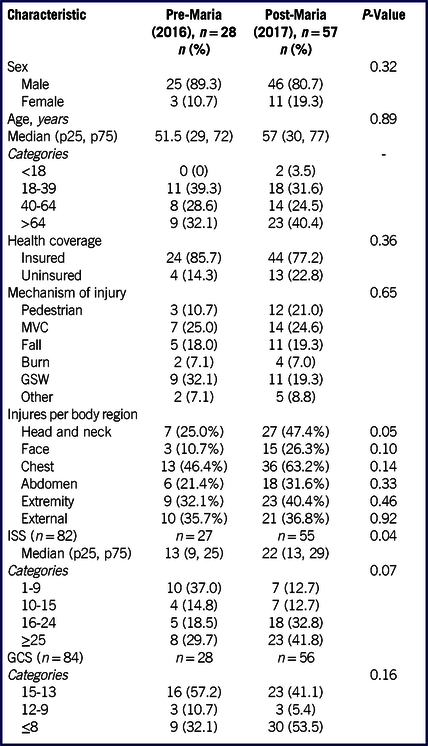
The proportion of women among deceased patients was higher after the hurricane compared with the control cohort (10.7% vs 19.3%; P = 0.32), although this difference did not reach statistical significance. With regard to age, the frequency of deceased between 18 and 64 y presented a decline of 11.8%, whereas elderly patients (> 64 y) experienced an increase of 8.3% (no statistical test calculated). Furthermore, 2 mechanisms of injury showed marked changes post-Maria. Although not statistically significant, pedestrian accidents doubled (10.7% vs 21.0%), and GSWs decreased by 12.8% (P = 0.65).
Head and neck injuries increased from 25.0% to 47.4% among deceased patients (P = 0.05). Similarly, traumas to the face exhibited a marginally significant increase of 15.6% (P = 0.10). However, chest, abdominal, extremity, and external injuries had similar proportions in both periods. When assessing patients’ severity, there was a significant increase in the median ISS among poststorm deceased compared with their prestorm counterparts (22 vs 13; P = 0.04). The number of patients with an ISS ≥ 25 also increased from 29.7% to 41.8%; this difference was marginally significant (P = 0.07). Additionally, the GCS ≤ 8, although not statistically significant, was more frequent among deceased patients after Maria (32.1% vs 53.6%; P = 0.16) (Table 2).
In-Hospital Mortality
In the bivariate analysis, in-hospital mortality doubled following the hurricane (6.4% vs 12.0%; P < 0.01) (Table 1). Throughout the post-Maria period, with the exception of 3 wk, mortality remained higher than that of the previous year. Indeed, the proportion of postlandfall deaths exceeded 20% in 4 different weeks, while mortality preceding Maria surpassed 12%, the highest frequency reported, only 1 wk (16.7%). Figure 1B displays the trend analyses for in-hospital deaths per week.
Profile of Deceased Trauma Patients (N = 85)

Continuous variables were evaluated using the Wilcoxon rank-sum test; categorical variables were evaluated using the Pearson’s X2 test except for mechanism of injury and GCS (Fisher’s extended test).
Abbreviations: p25 = 25th percentile; p75 = 75th percentile; MVC = motor vehicle collision; GSW = gunshot wound; ISS = Injury Severity Score; GCS = Glasgow Coma Scale.
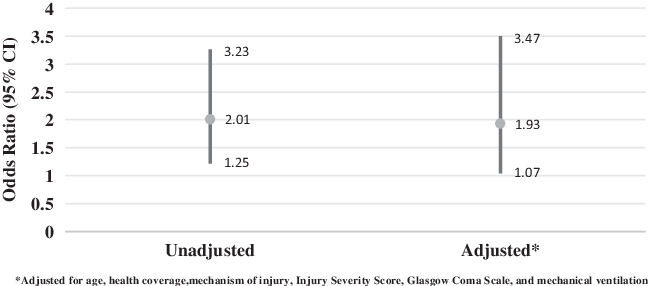
The postlandfall period was related to a 2-fold (95% CI: 1.25-3.23) increase in the risk of death. Moreover, when adjusting for all relevant covariates—age, health coverage, mechanism of injury, ISS, GCS, and MV—the excess mortality risk observed after the hurricane maintained the magnitude of its effect and its statistical significance, with an OR of 1.93 (95% CI: 1.07-3.47) (Figure 3).
Risk of Death After Hurricane Maria (N = 900).

DISCUSSION
This study aimed to determine whether the hazardous environmental conditions generated by Maria modified the injury patterns in PR to better plan for future natural disasters. The scientific literature on this topic is scarce and heterogeneous, thereby making it difficult to compare our findings with the effects observed historically in similar contexts. To our knowledge, this is the first research that describes in detail the morbidity associated to injuries and the characteristics of in-hospital decedents after a hurricane, as well as estimates the risk of death in trauma patients following such an atmospheric event.
Our results demonstrated that admissions dropped immediately postlandfall, but afterward they started to increase compared with the previous year. This trend is consistent with that reported in EDs elsewhere following a storm. Nevertheless, the changes in admission patterns at the PRTH occurred slower and lasted longer than those reported in previous studies, most of which documented a return to prelandfall volume of patients within 1 or 2 wk after the atmospheric phenomenon. Reference Smith and Graffeo9-Reference Miller, Kearney and Proescholdbell12 For instance, although our admissions increased by the second wk, it was not until the fourth wk that they surpassed the number of cases registered for the control period. Likewise, we noted another rise in the total cases from the 11th to the 15th wk.
Research has found that intensity, simultaneous heavy rain and direct landfall of a storm are the strongest predictors of a pattern change in ED visits. Reference Lin, Hou and Shih25 Maria was a powerful hurricane that met these 3 criteria; thus, the change in hospital admission patterns was expected. The impassable roads across the country, along with the collapsed communications infrastructure, might have played an important role in preventing people from accessing medical treatment for their injuries during the first weeks postlandfall. However, hurricane recovery efforts were prolonged in the Island, not only because of the magnitude of the devastation, but also due to the economic recession it has faced for over a decade. At the end of the study period, 4 mo after Maria hit, nearly 40% of residents remained without electrical service, tens of thousands of people had not received blue tarps for temporary roofing, 80% of intersections with stoplights were unpowered, and tons of debris continued to be piled up along roads and in front of homes. Reference Coto30,Reference Sutter31 This directly translates into increased risk of injuries, which may account for the excess hospital admissions observed throughout the exposure period.
The mechanisms of injury that showed the most significant changes per week after the storm were falls, GSWs, and burns. Falls are among the top mechanisms that, according to the literature, increase their frequency in the aftermath of natural disasters. Reference Miller, Kearney and Proescholdbell12,Reference Sullivent, West and Noe19,Reference Rotheray, Aitken and Goggins32 The first rise in fall-related admissions, noted during the second wk, could be related to flooding, debris, dangling power lines, and other hazards Maria left behind. In contrast, its highest frequency, observed in the eighth wk, potentially reflects falls from roofs and trees, as people were involved in clean-up activities and installment of temporary roofing (ie, blue tarps). In fact, a greater proportion of patients falling from higher levels was reported at our Center after the fifth wk compared with the preceding weeks (not shown in the tables), supporting this rationale.
Historically, GSWs have represented a highly prevalent mechanism at the PRTH, accounting for 20% of admissions. Reference Pascual-Marrero, Ramos-Meléndez and García-Rodríguez33 The downward trend in GSWs during the first half of the post-Maria period could be partially explained by the nightly curfew that Puerto Rico’s governor decreed for 4 wk in an attempt to avoid a rise in crime. Reference Banuchi34 On the contrary, massive absences of police officers reported in December 2017 and January 2018, when roughly 2700 of 13,000 officers were calling in sick every day “to press demands for unpaid overtime,” coincide with the upward trend in GSWs observed throughout the second half of the period. Reference Coto35 This reflects the link between lack of public safety and vigilance and increased violent crimes.
Finally, burn-related injuries, although they are one of the least common mechanisms at our Center, Reference Pascual-Marrero, Ramos-Meléndez and García-Rodríguez33 doubled after Maria. Their substantial increase might be related to the use of electric generators, candles, and other lighting products, as most people were without electricity. Kalina et al. (2016) also found that injury patterns associated with burns change following a storm, with scalds becoming the most frequent burn type. Reference Kalina, Malyutin and Cooper20
With regard to the sociodemographic profile, the increase in the median age of postlandfall patients compared with their prelandfall counterparts, according to Platz et al. (2007), is because adults are more involved in cleaning and repair tasks; which are tasks associated with most posthurricane injuries. Reference Platz, Cooper and Silvestri10 The main contributing factor to the increased admissions of the older population at the PRTH must be the massive exodus the Island experienced right after the hit of Maria. Meléndez and Hinojosa (2017) estimated that PR would “lose up to 470,335 residents or 14% of the population” from 2017 through 2019, with more than 40% being young people. Reference Meléndez and Hinojosa36
Another fundamental sociodemographic aspect is the fact that the proportion of patients admitted to our hospital without health insurance was significantly greater after the storm. This is indicative that vulnerable populations are disproportionately exposed to hurricane hazards, and its associated risk of injuries. 26 Consistent with the latter, it is known that people living in geographical zones through which the hurricane makes landfall are also at greater risk of traumas. In fact, subjects from the Southeast region, where Maria came ashore, showed an increase in admissions to our hospital during the exposure period.
Maria possessed the potential to increase, not only the occurrence of injuries, but also the severity of them. Indeed, 2 markers of injury severity, ISS and GCS, were increased at the PRTH. In a study in New Jersey, however, Curran et al. (2017) reported dissimilar results when comparing the patients’ ISS after Hurricane Sandy with a control period at a level-1 trauma center. Reference Curran, Bogdanovski and Hicks23 They found an average score of 7 for both cohorts. A possible explanation for this discrepancy is the intensity of each tropical cyclone upon which its destructive potential for people and the environment depends. Sandy made landfall in New Jersey as a category 2 storm, while Maria came ashore in PR as a high-end category 4 hurricane. Therefore, more severe injuries were expected during the latter. Moreover, this higher ISS among our poststorm patients may account, in turn, for their prolonged stay in the ICU.
The risk of trauma-related death after a tropical cyclone has not yet been assessed. The mortality increase observed at our Center was expected, as several strong mortality predictors increased in frequency following Maria: patients were older, more severely injured (ISS ≥ 25 and GCS ≤ 8) and more prone to be uninsured. However, through logistic regression models we demonstrated that the excess risk of death persisted after controlling for all of these covariates. This suggests that a powerful hurricane, such as Maria, exerts significant influence on mortality risk factors associated with trauma and constitutes a risk factor in itself.
This project has some limitations, the primary being the inability to identify those injuries directly related to Hurricane Maria. This prevented us from classifying the traumas as directly or indirectly caused by the storm and thus describing the burden of injuries separately. Another disadvantage was the lack of information on prehospital management, which has strong implications for patients’ prognosis.
The findings of our study are crucial for future disaster planning. The scope of this work transcends hospital settings; it sheds light on disaster preparedness at the community level and has important public policy implications. Primarily, the effect of a category 4 hurricane on the morbidity and mortality patterns associated to injuries is prolonged, so that both short- and long-term prevention and clinical management strategies are needed. Moreover, the socioeconomic background and infrastructure status of the affected area become major aspects to consider, because an economy in recession and an impoverished infrastructure lengthen the recovery process and, thus, increase the risk of injury.
The short-term approach to managing a tropical cyclone emergency should include mobile trauma units to be located in key areas throughout the country to provide care for life-threatening injuries. This is essential because access to hospitals becomes extremely limited after the storm leaves roads impassable. Furthermore, once road access begins to be restored, trauma centers should be prepared to manage an increased number of fall- and burn-related injuries. In the long-term management approach, it is necessary to consider logistics issues related to public safety and vigilance, such as a shortage of police officers, as this might lead to an increase in intentional injuries. Additionally, the potential burnout and stress among all workers involved in the emergency management need to be taken into account.
CONCLUSIONS
Based on our results regarding the sociodemographic characteristics, injury severity, and risk of death of post-Maria patients, trauma centers might expect an older population, with more severe injuries and a 2-fold increased mortality risk following a hurricane. Therefore, injury prevention activities targeted at high-risk groups (eg, older adults, subjects without health insurance, and those living in the landfall zone) should be part of governments’ disaster planning to effectively mitigate trauma morbidity and mortality associated to tropical cyclones. Future research efforts should evaluate the impact of hurricanes on prehospital management, which directly influences trauma patients’ outcome.
Acknowledgments
We thank Colleen B. Murphy Vellena, DrPHc, MPH, for help in editing this article.
Funding
This study received no external funding.
Conflict of Interest
The authors declare no conflicts of interest.
Scientific Presentations
The study was presented at the Region 2 Annual Residents Trauma Papers Competition of the American College of Surgeons Committee on Trauma held in San Juan, Puerto Rico, on November 30, 2018.
Author Contributions
E.O.R.M., M.N.P., and L.R.M searched the literature. E.O.R.M., M.N.P, L.G., and P.R.O designed the study. J.L.M., M.N.P., and E.O.R.M. collected the data. M.N.P. and E.O.R.M. analyzed the data. E.O.R.M., M.N.P., J.L.M., L.R.M., L.G., and P.R.O. contributed to data interpretation and manuscript preparation.