Introduction
The European fruit lecanium (EFL), Parthenolecanium corni Bouché (Hemiptera: Coccoidea) (Kawecki, Reference Kawecki1958; Kosztarab & Kozar, Reference Kosztarab and Kozar1988), is a common and harmful soft scale, infesting the branches and trunks of its host plants, particularly Fraxinus spp. and some other ornamental and fruit plants. In a heavy infestation, the plant may even die. Plants often become defoliated due to the accumulation of sooty moulds growing on the honeydew (Borchsenius, Reference Borchsenius1957; Khadzhibeili, Reference Khadzhibeili1983; Kosztarab & Kozar, Reference Kosztarab and Kozar1988).
Integrated pest management (IPM) is now recognized as the preferred strategy to achieve sustainable agricultural production (Yasnosh et al., Reference Yasnosh, Chkhaidze and Tabatadze1996) because alternatives, such as the use of pesticides, have various side-effects on both the environment and human health.
EFL is regulated by a large number of species of parasitoids and predators in Georgia and some Eastern European countries (Thompson, Reference Thompson1954). We are currently investigating the phenology of EFL in Tbilisi. The aim of our investigation is to clarify the role of the parasitoid complex in the population dynamics of the EFL. These investigations consider only the parasitoids and do not include other natural enemies of the EFL, such as predators, nematodes and viruses.
Material and methods
The investigations and collection of material was conducted in four different localities, between April–October 1995–2000, 2002 and 2006 on Fraxinus and stone fruit trees in Tbilisi. In addition to the data collected in the four study sites, published information was included in our investigation (Sugonjaev, Reference Sugonjaev1976, Reference Sugonjaev1984; Trjapitzin, Reference Trjapitzin1989; Guerrieri & Noyes, Reference Guerrieri and Noyes2000; Rzaeva, Reference Rzaeva2002; Sentenac & Kuntzmann, Reference Sentenac and Kuntzmann2003; Japoshvili & Noyes, Reference Japoshvili and Noyes2005; Noyes, Reference Noyes2006).
Our estimate of the scale of density was based on the mean number of adult coccids per ten centimeter branch and their developmental rate from studying 200 insects on a plant. At each site, we sampled ten randomly chosen 12–13-year-old scale-infested Caucasian ash trees (Fraxinus oxycarpa). Samples were also collected regularly from other host plants, including the following: Cercis siliquastrum, Prunus divaricata, Celtis caucasica, Acer sp., Acacia sp., Ulmus foliacea, Rosa spp., Malus domestica and Cornus mas. Parasitoids were reared in glass bottles covered with a fine mesh. To prevent desiccation, the humidity was maintained by placing a wet filter paper inside each bottle and changing it daily (see Nikolskaya & Yasnosh, Reference Nikolskaya and Yasnosh1966). The emerging parasitoids were identified and counted. The number of parasitized scales was determined by the presence of exit holes in the adult scales. Second instar nymphs also were parasitized and the parasitism was considered together with adult females. From this, we estimated the percentage parasitism.
The population fluctuations of EFL and its natural enemies were determined in the four main sites and also generally in the streets of Tbilisi (including 5–25-year-old trees). The sites represented two groups: two undisturbed areas in the surroundings of Tbilisi, and two areas inside the city of Tbilisi polluted by car exhausts. In each site, EFL-infested trees were selected randomly and the scale insects were collected from the trunk, branches and twigs. The percentage of plants damaged by EFL was calculated using the formula P=B×100a−1, where P is the percentage damage, B are the harmed plants (infested plants) and a is the number of studied samples (Khadzhibeili, Reference Khadzhibeili1983). This formula was also used to establish the role of parasitoids in the suppression of the EFL. Standard error was also calculated.
We also compared the EFL parasitoid fauna of Georgia with that of some East European countries using the Jaccard formula where the coefficient of similarity equals c×(a+b−c)−1 (Magurran, Reference Magurran1988), where a is the number of species in one plot, b is the number of species in the second plot and c is the number of species which were recorded at both sites.
Results and discussion
EFL was found in most areas of Tbilisi; it has one generation per year and overwinters as second-stage nymphs on the branches and trunks of the host tree. Observations showed that, after overwintering, the second-stage nymph begins to develop, then molts into the third-stage nymph, which finally molts into the adult stage between the end of April and mid-May. In mid-May, the insects mate and the females lay 220–1200 eggs during 25–30 days. First-stage nymphs crawl over plants, settling on the young branches. The adult females produce abundant sweet ‘honeydew’, which pollutes the leaves. Saprophytic sooty-mould fungi develop on the honeydew, causing blackening of the leaves, thus, greatly diminishing the quality of the host.
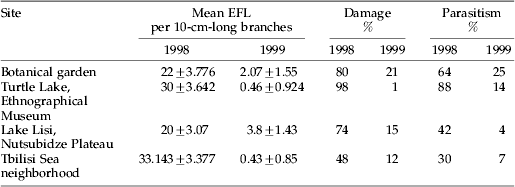
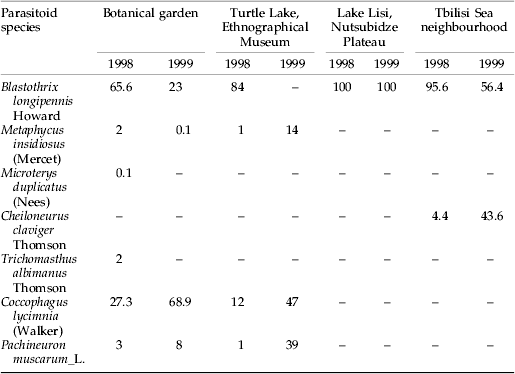
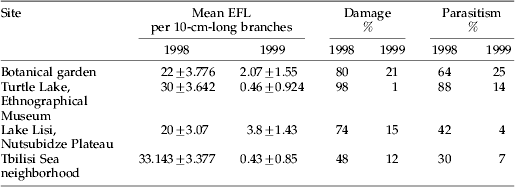
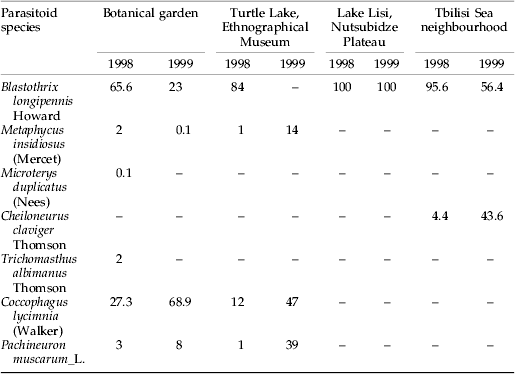
Table 1 gives the scale population, the % damage and the % parasitism for four sites. In 1998, the average number of ovipositing females on 10-cm-long trunks from all sites was less than that found in 1999. The degree of parasitism also decreased from 1998 to 1999. The population decreased due to the effect of high parasitism and, consequently, in the following years decreased parasitoid number. In 2000 and 2002, we could not locate any samples of EFL, probably as a result of a cold winter and hot summer in 2000. In 2006, we found very few scales, only one tree that was infested at a low density, with not more than one female per ten centimeters sampled. Table 2 shows the % parasitism of EFL by each of the parasitoids recorded in this study at each of the four sites in Tbilisi. The most abundant parasitoid at all the sites was Blastothrix longipennis Howard, with a parasitism rate of 65.6% and 1:1 (female:male) sex ratio. The next most abundant parasitoid was Coccophagus lycimnia Walker, which was found at two of the sample sites, had 38.8% parasitism and a male:female sex ratio of 3:1. Pachyneuron muscarum L. and Metaphycus insidiosus (Mercet) were also recorded at two of the sites and their parasitism rates were 12.75% and 4.3%, respectively, with a similar male to female sex ratio of 2:1. Cheiloneurus claviger Thomson, Trichomasthus albimanus Thomson and Microterys duplicatus (Nees) were recorded only at one site, and their parasitism rates were 24%, 1% and 0.05%, respectively.
Mean population density of Parthenolecanium corni per ten centimetre of branch, % damage and % parasitism at four sites in Tbilisi, April–August, 1998–1999.
Percentage parasitism for each of the seven parasitoids recorded from Parthenolecanium corni at four sites in Tbilisi, June–October, 1998–1999.
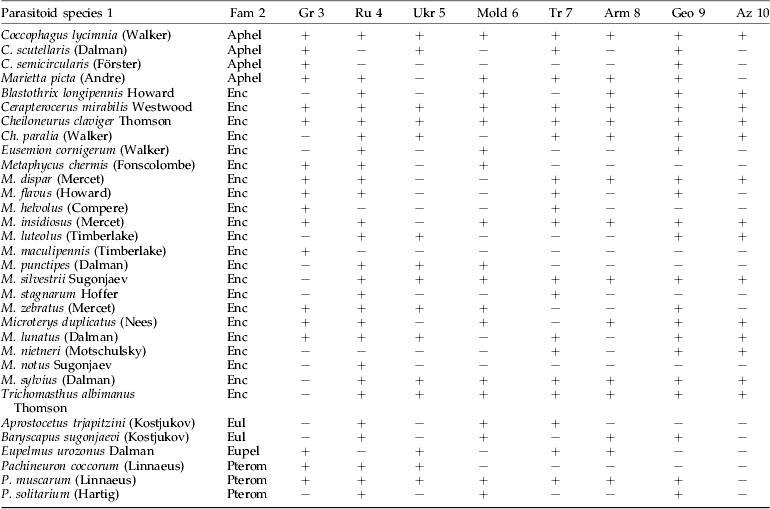
A list of parasitoids recorded from EFL in central western and southeastern Europe is presented in table 3. The EFL parasitoid fauna of Georgia is most similar to that of Russia, with a coefficient of similarity of 0.69. A high coefficient of similarity is also seen for Georgia-Azerbaijan (0.61), Georgia-Moldova and Georgia-Armenia (0.58 each) and Georgia-Turkey (0.56). The lowest coefficient of similarity was between Georgia-Ukraine and Georgia-Greece with 0.46 each. We also compared the fauna of Transcaucasus with Greece, Russia, Ukraine, Moldova and Turkey. The results were 0.5, 0.67, 0.5, 0.56 and 0.59, respectively.
Parasitoid records from Parthenolecanium corni from five regions in Eastern Europe and Transcaucasus.
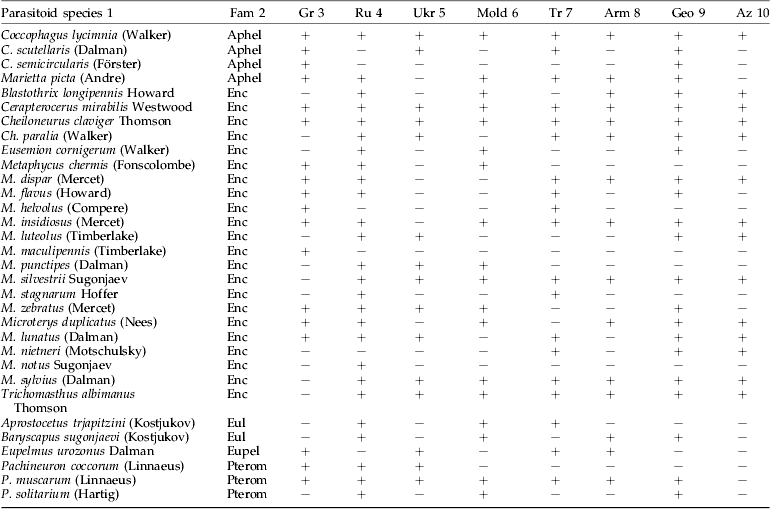
Fam, family; Aphel, Aphelinidae; Enc, Encyrtidae; Eul, Eulophidae; Eupel, Eupelmidae; Pterom, Pteromalidae; Gr, Greece; Ru, Russia; Ukr, Ukraine; Mold, Moldova; Geo, Georgia; Arm, Armenia; Tr, Turkey; Az, Azerbaijan.
Thirty-two species of chalcidoid parasitoids have been recorded from EFL in southeastern parts of Europe (table 3). Seven species were not included in table 3 since we considered these records to be based on erroneous identification: Coccophagus pulchellus (Boucek, Reference Boucek1977), Pteroptrix dimidiata (Yasnosh et al., Reference Yasnosh, Chkhaidze and Tabatadze1996), Blastothrix britannica (Sentenac & Kuntzmann, Reference Sentenac and Kuntzmann2003), B. sericea (Thompson, Reference Thompson1954; Mitic-Muzina, Reference Mitic-Muzina1964, Reference Mitic-Muzina1967; Herting, Reference Herting1972; Boucek, Reference Boucek1977; Sikharulidze & Tavamaishvili, Reference Sikharulidze and Tavamaishvili1977; Tudor, Reference Tudor1982; Noyes & Hayat, Reference Noyes and Hayat1994), Discodes aeneus (Boucek, Reference Boucek1961, Reference Boucek1965; Herting, Reference Herting1972), Metaphycus pappus (Trjapitzin, Reference Trjapitzin and Medvedev1978) and Thysanus ater (Trjapitzin, Reference Trjapitzin1975, Reference Trjapitzin and Medvedev1978; Boucek, Reference Boucek1977). It appears that EFL populations are significantly under control by their natural enemies. We suggest that a long-term investigation be undertaken to determine the EFL-parasitoid relations in the urban areas in order to determine the influence of pollution on their population dynamics. The results of this investigation indicate that one of the significant factors in maintaining P. corni below its economic threshold is the complex of natural enemies, the most important of which is the parasitoid Blastothrix longipennis.
Although the above findings are based on an extensive amount of material, the study is still far from complete and is being continued both in Tbilisi and neighbouring sites.