1. The Performer's Voice: Research strands in electroacoustic instrumental performance
An astonishing sense of anticipation is felt, the imminent connection to notes, the opening multiphonic, the breath that imbues this work with meditative and seductive style; quarter tones, altered tone fingerings, strands of tones linking and separating, spaces in sounds, spaces of sounds. Here in performance, the spinning threads construct the evocative soundscape, transporting us into the music. The breathing reflects a stylized gesture, locating the performer at once in that sound, and coming from that sound. An immersion is created, we glide together: the audience's attention is palpable. The flute becomes a body extension, part flesh, part conduit, simultaneously directing and following the performance. Dreams again, of perfection and ease … My thoughts become the notes, travellers across the page, the room … What a sweet sound, what a beautiful song of yearning, of wafting and dreaming. The music appears to move, to build invisible textures and structures, to draw us in. The amplification is amazing, it projects strength and colours, it provokes confidence and definition, it is in love with whistle tones so hard to pitch, it throws a resonant phrase to the back wall, it creates amazing whirls of harmonics and glissandi. An unimagined delicacy of tone arrives, a shimmering vibrato slides through the room, a sharp accent penetrates the fragile timbres.We are in a forest? What a place this is!
Author's journal entry, March 2007, after performing Mario Lavista's Canto del alba (Penny Reference Penny2009b)
The journal excerpt above represents a personal account of an experience of performing a work for solo amplified flute. The performer's identity here springs from, and merges with, thoughts and memories of the flute, renewed sonic dialogue with electrical presence, intermingled old and new gestures, and a sharing of sensations. The outer skin of the performer is metaphorically peeled off, the mask is removed, the fragility exposed. The ‘voice’ in this instance is the thought pattern of the musician in situ – the mask remover. Conversely, consider the mask as concealer, as capricious questioner, as re-locator or provocateur. This mask is evoked by electronics; it has a complex entity, its presence variously evidenced as transformed sound, as shadow, as multiple characterisation. An unpredictable and expanding element arrives in performance practice: a vehicle for significant freedoms, for new artistic potentials and choices.
The emergent performance ontologies of the electroacoustic instrumentalist introduce a plurality of performative layers, evolving into a complex, yet compelling exploration. The use of the instrumentalist's voice, for example, introduces a vibrant strand: the personal, human perspective of the performer is projected directly, and often surprisingly, through these techniques. The impact of melding voice or whispering with the instrument, or of using the voice as narrative in disembodied projection immediately creates a diverse expression, a multi-dimensional persona. The position of the player becomes subject to distance perception, to reality challenges and identity questioning. These elements generate new performative responses, extending experience, perceptions and artistic engagements. Revelations occur – to ourselves and to the audience – as new layers are added to performance personas. The voice as narrative, as tone colour, as representative of a performer's bodily presence, and the invisible partners (implied voices) in electroacoustic performance are discussed here in relation to works from the flute and electronics repertoire.
2. Mapping masks, voices and meaning
A reference to Maskenfreiheit compels a brief contextual investigation and explanation. Coming across this concept as a performer, one may recognise facets of one's own practice as metaphorical masking: the sense of freedom afforded by a renewed and shifting sonic palette (amplified and/or treated), new potentials for multi-layering a performative identity, extensive characterisation potentials and diverse instrumentalist/technology interactivity. Elements of electroacoustic performance could, in some ways, be aligned to the use of masks in ancient Greek or Noh theatre; the concealment/revelation dichotomies of the masks of philosophic discourse; or, suggestively, the ‘freedom conferred by masks’ described by Heinrich Heine as ‘the most beautiful equality and the most beautiful freedom’ (Heine 1887: 466) in reference to the Venetian masked ball. Nietzsche's adoption of the mask as a point of departure for discussions of interpersonal relationships and behaviour reveal, perhaps, a somewhat performative eagerness for camouflage and pretence: ‘The spirit’, he says, ‘enjoys the multiplicity and craftiness of its masks, it also enjoys the feeling of security behind them’ (Nietzsche Reference Nietzsche1966: 160). These sensations and the performance potentials of masking inevitably allude to connections of visible and invisible elements in performance, and capacities for discovery. This steers us towards Merleau-Ponty: ‘Veiling them, it unveils them’ (Merleau-Ponty Reference Merleau-Ponty1968: 131). In her phenomenological study of dance with technology, Susan Kozel refers to differentiations of the visible and invisible as, in Merleau-Ponty's words, a ‘dehiscence’, as the way of seeing and being seen (Kozel Reference Kozel2007: 42). Peter Brook captures a fundamental attraction of masking: ‘[it] makes it unnecessary for you to hide. Because there is a greater security, you can take great risks; and because here it is not you, and therefore everything about you is hidden, you can let yourself appear’ (Brook Reference Brook1988: 231).
This author suggests that notions such as these can be readily transferred to music performance scenarios, especially in concert with electronics, where shifting sonorities, location perspectives, performance hierarchies and spatial dynamics may challenge expectations and responses. The performer may take on multiple characters or masks, become veiled, expand, seem close or distant, become disembodied or entwined with concepts of ‘voice’. The historical intersection of mask and voice includes the important element of amplification. In ancient Greek theatre, states Anthony Sheppard, ‘over-the-head masks … functioned as sound boxes for the performer and allowed the actor's voice to resound with the power of a god or a mythic hero’. In Japanese Noh, he goes on, the ‘voice projected from behind a Noh mask is intended to sound as though it comes from another world’ (Sheppard Reference Sheppard2001: 32). These allusions to the expressive sound qualities of theatrical voices, set apart from the precise meaning of words and the means by which these could be interpreted, carry forward into the vocalisations of twentieth-century composition styles, for example Harry Partch's extensive use of ‘meaningless words’ in works such as Oedipus and Delusion, and the music of Luciano Berio. In Omaggio a Joyce (1958) and Visage (1961), Berio used voice, specifically the voice of Cathy Berberian, as source material for two highly emotive electronic works. Simon Emmerson (Reference Emmerson2007: 78) notes that in Visage ‘paralanguage, utterance, vocal (but non-verbal) gesture’ represent emotional states that are, at times, directly confrontational. An abstract voice may or may not mask or reveal the identity of the performer: but its ability to evoke striking performance personae is certain.
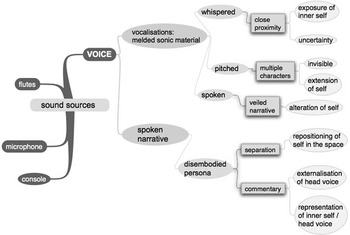
As a performer, one searches for the meaning of altering flute sounds, and using voice with flute in diverse compositions: what does it add to this already perfect sound? What happens to the performing identity, the tone that has been formed, harried, refined, renewed and gives ‘voice’ to one's own identity? What implications are there in the performance space, the interpretations and audience perception? It seems vital to examine the issues from within the performance, to observe the self and respond on a personal level. The diagram in Figure 1 is an exemplar of preliminary investigation, and is presented to show pathways of meaning sought from the use of the voice with flute in performance, and the impact on projection. Following the linear directions of the mind map uncovers intuitive approaches, identifies streams and processes, and helps define awareness, interpretation and experience. In this example, the search for connections of the voice with other sound sources (flutes, electronics) breaks into seemingly endless trails, here contracted to fit the page. Investigating spoken narrative and melded vocalisation with flute sound in this way clarifies meaning and interpretational ideas. The voice symbolises and creates a human presence, in this case the presence of the flautist. It is an unexpected side of the flautist that appears, at times disembodied or smudged with flute sounds, creating a new sensation, a new location, a new sense of self. Vocalisations meld with flute, breath or synthesised material; they emanate from whispers, pitches or speech; they suggest location, other presences and diverse manifestations of self. Disembodiment of diffused voice creates a sensation of external commentary of inner thoughts, of looking in from outside. In performance these sensations can create a distinct shape to the performance space, and appear to extend the personal space of the performer, to unveil transformations or aspects of self normally hidden. Steven Connor's talk, The Chronopher, provides valuable understandings of performative actuality as he describes re-locations and re-balancing of perceptions created by speech: ‘When I speak, my body becomes a potential, a projective and a sequential thing, not a given thing, opening itself, and me its vehicle, to ongoingness’ (Connor Reference Connor2009: para 4). ‘Uttering is outering’, he says, ‘the giving forth of something which, far from expressing something previously inner, is actually drawn to, even drawn out of, the utter, the infinitively outermost’ (2009: para 6).
Voice and meaning map.

3. Mixing sound layers and identities: Saariaho's NoaNoa
Kaija Saariaho's NoaNoa (Reference Saariaho1992) for flute and electronics uses the performer's voice to present text, fragments of which meld with flute tone, creating potent sonic material to express sensation and multiple personas. Whispered and spoken French words, as well as pitched voice, suggest the colours, scents and sensations of Gauguin's Tahiti as described in his journal NoaNoa (1891–93):
l'arbre sen-tait la rose la rose très o-do-rant sen-tait rose rose sen-tait rose s t r t s t s t s t t t t t t
sen-tait la rose
mes-s yeux voil-és mon coeur-rr
sen-tait la rose la fleur-r
la…fleur
t t t t t t t très…odorant me-lange me-lange me-lange…d'odeur l'ar-bre sen-tait la rose fleur-r
tr tr tr
fleur fanée fleur fleur l f l f r
me-lange d'odeur par-fums par-fums de san-tal très…odorant s f tr f s z t f
l'arbre sentait
fleur…dorée Je…reviendrai
mes yeux yeux la fleur-r fleur fleur fleur fanée
t r t r t t t t t t t t t
je
fl sa tr t t t t t s t s t k s t k s t k s t k k tr ro je je t je t ta ka ta ka ro tr re fl sa ka tr s z t k z t k
fl tr z t k ro fl tr
ka z t fl tr ro z t k fl tr z t k st s
la…fleur
f r s t s s t s
la…fleur
A literal translation of these words is superfluous, as the principle effect of the voice is the tonal colour and physical sensations it evokes. Phonemes become acoustic material, melded or contrasted with flute sound, given projection and musical presence by amplification and reverberation effects. Flute notes obscured by these vocalisations and altered mouth configurations become sustained and positioned, the tangles of flute and voice at times making the two sounds indistinguishable, and giving a rather unsettling sense of performative ambiguity, of other presences and shadows. There is a veiled or masked quality to the sound, the flute masking the voice, and vice versa. Often the voice is whispering, sometimes pitching, sometimes adding partial breathtone, and at times interrupting sustained trills or multiphonics. As the work progresses the words become more disjointed, often becoming strings of consonants or explosive sforzandi, interjected through the flute line. Flutter tonguing emerges from rolled ‘r's, or repeated ‘t's, anticipated in the manner of a stutter.
The vocalisations have an extraordinary impact: the presence of the human body is imprinted on the soundscape; a new dimension accentuates an intimacy that becomes derived from the sensation and vibration of the sounds, and the physical shift of pitching and projection of voice that occurs. Sonic pauses appear as transitions; the vibrato-free flute tone melds with voice at a semitone – a feeling as much as a sound; a sigh-like bisbigliando (altered fingering) phrase circles the pitch centre (ancora più lento). Initial rehearsals with electronics reveal these meanings with astonishing clarity, as projection and sustained lines are facilitated through amplification and reverberation. In performance, the sensations of these vocalisations with flute emphasise and articulate a dramatic introspection, a ‘turning inside-out’ of the self as well as a shifting of performance mode in the presentation of the exotic character of the piece.
The use of amplified breath tone and flute has been investigated in earlier publications (Penny Reference Penny2009a and Reference Penny2009b), where effects of the technique are explored. In summary, along with the generation of an augmented sound palette, changing illusions of proximity can imply exposure of the physical interior of the performer, giving the sensation of extending the inner self into the music and out into the hall. This connection of inner and outer identities evokes intimacy through these impressions of the performer's interior physicality conveyed as a performance gesture. Such hyper-magnification of breath sounds and vocalisation create an expanded capacity to draw the listener into the sound world of the performer. The ‘feeling’ in the room can be manipulated through this expansion and contraction, as an immersion in the sound environment externalises and communicates internal flows.
In NoaNoa, electronic reverberation of instrumental and vocal sound adds to this sense of immersion, through the build-up of textures, a sense of enlargement of the tonal space and dialogue with the musical material or implied hidden persona. Reverberation, Katharine Norman suggests (Reference Norman2004: 128), puts a sound in a place, the echo confirming its existence. Within this context, new modalities of attention are set in place: attention to the self (performer), the space (location) and proximity. These influences are vibrantly demonstrated in NoaNoa. The reverberation ranges from very close to quite distant within the piece, and it is through this technique that Saariaho creates such a powerful atmospheric aura, implying fragrance and shadows, perhaps tropical heat and humidity, certainly intensity of colour and sound. She conveys a sense of unexpected outcome, as sometimes this reverberation follows the dynamic – starting very close in a loud passage and spreading out as the sound diminishes (opposite to the normal pattern and expectation). The amplification and delaying of the flute expands and softens sounds such as pitch glissandi, and momentary spaces are created through spatialisation of the flute and breath tones. A transformation of space perception thus complements the projection of an ambiguous performer identity, in which voice, breath, flute and electronic sounds merge.
4. Voice as narrative: Hajdu's Sleeplessness
Georg Hajdu's Sleeplessness for flutes, narrator and Max/MSP (Reference Hajdu1997, revised 2007) explores the musical creation of an enclosed space, multiple selves and anxiety. The spoken narrative establishes an invisible, theatrical domain with the disembodied pre-recorded voice of the performer playing through speakers spread through the hall. This narrative becomes a pivotal character of the piece, with the flute's dialogue something of an accompanist, an elaborator of sensations described and intensified by the electronics. The soloist assumes multiple roles separated out into distinct performative layers: verbal commentary, hidden electronic sound transformations and the musical and gestural responses happening visibly on the stage.
The text describes a head-voice commentary; a sense of uneasiness is immediately created with the opening words – ‘You'd been restless the entire day. You sat down in the evening, you still wanted to accomplish something. There was this word …’ – expressing apprehension, discomfort and an unsettled mood. The listener becomes situated within the house as the drama unfolds first in the living room, then bedroom and bathroom. This spatial metaphor for the psyche of the self, moving agitatedly through states (or rooms) of unease, is enhanced by a repertoire of sound effects melded with the flute line. Anxiety is expressed through fragmented phrases, unfocused tone colours, angular lines and disjunct accents. Breath tones express a grainy indistinctness and uncertainty. The electronics add undercurrents, often through reverberation, capturing feelings of shakiness and nervous twitches; they conjure up shadows and confusion through harmonisation effects that introduce new characters and voices. The separateness of the recorded voice, presented as a strong persona in the hall, gives it an almost overbearing presence, which builds up to a frenzy, and then quietly slips away at the end.
A strong, and enticing, feature of Sleeplessness is the variety and effectiveness of the flute sounds. The first section of the piece utilises whispy staccatos, glissandi and flutter tonguing on bass flute to create spikes and twitches, picking up rhythmic drive in an episode for breath tone. The bass range (used in the opening episodes) creates a close, intimate, feeling: you are right there with the sound, the low range implying bodily proximity. The instrument itself is heavy, it needs space, it requires an inner calm of the performer, plenty of air, but relaxed breath. It is deliberately indistinct, uncertain, disconcerting: one is left with a feeling of inner disquiet, but enveloped, both physically and aurally (‘suddenly a sea of tiny red, blue and yellowish-green dots…’). This unfocused bass sound is somewhat wobbly and unwieldy, and the writing is scattered and interrupted. Harmonics and multi-phonics add to the uncertainty and gathering unease, and harmonisations create shadows and invisible companions. The fields of sound move from isolated flickering to a soundscape that is suddenly saturated with a dense and highly active bass line. In rehearsal, the physical mapping of these sounds to the body begins to feel like the sounds themselves, the twitching, spiking and shuddering.
The screeching reverberated piccolo signifies the onset of panic. Playing the piccolo is equally intense for player and listener: the high pitches, forceful air pressure, ear tension and resultant jangling nerves creating a very clear metaphor for the panic described in the text: ‘My god!! You're dying! Your heart is beating like mad, your head is inside a suction cup …’. The line dissipates, becomes shaken and jittery as it is juxtaposed against the whispering piccolo, an unusual sound that gives an impression of rustling disturbance with whistle tones, glissandi and pizzicato. The move to alto flute towards the end signals a transition to calmer resolute acceptance (‘You should change your life …’). This is represented by a progression to normal, soothing, resonant tone in the middle-range flute. A melodic sequence appears to act as a comforter, but the work ultimately makes no resolution, the music retains remnants of questioning, and the narrative ends with an incomplete question, the issues unsolved, deferred to another day.
The capacity of anxiety to engulf is emulated through technological illusions in this enclosure, the sensation of emotions encircling the space, of shadows and multiplied voices, immersing and separating through the shifting patterns of the work. Integrating body, voice, instrument and electronics becomes defined by the constructs and interplay, the sonic contexts in the evolution of the drama. In practice, the sense of the music darting around the text creates a challenge to keep up the momentum, to achieve flow and balance, sharp juxtapositions, vivid images and a projection of the dramatic mood. A cohesive thread of invisible theatrical characterisation is called for, as the episodes glide (or spill) from one to another.
The visual appearance of the performer and performance space, the readability of gestures, the context, and the formality or informality of approach influence the projected sense of place (Schick Reference Schick2006). The visual ambiguities evident in Sleeplessness emphasise a need to clarify the three theatrical spatial fields: the performance space (the sound source), the listener's space (the virtual space, where illusions become constructed through recognitions and spatialised sound) and the mental space (the imaginary space – where the drama is played out). The power of the electronics to define this space is clear: the reverberation anchors and describes it, the harmonisations create additional presences, the virtual constructs trigger recognitions of shared life experience. Reverberation, and its absence, is a crucial musical tool: its presence creates a sense of space around the performer, a wide open head space, that at times gives way to a dry non-reverberated sound, which draws the listener in to a very close, personal head space. Projective clarity of micro sounds is not possible in an acoustic situation; they would blur into a void, changing the complexion of the music completely. A sense of power comes from the amplification, transfers to the self, and enriches the experience through a sense of performative control.
The impact of the narrative in the space adds further dimensions: one's own voice is heard from above and in front, calling the pace of the drama, and questioning performance identity. The electronics emerge as a representation of the inner self, as both driver of and reactor to the drama. The disembodied voice tells the story, presenting the performer as invisible, character actor role, and underlining the internalisation of the anxiety, and solitariness of this journey through the night. We can sense elements of masking, as the performer's interior and exterior identities shift and expand, recognising ‘a double existence, for he is at once himself and someone else’ (Smith Reference Smith1984: 2). The performer not only ‘exposes his or her voice, as voiced by the instrument, as coming from inside his or her body and going into an exterior space, one that extends beyond the body’ (Schroeder Reference Schroeder2006: 132), but also multiplies, reorients and transforms that voice.
5. Imaginary voice: invisible sound partners
Marco Stroppa's little i for flutes (concert, alto, piccolo) and electronic room (Reference Stroppa1996) presents a divergent voice – suggested through the poem of e.e. cummings, and represented through dialogues with invisible partners, and ambiguities of space and musical presences. There are implied voices, shifting balances and a dramatic real-time/virtual arena to establish in this work. Captivating elements of Maskenfreiheit emerge as the relationships of instrumental soloist and other invisible presences are explored, with the flute and the two sources of electronic sound (the technologist and the pre-recorded material) participating in an imaginary trio. The pre-recorded sounds (synthesised sounds and processed flute sounds) are an ‘immaterial’ part of the instrumentalist, who ‘sees’ and communicates with the invisible sound partners. The composer clarifies:
The tape is a sort of ‘immaterial’ part of you: each time you have a rest, fall back into its character, try to make it part of your sound world and to find a correspondence in your playing … then the relationship between your playing and what is coming out of loudspeakers can be a very musical one, as if you're ‘seeing’ and communicating with your invisible sound partners. (Stroppa, personal communication)
Part of the spatialisation effect emanates from the locations of the flute player, who takes four different positions in the performance space, creating echo effects, multiplication and separation of the flute from both sound source and the electronic material. The sound diffusion is composed and actuated with real-time control over sound levels, equalisation and placement of sound creating interplay with the virtual and real. The movement of player and sound sources gives the illusory element presence and a sense of the unexpected. Processed pre-recorded flute sounds present a wide spectrum of colours and pitches, sometimes merging with the live flute, or in dialogue and, in a sense, expanding the flute outwards into multi characterisations. The sense of the flute itself is spatialised in this way, and through live amplification. For example, different sounds from different ends of the flute, such as tongue rams from the lower end of the alto flute and pizzicato tonguing from the top end, are sent to varied speakers to suggest distance and other presences. ‘Vocal and instrumental gestures account for the visibility of the gesture of performance; electroacoustic and digital gestures make the gestures of performance invisible’, states Paulo Chagas (Reference Chagas2006: 125). In little i, these visible and invisible elements mix and diverge, as flute sounds are disembodied and moved through the spatial field separately, blurring conventional cause-and-effect expectations, through obscuring the source of the live and pre-recorded sounds, the dispersal of canonic style dialogues, disparate sound associations and the composed movement of the sounds through the six speakers. The electroacoustic environment takes on a chamber-music style as the processed sounds are fixed, but triggered and balanced by the sound technologist as a performer in an ensemble setting, where adjustments are made in situ.
Stroppa uses spatialisation to set out the characters in the virtual space, to create this space as a dramatic scene and to imbue the flutes with uncertain, but enlarged, qualities that merge with and emerge from the electronically produced material and effects. The movement of player and sound sources gives this illusory element a physical presence, as the performer moves quietly from station to station. From the very first note of little i, it feels like entering an exceptional place, an absorbing sonic environment and theatre. Multiple characterisations indicated in the score, such as fatato, scalmanato, vorace, girovago and ticchettio, provoke a marvellous sense of Maskenfreiheit, as identities of performers, sounds and locations, even motifs, are shaped and illuminated together. The uncertainty of location and sound source presents challenges to expectations as the performer plays in one position, yet the sound is sent through speakers on other locations on the stage; a play with invisible partners (electronics) and disembodied ‘voices’ takes place, akin to the ventriloquist's practice, as discussed by Steven Connor:
In the so-called ‘distant voice’ [of ventriloquism], the voice may be in the air, on the roof, up a chimney, in a basement or on the end of the telephone line. But the knowledge that the voice really belongs to the one who affects only to hear it keeps us aware of a kind of filament or cord stretching between the apparent and real locations of the voice. (Connor Reference Connor2004: para 22)
Connections to the performer's presence suggest an ambiguity in little i where, perhaps, the ‘freedoms’ are illusory. Many of the sounds appear to be, or are, generated from outside the body. Yolande Harris describes some comparable experiences of the inside-out instrument: ‘the audience spectator no longer has the focal point of body-instrument-sound … It is like a turning inside-out of the intimacy of the musician-instrument into a space inhabited by multiple performers and instruments’ (Harris Reference Harris2006: 161). Perhaps there is a sense of liberation of the flute sound from its source in little i, a freeing-up of rigid performance rituals, and an opening-up of nuance and dialogues with discrete partners, and yet this is a score of immense precision, quite ‘maximalist’ in notational style and highly controlled by composer ideals.
6. Voice as performer's presence
In a recent young composer's workshop in Australia,Footnote 2 composers were asked to write a work based on a newly written poem. Of the six works for flute forthcoming from this exercise, all used varying amounts of breath tone, and two incorporated text into the work. In one case this involved whispering parts of the poem and in the other, vocalisations were a consistent layer of colour throughout. This later work, Voice for Solo Flute by Korean composer Ji Eun Moon, included dramatic exclamations of words, tongued vocalisations and singing with playing. These techniques are quite standard, but my interest was spiked by the variety of emphases and the range of feelings evoked. Separated text and flute gives a feeling of delivery of words and notes alongside the music – a distinct sense of responsibility to the authors. Conjoined flute lines and voice sounds seem to create a much greater sense of exposure and vulnerability in the performer – a presentation of self, an integrated but altered flautist identity that suddenly becomes less abstract and more accountable. Questions are immediately generated to explain this: is the abstract practice of the instrumentalist essentially a kind of mask, a covering of human voice? Is the sound of the voice an acute representation of body, of personality, and therefore more unsettling in performance? This changed situation certainly requires significant performative attention. Clarinettist Richard Haynes speaks of preparing Richard Barrett's work interference (1999–2000) for contrabass clarinet, voice, bass drum and electronics. He worked on the three performative layers separately, taking voice lessons and drum lessons, and was gradually able to bring all three into a single entity – a solo ensemble, perhaps. The result in performance is dramatic and spectacular, as extremes of volume of each element are exploited electronically and spatialised around the venue in performance. From within the audience, the performer appears as a powerful multi-faceted entity, perhaps even extreme, certainly theatrical. Barthes’ reference to the body in the voice as the ‘grain of the voice … the hand as it writes, the limb as it performs’ (Barthes Reference Barthes1977: 188) comes to mind in these contexts, as the voice and amplified instrument in or on the mouth reveals the interior – breath, moisture, declamation – spatialised out into the hall.
Taking Naomi Cumming's idea of the signification of the performer's presence in the sound and ‘presence’ in performance as interpreted effect – ‘presence is created in the act of interpretive performance itself’ (Cumming Reference Cumming2000: 160) – we can further examine the performer's voice, the sonic alterations of live electronic settings, and the implications for bodily and performative presence. A musician is the sound she or he makes; in fact, the motivating element to be a musician, is, in general, to be the music, to embody the sound (Coessens, Crispin and Douglas Reference Coessens, Crispin and Douglas2009: 150). Therefore, does a displaced sound, a disembodied sound or timbrally treated sound displace the performer and alter her or his performative persona? From the performer's perspective, there is a re-orientation in the space, both inwards and outwards. Reassessments of projection and tone colour occur, responses to the dialogues of spatialisation and interaction, as well as the potential for instability in the performance space. A turning in towards the instrument is evident, an extended awareness of physicality arises, an intense focus on the inside. Minute shifts of embouchure or breath, throat or fingers and new muscular and visceral responses strive to balance with large arm, leg or full body movements. Electronics further extend this experience, as the player becomes part of an ensemble of sounds in virtual space, merging and emerging, opposing and supporting, dominating or yielding. The following passage describes personal inward/outward responses to a performance for flute with electronics, exploring spatialisation techniques and influences of amplification:
My energy and inspiration came from a symbiosis of internal and external drives, the source of renewed capacities and amazing choices, responses to self-exploration and altered perceptions. The ideals of electronics used as magnifier of the inner and intimate opened up expressive potential, and gave transparency and form to my sound and thought processes. My mental positioning, particularly through my instrument as an amplifier of myself,Footnote 3 adapted to this array of choice, the possibility of hidden and dominant presences, the attached emotionality of tonal qualities, shaping and manoeuvring, and perceiving my work with reviewed conceptual goals. As the new sounds and functions became recognized and usable artistic materials, they became instilled as an integral part of my own self-perception as a flautist. This is a manifestly shared ownership, however, as so much of the sonic control is remotely activated, from the sound technologist's desk. (Penny Reference Penny2009b: 90)
These elements have a powerful impact on the self-perception of the performer, and the performer's voice as presence. Steven Connor's reference to ambiguities of presences can be easily extrapolated into the electroacoustic instrumentalist's field: ‘One cannot be fully “here” unless one is silent; one cannot vocalise without being “there” as well as here, without being drawn out into the ambivalence of being here and there at once’ (Connor Reference Connor2004: para 12).
7. Summation
This discussion has sprung from the midst of performance, a performative journal responding to the sensations of the amplified flautist's experience, and performance presence. Performative layers and identities induced by multiple electronic techniques have been considered, as well as the place of voice – as narrative, tone colour, text and presence. These questions have been explored in a context of Maskenfreiheit, provoking an exploration of masking and perceived freedoms associated with performance with electronics. Diverse discussions have arisen, including the visible and invisible facets of performance, the relational aspects of the performer's embodiment of music and gesture, characterisation and shifting musical and spatial emphases.
The notated works for flute and electronics discussed have provided a location for delving into the musical meanings and performative understandings of extended performance ontologies. These expanded processes enable not just a wider range of musical outcomes, but also an opportunity to examine the musician's integration of new elements, and transformed experience. The construction of new textures, new performance spaces and distinctive dramatic styles emerge as magnifiers of the interior identities, and the centre of performance the platform from which to observe and reflect on the interconnections of flute performance and electronic technology.