Introduction
Neonatal lamb mortality is a significant welfare and production concern. Mortality of live-born offspring can be as high as 25%, which extrapolates to more than four million lamb deaths annually in the UK. Lamb mortality represents both a welfare issue (due to the considerable suffering and distress) and an important production inefficiency (Mellor and Stafford, Reference Mellor and Stafford2004). In lambs, approximately 80% of mortality can be attributed to the starvation–mismothering–exposure complex and, as a consequence, the vast majority of pre-weaning deaths occur in the first 3 days after birth (Haughey, Reference Haughey1993). Thus the neonatal period is critical for ensuring pre-weaning survival. Since considerable technological and management changes have failed to improve these mortality figures, examining the behaviour and adaptations of the animals may be a more fruitful route to improving neonate survivability. The nutrition of the ewe is an important factor that may influence ewe and lamb behaviour and therefore survival of the lamb.
Under-nutrition of the ewe has an important influence on the lamb at the extreme being manifested as intra-uterine growth retardation (IUGR). The effects of under (and over)-nutrition of the ewe have been actively studied as a model for human IUGR. Sheep IUGR has recently been reviewed in depth by Wu et al. (Reference Wu, Bazer, Wallace and Spencer2006). These authors proposed that impaired syntheses of nitric oxide (an angiogenic factor) and polyamines by the placenta may be underlying factors, which in turn might be mediated at the molecular level by alterations in the epigenetic state. However, the effects of changing the nutrient balance of diets fed to the pregnant animal have been less extensively studied. In rodents (McArdle et al., Reference McArdle, Andersen, Jones and Gambling2006), amino acid restriction and Fe depletion of the mother are established models for perturbing blood pressure in the offspring. In ruminants, the effects of feeding low-protein diets, especially those that are forage-based, may be confounded by reductions in overall feed and energy intakes because of reductions in rates of fermentation in the reticulo-rumen; therefore, assessing the effect of low-protein diets is problematic. A number of studies have addressed the effects of micronutrient supplementation or deficiency on neonatal lamb survival and it is the object of the current review to determine the micronutrient(s) most likely to have a positive effect on neonatal lamb survival.
In the context of this review, micronutrient refers both to trace elements and to vitamins. There are as many as 40 trace elements that occur in the body at concentrations of less than 50 mg/kg that have a role in metabolic processes (McDonald et al., Reference McDonald, Edwards, Greenhalgh and Morgan2002). Micronutrients discussed will be those for which relevant information is available, largely because clinical or sub-clinical deficiencies arise in practice. For trace elements these elements are Co, Cu, I, Fe, Mn, Se and Zn. Complex interactions exist between trace elements and other nutrients, as for example, in the case of Cu, where the concentrations of S and Mo need to be taken into account. In practice, however, such interactions have largely been ignored in studies relating to lamb vigour and mortality. Only a minority of vitamins have been associated with impaired reproductive performance in ruminants as adequate biosynthesis of the majority of vitamins occurs within the rumen. In practice, relevant information is restricted to vitamins A (retinol) and E (α-tocopherol).
Since the focus of this review is on neonatal viability, some of the more common indicators of reproductive response in the sheep such as increases in fertility and fecundity are of less relevance. In reviewing the literature, the potential indicators of neonatal viability that have been used are as follows.
(a) Live weight at birth when not confounded by twinning, because of the established correlation between birth weight and survival.
(b) Weaning weight and pre-weaning weight gain of the individual lamb or litter as a combined indicator of birth weight, colostrum and milk intake and the ability to cope with stressors.
(c) Mortality of live-born lambs prior to weaning.
(d) Lamb behaviours, for example, time to stand and reach the udder, as indicators of vigour.
(e) Colostrum or immunoglobulin G (IgG) uptake.
(f) Resistance to specific stresses, for example, hypothermia and disease.
Although the above traits are influenced by pre partum and post partum factors other than nutrition of the ewe, the restricted numbers of reports necessitates this wider approach. Furthermore, it would have been desirable that requirements of the ewe for a micronutrient were met in a control group, as the objective was to determine an optimum inclusion for a micronutrient above the stated requirement. However, in many published studies a sub-clinical deficiency may have been present for which evidence may or may not have been presented. Therefore wherever possible an analysis of the adequacy of the control regime was performed. An alternative situation existed for n-3 fatty acids where there was no stated requirement and thus the control group was assumed to be adequate. Other potentially confounding factors were: (a) the chemical form in which the micronutrient was supplied; (b) the method by which it was delivered to the ewe (in-feed, dosed orally or injected); and (c) studies in which more than one nutrient was administered to the treatment group(s) are difficult to interpret because of the known interactions between elements.
If responses to supplementation are to be useful in practice, then the usual diet should not contain amounts of the micronutrient greatly in excess of requirement. Therefore information on dietary supply has been calculated from the literature cited. Further information (J. A. Rooke, unpublished observations) on the practical likelihood of dietary excess and deficiency has been estimated from (a) a grass silage mineral survey performed on 200 samples submitted for routine advisory analysis in Scotland and (b) for vitamins A and E from sheep blood samples submitted for routine analysis (n = 814). For requirements, values from Agricultural Research Council (ARC, 1980) and the Interdepartmental Working Party (IDWP, 1983) are used, and for assessment of trace element adequacy the marginal bands given by Underwood and Suttle (Reference Underwood and Suttle1999). The lower marginal value is defined as that below which there is a high probability of dysfunction, and the upper as that above which it is unlikely that supplementation will be beneficial.
Trace elements
Cobalt
The IDWP (1983) recommendation for dietary Co supply was 0.11 mg Co/kg dry matter (DM). Marginal bands for Co were given as vitamin B12 concentrations since vitamin B12 is the sole functional form of Co. Underwood and Suttle (Reference Underwood and Suttle1999) gave marginal bands of 0.46 to 0.68 ng vitamin B12 per ml serum.
Duncan et al. (Reference Duncan, Morrison and Garton1981) fed ewes (18 months old) a Co-deficient diet (less than 0.05 mg Co per kg DM) throughout pregnancy and lactation. Control ewes had CoSO4 added to drinking water and maintained serum vitamin B12 concentration above 1.5 ng/ml. In deficient ewes, serum vitamin B12 concentrations were always less than 0.5 ng/ml. Lamb birth weights were normal but all lambs from deficient ewes died before weaning. Since Co-deficient ewes experienced inappetance during lactation, it was difficult to determine whether morbidity was due to poor milk yield of the ewes or to poor lamb viability. However, the study showed that induced Co deficiency was associated with lamb mortality and morbidity. Quirk and Norton (Reference Quirk and Norton1987) supplemented ewes (3 to 4 years old) grazing pasture low in Co (0.046 to 0.1 mg/kg DM) throughout gestation with 0.03 or 0.06 mg Co per day administered by a weekly drench. Although supplementation only increased serum vitamin B12 from between 0.1 and 0.2 to between 0.2 and 0.4 ng/ml, lamb birth weight, ewe milk yield and lamb weight gain were increased by supplementation. For supplementation with 0.06 mg Co per day, lamb performance was not different from that of a positive control group. Fisher and MacPherson (Reference Fisher and MacPherson1991) reported two experiments. In each experiment ewes were fed either a deficient diet (0.06 mg Co/kg DM) or one supplemented with 0.1 mg Co per day (weekly drench) throughout gestation. Supplementation increased blood vitamin B12 concentrations from less than 0.5 ng/ml to greater than 0.5 ng/ml. In experiment 1, a third group of ewes were supplemented until day 74 of pregnancy; in experiment 2, supplementation began on day 74 in the third group. In experiment 1, lamb birth weights did not differ but pre-weaning losses were significantly reduced in both supplemented groups. In the half-supplemented group, more lambs were treated for ill health than in the fully supplemented group. In experiment 2, there was a numerical reduction in birth weight in the non-supplemented group but no other effects. Time to find the udder and suck was reduced by supplementation with the half-supplemented group being intermediate. Co deficiency therefore reduced lamb viability and both early and late supplementation partially ameliorated the deficiency compared to supplementation throughout gestation. Finally, Mitchell et al. (Reference Mitchell, Robinson, Watt, McEvoy, Ashworth, Rooke and Dwyer2007) supplemented Blackface ewes with Co by means of a rumen bolus, administered 24 days prior to mating. The experiment lasted from mating to weaning. The effects of pre-mating and post-mating Co status was assessed by reciprocal transfer of single embryos, 6 days after artificial insemination. All supplemented ewes maintained vitamin B12 concentrations above 1.5 ng/ml throughout the experiment, while non-supplemented ewes were marginally deficient with vitamin B12 values between 0.3 and 0.5 ng/ml. There was no effect of Co status on lamb birth weight. Lambs derived from embryos whose mothers were Co supplemented before mating were more active.
In conclusion, maintaining breeding ewes on Co-deficient diets leads to adverse effects on lamb performance prior to weaning and supplementation remedies this. However, there was no experimental evidence for improvements in lamb status by Co supplementation of the ewe when the control diet consisted of Co-adequate ewes.
Copper
Cu deficiency is responsible for the occurrence of sway back in lambs. However, lambs can also be born with liver Cu stores that can sustain the animal for long periods in the face of inadequate intake. Williams et al. (Reference Williams, McDonald and Bremner1978) have calculated that liver Cu could maintain the lamb for 2 weeks in the absence of dietary Cu. Further, since the absorption coefficient for Cu by the neonate approaches 1 and milk Cu is greatest in early lactation (Wiener et al., Reference Wiener, Wilmut, Woolliams, Woolliams and Field1984), Cu deficiency is unlikely if the ewe is Cu adequate. The IDWP (1983) gave a Cu requirement of 6 mg/kg DM for sheep. However, this figure is useful only for guidance. The range of efficiencies of absorption of Cu varies widely depending on the form of dietary Cu. Well-known antagonisms exist between Cu, S and Mo in particular and also between Cu, Fe and Zn. Finally, there are between-breed variations in the ability to handle Cu. The end result is that the same dietary Cu intake can be deficient for some animals yet toxic for others. In relation to toxicity, the upper permitted level of dietary Cu is 15 mg/kg (EU legislation). Therefore the safe margin between meeting requirement and toxicity for Cu is small when compared with other minerals. Underwood and Suttle (Reference Underwood and Suttle1999) gave marginal bands of 6.4 and 19.2 mg/kg DM for liver Cu and for serum and blood Cu 0.20 to 0.58 mg/l and 0.38 to 0.64 mg/l, respectively. The grass silage survey gave a mean of 5.8 mg Cu/kg with the concentration of Cu in 0.65 of samples less than the stated requirement for sheep. However, and not surprisingly, given the variability in dietary Cu requirements and the potential for toxicity, few supplementation studies have been reported.
Van Niekerk et al. (Reference Van Niekerk, Cloete, Van der Merwe, Heine and Scholtz1995) gave ewes a single injection of Cu heptonate (a long-acting source; 12.5 mg Cu per animal) in the first 3 months of pregnancy. Although no information was given on the basal diet, ewe blood Cu was increased by Cu injection (from 0.9–1.2 to 1.1–1.5 mg/l) and the effect of injection lasted for up to 4 months. These Cu concentrations were all greater than the upper marginal band. There were no effects on lamb birth or weaning weights but there was a trend towards improved lamb survival (0.68 v. 0.60). Therefore there was a possible response to supply the above requirement. In conclusion, although there is one piece of evidence for a positive response to Cu, practically, as long as deficiency is avoided, Cu supplementation would not be advised because of the risks of inducing toxicity.
Iodine
The IDWP (1983) suggested an I requirement of 0.5 mg I/kg DM with a toxicity level of 8 mg/kg DM. Underwood and Suttle (Reference Underwood and Suttle1999) gave several marginal bands for sheep. Marginal bands were given for tri-iodothyronine (T3) and thyroxine (T4) since incorporation of I into tyrosine and hence into thyroid hormones is the sole biological function of I. Marginal bands are given for newborn lamb thyroid weights (0.4–0.9 g/kg live weight) and for concentrations of serum T3 1.0 to 1.7 nmol/l and T4 20 to 30 nmol/l in adult sheep. Furthermore, a ratio of newborn lamb: adult sheep T4 of less than 1 was suggested to be indicative of I deficiency in the lamb. However, as discussed by Underwood and Suttle (Reference Underwood and Suttle1999), serum T3 and T4 concentrations are influenced by a variety of factors and reliability is questionable. Since iodothyronine deiodinase is a Se-dependent enzyme, a Se deficiency will result in impaired conversion of T4 to T3 and T4 status will be misleading.
Sargison et al. (Reference Sargison, West and Clark1998) administered a single injection of iodised oil (400 mg I) to Manawatu Romney ewes about 2 weeks before mating. With a sward containing 0.31 mg I/kg DM and a flock history of I deficiency, the control group were likely to be I deficient. This was confirmed from thyroid weights (relative to body weight) of dead lambs from non-supplemented ewes (0.3 g thyroid/kg live weight). Injection of I increased thyroid weights of supplemented lambs and there was a tendency for lamb mortality to be lower in the supplemented group. Supplemented ewes had greater T4 concentrations, 2 to 3 weeks post lambing but T4 concentrations for both groups were above the upper marginal band throughout. T3 concentrations were between 1.2 and 2.0 nmol/l but with no difference between the groups.
Donald et al. (Reference Donald, Langlands, Bowles and Smith1994) gave grazing Merino ewes 77 mg I as KI fortnightly from day 50 of pregnancy (average, 5.5 mg I/day). Iodine supplementation had no effect on T3 or T4 or lamb birth weight but there was a tendency for cold-stressed, supplemented lambs to have higher mean rectal temperatures. Control I status as assessed by T3 and T4 was adequate.
In a series of studies, twin-bearing ewes were given mineral supplements from days 90 to 100 of pregnancy. The initial finding was that excess mineral intakes reduced lamb plasma IgG concentrations (Crosby et al., Reference Crosby, Boland, Brophy, Quinn, Callan and Joyce2004) but there were no differences in ewe colostrum IgG concentrations (Boland et al., Reference Boland, Brophy, Callan, Quinn, Nowakowski and Crosby2004). Cross-fostering studies (Boland et al., Reference Boland, Brophy, Callan, Quinn, Nowakowski and Crosby2005a and Reference Boland, Keane, Nowakowski, Brophy and Crosby2005b) established that the response was due to the I component of the mineral mix and that the lamb was unable to absorb IgG. The depression in IgG absorption was part of a more general disruption of absorption as vitamin E absorption was also perturbed (Boland et al., Reference Boland, Callan, Brophy, Quinn and Crosby2006). Dose–response studies established that the effect became apparent above an intake 9 mg I/day. Therefore the toxicity level (8 mg I/kg) noted above may be set too high. Rose et al. (Reference Rose, Wolf and Haresign2007) assessed the effect of I supplementation on lamb serum free T3 and total T4 concentrations. When IgG absorption was depressed, T4 concentration was elevated. However, Boland et al. (Reference Boland, Hayes, Murphy, Callan, Sweeney and Crosby2007), albeit using a higher I concentration, recorded no change in total T4 concentration but decreases in free and total T3 when IgG absorption was depressed. The mechanism for the malabsorption is unknown but given the perturbed T3 and T4 concentrations, it is tempting to speculate that premature maturation and therefore closure of the gut may be involved. Intriguingly, there is also evidence of between-breed variability in tolerance to I as Ronaldsay sheep can tolerate intakes of 2850 mg I/day (Lu et al., Reference Lu, Suliman, Hansen and Feldmann2006). Since commercial ewe mineral mixes can provide up to 10 mg I/day, control of I intake is important to avoid depression in IgG absorption. Thus although there is some weak evidence that (sub-clinical) deficiency of I may impair thermogenesis and survival of lambs, excess intakes certainly impair IgG absorption. Evidence for positive effects of intakes above requirements is sparse and the risk of toxicity must be carefully weighed in any supplementation study.
Iron
The IDWP (1983) considered that anaemia as a result of Fe deficiency was not a major problem in sheep. However, the milk-fed lamb is most at risk because milk Fe concentrations are low, although if the ewe herself is adequate in Fe, then lamb liver Fe stores are likely to be sufficient to buffer the lamb until weaning. The IDWP (1983) recommended a dietary level of 30 mg Fe/kg DM. Practically, Fe concentrations in forages vary widely because of soil contamination. However, concentrations of Fe (mean 338 mg/kg DM) in the grass silage survey were well above the requirements of livestock. Probably because of the above, no reports have been found describing the effects of Fe status on lamb viability or related topics. However, one should remember that Fe deficiency in rodent models programmes hypertension and affects placental development (Gambling and McArdle, Reference Gambling and McArdle2004; McArdle et al., Reference McArdle, Andersen, Jones and Gambling2006).
Manganese
The ARC (1980) quoted papers where low Mn adversely affected reproductive status but did not mention neonatal viability. The IDWP (1983) recommended a level of 40 mg Mn/kg DM, approximately twice the range of 15 to 25 mg Mn/kg DM recommended by ARC (1980) to give normal reproduction in cattle. The grass silage survey reported a mean Mn of 109 mg/kg DM, suggesting that forage-based diets would generally be adequate in Mn. An exception to this of practical consequence is maize silage that only contains about 15 mg/kg DM (Ministry of Agriculture Fisheries and Food, 1990). Underwood and Suttle (Reference Underwood and Suttle1999) gave a marginal concentration band of 1.8 to 2.0 μg Mn/l serum.
No reports were found for Mn supplementation studies for breeding sheep. Recently, in cattle, Hansen et al. (Reference Hansen, Spears, Lloyd and Whisnant2006) added increasing amounts of supplemental Mn to a basal diet containing 16 mg Mn/kg DM. No reproductive responses were found and all reported Mn status parameters were above the upper marginal band. Therefore Mn was probably not depleted sufficiently to have an effect on reproduction status. Thus there is no practical evidence for Mn deficiency and most forage-based diets will contain more than requirement.
Selenium
Se deficiency is the established cause of nutritional myopathies and is linked to levels of the Se containing antioxidant enzyme, glutathione peroxidase (GPx). The role of Se in thyroid metabolism as a co-factor in iodothyronine deiodinase is also of importance in neonatal development. Se adequacy is also closely related to vitamin E supply but Se deficiency per se is important. Long-term deprivation is required for deficiency to emerge. The IDWP (1983) recommended 0.1 mg Se/kg dietary DM as an allowance (toxicity 15 mg Se/kg DM). Underwood and Suttle (Reference Underwood and Suttle1999) gave marginal bands for Se, which gives an indicator of the current status of Se in blood (40 to 71 μg/l), serum (20 to 40 μg/l) and liver (20 to 36 μg/kg). GPx is often reported as a measure of antioxidant status but one needs to remember that for Se this is a historical measure (2 months post erythrocyte formation); units for GPx can be confusing depending on which blood fraction is used as reference (40 units per ml red blood cells is one measure of adequacy).
For Se, there are a number of studies that may indicate responsiveness to supplementation above the adequate status. There are several potentially confounding effects, due to the chemical form of Se used (sodium selenite or selenate; barium selenate; organically bound Se) and due to the route of administration (injection; drench, in-feed).
Injection
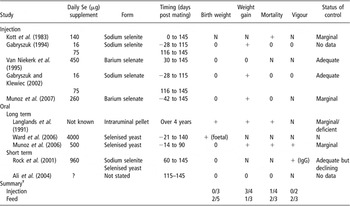
The amount of Se administered has been calculated as μg Se per day by dividing the injected dose by the number of days between injections or before lambing (if only a single injection was given). Most studies first injected Se either before or shortly after mating. Kott et al. (Reference Kott, Ruttle and Southward1983) gave monthly injections of sodium selenite (140 μg Se per day) throughout gestation that increased blood Se from approximately 40 to 160 μg Se/l. Thus control ewes were marginal in status. In each of 2 years, lamb survival to weaning was improved with Se injections. Gabryszuk (Reference Gabryszuk1994) gave two injections of barium selenate 4 weeks before mating (16 μg/day) and 4 weeks before lambing (75 μg day). No indication of Se status was given. Lambs from Se-supplemented ewes gained more weight before weaning. Van Niekerk et al. (Reference Van Niekerk, Cloete, Van der Merwe, Heine and Scholtz1995) gave single injections of barium selenate at varying times after mating (0 to 90 days; about 450 μg/day). Ewes appeared to be adequate in Se status throughout (blood Se 200 to 300 μg/l) and there was no response to injection. Gabryszuk and Klewiec (Reference Gabryszuk and Klewiec2002) gave ewes injections of sodium selenate 4 weeks before mating (16 μg/day) and 4 weeks before lambing (16 μg/day). Blood Se concentrations indicated that all ewes were adequate (110 μg/l) in Se status. There was an increase in lamb live-weight gain prior to weaning for lambs from Se-supplemented ewes. Finally, Munoz et al. (Reference Munoz, Carson, McCoy, Dawson and Irwin2007) gave a single injection of barium selenate 6 weeks before mating (260 μg/day). Blood Se for control ewes was less than 80 μg/l, throughout and therefore Se status was marginal. Lambs born to supplemented ewes had superior weight gains in the first 6 weeks of life.
In-feed throughout pregnancy
Langlands et al. (Reference Langlands, Donald, Bowles and Smith1991) maintained blood Se more than 50 μg/l in one group of ewes by administering intra-ruminal Se pellets while control ewes had blood Se concentrations of less than 20 μg/ml and therefore were deficient. Lamb mortality was reduced and weight gains increased when ewes were supplemented with Se. Ward et al. (Reference Ward, Caton, Taylor, Reed, Borowicz, Vonnahme, Redmer and Reynolds2006) fed Se-adequate and supra-adequate diets (~400 v. ~4400 μg/day) from 21 days before breeding to sacrifice at day 140 of pregnancy. Foetuses from Se-supplemented ewes had greater body weights. Munoz et al. (Reference Munoz, Carson, McCoy, Dawson and Gordon2006) fed an additional 500 μg organically bound Se daily from 14 days before mating to day 90 of pregnancy. Initial mean GPx activities (~33 U per ml red blood cells) were in the low to marginal range. Supplemental Se increased GPx activity to adequate values, the delay in response being about 40 days (consistent with the incorporation of Se into GPx). All ewes were supplemented with Se after day 90 of pregnancy. Positive responses to Se were decreased lambing assistance, lamb mortality and increased pre-weaning growth.
In-feed in late pregnancy
Rock et al. (Reference Rock, Kincaid and Carstens2001) supplemented the diet of ewes with either sodium selenite or selenised yeast from day 60 of pregnancy to lambing (40 v. 1000 μg Se/day). Se status of ewes was adequate at start (200 μg Se/l serum) although status declined from start of the experiment to lambing (28 v. 60 μg/l). Lamb plasma IgG concentrations in bottle-fed lambs were greater with Se supplementation due to enhanced absorption. Ali et al. (Reference Ali, Morrical, Hoffman and Al-Essa2004) gave ewes free access to mineral/vitamin mixes containing either 10 or 90 mg/kg Se from 4 weeks before lambing. No data were given for the form of dietary Se, feed intakes of ewes, or the Se status of ewes or lambs. There was no overall effect of Se.
Table 1 summarises the results. There were no negative effects of supplementation. Evidence would suggest that increasing Se status over the entire pregnancy was more beneficial than short-term supplementation in late pregnancy perhaps because of the time lag of incorporation of Se into gluthathione peroxidase in erythrocytes. The most consistent response was in lamb live-weight gain prior to weaning with fewer reports of reduced mortality. However, as in only a minority of studies could Se status be confirmed as adequate, it is difficult to be certain whether responses were due to supplementation of Se-adequate ewes.
Responses to Se supplementation

N = not reported; 0 = no response; + = positive response.
†Positive responses/total responses reported.
Zinc
ARC (1980) recommended a dietary allowance of 30 mg Zn/kg DM for sheep that the IDWP (1983) raised to 40 mg/kg DM because of possible interactions (primarily with Ca) and between-animal variation. Underwood and Suttle (Reference Underwood and Suttle1999) gave marginal bands of 0.4 to 0.6 mg Zn/l serum. In the forage survey, 0.88 of samples had Zn less than the IDWP allowance of 40 mg Zn/kg DM.
Historically, Zn deficiency causes reduced lamb birth weight (Underwood and Suttle, Reference Underwood and Suttle1999) and is associated with prolonged labour and retained placenta (Apgar et al., Reference Apgar, Everett and Fitzgerald1993). A more recent study by Ali et al. (Reference Ali, Ezzo and El-Ekhnawy1998) who fed Barki ewes control or supplemented diets from 1 month before mating to lambing found lamb birth weight was increased from 2.9 to 4.0 kg in supplemented ewes and differences were maintained until weaning. Plasma Zn concentrations suggested that control ewes were marginally deficient (0.4 to 0.55 mg Zn/l) and supplemented ewes were Zn adequate (0.66 to 0.85 mg Zn/l) although no dietary Zn data were presented. This experiment therefore reported an expected outcome of Zn deficiency. Mackenzie et al. (Reference Mackenzie, Wilde, Pattinson and Wilkinson2005) reported supra-physiological (approximately 270 mg Zn/kg DM) supplementation of Suffolk-cross ewes with different forms of Zn (ZnO v. Zn proteinate) from 6 weeks prior to lambing to 4 weeks post lambing. Unfortunately no control Zn-adequate diet was fed in this experiment. There was a trend for lambs from Zn-proteinate ewes to be heavier at 4 weeks of age (12.0 v. 11.2 kg). Plasma Zn concentrations were approximately 0.65 mg/l. Therefore while Zn deficiency reduces lamb birth weight, no evidence exists for positive effects of supplementation above requirement. It should be noted however that mouse work using knock-outs points out the essentiality of Zn finger proteins in reproductive processes (e.g. Ramos et al., Reference Ramos, Stumpo, Kennington, Phillips, Bock, Ribeiro-Neto and Blackshear2004; Xin et al., Reference Xin, Davis, Molkentin, Lien, Duncan, Richardson and Olson2006).
Vitamins
Vitamin A (retinol)
Vitamin A is essential for normal embryonic and foetal development through the interaction of retinoic acid with specific nuclear retinoic acid receptors (Zile, Reference Zile2001). However, there is little information on vitamin A in breeding sheep, probably for two reasons. First, storage of retinol within the liver acts as an extensive buffer against depletion. Second, the supply of β-carotene, a precursor of vitamin A, from herbage contributes to vitamin A supply. The IDWP (1983) gave a requirement for ewes of 20 to 35 μg retinol per kg live weight. β-carotene is given an equivalence of 6 : 1 (carotene : retinol). β-carotene may also have functional significance on its own. Less than 0.20 μg retinol per ml serum is considered deficient while the normal range is 0.26 to 0.60. Of blood samples analysed for retinol, 0.175 were less than 0.20 μg retinol per ml serum (J. A. Rooke, unpublished observations), indicating vitamin A depletion may, exist in practice.
Published studies shed little light on whether responses may be expected due to supplementation. Kumagai and White (Reference Kumagai and White1995) fed a combined vitamin supplement (6 mg vitamin A and 300 mg vitamin E daily) throughout pregnancy. Although supplementation increased liver retinol concentration from 130–170 mg/kg to 200–250 mg/kg, there were no effects on performance, and since dual supplementation with vitamins E and A took place, it is difficult to interpret results. Similarly, Avci et al. (Reference Avci, Karakilcik and Kanat2000) and Soliman (Reference Soliman2002) fed supplementary vitamin A to ewes. But, in both cases, the feeding period was not defined, nor were any indices of status given and therefore although Soliman (Reference Soliman2002) reported greater live-weight gains in lambs from supplemented ewes, these data cannot be assessed. Therefore because of restricted and incomplete information, few grounds exist to expect responses to supplementation with retinol.
Vitamin E (α-tocopherol)
Vitamin E is the major lipid-soluble, chain-breaking antioxidant in mammalian tissues and prevents free radical generation from, in particular, polyunsaturated fatty acids (PUFA). Thus there is synergy with glutathione peroxidase, Se status and induction of myopathies. The requirement for vitamin E given by IDWP (1983) was 15 mg/kg DM intake that was increased by 3 mg/g PUFA when PUFA are added to the diet. Normal ranges used in serum are 0.4 to 2.6 μg α-tocopherol per ml. Vitamin E status of sheep measured as serum tocopherol showed that only 0.044 samples were less than 0.4 μg/ml (mean value 1.90 μg/ml), indicating that most sheep were adequate in vitamin E (J. A. Rooke, unpublished observations).
Injection
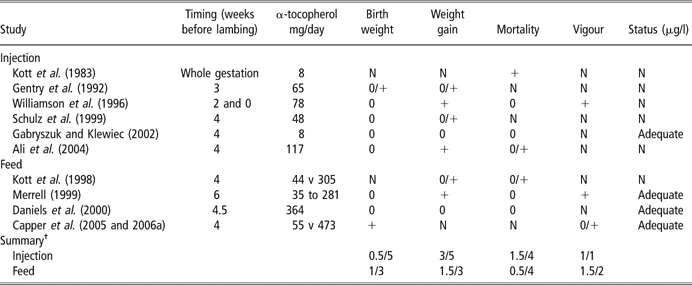
The amount of vitamin E administered has been calculated as mg α-tocopherol per day by dividing the injected dose by the number of days between injections or before lambing (if only a single injection was given). Most reports administered one or more injections of vitamin E by injection from about 4 weeks before the expected date of lambing. The exception was Kott et al. (Reference Kott, Ruttle and Southward1983) who injected vitamin E at monthly intervals from mating (8.3 mg α-tocopherol per day) and observed an increase in lamb vigour. However, no data were given for vitamin E status of the ewes.
No response was observed to injection of vitamin E, 4 weeks before lambing (8.3 mg/day; Gabryszuk and Klewiec, Reference Gabryszuk and Klewiec2002) in contrast to studies where larger amounts of vitamin E were injected in which positive but variable responses have been reported. Gentry et al. (Reference Gentry, Ross, Oetting and Birch1992) injected vitamin E, 21 days before lambing (65 mg/day). The experiment was conducted over 2 years with differing responses in each year. In year 1 there was a response to supplementation in lamb live-weight gain prior to weaning. In year 2 there was a response in lamb birth weight. In year 2 there was also an increase in IgG concentration in lamb plasma in response to ewe vitamin E supplementation. As there was no effect on ewe colostrum IgG concentration, this was interpreted as increased absorption of IgG by the lamb. Williamson et al. (Reference Williamson, Riley, Taylor and Sanson1996) injected vitamin E (78 mg/day) 2 weeks before lambing and observed an increase in lamb vigour score at birth and daily weight gain to weaning after supplementation. Similarly, Schulz et al. (Reference Schulz, Ross, Salisbury and Melton1999) injected Suffolk ewes with vitamin E, 28 days before lambing (49 mg/day). Overall, no significant effects were observed but in a sub-group of lambs exposed to handling stress, those from supplemented ewes had superior weight gain to weaning. Finally, Ali et al. (Reference Ali, Morrical, Hoffman and Al-Essa2004) gave ewes weekly injections of vitamin E from 4 weeks (117 mg/day) before lambing. Additional vitamin E increased pre-weaning live-weight gains and in one of 2 years, twin lambs from supplemented ewes had greater survival rates.
Feed
All studies in which vitamin E has been added to feed have taken place in the later stages of pregnancy (from 8 weeks or less before lambing) and most studies only offered one level of supplementation. Kott et al. (Reference Kott, Thomas, Hatfield, Evans and Davis1998) fed vitamin E from 4 weeks before lambing giving intakes of 44 or 305 mg/day (20 v. 158 mg/kg DM) There was a reduction in neonatal mortality and an increase in live-weight gain to weaning with supplementation in the first but not in the second half of the lambing season. No diagnostic data were given. Daniels et al. (Reference Daniels, Hatfield, Burgess, Kott and Bowman2000) dosed ewes orally with 364 mg α-tocopherol daily from 32 days before lambing and vaccinated ewes against para-influenza virus to assess immune response. Serum α-tocopherol was increased from 1.2 to 1.9 μg/ml by treatment. No responses to vitamin E in lamb performance or immune status were observed. Yaprak et al. (Reference Yaprak, Emsen, Emsen and Macit2004) added vitamin E (364 mg/day) to the feed of ewes 21 days before lambing. Supplemented ewes produced heavier lambs (4.6 v. 3.8 kg). However, no initial ewe weights were given and supplemented ewes were substantially heavier at lambing. Therefore a confounding effect of ewe weight and body condition may have been present. Finally, beginning on day 90 of pregnancy and using a 2 × 2 factorial design, Capper et al. (Reference Capper, Wilkinson, Kasapidou, Pattinson, Mackenzie and Sinclair2005 and Reference Capper, Wilkinson, Mackenzie and Sinclair2006a) fed twin-bearing ewes diets concentrates containing either 55 or 473 mg α-tocopherol/kg DM and either Megalac or fish oil. In control ewes, plasma vitamin E declined from 2.2 at the start to 0.9–1.35 μg/ml, 14 days post partum. Supplemented ewes maintained or increased plasma vitamin E. Vitamin E supplementation increased lamb birth weight, and lambs whose dams were fed supplemented diets in the presence of fish oil were quicker to stand.
Merrell (Reference Merrell1999) carried out a series of experiments in which vitamin E was given as a feed supplement from 6 weeks before lambing. In one experiment, increasing amounts of vitamin E were included in the concentrate (from 35 to 281 mg α-tocopherol per head per day). Ewe serum α-tocopherol concentration response to supplementation was of a J shape with concentration only increasing when 116 mg/day α-tocopherol was fed. Improvements in lamb vigour (time to stand and suck) and increases in live-weight gain were recorded. However, results are difficult to interpret as dose–response relationships differed for different parameters. Lamb vigour followed a dose–response relationship increasing up to the inclusion of 116 mg/day α-tocopherol per day but then decreasing. Live-weight gain benefit was achieved with the lowest level of supplementation but there were no further benefits with greater amounts of vitamin E. In other experiments, improvements in lamb vigour with supplementation were replicated.
The above experiments are summarised in Table 2. Conclusions can only be drawn for supplementation for the last 8 weeks of pregnancy. The pattern of response for injection and supplementation did not differ markedly with supplementation appearing to give a slightly more consistent response, which may have been due to a more stable pattern of vitamin E supply. Where serum vitamin E concentrates were given, all values were within reference ranges. Therefore, there is evidence for positive responses to vitamin E in the last month of pregnancy, probably in a situation where ewes are adequate for vitamin E. Some of the variability in response may be explained by Merrell (Reference Merrell1999) where dose–response relationships for live-weight gain and lamb vigour differed. Maximum responses were not necessarily obtained at the highest vitamin E inclusion rate. In this context, it should be noted that all supplementation studies used vitamin E inclusions that were more than 10-fold greater than requirement. It is also difficult to reconcile responses in lamb birth weight and vigour with reports that vitamin E does not cross the placenta in appreciable quantities (McDowell et al., Reference McDowell, Williams, Hidiroglou, Njeru, Hill, Ochoa and Wilkinson1996) in sheep when assessed by neonatal plasma vitamin E concentration. Capper et al. (Reference Capper, Wilkinson, Kasapidou, Pattinson, Mackenzie and Sinclair2005) observed increases in neonatal lamb brain and muscle vitamin E at birth when no vitamin E was detectable in plasma, suggesting that plasma concentration may not be a reliable indicator of neonatal status.
Responses to vitamin E supplementation
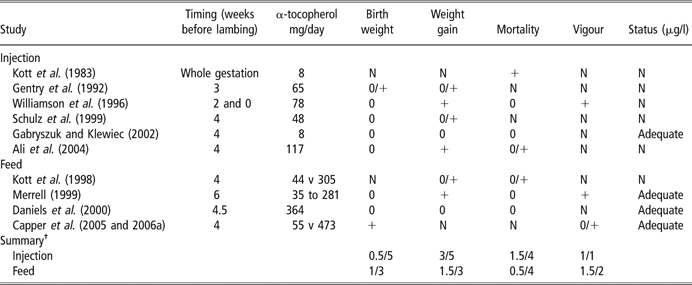
N = not reported; 0 = no response; 0/+ = part response; + = positive response.
†Positive responses/total responses reported.
Fatty acids
No stated requirements are given for fatty acids in ruminants (ARC, 1980) as no case of essential fatty acid deficiency (n-6 fatty acids) has ever been reported for animals with a functional rumen. In the case of n-3 fatty acids, forages are a good source of 18:3n-3. However, in other species, there is a conditional requirement for long-chain n-3 fatty acids (eicoso-pentaenoic acid (EPA), 20:5n-3 and docosahexaenoic acid (DHA), 22:6n-3) during pregnancy because of the extensive deposition of DHA in developing neural and retinal tissues. Hence, lamb development may be enhanced by a supply of DHA to the ewe. Although sheep are unlikely to encounter DHA to any extent in their normal diet, concentrates fed in pregnancy are high in 18:2n-6 and the n-6/n-3 ratio of dietary fatty acids may be unbalanced leading to an increased demand for n-3 fatty acids.
There are several possible mechanisms for n-3 fatty acid responses. First, foetal development may be enhanced because of increased DHA supply and incorporation into target tissues. Secondly, a change in the substrate available for prostaglandin biosynthesis away from arachidonic acid (20:4n-6) towards EPA may result in the production of more of the less bioactive 3-series prostaglandins. This may influence the timing of parturition and therefore maturation of the foetus. Administration of n-3-enhanced (EPA/DHA) intralipid delayed parturition in sheep (Baguma-Nibasheka et al., Reference Baguma-Nibasheka, Brenna and Nathanielsz1999). In addition, a series of studies (Cheng et al., Reference Cheng, Elmes, Abayasekara and Wathes2003, Reference Cheng, Elmes, Kirkup, Abayasekara and Wathes2004, Reference Cheng, Abayasekara and Wathes2005a and Reference Cheng, Elmes, Kirkup, Chin, Abayasekara and Wathes2005b; Elmes et al., Reference Elmes, Tew, Cheng, Kirkup, Abayasekara, Calder, Hanson, Wathes and Burdge2004 and Reference Elmes, Green, Poore, Newman, Burrage, Abayasekara, Cheng, Hanson and Wathes2005) have demonstrated the opposite effect. In vitro and in vivo, increasing n-6 fatty acid supply increased 2-series prostaglandin production by late-pregnancy ovine endometrium. Finally, changes in brown adipose tissue thermogenesis may occur, as in rodents PUFA supplementation has been shown to increase brown adipose tissue thermogenesis (Sadurskis et al., Reference Sadurskis, Dicker, Cannon and Nedergaard1995).
Capper et al. (Reference Capper, Wilkinson, Kasapidou, Pattinson, Mackenzie and Sinclair2005 and Reference Capper, Wilkinson, Mackenzie and Sinclair2006a) fed ewes concentrates containing about 100 g fatty acids/kg DM with ad libitum straw (added oil content about 50 g/kg) where the other factor in a 2 × 2 factorial experiment was addition of vitamin E. The added oils were either Megalac or fish oil. The fish oil diet probably supplied about 3 g EPA and 3 g DHA per day. Fish oil reduced the latency of lambs to suck and tended to reduce the time to stand. There were some indications of positive vitamin E/fish oil interactions. Diets were fed during lactation and undesirable side effects were observed in reduced colostrum total yield and fat content when the fish oil was fed. Capper et al. (Reference Capper, Wilkinson, Mackenzie and Sinclair2006b) investigated the milk yield depression but only observed 28-day milk yield. Ewes were fed either algal biomass as a source of DHA, linseed oil as a source of linolenic acid or Megalac. At lambing, ewes on biomass or linseed were switched to linseed or Megalac, respectively. Switching away from algal biomass or linseed increased milk fat but the depressive effect of pregnancy feeding on overall milk yield was still present. It is possible the depression in milk yield and fat was associated with the EPA and not DHA fed.
Dawson and Edgar (Reference Dawson and Edgar2005) fed ewes 0, 20 or 40 g fish oil per day as either salmon or herring/mackerel oil for the last 6 weeks of pregnancy but not during lactation. No differences were observed between the oil types. Estimated DHA intakes (about 3 g/day) were similar to Capper et al. (Reference Capper, Wilkinson, Kasapidou, Pattinson, Mackenzie and Sinclair2005 and Reference Capper, Wilkinson, Mackenzie and Sinclair2006a). Fish oil reduced colostrum yield but feeding 20 g fish oil per day improved lamb survival to weaning.
A further series of experiments supplied DHA as algal biomass and fed 6 or 12 g DHA from 9 weeks before lambing (Pickard et al., Reference Pickard, Beard, Seal and Edwards2005 and Reference Pickard, Beard, Gentle, Scott-Baird and Edwards2006; Gentle et al., 2006). No adverse effects were observed on lamb growth and therefore by implication there was no adverse effect on colostrum or milk yield. This was claimed to be because feeding stopped at lambing. Pickard et al. (Reference Pickard, Beard, Seal and Edwards2005 and Reference Pickard, Beard, Gentle, Scott-Baird and Edwards2006) fed 12 g DHA per day and looked at 3-week windows of supply of DHA. Results suggested that the middle weeks (6 to 4 weeks before lambing) were most important. Either the time for lambs to stand (Pickard et al., Reference Pickard, Beard, Seal and Edwards2005) or the time for lambs to suck (Pickard et al., Reference Pickard, Beard, Gentle, Scott-Baird and Edwards2006) was reduced when ewes were fed algal biomass. Gentle et al. (2006) fed 6 or 12 g DHA for the last 6 weeks of pregnancy. In this experiment, the latency for lambs to suck was reduced with both DHA inclusions. Maternal behaviour was also recorded but algal biomass had no effect.
Finally, Chen et al. (Reference Chen, Carstens, Gilbert, Theis, Archibeque, Kurz, Slay and Smith2007) fed twin-bearing ewes diets containing 20, 40 or 80 g/kg rumen protected saturated or unsaturated fat from 40 days prior to parturition. To investigate the effects of supplementation on brown adipose tissue thermogenesis, lambs were cold-stressed for a 2-h period at 4 h of age and then sacrificed. There were no effects on brown adipose tissue mass or uncoupling protein-1 expression. Lambs fed 80 g saturated fat per kg exhibited depressed thermogenesis and fatty acid oxidation in brown adipose tissue. Hence there was no evidence for an effect of PUFA on thermogenesis.
In conclusion, feeding fish oil or algal biomass (DHA) during late gestation has consistently improved lamb vigour and reduced mortality. Adverse effects on colostrum yield were noted in some studies that may be related to the continued feeding of oils during lactation.
Overall conclusions
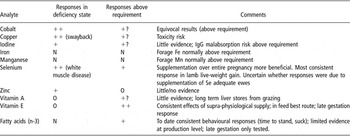
Table 3 summarises available evidence on responses in lamb viability to trace element supplementation both below and above requirement. For Co, Fe, Mn and Zn, there was no evidence of positive responses to supplementation. Cu and I have toxicity thresholds that are so close to requirement that there are risks of inducing toxicity when supplementing above requirement. In the case of vitamin A, while serum levels indicate that sub-optimal status does exist, long-term buffering from liver stores (from grazing) will make experimentation difficult and practical benefits unlikely. Therefore, the most likely candidates for supplementation are Se, vitamin E and fatty acids. On cost grounds it is unlikely that fatty acid supplementation will be economic. For Se, there is a need for more studies where the control ewes are clearly adequate in Se and for vitamin E, the optimum dietary inclusion of vitamin E and period of feeding during pregnancy still require clarification.
Summary for responses in lamb viability to modification of the trace element status of the diet

+/, +, ++ = increasingly positive response; O = no response; N = no evidence.
Acknowledgements
SAC received financial assistance from the Scottish Government. We thank John Robinson and Colin Morgan for reading and commenting on the manuscript.