


Theoretical and research basis for therapy
With the high demands on psychological services, it seems crucial to consider innovative ways of working. NICE guidelines (2005) state that adults with obsessive compulsive disorder (OCD) should be offered cognitive behavioural therapy (CBT), with exposure response prevention (ERP). It is recommended that up to 10 therapist hours per patient should be offered if the patient's degree of functional impairment is mild, and more than 10 therapist hours per patient when functional impairment is moderate or severe. NICE guidelines state that CBT should be offered as individual therapy or as group therapy. Research provides no conclusive evidence regarding the effectiveness of CBT offered in group format compared to that offered in individual format. Furthermore, research recommendations (NICE, 2005) include proposals to assess the effectiveness, including cost-effectiveness, of different delivery formats of CBT for adults with OCD, including group and individual CBT. However, given limited resources and the necessity to include cost as an outcome of clinical interventions, and on the assumption that group therapy is more cost-effective than offering individual therapy, group therapy is one approach that is often proposed (Morrison, Reference Morrison2001). Group therapy for OCD is widely considered in psychological therapy settings.
Several studies have shown benefits of group behavioural therapy for OCD (e.g. Krone et al. Reference Krone, Himle and Nesse1991; Fals-Stewart et al. Reference Fals-Stewart, Marks and Schafer1993; Van Noppen et al. Reference Van Noppen, Pato, Marsland and Rasmussen1998). The efficacy of group therapy including the cognitive component (group CBT) has been demonstrated in a study by Cordioli et al. (Reference Cordioli, Heldt, Bochi, Margis, de Sousa, Tonello, Manfro and Kapczinski2003); there were significant pre- to post-treatment reductions in intensity of obsessive compulsive symptoms and intensity of over-valued ideas, and significant improvement in ratings of quality of life, all of which further improved at 3-month follow-up. This team also demonstrated that the reduction in severity of symptoms was maintained at 1 year follow-up (Braga et al. Reference Braga, Cordioli, Niederauer and Manfro2005). Research directly comparing efficacy of group CBT and individual CBT for clients with OCD is particularly limited. However, Anderson & Rees (Reference Anderson and Rees2007) reported findings from a study directly comparing group and individual CBT for clients with OCD; there were significant improvements for both therapy conditions over the control group; individual treatment was associated with a more rapid response but both treatment groups had equivalent rates of ‘recovered participants’ at 1-month follow-up. In a more recent study, Jónsson et al. (Reference Jónsson, Hougaard and Bennedsen2011) concluded from their research and a meta-analysis of four studies that ‘OCD can be treated effectively with a group format of CBT, thus sparing some therapist resources’ (p. 387), but that it is not possible to ‘rule out the possibility of a small superiority of individually conducted CBT’ (p. 387). Although, Cabedo et al. (Reference Cabedo, Belloch, Carrió, Larsson, Fernández-Alvarez and García2010) concluded that group CBT is effective in decreasing OCD severity, they also concluded that individual CBT may be superior to group CBT in relation to follow-up findings that 1 year later, changes were higher in clients who received individual CBT. However, in a recent study, the group format resulted in nearly double the drop-out rate compared to the individual format (Jaurrieta et al. Reference Jaurrieta, Jimenez-Murcia, Alonso, Roser, Cinto, Labad and Menchón2008; see Jónsson et al. Reference Jónsson, Hougaard and Bennedsen2011).
Albeit limited, the findings regarding efficacy of group CBT for OCD are somewhat encouraging. However, reservations about group therapy for OCD have been expressed (e.g. P. Salkovskis, personal communication), suggesting that a group of individuals with OCD and limited understanding of the developmental and maintaining factors of their difficulties, may result in a group for ‘sharing problems’ as opposed to the desired outcome of ‘sharing solutions’. In many group interventions, clients are offered a brief assessment, and then offered group sessions. Salkovksis (personal communication) proposed that clients should be offered group therapy only at the point when a shared understanding of their difficulties has been developed, and when clients have engaged in this model and are ready to commit to behavioural experiments and work on ERP. Salkovskis also proposed that individuals should be grouped such that there is overlap between the particular issues with which they are struggling. It is likely that such adaptations would also reduce the dropout rate from group CBT. This paper discusses the service development of a group therapy programme which includes these adaptations, in line with those suggested by P. Salkovskis (personal communication) and B. Stobie (personal communication). Outcome measures are included as a means of evaluating the group protocol.
In the decision whether or not to offer group therapy in this clinical setting, the issue of our extensive waiting list played a major role. It was agreed that any group offered therapy would include the two adaptations in line with the recommendations described above.
(1) As well as an individual assessment appointment (1½–2 h), clients were also offered a follow-up assessment appointment (2 h) in order to develop a shared understanding of the difficulties.
(2) Clients with similar difficulties would be grouped together as much as possible.
Calculations were also made regarding therapist hours. This was based on findings from recent audits that clients at this service received 9–15 therapist hours plus a 2-h assessment (mode 11+2 h). Clients who were invited to a group would be offered four individual therapy hours, plus 2½ h, run over eight sessions with a qualified clinical psychologist and assistant psychologist, meaning that therapist hours were lower in the group format if at least five people attended each group. This is a conservative estimate as in this calculation the assistant psychologist's hours are counted as full therapist hours.
Following these calculations and given the demands on the service, and the inconclusive evidence for or against group therapy over individual therapy for OCD, it seemed almost unethical not to offer group therapy. The clinical team concluded that, drawing on the research findings described above in the most conservative manner, offering group CBT for OCD was the best compromise in terms of cost-effectiveness between quality of therapy and quantity of clients offered intervention.
Method
Setting
The group was set up in The North West Surrey Specialist Psychological Service, Surrey and Borders Mental Health NHS Foundation Trust. This is a small service providing assessment and treatment for people with moderate to severe psychological difficulties. Due to the growing waiting list, there were demands to work innovatively to offer more clients therapy quickly. The team therefore decided to offer group CBT for OCD as part of a service development. This was evaluated in terms of effectiveness and therapy hours, as part of an ongoing audit of the service.
Procedure
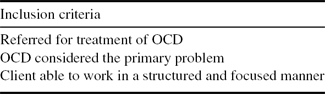
All clients who were referred to the service for OCD were invited to an assessment session. The assessment was offered by an assistant psychologist (1½–2 h) with the aim of gaining a general understanding of the clients’ difficulties and goals for therapy, as well as assessing risk. The assessment also allowed consideration as to whether a group intervention may be helpful for the client. Inclusion criteria for the OCD group programme are shown in Table 1. Clients for whom high risk was an issue were excluded from the group.
Inclusion criteria
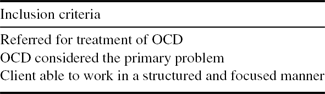
OCD, Obsessive compulsive disorder.
Once assessed, appropriate clients were contacted and invited to the new OCD group programme. Those who were interested in attending the group were then offered a follow-up assessment session, followed by the group sessions. Clients who were not interested or for whom the group format was not thought to be suitable were returned to the waiting list for ‘treatment as usual’ which consisted of individual sessions once they reached the top of the waiting list.
Participants
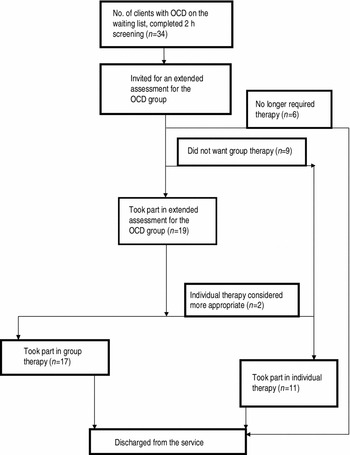
Over a period of 13 months, four groups were run, with a total of 17 clients. No clients dropped out of group therapy. Unfortunately post-treatment data is available for only 15 clients as two clients had to leave the final session promptly (the group had overrun) and did not complete the questionnaire. Over this period, 11 clients received individual therapy (see Fig. 1).
Flow diagram showing the process through which clients were invited for group or individual therapy.

Course of therapy
The treatment programme was based on Salkovskis’ model for OCD (Salkovskis, Reference Salkovskis1985); it consisted of psycho-education, cognitive restructuring and ERP exercises (set up with the goal of habituating to anxiety) and behavioural experiments (introduced as an opportunity to test beliefs). The programme was similar to group programmes used in previous research, e.g. Jónsson et al. (Reference Jónsson, Hougaard and Bennedsen2011). Specific homework exercises were also attached to each component of the treatment. The main adaptation from this group, was in line with more recent recommendations (as recommended by P. Salkovskis, personal communication and B. Stobie, personal communication), that an individual assessment session is offered before group work begins.
In light of these recommendations, following the initial assessment, clients were invited for a further individual session (2 h). The purpose of the individual session was to:
• further assess the clients’ difficulties;
• complete the Yale–Brown Obsessive Compulsive Scale (YBOCS; Goodman et al. Reference Goodman, Price, Rasmussen, Mazure, Fleischmann, Hill, Heninger and Charney1989);
• consider suitability for the group programme;
• engage client with the CBT model;
• start a written individual formulation for each client; and
– offer some psychoeducation about OCD;
– select individuals for each group programme with similar difficulties;
– identify idiosyncratic areas to target.
Group programme
Group format
• All clients were seen for an extended individual session prior to the group (see above).
• The group ran for 2½ h for 7–8 sessions (spaced by 1 or 2 weeks).
• Clients were invited to ask for individual sessions during the therapy programme if necessary.
• The group protocol followed a standard CBT model.
Content
Group session content included:
• psychoeducation on CBT and OCD (including a review of psychoeducation provided in the individual session);
• individual formulations/shared understanding of the difficulties (review from the individual session);
• goal setting (including a review of some of the discussion from the individual session);
• work on intrusive thoughts, and normalizing;
• work on interpretation of intrusive thoughts;
• role of responsibility interpretations;
• work on Theory A/Theory B;
• behavioural experiments and ERP;
• strategies for relapse prevention.
Outcome measures
Clients who attended the group were asked to complete several questionnaires, to assess general levels of depression and anxiety, obsessive compulsive symptomatology and the impact of difficulties.
• Beck Depression Inventory (BDI; Beck, Reference Beck2001). A 21-item self report measure which is designed to rate the severity of depression symptoms.
• Beck Anxiety Inventory (BAI; Beck, Reference Beck1990). A 21-item self-report measure which is designed to rate the severity of anxiety symptoms.
• Yale–Brown Obsessive Compulsive Scale (YBOCS; Goodman et al. Reference Goodman, Price, Rasmussen, Mazure, Fleischmann, Hill, Heninger and Charney1989) (group clients only). A semi-structured interview comprising of a checklist of various obsessions and compulsions regarding frequency, distress and control.
• Obsessive Compulsive Inventory (OCI; Foa et al. Reference Foa, Kozak, Salkovskis, Coles and Amir1998) (group clients only). Clients were asked to buy Overcoming Obsessive Compulsive Disorder and complete the questionnaire in the book. It is a self-report measure comprising of seven subcategories: washing, checking, doubting, ordering, obsessing, hoarding and neutralizing.
• Impact of difficulties questionnaire (Likert scale: length of problem, severity, coping, interference with work. Interference with leisure, interference with relationships, interference with chores).
In the final session, in an anonymous questionnaire, clients were asked to state what had been helpful about the group, and what had been unhelpful.
Clients who received individual therapy completed the BDI, BAI and Impact of Difficulties questionnaire at the start of therapy, allowing for between-group comparisons on these pre-intervention measures. Therapist hours were calculated for individuals in the group therapy programme and in the individual therapy programme, to allow for a comparison of costs.
Therapist details and supervisory arrangements
The initial assessment was conducted by a psychology assistant (C.W.) who was supervised by a clinical psychologist with expertise in the area of OCD (A.W.). Supervision was offered to consider each client individually following the initial assessment, in order to make a decision as to whether or not the group programme would be suitable for that client. The group programme was offered by a clinical psychologist with specific training in OCD (A.W. or another clinical psychologist who was supervised by A.W.) together with an assistant psychologist (C.W. or another clinical psychologist) or trainee clinical psychologist (supervised by A.W.). Supervision for A.W., and all managerial supervision, was offered by a consulting clinical psychologist who was the clinical lead for the service. A.W. was also in discussion with an international expert in the field of OCD, who offered guidance in the development of the group (P. Salkovskis).
Outcomes of the interventions
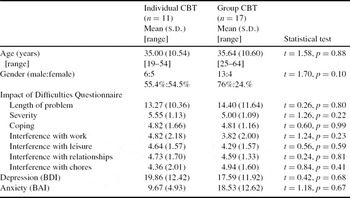
Scores suggested that participants experienced ‘severe’ OCD, with mild depression and moderate general anxiety (see Table 2). Clients who attended the group sessions were compared on several measures to those who were offered individual therapy. There were no significant differences between these individuals in terms of age, gender, impact of difficulties, anxiety and depression.
Pre-treatment scores of individuals who attended group therapy and individual therapy, and statistical comparisons

BDI, Beck Depression Inventory; BAI, Beck Anxiety Inventory.
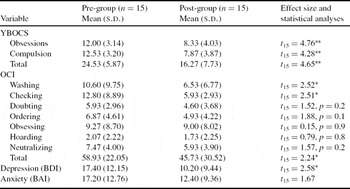
Pre- and post-intervention psychological measures were analysed using paired t tests with regard to measures of depression and anxiety, impact of difficulties, and OCD-specific measures. Analyses demonstrated significant improvement in OCD symptoms for clients offered group therapy, as measured by the OCI and YBOCS (see Table 3). Effect sizes were comparable to those found in previous research by Jónsson et al. (Reference Jónsson, Hougaard and Bennedsen2011); i.e. effect size of 0.77 for the YBOCS in this study compared to 1.06 in previous research; and effect size of 0.50 for the OCI compared to 0.55 in previous research. There was a significant decrease in scores of depression (BDI) (effect size 0.48, also comparable to the effect size of 0.50 in the previous research by Jonsson et al. Reference Jónsson, Hougaard and Bennedsen2011) but no significant change in measures of anxiety (BAI).
Comparison of pre- and post-treatment scores of clients offered group therapy

YBOCS, Yale–Brown Obsessive Compulsive Scale; OCI, Obsessive Compulsive Inventory; BDI, Beck
Depression Inventory; BAI, Beck Anxiety Inventory.
* p < 0.05, ** p < 0.01.
Independent sample t tests were used to compare therapist hours for clients who received CBT in the individual format and those who received CBT in the group format. An assistant psychologist was counted as 0.67 the value of a qualified clinician (representing the difference in service cost). Findings demonstrated that the number of therapist hours involved in group therapy was significantly less than for individual therapy. Waiting times for clients who attended group therapy were also significantly less (see Table 4).
Comparison of waiting time and clinician hours for group therapy and individual therapy

* p < 0.05, ** p < 0.01.
Client feedback
Qualitative feedback from clients who underwent group therapy was both positive and negative. The most frequent comments relating to the group aspect was that the group was helpful in respect to ‘meeting others’, ‘talking to others’, and ‘understanding the different ways OCD can impact on individuals’. Clients also mentioned the usefulness of the individual session at the beginning in gaining a shared understanding of the difficulty, and in being ‘fully heard’. Clients reported that it had been helpful to work with others with similar difficulties in carrying out behavioural experiments; this offered a lot of support. The most frequently stated unhelpful aspect of the group were issues such as ‘discussing my problems in a group’, and ‘lack of individual sessions’. Unsurprisingly, it appears that individuals responded to the group in different ways. Whereas some benefited from working with other clients, others did not.
Clinician feedback
In debriefing sessions, clinicians also noted benefits and disadvantages. In a couple of groups, the clients appeared to share a common understanding, and were able to use this in encouraging each other to engage in behavioural experiments and to conduct ERP exercises. However, on another occasion, it was felt that the focus of peer support was more on ‘sharing problems’, which seemed to allow for less of a focus on ‘sharing solutions’. As raised by clients, the inclusion of the individual sessions before group therapy felt crucial. Two clients also made use of the opportunity to meet with a therapist between group sessions, and reported that this was invaluable.
Discussion of therapy implications of the group
This case study of group CBT for OCD demonstrates significant improvements in pre- to post-treatment scores on OCD-specific measures (OCI total and YBOCS), comparable to findings from previous research, e.g. Jónsson et al. (Reference Jónsson, Hougaard and Bennedsen2011). Unfortunately this was not compared directly to the outcome measures of individuals who attended the individual therapy sessions. There was also a significant improvement in depression as measured by BDI. However, there was no significant change in scores of anxiety. This is not consistent with other research findings, and the reasons for this are not clear. It is possible that the clients in this sample had primary anxiety disorder other than OCD (‘other anxiety disorders’ was not an exclusion criteria as is the case in much other research, e.g. Jónsson et al. Reference Jónsson, Hougaard and Bennedsen2011). Whereas individual therapy may have addressed these other issues, the group format did not easily offer the opportunity to address issues other than OCD. The small sample size is also a limiting factor. However, this study was an audit to evaluate a small service development, and offers encouraging findings for group interventions which could be formally and systematically evaluated.
Despite significant reductions in measures of obsessive compulsive symptomatology, it is notable that the post-intervention scores suggest residual OCD symptoms. It may be helpful therefore to offer booster sessions for clients.
An important difference between individual therapy and group therapy is the therapist hours involved. Findings demonstrate significantly fewer therapist hours necessary for group therapy. This was the case even though therapy groups were small (4–6 clients). Limitations of the study included the fact that the hours involved in preparing the group programme were not included in the analyses. This was decided upon because preparation hours varied considerably, with substantial reductions in time involved as clinicians became more familiar with the group programme. Similarly preparation hours for individual therapy sessions were not included in the analyses. It would be helpful to included preparation hours for both group and individual formats, in any future evaluations of the effectiveness of group CBT.
It is interesting to note that no clients dropped out of group therapy. This is different from many studies considering group CBT for OCD (see Jónsson et al. Reference Jónsson, Hougaard and Bennedsen2011), and may be related to one of several reasons: it may be that the individual follow-up assessment session helped engage clients as well as helping clients to engage in the CBT work; it may be that grouping clients in such as way that there is an overlap in the issues with which they are struggling facilitated peer support and sharing of solutions. Other possibilities include the fact that individuals had made an informed choice about individual vs. group therapy, having met with one of the group facilitators, so were more ready to commit to group work; and the fact that many participants had waited a considerable length of time for therapy and were ready to engage in the work.
The feedback from clients and group facilitators highlighted clear advantages and disadvantages in working with clients in a group. It would have been interesting to include post-intervention interviews whereby qualitative data could be analysed using thematic analysis; this would provide the authors with a clear and thorough understanding of how clients experienced the group.
Taking into account published literature (Krone et al. Reference Krone, Himle and Nesse1991; Fals-Stewart et al. Reference Fals-Stewart, Marks and Schafer1993; Van Noppen et al. Reference Van Noppen, Pato, Marsland and Rasmussen1998; Cordioli et al. Reference Cordioli, Heldt, Bochi, Margis, de Sousa, Tonello, Manfro and Kapczinski2003; Braga et al. Reference Braga, Cordioli, Niederauer and Manfro2005), it is likely that there is not sufficient evidence to argue that group therapy is more effective than individual therapy. However, taking into account the therapy hours involved, it may be that group therapy offers the best clinical outcomes for some services with lengthy waiting times, in line with recommendations by Morrison (Reference Morrison2001).
Recommendations to therapists
It was concluded that given the high demands on the small clinical service, it was crucial at that point to offer group CBT. This case study demonstrates that the group intervention can be offered in such a way as to ensure that it is effective and results in a reduced dropout rate; small adaptations were made in line with recommendations from experts in the field of OCD (P. Salkovskis, personal communication; B. Stobie, personal communication). To reduce therapist hours further, it may be possible to utilize larger therapy groups.
On the basis of these findings, and feedback from clients, it is recommended that this format is followed, such that all clients receive an extended individual assessment session before using the group format, and clients are grouped with people with similar difficulties.
In summary, there were two main differences between this group intervention and a standard procedure.
(1) First, as much as possible, clients in each group were matched in terms of their type of difficulty. It was felt that this was helpful in terms of clients working together to develop behavioural experiments and engage in ERP exercises, and be able to motivate each other.
(2) Second, individuals were offered an individual extended assessment session before the group format. This facilitated clients’ engagement with the CBT model and development of an individual formulation for each client. It also facilitated in the selection of individuals for each group programme with similar difficulties and identified idiosyncratic areas to target.
Outcomes and feedback from clients suggested that these adaptations were helpful.
Summary of the main points of the paper
(1) There is a strong evidence base for CBT for OCD.
(2) Literature on CBT for OCD offered in group format is inconclusive.
(3) Literature to date does not support group CBT over individual CBT for OCD; evidence suggests that CBT for people with OCD should be offered in group format only if there are significant demands on the service capacity.
(4) If group CBT is to be offered, the structure needs to be adapted from a standard group protocol, such that: (i) all clients have some individual therapy before they are introduced to a group format; and (ii) clients are grouped such that they are working with other clients with similar difficulties, and can therefore support each other in performing behavioural experiments and engaging in ERP exercises.
Acknowledgements
The authors thank their co-therapists for their input, and the clients who worked so hard in the treatment sessions.
Declaration of Interest
None.
Learning objectives
Through considering this paper, it is hoped that readers will:
(1) Have some knowledge regarding the literature on group therapy vs. individual therapy for OCD.
(2) Be able to discuss the advantages and disadvantages of group therapy and individual therapy for OCD.
(3) Be aware of adaptations to the standard group format that may enhance effectiveness of the CBT group for people with OCD.
(4) Have basic knowledge to set up a cost-effective group format for people with OCD, in line with recommendations from experts in the field.




Comments
No Comments have been published for this article.