1. Introduction
Plate interiors can record far-field deformation as a consequence of tectonic events at their boundaries (e.g. Lacombe et al. Reference Lacombe, Laurent and Rocher1996; Lacombe & Mouthereau, Reference Lacombe and Mouthereau1999). The propagation of stress regimes within the intraplate domain may result in long-wavelength folding, reactivation of existing discontinuities, differential erosion of tilted blocks and the development of faults, joints, tension gashes or stylolites, especially in sedimentary strata of intracratonic basins (e.g. Bergerat, Reference Bergerat1987; Lacombe & Obert, Reference Lacombe and Obert2000; Parrish et al. Reference Parrish, Parrish and Lasalle2018). In carbonate rocks, these deformation patterns may enhance fluid flow in permeable strata and favour calcite dissolution–recrystallization, the cementation of primary intergranular porosity or the creation of a secondary pore space (e.g. Bruna et al. Reference Bruna, Guglielmi, Lamarche, Floquet, Fournier, Sizun, Gallois, Marié, Bertrand and Hollender2013). Such far-field deformations have long been recognized in the European plate, and palaeostress reconstructions were proposed using the inversion of fault slip data or the orientation of calcite twins (e.g. Lacombe et al. Reference Lacombe, Angelier, Laurent, Bergerat and Tourneret1990).
In the context of radioactive waste storage within sedimentary rocks, the knowledge of the precise chronology of palaeostress fields is essential to understand the development of fracture networks and the self-sealing capacities of the sedimentary system (e.g. Sutcliffe et al. Reference Sutcliffe, Thibodeau, Davis, Al-Aasm, Parmenter, Zajacz and Jensen2020). It also brings a source of valuable information regarding the palaeo-fluid flow in carbonates and the potential advective flows within claystones (Mazurek et al. Reference Mazurek, Davis, Madritsch, Rufer, Villa, Sutcliffe, de Haller and Traber2018; Pagel et al. Reference Pagel, Bonifacie, Schneider, Gautheron, Brigaud, Calmels, Cros, Saint-Bezar, Landrein, Sutcliffe, Davis and Chaduteau2018). In the eastern Paris Basin, tectonic markers have been investigated in detail within and around the Underground Research Laboratory (URL) of the French National Agency for Radioactive Waste Management (Andra) (André et al. Reference André, Hibsch, Fourcade, Cathelineau and Buschaert2010 and references therein). All studies converge in demonstrating that most of the brittle deformation has developed during Cenozoic times. Defining the succession of palaeostress regimes from microtectonic analyses in this area is, however, complicated owing to many uncertainties. The relationship between a tectonic marker and a corresponding deformation event can indeed be ambiguous (e.g. in the eastern Paris Basin, bedding stylolites have developed both during sedimentary burial and in response to extensional stresses during Eocene–Oligocene times, while this portion of the basin was subjected to inversion; André et al. Reference André, Hibsch, Fourcade, Cathelineau and Buschaert2010). The cross-cutting relationships and the relative chronology of tectonic features are sometimes unclear (André et al. Reference André, Hibsch, Fourcade, Cathelineau and Buschaert2010; Vandeginste et al. Reference Vandeginste, Swennen, Allaeys, Ellam, Osadetz and Roure2012; Hoareau et al. Reference Hoareau, Crognier, Lacroix, Aubourg, Roberts, Niemi, Branellec, Beaudoin and Suárez Ruiz2021). If the same palaeostress regime occurred during distinct deformation events, the orientation of tectonic markers may fail to provide genetic information. For instance, in the eastern Paris Basin, NW–SE compression may either be attributed to Late Cimmerian Unconformities (Guillocheau et al. Reference Guillocheau, Robin, Allemand, Bourquin, Brault, Dromart, Friedenberg, Garcia, Gaulier, Gaumet, Grosdoy, Hanot, Le Strat, Mettraux, Nalpas, Prijac, Rigoltet, Serrano and Grandjean2000) during the Jurassic/Cretaceous transition or to Alpine compression during the Miocene period (André et al. Reference André, Hibsch, Fourcade, Cathelineau and Buschaert2010). Moreover, the orientation of the main stress axes rotated through time during the propagation of contractional deformation related to the Pyrenean and Alpine orogens (André et al. Reference André, Hibsch, Fourcade, Cathelineau and Buschaert2010).
Based on the orientation of tension gashes and the petrogeochemical characteristics of calcite filling fractures, vugs and intergranular pore spaces, Carpentier et al. (Reference Carpentier, Brigaud, Blaise, Vincent, Durlet, Boulvais, Pagel, Hibsch, Yven, Lach, Cathelineau, Boiron, Landrein and Buschaert2014) proposed a conceptual cementation model for the Middle and Upper Jurassic carbonates in the eastern Paris Basin. The synthetic paragenetic sequence of Carpentier et al. (Reference Carpentier, Brigaud, Blaise, Vincent, Durlet, Boulvais, Pagel, Hibsch, Yven, Lach, Cathelineau, Boiron, Landrein and Buschaert2014) is based on relative chronologies of cements, fractures and stylolites, together with the correlation of several petrogeochemical characteristics of calcite cements, including cathodoluminescence, major and trace elemental concentrations, and on oxygen and carbon stable isotope compositions. Such correlations should, however, be taken with caution, since all these properties are controlled by the physical-chemical parameters prevailing locally during calcite precipitation, such as the temperature, the intensity of fluid–rock interaction and the fluid/rock ratio, the elemental and isotopic composition of calcite-crystallizing fluids, and finally the vertical and lateral variations in the diagenetic medium (pore sizes, presence of stylolites, composition of the host carbonate rocks).
By contrast, calcite U–Pb geochronology constitutes a far more robust tool to provide absolute temporal correlation of cementation phases and their genetic relationship to large-scale brittle deformation events (Beaudoin et al. Reference Beaudoin, Lacombe, Roberts and Koehn2018; Hansman et al. Reference Hansman, Albert, Gerdes and Ring2018; Lawson et al. Reference Lawson, Shenton, Stolper, Eiler, Rasbury, Becker, Phillips-Lander, Buono, Becker, Pottorf, Gray, Yurewicz and Gournay2018; Roberts et al. Reference Roberts, Lee, Holdsworth, Jeans, Farrant and Haslam2020). So far, three U–Pb ages in calcite cement filling either vugs or fractures were evidenced in the studied area using either isotope dilution thermal ionization mass spectrometry (TIMS) (Pisapia et al. Reference Pisapia, Deschamps, Battani, Buschaert, Guihou, Hamelin and Brulhet2018) or laser ablation inductively coupled plasma mass spectrometry (LA-ICP-MS) (Pagel et al. Reference Pagel, Bonifacie, Schneider, Gautheron, Brigaud, Calmels, Cros, Saint-Bezar, Landrein, Sutcliffe, Davis and Chaduteau2018; Brigaud et al. Reference Brigaud, Bonifacie, Pagel, Blaise, Calmels, Haurine and Landrein2020). The first age is c. 150 Ma, found exclusively in the Middle Jurassic limestones. The second and third ages are c. 43 Ma and 33 Ma, respectively. Although these ages offer a better understanding of the cementation events within the studied area, their link with geodynamic events, the duration of deformation (episodic versus continuous) and the relationship with palaeostress regimes remain uncertain. Moreover, the absence of calcite cement younger than c. 33 Ma puts into question the role of the Alpine orogen located closer to the investigated area when compared to the Pyrenean front. Finally, the origin of fluids involved in calcite precipitation in fractures, vugs or in the intergranular pore space still requires further investigation. The oxygen stable isotope composition of calcite in tension gashes was systematically measured by André et al. (Reference André, Hibsch, Fourcade, Cathelineau and Buschaert2010), but the nature of mineralizing fluid was not fully resolved because crystallization temperatures were not known.
In this contribution, we integrated in situ U–Pb geochronology with clumped isotope thermometry in calcite-filled tension gashes, hydraulic breccias and intergranular pore space to constrain the origin, impact and duration of the main deformation phases that affected the eastern Paris Basin. We discuss the nature and temperature of calcite parent fluids and the impact of brittle structures on the cementation of the Middle and Upper Jurassic limestones. We compare our ages obtained on calcite cements with those documented by previous authors in the Paris Basin (Mangenot et al. Reference Mangenot, Gasparrini, Gerdes, Bonifacie and Rouchon2018; Pagel et al. Reference Pagel, Bonifacie, Schneider, Gautheron, Brigaud, Calmels, Cros, Saint-Bezar, Landrein, Sutcliffe, Davis and Chaduteau2018; Pisapia et al. Reference Pisapia, Deschamps, Battani, Buschaert, Guihou, Hamelin and Brulhet2018; Brigaud et al. Reference Brigaud, Bonifacie, Pagel, Blaise, Calmels, Haurine and Landrein2020) and in the northern and southern Pyrenees (Cruset et al. Reference Cruset, Vergés, Albert, Gerdes, Benedicto, Cantarero and Travé2020; Parizot et al. Reference Parizot, Missenard, Haurine, Blaise, Barbarand, Benedicto and Sarda2021, respectively). Our results contribute to the understanding of the relationship between intraplate deformation and the cementation of carbonate rocks in intracratonic sedimentary basins.
2. Geological setting
A detailed view of the facies and diagenesis in the Jurassic strata of the eastern Paris Basin is given in Brigaud et al. (Reference Brigaud, Vincent, Carpentier, Robin, Guillocheau, Yven and Huret2014) and Carpentier et al. (Reference Carpentier, Brigaud, Blaise, Vincent, Durlet, Boulvais, Pagel, Hibsch, Yven, Lach, Cathelineau, Boiron, Landrein and Buschaert2014). A succession of blocky calcite phases was evidenced that precipitated either during burial (Vincent et al. Reference Vincent, Emmanuel, Houel and Loreau2007; Brigaud et al. Reference Brigaud, Bonifacie, Pagel, Blaise, Calmels, Haurine and Landrein2020) or during the inversion phase that occurred throughout the Cenozoic period (Buschaert et al. Reference Buschaert, Fourcade, Cathelineau, Deloule, Martineau, Ayt Ougougdal and Trouiller2004; Pagel et al. Reference Pagel, Bonifacie, Schneider, Gautheron, Brigaud, Calmels, Cros, Saint-Bezar, Landrein, Sutcliffe, Davis and Chaduteau2018; Brigaud et al. Reference Brigaud, Bonifacie, Pagel, Blaise, Calmels, Haurine and Landrein2020; Blaise et al. Reference Blaise, Cathelineau, Boulvais, Techer, Boiron, Tarantola, Brigaud and Landrein2022). Blocky calcite of Cenozoic ages precipitated from meteoric fluids (Buschaert et al. Reference Buschaert, Fourcade, Cathelineau, Deloule, Martineau, Ayt Ougougdal and Trouiller2004) and displays a typical dull brown cathodoluminescence (Carpentier et al. Reference Carpentier, Brigaud, Blaise, Vincent, Durlet, Boulvais, Pagel, Hibsch, Yven, Lach, Cathelineau, Boiron, Landrein and Buschaert2014). Below, we will first focus on the sedimentary cycles and facies of the Middle and Upper Jurassic limestones, and subsequently on major faults and palaeostress regimes.
The Lower Bajocian consists of ∼30 m thick bioclastic limestones together with bioherms, called the Calcaires à Polypiers Formation (Durlet & Thierry, Reference Durlet and Thierry2000; Brigaud et al. Reference Brigaud, Vincent, Carpentier, Robin, Guillocheau, Yven and Huret2014), changing to marly sedimentation during the Early/Late Bajocian transition (Marnes de Longwy Formation). A new carbonate ramp then developed in the northeastern Paris Basin from Late Bajocian to Early Callovian times, with a typical inner ramp depositional environment (oolitic shoal or lagoon: Oolites miliaire and Calcaires de Chaumont formations) at the origin of ∼150 m thick oolithic, bioclastic or mud-dominated limestones (Brigaud et al. Reference Brigaud, Durlet, Deconinck, Vincent, Pucéat, Thierry and Trouiller2009). A general flooding of the platform resulting in the deposition of locally thick (>100 m) clay-rich sediments started during Callovian time and lasted until Early Oxfordian time. The carbonate sedimentation started again during Middle Oxfordian time, with ∼150 m thick reefal-dominated limestones (Complexe récifal Formation) and oolitic limestones (Oolithe de Lamothe and Oolithe de Saucourt formations; Brigaud et al. Reference Brigaud, Vincent, Carpentier, Robin, Guillocheau, Yven and Huret2014). Flooding of the platform coeval with a climate cooling (Olivier et al. Reference Olivier, Carpentier, Martin-Garin, Lathuilière, Gaillard, Ferry, Hantzpergue and Geister2004; Carpentier et al. Reference Carpentier, Lathuilière, Ferry and Sausse2007; Brigaud et al. Reference Brigaud, Pucéat, Pellenard, Vincent and Joachimski2008) favoured a decrease in the carbonate production and the increase of siliciclastic inputs at the beginning of Late Oxfordian time with the deposition of the Argiles à huîtres (Carpentier et al. Reference Carpentier, Lathuilière and Ferry2010; Brigaud et al. Reference Brigaud, Vincent, Carpentier, Robin, Guillocheau, Yven and Huret2014). A major carbonate production crisis occurred during the Oxfordian/Kimmeridgian transition (Lefort et al. Reference Lefort, Lathuilière, Carpentier and Huault2011), with marl-dominated sedimentation (Marnes à Exogyres Formation), followed by a mixed carbonate, evaporite and siliciclastic ramp environment during Tithonian time (Brigaud et al. Reference Brigaud, Vincent, Pagel, Gras, Noret, Landrein and Huret2018).
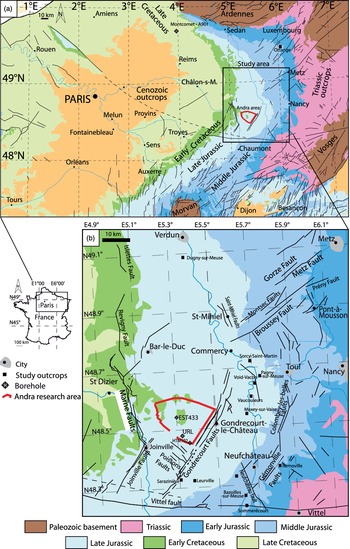
The major tectonic discontinuities in the eastern Paris Basin are reported in Figure 1. A detailed description of the main fault systems can be found in Le Roux (Reference Le Roux1980), Bergerat et al. (Reference Bergerat, Elion, Frizon de Lamotte, Proudhon, Combes, André, Willeveau, Laurent-Charvet, Kourdian, Lerouge and Ott d’Estevou2007) and André et al. (Reference André, Hibsch, Fourcade, Cathelineau and Buschaert2010). Some faults correspond to Variscan sutures that later were reactivated during Meso-Cenozoic times, such as the E–W Vittel fault, the E–W to NE–SW Metz fault and the NNW–SSE to NW–SE Marne fault. By contrast, the NNE–SSW Gondrecourt and Joinville grabens are rooted within the Keuper halite Formation and did not propagate through the basement. These symmetric troughs are related to the European Cenozoic Rift System (ECRIS; Coulon, Reference Coulon1992; Ziegler & Dèzes, Reference Ziegler and Dèzes2007; Ring & Gerdes, Reference Ring and Gerdes2016). Roughly perpendicular to the Gondrecourt graben, the Poissons fault system constitutes the western border of the area currently investigated by Andra.
(a) Geological map of the eastern Paris Basin with (b) a detailed view of the major structures in the studied area. Outcrop and quarry sample locations are indicated by black squares.

At the regional scale, the orientations and relative chronology of minor faults, tension gashes and stylolites can be correlated with the major deformation events recorded in the western European domain during the Meso-Cenozoic period (Bergerat, Reference Bergerat1985, Reference Bergerat1987; Letouzey, Reference Letouzey1986; Villemin, Reference Villemin1986; Coulon & Frizon de Lamotte, Reference Coulon and Frizon de Lamotte1988; Coulon, Reference Coulon1992; Rocher et al. Reference Rocher, Cushing, Lemeille, Lozac’h and Angelier2004; Bergerat et al. Reference Bergerat, Elion, Frizon de Lamotte, Proudhon, Combes, André, Willeveau, Laurent-Charvet, Kourdian, Lerouge and Ott d’Estevou2007; André et al. Reference André, Hibsch, Fourcade, Cathelineau and Buschaert2010).
While the Triassic was a period of tectonic quiescence, an initial E–W extensional regime is recorded during the Late Triassic period and lasts until Middle Liassic time (Guillocheau et al. Reference Guillocheau, Robin, Allemand, Bourquin, Brault, Dromart, Friedenberg, Garcia, Gaulier, Gaumet, Grosdoy, Hanot, Le Strat, Mettraux, Nalpas, Prijac, Rigoltet, Serrano and Grandjean2000). A second extension of similar orientation occurred during Late Jurassic time, attributed to the Central Atlantic opening. This regime evolved into an E–W to NE–SW compression during Early Cretaceous time, with two discrete episodes that generated significant uplift and erosion (Guillocheau et al. Reference Guillocheau, Robin, Allemand, Bourquin, Brault, Dromart, Friedenberg, Garcia, Gaulier, Gaumet, Grosdoy, Hanot, Le Strat, Mettraux, Nalpas, Prijac, Rigoltet, Serrano and Grandjean2000; Brigaud et al. Reference Brigaud, Vincent, Pagel, Gras, Noret, Landrein and Huret2018): (1) the Late Cimmerian Unconformities corresponding to a succession of two distinct truncations in the Paris Basin and (2) the Late Aptian Unconformity. For some authors however, these Early Cretaceous deformations more likely relate to an extensional regime in the eastern Paris Basin (André et al. Reference André, Hibsch, Fourcade, Cathelineau and Buschaert2010).
Early Paleocene NNW–SSE to N–S shortening is reported by André et al. (Reference André, Hibsch, Fourcade, Cathelineau and Buschaert2010) in the eastern Paris Basin. Briais et al. (Reference Briais, Guillocheau, Lasseur, Robin, Châteauneuf and Serrano2016) showed that long-wavelength deformation occurred in the central Paris Basin during the intra-Maastrichtian to pre-Thanetian period. This deformation, known as the Laramian or Laramide phase (Ziegler, Reference Ziegler1990), is well documented in western Europe and is coeval with the North Atlantic opening (Briais et al. Reference Briais, Guillocheau, Lasseur, Robin, Châteauneuf and Serrano2016 and references therein). Briais et al. (Reference Briais, Guillocheau, Lasseur, Robin, Châteauneuf and Serrano2016) documented two other deformation phases during the Ypresian period: a minor medium-wavelength deformation during Early Ypresian time that could be a far-field consequence of the North Atlantic rifting, and a long-wavelength deformation during latest Ypresian time, with the emersion of the central Paris Basin in response to the convergence between the Iberian and Eurasian plates. So far, these Ypresian phases are not documented in the eastern border of the Paris Basin.
During Eocene time, the Pyrenean compression generated a NNE–SSW transcurrent regime (Pyr1; André et al. Reference André, Hibsch, Fourcade, Cathelineau and Buschaert2010) that rotated into NE–SW (Pyr2; André et al., Reference André, Hibsch, Fourcade, Cathelineau and Buschaert2010). According to André et al. (Reference André, Hibsch, Fourcade, Cathelineau and Buschaert2010), Pyr2 is strongly expressed in the area, but its age remains uncertain. Indeed, for some authors, a NE–SW compression more likely occurred after the Oligocene extension (Bergerat, Reference Bergerat1985).
A NW–SE to E–W extension prevailed during Late Eocene – Oligocene times, and the discontinuities generated during the Pyr1 and Pyr2 strike-slip movements were reactivated as normal and oblique faults (Lacombe et al. Reference Lacombe, Angelier, Laurent, Bergerat and Tourneret1990). The Gondrecourt and Joinville grabens formed at that time, together with the main grabens constituting the ECRIS. Bedding stylolites developed in the Middle and Upper Jurassic carbonates in response to this extensional deformation (Coulon, Reference Coulon1992). Bergerat et al. (Reference Bergerat, Elion, Frizon de Lamotte, Proudhon, Combes, André, Willeveau, Laurent-Charvet, Kourdian, Lerouge and Ott d’Estevou2007) considered this Oligocene event as the most strongly expressed in the area.
An ENE–WSW shortening, which post-dates the Oligocene extension was recognized by Bergerat (Reference Bergerat1987) and André et al. (Reference André, Hibsch, Fourcade, Cathelineau and Buschaert2010) and may correspond to a later expression of the Pyrenean compression (Pyr3; André et al. Reference André, Hibsch, Fourcade, Cathelineau and Buschaert2010).
The Oligocene NW–SE extension switched into a NE–SW extensional regime during the Oligocene–Miocene transition through a σ2/σ3 permutation. The Alpine compression is then expressed during Miocene–Pliocene times by a clockwise rotation of σ1 from WNW–ESE to NNW–SSE (André et al. Reference André, Hibsch, Fourcade, Cathelineau and Buschaert2010).
It is worth noting that, owing to the lack of a syn-deformation sedimentary record, all age attributions only rely on correlations with the better-constrained tectonic agenda of adjacent domains such as the Rhine Graben, Alpine belt or Pyrenean domain.
3. Material and methods
3.a. Sampling and petrography
Twenty-seven samples were collected from the Middle Jurassic (Bajocian and Bathonian) and Upper Jurassic (Oxfordian) limestones, from outcrops, quarries and boreholes (Fig. 1). They mostly correspond to tension gashes filled by calcite affecting mudstones or grainstones from well-identified sedimentary formations (Fig. 2). The orientation of nine tension gashes is reported. Five samples correspond to calcite filling coral or mouldic vugs, sometimes connected to fractures. Two samples, collected at Leurville (Fig. 1), are hydraulic breccias found as isolated rock fragments dispersed in agricultural crops. Eleven samples contain several tension gashes, either parallel or crossing each other. In three samples, calcite cements filling the intergranular porosity were targeted for U–Pb geochronology.
Simplified lithostratigraphic section in the eastern Paris Basin, showing the position of samples within the stratigraphic formations or members.

Samples were either mounted in epoxy or prepared as 30 µm thin-sections and polished. All samples were observed under the optical microscope using transmitted polarized light and under cathodoluminescence (CL) microscopy at 13 keV and 130 mA. For each sample, a series of photomicrographs were gathered to create a composite image (see online Supplementary Material S2).
3.b. Calcite U–Pb geochronology
The method which has been employed is similar to that described in Brigaud et al. (Reference Brigaud, Bonifacie, Pagel, Blaise, Calmels, Haurine and Landrein2020). Sampling and analysis were performed using a sector field ICP-MS Element XR (Thermo ScientificTM, Waltham, MA, USA) coupled to a 193 nm ArF laser ablation system (TELEDYNE, Thousand Oaks, CA, USA) at the Geosciences Paris-Saclay (GEOPS) laboratory of the University of Paris-Saclay.
Samples and calcite reference materials were ablated at a frequency of 8 Hz and a fluence of 1 to 2 J.cm−2 with a circular-shaped beam diameter of 150 µm. Glass reference material NIST614 was ablated at a frequency of 10 Hz, a fluence of 6.25 J.cm−2 and a beam size of 110 µm. Each analysis consisted of 30 s background acquisition followed by 30 s of sample ablation and 30 s washout. Prior to analysis, each spot was pre-ablated during 4 s at a frequency of 8 Hz and with a fluence of 2 J.cm−2. NIST614 was used to correct for 207Pb/206Pb fractionation, while 238U/206Pb was corrected using WC-1 (Woodhead et al. Reference Woodhead, Horstwood and Cottle2016; Roberts et al. Reference Roberts, Rasbury, Parrish, Smith, Horstwood and Condon2017). To ensure accuracy, two secondary calcite reference materials were included in each analytical session: Duff Brown Tank (DBT), dated at 64.0 ± 0.7 Ma by U–Pb isotope dilution (Hill et al. Reference Hill, Polyak, Asmerom and Provencio2016), and B6, dated at 43.0 ± 1.0 Ma by LA-ICP-MS (Pagel et al. Reference Pagel, Bonifacie, Schneider, Gautheron, Brigaud, Calmels, Cros, Saint-Bezar, Landrein, Sutcliffe, Davis and Chaduteau2018). Each analytical sequence is composed of five reference material analyses (one NIST614, one WC-1, one DBT and two B6) inserted at between 10 and 15 spots on unknown calcites. Data were acquired overnight in five sequences of around 400 analyses.
Data were reduced in Iolite© (Paton et al. Reference Paton, Hellstrom, Paul, Woodhead and Hergt2011) using the NIST614 glass as the primary reference material for baseline subtraction, to correct for Pb isotope mass bias and for the estimation of 206Pb/238U and 207Pb/206Pb instrumental drift over the sequencing time. No down-hole fractionation correction is applied in Iolite© (Nuriel et al. Reference Nuriel, Weinberger, Kylander-Clark, Hacker and Craddock2017).
The 2 standard errors in the mean 207Pb/206Pb and 206Pb/238U ratios measured on NIST614 during the analytical session were propagated to the final age uncertainty of all calcite samples by quadratic addition. Data were plotted on Tera-Wasserburg graphs using IsoplotR online (Vermeesch, Reference Vermeesch2018), without anchoring the initial 207Pb/206Pb value. Error ellipses of each spot and the error in the Tera-Wasserburg intercept age are at a level of two sigma. In each Tera-Wasserburg graph, a first age uncertainty is given that does not include uncertainty propagations. A second age uncertainty is given, by propagating the systematic uncertainty of the age of primary reference material WC-1 (2.6 %), and the 2 standard errors of the 207Pb/206Pb and 206Pb/238U of the analytical session by quadratic addition. Sample ages and uncertainties are listed in Table 1 and detailed metadata for LA-ICP-MS calcite U–Pb geochronology are available in the online Supplementary Material.
Samples description and associated calcite U–Pb geochronology data

3.c. Oxygen and carbon stable isotope composition and clumped isotope thermometry
For oxygen and carbon stable isotope analysis, 11 calcite crystals from fracture in-fills were fragmented and collected with tweezers under the magnifying glass. The crystals were subsequently ground into a homogeneous powder in an agate mortar. Oxygen and carbon isotopes were analysed in the Geosciences Laboratory of Rennes University (France) following the methodology described in Malfilatre et al. (Reference Malfilatre, Boulvais, Dabard, Bourquin, Hallot, Pallix and Gapais2012). All isotopic values are reported to the Vienna PeeDee Belemnite (V-PDB) standard (Table 2).
Oxygen and carbon stable isotope composition and clumped isotope thermometry

Five samples consisting of large in-fillings were selected for clumped isotope analysis. 30 mg of calcite was sampled using a micro-drilling tool. Δ47 measurements were performed at the California Institute of Technology (USA) in two analytical sessions (April and May 2021) with an automated acid digestion and gas purification device coupled to a dual inlet Thermo MAT253, as described in Passey et al. (Reference Passey, Levin, Cerling, Brown and Eiler2010). Samples were weighed into silver capsules (∼8 mg) and reacted in a common phosphoric acid bath (∼103 %) for 20 minutes at 90 °C under static vacuum. The resulting CO2 was passed through an ethanol/dry ice U-trap (∼ –80 °C) before being collected on a liquid nitrogen temperature (–196 °C) U-trap. Following the 20 minutes reaction period, the collected CO2 was thawed, entrained in helium and carried through a Porapak Q 120/80 mesh gas column held at –20 °C using He as the carrier gas. The purified CO2 was analysed using a Thermo Scientific MAT 253 mass spectrometer set to collect masses 44–49. Mass 48 was only monitored to detect any hydrocarbon contaminant. δ18O and δ13C data were also acquired as part of each Δ47 analysis and calculated using the parameters reported relative to the PDB reference frame based on the calibrated composition of the laboratory working gas and the correction scheme and constants from Brand et al. (Reference Brand, Assonov and Coplen2010). In order to account for the temperature dependence of oxygen isotope fractionation between CO2 gas and carbonate resulting from the reaction with phosphoric acid at 90 °C, a fractionation factor of 1.00811 was used for calcite (following Swart et al. Reference Swart, Burns and Leder1991). The raw Δ47 data were corrected for instrument non-linearity and scale compression (Dennis et al. Reference Dennis, Affek, Passey, Schrag and Eiler2011) using several heated (at 1000 °C) and equilibrated gases (at 25 °C) of various bulk isotopic compositions that were run during each session. These gases were used to convert measurements into the inter-laboratory absolute reference frame (Dennis et al. Reference Dennis, Affek, Passey, Schrag and Eiler2011). To guarantee accuracy of the Δ47 data, we routinely analysed two carbonate reference materials (Carrara marble and TV04). One of these two carbonate standards was analysed once for every five analyses of the unknown samples in order to check for procedural analytical stability and accuracy, and to determine the long-term external reproducibility of our measurements. The Δ47 values obtained for these carbonates over the course of this study (May to July 2019) are: Δ47-CDES25 = 0.409 ± 0.016 ‰ (1SD, n = 10) for Carrara; Δ47-CDES25 = 0.666 ± 0.011 ‰ (1SD, n = 8) for TV04, i.e. within accepted Δ47 values for TV04 (Δ47-CDES25 = 0.655 ‰) and Carrara (Δ47-CDES25 = 0.405 ‰). Finally, the corrected Δ47 values were converted into temperatures using the composite Δ47-T calibration of Bonifacie et al. (Reference Bonifacie, Calmels, Eiler, Horita, Chaduteau, Vasconcelos, Agrinier, Katz, Passey, Ferry and Bourrand2017), which has been shown to be appropriate for calcite and dolomite between 0 and 300 °C, and which has been shown to be consistent with measurements made at Caltech. The oxygen isotopic compositions of the water (δ18Owater) from which the carbonates precipitated were calculated for each estimated TΔ47 using the bulk δ18Ocarb values and the calcite–water fractionation equation from O’Neil et al. (Reference O’Neil, Clayton and Mayeda1969).
4. Results
4.a. Calcite petrography
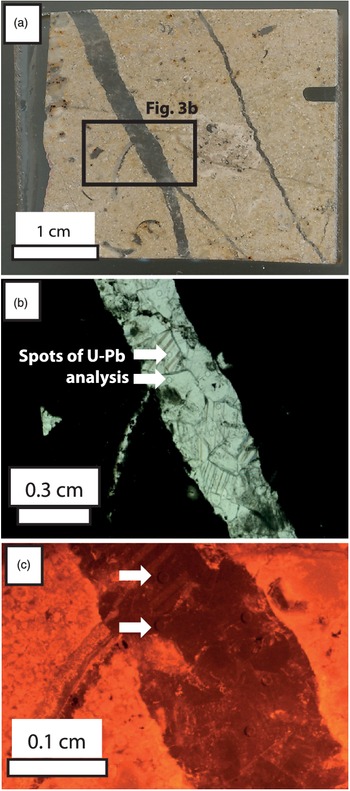
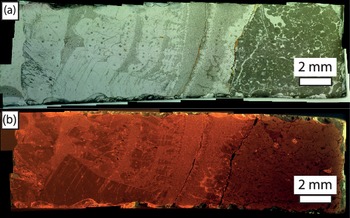
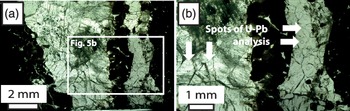
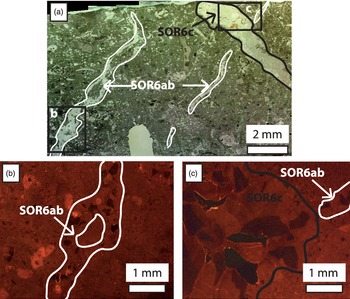
All samples consist of blocky calcite filling tension gashes (Fig. 3) and vugs, apart from the hydraulic breccia sampled at Leurville (LEU samples; Fig. 4). Crystal sizes vary from a few hundred micrometres in small tension gashes to a few millimetres in hydraulic breccias. No syntaxial or antitaxial growth orientations are identified (sensu Bons et al. Reference Bons, Elburg and Gomez-Rivas2012). While most samples contain clean crystals, a few of them (e.g. SOM1-1, SOM1-2, REM1) incorporated micrite inclusions from the host rocks during crystallization (Fig. 5). Most samples contain non-luminescent or weakly brown luminescent crystals under CL, without clear successive growth stages. No evidence of multi-phase fracture opening was observed. Apart from samples SOR6-c and DGSM29-1, all fractures are entirely cemented by blocky calcite. No dissolution features, such as corrosion gulfs, were observed. Samples SR6 and SOR6 display ambiguous cross-cutting relationships between at least two distinct generations of tension gashes that are filled with calcite displaying the same cathodoluminescence (Fig. 6). Petrographic illustrations of all samples are available in online Supplementary Material S2.
(a) Example of sub-parallel tension gashes affecting a wackestone sampled at Bazoilles-sur-Meuse (sample BAZX90a) in (b) transmitted light and (c) cathodoluminescence microscopy. Ablation craters (150 µm in diameter) are visible in (b) and (c) (white arrows).

Hydraulic breccia developed in the Oolithe de Saucourt Formation (sample LEU-2) in (a) transmitted light and (b) cathodoluminescence microscopy. Ablation craters (150 µm in diameter) are visible.

Tension gash in the Oolithe miliaire Formation sampled at Removille (sample REM1) observed in transmitted light. The white square in photomicrograph (a) corresponds to the magnification in (b). This sample illustrates the impurities contained in some calcite cements. Ablation craters (150 µm in diameter) are visible (white arrows) and located, when possible, in the most limpid parts of the crystals.

Tension gashes developed in sample SOR6 (Sorcy-Saint-Martin locality). The relative chronology between the fractures encircled in white (SOR6ab) and in black (SOR6c) is unclear, because no clear cross-cutting relationship is visible. Moreover, both tension gash populations are filled by blocky calcite displaying comparable cathodoluminescence.

4.b. U–Pb ages
Among the 27 samples collected for the purpose of this study, four were not amenable to U–Pb geochronology and were thus excluded. A total of 32 U–Pb ages are reported (Table 1). The oldest age measured in tension gashes is found in the Upper Bathonian sampled in the Montcornet borehole (sample A901-22), dated at 92.9 ± 10.3 Ma. In the same sample, another population of tension gashes is dated at 68.4 ± 4.0 Ma. In the Sarazinière quarry, a tension gash oriented N50° (sample SR6a) gives an age of 58.9 ± 1.8 Ma. Most of the ages obtained are between 50.4 ± 2.4 Ma (sample PPA1073) and 27.4 ± 2.8 Ma (sample MXV9a). A hydraulic breccia sampled at Leurville (sample LEU-2) gives an age of 22.2 ± 1.2 Ma. Finally, a tension gash oriented N150° gives a younger age of 18.7 ± 1.0 Ma (sample SR6b).
In addition, three ages were measured in the intergranular calcite cements, yielding ages of 100.9 ± 22.7 Ma (sample A901-22e), 57.7 ± 2.6 Ma (sample SR6c) and 30.6 ± 7.0 Ma (sample DGSM29-2b).
4.c. Oxygen and carbon stable isotope composition and clumped isotopes
δ18O values range between –7.0 ‰V-PDB (sample SOR6ab) and –10.5 ‰V-PDB (samples BAZX90a and LEU1-1), while δ13C are between 1.1 ‰V-PDB (sample A901-22a) and 3.4 ‰V-PDB (sample VCLD). δ18O and δ13C values measured by clumped isotopy are identical within the limits of analytical uncertainty to the ones obtained from the traditional method where C and O stable isotope compositions are measured separately. The highest Δ47 temperature is obtained for sample BAZX90a (53 ± 5 °C), and the lowest for sample SR6b (27 ± 3 °C). Three other samples give temperatures of 37 ± 2 °C (VCLD), 41 ± 1 °C (25209) and 42 ± 2 °C (25229). Sample types and associated isotopic values are summarized in Table 2.
5. Discussion
5.a. Ages, impact and duration of brittle deformation
Since no syntaxial or antitaxial growth orientations were identified (sensu Bons et al. Reference Bons, Elburg and Gomez-Rivas2012), the syn-kinematic precipitation of calcite crystals within tension gashes is unclear (Roberts & Holdsworth, Reference Roberts and Holdsworth2022). Field observations have revealed that tension gashes are generally associated with tectonic stylolites, suggesting syn-kinematic calcite dissolution and recrystallization (André et al. Reference André, Hibsch, Fourcade, Cathelineau and Buschaert2010). Furthermore, although CL sectorial zoning is observed in some samples, no successive calcite growth stages can be clearly determined, suggesting that all crystals filling a given tension gash or vug are monogenic. An isochron obtained from the sampling of several crystals filling a given tension gash proves that calcite formed during a single precipitation event. Yet, calcite cements can post-date fracture opening. Such uncertainty is somehow minimized by the large number of samples considered for this research, and by the good agreement between the orientation of fractures and their U–Pb ages, which will be discussed below.
Calcite mechanical twinning is observed in some samples (LEU1-1, VCLD, BAZX90a, REM-3-2, REM1, OT-1-2, SOM1-1, SOM1-2). The development of such twinning cannot be correlated with the age or location of the samples. The absence of calcite twinning in most samples may be due to the small size of blocky calcite crystals filling tension gashes (Lacombe et al. Reference Lacombe, Angelier, Laurent, Bergerat and Tourneret1990).
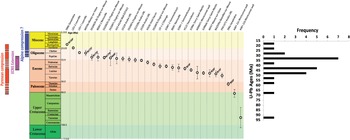
The tension gash showing the oldest age was sampled in the Montcornet borehole, located ∼200 km northwest of the Andra URL, in the vicinity of the Ardennes massif (Fig. 1). The U–Pb age of 92.9 ± 10.3 Ma suggests the Albian to Santonian period, which may be related to a major inversion phase documented in northern France (Bergerat & Vandycke, Reference Bergerat and Vandycke1994). Interestingly, this calcite U–Pb age matches with the age obtained on the first dolomite cement identified in the Middle Jurassic at depth in the central Paris Basin (Mangenot et al. Reference Mangenot, Gasparrini, Gerdes, Bonifacie and Rouchon2018). Our data agree with André et al. (Reference André, Hibsch, Fourcade, Cathelineau and Buschaert2010) and tends to indicate the absence of this tectonic phase around the Andra URL. Another sample in the same borehole was dated at 68.4 ± 4.0 Ma, i.e. the Cretaceous–Paleocene transition (Fig. 7). This age cannot be confidently interpreted and attributed to a known deformation phase. It may either be linked to the so-called ‘sub-Hercynian’ inversion phase defined by Ziegler (Reference Ziegler1987) or to an early stage of the Pyrenean compression, as evidenced in the southeastern Pyrenees (Cruset et al. Reference Cruset, Vergés, Albert, Gerdes, Benedicto, Cantarero and Travé2020). In the central Paris Basin, a second blocky calcite generation was also dated at 68.5 ± 7.7 Ma in the deep Middle Jurassic (Mangenot et al. Reference Mangenot, Gasparrini, Gerdes, Bonifacie and Rouchon2018). Regardless, these early phases recorded here more than 150 km north or west of the URL are not described in the eastern Paris Basin, where brittle structures are mostly thought to be Cenozoic in age (Bergerat et al. Reference Bergerat, Elion, Frizon de Lamotte, Proudhon, Combes, André, Willeveau, Laurent-Charvet, Kourdian, Lerouge and Ott d’Estevou2007; André et al. Reference André, Hibsch, Fourcade, Cathelineau and Buschaert2010; this study). Indeed, the ages of tension gashes and hydraulic breccias documented here span from 58.9 ± 1.8 Ma to 18.7 ± 1.0 Ma, i.e. from the Thanetian to the Burdigalian periods (Fig. 7).
Compilation of calcite U–Pb ages in tension gashes and hydraulic breccias. In the histogram, data are plotted without considering the corresponding age uncertainties.

Our data show that tectonic quiescence then prevailed during Paleocene and Early Ypresian times, a result in agreement with the slow rate of N–S convergence between the Iberian and Eurasian plates during this period (Macchiavelli et al. Reference Macchiavelli, Vergés, Schettino, Fernàndez, Turco, Casciello, Torne, Pierantoni and Tunini2017; Grool et al. Reference Grool, Ford, Vergés, Huismans, Christophoul and Dielforder2018; Mouthereau et al. Reference Mouthereau, Angrand, Jourdon, Ternois, Fillon, Calassou, Chevrot, Ford, Jolivet, Manatschal, Masini, Thinon, Vidal and Baudin2021). A single tension gash oriented N50° is dated at 58.9 ± 1.8 Ma (Paleocene) in the Sarazinière quarry. This fracture may be related to an early stage of the Pyrenean compression. Alternatively, this event may be linked to the so-called ‘Laramide’ phase (Ziegler, Reference Ziegler1987), which corresponds to a major inversion period with an uplift and erosion quantified to ∼600 m in the Morvan Massif, south of the Paris Basin, and to 300 m in the study area (Barbarand et al. Reference Barbarand, Quesnel and Pagel2013; Blaise et al. Reference Blaise, Barbarand, Kars, Ploquin, Aubourg, Brigaud, Cathelineau, El Albani, Gautheron, Izart, Janots, Michels, Pagel, Pozzi, Boiron and Landrein2014). This event does not seem to be restricted to the eastern border of the Paris Basin, since a U–Pb age of 61.1 ± 2.5 Ma was documented for calcite cements in the Middle Jurassic at depth in the central Paris Basin (Mangenot et al. Reference Mangenot, Gasparrini, Gerdes, Bonifacie and Rouchon2018).
A continuous deformation is then recorded in the age distribution of tension gashes from the Late Ypresian to the Rupelian, although two age clusters can be evidenced between 40–50 Ma (nine samples) and 30–35 Ma (seven samples) (Fig. 7). The first age cluster (40–50 Ma) is associated with N10° to N20° tension gashes (BAZX90a, MXV7, VCLD). The Late Ypresian to Bartonian opening and filling of these gashes probably records the far-field onset of the main Pyrenean compressional event at that time (Macchiavelli et al. Reference Macchiavelli, Vergés, Schettino, Fernàndez, Turco, Casciello, Torne, Pierantoni and Tunini2017). Within this deformation phase, discrete tectonic pulses may have generated higher rates of fracturing. A cluster of ages is recorded at c. 48 Ma (samples A00607c, SOR6ab, SOR6c, BAZX90a), synchronous with the emersion of the central Paris Basin (Briais et al. Reference Briais, Guillocheau, Lasseur, Robin, Châteauneuf and Serrano2016) in response to the main Pyrenean compression period (e.g. Cruset et al. Reference Cruset, Vergés, Albert, Gerdes, Benedicto, Cantarero and Travé2020). Several tension gashes are then dated at c. 43 Ma (Fig. 7), matching the U–Pb ages reported by Pagel et al. (Reference Pagel, Bonifacie, Schneider, Gautheron, Brigaud, Calmels, Cros, Saint-Bezar, Landrein, Sutcliffe, Davis and Chaduteau2018) along the Gondrecourt graben and the age of a vertical tension gash in HTM102 borehole close to the Andra URL (Brigaud et al. Reference Brigaud, Bonifacie, Pagel, Blaise, Calmels, Haurine and Landrein2020).
A reactivation of the Variscan Vittel fault south of the studied area is evidenced by two fractures sampled in the Sommerécourt quarry and dated at 42.5 ± 3.9 Ma and 40.9 ± 1.7 Ma (Fig. 7). At Removille, sample REM1 was collected along a fault delimiting a small graben of similar orientation to the Gondrecourt and Joinville grabens. The age of this sample, 42.1 ± 2.7 Ma confirms the synchronous formation of these structures. Finally, sample OT1-2 from the Ottange quarry dated at 40.8 ± 2.2 Ma demonstrates that this intraplate deformation extended far north of the study area (Fig. 1). They are also recorded in the central Paris Basin, as documented by Mangenot et al. (Reference Mangenot, Gasparrini, Gerdes, Bonifacie and Rouchon2018). These deformations and cementations are all interpretated as a far-field consequence of Pyrenean shortening.
A few fractures are dated between 40 and 35 Ma, while another main fracturing event is identified at c. 33 Ma (Fig. 7; Table 1). Ten of the 32 measured U–Pb ages obtained are in the 35–30 Ma range, matching previous U–Pb ages of c. 33 Ma reported for fractures along the Gondrecourt faults (Pagel et al. Reference Pagel, Bonifacie, Schneider, Gautheron, Brigaud, Calmels, Cros, Saint-Bezar, Landrein, Sutcliffe, Davis and Chaduteau2018) and vug-filling calcites in Oxfordian limestones from the Andra URL borehole cores (Pisapia et al. Reference Pisapia, Deschamps, Battani, Buschaert, Guihou, Hamelin and Brulhet2018). Following Pagel et al. (Reference Pagel, Bonifacie, Schneider, Gautheron, Brigaud, Calmels, Cros, Saint-Bezar, Landrein, Sutcliffe, Davis and Chaduteau2018) by analogy with the known tectonic agenda of the Rhine Graben, we suggest that these dated structures are related to extensional deformation and the opening of the ECRIS (Dèzes et al. Reference Dèzes, Schmid and Ziegler2004; Bergerat et al. Reference Bergerat, Elion, Frizon de Lamotte, Proudhon, Combes, André, Willeveau, Laurent-Charvet, Kourdian, Lerouge and Ott d’Estevou2007; Ring & Gerdes, Reference Ring and Gerdes2016), an event that is strongly expressed in the eastern Paris Basin (Bergerat et al. Reference Bergerat, Elion, Frizon de Lamotte, Proudhon, Combes, André, Willeveau, Laurent-Charvet, Kourdian, Lerouge and Ott d’Estevou2007) as attested to by the formation of the small Gondrecourt and Joinville grabens. A second generation of tension gashes collected along the Removille graben (REM3-2) yield an age of 31.7 ± 3.8 Ma, showing that this graben was formed through a two-step evolution identical to the Gondrecourt graben, i.e. a strike-slip or oblique displacement during Lutetian time, followed by extension during Rupelian time.
On the other hand, we cannot fully exclude a compressional origin for all of these c. 33 Ma tension gashes as a consequence of further Pyrenean or Alpine far-field deformations (Cruset et al. Reference Cruset, Vergés, Albert, Gerdes, Benedicto, Cantarero and Travé2020; Parizot et al. Reference Parizot, Missenard, Haurine, Blaise, Barbarand, Benedicto and Sarda2021). Regardless, we show here that deformation in the eastern Paris Basin occurred continuously from Late Ypresian to Rupelian times (Fig. 7) and that the transition from a contractional regime prevailing during the Eocene period to an extensional deformation during Oligocene time may have been progressive.
After this 33 Ma ECRIS-related event, few younger gashes are dated at c. 30 Ma. Tension gashes developed in the quarries of Dugny-sur-Meuse and Maxey-sur-Vaise dated at c. 32–27 Ma are oriented N170° and N175° and may have opened during a compressional phase documented by Bergerat (Reference Bergerat1987) and André et al. (Reference André, Hibsch, Fourcade, Cathelineau and Buschaert2010) and interpreted as a late Pyrenean horizontal stress. This age also replicates the ones obtained by Parizot et al. (Reference Parizot, Missenard, Haurine, Blaise, Barbarand, Benedicto and Sarda2021) in the north Pyrenean foreland basin, and those of Cruset et al. (Reference Cruset, Vergés, Albert, Gerdes, Benedicto, Cantarero and Travé2020) in the southern Pyrenees, interpreted as a short-lived reactivation of the compression at that time and whose expression is recorded up to the southern coast of England (Parrish et al. Reference Parrish, Parrish and Lasalle2018). Alternatively, such tension gashes could have formed in response to a NE–SW extension generated from an interchange between σ2 and σ3 (André et al. Reference André, Hibsch, Fourcade, Cathelineau and Buschaert2010).
Post-Rupelian brittle structures are scarce (Fig. 7). The absence of tension gashes dated between c. 27 Ma and 22 Ma suggests a period of quiescence during Chattian time before the renewal of compressive deformation. Calcite-cemented hydraulic breccias affecting the Oolithe de Saucourt Formation precipitated during the Chattian–Aquitanian period. In the Sarazinière quarry, a tension gash oriented N150° gave a younger age of 18.7 ± 1.0 Ma. Thus, this renewal of deformation had a limited impact on the opening of fractures in the eastern Paris Basin. This is in agreement with field observations that documented poorly developed tectonic microstructures related to the Miocene period (André et al. Reference André, Hibsch, Fourcade, Cathelineau and Buschaert2010), and the absence of reactivation of the main discontinuities (Bergerat et al. Reference Bergerat, Elion, Frizon de Lamotte, Proudhon, Combes, André, Willeveau, Laurent-Charvet, Kourdian, Lerouge and Ott d’Estevou2007).
Both Miocene calcites were sampled in the vicinity of the NW–SE Poissons fault system (Fig. 1) that reactivated in response to the compression during either the earliest stages of the Alpine contractional stress or a late Pyrenean event during Aquitanian/Burdigalian times (Hoareau et al. Reference Hoareau, Crognier, Lacroix, Aubourg, Roberts, Niemi, Branellec, Beaudoin and Suárez Ruiz2021; Parizot et al. Reference Parizot, Missenard, Haurine, Blaise, Barbarand, Benedicto and Sarda2021).
Finally, the absence of younger ages indicates that the growth of the nearby Jura fold-and-thrust belt formed roughly between 11 and 3 Ma (Homberg et al. Reference Homberg, Bergerat, Philippe, Lacombe and Angelier2002; Smeraglia et al. Reference Smeraglia, Looser, Fabbri, Choulet, Guillong and Bernasconi2021) had no or very limited impact on the deformation of the eastern Paris Basin.
To sum up, the deformation of the eastern Paris Basin is essentially related to far-field propagation of compressional stress during the Pyrenean orogen growth. It has been accommodated continuously by the opening of tension gashes and the development or reactivation of strike-slip faults and stylolites between c. 50 Ma (sample PPA1073) and 27 Ma (sample MXV9a), with deformation pulses at c. 48 Ma and 43 Ma, and only interrupted for a short time by the ECRIS-related extensional event at c. 33 Ma.
On a larger scale, this tectonic agenda of the eastern Paris Basin is consistent with the U–Pb ages of slickenfibres and fracture-filling calcites in the north foreland basin of the Pyrenees (Parizot et al. Reference Parizot, Missenard, Haurine, Blaise, Barbarand, Benedicto and Sarda2021), in the southeastern Pyrenean fold-and-thrust belt and the south foreland Ebro basin (Cruset et al. Reference Cruset, Vergés, Albert, Gerdes, Benedicto, Cantarero and Travé2020) and along the Cevennes fault system (Parizot et al. Reference Parizot, Missenard, Barbarand, Blaise, Benedicto, Haurine and Sarda2022). South of the Paris Basin, fluorite mineralization occurred likely in response of this contractional event (Lenoir et al. Reference Lenoir, Blaise, Somogyi, Brigaud, Barbarand, Boukari, Nouet, Brézard-Oudot and Pagel2021). This event is also recorded in the Jura fold-and-thrust belt, where a pre-orogenic NE–SW strike-slip fault was recently evidenced through U–Pb geochronology of slickenfibre calcite yielding two ages similar to ours at 48.4 ± 1.5 Ma and 44.7 ± 2.6 Ma (Smeraglia et al. Reference Smeraglia, Looser, Fabbri, Choulet, Guillong and Bernasconi2021).
5.b. Origin and temperature of calcite-mineralizing fluids
The meteoric origin of waters from which calcite precipitated in tension gashes was suggested by André et al. (Reference André, Hibsch, Fourcade, Cathelineau and Buschaert2010) on the basis of the δ18O values measured in calcite. Yet, the oxygen stable isotope composition of parent-waters was uncertain, since the fractionation factor between H2O and calcite was estimated from only six two-phased aqueous fluid inclusions that homogenized at temperatures ranging from 31 to 38 °C (Buschaert et al. Reference Buschaert, Fourcade, Cathelineau, Deloule, Martineau, Ayt Ougougdal and Trouiller2004). Thanks to the Δ47 clumped isotope composition of calcite, the origin of parent-waters can be determined with a higher level of confidence, especially in low-temperature environments in which aqueous inclusions remain in a single-phase metastable state (Goldstein & Reynolds, Reference Goldstein and Reynolds1994). The δ18O values of calcite-mineralizing waters, determined on five samples from their clumped isotope composition, range from –4.6 to –2.6 ‰V-SMOW, supporting the views of André et al. (Reference André, Hibsch, Fourcade, Cathelineau and Buschaert2010) and Pagel et al. (Reference Pagel, Bonifacie, Schneider, Gautheron, Brigaud, Calmels, Cros, Saint-Bezar, Landrein, Sutcliffe, Davis and Chaduteau2018) regarding their meteoric origin.
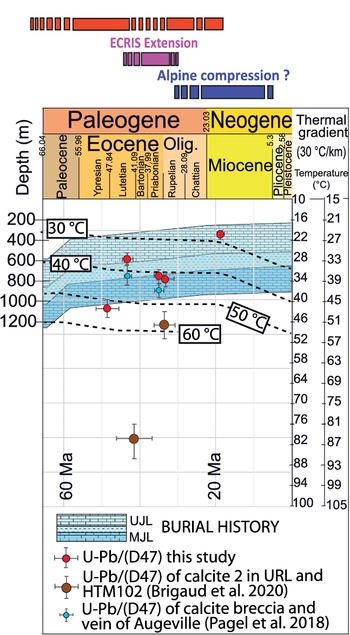
The temperature at which calcite cements precipitated in veins and hydraulic breccias along the Gondrecourt graben was lower than 50 °C (Pagel et al. Reference Pagel, Bonifacie, Schneider, Gautheron, Brigaud, Calmels, Cros, Saint-Bezar, Landrein, Sutcliffe, Davis and Chaduteau2018), slightly higher than the expected temperature of the host rock. Yet, Brigaud et al. (Reference Brigaud, Bonifacie, Pagel, Blaise, Calmels, Haurine and Landrein2020) reported higher temperatures, up to 90 °C, in a calcite-filled tension gash dated at 41.5 ± 4.8 Ma at the vicinity of the Gondrecourt graben (well HTM102 located 2 km from the graben; Fig. 7). These temperatures suggest that hot fluid flow migrated along deeply rooted faults during the Ypresian/Bartonian compressional regime (Brigaud et al. Reference Brigaud, Bonifacie, Pagel, Blaise, Calmels, Haurine and Landrein2020). Here, the highest Δ47 temperature is c. 53 °C in the Calcaires de Chaumont Formation (Bathonian), showing that meteoric waters were slightly in thermal disequilibrium with their host rocks. In such case, meteoric waters from deeper strata may have risen upward through the fracture network (Ge & Garven, Reference Ge and Garven1992; Sibson, Reference Sibson and Parnell1994). In addition, the Δ47 temperatures may also reflect the burial depth at which calcite precipitation occurred: the oldest fractures may have developed at a depth of 700 to 1000 m. Since the eastern Paris Basin experienced inversion and associated erosion during Cenozoic times, the youngest fractures (Miocene) were generated closer to the present-day surface (Fig. 8).
Calcite U–Pb age as a function of crystallization temperature determined from Δ47 thermometry.

5.c. Origin of intergranular calcite cements
The impact of Cenozoic intraplate deformation in the interparticle cementation of the Jurassic limestones in the eastern Paris Basin is still unclear. André et al. (Reference André, Hibsch, Fourcade, Cathelineau and Buschaert2010) and Carpentier et al. (Reference Carpentier, Brigaud, Blaise, Vincent, Durlet, Boulvais, Pagel, Hibsch, Yven, Lach, Cathelineau, Boiron, Landrein and Buschaert2014) stressed that contractional deformation generated vertical stylolites with horizontal peaks and that a high density of bed-parallel stylolites could be attributed to the Late Eocene – Oligocene extensional period. These tectonic stylolites developed during the inversion of the eastern Paris Basin and may have contributed to calcite dissolution–recrystallization and eventually to the cementation of intergranular pores (Buschaert et al. Reference Buschaert, Fourcade, Cathelineau, Deloule, Martineau, Ayt Ougougdal and Trouiller2004; André et al. Reference André, Hibsch, Fourcade, Cathelineau and Buschaert2010). This scenario is supported by recent U–Pb ages of vug-filling calcite in the Oxfordian limestones at c. 33 Ma (Pisapia et al. Reference Pisapia, Deschamps, Battani, Buschaert, Guihou, Hamelin and Brulhet2018), showing that the Late Eocene – Oligocene extension effectively contributed to occlude the pore space.
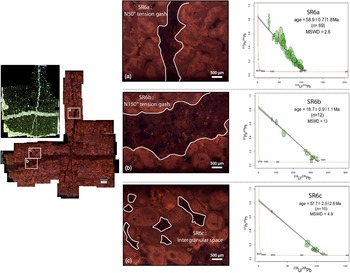
Among the samples considered for this research, three display blocky calcite cementing the intergranular porosity large enough to be targeted for U–Pb dating. In sample DGSM29-2, these blocky calcites yielded an age of 30.6 ± 7.0 Ma (DGSM29-2b; Table 1), identical, within the limits of analytical uncertainties, to the age of the nearby N170° tension gashes (DGSM29-2a and DGSM29-1) at 32.0 ± 1.5 Ma and 31.6 ± 2.9 Ma. In sample A901-22, blocky calcite cements filling intergranular pores are dated at 100.9 ± 22.7 Ma (A901-22e), matching the age of the nearby fracture dated at 92.9 ± 10.3 Ma (A901-22a). However, age uncertainties are large for this sample, which may be explained by low U/Pb ratios together with the presence of a younger calcite infilling fractures (A901-22c, dated at 68.4 ± 4 Ma), which may have induced the dissolution–recrystallization of the older calcite cement. A third example is illustrated in Figure 9 with a grainstone sampled at the Sarazinière quarry (Oolithe de Lamothe Formation, Upper Oxfordian), affected by two generations of tension gashes. The first generation is oriented N50° and yields an age of 58.9 ± 1.8 Ma (SR6a), while the second is oriented N150° and is dated at 18.7 ± 1.1 Ma (SR6b). Both tension gashes are filled by calcite crystals displaying the same cathodoluminescence (Fig. 9), hence the difficulty in establishing a relative chronology from their cross-cutting relationship. Calcite U–Pb geochronology resolves this issue. Moreover, the intergranular pore space is entirely plugged by a blocky calcite showing a comparable dull brown cathodoluminescence. The U–Pb age of this blocky calcite, 57.7 ± 2.6 Ma (SR6c), is identical to the older tension gash (SR6a, 58.9 ± 1.8 Ma). It is worth noting that these ages match the one obtained on the second blocky calcite generation in the deep Middle Jurassic carbonate strata from the Paris Basin depocentre (Mangenot et al. Reference Mangenot, Gasparrini, Gerdes, Bonifacie and Rouchon2018).
Calcite U–Pb ages determined in the SR6 sample (Sarazinière quarry, Oolithe de Lamothe Formation, Upper Oxfordian).

Therefore, although tension gashes could have acted as preferential conduits for meteoric waters, fluid flow and associated calcite crystallization were not only restricted to the fracture network. Palaeo-water flows through the intergranular porosity and subsequent cementation was enhanced by the development of brittle microstructures (Hansman et al. Reference Hansman, Albert, Gerdes and Ring2018; Sun et al. Reference Sun, Gomez-Rivas, Cruset, Alcalde, Muñoz-Lopez, Cantarero, Martin-Martin, John and Travé2022). This is shown by the synchronous precipitation of calcite in tension gashes and in the adjacent intergranular pore space. However, the spatial extension of such ‘tectonic-induced cementation’ is unknown and needs further research and complementary geochronological data on calcite cements occluding the intergranular pore space.
6. Conclusions
We have provided evidence for a continuous fracturing of the Jurassic carbonates from the Ypresian to the Rupelian period in the eastern Paris Basin. This period coincides with the main shortening related to the Pyrenean orogen growth, interrupted by extensional deformation during Late Eocene – Early Oligocene times. Three U–Pb age clusters are identified, the first two at c. 48 Ma and 43 Ma, related to the far-field propagation of Pyrenean horizontal stress, and a third at 33 Ma corresponding to the ECRIS-related extensional regime. Fluids of meteoric origin percolated through the fracture networks at rather low temperatures (from 27 to 53 °C), with a progressive decrease of temperature though time. Fluid flow and associated calcite precipitation was not restricted within the fractures, but also occurred in the intergranular pore space.
Supplementary material
To view supplementary material for this article, please visit https://doi.org/10.1017/S0016756822000772
Acknowledgements
This manuscript benefited from fruitful discussion with Christian Hibsch. We also thank Frédéric Haurine for his assistance during the LA-ICP-MS U–Pb analysis. This work is the outcome of a collaborative project between the University Paris-Saclay and Andra, the French agency for radioactive waste management, funded in part by Andra. We thank the two anonymous reviewers for their constructive comments that helped to improve the manuscript.
Conflict of interest
None.