Contaminated endoscopes are one of the most common causes of device-related outbreaks of healthcare-associated infections. Reference Rutala and Weber1 Flexible bronchoscopy is a common endoscopic procedure for diagnosing and treating respiratory conditions. Although it can provide significant diagnostic and therapeutic benefit for patients, lapses in bronchoscope reprocessing or infection prevention and control (IPC) practices surrounding the bronchoscopy procedure can lead to the transmission of pathogens. Reference Kovaleva, Peters, van der Mei and Degener2 However, assessing the scale and significance of bronchoscope-related transmission events can be challenging given the lack of active surveillance for bronchoscopy-associated infections. Reference Srinivasan3 Furthermore, limited information is available on key considerations when investigating outbreaks and pseudo-outbreaks associated with bronchoscopes.
The US Centers for Disease Control and Prevention (CDC) Division of Healthcare Quality Promotion (DHQP) provides technical assistance to health departments and healthcare facilities investigating healthcare-associated infections. Here, we describe the CDC’s experience with bronchoscope-associated investigations. We have summarized the prominent features of these investigations, and we have identified common associations, potential transmission routes, and key IPC areas. This information can inform providers, infection preventionists, and state and local health departments regarding bronchoscope-associated outbreak prevention and response strategies.
Methods
We reviewed DHQP internal consultation records from July 1, 2014, through September 30, 2022, for any investigations involving bronchoscopy. We excluded investigations reported from jurisdictions outside the United States and if an alternative transmission pathway, unrelated to bronchoscopy, was determined. We defined outbreaks as (1) any investigation in which a pathogen was cultured from a clinical specimen and was responsible for the colonization or clinical infection of patients or (2) an investigation in which the pathogen was cultured from a bronchoscope but no patient colonization or infection was identified. We defined pseudo-outbreaks as any investigation in which a pathogen was cultured from a clinical specimen but its introduction was believed to have occurred during specimen handling or processing. For each investigation for which information was available, we calculated the number of patients involved, and we identified specimen source for cultures and corresponding results, IPC breaches, potential routes of transmission, and mitigation measures implemented.
Results
We consulted on 26 investigations involving bronchoscopy during the study period. Among them, 3 investigations involved bronchoscope reprocessing breaches without an identified outbreak or pseudo-outbreak: One investigation involved the use of expired test strips for monitoring the minimum concentration of high-level disinfectant during bronchoscope reprocessing, and 2 investigations involved gaps in staff knowledge and training leading to missing multiple reprocessing steps in manual cleaning and storage. Also, 19 investigations were outbreaks and 4 investigations were pseudo-outbreaks, and 234 patients were involved. No deaths were linked to these outbreaks and pseudo-outbreaks.
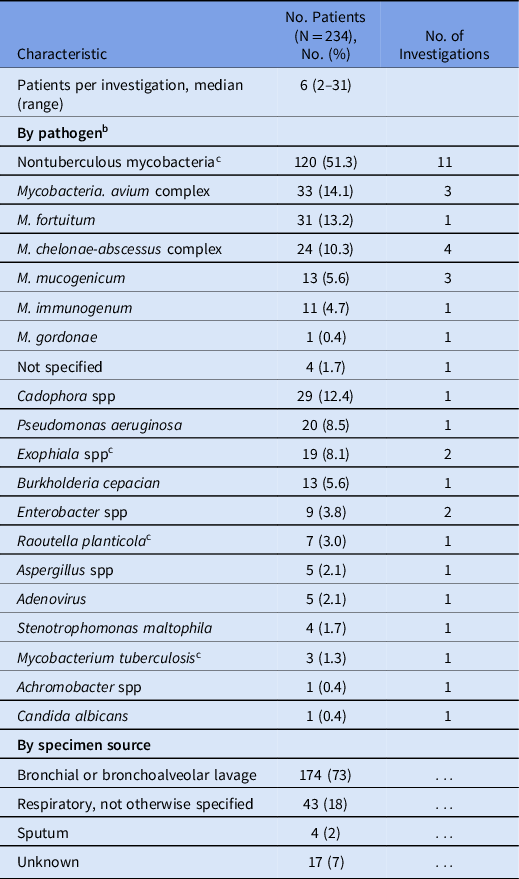
Table 1 describes the microbiological features of the 23 outbreaks and pseudo-outbreaks. Bacteria were identified in 18 investigations (78%), fungi were identified in 5 investigations (22%), and viruses were identified in 1 investigation (4%). Overall, nontuberculous mycobacteria (NTM) were the most common pathogens; they were identified in 11 investigations (46%) and 120 patients (51%). Also, 7 investigations (29%) involved environmental Gram-negative bacilli. Furthermore, 4 investigations included >1 organism, and 3 of these involved >1 NTM species. In these investigations, 221 patients (93%) had pathogens isolated from respiratory specimens only, such as sputum or bronchoalveolar lavage.
Microbiological Features of Bronchoscope-Associated Outbreak Consultations: Data from 23 Investigations, a Division of Healthcare Quality Promotion, CDC—United States, 2014–2022

a Includes only outbreaks and pseudo-outbreaks.
b Categories are not mutually exclusive.
c Identified in a pseudo-outbreak.
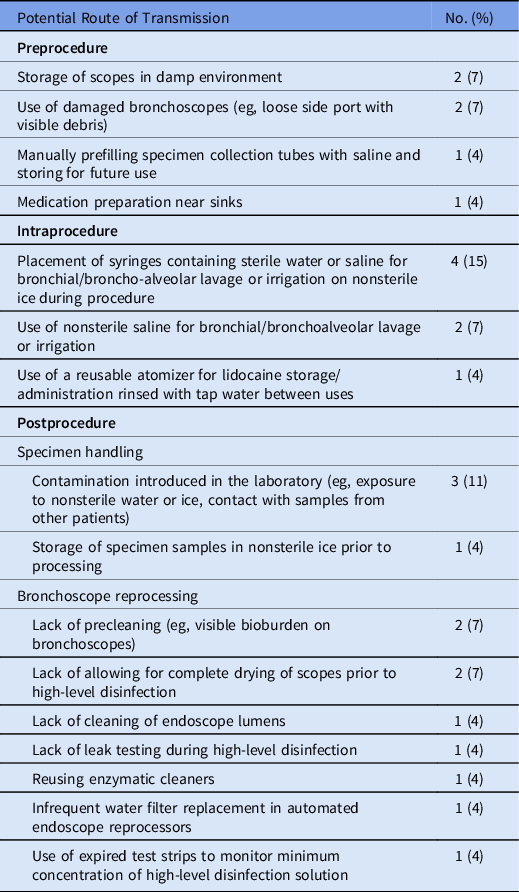
Table 2 summarizes possible transmission routes identified in these investigations. The most common transmission route was bronchoscope contamination from bronchoscope reprocessing gaps (n = 20, 77%), followed by exposure to nonsterile water, ice, or saline (n = 10, 39%). In 7 investigations (27%), >1 potential transmission route was identified.
Potential Routes of Transmission a Identified in Bronchoscope-Associated Investigations (N = 26), Division of Healthcare Quality Promotion, CDC—United States, 2014–2022

a Not mutually exclusive.
The following IPC interventions (data not shown) were implemented: (1) adjustments to scope reprocessing practices (eg, utilizing sterile over tap water for precleaning and increased frequency of filter replacement for automated endoscope reprocessors), (2) discontinuation of prefilling specimen collection tubes with saline prior to the procedure, (3) transitioning from a multiuse atomizer for intraprocedural lidocaine administration to single-use vials, (4) returning damaged or contaminated bronchoscopes to the manufacturer, (5) retraining staff on proper bronchoscope reprocessing procedures, and (6) implementation or optimization of quality control practices.
To limit exposure of patient samples or bronchoscopy supplies to nonsterile ice, (1) specimen containers and syringes containing chilled sterile water or saline for irrigation and hemostasis during bronchoscopy were placed in clean, single-use bags prior to placement on ice; (2) sterile ice was used; or (3) ice was discontinued entirely. Point-of-use filters were installed on sink faucets in bronchoscope suites and reprocessing areas.
Discussion
Transmission of infectious pathogens related to bronchoscopy procedures adversely affects patients and the healthcare system, potentially resulting in patient morbidity and mortality, significant cost to facilities, and, in cases of pseudo-outbreaks, misdiagnoses and inappropriate treatment. In this review of CDC consultations of bronchoscope-related investigations over an 8-year period, we identified bronchoscope contamination due to reprocessing gaps and exposure of the bronchoscope or other bronchoscopy-related supplies to nonsterile water as important exposure pathways.
Proper reprocessing of bronchoscopes is a critical measure to prevent transmission, and it requires implementation of clear policies, sufficient personnel and supply resources, regular review of practices, sufficient documentation, and regular staff training. 4 Breakdowns in any of these components can undermine the effectiveness of bronchoscope reprocessing and can lead to reprocessing gaps in nearly every step, as identified in these investigations.
We commonly identified exposure to nonsterile water, ice, and saline in these investigations. Reference Engers, Swarup and Morrin5 Exposure to nonsterile water and ice has been previously linked to bronchoscope-associated outbreaks, Reference Bringhurst, Weber and Miller6,Reference Perkins, Reddy, Fagan, Arduino and Perz7 and the variety of exposure pathways identified in this summary is a reminder that nonsterile water and ice can come into direct or indirect contact with patients or patient specimens during bronchoscopy. The most common infectious pathogens identified in these investigations were water-associated bacteria, particularly NTM. NTM frequently infect or colonize susceptible patients through preventable exposure pathways including bronchoscopy. Reference Li, Abebe, Cronk and Bartram8 Thus, a comprehensive water management program is needed in both inpatient and outpatient settings where bronchoscopy is performed. Tap water and nonsterile ice exposure must be avoided during bronchoscopy.
Multiple pseudo-outbreaks have been described associated with bronchoscopy. Reference Kovaleva, Peters, van der Mei and Degener2,Reference Weber and Rutala9,Reference Seoane-Vazquez, Rodriguez-Monguio, Visaria and Carlson10 We also identified 4 pseudo-outbreaks in which contamination likely occurred following specimen collection and was not introduced by the bronchoscope or during the bronchoscopy procedure itself. One example was a cluster of infections in which Raoultella planticola was isolated from unused specimen-collection tubes prefilled with saline.
Mitigation measures implemented included removing any damaged or potentially contaminated bronchoscopes from circulation, incorporating sterile water or saline in bronchoscopy or bronchoscope reprocessing procedures when feasible, employing additional measures to ensure water quality, and re-educating staff. Staff education extends not only to bronchoscope reprocessing technicians but also to all healthcare personnel performing or assisting with bronchoscopy and caring for patients undergoing this procedure.
This summary had several limitations. First, our report represents only investigations reported to DHQP; therefore, it likely underestimates the total number of bronchoscope-associated outbreaks in the United States. Second, inconsistency in the data elements available for each investigation limited complete comparisons across investigations. Third, many bronchoscope-associated outbreaks are likely undetected because routine surveillance of respiratory cultures associated with bronchoscopy is not standard practice.
In conclusion, healthcare personnel, infection preventionists, hospital epidemiologists, and health department personnel should carefully evaluate gaps in all steps of bronchoscope reprocessing. The introduction of nonsterile water, ice, and products before, during, and after bronchoscopy should be considered when investigating bronchoscope-associated outbreaks. As this summary demonstrates, although water-associated bacteria, especially NTM, were the most common infectious pathogens associated with bronchoscope-related transmission events, fungi and viruses should also be considered. To protect patients from infectious risks associated with bronchoscopy, healthcare facilities should strongly consider establishing policies and procedures that prevent intraprocedural use of nonsterile water and ice. Other strategies include consistent and frequent staff training regarding appropriate bronchoscope inspection and reprocessing procedures and establishing a robust and comprehensive water management program. Interventions should be multimodal, should involve measures to eliminate sources of contamination, and should enforce strict adherence to standard IPC practices.
Acknowledgments
The authors thank Ayana Hart for her assistance in database management, the Prevention and Response Branch, the Clinical and Environmental Microbiology Branch, and other DHQP and CDC staff who assisted with the consultations included in this report.
Financial support
No financial support was provided relevant to this article.
Competing interests
All authors report no conflicts of interest relevant to this article.