Oral language skills are the most important predictors for developing written language proficiency. Second language (L2) learners with a language minority background seem to struggle in developing adequate oral language skills, which seem to affect their subsequent school performance and decrease the chances of school success (Lervåg & Aukrust, Reference Lervåg and Aukrust2010; OECD, 2010). The oral language skills involved in narrative production require production of longer and more complex utterances than in everyday oral communication. Oral skills require lexical knowledge and knowledge of linguistic rules (Leikin, Ibrahim, & Eghbaria, Reference Leikin, Ibrahim and Eghbaria2014; Verhoeven, Reference Verhoeven, Strömquist and Verhoeven2004), as well as knowledge of how to organize linguistic units in line with an overall theme. Several studies have emphasized the positive and mutually enhancing relationship between narrative production and reading comprehension (Cain, Reference Cain2003; Feagans & Short, Reference Feagans and Short1984; Geva & Olson, Reference Geva and Olson1983), and the available but limited research on this relationship in L2 learners indicates that the relationship is similar to that found in monolingual samples (Miller et al., Reference Miller, Heilmann, Nockerts, Iglesias, Fabiano and Francis2006). The linguistic and structural complexity of narrative production as well as differences in cultural norms for narratives and language use may make narrative production a particular challenge for L2 learners. In the current study, we investigated the narrative production of a sample of young Norwegian L2 learners with a minority language as their home language, using the picture book Frog, Where Are You? (Mayer, Reference Mayer1969). We examined different aspects of their narratives, such as the story structure, number of different words used, and linguistic complexity, as well as the possible role of cognitive, linguistic, and contextual factors in predicting narrative production. Understanding how these different factors relate to each other and to narrative production will increase our understanding of L2 development, of the factors that are related to this development, and provide a better possibility for preventing language disabilities and academic failure.
NARRATIVE ORGANIZATION
When thinking of narrative organization it is useful to consider two levels: the macrolevel and the microlevel. Macrolevel organization refers to the global organization (coherence) of a story. Microlevel organization refers to the linguistic complexity and how relationships between words and sentences are indicated (cohesion).
Narrative macrostructure, or coherence, is often conceptualized as a variation of the presence of an introduction, a main plot, and a resolution (e.g., Berman & Slobin, Reference Berman and Slobin1994). Based on the results of narrative script development in young language minority children (first language [L1]: Russian; L2: Hebrew) within different educational contexts, Schwartz and Shaul (Reference Schwartz and Shaul2013, p. 49) argue that “the ability to produce a narrative is more dependent on cognitive processes than on the specific language in cultures that share narrative conventions.” The presence of a universal, cognitive schema for narrative organization (e.g., Trabasso, Stein, & Johnson, Reference Trabasso, Stein, Johnson and Bower1981) is supported by the correspondence in narrative structure across different languages and samples (Gorman, Fiestas, Peña, & Reynolds Clark, Reference Gorman, Fiestas, Peña and Reynolds Clark2011), and the increasing complexity in narrative production associated with age (for a summary, see Berman, Reference Berman and Foster-Cohen2009; Berman & Slobin, Reference Berman and Slobin1994), as well as by correlations found between the narratives produced by bilingual children in their two languages (Severing & Verhoeven, Reference Severing, Verhoeven, Verhoeven and Strömqvist2001; Viberg, Reference Viberg, Verhoeven and Strömqvist2001), and similar story organization across different samples (Berman & Slobin, Reference Berman and Slobin1994).
The microlevel of narrative organization refers to the linguistic complexity, including the cohesion of the narrative, which demonstrates the narrator's control of basic language structures (Leikin et al., Reference Leikin, Ibrahim and Eghbaria2014). The concept of linguistic complexity covers aspects of language use such as the variety of words used in the narratives, the relationship between words and sentences, and the complexity of the syntax. Cohesion concerns the linguistic devices that narrators use to indicate the semantic relationships between sentences or clauses such as pronouns and connectives (Cain, Reference Cain2003; Halliday & Hasan, Reference Halliday and Hasan1995/1976). Children's use of cohesive devices provides important information about their language and narrative development. For example, younger children tend to use the additive connective and in their narratives, whereas older children are more likely to also use temporal and causal connectives, such as then or because (Berman, Reference Berman and Foster-Cohen2009; Geva, Reference Geva and Horowitz2007; Shapiro & Hudson, Reference Shapiro and Hudson1991).
Even though narrative coherence and cohesion are important aspects of narrative production (Hickman, Reference Hickman, Strömqvist and Verhoeven2004), and the levels of organization seem to influence each other reciprocally (Carrell, Reference Carrell1982; Halliday & Hasan, Reference Halliday and Hasan1995/1976; Squires et al., Reference Squires, Lugo-Neris, Peña, Bedore, Bohman and Gillam2014), most research on the subject has focused on either coherence (macrolevel) or cohesion (microlevel). Consequently, the nature of the relationship among narrative macrostructure and language proficiency, such as lexical knowledge, linguistic complexity, and cohesion, in narrative production is not yet clear (Hipfner-Boucher et al., Reference Hipfner-Boucher, Milburn, Weitzman, Greenberg, Pelletier and Girolametto2015), and is possibly also affected by inconsistency in the measures of narrative macro- and microstructure that are used in different studies. Understanding the nature of these relationships may give us a clearer picture of L2 development and therefore also a better understanding of how to support L2 learners in developing adequate language skills.
Linguistic factors in L2 narrative production
Cohesive relationships between sentences, such as use of referential pronouns and conjunctions, are related to grammar, and vocabulary knowledge is needed to create lexical cohesion (Halliday & Hasan, Reference Halliday and Hasan1995/1976). Accordingly, vocabulary knowledge and grammatical skills are important prerequisites for oral language production, including the production of narratives.
The results of research on L2 learners’ narrative production are not consistent with regard to the question of the relationship between linguistic proficiency (e.g., vocabulary and grammatical knowledge) and narrative production. However, it seems that one is more likely to find correlations between linguistic proficiency and narrative production once a certain level of proficiency in the L2 has been attained (Crosson & Lesaux, Reference Crosson and Lesaux2010; Geva, Wade-Woolley, & Shany, Reference Geva, Wade-Woolley and Shany1997). To illustrate, on the basis of the results from a study of narrative production in Swedish L2 learners at different ages, Viberg (Reference Viberg, Verhoeven and Strömqvist2011) argues that children whose L2 skills have not reached a certain linguistic proficiency threshold in the L2, are unable to generate narratives. Although the concept of threshold is ill defined, Viberg argues that a threshold for linguistic proficiency may have consequences for narrative production, including linguistic complexity at the microlevel as well as narrative structure at the macrolevel.
Along the same lines, Montanari (Reference Montanari2004) found that even though the three English–Spanish bilingual children in her study had the cognitive skills to build a coherent and cohesive narrative in their L1, they did not seem to be able to do so in their L2. She argues that the bilingual children's inability to produce narratives in their L2 stemmed from their weaker language skills in the L2, an argument supported by information about their performance on standardized tests of listening and speaking proficiency.
Bedore, Peña, Gilliam, and Tsung-Han (Reference Bedore, Peña, Gilliam and Trung-Han2010) examined predictors of language proficiency (semantic and morphosyntactic knowledge in both the L1 and the L2) during a narrative task in Spanish–English bilingual children. They found that neither number of total words nor number of different words in the narratives were significant predictors of language proficiency. Grammatical proficiency, however, was a better indicator of language skills than was vocabulary. They did also find that number of different words correlated with proficiency in the L2, and explained that this could be because “children need to have some critical amount of vocabulary to be able to use the language to complete the testing tasks” (p. 506).
In the same vein, Verhoeven (Reference Verhoeven, Strömquist and Verhoeven2004) suggested that knowledge of the core grammar of a language is a prerequisite for narrative production. However, Gutiérrez-Clellen (Reference Gutiérrez-Clellen2002) found that children in the process of learning an L2 produced coherent narratives even though they had limited grammatical skills in their L2. Likewise, in another study of minority language children in Canada, Hipfner-Boucher (Reference Hipfner-Boucher2011) did not find differences in narrative production between young monolingual children and L2 learners in terms of either microstructure or macrostructure, despite a gap in L2 vocabulary proficiency. The only difference Hipfner-Boucher found in narrative production was in morphosyntactic performance, on which the monolingual children outperformed the L2 learners. However, when examining the narrative production in subgroups (English L1 learners, English L2 learners, and minority language users learning English as an L2), Hipfner-Boucher et al. (Reference Hipfner-Boucher, Milburn, Weitzman, Greenberg, Pelletier and Girolametto2015) found that even though there were no group differences in the number of utterances or story grammar, minority language users had significantly lower scores on all microstructure measures (sentence length, number of different words, and grammaticality) relative to the English L1 and English L2 comparison groups, indicating that home exposure to the L2 was related to narrative microstructure.
The available research indicates that the reported relationship between language proficiency in the L1 and L2 varies among studies. This may be due to the specific aspect of language examined in different studies (e.g., decoding, syntax, or vocabulary; Melby-Lervåg & Lervåg, Reference Melby-Lervåg and Lervåg2011; for a systematic review see also Genesee, Geva, Dressler, & Kamil, Reference Genesee, Geva, Dressler, Kamil, August and Shanahan2006). One of the most influential theories on the L1 and L2 relationship, the interdependence hypothesis, argues that both the L1 and the L2 rest on a common underlying proficiency (Cummins, Reference Cummins1979). Consequently, well-developed L1 proficiency may facilitate the development of the L2. Uccelli and Paez (Reference Uccelli and Paez2007) investigated the narrative production in bilingual Spanish–English children and found that L1 story structure skills predicted significant variance in L2 narrative quality (a combined variable including story structure and language skills) after controlling for L2 vocabulary. Vocabulary knowledge in kindergarten predicted narrative production in first grade within the same language (i.e., English or Spanish), but vocabulary did not predict narrative production cross-linguistically. According to the authors, the results suggest that narrative proficiency and vocabulary represent different sets of skills (Uccelli & Paez, Reference Uccelli and Paez2007). Note that these authors did not control for either cognitive ability or contextual factors, and acknowledged this as a weakness in their study.
In summary, previous studies support the existence of a relationship between grammatical skills and narrative production (e.g., Berman & Slobin, Reference Berman and Slobin1994), but the results are not straightforward (Gutiérrez-Clellen, Reference Gutiérrez-Clellen2002). The evidence for a relationship between vocabulary and narrative production is even less clear (Hipfner-Boucher, Reference Hipfner-Boucher2011), but some researchers have found support for such a relationship (Uccelli & Paez, Reference Uccelli and Paez2007). These inconsistent results suggest that more research is needed to untangle the relationships among aspects of language proficiency such as grammatical knowledge and vocabulary, on the one hand, and narrative production, on the other hand. The more limited vocabularies of L2 learners compared with those of monolingual children (August, Carlo, Dressler, & Snow, Reference August, Carlo, Dressler and Snow2005; Ndlovu & Geva, 2007) might have an impact on story structure indices, making it even more important to uncover the range of cognitive and linguistic factors that might contribute to narrative proficiency in children developing their literacy skills in an L2 in a majority language context. It is reasonable to expect that L2 learners might have language proficiency in both their L1 and their L2, but the degree of this proficiency may depend on opportunities to learn both languages. Regardless, the relationship between L2 vocabulary and grammatical knowledge and L2 narrative production has not been examined in samples other than Spanish–English bilinguals (e.g., Uccelli & Paez, Reference Uccelli and Paez2007). It is not clear whether the same relationships would be found in other typologically different language combinations such as Norwegian–Urdu/Punjabi. Further, the conflicting results regarding the role of language skills in narrative production in L2 learners suggest that the contribution of other factors, including contextual variables such as home literacy and experience with telling and listening to narratives, may contribute to this relationship.
Contextual factors in narrative production
A relationship between children's language development and parental book reading has been found in several studies (e.g., Bus, van IJzendoorn, & Pellegrini, Reference Bus, van IJzendoorn and Pellegrini1995; Leseman & de Jong, Reference Leseman and de Jong1998; Teale & Sulzby, Reference Teale and Sulzby1986). In a comprehensive study, Evans, Kelley, Sikora, and Treiman (Reference Evans, Kelley, Sikora and Treiman2010) examined families coming from varying socioeconomic contexts across 27 different countries, and found that number of books in the home correlates with children's educational attainment in all countries. Thus, it seems that this measure is a powerful index of home literacy environment, which has been shown to contribute to children's literacy development. However, not all studies have demonstrated a positive relationship between children's narrative production and parental book reading to their children. For example, in a study of 4-year-old children, Sènèchal, Pagan, Lever, and Oulette (Reference Sènèchal, Pagan, Lever and Oulette2008) found that the frequency of shared reading at home predicted expressive vocabulary, morphology, and syntactic skills in children, but not narrative production (conceptualized in terms of number of different words, cohesion, and narrative structure). Other studies have established a positive relationship between home literacy activities and narrative production in children (e.g., Snow & Dickinson, Reference Snow and Dickinson1990), and it is suggested that familiarity with story structure as a result of book reading activities could be especially important for narrative production because it enhances familiarity with story structure (Cain, Reference Cain2003).
At the same time, it is important to remember that home literacy activities are not children's only source of language input and narrative experience. Typically, children spend a significant amount of their time in kindergarten, and Gorman et al. (Reference Gorman, Fiestas, Peña and Reynolds Clark2011) have argued that schooling shapes children's narrative style. Rydland, Grøver, and Lawrence (Reference Rydland, Grøver and Lawrence2014) found that qualities within the kindergarten context predicted vocabulary skills in Norwegian L2 learners. In a similar vein, Squires et al. (Reference Squires, Lugo-Neris, Peña, Bedore, Bohman and Gillam2014) found that English (L2) experience in kindergarten predicted the growth of English macrostructure in English–Spanish bilinguals. This is in line with the results reported by Scheffner et al. (Reference Scheffner Hammer, Komaroff, Rodriguez, Lopez, Scarpino and Goldstein2012), who found that children's exposure to English (L2) from both teachers and mothers correlated with their English narrative scores. The authors argued that this finding was an outcome of the mothers’ and teachers’ book reading practices. Snow and Dickinson (Reference Snow and Dickinson1990) maintain that variance in kindergarten experiences might also affect narrative development. In a small-scale study, they examined the effect of contextual factors, and concluded that mother–child conversations as well as literacy-related activities in preschool contribute to children's narrative skills. Notwithstanding the importance of the research reviewed above, more research is needed that examines macrolevel and microlevel of narrative production in language combinations that have not been examined to date, and that takes into account, at the same time, the contribution of cognitive, linguistic, and contextual factors to the emergence of L2 narrative production in the primary grades.
THE CURRENT STUDY
The present study set out to examine the L2 narrative production of children with a Pakistani origin, this being one of the largest and oldest immigrant groups in Norway. Urdu/Punjabi was the home language of these children, and they were acquiring the majority language, Norwegian, as their L2. This is an interesting group to examine, because to date the bulk of research on L2 narratives has mainly focused on Spanish–English bilingual children. The objective was to investigate the contribution of cognitive, linguistic, and contextual factors measured in kindergarten, to L2 narrative production 1 year later when the children were in Grade 1. Such a broad range of predictors has not been included in previous studies. The wordless picture book Frog, Where Are You? (Mayer, Reference Mayer1969) was used to examine different aspects of children's narratives. Because of the large variation in L2 linguistic skills often found in L2 samples (Hipfner-Boucher et al., Reference Hipfner-Boucher, Milburn, Weitzman, Greenberg, Pelletier and Girolametto2015) we expected to find diversity in the macro- and microdimensions of narrative production of the children. Linguistic factors are likely to be more closely related to the microlevel than the macrolevel of the narratives.
First, an overall hypothesis of the study was that the different predictors would have different impacts on the various aspects of narrative production.
Second, we hypothesized that L1 proficiency (vocabulary and grammar) would predict L2 narrative production after cognitive ability was controlled for. We expected the effect of L1 linguistic skills to be stronger for microlevel than for macrolevel narrative skills, but small compared to the effect from the same-language (L2) linguistic variables (see Uccelli & Paez, Reference Uccelli and Paez2007).
Third, in line with Berman and Slobin (Reference Berman and Slobin1994) and Uccelli and Paez (Reference Uccelli and Paez2007), for example, we hypothesized that L2 grammar and vocabulary knowledge, respectively, would predict L2 narrative production. We also hypothesized that L2 linguistic proficiency would predict the narrative production after the contextual variables (see the fourth hypothesis below) was controlled for.
Fourth, and in line with Snow and Dickinson (Reference Snow and Dickinson1990), we hypothesized that contextual variables (number of books in the home and time spent in kindergarten) would predict the different aspects of narrative production.
METHOD
Participants
The participants in this study were 66 children with Norwegian as their L2. The gender distribution was 34 boys and 32 girls, and the mean age was 5 years and 3 months. Because of the longitudinal design of the study, there was some attrition from the first to the second wave of assessment; only 54 children were assessed in first grade (gender distribution: 27 boys, 27 girls; mean age = 6 years, 5 months). The main reasons for the attrition were mobility between school districts (n = 7) and loss of narratives caused by technical problems (n = 5). We found no systematic differences between the original sample and the remaining children, as analyzed and described in the Results section.
The participants had a language minority background with Urdu or Punjabi as their L1. Seventy-three percent of the children had entered kindergarten by the age of 3; by the age of 4, 95% had entered kindergarten, and all participants had entered kindergarten by age 5. All children but two were born in Norway. At school, they received language and literacy instruction in Norwegian, which is also the language used in kindergarten. Their L1 was acquired at home. Even though Punjabi is the L1 for most people coming from Pakistan to Norway, Urdu is the official language of Pakistan and is therefore frequently used. The two languages share linguistic features (Thiesen, Reference Thiesen2003), and both are used within the Pakistani–Norwegian community (Aarsæther, Reference Aarsæther, Bull and Lindgren2009).
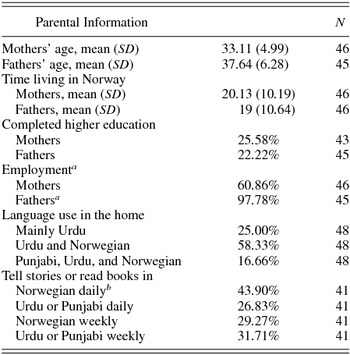
Immigrants from Pakistan represent one of the largest immigrant groups in Norway (the second largest after immigrants from Poland in 2009, represented by just above 30,000 persons; Høydahl & Rustad, Reference Høydal and Rustad2009): the first wave of immigrants came as labor migrants from Pakistan in the 1960s and 1970s, and the group has increased since then, primarily as a result of family reunion initiatives. The background of the parents of children participating in the study was heterogeneous: some were born in Norway, and some came to Norway as adults. Table 1 presents summary demographic information about family background and language use in the home. As can be seen, not all parents responded to all questions in the parent questionnaire (n range = 41–48). The education levels of the mothers varied, with a quarter having completed postsecondary education. A substantial group (about 66%) reported that they had completed high school. While relatively high, the latter is lower than the 81% reported for the total population in Norway (OECD, 2012).
Descriptive statistics on parents’ background and language use in the home

a Full time or part time.
b Some parents tell stories in both Urdu and Norwegian.
The participants were recruited from 26 kindergartens in the central regions of Norway. All kindergartens in 9 out of 15 city districts in Oslo were invited to participate in the study. The districts were selected mainly because of the high proportion of language minorities in these areas. Consequently, most children (n = 60) came from urban areas. Five children came from slightly more rural areas. The kindergarten staff handed out information and requests for participation to parents of children with Urdu and Punjabi as their mother tongue. The written information was given in both Norwegian and Urdu, and the kindergarten staff was encouraged to also present the information orally. Due to confidentiality practices of the kindergarten staff, information concerning rates of refusals is unavailable. All the participants had Urdu or Punjabi as their mother tongue, and there were no known sensory or developmental disorders.
Kindergartens in Norway are in many ways similar to daycare centers in Western countries such as the United States. The mandate of Norwegian kindergartens is to provide an environment that is caring and facilitates learning (Ministry of Education and Research, 2005). However, the learning objectives are somewhat less explicit than in, for example, the United States. Typically, kindergartens organize activities that promote learning in the mornings, including storytelling activities, rhyme activities, and other activities related to language awareness. For children aged 5–6 there are also some letter learning activities. After lunch, children often engage in spontaneous and self-directed play activities with varying degrees of direct adult involvement. However, there is a certain focus on language stimulation in Norwegian, which is the main language in Norwegian kindergartens. Some kindergartens have employees who speak minority languages and use these languages with the children to some extent, but Norwegian is still the main language used. Children stay in kindergarten for a mean of 31 hr per week (Simonsen & Solheim, Reference Simonsen and Solheim2010). For children aged 4–6, the national Norwegian mean for class size in kindergartens is 18.6 children, but classes vary in terms of size, the age range, and the number of minority children in each class (Vassenden, Thygesen, Brosvik Bayer, Alvestad, & Abrahamsen, Reference Vassenden, Thygesen, Brosvik Bayer, Alvestad and Abrahamsen2011). Kindergarten attendance is not obligatory in Norway.
Measures
In the fall of the children's last year in kindergarten (Time 1), cognitive and language skills were assessed. Narrative production was assessed halfway (winter) through Grade 1 (Time 2). Because the tests are not standardized on L2 learners, we report the results in the form of raw scores. Background information was assessed using a parent questionnaire distributed at Time 1.
Predictors
L1 AND L2 MEASURES
Vocabulary knowledge and grammatical skills were assessed at Time 1 in both Norwegian and Urdu/Punjabi. To assess the children's L1 proficiency, they were asked about their preferred language, either Urdu or Punjabi, before the testing started. At Time 1, 60 children preferred to be tested in Urdu, and 6 preferred to be tested in Punjabi.
Norwegian and Urdu/Punjabi vocabulary knowledge was assessed at Time 1 using a Norwegian and an Urdu/Punjabi version of the British Picture Vocabulary Scale—II (BPVS-II; Dunn, Dunn, Whetton, & Burley, Reference Dunn, Dunn, Whetton and Burley1997). This test measures receptive vocabulary breadth. For each item, the children were asked to match a word presented by the administrator with one of four pictures. There are 144 items on the test, and testing is stopped when a child makes eight errors within a block of 12 items. The procedure was the same for the Urdu/Punjabi version as for the Norwegian version of the test, except that the children listened to the words presented through audio recordings when their L1 vocabulary was measured. This procedure made it possible for Norwegian native speakers to assess receptive L1 skills. The BPVS-II was translated and tested on different language minorities in Norway by Monsrud, Bjerkan, and Thurmann (Reference Monsrud, Bjerkan and Thurmann2010). Reported Cronbach α reliabilities were 0.97 or higher when administered to children speaking different minority languages in Norway (Monsrud et al., Reference Monsrud, Bjerkan and Thurmann2010) and 0.92 when administered in Norwegian to L1 children (Lyster, Horn, & Rygvold, Reference Lyster, Horn and Rygvold2010).
Norwegian and Urdu/Punjabi grammatical knowledge was assessed with a Norwegian and an Urdu/Punjabi version of the Test for Reception of Grammar—II (TROG-II; Bishop, Reference Bishop2003). In this test, children listen to different grammatical utterances, and for each item, they must decide which of four pictures the utterance refers to (e.g., English: The dog runs after the boy. Norwegian: Hunden løper etter gutten. Urdu:
 ). There are 80 items in the task, organized in blocks of four related grammatical utterances, and the stop criterion is errors in five consecutive blocks. We used the score of total number of correct items in the analyses. For the Urdu/Punjabi version of the TROG-II, the Cronbach α was 0.97 (Monsrud, Geva, & Lyster, Reference Monsrud, Geva and Lyster2015). For the Norwegian version of the test, the Cronbach α was 0.95 (Bishop, Reference Bishop2003).
The translations of both the TROG-II and the BPVS-II into Urdu and Punjabi followed the same procedures. Two independent teachers of each of the two languages separately translated the tasks, and subsequently discussed the translations with each other and a project group (consisting of the researcher and the translators; Monsrud, Bjerkan, & Thurmann-Moe, Reference Monsrud, Bjerkan and Thurman-Moe2011). The version this group agreed on was then translated back from Urdu and Punjabi to Norwegian (cf. linguistic equivalence; Peña, Reference Peña2007). Notwithstanding these precautions, it is important to acknowledge that the translations had satisfactory reliability, the items were judged to be appropriate by native speakers, and the results showed a steady progression from ages 7 to 12 (Monsrud et al., Reference Monsrud, Bjerkan and Thurman-Moe2011), suggesting rather solid measurement properties.
NONVERBAL ABILITY
Nonverbal ability was assessed using the block design subtest from the third edition of the Wechsler Preschool and Primary Scale of Intelligence (Wechsler, Reference Wechsler2002). On this test, the child is asked to build patterns with one- or two-colored blocks following two- or three-dimensional models. This test is considered to be independent of verbal skills but may still be sensitive to cultural differences (Rosselli & Ardila, Reference Rosselli and Ardila2003). For example, the Norwegian standardization showed a 6-month difference compared with the English norm group on the nonverbal tasks on the Wechsler Preschool and Primary Scale of Intelligence (Wechsler, Reference Wechsler2002; Norwegian version). Cronbach α for the Norwegian standardization of the block design is 0.88.
CONTEXTUAL INFORMATION
All parents were given a questionnaire at Time 1, and 56 (85%) of the questionnaires were returned. The questionnaire included questions about the background of the parents, and the literacy practices and language use in the families. To maximize parental involvement, the questionnaires were provided in both Norwegian and in Urdu (Punjabi is not a written language in Pakistan).
Number of children's books at home is considered a marker of home literacy activities (Bus et al., Reference Bus, van IJzendoorn and Pellegrini1995) and was therefore used as an indicator of home literacy factors. The parents were asked how many children's books they had at home and were given the following alternatives: 0–2, 3–10, 11–50, or “more than 50.” The number of children's books at home was assessed independently of the language of the books.
Kindergartens are institutions where minority language children use the societal language, and we therefore assessed the amount of time the children spent there. Moreover, Norwegian kindergartens aim to familiarize children with books and stories (Ministry of Education and Research, 2011). To obtain a measure of time spent in kindergarten, we asked the parents how many hours their children spent in kindergarten per week (1–10 hr = 1 point, 11–20 hr = 2 points, 21–27 hr = 3 points, 28–35 hr = 4 points, 36–43 hr = 5 points, or more than 43 hr = 6 points). In addition, they were also asked at what age the children had entered kindergarten (with ages ranging from 1 to 5). Each half a year in kindergarten was given 1 point. Both scales represent increased amount of time in kindergarten and therefore increased exposure to Norwegian. The sum of the two scales reflects extent of exposure to kindergarten. For example, a child who spent 1–10 hr in kindergarten and began attending kindergarten at the age of 5 received 2 points. Scores on this combined measure could range from 2 to 15.
The dependent variables: Narrative assessment
To assess narrative production, the wordless picture book Frog, Where Are You? (Mayer, Reference Mayer1969) was used. The book tells the story of a boy and a dog in their search for a runaway frog in 24 pictures. It has been used extensively in previous research (e.g., Berman & Slobin, Reference Berman and Slobin1994), and its advantages as a method of narrative assessment are thoroughly described (e.g., Strömquist & Verhoeven, Reference Strömquist and Verhoeven2004).
The children were presented with the task as a book with no words in it and were given the opportunity to browse through the book before they were encouraged to tell the story in Norwegian while looking at the pictures. Only minimal prompts were given (e.g., Yes, hmm, do you want to tell me more?). The stories were audiotaped and transcribed.
CODING THE NARRATIVES
Both linguistic complexity and story structure elements are important aspects of children's narrative production (Geva & Olson, Reference Geva and Olson1983), and both aspects were taken into account in the coding procedures. The narratives were coded on five aspects of narrative production; microstructure features were coded for number of clauses, number of different words, linguistic complexity (terminable units [T-units] divided by number of different words), and story complexity (see Stadler & Word, Reference Stadler and Ward2005). The narrative macrostructures were coded on the presence of eight plot elements, all of which are described in more detail below.
NUMBER OF CLAUSES
To measure story length, the stories were divided into clauses, described by Berman and Slobin (Reference Berman and Slobin1994, p. 26) as “any unit containing a unified predication, whether in form of a verb or adjective.” Modal verbs (e.g., could or would) were counted together with the main verb, and subordinate clauses were counted as individual clauses (e.g., “since he ran away”).
LINGUISTIC COMPLEXITY
Different approaches to the assessment of linguistic complexity in narratives have been used in previous research (see, e.g., Halliday & Hasan, Reference Halliday and Hasan1995/1976). To create a measure of linguistic complexity that was independent of story length, we divided the number of words used in each story by the number of T-units. T-units were defined as “one main clause plus any subordinate clause or non-clausal structure that is attached to or embedded in it” (Hunt, Reference Hunt1970, p. 4). Complex sentences, such as and then he fell because the owl came, were counted as one T-unit, and compound sentences, such as a moose came and he fell, were counted as two T-units. Sentences connected with and were treated as two units unless the subject was expressed only in the first clause, for example, a moose came and took him (Norbury & Bishop, Reference Norbury and Bishop2003).
NUMBER OF DIFFERENT WORDS
Number of different words has been found to be a better indicator of narrative production than total number of words (Uccelli & Paez, Reference Uccelli and Paez2007). We used the Hermetic Word Frequency Counter (Meyer, Reference Meyer1997) to count the number of different word forms used in each narrative. A word form refers to a word stem or a stem with additional morphemes; for example, run and running were counted as two word forms. This resulted in a total score of different word forms.
STORY COMPLEXITY
The story complexity score was based on the scoring system developed by Stadler and Ward (Reference Stadler and Ward2005). They presented five different levels of story complexity. The first two levels of Stadler and Ward's hierarchy of narrative complexity (labeling and listing) were merged because it was difficult to separate these levels in the data. At the first level, stories are told as descriptions of characters and actions that are not explicitly related. The next level is connecting, where the additive connector and is used and the stories are perceptually but not temporally organized. Sequencing is the third level, where actions are temporally and, in some cases, causally, organized. In these kinds of stories, when and why questions are (implicitly) answered, and formulations that include connectors such as but and because are used (Stadler & Ward, Reference Stadler and Ward2005). The highest level of complexity is the narrating level. Narratives at this level are goal-directed stories in which the events are temporally and causally organized. The children received 1 point when their narratives were at the describing level (labeling and listening), 2 points when their narrative was characterized as being at the connecting level, 3 points for a narrative characterized as being at the sequencing level, and 4 points for a narrative rated as being at the narrating level.
STORY STRUCTURE
As Norbury and Bishop (Reference Norbury and Bishop2003) note, Frog, Where Are You? follows a relatively simple structure, yet it is quite complex because it requires the child to draw inferences about causality and the intentions of the characters. Some adjustments were made compared with previous research (e.g., Trabasso et al., Reference Trabasso, Stein, Johnson and Bower1981; Viberg, Reference Viberg, Verhoeven and Strömqvist2001) to capture the complexity of the story's macrostructure. The story structure was coded based on the presence of eight plot elements, and the children received 1 point for including each of the plot elements, as follows: orientation (There was a boy with two pets, a dog and a frog); onset (The frog runs away); discovery (The boy wakes up and discovers that the frog is gone. Discovery includes the goal: to find the frog); and the search indoors, either generally (e.g., The boy searched everywhere) or more specifically (The boy looks for the frog in a shoe and in his boots; the dog gets stuck in a jar). For the adventures outside, 1 or 2 points were awarded (The boy looks in a hole; the dog gets chased by bees; the boy gets scared by an owl and falls out of a tree; a reindeer runs away with the boy and makes him fall in the water), following Norbury and Bishop (Reference Norbury and Bishop2003). One point was given if the child mentioned one event, and 2 points were given if the child mentioned two or more events. For an utterance to be considered an event, however, the child had to describe at least two related elements connected to the event (e.g., 1. The boy looks into a hole. 2. A mouse comes out. or 1. The boy climbs in a tree. 2. He falls down.). Finally, 1 point was awarded for the resolution (The boy and the dog find some frogs), and 1 point was awarded for the ending (The boy and the dog bring their own frog, or a substitute, home). For the ending, it was crucial that the child explicitly mention whether the frog that was taken home was the same as or a substitute for the one that ran away. A total of 8 points could be obtained on the story structure scale.
Procedure
The participants were recruited as part of a larger project that focuses on language development in Norwegian children (Karlsen, Lyster, & Lerväg, Reference Karlsen, Lyster and Lervåg2015). The first wave of measurement (Time 1) took place in the fall of the year in which the children turned 5, during the children's last year of kindergarten. The second assessment wave (Time 2) took place approximately 14 months after the first assessment, roughly half way through first grade. The children were tested individually in rooms isolated from their peers by trained research assistants or the first author. None of the testers were proficient in the children's L1. The testing was conducted over 2 days, with a minimum of 1 week in between the first and second days of testing. Each session lasted 30–50 min and was carried out by trained assistants or doctoral students. The L1 version of the BPVS-II was always administered approximately 1 week after the L2 version, and the Norwegian version of the TROG-II was administered approximately 1 week after the Urdu/Punjabi version.
Interrater reliability
To establish interrater reliability for the narrative measures that involved personal judgment, 20% of the stories were recoded by a research assistant. The κ value was 0.855 for story structure and 0.728 for story complexity. The agreements are considered substantial when ranging from 0.61 to 0.80 and excellent when ranging from 0.81 to 1.0, as suggested by Landis and Koch (Reference Landis and Koch1977). Disagreements were resolved by discussion.
Statistical methods
In order to answer the research questions, we used several series of fixed-order hierarchical regression analysis. Because we were interested in the unique contributions of the different independent variables, they were entered stepwise into the models. The research questions guided the order of entering the variables into the models. The contextual variables (number of books in the home and time spent in kindergarten) were entered simultaneously to see the shared contribution from these contextual variables. Sample size (N = 54) and power considerations limited the number of independent variables possible in each series; thus, we included a maximum of three independent variables in each regression analysis. Consequently, we ran a number of regression series in order to investigate the effect of the predictor variables.
Missing data
To examine the risk of systematic missing data from Time 1 to Time 2, we used t tests comparing the means of the variables with missing values and those with no missing values (Peugh & Enders, Reference Peugh and Enders2004). The missing data on the contextual variables were due to unanswered questions in the questionnaire and reduced the sample size. To increase power in the analyses, we imputed variables using the expectation-maximum algorithm. This technique imputes values for the missing variables based on the observed values, estimating parameters using an iterative maximization process.
RESULTS
Preliminary analysis
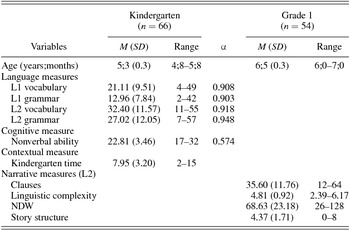
Table 2 provides descriptive statistics, including the range and the internal consistency (Cronbach α) of the independent variables (i.e., the language measures and nonverbal measure assessed in kindergarten, and time spent in kindergarten) and the dependent variables (i.e., the narrative measures assessed in first grade). As shown in the table, all measures had good internal consistency (Cronbach α ≥ 0.91) except for the test of nonverbal ability (α = 0.574). The nonverbal sample mean was within the lower normal range compared with the Norwegian standardization of the test (Wechsler, Reference Wechsler2002).
Descriptive statistics for kindergarten and Grade 1 measures
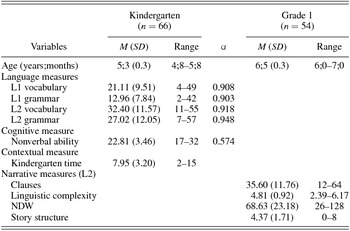
Note: L1, First language; L1 vocabulary, British Picture Vocabulary Scales (BPVS II) Urdu/Punjabi; L1 grammar, Test of Reception of Grammar (TROG II) Urdu/Punjabi; L2, second language; L2 vocabulary, BPVS II Norwegian; L2 Grammar, TROG II Norwegian; Nonverbal ability, Block Design (Wechsler Preschool and Primary Scale of Intelligence); Kindergarten time, time spent in kindergarten; Clauses, number of clauses; NDW, number of different words.
The children had significantly higher vocabulary scores in their L2 than in their L1 vocabulary, t (6.437), p = .000, Cohen d = 1.001, but there were no significant vocabulary differences between the children who preferred to be assessed in Urdu and the children who preferred to be assessed in Punjabi, neither on Urdu/Punjabi vocabulary, t (1.615), p = .111, nor on Norwegian vocabulary, t (1.549), p = .126. It is also important to note that compared with the monolingual Norwegian standardization of the BPVS-II (Lyster et al., Reference Lyster, Horn and Rygvold2010), the mean of the Norwegian vocabulary score was almost two standard deviations below the standardized age mean (M = 60.91, SD = 11.99, α = 0.92), with a large effect size (Cohen d = 2.42).
There was some attrition from Time 1 to Time 2. T tests showed no significant differences in vocabulary knowledge between the remaining group and the children who had moved away, for example, BPVS-II in Norwegian: t (0.365), p = .717, or between the remaining children and the children whose narratives were lost because of technical problems, BPVS-II in Norwegian: t (–0.265), p = .702. The attrition is therefore considered to be at random (Peugh & Enders, Reference Peugh and Enders2004).
Almost 9% reported that they only had between 0 and 2 children's books at home (n = 4). More than half of the parents reported that they had 3–10 books at home (65.2%, n = 30), 21.7% reported that they had 11–50 books (n = 10), and 4.3% reported that they had more than 50 books (n = 2). The median value was 3–10 books. A recent study showed that monolingual Norwegian parents report having more children's books than what was reported by parents in this sample. In that study, almost half of the parents asked (47%) reported having more than 50 children's books at home (Karlsen, Lyster, & Lervåg, 2015). However, in Norway, access to Norwegian books is easier than to Urdu books; thus, this may be part of the reason for the low number of books in the Urdu/Punjabi-speaking families.
The frequency of the different plot elements that appeared varied considerably. The percentage of the different plot elements described was as follows: orientation (e.g., The boy had a dog and a frog): 29.6%; onset (e.g., In the night the frog ran away): 72.2%; discovery (e.g., The boy woke up and saw that the frog was gone): 68.5%; Activity 1, inside (e.g., He looked inside a boot, but the frog was not there): 59.3%; Activity 2, outside (e.g., He met a rat and the rat bit his nose): 88.9%; Activity 3, outside (e.g., Suddenly the deer stopped and the boy and the dog fell in a pond): 66.7%; resolution: 94.4% (e.g., He saw a frog); and ending (e.g., He took the frog back home): 7.4%. Of the different plot elements, “resolution” was the most frequent, followed by “descriptions” of one of the adventures outside and onset.
The coding of the narratives in terms of different story complexity levels indicates that about half of the stories (52%) used the connector and to connect the story events (the connecting level), but almost one third (30%) also used some more complex linguistic connectives, such as because, then, but, or after (the sequencing and narrating levels) to express story structure. Close to 17% of the narratives were categorized as describing level, and one narrative was categorized as reaching the highest level of narrative organization (the narrating level). This pattern is in line with previous research on monolingual children's typical narratives in kindergarten (Berman, Reference Berman and Foster-Cohen2009; Geva & Olson, Reference Geva and Olson1983; Shapiro & Hudson, Reference Shapiro and Hudson1991).
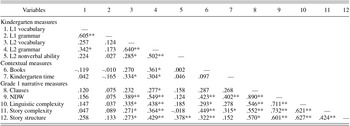
Table 3 presents the correlations among all kindergarten measures, the contextual factors, and the narrative measures in first grade. Because of the very high correlation between clauses and T-units (r = .967, p < .001), T-units were not included in the table or in subsequent analyses. There were no significant correlations between age in months and any of the measures, except for a weak correlation between L2 grammatical skills in kindergarten and age in months in Grade 1 (r = .278, p < .05).
Correlations among kindergarten language skills, nonverbal ability, contextual factors, and first grade narrative measures (N = 54)

Note: L1, First language; L1 vocabulary, British Picture Vocabulary Scales (BPVS II) Urdu/Punjabi; L1 grammar, Test of Reception of Grammar (TROG II) Urdu/Punjabi; L2, second language; L2 vocabulary, BPVS II Norwegian; L2 Grammar, TROG II Norwegian; Nonverbal ability, Block Design (Wechsler Preschool and Primary Scale of Intelligence); Kindergarten time, time spent in kindergarten; Clauses, number of clauses; NDW, number of different words.
*p < .05. **p < .01.
Several main patterns are noticeable in Table 3. First, a high correlation was found between L1 vocabulary and L1 grammar (r = .605, p < .001) and between L2 vocabulary and L2 grammar (r = .640, p < .001). Second, L2 vocabulary and grammar correlated positively and significantly with all narrative variables except for number of clauses, and narrative production (at the microlevel and the macrolevel) tended to be more strongly related to L2 grammar than to L2 vocabulary. However, when examining the difference between the dependent correlations using the Fisher Z test, we found that the differences between the correlations were not significant. Third, except for the correlation between L1 vocabulary and L2 grammar (r = .342, p < .05), the L1 variables did not correlate with any L2 variables. Fourth, there were moderate to strong correlations among the narrative variables. Fifth, the nonverbal task correlated positively and significantly with L2 proficiency and story structure (r = .285, p < .05 and r = .502, p < .001, respectively), suggesting that the test captured individual differences in spite of the low reliability (α = 0.574). Sixth, Table 3 shows that number of books in the home was a more stable correlate of narrative elements than was time spent in kindergarten.
In summary, at least moderate correlations were found among the L2 variables, but the relationships between L1 and L2 proficiency indices were low.
The role of cognitive and linguistic factors in predicting narrative production
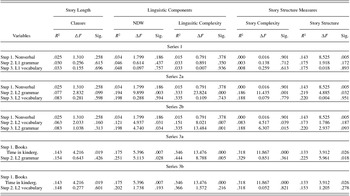
To further investigate the contributions of cognitive, linguistic, and contextual factors assessed in kindergarten to narrative production (as measured by number of clauses, number of different words, linguistic complexity [T-units divided by number of different words], and story complexity at the microlevel, and the presence of the eight plot elements at the macro level) 1.5 years later, when children were finishing Grade 1, we performed a series of fixed-order hierarchical regression analyses. Because of the small sample size, no more than three predictor variables were entered in each analysis. We therefore ran the regression analyses in three series, with the different narrative measures as dependent variables in separate analyses. We did not control for the possible impact of interactions between variables because of the small sample size (any interactions found between variables could very well be the result of chance). The results are presented in Table 4.
Effect of linguistic and contextual factors on narrative production: Series of fixed order hierarchical regression analysis summary
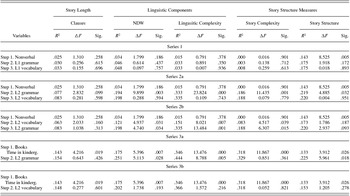
Note: The R 2 values are the percentage of variance explained after each step. NDW, Number of different words; Nonverbal, Block Design (Wechsler Preschool and Primary Scale of Intelligence); L1 first language; L1 grammar, Test of Reception of Grammar (TROG II) Urdu/Punjabi; L1 vocabulary, British Picture Vocabulary Scales (BPVS II) Urdu/Punjabi; L2, second language; L2 vocabulary, BPVS II Norwegian; L2 Grammar, TROG II Norwegian; Books, number of books at home; Time in kinderg, time spent in kindergarten.
In the first series of regression analyses, we controlled for nonverbal ability before entering the L1 grammar and then L1 vocabulary as predictor variables. There was no effect of L1 linguistic skills on any of the narrative measures after the nonverbal ability variable was controlled for. Thus, our second hypothesis that L1 proficiency would predict L2 narrative production was not supported.
In the next series of analyses, we followed the same procedures with the L2 variables. As Table 4, Series 1 shows, nonverbal ability predicted significant variance in story structure (14.3%, p = .05) when entered at the first step. In Series 2a, L2 grammar predicts significant variance on all narrative measures. The L2 vocabulary measure did not predict unique variance when it was entered after L2 grammatical knowledge and nonverbal ability. However, as Series 2b shows, when vocabulary preceded grammar, it explained between 8% and 15% of the unique variance on narrative measures including number of different words, linguistic complexity, and story complexity. Grammar explained an additional 7%–17% of the unique variance on number of different words and linguistic complexity. In this group of L2 learners there is a moderately high correlation between L2 vocabulary and grammar (see Table 3), but the variance inflation factor values did not indicate a problem with collinearity. These results indicate that our third hypothesis, that L2 grammar and vocabulary knowledge would predict L2 narrative production, was supported.
The role of contextual factors in predicting narrative production
In the third series of regression analyses, we examined the relative contributions of contextual factors and L2 vocabulary and grammatical skills to the narrative measures. Because not all parents’ questionnaires were handed in, we had some missing data on the contextual variables (n = 11). The Little missing completely at random test for missing data in SPSS confirmed that the data were missing completely at random, χ2 (18, N = 54) = 18.310, p = .629. Consequently, we could apply the expectation-maximization algorithm to impute values in the data set in order to increase the power (Cohen, Cohen, West, & Aiken, Reference Cohen, Cohen, West and Aiken2003). We used the variables that correlated significantly with number of books in the home and with time in kindergarten to estimate the missing values (see Table 3). Unbiased maximum likelihood estimates require relatively large samples (Scafer & Graham, Reference Scafer and Graham2002), and thus, the results should be interpreted with caution. As recommended by Tabachnick and Fidell (Reference Tabachnick and Fidell2007), we therefore ran a series of additional analyses using listwise deletion. When comparing the results from the original with the transformed data set, we found the same patterns. Because of the larger sample size, the imputations increased the power of the relationships among the variables, however, making the patterns in the regression analyses more apparent.
Because we expected the contextual factors to affect L2 vocabulary and grammatical skills as well as narrative production, we entered the contextual variables before the L2 measures (Bus et al., Reference Bus, van IJzendoorn and Pellegrini1995; Sènèchal et al., Reference Sènèchal, Pagan, Lever and Oulette2008). As shown in Table 4, the two contextual factors, number of books in the home and accumulated kindergarten hours, entered jointly in Step 1, explained unique and significant percent of variance on all the narrative measures. Examination of the β values revealed that number of books and time in kindergarten were equally important for the narrative variables, except for story complexity (number of books: β = 0.422, p = .001; time in kindergarten: β = 0.325, p = .001) and story structure (number of books: β = 0.321, p = .018; time in kindergarten: β = 0.137, p = .301). For these variables, number of books made a stronger contribution, and for story structure, only number of books was significant. These results support the fourth hypothesis, that contextual variables would predict different aspects of narrative production. Furthermore, L2 grammatical knowledge predicted additional variance in number of different words, linguistic complexity, and story structure after the contextual factors were accounted for, explaining together with the contextual variables 25.1%, 44.4%, and 22.5% of the variance, respectively. We replaced L2 grammar with L2 vocabulary in Series 3b, but L2 vocabulary did not predict additional variance in any of the narrative measures when it was entered after the contextual variables.
Because story structure seemed to differ from the other narrative variables, being the only variable that was related to nonverbal ability, we conducted a separate regression analysis with story structure as the dependent variable, entering nonverbal ability in the first step, the contextual variables in a second step, and L2 grammar in a third step. The contribution of nonverbal ability is presented in Table 4 (F = 8.525, p = .005). The contextual factors added 10.4% to the variance (F = 3.375, p = .042), and L2 grammar did not add to the variance (R 2 = .247, F = 1.256, p = .268). This result indicates that the variance explained by L2 grammar in the earlier analyses (Series 3a, Table 4) could be accounted for to some extent by nonverbal ability. The moderately high correlation between L2 grammar and nonverbal ability is in line with this notion (see Table 3).
In sum, the series of regression analyses suggest that while the two language measures, L2 grammar and vocabulary correlate with each other, L2 grammatical knowledge accounted for more of the variance in L2 narrative production than did L2 vocabulary. L1 proficiency, however, was not related to L2 narrative production in Grade 1. While both contextual factors were related to individual differences concerning linguistic aspects of the narrative production, number of books in the home seems to be the stronger and more consistent of the two contextual predictors for story complexity and story structure. Finally, it is noteworthy that different predictors relate to different narrative measures: while the micro-narrative structure components are predicted by L2 linguistic variables and both contextual variables, the macro- story structure is better predicted by the cognitive variable and number of books in the home.
DISCUSSION
With a handful of exceptions (e.g., Squires et al., Reference Squires, Lugo-Neris, Peña, Bedore, Bohman and Gillam2014; Uccelli & Paez, Reference Uccelli and Paez2007), little research has identified predictors of narrative production in the children of immigrants who develop their literacy skills in a societal language that is different from the home language. Clearly, narrative production correlates with later literacy and other academic skills (O`Neill, Pearce, & Pick, Reference O’Neill, Pearce and Pick2004; Stothard, Snowling, Bishop, Chipchase, & Kaplan, Reference Stothard, Snowling, Bishop, Chipchase and Kaplan1998), and there is evidence that young L2 learners are at an increased risk of experiencing academic difficulties (OECD, 2010). The present study investigated the narrative production of a group of Norwegian L2 learners whose home language is Urdu or Punjabi, and examined whether and to what extent cognitive, linguistic, and contextual factors predict variance in their narrative production. The study contributes to current research on L2 learners’ development of narrative production with two interesting main findings: first, that cognitive, linguistic, and contextual factors are all important for understanding individual differences in L2 narrative production; and second, that the different independent (predictor) variables are related to different aspects of L2 narrative production.
Narrative production in Norwegian L2 learners
As expected and in line with studies involving monolinguals (McCabe & Rosenthal Rollins, Reference McCabe and Rosenthal Rollins1994; Reilly, Losh, Bellugi, & Wulfeck, Reference Reilly, Losh, Bellugi and Wulfeck2004), the descriptive statistics showed large variations in the narrative production of the Norwegian L2 learners: some narrators were able to tell linguistically complex stories and include the relevant story structure elements, whereas others were not.
At the same time, there was a gap between children's proficiency in their home language and the societal language, with children's second (and societal) language, Norwegian, being the stronger language, a result suggesting that at this point in their development these children may not be able to draw on their poorly developed L2 skills when they generate narratives in Norwegian.
It is also important to note that even though they appeared to have better developed language skills in the L2 than in their home language, these L2 learners scored considerably below the monolingual Norwegian means on grammatical and vocabulary skills, suggesting that these underdeveloped linguistic skills might affect their narrative production in Norwegian.
Predictors of narrative production
In this study we examined the contributions of intraindividual factors (cognitive ability and linguistic skills) and contextual factors to L2 learners’ narrative production. In line with our first hypothesis, we found different predictor variables to be related to different aspects of narrative production. In particular, cognitive ability appears to be related only to narrative macrostructure, whereas L2 proficiency is mirrored in microlevel components of narrative production. At the same time, contextual variables appear to be related to both macro- and microcomponents of narrative production. Moreover, it makes sense that the extent to which these L2 learners have had opportunities to develop their L2 proficiency in kindergarten is more closely aligned with linguistic aspects of narrative production than with indices of narrative structure (story complexity and story structure). Using retelling tasks, Squires et al. (Reference Squires, Lugo-Neris, Peña, Bedore, Bohman and Gillam2014) and Scheffner Hammer et al. (Reference Scheffner Hammer, Komaroff, Rodriguez, Lopez, Scarpino and Goldstein2012) found that extent of English (L2) experience predicted English macrostructure. The present study adds nuance by noting that, time in kindergarten (and therefore, time spent in a primarily Norwegian-speaking environment) was more strongly aligned with microlevel, linguistic features of narrative production in Norwegian, than with narrative macrostructure.
Contributions of L2 skills to L2 narrative microlevel aspects
An interesting finding of the current study, addressed in our third hypothesis, concerns the longitudinal contributions of L2 proficiency components such as grammar and vocabulary, assessed when the children were in kindergarten, to the microlevel, language-based, aspects of narrative production a year later. Even when assessed 1 year prior to the assessment of narrative production, individual differences in L2 skills correlate with narrative language components produced a year later by children whose home language is Urdu or Punjabi. Uccelli and Paez (Reference Uccelli and Paez2007) have shown that vocabulary skills predict narrative production 1 year later, and Bedore et al. (Reference Bedore, Peña, Gilliam and Trung-Han2010) have shown that grammatical proficiency is a strong measure of L2 proficiency (morphosyntax and number of different words). Including both vocabulary and grammar aspects of L2 proficiency allowed us to untangle the contribution of these two pivotal aspects of language proficiency to L2 narrative production. The results showed that when grammar was entered first, vocabulary did not add to the variance. It is useful to briefly discuss here the nature of the construct of L2 proficiency. It is important to recognize that the correlation of L2 grammar with L2 vocabulary is moderately high, and these two components of L2 proficiency share approximately 38% of the variance. Other studies have also shown that vocabulary and grammar correlate in L2 learners (e.g., Farnia & Geva, Reference Farnia and Geva2013). We argue here that these two aspects of language proficiency are not interchangeable. The fact that vocabulary does not add to the variance once grammar has been considered in the analysis does not mean that L2 vocabulary knowledge contributes less to L2 narrative production than L2 grammar. Rather, it is important to consider that grammar measures, by their very nature, are a more complex task that is confounded with vocabulary skills (and other cognitive skills such as memory). In other words, to be able to carry out grammar tasks, one has also to be familiar with the meaning of the vocabulary used to form the various sentences. These two language skills form part of a more general L2 proficiency language construct, and individual differences in vocabulary knowledge are related to individual differences in L2 narrative production, as are grammatical skills. L2 grammatical knowledge is a unique predictor of L2 proficiency that is essential for narrative production and is to some extent independent of the contribution of home literacy and vocabulary knowledge. Knowledge of how to use and combine words and morphemes into meaningful and grammatically correct sentences provides an important window into L2 proficiency; it is essential for producing narratives, and is not captured completely by vocabulary tasks that focus on familiarity with the meanings of words. To tell stories children need both vocabulary and grammatical knowledge; in this case, it seems like that the grammatical task captures both the lexical and the syntactic aspects of language.
Contributions of cognitive ability to narrative macrostructure
Our findings show that nonverbal ability predicts variance in story structure; that is, children with higher cognitive capacity are able to produce stories that are more complex and better structured. This might indicate that producing better formed narrative macrostructures is a cognitive rather than a linguistic skill, as suggested in previous theory (e.g., Trabasso et al., Reference Trabasso, Stein, Johnson and Bower1981) and research (Berman, Reference Berman and Foster-Cohen2009; Severing & Verhoeven, Reference Severing, Verhoeven, Verhoeven and Strömqvist2001). Thus, in the case of L2 learners (just as in monolingual children), it is useful to distinguish between narrative macrostructures that are more strongly related to cognitive problem-solving skills and narrative microcomponents that are more strongly related to L2 proficiency. Even though we have to be careful in interpreting the results of a test with low internal reliability (i.e., the nonverbal measure) the results are consistent with those of previous research (e.g., Berman, Reference Berman and Foster-Cohen2009; Trabasso et al., Reference Trabasso, Stein, Johnson and Bower1981).
Contributions of L1 skills
The notion of transfer of oral language skills from the L1 to the L2 (Cummins, Reference Cummins1979) is rather prevalent in the literature on the development of L2 and literacy skills (Geva, Reference Geva2014). However, to date, empirical support for transfer of language skills such as vocabulary and grammatical knowledge to L2 comprehension and narrative production has been limited. A recent meta-analysis found only a small meta-correlation between L1 and L2 vocabulary, and large variations between studies (Melby-Lervåg & Lervåg, Reference Melby-Lervåg and Lervåg2011; see also Genesee et al., Reference Genesee, Geva, Dressler, Kamil, August and Shanahan2006). Likewise, in the current study we did not find support for the notion of transfer of L1 skills to L2 narrative production. This finding can be interpreted in two complementary ways: first, that L1 to L2 transfer is not ubiquitous and may depend on developmental level, extent of exposure, and opportunities to develop skills in both languages; and second, it is very likely that children's skills in the L1 were underdeveloped or below a certain threshold, and therefore they were unable to draw on them as they develop their language and literacy skills in Norwegian, the societal language.
Furthermore, as for the validity of the test translations, the items might have different meanings for the L2 learners than for L1 users of the majority language (cultural equivalence), and both the vocabulary and grammar items might represent different levels of difficulty in Urdu or Punjabi than in Norwegian or English (metric equivalence; Peña, Reference Peña2007). Thus, a limitation of the study is that stop-criteria were followed, even though the translations were not metric equivalent. Given that the translation of the tests to Urdu/Punjabi might represent a limitation of the study, the results regarding the Urdu/Punjabi measures should be interpreted with particular caution due to validity threats.
Finally, it may be possible perhaps to observe L1 to L2 transfer at the level of story structure (Severing & Verhoeven, Reference Severing, Verhoeven, Verhoeven and Strömqvist2001; Uccelli & Paez, Reference Uccelli and Paez2007; Viberg, Reference Viberg, Verhoeven and Strömqvist2001); however, L1 narrative production was not assessed in this study, and thus we remain mute on this point.
Contributions of contextual factors
Over and above the contribution of language and cognitive skills to narrative production, clearly it is important to also take into account individual differences in home background and opportunities to develop the L2 (and the L1). In this study, contextual factors explained a large proportion of the variance in the narrative measures compared with what has been the case in previous research (e.g., Sènèchal et al., Reference Sènèchal, Pagan, Lever and Oulette2008). Both number of books in the home and time spent in kindergarten make important contributions to the quality of narratives that these children of immigrants are able to produce in the societal language. A crude measure such as time in kindergarten only describes the quantity and not the quality of the kindergarten time, and number of children's books in the home is a global proxy of other related home literacy factors. Nevertheless, these simple contextual measures that estimate extent of schooling and crucial home literacy indices clearly correlate with L2 narrative production. Those immigrant children, who have more books at home, are more likely to produce better formed narratives, master cohesive elements, and understand coherent aspects of narration.
Kindergarten time is significantly related to several L2 proficiency measures. Kindergartens provide L2 learners with diverse experiences in the societal language, and the amount of time spent in kindergarten is related to L2 proficiency (Scheffner Hammer et al., Reference Scheffner Hammer, Komaroff, Rodriguez, Lopez, Scarpino and Goldstein2012; Squires et al., Reference Squires, Lugo-Neris, Peña, Bedore, Bohman and Gillam2014). However, there were no correlations between time spent in kindergarten and L1 skills; thus, we did not find support suggesting that increasing exposure to the L1 at home affect the development of L1 skills (as measured by a receptive vocabulary task).
The results suggest that the two contextual factors considered in this study are not interchangeable. Although number of books in the home is related to various aspects of story structure production, time spent in kindergarten is related to microlevel aspects of language usage such as number of different words and linguistic complexity in children's narratives. In other words, L2 children who have more extensive exposure to the societal language, Norwegian, in the context of kindergarten, even before the introduction of formal literacy instruction at the age of 6, have more opportunities to develop their Norwegian language proficiency and are better able to recruit their L2 skills to produce better formed narratives in the L2 (see also Hipfner-Boucher et al., Reference Hipfner-Boucher, Milburn, Weitzman, Greenberg, Pelletier and Girolametto2015). In contrast, children whose participation in kindergarten before Grade 1 is limited have poorer Norwegian language skills and less well formed narratives in the L2, and in the current study, they did not have an advantage with their L1. On the whole, the cumulative effect of language and literacy experiences at home and at school contributes not only to the development of L2 vocabulary and grammatical proficiency but also to broader language skills, such as narrative production.
Conclusions and implications for future research
The present study demonstrates that cognitive, linguistic, and contextual factors measured in kindergarten help to explain individual differences on various aspects of L2 narrative production a year later, though performance in the L1 does not. Additional nuance is gained when both macrolevel (e.g., story structure) and microlevel (e.g., linguistic complexity) aspects of children's narratives are considered. It turns out that nonverbal cognitive skills and home literacy predict story macrostructure in these young L2 learners. However, the microlevel components of story complexity are best predicted by L2 linguistic skills and two important contextual aspects: home literacy and amount of exposure to the L2 in kindergarten. It seems like knowledge of narrative macrostructure is acquired through book reading practices independent of home language, but that exposure to the societal language is an important condition for language minority children to develop linguistic skills in the majority language. Consequently, our findings suggest that L2 learners’ vocabulary and grammar should be assessed at an early stage so that intervention programs could be developed to possibly prevent academic failure in school. Supporting their narrative development in preschool by introducing quality L2 vocabulary and grammar programs, as well as encouraging book reading practices at home and kindergarten attendance, might give them a better platform for success in school.
Future research should investigate further the contribution of cognitive and linguistic factors and the contribution of language exposure at home and in kindergarten to L1 and L2 narrative production and to other types of discourse that develop with exposure to literacy and content learning. The development of appropriate L1 and L2 tests is another perennial challenge that faces researchers in this area. Replication with different ethnic–linguistic groups is needed to establish the generalizability of the results.