Introduction
Social vulnerability refers to a holistic measure of people's social circumstances which includes assessment of many different factors, including social support, social engagement, living situation, mastery, and socioeconomic status (Andrew, Reference Andrew2005; Reference Andrew, Fillit, Rockwood and Woodhouse2010; Andrew et al., Reference Andrew, Mitnitski and Rockwood2008). Using a deficit accumulation approach, increasing social vulnerability is associated with increased risk of death and of cognitive decline (Andrew et al., Reference Andrew, Mitnitski and Rockwood2008; Andrew and Rockwood, Reference Andrew and Rockwood2010). Considered in this way, social vulnerability represents a spectrum of vulnerability to insults, from low to high.
While social vulnerability influences health outcomes in longitudinal studies, it is not clear how it comes about; for example, what makes some individuals more socially vulnerable than others, given a similar set of “objective” socioeconomic circumstances? Personality factors are likely to play an important role, as are previously held values and patterns of behavior. For instance, as the continuity theory of aging postulates (Atchley, Reference Atchley1989), some individuals have never been “joiners”, preferring instead to live relatively solitary lifestyles. Neuropsychological factors may also be at play. For example, people with frontal lobe damage or with frontotemporal lobar degeneration present with signs and symptoms that include impaired social judgment and behavioral disinhibition as well as difficulties with executive abilities (including problems with sequencing, organizing, abstraction, and planning). As prefrontal cortical lobe functions are related to social behavior in humans, they may therefore also be related to profiles of social vulnerability.
With this study, we aimed to test the hypothesis that performance on neuropsychological tests of prefrontal cortical function is associated with social vulnerability, operationalized using a social vulnerability index comprising many potential social problems or “deficits”.
Methods
Study sample
The Canadian Study of Health and Aging (CSHA) is a representative study of dementia and aging-related conditions. Sampling was population-based and representative of English- and French-speaking Canadians aged 65 years and older, though its design excluded those who lived in the Yukon or Northwest Territories, residents of Aboriginal Reserves or military bases, and those with an immediately life-threatening illness (Rockwood et al., Reference Rockwood, McDowell and Wolfson2001). The sample of 10,263 individuals was clustered within five geographical regions and was stratified by age, with oversampling of those aged ≥75 years. Baseline assessments were conducted in 1991 at 18 study centers throughout Canada, with follow-up at five (CSHA-2) and ten (CSHA-3) years. In CSHA-1, 9,008 community-dwelling older people participated in a screening interview, of whom 5,703 had a repeat screening interview at CSHA-2. At each wave, institutionalized older people, those with evidence of cognitive impairment based on a Modified Mini-mental State Examination (3MS) score of <78, and a random sample of those with a 3MS score ≥78 had a comprehensive clinical assessment, which included (for those with a 3MS ≥50) detailed neuropsychological testing (Rockwood et al., Reference Rockwood, McDowell and Wolfson2001). Here, we included the 1,216 people who participated in both the CSHA-2 neuropsychological assessment and the CSHA-2 screening interview, which was enriched in social variables used to create the social vulnerability index. The mean age was 81.9 (SD 6.7) years and 677 (55.7%) of the sample were women.
Measures
Tests of prefrontal cortical function
The FAS verbal fluency test is a widely used test of phonemic verbal fluency, in which participants are asked to verbally generate as many words (excluding proper names) as they can starting with the letters “F”, “A” and “S”, each in a minute (Spreen and Benton, Reference Spreen and Benton1977). This task differs from assessments of semantic fluency, in which a list of words is generated from the same semantic category (e.g. animals). Here, the total number of words generated for all three letters was used as the measure of performance. Phonemic verbal fluency using the FAS test has been found to be impaired in individuals with frontal lobe lesions (Baldo and Shimamura, Reference Baldo and Shimamura1998; Kramer and Quitania, Reference Kramer, Quitania, Miller and Cummings2007) particularly left-sided lesions (Stuss et al., Reference Stuss1998). Category verbal fluency, in which subjects were asked to name as many animals as they could in a minute, was also tested. The FAS verbal fluency test is classically considered to test pre-frontal cortical function due to its requirement for efficient and strategic memory search but this association is less clear for semantic category verbal fluency, which can also be associated with anomia and pathology of the language-dominant posterior temporal lobe region. Regardless, while the localizing and diagnostic value of relative performance differences on these fluency tasks can be debated, both are commonly impaired in association with prefrontal cortical dysfunction (Delis et al., Reference Delis, Kaplan and Kramer2001; Lezak et al., Reference Lezak, Howieaon, Loring, Hannay and Fischer2004; Strauss et al., Reference Strauss, Sherman and Spreen2006).
The Trail Making Test is a widely used and validated neuropsychological test (Reitan, Reference Reitan1992). In the Part B Trail Making Test, the subject draws a line connecting letters and numbers in sequence (1-A-2-B. . .) that are pseudorandomly arranged on a paper. If errors occur, the subject is immediately corrected and redirected, and the task is timed. The Trails B is a test of divided attention and response alternation, and performance has been shown to be impaired in individuals with frontal lobe (particularly dorsolateral frontal) lesions (Stuss et al., Reference Stuss, Bisschop, Alexander, Levine, Katz and Izukawa2001).
The Wechsler Adult Intelligence Scale-Revised (WAIS-R) similarities subtest assesses abstraction and verbal problem-solving (Wechsler, Reference Wechsler1981). Participants were asked in what way two things are alike (e.g. banana-orange, coat-suit, table-chair). The response for each pair of words was scored as 0 (incorrect generalizations, only providing specifics about each of the pair), 1 (concrete similarity), or 2 (abstract similarity, general classification). Consecutive test items increased in difficulty. The scores were added for the seven word pairs of the abbreviated version of this test used in the CSHA test battery, yielding a total possible score range of 0–14 (Tuokko et al., Reference Tuokko, Kristjansson and Miller1995). Interpretation of similarities is a well-validated test of abstraction which is commonly used in clinical settings as a test of frontal lobe function (Kramer and Quitania, Reference Kramer, Quitania, Miller and Cummings2007) and is an element of screening assessments such as the Frontal Assessment Battery (Dubois et al., Reference Dubois, Slachevsky, Litvan and Pillon2000) and the 3MS (Teng and Chui, Reference Teng and Chui1987).
The WAIS-R comprehension subtest required the subject to provide socially appropriate responses to hypothetical questions (Wechsler, Reference Wechsler1981). For example, questions included “Why do we wash clothes?” and again increased in difficulty as the test proceeds. Each response was then scored as 0 (a response containing no correct element), 1 (an incomplete response, missing the key element, e.g. “to look attractive”) or 2 (a response indicating good understanding, e.g. “to clean them”). This is a validated test of judgment and problem solving in relation to hypothetical social situations (Wechsler, Reference Wechsler1981).
Tests of other cognitive domains
The Wechsler Memory Scale Information Subset tests long-term recall (Wechsler, Reference Wechsler1974). Subjects were asked six questions about their age and birth date and current political leaders relevant to their area of residence, yielding a total score of 0–6.
The Token Test assesses language comprehension through the ability to understand and perform simple commands (Benton and Hamsher, Reference Benton and Hamsher1989). The range of possible scores for this test was 0–44.
The WAIS-R Block Design test assesses constructional ability, or ability to copy designs correctly (Wechsler, Reference Wechsler1981). In the CSHA, a shortened version of the test was performed, in which five of the nine tests in the full version were administered. According to standard practice, time limits were observed and bonus points were awarded for speed. Possible scores ranged from 0–29.
For all of the neuropsychological tests, CSHA study neuropsychologists administered the tests using standardized methods and instructions to participants. Individuals who were unable to complete the test due to a physical disability, who refused the test, or who were unable to understand the task were coded as missing.
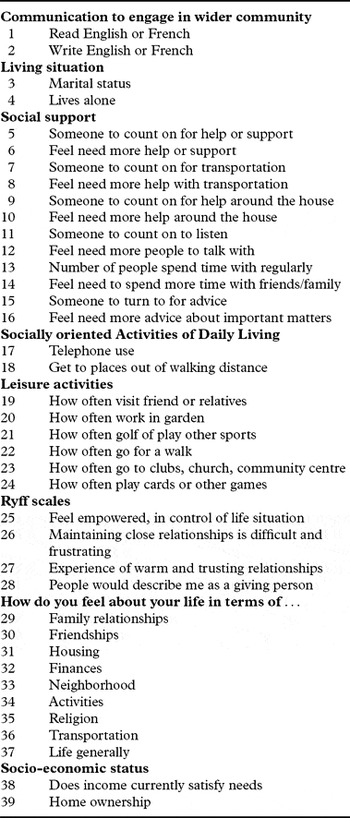
Social vulnerability was measured using a social vulnerability index which included 39 self-report social factors covering various domains of social circumstance, including socioeconomic status, social support, living situation, social engagement, and mastery. (Table 1) (Andrew et al., Reference Andrew, Mitnitski and Rockwood2008). Respondents were assigned a score between 0 and 1 on each of the potential social “deficits”: 0 if the deficit was absent and 1 if it was endorsed, with intermediate values applied for ordinal response categories. For example, on the item “do you ever feel you need more help or support”, the three possible responses of “never”, “sometimes” and “often” were assigned values of 0, 0.5 and 1, respectively. The sum of the deficit scores provided a social vulnerability index value for each individual with a maximum theoretical range of 0–39, in which higher scores indicated increased social vulnerability. For the purposes of this analysis, the sample was stratified into three tertiles of social vulnerability: high, intermediate, and low. This approach to measuring social vulnerability as an index of deficits builds on a similar approach to the operationalization of frailty (Mitnitski et al., Reference Mitnitski2005, Rockwood et al., Reference Rockwood, Andrew and Mitnitski2007) which has been multiply and independently cross-validated (Goggins et al., Reference Goggins, Woo, Sham and Ho2005; Kulminski et al., Reference Kulminski, Ukraintseva, Kulminskaya, Arbeev, Land and Yashin2008; Hastings et al., Reference Hastings, Purser, Johnson, Sloane and Whitson2008; Gu et al., Reference Gu, Dupre, Sautter, Zhu, Liu and Yi2009).
Canadian Study of Health and Aging social vulnerability index (Andrew et al., Reference Andrew, Mitnitski and Rockwood2008)

As previously published (Andrew et al., Reference Andrew, Mitnitski and Rockwood2008) but excluding education, which was treated as a stand-alone covariate in the present study due to its uniquely important association with performance on cognitive testing.
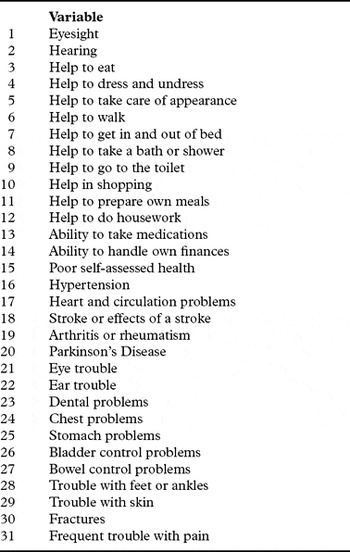
Here, frailty was operationalized as an index of 31 health deficits representing self-reported symptoms, health attitudes, illnesses, and impaired functions which were assigned scores in the 0–1 range as described above (Table 2). These deficit scores were then summed and divided by the total number of deficits considered (31) to generate a frailty index, such that a greater score corresponded to worse health status and increased frailty (Mitnitski et al., Reference Mitnitski, Song and Rockwood2004; Reference Mitnitski2005) The frailty index (FI) was dichotomized based on the previously published threshold: people with FI ≥ 0.25 were considered frail.
Canadian Study of Health and Aging frailty index (Mitnitski et al., Reference Mitnitski, Song and Rockwood2004)

As previously published (Andrew et al., Reference Andrew, Mitnitski and Rockwood2008) using the second wave of the CHSA, and excluding items in the social vulnerability index (living alone, telephone use, and ability to get places out of walking distance).
Educational attainment was reported by the participants as the number of years of formal schooling that they had completed. It was dichotomized such that <12 years of formal schooling represented low education.
The Mini-mental State Examination (MMSE) was used as a measure of general cognitive function. This is a widely used and well-validated screening instrument that tests orientation, concentration, memory, visuospatial ability and language (Folstein et al., Reference Folstein, Folstein and McHugh1975) and does not address the cognitive domains of prefrontal cortical functioning of interest in our analysis. The published cutoff of <24/30 was used to indicate cognitive impairment.
Depression was diagnosed clinically using DSM-III-R criteria.
Participants who were taking medications which might impair performance on neuropsychological testing (sedative hypnotics, anxiolytics, antipsychotics, opioids, and other psychoactive drugs) were identified using the CSHA's comprehensive data on medication use. For each participant, all prescription and non-prescription medications were recorded and coded according to the class of agent. All individuals who were taking one or more medication with the potential to impair test performance were identified in order to adjust the analyses for any confounding by medication use.
Statistical analyses
Performance on each of the neuropsychological tasks was tested in relation to the participant's tertile of social vulnerability using linear regression models adjusted for age, educational attainment, sex, frailty, general cognitive function (MMSE score), depression and medication use. Interaction terms were tested for all covariates. χ2 testing was used for proportions. All analyses were done using STATA 8.1 software.
Ethics
Ethical approval was obtained from the ethics committees of each of the 18 CSHA study centers. Written, informed consent for participation in the CSHA was obtained from each participant or proxy respondent.
Results
The mean age of participants was 81.9 years (SD 6.7); 56% of the sample were women. Participants had a mean educational attainment of 9.9 (SD 4.0) years, and 32.4% had completed ≥12 years of formal schooling. The mean frailty index was 0.19 (SD 0.11) which is below the established cut-off for frank frailty, with 28% of the sample being frankly frail, with a frailty index ≥0.25. The distribution of MMSE scores was skewed, with the tail trailing toward lower values. The median score was 26 (IQR 23–28) and 30.9% of the sample scored less than 24 points, the suggested cut-off for cognitive impairment. Higher social vulnerability was associated with female sex (p<0.001), increasing age (p<0.001), and frailty (p<0.001), but not with cognitive impairment on the MMSE (p = 0.3) or low education (p = 0.09). Women had more prevalent use of psychoactive medications (29% vs. 17% for men, p<0.001) but prevalence of depression did not differ between the sexes. Frail individuals were more likely to be taking psychoactive medications (35% vs. 17% for non-frail individuals, p<0.001).
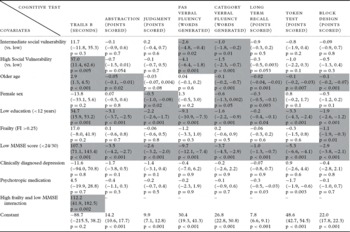
The most socially vulnerable group had worse performance on the FAS verbal fluency assessment, generating 4.1 fewer words (95% CI:1.8–6.4, p<0.001) than their counterparts in the least socially vulnerable group; the intermediate social vulnerability group generated 2.6 fewer words (95% CI:0.4–4.8, p = 0.02) (Table 3). Category verbal fluency (animal naming) was also associated with social vulnerability. The most socially vulnerable people generated 1.5 fewer animal names (95 CI: 0.7–2.3, p<0.001), while those with intermediate social vulnerability generated 1.0 fewer words (95% CI: 0.2–1.8, p = 0.01). The most socially vulnerable people also had impaired performance on the Trails B test, taking 37 (95% CI: 11–63) seconds longer to complete the task than the least vulnerable group (p = 0.005). These results were independent of age, educational attainment, sex, frailty, cognitive impairment on the MMSE, depression, and use of psychoactive medications. Social vulnerability was not associated with performance on the WAIS-R subtests of abstraction or judgment. Additionally, in these fully adjusted regression models, social vulnerability was not associated with performance on the Wechsler Memory Scale test of long-term memory, the WAIS-R Block Design subtest of constructional ability, or the Token Test of language comprehension.
Fully adjusted models of performance on the four prefrontal neuropsychological assessments by level of social vulnerability and adjusted for covariates. Statistically significant associations are shaded

In each of the full regression models which included all of the covariates, education and the MMSE score were independently strongly associated with performance on all of the cognitive tests, and contributed importantly to the final models. There was statistically significant interaction between frailty and MMSE score in the Trails B regression model, such that individuals who were both frail and cognitively impaired took 112 seconds longer to complete the task (95% CI: 42–183, p = 0.002). However, there was no other evidence of statistically significant interaction between these covariates in the remaining regression models.
Discussion
We found that the most socially vulnerable elderly people had lower performance on tests of executive function and verbal fluency, as measured by the Trails B test, FAS verbal fluency, and animal naming. This association was independent of age, educational attainment, sex, frailty, cognitive impairment as judged by the MMSE, depression, and use of psychoactive medications. However, performance on the WAIS-R Comprehension and Abstraction subtests, which assesses common sense judgment and abstract thinking, were not associated with social vulnerability. Tests of other domains of cognition (long-term memory, constructional ability, and language comprehension) were not associated with social vulnerability.
Educational attainment is strongly associated with performance on the tests of prefrontal systems function used in this study and age is commonly associated as well (Strauss et al., Reference Strauss, Sherman and Spreen2006). Thus, our finding that socially vulnerable people have worse performance on these tests, independent of educational attainment and age, is important. Performance on the Trails B and WAIS-R abstraction tasks declined with age, as did scores for long-term recall, language comprehension and constructional abilities (Table 3). The lack of statistically significant association between age and FAS verbal fluency may reflect the relatively restricted age range (70+ years) of the sample. Similarly, as Table 3 illustrates, both education and MMSE independently influenced performance on each of the cognitive tests. Despite this, socially vulnerable people had worse performance on these tests of executive function and verbal fluency, even when cognitive impairment on the MMSE was accounted for. While the MMSE has been criticized as being a suboptimal cognitive screening instrument in some respects (Strauss et al., Reference Strauss, Sherman and Spreen2006), we chose it in part for the reason that its relatively poor assessment of prefrontal cognitive functions allowed for adjustment of the presence of general cognitive impairment without “adjusting away” the primary association being considered. Of course, it remains possible that there are additional confounders that we have not taken into account in our models, although by also adjusting for sex, and frailty (a global measure of health and vulnerability), depression and medication use we have aimed to reduce this risk.
A statistically significant interaction between frailty and prefrontal cognitive test performance was identified for only one of the tasks, the Trails B. Those who were both frail and had general cognitive impairment on the MMSE performed much more slowly on this task, by an average of 112 seconds. This interaction was not evident for any of the other tests but is in keeping with the combined physical and cognitive elements of the Trails B. Specifically, Trails B is a timed test requiring efficient ocular motor scanning and manual dexterity in addition to its cognitive requirements of sequencing, divided attention and response alternation.
Our results must be interpreted with caution since our study was cross-sectional, and thus no assertions can be made regarding causation. Nevertheless, the association of social vulnerability with executive dysfunction and reduced verbal fluency in our sample highlights the importance of identifying patients with prefrontal cognitive impairment who present to clinical settings, particularly given that social vulnerability is associated with increased risk of mortality and cognitive impairment (Andrew et al., Reference Andrew, Mitnitski and Rockwood2008; Andrew and Rockwood, Reference Andrew and Rockwood2010). Paying particular attention to the social circumstances of such patients may prove beneficial. Additionally, those with prefrontal cognitive impairment may have difficulty participating in interventions (e.g. group activities) to reduce social vulnerability, and this should be borne in mind when such programs are designed and implemented. Our study may also be limited in that social vulnerability was based on self-report, and is thus not an “objective measure”. It seems likely, however, that given the subjective nature of a number of the elements used in this measure (such as mastery and perceived adequacy of social supports), self-perception of social vulnerability would be an important problem even in the absence of more objectively measured vulnerability.
To aid interpretation of our models, we dichotomized MMSE scores, educational attainment, and frailty. In reality, these factors show continuous distribution which is likely reflective of a clinically relevant gradient. Reassuringly, the results of “sensitivity analysis” regression models which treated these variables as continuous were not materially different from those using dichotomized variables based on the clinically meaningful cut-offs presented above.
The clinical diagnosis of depression is a strength of this study; however, because the CSHA was designed to focus on dementia, participants who had both depression and dementia would have been given a study diagnosis of dementia, likely leading to under-diagnosis of depression in those with co-existing dementia. However, individuals with more profound cognitive impairment (screening 3MS <50) were not subjected to the full battery of neuropsychological tests, and so they have been necessarily excluded from the present analyses.
Drugs that cause psychomotor slowing might be expected to affect timed tests disproportionately, including tests of pre-frontal cortical function such as Trails B and verbal fluency tests. However, we accounted for this possible confounder by adjusting our analyses for use of medications which may impair performance on these tests. The CSHA collected detailed medications lists for all participants in our sample, so it is unlikely that participants would have been misclassified on this variable (Rockwood et al., Reference Rockwood, McDowell and Wolfson2001).
Our study also has certain strengths in that the sample was representative of community-dwelling older people living in Canada and participants underwent standardized assessments by trained test administrators. The properties of our measures of frailty and social vulnerability have been previously studied, replicated and validated (Mitnitski et al., Reference Mitnitski, Song and Rockwood2004; Reference Mitnitski2005; Andrew et al., Reference Andrew, Mitnitski and Rockwood2008)
Impaired prefrontal cortex functioning has previously been identified in clinical samples of individuals with vascular cognitive impairment (Sachdev et al., Reference Sachdev2004), alcoholism (Deckel, Reference Deckel1999), and schizophrenia (Legendre Ropacki and Perry, Reference Legendre Ropacki, Perry, Miller and Cummings2007) who may (in the case of people with schizophrenia and problem drinking) be more socially vulnerable than those without these conditions. However, to our knowledge this is the first population-based study of the association between prefrontal cortical function and social vulnerability in elderly people.
Neuropsychological evaluation of prefrontal lobe functioning is complex (Stuss and Benson, Reference Stuss and Benson1984; Stuss, Reference Stuss, Miller and Cummings2007) and impaired performance on tests that purport to assess so-called “executive” abilities can arise for many reasons. We do not claim that the neuropsychological tests examined here represent a definitive test battery for prefrontal cortical function; rather, they are widely used tasks in clinical practice that are understood to be influenced at least in part by prefrontal lobe function.
It is interesting to note that the ability to organize verbal output rapidly, as measured by the FAS verbal fluency task, showed the strongest and most graded association with social vulnerability in our sample. Category verbal fluency, which also draws on executive functions, but which does not require the same degree of effort in organizing and switching between search strategies, was also diminished in those who were socially vulnerable. Perhaps expressive language abilities are particularly vital to social engagement such that it is those neuropsychological tests that reflect both “executive” and expressive language abilities that show the strongest associations with social vulnerability. Clearly, the various functions of the prefrontal cortex may have different implications for social function and social vulnerability but our cross-sectional design does not allow the direction of causation to be determined. Moreover, the association between social vulnerability and lower performance on tests of executive functions and verbal fluency is likely to be complex and bidirectional. It is possible, for example, that people with difficulties in language-based functions, such as verbal expressive difficulties, may withdraw from social activities and contact. On the other hand, those with social disinhibition or challenging deportment may offend their peers and be socially excluded as a result. Those who are socially disengaged may even lose the opportunities necessary to maintain their cognitive skills, thus resulting in poorer performance on tests of these abilities. Regardless of the direction of the causal relationship, our finding that social vulnerability is associated with impaired performance on tests of prefrontal cortical function in a representative sample of elderly persons is noteworthy, and illustrates the need for further inquiry in this area.
Conflict of interest
None.
Description of authors' roles
M. K. Andrew and K. Rockwood conceived the study. M. K. Andrew performed the analyses and wrote the initial drafts of the paper. J. D. Fisk contributed to the analyses and to interpretation of results. All authors contributed to revisions to the paper. K. Rockwood was a Principal Investigator in the CSHA and holds the data on-site.
Acknowledgments
This analysis was supported by the Canadian Institutes for Health Research (CIHR) grant MOP 62823. The data reported in this article were collected as part of the Canadian Study of Health and Aging. The core study was funded by the Seniors’ Independence Research Program, through the National Health Research and Development Program (project no. 6606-3954-MC(S)). Melissa Andrew was supported by a CIHR Clinical Research Initiative Fellowship and by a Killam Scholarship. Kenneth Rockwood receives career support from the Dalhousie Medical Research Foundation as Kathryn Allen Weldon Professor of Alzheimer Research. The sponsors had no input into the analyses, and Professor Rockwood holds a copy of and has full access to the CSHA dataset at Dalhousie University.