

Cancer is a disease marked by genetic and epigenetic instability. Although the role of heritable constitutive and acquired genetic mutation in neoplasia is well documented, less is understood about epigenetic changes in cancer. In the past decade, nuclear factors such as nuclear architecture (Ref. Reference Cremer and Cremer1), higher-order chromatin structure (Ref. Reference Schoenfelder, Clay and Fraser2), post-translational histone modifications (Ref. Reference Kouzarides3) and DNA methylation (Ref. Reference Jones and Baylin4) have been identified as components of the epigenome. However, the extent to which these factors are indeed independent of DNA sequence should be reappraised. For example, DNA methylation occurs in the context of CpG dinucleotides, heterochromatin is often associated with DNA repeat elements, and transcription factors bind specific sequence motifs (Ref. Reference Filion5). It is now also known that noncoding RNA plays a sequence-specific role in regulating gene expression (Ref. Reference Rinn6). In the study of DNA sequence and epigenetic interactions, it is useful to consider genomic imprinting, where two homologous alleles have similar – if not identical – DNA sequences yet each allele maintains its parent-of-origin epigenetic mark. The importance of this mechanism for the regulation of gene dosage is not fully understood, but several imprinted gene products function within signalling pathways that regulate early fetal growth. These pathways also play a role in cancer progression.
Here we first review the molecular mechanisms of imprinted gene regulation with regard to epigenetic predisposition to cancer, and then discuss acquired epigenetic changes either as a result of cancer or as an early event in neoplasia. In addition, we summarise the signalling pathways that could be affected by dosage changes of imprinted genes and consider future clinical applications of potential epigenetic therapies.
Parent-of-origin effects and increased cancer risk
The most extreme parent-of-origin effect is observed in uniparental embryos where the diploid genetic information within the embryo is of one parental origin and all imprinted genes are expressed at abnormal levels.
In parthenogenesis, arising from the spontaneous activation of oocytes, the genetic information is entirely maternal in origin. The resulting ovarian teratomas are a neoplastic mix of differentiated mature tissue from all three germ-cell layers, but lack any extra-embryonic tissue (Ref. Reference Varmuza and Mann7). Ovarian teratomas are thought to have been present at birth and can be subclassified into two groups: mature teratomas, which are present in women of childbearing age and are usually benign and successfully removed by surgery; and immature teratomas, which are rare, are present in girls and younger women (under 18 years old), and contain neoplastic cells of an early developmental stage (Ref. Reference Daponte8).
Androgenetic conception, where the genetic material is entirely paternal in origin, occurs in about 1 in 1000 pregnancies. This results in a complete hydatidiform mole, which, in contrast to ovarian teratomas, contains solely extra-embryonic tissue and predominantly paternal imprints (Ref. Reference Cheung9). Hydatidiform moles either result in loss of the pregnancy or progress to choriocarcinoma, a unique malignant neoplasm composed of tissue of placental origin (Ref. Reference Cheung9).
Congenital loss of imprinting and cancer risk
The best-characterised association between cancer and an imprinted locus is the association of loss of imprinting (LOI) at the IGF2–H19 locus with Wilms tumour (WT; OMIM #194070). The locus at chromosome 11p15.5 contains the maternally expressed noncoding H19 gene and the paternally expressed insulin-like growth factor 2 (IGF2) gene. Congenital LOI at this locus, by mutation, epimutation (a mutation affecting epigenetic marks but not the DNA sequence itself) or uniparental inheritance, results in either Silver–Russell syndrome (OMIM #180860) or Beckwith–Wiedemann syndrome (BWS; OMIM #130650) (Ref. Reference Weksberg, Shuman and Beckwith10). Children with BWS and biallelic (increased) IGF2 expression have an increased risk of developing childhood cancers of about 600 times that of the general population. BWS individuals are susceptible to Wilms tumour and hepatoblastoma (and to a lesser extent to adrenocortical carcinoma, neuroblastoma and rhabdomyosarcoma) (Ref. Reference Engel11).
LOI has also been detected at the Wilms tumour locus (WT1) at 11p13, affecting expression of the transcripts WT1-AS and AWT1 in some Wilms tumour patients. The relationship between LOI at 11p13 and 11p15 was recently examined with regard to the timing of LOI, and it was found that LOI at 11p13 was independent of the imprinted state at 11p15 and also slightly more frequent (Ref. Reference Brown12).
Other examples of congenital syndromes that show a predisposition to cancer and involve imprinted genes include McCune–Albright syndrome (MAS; OMIM #174800) and Prader–Willi syndrome (PWS; OMIM #176270). MAS involves imprinting changes at the GNAS locus 20q13.2, and shows increased susceptibility to thyroid cancer, osteosarcoma, skin cancer and neurofibromatosis (Ref. Reference Murrell13). In PWS, patients with altered imprinting at the 15q11–13 locus have an increased risk of developing myeloid leukaemias (Ref. Reference Davies14); however, it is uncertain whether the increased risk is due to a gene in the imprinted locus, or secondary and linked to symptoms of PWS such as obesity.
Imprinting of RB1 and cancer
The parent-of-origin-specific inheritance of retinoblastoma susceptibility has been observed for two decades, but imprinting at this locus was demonstrated only recently (Ref. Reference Kanber15). Previous observations of cytogenetic deletions at the paternal RB1 (retinoblastoma 1) allele that associated with sporadic osteosarcoma (Ref. Reference Toguchida16), and sporadic cases of RB1 mutations present on the paternally inherited allele, hinted at a parent-of-origin effect of the RB1 gene (Ref. Reference Kato17). Paradoxically, the presentation of retinoblastoma in children with loss of the maternal allele of RB1 was one year earlier than in children with loss of the paternal allele of RB1 (Ref. Reference Schuler18). A splice mutation within the RB1 gene that results in a truncated protein led to a different susceptibility to cancer that was dependent on the parental origin of the mutation: when the mutation was inherited from the mother, 12% of the offspring had retinoblastoma; in contrast, when the mutation was inherited from the father, 75% of the offspring had retinoblastoma (Ref. Reference Kanber15). This evidence further suggested imprinting of RB1, but analysis of the full-length RB1 transcript showed it was not imprinted. It was only after a genome-wide analysis of a patient with a hypomethylation syndrome that a novel promoter regulating an RB1 transcript expressed with a paternal bias was uncovered (Ref. Reference Kanber15). The precise effect that the presence of this imprinted transcript has on the regulation of the full-length RB1 transcript is still to be elucidated.
Parent-of-origin inheritance of cancer susceptibility/risk alleles
It is now increasingly evident that an imbalance in imprinted gene dosage associates with cancer susceptibility. Recent work has shown how single-nucleotide polymorphism (SNP) variants within imprinted loci also associate with parent-of-origin susceptibility to cancer (Ref. Reference Kong19). Basal cell carcinoma and breast cancer have associated SNP variants that show a parent-of-origin-dependent risk versus protection feature. The SNP rs157935 associated with basal cell carcinoma maps to the imprinted MEST (mesoderm-specific transcript) gene cluster on chromosome 7, and the SNP rs3817198 associated with breast cancer maps to chromosome 11 within the imprinted IGF2–H19 locus. In these cases, inheritance of the ‘C’ allele from the mother is protective; however, when it is passed through the father, it increases susceptibility to cancer. This might be because the SNPs that are in linkage disequilibrium with the marker SNP have a parent-of-origin-specific regulatory role within the region, or map within an expressed region, resulting in different proteins. This work was limited to a relatively small sample set and a larger sample set might show more SNP variants with parent-of-origin-specific risk. It will be interesting to see whether SNP data together with DNA methylation data will show further associations with cancer risk.
Comparison of epimutations in cancer and congenital syndromes
It was previously assumed that epimutations that lead to congenital syndromes with cancer predisposition are the same as those observed in comparable nonsyndromic cancer; however, we have found that this is not the case at the IGF2–H19 locus. The epimutations observed in BWS patients that lead to Wilms tumour are hypermethylation at the imprinting control region (ICR; explained below) located upstream of the H19 promoter, and hypermethylation of IGF2 in the differentially methylated region 0 (DMR0) within the upstream promoters (Ref. Reference Murrell20). This results in LOI, and thus overexpression of IGF2. Interestingly, in many nonsyndromic Wilms tumour patients, the ICR is also hypermethylated, suggesting that in Wilms tumour this epimutation is an early event. However, cancer cells acquire additional DNA methylation defects, and in most Wilms tumour patients DNA hypomethylation at IGF2 DMR0 is also observed, indicating that DNA methylation changes at the IGF2–H19 locus differ between congenital defects and the associated cancer (Ref. Reference Murrell20).
Acquired epigenetic changes in cancer and loss of imprinting
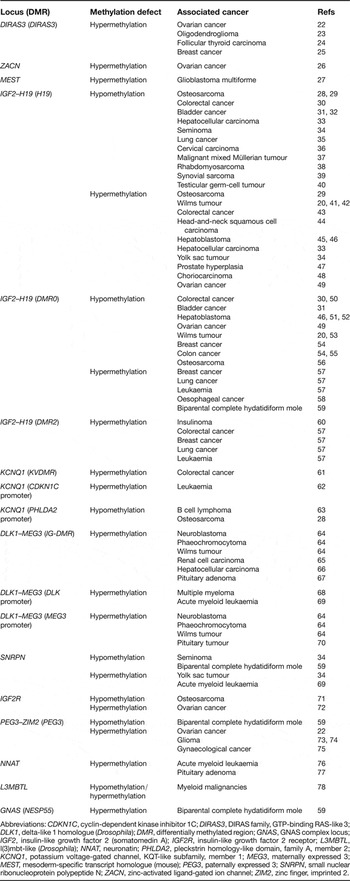
Imprinted genes typically contain DNA sequences with differential chromatin architectures termed differentially methylated regions (DMRs) (Ref. Reference Edwards and Ferguson-Smith21). The DMRs that are established in the germline (termed germline DMRs) are resistant to epigenetic modification throughout somatic development. Some germline DMRs are known as ICRs because they regulate several loci within imprinted gene domains. Additional DMRs within imprinted loci appear more plastic and their chromatin signatures are acquired after fertilisation, often in a tissue-specific manner; these are termed somatic DMRs. Nevertheless, DNA methylation is remarkably stable at imprinted genes during development and cell differentiation, withstanding global epigenetic reprogramming events. The level of DNA methylation at imprinted loci is therefore a potential marker of a cell's overall epigenetic stability. Indeed, aberrant DNA methylation at one or more DMRs at imprinted loci has been reported in many cancers (Table 1).
Aberrant DNA methylation at DMRs, and associated cancers

Abbreviations: CDKN1C, cyclin-dependent kinase inhibitor 1C; DIRAS3, DIRAS family, GTP-binding RAS-like 3; DLK1, delta-like 1 homologue (Drosophila); DMR, differentially methylated region; GNAS, GNAS complex locus; IGF2, insulin-like growth factor 2 (somatomedin A); IGF2R, insulin-like growth factor 2 receptor; L3MBTL, l(3)mbt-like (Drosophila); NNAT, neuronatin; PHLDA2, pleckstrin homology-like domain, family A, member 2; KCNQ1, potassium voltage-gated channel, KQT-like subfamily, member 1; MEG3, maternally expressed 3; MEST, mesoderm-specific transcript homologue (mouse); PEG3, paternally expressed 3; SNRPN, small nuclear ribonucleoprotein polypeptide N; ZACN, zinc-activated ligand-gated ion channel; ZIM2, zinc finger, imprinted 2.
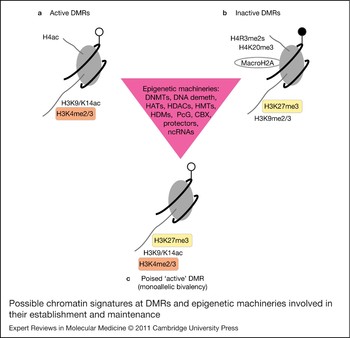
In addition to DNA methylation, differential histone post-translational modifications are associated with DMRs (Ref. Reference Kacem and Feil79). In general, active alleles have no DNA methylation and are enriched for di- and trimethylation of histone H3 lysine 4 (H3K4me2/3) and acetylation of H3 lysine 9 (H3K9ac) at the DMRs (Fig. 1). Inactive alleles contain methylated CpGs and also display ‘heterochromatic’ histone marks such as trimethylation of H3 lysine 9 (H3K9me3), H3 lysine 27 (H3K27me3) and H4 lysine 20 (H4K20me3) as well as methylation of H2A/H4 arginine 3 (H2A/H4R3me) at the DMRs (Ref. Reference Kacem and Feil79). How such chromatin signatures can specifically attract regulatory complexes, determine chromatin architectures and influence transcriptional output, as well as their behaviour in tumourigenesis, is discussed further below.
Possible chromatin signatures at DMRs and epigenetic machineries involved in their establishment and maintenance. Chromatin signatures are shown on a nucleosome represented as DNA wound around a histone core with protruding histone tails. (a) Active DMRs contain unmethylated CpGs (open lollipop on DNA) and can be enriched for active marks in histone H3 and H4 tails (such as H3K4me2/3, H3K9/K14ac and H4ac). (b) Inactive DMRs contain methylated DNA (filled lollipop) and can be enriched for repressive marks in histone H3 and H4 tails (such as H3K9me2/3, H3K27me3, H4R3me2s and H4K20me3). The histone variant macroH2A has also been detected at inactive/DNA-methylated DMRs. (c) Poised ‘active’ DMRs display monoallelic bivalency where active (H3K4me2/3) and repressive (H3K27me3) marks coexist with unmethylated CpGs. Epigenetic machineries include DNMTs, DNA-demethylating activities, HATs, HDACs, HMTs, HDMs, PcG, CBX, protectors [such as DPPA3 (PGC7/Stella), CTCF and MBD3] and ncRNAs (noncoding RNA). Abbreviations: CBX, chromobox proteins; DMR, differentially methylated region; DNMT, DNA methyltransferase; HAT, histone acetyltransferase; HDAC, histone deacetylase; HDM, histone demethylase; HMT, histone methyltransferase; PcG, polycomb group proteins.

In embryonic stem cells (ES cells), lineage-specific genes are repressed but kept in a poised state, ready for activity, by the coexistence of active and repressive modifications (Ref. Reference Azuara80). This type of chromatin signature is referred to as a ‘bivalent’ state. Bivalency for active (H3K4me3) and repressive (H3K27me3) marks has been observed for several DMRs (Refs Reference Monk81, Reference Sanz82) (Fig. 1). At these DMRs, the bivalent mark is present on one allele only (monoallelic bivalency), and the bivalent signatures become monovalent (H3K27me3 is lost) on tissue specification to allow activity of that allele. Furthermore, analysis of genome-wide datasets has shown that several DMRs (including all ICRs) display a trimethyl mark (H3K4me3–H3K9me3–H4K20me3) (Ref. Reference McEwen and Ferguson-Smith83). Interestingly, this analysis also showed that the transcriptional start sites of imprinted genes can be differentially marked, depending on the presence of a DMR at their promoters: H3K9me3 and H4K20me3 are detected only at the transcriptional start sites of imprinted genes with promoter DMRs, whereas H3K4me3 and H3K27me3 can be detected at the start sites of imprinted genes with or without promoter DMRs (Ref. Reference McEwen and Ferguson-Smith83). This distinction between promoter and nonpromoter DMRs is relevant to imprinting control in tumourigenesis because promoter CpG islands become hypermethylated in cancers whereas other regions of the genome lose DNA methylation (Refs Reference Feinberg and Vogelstein84, Reference Ito54).
DNA methylation
Imprint acquisition and maintenance are regulated processes involving factors that attract, prevent and remove DNA methylation (Fig. 1). DNA methylation is placed in mammalian genomes by the DNA methyltransferases (DNMTs), which transfer methyl groups from S-adenosyl methionine onto cytidines of CpG pairs in DNA. Maintenance of DNA methylation is through DNMT1, which recognises hemimethylated DNA (Ref. Reference Fatemi85) and transmits DNA methylation patterns to daughter cells. De novo methylation in germ cells is carried out by DNMT3A and DNMT3B (Ref. Reference Weaver, Susiarjo and Bartolomei86). All the DNMTs can recognise DNA sequences, but are also brought to various loci by factors with affinity to specific DNA sequences or chromatin states. Recently, the KRAB zinc finger protein ZFP57 was shown to have a role in the establishment and somatic maintenance of some imprinted regions in the mouse (Ref. Reference Li87). In humans, mutations in ZFP57 lead to loss of methylation at several maternally methylated imprinted genes (Ref. Reference Mackay88). In addition, factors can protect imprints from losing DNA methylation: premature demethylation of the maternal genome is observed in mouse zygotes lacking DPPA3 (PGC7/Stella). The global demethylation is accompanied by loss of DNA methylation at some imprinted loci (the paternally expressed genes Peg1, Peg3, Peg5 and Peg10) as well as at the intracisternal A particle repetitive elements (Ref. Reference Nakamura89). Other factors might protect from gain of DNA methylation; for example, the CCCTC transcription factor (CTCF) protects the H19 ICR (Ref. Reference Schoenherr, Levorse and Tilghman90). The DNMTs are often overexpressed in cancers and have been shown to cooperate to silence genes in mouse models and human cancer cells to promote tumourigenesis with concomitant LOI effects (Ref. Reference Rhee91).
Global or local levels of DNA methylation might also be regulated by DNA-demethylating activities, which are achieved through base-excision repair pathways or other presently unknown mechanisms involving elongator complex components (Ref. Reference Wu and Zhang92). Surprisingly, base-excision repair pathway component MBD4 has been shown to be reduced in colorectal carcinogenesis (Ref. Reference Lucci-Cordisco and Neri93). Changes in DNA methylation patterns in cancer cells might also be a reflection of changes in the levels of hydroxymethylcytosine, a modification that might affect the binding of methyl-binding domain (MBD) proteins and is implicated in embryonic development (Ref. Reference Tahiliani94).
Histone H3 lysine 27 methylation
The polycomb group (PcG) proteins are repressors that regulate many cellular and epigenetic processes (Ref. Reference Sparmann and van Lohuizen95), and form two major multiprotein complexes named polycomb repressive complex-1 and -2 (PRC1 and PRC2) (Ref. Reference Simon and Kingston96). PRC2 is a smaller complex containing the three core proteins SUZ12, EED and EZH2, and EZH2 is the catalytic subunit that trimethylates H3K27. This modification serves as a docking site for PRC1 recruitment (Refs Reference Cao97, Reference Schwartz and Pirrotta98). EED was the first PcG protein shown to have a role in regulating imprinting of some imprinted genes (Ref. Reference Wang99). The PRC1 component RING1B (RNF2) can also regulate imprinted gene expression by histone H2A lysine 119 ubiquitination (Refs Reference Pandey100, Reference Terranova101). Notably, the PcG and TrxG (Trithorax group) proteins interact with, and are targeted to, imprinted and other loci by noncoding RNAs (ncRNAs; discussed below) (Refs Reference Redrup102, Reference Bracken and Helin103). H3K27 demethylases might also control the levels of PcG complexes at target loci by removing the H3K27 methylation mark (Ref. Reference Pasini104).
Loci targeted by PcG are prone to aberrant DNA methylation in cancer (Ref. Reference Ohm105), probably as a result of the physical association between PcG proteins and DNMTs (Ref. Reference Vire106). Interestingly, the formation of long-range chromatin interactions has been suggested as one mechanism of PcG-mediated and DNA-methylation-associated gene silencing (Ref. Reference Tiwari107).
Histone H3 lysine 9 methylation
Other repressor complexes are brought to genes by H3K9 methylation, which is catalysed by the SUV39H1/2 and EHMT2 (G9a) enzymes. Recognition of this histone modification, by chromobox (CBX)-containing proteins for example, can recruit DNA methylation to genomic loci (Ref. Reference Smallwood108). Furthermore, G9a itself can interact with the DNA methyltransferase DNMT1 (Ref. Reference Esteve109). The precise mechanisms for the control of DNA methylation by histone methylation are nevertheless not fully understood, and in many instances H3K9 methylation and DNA methylation regulate gene expression and genomic imprinting independently of each other (Refs Reference Tachibana110, Reference Wagschal111). G9a, as is the case for PcG proteins, can be targeted to loci by ncRNA (Ref. Reference Nagano112). G9a might also be targeted to other loci through interaction with the WIZ zinc finger protein (Ref. Reference Ueda113). Recently, G9a has been shown to methylate, and perhaps inactivate, p53 protein (TP53), and has been found to be overexpressed in many cancers (Ref. Reference Huang114). The SUV39H methyltransferases do not appear to control imprinted genes normally (Ref. Reference Pannetier115). However, SUV39Hs associate with cell cycle regulators, including RB1 (Ref. Reference Nielsen116), PcG proteins (Ref. Reference Sewalt117) and SMADs (Ref. Reference Frontelo118), and absence of SUV39H leads to chromosome mis-segregation defects and lymphomas in mice (Ref. Reference Peters119).
Histone H3 lysine 4 methylation
Currently, the enzyme that methylates H3K4 at imprinted loci is unknown. The mixed lineage leukaemia (MLL) factors are K4 dimethyl transferases. More than 40 MLL1 translocations have been found in human cancers (Ref. Reference Ayton and Cleary120). Intriguingly, these translocations lack the C-terminal SET domain, rendering MLL1 fusions unable to methylate substrates. However, MLL1 complexes might be large, and their associated factors can also methylate H3K4 as well as acetylate, deacetylate and remodel nucleosomes (Ref. Reference Patel121). Other H3K4 methyltransferases can potentially affect imprinted genes indirectly by methylating other regulatory proteins – for example, SETD7 (or KMT7, an H3K4 monomethyl transferase) has been shown to be capable of methylating and destabilising DNMT1 (Ref. Reference Esteve122).
In oocytes, H3K4 methylation prevents the binding of DNMT3L, protecting against de novo methylation. Recently, a lysine 4 demethylase (KDM1B) was shown to be responsible for removing this H3K4 methylation and thus enabling DNMT3L-mediated methylation of DNA by DNMT3A (Ref. Reference Ciccone123).
Histone demethylases are deregulated in cancers (Ref. Reference Wang124). KDM1A (LSD1) is a histone H3K4 and H3K9 demethylase that is also required for the maintenance of global levels of DNA methylation in mouse ES cells, potentially through demethylation and stabilisation of DNMT1 but also by its association with the Mi-2/nucleosome remodelling and deacetylase (NuRD) complex (Ref. Reference Wang124), which contains the MBD3 protein (Ref. Reference Zhang125). MBD3 has been shown to be required for the maintenance of DNA methylation at the paternal allele of H19 in mouse embryos (Ref. Reference Reese126). Removal of H3K4 trimethylation is also regulated by the retinoblastoma binding protein 2 (or KDM5A; previously known as RBBP2) (Ref. Reference Klose127).
Histone H4 lysine 20 methylation
At imprinted loci, H4K20me3 is prominent at the DNA-methylated allele of most DMRs (Ref. Reference Pannetier115). H4K20me3 is catalysed by SUV420H1/2 (KMT5B/C) (Ref. Reference Schotta128), and absence of this enzyme in mouse embryonic fibroblasts leads to altered H4K20 and H3K9 methylation at the mouse H19 DMR and Kcnq1 DMR (previously known as KvDMR) (Ref. Reference Pannetier115). However, imprinted expression or DNA methylation was not affected in SUV420H-null mouse embryonic fibroblasts (Ref. Reference Pannetier115). The presence of H4K20me3 at imprinted regions, however, requires H4K20me1, which is placed by PR-SET7/SETD8 (KMT5A) (Refs Reference Pannetier115, Reference Nishioka129).
In cancers, global reduction of H4K20me3, and H4 lysine 16 acetylation, is associated with reduced DNA methylation at repetitive elements (Ref. Reference Fraga130). Moreover, loss of DNA methylation in breast cancer cells is associated with aberrant expression of SUV420H2, DNMT1 and the methyl-binding domain proteins MECP2 and MBD2 (Ref. Reference Tryndyak, Kovalchuk and Pogribny131). Furthermore, RB1 family members interact with SUV420H and DNMT1 (Ref. Reference Nielsen116), and two recently identified pRB-binding proteins (RBBP1 and RBBP1-like 1; now known as ARID4A and ARID4B, respectively) were shown to contribute to the maintenance of both H4K20me3 and H3K9me3 at the SNRPN ICR (Ref. Reference Wu, Tsai and Beaudet132). H4K20me3 thus uncovers a significant link between genomic imprinting and cancer.
Histone H4 arginine methylation
Histone arginine methylation might attract DNA methylation; compelling evidence has shown that symmetric H4 arginine 3 dimethylation (H4R3me2s) placed by PRMT5 is recognised by DNMT3A, which facilitates DNA methylation at the β-globin locus (Ref. Reference Zhao133). Whether such a mechanism operates at imprinted loci remains to be shown. BORIS (a cancer-testis gene product also known as CTCF-like, CTCFL) has been shown to interact with another arginine methyltransferase, PRMT7. This interaction, together with its capacity to bind DNA, appears to enable BORIS to recruit DNA methylation and ‘heterochromatin’ to the H19 DMR in the paternal germline (Ref. Reference Jelinic, Stehle and Shaw134). The role of BORIS in normal development and cancer is still poorly understood. BORIS has identical zinc fingers to CTCF and should theoretically bind to the same consensus sequences as CTCF (for a recent review, see Ref. Reference Ohlsson, Lobanenkov and Klenova135). Unlike CTCF, BORIS is able to bind to methylated DNA sequences (Ref. Reference Nguyen136).
Histone variants H2A.Z and macroH2A
Histone variants have also been shown to be important for cancer development and for genomic imprinting. H2A.Z in yeast prevents the binding of silencers, and in plants H2A.Z protects genes from DNA methylation (Ref. Reference Zilberman137). Genome-wide analyses have shown that H2A.Z is present in close proximity to transcriptional start sites of active genes, or start sites with bivalent chromatin signatures, indicative of a poised state that might facilitate subsequent activation (Ref. Reference Barski138). Interestingly, H2A.Z colocalises with H3K4me1 and H3K4me3 at putative enhancer/insulator elements also bound by CTCF (Ref. Reference Barski138), reminiscent of some DMRs/ICRs. Nevertheless, it remains to be seen whether H2A.Z specifically marks ICRs.
The variant histone macroH2A mainly associates with the heterochromatic regions of chromosomes and correlates with gene repression (Ref. Reference Costanzi139). MacroH2A has been shown to be enriched at the DNA-methylated allele within imprinted gene ICRs (Ref. Reference Choo140) and to be expressed at equal levels in female and male germ cells (Ref. Reference Rasmussen141). Interestingly, macroH2A has been shown to have an important role in senescence (Ref. Reference Zhang142), and has recently been shown to predict lung cancer recurrence (Ref. Reference Sporn143).
Higher-order chromatin architecture in imprinting and cancer
Recent work has indicated that at the human IGF2 locus, higher-order chromatin conformation has a role in regulating imprinted expression by forming loops between CTCF-binding sites within and surrounding the locus (Ref. Reference Nativio144). These allele-specific looping structures enable the CTCF-mediated insulation between the IGF2 and the H19 genes and their reciprocal access to enhancers downstream of the locus. Recent data suggest that in cancer cell lines with aberrant DNA methylation, the looping conformation is altered (Ref. Reference Vu, Nguyen and Hoffman145); however, it still remains to be determined how in some cancer cells the control of biallelic expression becomes independent of DNA methylation levels. Cohesin was recently shown to stabilise CTCF-mediated loops at IGF2 and other loci (Refs Reference Nativio144, Reference Hadjur146, Reference Mishiro147). Depletion of cohesin by small interfering RNA (siRNA) resulted in biallelic IGF2 expression without alteration of DNA methylation, suggesting that an aberrant looping conformation could theoretically have a role in decoupling DNA methylation and imprinted expression in cancer (Ref. Reference Nativio144).
Noncoding RNAs in imprinting and cancer
RNAs that do not code for proteins (ncRNAs) are novel functional elements capable of regulating gene expression and they modulate a wide range of disease phenotypes, including cancer. ncRNAs of more than 200 nucleotides are classified as long noncoding RNAs (lncRNAs); other shorter species of regulatory ncRNAs include microRNAs (miRNAs, ~22 nucleotides), siRNAs (~21–22 nucleotides), PIWI-interacting RNAs (piRNAs, ~26–30 nucleotides) and small nucleolar RNAs (snoRNAs, ~80–300 nucleotides) (Ref. Reference Taft148). With the exception of piRNAs, all other types of ncRNAs are present at the different imprinted loci, and can regulate gene expression in cis or in trans.
In cis
The archetypal example of cis-acting lncRNA is the Xist RNA, a 17 kb RNA that coats and inactivates genes on one of the two X chromosomes, and recently Tsix, a 40 kb RNA, has been shown to regulate Xist (for a recent review, see Ref. Reference Ng149). Cis-acting lncRNAs also operate at imprinted loci: Airn at the mouse Igf2r locus (Ref. Reference Sleutels, Zwart and Barlow150), Kcnq1ot1 at the mouse Kcnq1 locus (Ref. Reference Thakur151), Nespas at the mouse Gnas locus (Ref. Reference Williamson152) and Lncat_Ube3a-as at the mouse PWS–AS locus (Ref. Reference Le Meur153). These antisense transcripts arise from the unmethylated ICRs that regulate imprinted expression of neighbouring genes within the imprinted clusters (Refs Reference Peters and Robson154, Reference Latos and Barlow155). Functional studies of these ncRNAs indicate that they are capable of targeting repressor complexes (Ref. Reference Nagano112) and might be involved in generating polycomb repressive nuclear domains (or clouds) that constrain loci (Refs Reference Pandey100, Reference Terranova101, Reference Redrup102) as well as interfere with transcription-coupled events necessary for the adequate function of promoters or enhancers (Refs Reference Latos and Barlow155, Reference Wang156).
An intriguing aspect of imprinting in clusters is that the number of imprinted loci within a cluster differs between embryonic and extra-embryonic tissues, highlighting that different mechanisms, or combinations from those mentioned above, operate in the two tissue types (Ref. Reference Hudson157). These observations may be relevant to neoplasia where such mechanisms might also differ between normal/preneoplastic and neoplastic tissues. Interestingly, a lncRNA antisense to the CDKN2B (p15) tumour suppressor can regulate the chromatin and DNA methylation status of the p15 locus (Ref. Reference Yu158), and similar behaviour was observed for a lncRNA to the CDKN1A (p21) locus (Ref. Reference Morris159).
In trans
Effects in trans, where RNA molecules can alter the expression of a genes in a chromosome separate to the one that originates the RNAs, have been described for lncRNAs. Deep sequencing maps of sense–antisense transcript pairs that originate from repeat elements, transposons, pseudogenes or mRNAs from mouse oocytes and Drosophila somatic cells have shown that these are processed into large numbers of small RNAs that might have functions in epigenetic memory (Refs Reference Watanabe160, Reference Tam161). Indeed, chromatin signatures have highlighted genome-wide maps of large intergenic ncRNAs (lincRNAs) (Ref. Reference Guttman162) that can associate with chromatin-modifying complexes to affect gene expression in trans (Ref. Reference Khalil163). More-defined examples of trans effects include the HOTAIR, H19 and MEG3 ncRNAs. HOTAIR originates from the HOXC locus, but affects expression of HOXD loci (Ref. Reference Rinn6) as well as many additional loci involved in tumour progression and metastasis (Ref. Reference Gupta164). The imprinted H19 ncRNA is implicated as both a tumour suppressor and an oncogene by effects in trans (Refs Reference Yoshimizu165, Reference Tsang166). The MEG3 ncRNA that arises from the Delta-like homologue 1 (DLK1) imprinted region in human chromosome 14 activates p53 expression (Ref. Reference Zhou167), and reduced expression of MEG3 is associated with meningioma pathogenesis and progression (Ref. Reference Zhang168).
Many imprinted loci also contain miRNAs that can have profound trans effects on gene expression if LOI occurs. Deregulation of a single miRNA can substantially affect the proteome and mRNA status (Ref. Reference Baek169). The mouse Dlk1–Meg3 imprinted locus contains two clusters with over 40 miRNAs (Refs Reference Seitz170, Reference Glazov171), including miR-127, miR-136, miR-134 and miR-379. miR-127 can target the BCL6 proto-oncogene (Ref. Reference Saito172) and is implicated in cervical carcinomas (Ref. Reference Lee173), miR-136 is enriched in human leukaemic cells (Ref. Reference Yu174), and miR-134 and miR-379 affect sensitivity to anticancer agents in human small-cell lung cancer cells (Ref. Reference Guo175). The IGF2 and H19 loci contain miR-483 and miR-675, respectively: miR-483 is highly expressed in malignant mesothelioma (Ref. Reference Guled176) and is deregulated in a variety of primary tumours, including breast and colorectal cancers (Ref. Reference Veronese177); miR-675 can target RB in human colorectal cell lines and human colorectal cancer tissues (Ref. Reference Tsang166). miRNA-184 from the RASGRF1 locus, which is not imprinted in humans, is reduced on malignant glioma progression (Ref. Reference Malzkorn178) and overexpressed in squamous cell carcinoma of the tongue (Ref. Reference Wong179). Recently, epigenetic regulation of miR-184 in mouse cells by the MBD1 protein was shown to regulate the proliferation of adult neural stem cells through the targeting of NUMBL (a Notch pathway inhibitor) (Ref. Reference Liu180). For several of these, and other miRNAs within imprinted loci (see Ref. Reference Peters and Robson154), the imprinted state has not been fully characterised.
Signalling pathways, imprinting and cancer
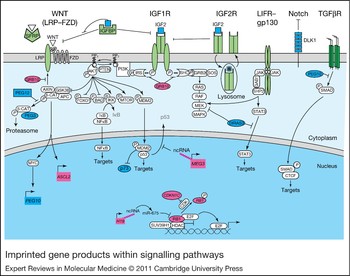
Several imprinted genes encode factors that regulate the activity of signalling cascades involved in diverse biological processes, including the control of cellular growth (Fig. 2). LOI, where the dose of an imprinted gene is doubled if the repressed allele becomes active, effectively alters the activity of the signalling cascade. LOI is primarily defined at the transcriptional level when the allelic contribution can be measured, and rarely is the dose quantified at the protein level. It is possible that biallelic transcription does not necessarily lead to increased protein level. It is also possible that increased transcription of the active allele – without LOI – leads to increased protein output. Very little is known about how deregulated signalling pathways affect chromatin and transcription in general, and imprinted genes in particular. It is clear, however, that imprinted genes are frequently associated with neoplasias where aberrant cell transduction signals are also present. Here we aim to place imprinted gene products in the context of signalling pathways.
Imprinted gene products within signalling pathways. Several signalling pathways are indicated, with receptors and other ligand-binding molecules shown in green. Imprinted gene products that behave as growth promoters are indicated as filled squares or rectangles and those that behave as growth suppressors as filled ovals. Pink and blue indicate maternal and paternal expression, respectively. Imprinted genes are represented by rectangles without a black border. For example, GRB10 is a maternally expressed tumour suppressor that inhibits WNT and IGF1R pathways whereas DIRAS3 is a paternally expressed tumour suppressor that inhibits Ras and STAT signalling. See text for more details. These pathways can control cellular processes such as metabolism (Ref. Reference Stubbs and Griffiths181), growth, differentiation and apoptosis (Ref. Reference Timp, Levchenko and Feinberg182), senescence and autophagy (Ref. Reference Young and Narita183). The circled P indicates phosphorylation. Lines with a broken end indicate a negative influence and lines with arrows indicate a positive influence on the pathway. Grey type (1κB, p53) indicates degradation. The full versions of most protein names are given in the text or can be found at http://www.genenames.org/. Selected abbreviations: β-CAT, β-catenin (CTNNB1); GRB10, growth-receptor-bound protein 10; IκB, inhibitor of κB; IGF1R, insulin-like growth factor 1 receptor; IKK, IκB kinase; MEK, mitogen-activated protein kinase kinase (MAP2K); miR, microRNA; ncRNA, noncodingRNA; NFκB, nuclear factor κB; p53, tumour protein p53 (TP53); PIP2, phosphatidyl inositol (3,4)-bisphosphate; PIP3, phosphatidyl inositol (3,4,5)-trisphosphate.

For example, the growth-receptor-bound protein 10 (GRB10) is a maternally expressed tumour suppressor that can inhibit WNT signalling in human cells by interfering with the binding of the intracellular signalling protein AXIN to the lipoprotein-receptor-related protein LRP6 (Ref. Reference Tezuka, Brown and Yanagawa184). The presence of GRB10 might therefore stabilise the AXIN–GSK3B–APC complex that phosphorylates and targets β-catenin for proteasome degradation. β-Catenin transport to the proteasome can also be facilitated by the paternally expressed tumour suppressor PEG3 (Ref. Reference Jiang185). In contrast, the product of the paternally expressed gene PEG12 might positively regulate WNT signalling (Ref. Reference Kobayashi186). The ASCL2 transcription factor is upregulated in colorectal adenocarcinomas and its imprinted mouse homologue is a direct target of β-catenin (Ref. Reference Jubb187).
Crosstalk between the WNT and IGF1 receptor (IGF1R) pathways is observed at the extracellular and intracellular levels. Recently, the insulin-like-growth-factor-binding protein 4 (IGFBP4) was shown to inhibit WNT signalling by directly binding to the membrane proteins FZD and LRP6 and preventing WNT3A ligand binding (Ref. Reference Zhu188). IGFs could sequester IGFBP4 to attenuate the inhibitory effect on the WNT pathway. Circulating levels of IGF2 can therefore regulate crosstalk between the WNT and IGF1R pathways. Circulating IGF2, the levels of which are also regulated by the IGF2 receptor (IGF2R), can trigger IGF1R or insulin receptor autophosphorylation and induce signals by the phosphoinositide 3-kinase (PI3K)–AKT or the Ras–MAPK (mitogen-activated protein kinase) pathways. GRB10 might inhibit both pathways by disrupting the physical interaction between IGF1R and the insulin receptor substrate (IRS) (Ref. Reference Wick189) or by blocking insulin-stimulated SHC phosphorylation (Ref. Reference Langlais190). This correlates well with growth phenotypes on deregulation of mouse Grb10 (Ref. Reference Charalambous191).
Crosstalk between the IGF1R and WNT pathways can also occur by inhibition of GSK3B phosphorylation, and enhanced stability of β-catenin, on IGF1 stimulation (Ref. Reference Playford192). In addition, the IGF1R–PI3K–AKT pathway controls a host of signalling molecules, including FOXO1, BAD, IκB kinase, MTOR and MDM2 (Ref. Reference Timp, Levchenko and Feinberg182). AKT-induced phosphorylation of MDM2 induces the degradation and nuclear export of p53 (Ref. Reference Wade, Wang and Wahl193). Inhibition of this pathway by GRB10 might therefore suppress tumourigenesis by stabilising p53. Furthermore, overexpression of MEG3, a ncRNA from the imprinted DLK1–MEG3–RTL1 human locus, results in downregulation of MDM2 and increased p53 stability (Ref. Reference Zhou167). TP73, a maternally expressed gene product and homologue of p53 (Ref. Reference Kaghad194), is also inhibited by MDM2, through competition for binding to the p300 co-activator (Ref. Reference Kim195).
DIRAS3 is present only in humans and is a paternally expressed tumour suppressor with homology to Ras. However, DIRAS3 can inhibit signalling by the Ras or PI3K pathways (Ref. Reference Yu196). DIRAS3 might also inhibit JAK–STAT-dependent signalling by competing with STAT3 for nuclear import or by inhibiting the binding of STAT3 to DNA (Refs Reference Nishimoto197, Reference Huang198).
The Notch pathway has been shown to regulate the PcG proto-oncogene BMI1 in colorectal tumours and to collaborate with PcG silencers to cause malignant tumours by epigenetic silencing of Rb in Drosophila (Ref. Reference Ferres-Marco199). Similarly, and despite its atypical nature, the product of the paternally expressed gene DLK1 is able to repress Notch signalling (Ref. Reference Bray200).
Transforming growth factor β (TGF-β/TGFB) signals are central to tumour progression and are transduced by SMAD complexes (Ref. Reference Ikushima and Miyazono201). Interestingly, SMADs can directly interact with CTCF and co-occupy the H19 ICR in an allele-specific manner (Ref. Reference Bergstrom202). Such targeting of SMAD regulatory complexes by CTCF implies that TGF-β signalling might have profound effects on epigenetic gene regulation. In addition, TGF-β signalling was shown to upregulate expression of the maternally expressed tumour suppressor CDKN1C, albeit without disrupting its imprinting (Ref. Reference Scandura203). TGF-β pathway activity can be inhibited in humans by the paternally expressed zinc finger protein PEG10, which binds and inhibits the TGF-β type 1 receptor ACVRL1 (ALK1) (Ref. Reference Lux204). PEG10 has also been shown to be a target of MYC (Ref. Reference Li205) and to regulate p53-mediated apoptotic response (Ref. Reference Okabe206).
The H19 ncRNA, as well as miR-675 derived from the H19 ncRNA, is overexpressed in colorectal cancer tissues and cell lines. Reporter assays and tissue analysis indicate that miR-675 targets RB1 (Ref. Reference Tsang166). Interestingly, the maternally expressed tumour suppressor CDKN1C is a cyclin-dependent kinase inhibitor that is potentially able to stabilise RB1 (Ref. Reference Zhang207). As discussed above, genomic imprinting of RB1 has recently been shown.
Outstanding questions and clinical implications
Genome-wide mapping of post-translational histone modifications in a variety of normal cells, high-throughput SNP association studies and genome-wide DNA methylation analyses have been the tools of the first decade of the new millennium. Refinement of such techniques to include single-cell analysis and designing studies to take parent-of-origin effects into consideration will highlight the influences of genetic background on monoallelic gene expression patterns (Ref. Reference Montgomery208) as well as the effects of the parental germline on disease outcomes (Ref. Reference Kong19).
The histone signatures that mark active and silent chromatin have recently converged upon cellular signalling cascades, and it is becoming apparent that post-translational histone modifications and chromatin structure can be influenced by kinase signalling pathways that phosphorylate serine or tyrosine residues on histones (Ref. Reference Dawson209). These studies pave the way for further understanding the effects of external stimuli on chromatin and responsive gene expression. It will be particularly interesting to see how ncRNAs are involved in recruiting epigenetic modifiers to specific target genes; such sequence-specific mechanisms will be powerful targets for future gene therapy (Ref. Reference Saito and Jones210).
So far, promising clinical trials currently based on an epigenetic therapy approach use a very limited number of compounds, with broad specificity (Ref. Reference Jones and Baylin4). Current small-molecule inhibitors to DNMTs include nucleoside analogues (5-azacitidine, decitabine and zebularine) that become incorporated into DNA/RNA and irreversibly bind to DNMTs, and can lead to DNA hypomethylation. Additionally, the covalent binding of the nucleoside analogues to DNMT might inhibit DNA and RNA polymerases, which can lead to DNA strand breaks and activation of apoptosis. Currently, azacyitidine and decitabine have both been approved by the US Food and Drug Administration (FDA) and have shown good clinical responses and overall survival benefit in patients with myelodysplastic syndrome. The limitations of nucleoside analogues are that they are pleiotropic and toxic. For this reason, the focus has shifted to non-nucleoside inhibitors of DNMT1 such as RG108, and hydrazine. Additionally, a DNMT1 antisense compound, MG98, has been investigated. However, clinical phase trials with MG98 have not been able to demonstrate any effects that could be linked to DNMT1 inhibition (Ref. Reference Klisovic211).
Histone deacetylase (HDAC) inhibitors and particularly hydroxamic acids such as trichostatin A and suberoyl anilide hydroxamic acid (SAHA, known as vorinostat or zolinza) have been successful as therapeutic agents in clinical trials. SAHA has received FDA approval for cutaneous T cell lymphoma-induced skin lesions (Ref. Reference Ptak and Petronis212). Several improvements to the design of HDAC and DMNT inhibitors are under way. There is an increasing interest in using epigenetic modulators in combination therapy (so as to sensitise tumours to cytotoxic reagents or radiation) or using DNMTs and HDAC inhibitors together to achieve gene reactivation. We look forward to the discovery and implementation of a wider, more comprehensive panel of compounds capable of specific inhibition of factors that regulate chromatin structures. In the meantime, it is essential to further identify and characterise epigenetic biomarkers. Epigenetic biomarkers not only provide an invaluable insight into the mechanisms underlying tumourigenesis but also aid in the diagnosis, prognosis and follow-up of therapeutic interventions.
Acknowledgements and funding
We thank Yoko Ito and Joanna Huddleston (Cancer Research UK, Cambridge, UK) for helpful discussions. We also thank the reviewers for their helpful comments. We sincerely apologise to authors whose work could not be acknowledged because of space constraints. This work was supported by The University of Cambridge, Cancer Research UK and Hutchison Whampoa Limited.