




No CrossRef data available.
Article contents
Atypical antipsychotics in the management of delirium: A review of the empirical literature
Published online by Cambridge University Press: 03 March 2006
Abstract
Objectives: To review the existing literature of atypical antipsychotics in the treatment of delirium and make recommendations regarding their use in the treatment of delirium.
Methods: I conducted a literature search in Pubmed, Psychlit, and Embase for studies using atypical antipsychotics in the treatment of delirium. In the absence of studies, case reports were used.
Results: Overall 13 studies examined the use of risperidone, olanzapine, and quetiapine, two cases were reported about ziprasidone, and no publication was found using aripiprazole in the treatment of delirium. Among the existing studies were retrospective and prospective, open label studies in addition to one with a double blind design using risperidone. Risperidone, olanzapine, and quetiapine may be all similarly effective in the treatment of delirium, whereas there may be limited efficacy in the use of olanzapine in the hypoactive subtype of delirium in elderly populations, which may generalize to the other atypical antipsychotics. The use of atypical antipsychotics in the treatment of delirium is safe and carries a low burden of side effects.
Significance of results: Although atypical antipsychotics are widely used in the treatment of delirium, well-designed studies do not exist. Among the existing studies, stronger data supports the use of risperidone and olanzapine, and also quetiapine may be considered in the treatment of delirium. Recommendations are made based on the existing data and literature. The need for well-designed studies to validate the use of atypical antipsychotics in the treatment of delirium continues.
Information
- Type
- REVIEW ARTICLE
- Information
- Copyright
- © 2005 Cambridge University Press
INTRODUCTION
Delirium is a neuropsychiatric disorder characterized by abrupt onset of disturbances of consciousness, attention, cognition, and perception that tend to fluctuate over the course of the day and usually have an underlying etiological, physiological factor (American Psychiatric Association, 1994).
Delirium is a common event in the course of hospitalization, also depending on the age of the patient and the severity of the illness. In a general hospital setting the occurrence of delirium in medically ill patients can range between 15% and 30%, in the hospitalized elderly between 10% to 40% (Bucht et al., 1999; Lipowski, 1987; Trzepacz et al., 1999), and in terminal illness the incidence of delirium can reach up to 85% (Breitbart & Strout, 2000; Massie et al., 1983). On admission already 14%–24% of elderly patients may be delirious and 6%–56% develop delirium in their course of hospitalization, which is associated with poor functional outcome. Furthermore, delirium increases morbidity and mortality as well as prolongs the hospitalization (Inouye, 1998). Prodromal symptoms or subclinical delirium often predate the onset of overt delirium, which usually lasts from less than 1 week to 2 months (Cole et al., 2003; Manos & Wu, 1997; Rockwood, 1993).
A final common pathway of delirium involving acetylcholine and dopamine has been postulated (Trzepacz, 1999, 2000). Additionally to cholinergic and dopaminergic transmission, also serotonergic, opiatergic, gabaergic, and glutamatergic transmission likely contribute to delirium (Koponen, 1999). Delirium is characterized by abnormal functioning in subcortical structures (Trzepacz et al., 1989), an increase or decrease in cerebral blood flow, and reduced cerebral blood flow in cerebral and subcortical structures (Lockwood et al., 1991; Doyle & Warden, 1996) that normalize with remission of the delirious state (Yokota et al., 2003).
Among the different scales used to measure delirium (Robertsson, 1999) the Delirium Rating Scale (DRS) (Trzepacz et al., 1988), its revised version DRS-R-98 (Trzepacz et al., 2001), and the Memorial Delirium Assessment Scale (MDAS) (Breitbart et al., 1997), particularly used and validated in cancer patients, provide the best measurement for delirium.
The standard approach to managing delirium includes identification and elimination of factors contributing to the delirium and pharmacological and nonpharmacological treatment interventions (Breitbart et al., 1996; Schwartz & Masand, 2002). The standard approach to the pharmacological treatment of delirium was using typical antipsychotics, foremost haloperidol (Breitbart et al., 1996; Conn & Lieff, 2001). The benefits of haloperidol (2.7 mg) usually appear in a day (Platt et al., 1994), but extrapyramidal symptoms (EPS) have been reported in up to 39% (Someya et al., 2001).
Atypical antipsychotics were introduced in the 1990s and have gained widespread use since then. EPS occur at higher antagonism (more than 80%) at the dopamine 2 (D2) receptor site, and atypical antipsychotics cause less EPS due to different mechanisms of action (Factor 2002). The prominent serotonin 2A antagonism, which increases dopamine release in the nigrostriatal system (Lieberman et al., 1998), and fast dissociation from the dopamine receptor, which does not constantly prevent dopaminergic transmission (Kapur & Seeman, 2001) and possibly specificity in the site of action, mainly limbic antagonism over nigrostriatal antagonism (Borison & Diamond, 1983), are considered to convey the advantage regarding low incidence of EPS. Miyamoto et al. (2005) provide a comprehensive review of the action and pharmacology of antipsychotics.
Schwartz and Masand (2002) reviewed the use of atypical antipsychotics in delirium, and included mostly case reports and retrospective studies. Since then a number of studies have been published and not been reviewed.
METHODS
We conducted a literature search through Pubmed, Psychlit, and Embase for the terms delirium, treatment, antipsychotics, and atypical antipsychotics, including the name of each individual atypical antipsychotic from 1996 to April 15, 2005, and included all medical publications that cited clinical trials or case reports of risperidone, olanzapine, quetiapine, ziprasidone, or aripiprazole in the treatment of delirium. The focus in this review is placed on the current studies; where there was a lack of studies, case reports are mentioned.
RESULTS
Overall 13 publications studied the use of risperidone, olanzapine, and quetiapine in the treatment of delirium. Among these, three studies used a retrospective design, nine were prospective and open label, and one study was double blinded. The use of ziprasidone in delirium was published in two case reports, and no publications were found on aripiprazole.
Risperidone
Risperidone, a benzisoxazol, acts primarily on serotonin 2a, dopamine D2, and alpha1 receptor sites, displays dose linear pharmacokinetics, and reaches steady state in humans within 24 h. Advantages of risperidone over haloperidol may include a faster onset of antipsychotic action and a lower incidence of EPS, although at higher doses risperidone can induce EPS as well (Ereshefsky & Lacombe, 1993; Grant & Fitton, 1994; Miyamoto et al., 2005).
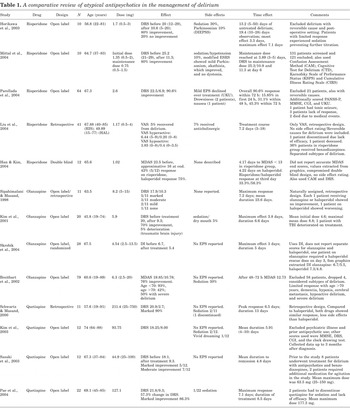
Studies examining the role of risperidone in the management of delirium are listed in Table 1. In a retrospective study Liu et al. (2004) analyzed 77 cases of delirium, out of which 41 were treated with risperidone and 36 with haloperidol. Both drugs showed efficacy in the treatment of hyperactive and hypoactive subtypes of delirium, and the patients treated with risperidone required less medication with anticholinergic agents for EPS. The average dose of risperidone was 1.17 mg; the range was 0.5 to 4 mg. The average age in the risperidone group was 67.9 years, which was higher than in the haloperidol groups (49.89 years). The mean scores of the hyperactive and hypoactive syndromes were assessed on a visual analogue scale, 6.44 and 3.85 before treatment and 0.2 and 0.4 after treatment. Ninety-five percent of the patients recovered from their delirium, one patient was switched to a different antipsychotic, and another patient died. The average treatment course was 7.2 days, and the majority of patients (74%) received 0.5–1 mg risperidone. No patient in the risperidone groups required rescue doses of haloperidol, 36% received additional benzodiazepines, and 3% received an anticholinergic. This study stresses the advantage of using an atypical antipsychotic in the light of a reduced need for anticholinergic agents, which may worsen the symptomatology of delirium (Liu et al., 2004).
A comparative review of atypical antipsychotics in the management of delirium

Three open label studies found risperidone to be effective in the treatment of delirium. Horikawa et al. (2003) conducted a small open study on 10 patients with delirium and was able to successfully treat 8 patients with an average of 1.7 mg risperidone. The 10 patients in the study had an average age of 56.8 years and the mean duration of delirium was 13.2 days. Prior to entering the study all patients were temporarily treated with haloperidol from 0.75 to 5 mg/d without improvement. The delirium measured with the DRS was 20.0 at baseline, subjects were started on 0.5 mg risperidone, and the dose was adjusted until either improvement or side effects occurred. Risperidone was continued until 1 week after the target score was reached, then discontinued. The average observation time was 19.4 days; the onset of any effect was 3.3 days; after 7.1 days the maximum effect was reached. The end DRS score was 10.6, which represents a 47% improvement over the baseline score. Fifty percent of the patients showed a marked improvement, 30% a mild improvement, and 20% failed to show improvement. The effective dose and duration of treatment were only from the patients that showed marked and moderate responses. Side effects were assessed using the Drug-Induced Extrapyramidal Symptoms Scale (DIEPPS). Three patients complained of sleepiness and one patient developed Parkinsonian symptoms at 3 mg risperidone, which was treated with biperiden. The patients who did not show any improvement were not further titrated, as they experienced sedation as a side effect at a dose of 1.5 mg risperidone. Both patients had severe illness with diagnoses of lung cancer/hepatoma and multiple organ failure.
Mittal et al. (2004) conducted a study in 10 patients with delirium over 6 days and achieved improvement in 80% on an average dose of 1.35 mg risperidone. The mean age of the patients was 64.7 years, delirium assessed with the DRS ranged from 21 to 32, the average DRS score was 25.2 before treatment, and the subjects had high ratings on delusional and abnormal psychomotor behavior. Patients were started on risperidone 1 mg divided into two doses, titrated on day 1 if necessitated by symptomatology. The dose from day 1 was continued until the DRS decreased to less than 12. Fifty percent of the day 1 dose was used as a maintenance dose after that; the maintenance dose was 0.5 to 1.5 mg risperidone. Two patients were not able to finish the study; on day 3 one patient experienced severe heart failure, bradycardia, and hypotension and another became lethargic until obtundation. Side effects measured by Extrapyramidal Symptom Rating Scale (ESRS) were low on day 1 when the patients received the higher doses and decreased until day 6. The main EPS was mild Parkinsonism; no prolongation in the QTc interval was noted. Two patients experienced sedation; one of them belonged to the group that was not able to finish the study. The Kamofsky Scale of Performance Status (KSPS) improved from 32 to 45.5, which overall represented a severely ill population, which required at least considerable assistance and medical care.
The study by Parellada et al. (2004) included 64 patients, treated over 7 days, and achieved a 90.6% improvement in DRS with an average of 2.6 mg risperidone. The mean age of the patients was 67.3 years. In 71.8% of the subjects the etiology of the delirium was presumed, and 31.2% had multiple etiologies of delirium. Some 95.8% of the patients were receiving active medical treatment and 26% took psychoactive substances that were kept at a fixed schedule. Risperidone was started at 2.5 mg for patients younger than 65 years and 1.25 mg for patients older than 65 years. Risperidone was given twice daily and the dose was adjusted to symptom prevalence. The average dose was 2.6 mg risperidone on day 3, which was reduced progressively to 1.6 mg risperidone on day 7. The DRS score was 22.5 before treatment, 12.5 at day 3, and 6.8 at the end of the study. The DRS score decreased through the first 24 h by 15.8%, at 48 h by 31.1%, and at 72 h by 45.8%. The Positive and Negative Syndrome Scale–Positive subscale (PANSS-P) declined from 21.5 to 10.1; the Mini Mental State Examination (MMSE) increased from 13.1 to 26.4. No other psychotropic medication was given, except medication used before the episode of delirium or any other medication for nonpsychiatric illness. Six patients were not able to complete the study as three did not show any response on day 3, two patients died due to medical events, and one patient had a seizure. Risperidone was well tolerated; EPS rated with the UKU scale (Udvalg Fur Kliniske Undersogesler) declined from 1.2 on day 1 to 1.0 at the end of the study. Other side effects included drowsiness (3.6%) and nausea (1.6%).
Han and Kim (2004) conducted the first double blind study in delirium comparing an atypical antipsychotic, risperidone, with haloperidol. Twenty-eight patients were assigned to a flexible dose of risperidone and haloperidol over 7 days, and in the end 14 patients received risperidone. The average age was 65.6 years in the risperidone group, and the starting dose was 0.5 mg twice a day with adjustment toward symptomatology in the following days. The mean risperidone dose was 1.02 mg and the mean haloperidol dose was 1.71 mg. The MDAS score was 23.50 in the risperidone group before treatment. At day 3, 4 of 12 patients in the risperidone group and 7 of 12 patients in the haloperidol group showed a response to treatment. At the end of the study 5 of 12 patients responded to treatment with risperidone compared to 9 of 12 treated with haloperidol. The MDAS score was above 16 in the risperidone group and around 11 in the haloperidol group at the endpoint as shown in the graphics. The time to response was 4.17 days in the risperidone group compared to 4.22 days with haloperidol. Two patients did not complete the study in the risperidone group, as consent was retracted and an emergency operation occurred, as well as two patients in the haloperidol group. Side effects were not measured by an objective scale, but clinically significant side effects were not recorded in the risperidone-treated patients.
The authors mention the limitations to the double blind design in this study, as the medication could not be applied in a blinded fashion, as the authors were not able to blind the medication. No statistical difference was found in efficacy and response rate between both groups, although the authors conclude that risperidone may not be more effective than haloperidol.
In a later study Kim et al. (2005) studied dopamine transporter gene polymorphism and response in delirium using risperidone and haloperidol. Among 42 subjects enrolled, 24 received haloperidol and 18 received risperidone. The DRS-R98 scores were 22.04 and 21.61 in the haloperidol and risperidone groups, respectively. Haloperidol was started at 2.67 mg and risperidone at 0.97 mg. The end scores were 8.0 and 9.72, and the end doses were 1.67 mg and 1.19 mg, respectively; the mean drug response was reached at 8.5 days in the haloperidol group and 4.8 days in the risperidone group. The authors concluded that relatively low doses of both antipsychotics showed similar efficacies, and dopamine transporter gene polymorphism did not influence treatment outcome of delirium in Korean patients.
Olanzapine
Olanzapine is a thienobenzodiazepine and has structural similarities to clozapine. Olanzapine has strong in vitro affinities to the serotonin 2a, histamine, and muscarinergic m1 receptor and has only moderate affinity to the dopamine D2 receptor. Olanzapine has a rapid onset of action and is associated with significantly fewer adverse EPS than haloperidol (Fulton & Goa, 1997; Miyamoto et al., 2005).
Studies examining the role of olanzapine in the management of delirium are listed in Table 1. Sipahimalani and Masand (1998) published the first retrospective study using olanzapine compared to haloperidol in the treatment of delirium. The DRS score declined 42.5%; 5 out of 11 patients showed marked reduction in DRS, and no side effects occurred on an average of 8.2 mg olanzapine. The olanzapine patients were 63.5 years of age on average and had multiple psychiatric diagnoses in addition to their medical diagnoses. Olanzapine was started at 5 mg and was titrated until maximum clinical effect was reached; the maximum dose was 15 mg. The DRS score was retrospectively assessed from a chart review and declined from 17.9 to 10.3 in the olanzapine group. The mean duration for the olanzapine group was 23.6 days, the maximum response was reached after 7.2 days, and no side effects were reported in the olanzapine group (side effects were not rated with a scale). Three patients in the olanzapine group were on concomitant antipsychotics for the treatment of a psychiatric illness, namely haloperidol and fluphenazine, which were kept at a constant dose regimen. One olanzapine patient out of the group with minimal improvement was given additionally haloperidol for agitation (4 mg); the posttreatment DRS was assessed before addition of haloperidol. Two patients were switched from the haloperidol group after they developed EPS. The authors stress the equal efficacy for the treatment of delirium of both drugs, the equivalent time of onset, and the benign side effect profile of olanzapine.
Kim et al. (2001) conducted a study on delirium secondary to medicosurgical conditions in Korea using an average of 5.9 mg olanzapine.
The mean age was 45.8 years and 55% of the patients carried the diagnosis of leukemia. All 20 patients were evaluated using the DRS, had a pretreatment score of 20.0, and 70% showed a marked reduction in DRS (by 9.3). The mean initial dose of olanzapine was 4.6 mg and the mean maximum dose was 8.8 mg. The mean duration of treatment was 6.6 days and the maximal response was at 3.8 days mean. Most of the subjects had a diagnosis of leukemia, and all subjects with leukemia had a reduction in DRS of more that 50%. No measures for side effects were used, two patients with traumatic brain injury showed mild sedation and dry mouth. All 20 patients completed the study, and olanzapine was considered an alternative approach to treating delirium.
Breitbart et al. (2002) conducted the most extensive study using olanzapine in the treatment of delirium, including 79 hospitalized cancer patients over 7 days. The mean age for the patients was 70.6 years and delirium was classified into mild, moderate, and severe and into three subtypes: hyper/hypoactive and mixed. Patients were usually started on 2.5 mg olanzapine and adjusted based on symptomatology, which resulted in a MDAS decline from 19.85 to 10.78 in 7 days. The overall improvement was 76%; if the age group of 70 and older was excluded, the response rate was over 90%. Etiological factors such as central nervous system metastasis and hypoxia, as well as being over 70 with hypoactive delirium and having a history of dementia, predicted poor response. Sedation appeared to be the most common side effect (30%), causing a dose reduction in eight patients, which may be a limiting factor in treating delirium and may explain the less satisfactory outcome in severe delirium. Another three patients experienced mild side effects such as rash, pruritus, nausea, stomach ache, dizziness, lightheadedness, blurring of vision, and headache. In two patients over 80 years of age, the delirium worsened under treatment and olanzapine was discontinued.
Skrobik et al. (2004) compared olanzapine and haloperidol in a critical care setting over 5 days using the Delirium Index (DI). Out of 73 patients diagnosed with delirium 28 were assigned to the olanzapine group. Twelve patients out of the 73 patients entered into the study died within 3 days. The study population was predominantly surgical and had a mean age of 67.5 years in the olanzapine group. Olanzapine was administered at an average of 4.53 mg; rescue doses of haloperidol were given in the first treatment day (10/28 patients, 2.32 mg mean; 1–5 mg). One patient in the olanzapine group required a rescue dose of haloperidol on day 3. All patients received opiates and sedatives in addition to their assigned treatment. No side effects were recorded with ESRS and Simpson Angus in the olanzapine group compared to 13% with mild Parkinsonian symptoms in the haloperidol group. The DI score decreased for both groups from 7.08 to 5.05; no differences between groups were found. The authors did not report separate scores for the haloperidol and olanzapine groups outside the graphics.
Quetiapine
Quetiapine is a dibenzothiazepine, structurally related to clozapine and olanzapine. It has a high affinity to the alpha1 adrenergic receptor, moderate affinity to the serotonin 2a and histamine receptors, and only low affinity to the dopamine D2 receptor. The side effect profile regarding extrapyramidal symptoms is very low due to the low affinity to the dopamine D2 receptor (Goren & Levin, 1998; Miyamoto et al., 2005).
Studies examining the role of quetiapine in the management of delirium are listed in Table 1. Kim et al. (2003) treated 12 older delirious patients with a mean age of 74 years with quetiapine with an average dose of 93.75 mg and required a mean duration for stabilization of 5.91 days. Subjects were started on 25 mg bid quetiapine and the dose was adjusted by 25 mg every other day as necessitated by symptomatology; the maximum dose was 150 mg. When patients required an adjunctive psychotropic therapy for acute symptoms, lorazepam was administered, which happened to one patient (1 mg). After stabilization patients were discharged; the first follow-up visit was in the first month after treatment and the quetiapine was tapered by 25 mg every 3 days from there on. The last measurement was taken in the third month of treatment. Side effects were evaluated clinically, oriented with open questions. Eleven out of 12 patients were able to finish the study; one deceased due to a myocardial infarction. DRS declined from 18.25 to 8.00. None experienced any EPS; sedation and vivid dreaming were the only side effects. The authors were not able to clearly determine whether the improvement of delirium was due to treatment or resolution of underlying medical conditions.
Sasaki et al. (2003) conducted a study on delirium using a mean dose of 44.9 mg quetiapine on 12 patients. The mean age was 67.3 years; patients were mostly postsurgical and the etiologies of delirium were diverse. Eight patients had been previously treated with antipsychotics and benzodiazepines separately and in combination. The starting dose was 25–50 mg quetiapine and adjusted according to symptomatology. Additionally, haloperidol and benzodiazepines were given for severe agitation and insomnia. The mean duration until remission was 4.8 days and the DRS decreased from 18.1 to 9.3. After resolution of the delirium quetiapine was continued, reduced, or stopped based on the individual case. No side effects occurred as measured by the DIEPPS; further measures taken were the MMSE.
Schwartz and Masand (2000) retrospectively reviewed the charts of 11 patients treated with quetiapine for delirium and compared them to haloperidol. The mean age in the quetiapine group was 57.6 years; the average dose was 211.4 mg. The DRS score decreased from 20.9 to 2.7 and 10 of 11 patients showed marked reduction in DRS. Two patients in the quetiapine group experienced sedation, which led to the discontinuation in one patient, and no EPS were reported in contrast to the haloperidol group with two patients experiencing EPS.
Pae et al. (2004) conducted an open label trial of quetiapine on 22 Korean patients using 127.1 mg and measured a marked reduction in delirium in 19 patients (86.3%). Patients were 69.1 years and started on an average of 37.5 mg quetiapine and the mean maximal dose was 177.3 (121.0) mg. DRS-R-98 was used for measuring the delirium, and the reduction averaged from 21.8 to 9.3 (57.3%). The mean days of reduction in DRS-R-98 lower than 15 was 7.1 days; the mean duration of treatment was 8.5 days. One patient showed a deterioration documented by DRS-R-98 from 19 to 21. No objective measures of side effects were used; clinically no EPS were observed. Twenty patients completed the trial, two left the trial for either lack of efficacy or sedation; therefore overall sedation was recorded on three patients. The study group showed a reduction in Clinical Global Impression (CGI) score of 55.1%. The authors consider low-dose quetiapine a treatment option for delirium and were not able to show an increased benefit with higher doses of quetiapine.
Ziprasidone
Two case reports found favorable results for ziprasidone in the treatment of delirium. Leso and Schwartz (2002) treated a HIV/AIDS patient with multiple medical problems with ziprasidone titrated to 100 mg daily and reported a reduction in DRS from 26 to 14, but had to discontinue ziprasidone later, as assumedly uncontrollable electrolyte imbalances caused a fluctuating QTc interval. Interestingly Young and Lujan (2004) used ziprasidone (20 mg) in an intravenous formulation in a patient failing to respond to intravenous haloperidol with a dramatic response in an intensive care setting. No changes in QTc interval were noted.
DISCUSSION
The American Psychiatric Association “Guidelines for the Treatment of Delirium” (Trzepacz et al., 1999) identified the need for studies using atypical antipsychotics in the treatment of delirium. Since then a number of case reports and studies have shown the benefits of atypical antipsychotics, mainly risperidone and olanzapine, but also more recently quetiapine in the management of delirium.
Most of these studies have an open label design and were conducted in a retrospective (Sipahimalani & Masand, 1998; Schwartz & Masand, 2000; Liu et al., 2004) or prospective manner. Retrospective studies with collection of data mostly by chart review are limited in accurately assessing the patient, whereas prospective open label studies may be biased. Only one study with risperidone (Han & Kim, 2004) used a prospective, double blind design, but it does not report the end score in both treatment groups or measures side effects. Furthermore the double blind design was compromised as the medication itself was not blinded.
A common problem of most studies is the limited number of subjects, which usually ranges between 10 and 20 subjects. Only the studies by Parellada et al. (2004), Breitbart et al. (2002), and Liu et al. (2004) provide data for 60 and more patients. Although Liu et al. studied 77 patients with delirium, their study falls behind Parellada's and Breitbart's as it used a retrospective design and only crude measures for delirium (VAS) and side effects (use of anticholinergics).
The majority of studies use either versions of the DRS or the MDAS as measures of delirium. Both scales have been well established and allow a comparability between studies using the same scale. The use of side effect rating and also the use of level of functioning scales varies over the different studies. Particularly, an indication of the level of functioning may be desirable, as the etiology and the severity of underlying illness may have a significant effect on the outcome. Some studies using quetiapine, for example, included patients with drug intoxication and other reversible causes of delirium, which were more often excluded in the studies with risperidone and olanzapine, possibly favoring the outcome.
Another deficit in the design of many studies is the lack of differentiation between subtypes of delirium. Breitbart et al. (2002) showed that hypoactive delirium in elderly patients, as well as history of dementia or hypoxia and cerebral metastasis as etiological factors, might not respond well to treatment with olanzapine. Similar findings can be extracted from some of the risperidone studies, and it is unclear if the different subtypes of delirium in certain age groups show poorer response and would require a different treatment approach. Further research should validate Breitbart's findings and study the subtypes of delirium and their response to treatment better.
Among the existing trials, studies of risperidone and olanzapine provided data for the overall highest number of subjects and showed robust results for both drugs in the treatment of delirium. Risperidone is considered by some authors as a preferable choice over olanzapine due to the lack of anticholinergic activity. Although the in vitro anticholinergic activity of olanzapine has been well documented, controversy persists over the in vivo anticholinergic activity. Kennedy et al. (2001) found no significant difference between olanzapine and placebo in central anticholinergic-like adverse events at any olanzapine dose in Alzheimer Dementia patients. Raedler et al. (2000) determined olanzapine as a muscarinergic M2 subtype selective agent with a low profile in adverse central anticholinergic activity, whereas cognitive side effects are usually mediated by the muscarinergic M1 subtype. In this context the importance of atypical antipsychotics increasing acetylcholinergic transmission in the cortex (Ichikawa et al., 2002a, 2002b), an area of cholinergic hypofunction in the pathophysiologic model of delirium (Trzepacz, 1999), remains to be determined (Trzepacz, 2000). Therefore anticholinergic activity should not necessarily determine the choice between risperidone and olanzapine, unless the brain function may be compromised as Breitbart et al. (2002) showed, although limitations of efficacy of risperidone in this population, which may be recognizable in some of the risperidone studies, are unclear.
The difference in the level of sedation between risperidone and olanzapine could influence the decision of selecting between these two medications. Olanzapine is, through its strong antihistaminergic activity, the more sedating one. Sasaki et al. (2003) advocate for the use of quetiapine due to its potential benefit in antihistaminergic activity and resulting regulation of a disturbed sleep–wake cycle in delirium. The significance of this mechanism remains to be determined, as, for example, pheniramine, a H1 receptor antagonist, has been shown to be able to induce delirium (Tejera et al., 1994). Antihistaminergic activity might be, along with anticholinergic activity, one of the reasons for the lack of efficacy in the hypoactive, delirious elderly described by Breitbart et al. (2002), as histamine itself plays a role in wakefulness and brain activation (Tuomisto et al., 2001). The role of wakefulness stimulating agents such as modafinil in this, the hypoactive subtype of delirium, remains to be assessed.
Another approach to the treatment of hypoactive delirium may be the use of cholinergic medications. Wengel et al. (1998) treated delirium in a dementia patient with cholinergic agents and achieved a fast resolution. Fischer (2001) treated a nonanticholinergic delirium successfully with a cholinergic medication. Breitbart et al.'s (2002) finding of reduced efficacy in the treatment of hypoactive delirium in elderly patients, which might be caused by a decreased cholinergic transmission in this population at baseline in addition to the deficit of cholinergic transmission in delirium as posited by Trzepacz (1999, 2000) and the use of cholinergic agents might be beneficial. The use of cholinergic agents in the treatment of delirium, though particularly in the elderly, has not been systematically evaluated.
Wooltorton (2002) reported an increased risk of cerebrovascular accidents (CVA) in an elderly population taking risperidone, which led to caution in the use of risperidone in elderly populations. In a newer, more comprehensive study Herrmann et al. (2004) could not find a significant difference between the atypical and typical antipsychotics in the incidence of CVA, and therefore the choice of antipsychotic may not make a difference.
Metabolic dysregulation (Ananth et al., 2004; Melkersson & Dahl, 2004; Nasrallah & Newcomer, 2004) induced by the use of atypical antipsychotics, foremost olanzapine, has been a major health concern and may affect the choice of atypical antipsychotic, in particular, for populations with preexisting metabolic disturbances. In the treatment of delirium, which usually takes place for a limited time and in a hospital setting, these concerns appear to be less important. The primary objective remains the effective treatment of the delirium, and temporary, reversible metabolic disturbances can be generally tolerated and counteracted in a hospital setting.
With the introduction of ziprasidone increased concerns about prolongation of the QTc interval and Torsade de Pointes have been raised, but this may be a class effect rather than specific to ziprasidone. Any use of antipsychotics should go along with monitoring of the QTc interval to prevent adverse outcomes (Harrigan et al., 2004).
Taking into account the existing studies of treatment of delirium with atypical antipsychotics, stronger evidence supports the use of risperidone and olanzapine, which may be the preferable medication in the treatment of delirium; some evidence may also suggest the use of quetiapine.
CONCLUSIONS
After reviewing the literature regarding the use of atypical antipsychotics in the treatment of delirium, the need for well-designed studies assessing the efficacy of atypical antipsychotics persists; in addition studies comparing the existing atypical antipsychotics among each other persists. From the existing studies, the following recommendations can be made.
Risperidone may be used in the treatment of delirium, starting at doses ranging from 0.25 mg to 1 mg and titrated upward as necessary with a certain risk of EPS and sedation at higher doses.
Olanzapine can be started between 2.5 mg and 5 mg and titrated upward with the limitation of sedation, which may be favorable, but can interfere with the treatment of delirium. The risk for EPS is lower than with risperidone. In the elderly population with hypoactive delirium, olanzapine might not be very effective, but it is unclear whether risperidone shows a superior effect in this population.
Both drugs, risperidone and olanzapine, differ in the level of sedation. If sedation is desirable, as in agitated states or severe sleep–wake cycle disturbances, olanzapine may be the drug of choice; in already sedated patient risperidone may appear to be favorable. The risk of cerebrovascular events should not influence the choice of drug against risperidone, as there appears no difference in the risk for cerebrocascular events between antipsychotics; preexistent metabolic disturbances should not prevent the temporary use of olanzapine.
The data about quetiapine suggest a starting dose of 25 to 50 mg and a titration to 100 to 200 mg. Similarly to olanzapine, sedation may be a limiting, although also a potentially desirable factor in the choice of quetiapine; the required titration schedule to avoid oversedation and orthostatic hypotension may be a limiting factor, possibly resulting in a later onset of action. As long as the data remain limited, it may be a second choice.
Although neither ziprasidone or aripiprazole have been studied in the treatment of delirium, both drugs may be interesting options in the treatment of delirium.
References
REFERENCES
American Psychiatric Association.
(1994).
Diagnostic and Statistical Manual of Mental Disorders,
4th ed.
Washington, DC:
American Psychiatric Association.
Ananth, J.,
Parameswaran, S., &
Gunatilake, S.
(2004).
Side effects of atypical antipsychotic drugs.
Current Pharmaceutical Design,
10,
2219–2229.Google Scholar
Borison, R.L. &
Diamond, B.I.
(1983).
Regional selectivity of neuroleptic drugs: An argument for site
specificity.
Brain Research Bulletin,
11,
215–218.Google Scholar
Breitbart, W.,
Marotta, R.,
Platt, M.M.,
et al.
(1996).
A double-blind trial of haloperidol, chlorpromazine, and lorazepam
in the treatment of delirium in hospitalized AIDS patients.
American Journal of Psychiatry,
153,
231–237.Google Scholar
Breitbart, W.,
Rosenfeld, B.,
Roth, A.,
et al.
(1997).
The Memorial Delirium Assessment Scale.
Journal of Pain and Symptom Management,
13,
128–137.Google Scholar
Breitbart, W. &
Strout, D.
(2000).
Delirium in the terminally ill.
Clinics in Geriatric Medicine,
16,
357–372.Google Scholar
Breitbart, W.,
Tremblay, A., &
Gibson, C.
(2002).
An open trial of olanzapine for the treatment of delirium in
hospitalized cancer patients.
Psychosomatics,
43,
175–182.Google Scholar
Bucht, G.,
Gustafson, Y., &
Sandberg, O.
(1999).
Epidemiology of delirium.
Dementia and Geriatric Cognitive Disorders,
10,
315–318.Google Scholar
Cole, M.,
McCusker, J.,
Dendukuri, N.,
et al.
(2003).
The prognostic significance of subsyndromal delirium in elderly
medical inpatients.
Journal of the American Geriatric Society,
51,
754–760.Google Scholar
Conn, D.K. &
Lieff, S.
(2001).
Diagnosing and managing delirium in the elderly.
Canadian Family Physician,
47,
101–108.Google Scholar
Doyle, M. &
Warden, D.
(1996).
Use of SPECT to evaluate postcardiotomy delirium.
American Journal of Psychiatry,
153,
838–839.Google Scholar
Ereshefsky, L. &
Lacombe, S.
(1993).
Pharmacological profile of risperidone.
Canadian Journal of Psychiatry,
38(Suppl. 3),
S80–S88.Google Scholar
Factor, S.A.
(2002).
Pharmacology of atypical antipsychotics.
Clinical Neuropharmacology,
25,
153–157.Google Scholar
Fischer, P.
(2001).
Successful treatment of nonanticholinergic delirium with a
cholinesterase inhibitor.
Journal of Clinical Psychopharmacology,
21,
118.Google Scholar
Fulton, B. &
Goa, K.L.
(1997).
Olanzapine. A review of its pharmacological properties and
therapeutic efficacy in the management of schizophrenia and related
psychoses.
Drugs,
53,
281–298.Google Scholar
Goren, J.L. &
Levin, G.M.
(1998).
Quetiapine, an atypical antipsychotic.
Pharmacotherapy,
18,
1183–1194.Google Scholar
Grant, S. &
Fitton, A.
(1994).
Risperidone. A review of its pharmacology and therapeutic potential
in the treatment of schizophrenia.
Drugs,
48,
253–273.Google Scholar
Han, C.H. &
Kim, Y.K.
(2004).
A double-blind trial of risperidone and haloperidol for the
treatment of delirium.
Psychosomatics,
45,
297–301.Google Scholar
Harrigan, E.P.,
Miceli, J.J.,
Anziano, R.,
et al.
(2004).
A randomized evaluation of the effects of six antipsychotic agents
on QTc, in the absence and presence of metabolic inhibition.
Journal of Clinical Psychopharmacology,
24,
62–69.Google Scholar
Herrmann, N.,
Mamdani, M., &
Lanctot, K.L.
(2004).
Atypical antipsychotics and risk of cerebrovascular
accidents.
American Journal of Psychiatry,
161,
1113–1115.Google Scholar
Horikawa, N.,
Yamazaki, T.,
Miyamoto, K.,
et al.
(2003).
Treatment for delirium with risperidone: Results of a prospective
open trial with 10 patients.
General Hospital Psychiatry,
25,
289–292.Google Scholar
Ichikawa, J.,
Dai, J.,
O'Laughlin, I.A.,
et al.
(2002a).
Atypical, but not typical, antipsychotic drugs increase cortical
acetylcholine release without an effect in the nucleus accumbens or
striatum.
Neuropsychopharmacology,
26,
325–339.Google Scholar
Ichikawa, J.,
Li, Z.,
Dai, J.,
et al.
(2002b).
Atypical antipsychotic drugs, quetiapine, iloperidone, and
melperone, preferentially increase dopamine and acetylcholine release in
rat medial prefrontal cortex: Role of 5-HT1A receptor agonism.
Brain Research,
956,
349–357.Google Scholar
Inouye, S.K.
(1998).
Delirium in hospitalized older patients.
Clinics in Geriatric Medicine,
14,
745–764.Google Scholar
Kapur, S. &
Seeman, P.
(2001).
Does fast dissociation from the dopamine d(2) receptor explain the
action of atypical antipsychotics? A new hypothesis.
American Journal of Psychiatry,
158,
360–369.Google Scholar
Kennedy, J.S.,
Zagar, A.,
Bymaster, F.,
et al.
(2001).
The central cholinergic system profile of olanzapine compared with
placebo in Alzheimer's disease.
International Journal of Geriatric Psychiatry,
16(Suppl. 1),
S24–S32.Google Scholar
Kim, J.Y.,
Jung, I.K.,
Han, C.,
et al.
(2005).
Antipsychotics and dopamine transporter gene polymorphisms in
delirium patients.
Psychiatry and Clinical Neurosciences,
59,
183–188.Google Scholar
Kim, K.S.,
Pae, C.U.,
Chae, J.H.,
et al.
(2001).
An open pilot trial of olanzapine for delirium in the Korean
population.
Psychiatry and Clinical Neurosciences,
55,
515–519.Google Scholar
Kim, K.Y.,
Bader, G.M.,
Kotlyar, V.,
et al.
(2003).
Treatment of delirium in older adults with quetiapine.
Journal of Geriatric Psychiatry and Neurology,
16,
29–31.Google Scholar
Koponen, H.J.
(1999).
Neurochemistry and delirium.
Dementia and Geriatric Cognitive Disorders,
10,
339–341.Google Scholar
Leso, L. &
Schwartz, T.L.
(2002).
Ziprasidone treatment of delirium.
Psychosomatics,
43,
61–62.Google Scholar
Lieberman, J.A.,
Mailman, R.B.,
Duncan, G.,
et al.
(1998).
Serotonergic basis of antipsychotic drug effects in
schizophrenia.
Biological Psychiatry,
44,
1099–1117.Google Scholar
Lipowski, Z.J.
(1987).
Delirium (acute confusional states).
Journal of the American Medical Association,
258,
1789–1792.Google Scholar
Liu, C.Y.,
Juang, Y.Y.,
Liang, H.Y.,
et al.
(2004).
Efficacy of risperidone in treating the hyperactive symptoms of
delirium.
International Clinical Psychopharmacology,
19,
165–168.Google Scholar
Lockwood, A.H.,
Yap, E.W.,
Rhoades, H.M.,
et al.
(1991).
Altered cerebral blood flow and glucose metabolism in patients with
liver disease and minimal encephalopathy.
Journal of Cerebral Blood Flow and Metabolism,
11,
331–336.Google Scholar
Manos, P.J. &
Wu, R.
(1997).
The duration of delirium in medical and postoperative patients
referred for psychiatric consultation.
Annals of Clinical Psychiatry,
9,
219–226.Google Scholar
Massie, M.J.,
Holland, J., &
Glass, E.
(1983).
Delirium in terminally ill cancer patients.
American Journal of Psychiatry,
140,
1048–1050.Google Scholar
Melkersson, K. &
Dahl, M.L.
(2004).
Adverse metabolic effects associated with atypical antipsychotics:
Literature review and clinical implications.
Drugs,
64,
701–723.Google Scholar
Mittal, D.,
Jimerson, N.A.,
Neely, E.P.,
et al.
(2004).
Risperidone in the treatment of delirium: Results from a prospective
open-label trial.
Journal of Clinical Psychiatry,
65,
662–667.Google Scholar
Miyamoto, S.,
Duncan, G.E.,
Marx, C.E.,
et al.
(2005).
Treatments for schizophrenia: A critical review of pharmacology and
mechanisms of action of antipsychotic drugs.
Molecular Psychiatry,
10,
79–104.Google Scholar
Nasrallah, H.J. &
Newcomer, J.W.
(2004).
Atypical antipsychotics and metabolic dysregulation: Evaluating the
risk/benefit equation and improving the standard of care.
Journal of Clinical Psychopharmacology,
24,
S7–S14.Google Scholar
Pae, C.U.,
Lee, S.J.,
Lee, C.U.,
et al.
(2004).
A pilot trial of quetiapine for the treatment of patients with
delirium.
Human Psychopharmacology,
19,
125–127.Google Scholar
Parellada, E.,
Baeza, I.,
de Pablo, J.,
et al.
(2004).
Risperidone in the treatment of patients with delirium.
Journal of Clinical Psychiatry,
65,
348–353.Google Scholar
Platt, M.M.,
Breitbart, W.,
Smith, M.,
et al.
(1994).
Efficacy of neuroleptics for hypoactive delirium.
Journal of Neuropsychiatry and Clinical Neurosciences,
6,
66–67.Google Scholar
Raedler, T.J.,
Knable, M.B.,
Jones, D.W.,
et al.
(2000).
In vivo olanzapine occupancy of muscarinic acetylcholine receptors
in patients with schizophrenia.
Neuropsychopharmacology,
23,
56–68.Google Scholar
Robertsson, B.
(1999).
Assessment scales in delirium.
Dementia and Geriatric Cognitive Disorders,
10,
368–379.Google Scholar
Rockwood, K.
(1993).
The occurrence and duration of symptoms in elderly patients with
delirium.
Journal of Gerontology,
48,
M162–M166.Google Scholar
Sasaki, Y.,
Matsuyama, T.,
Inoue, S.,
et al.
(2003).
A prospective, open-label, flexible-dose study of quetiapine in the
treatment of delirium.
Journal of Clinical Psychiatry,
64,
1316–1321.Google Scholar
Schwartz, T.L. &
Masand, P.S.
(2000).
Treatment of delirium with quetiapine.
Primary Care Companion to the Journal of Clinical Psychiatry,
2,
10–12.Google Scholar
Schwartz, T.L. &
Masand, P.S.
(2002).
The role of atypical antipsychotics in the treatment of
delirium.
Psychosomatics,
43,
171–174.Google Scholar
Sipahimalani, A. &
Masand, P.S.
(1998).
Olanzapine in the treatment of delirium.
Psychosomatics,
39,
422–430.Google Scholar
Skrobik, Y.K.,
Bergeron, N.,
Dumont, M.,
et al.
(2004).
Olanzapine vs. haloperidol: Treating delirium in a critical care
setting.
Intensive Care Medicine,
30,
444–449.Google Scholar
Someya, T.,
Endo, T.,
Hara, T.,
et al.
(2001).
A survey on the drug therapy for delirium.
Psychiatry and Clinical Neurosciences,
55,
397–401.Google Scholar
Tejera, C.A.,
Saravay, S.M.,
Goldman, E.,
et al.
(1994).
Diphenhydramine-induced delirium in elderly hospitalized patients
with mild dementia.
Psychosomatics,
35,
399–402.Google Scholar
Trzepacz, P.T.
(1999).
Update on the neuropathogenesis of delirium.
Dementia and Geriatric Cognitive Disorders,
10,
330–334.Google Scholar
Trzepacz, P.T.
(2000).
Is there a final common neural pathway in delirium? Focus on
acetylcholine and dopamine.
Seminars in Clinical Neuropsychiatry,
5,
132–148.Google Scholar
Trzepacz, P.T.,
Baker, R.W., &
Greenhouse, J.
(1988).
A symptom rating scale for delirium.
Psychiatry Research,
23,
89–97.Google Scholar
Trzepacz, P.T.,
Breitbart, W.,
Franklin, J.,
et al.
(1999).
Practice guideline for the treatment of patients with delirium.
American Psychiatric Association.
American Journal of Psychiatry,
156,
1–20.Google Scholar
Trzepacz, P.T.,
Mittal, D.,
Torres, R.,
et al.
(2001).
Validation of the Delirium Rating Scale-revised-98: Comparison with
the delirium rating scale and the cognitive test for delirium.
Journal of Neuropsychiatry and Clinical Neurosciences,
13,
229–242.Google Scholar
Trzepacz, P.T.,
Sclabassi, R.J., &
Van Thiel, D.H.
(1989).
Delirium: A subcortical phenomenon?
Journal of Neuropsychiatry and Clinical Neurosciences,
1,
283–290.Google Scholar
Tuomisto, L.,
Lozeva, V.,
Valjakka, A.,
et al.
(2001).
Modifying effects of histamine on circadian rhythms and neuronal
excitability.
Behavioural Brain Research,
124,
129–135.Google Scholar
Wengel, S.P.,
Roccaforte, W.H., &
Burke, W.J.
(1998).
Donepezil improves symptoms of delirium in dementia: Implications
for future research.
Journal of Geriatric Psychiatry and Neurology,
11,
159–161.Google Scholar
Wooltorton, E.
(2002).
Risperidone (Risperdal): Increased rate of cerebrovascular events in
dementia trials.
Canadian Medical Association Journal,
167,
1269–1270.Google Scholar
Yokota, H.,
Ogawa, S.,
Kurokawa, A.,
et al.
(2003).
Regional cerebral blood flow in delirium patients.
Psychiatry and Clinical Neurosciences,
57,
337–339.Google Scholar
Young, C.C. &
Lujan, E.
(2004).
Intravenous ziprasidone for treatment of delirium in the intensive
care unit.
Anesthesiology,
101,
794–795.Google Scholar
A comparative review of atypical antipsychotics in the management of delirium
 You have
Access
- 72
- Cited by