“Gente Iudaeus, natione Polonus” (of Jewish descent, of Polish nationality) is how he introduced himself right away in the third sentence of his interview with Tadeusz Sobolewski (Flaszen Reference Flaszen2014:316).Footnote 1 Before that, Ludwik Flaszen had called Paris home for a quarter of a century and, 10 years previously, as a Pole living abroad, he had been honored with the Commander’s Cross of the Order of Merit of the Republic of Poland. In the interview with Sobolewski, he drew back the curtain on his family roots. He spoke about his grandfather, also named Ludwik, a native of the town of Szczakowa situated in a singular borderland near the Three Emperors’ Corner.Footnote 2 Why did he choose Latin to make his introduction? Did he remember the original passage from a Renaissance literature class he took as a student of Polish literature in college? The words, in a modified form, had been gleaned from the writings of Stanisław Orzechowski, himself a man of the borderland. Or perhaps he had shortened the famous adage of an anonymous inhabitant of the 16th‐century Polish‐Lithuanian Commonwealth, quoted by Norman Davies in God’s Playground: “Canonicus cracoviensis, natione Polonus, gente Ruthenus, origine Iudaeus” — a canon of Kraków, a member of the Polish nation, of the Ruthenian people, of Jewish origin (Reference Davies1982:12–13). That introduction would serve him even better even though he did not hold the post of canon and was not a native of Ruthenia. He was what the French call clerc, an independent intellectual: a clerc hailing from Kraków. He was also a connoisseur and lover of Russian culture and literature: his Russian was fluent; he recited passages from Pushkin from memory and, in the 1960s, was the first to translate the work of Bakhtin into Polish. These translations, extracts of Problems of Dostoevsky’s Poetics (Reference Bakhtin and Flaszen1966; Reference Bakhtin1967), came into being in connection with Apocalypsis cum figuris (1969), which was being mounted at Grotowski and Flaszen’s Laboratory Theatre at the time. That performance piece, which resounded with indictments from The Grand Inquisitor, was the offshoot of that dialogical way of experiencing the world that Bakhtin had discovered in Dostoyevsky. From then on, Flaszen remained faithful to Dostoyevsky. He revisited his work thrice by adapting and staging it in Nantes, Palermo, and Kraków. He was also drawn to Orthodoxy, the Eastern Church Fathers, and the Hesychasts, which may have been largely inspired by his childhood memories of listening to Orthodox chants.
At the age of 10, Flaszen was deported from Soviet‐occupied LwówFootnote 3 to the east, as a spetsposelenets (“special exile”), probably on account of his Jewish heritage. Taken deep into the forests of the Mari Republic, between the Volga River and the Ural Mountains, he and his parents lived in wooden barracks under the watchful eye of NKVD guards.Footnote 4 One winter, Flaszen and I went to see the Trinity Lavra of St. Sergius, described by Pavel Florensky as the “Russian Athens,” which had commissioned Andrei Rublev’s Trinity. Rublev’s inspired icon can no longer be found there, but the soot‐darkened iconostasis, made after Rublev’s idea and possibly under his supervision, remains. We had lunch at a restaurant outside the monastery walls. The bitter cold and snow deterred visitors, so we were the sole guests. The waiter and the checkroom attendant went about their duties with an air of solemnity; she handed us our garderobnye nomerki (cloakroom tags) with some gravitas. But as we wanted to be back in Moscow before dark, we left in a rush. When we were passing through Pushkino, I think, a town that was once home to an infamous NKVD school, Ludwik exclaimed in horror: “I didn’t return the cloakroom tag!” to which I replied with a line that could have been lifted from a Sławomir Mrożek play: “Now they’ll lock her up and it will be your fault.” That joke was perhaps a bit too harsh. It was still easy to trigger the fear of a miracle Holocaust survivor in Ludwik, who as a boy was guarded by an NKVD man and his dog in a bedbug‐infested barrack. His family was forbidden to move more than two kilometers from their forest settlement. He would go berry picking in the woods, which, to him, was a land of “wild strawberries.”
Then the family was taken even farther away, to the southeast, and resettled in the city of Andijan in Uzbekistan, between the Tian Shan and Altai Mountains. Andijan was an immensely ancient town, with clay houses surrounded by cotton fields and vineyards, a bazaar, camels, and donkeys. Local men wore colorful smocks and embroidered tubeteikas and carried khanjalis tucked under their belts. Women were yashmak‐clad.Footnote 5 Andijan is the birthplace of Babur Padishah, the emir of Fergana, Mawarannahr, and Kabul, and the founder of India’s Great Mogul dynasty. He reportedly once said: “There is no man worthy of the name who has not seen Andijan, who makes no mention of Andijan in his heavenly peregrinations.”Footnote 6 The town was a tower of Babel populated by a diverse mix of Uzbeks, Uighurs, Kyrgyz, Tajiks, Tatars, Mongols, Armenians, Russians, and Bukharan Jews — but for the most part Muslims. Years later, in Istanbul, at a conference organized by the Yeditepe Üniversitesi, Ludwik addressed the hosts in a tongue I did not recognize. At first they refused to believe their ears, but soon began to glow with pleasure. Ludwik spoke Uzbek and he was understood, which pleased him to no end. Over the following days, he would repeatedly dig deep into his memory to recall Uzbek words and sentences. Beaming, he strutted around like a peacock.
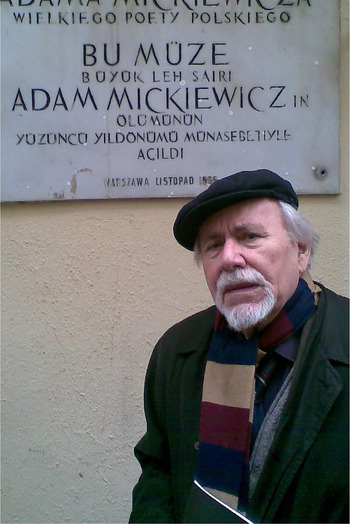
Ludwik Flaszen in Istanbul, 2009. (Photo courtesy of Leszek Kolankiewicz)

Approaching the Adam Mickiewicz Museum in Tarlabas*ı from an unusual direction, we passed a street lined with bawdy houses, maneuvered our way through a bazaar, and crossed a square where we witnessed chickens scratching and pecking at something. This put us in the mind of Adam Mickiewicz’s letter in which the Romantic poet describes a market square coated in an amalgam of mud or manure with feathers, where chickens and turkeys strolled among packs of napping dogs; it reminded him of his native Lithuania. And then, when we reached the museum in Tatlı Badem (Sweet Almond Street), a replica of the house rented by Mickiewicz and his companions where he would spend the final three weeks of his life, we thought of the Ukrainian inns that the house’s interiors evoked in the travelers’ minds. The poet stayed in wretched Istanbul lodgings, for he did not want his compatriots to think he had sold himself to one of their feuding factions for comfortable accommodation and “healthy” meals. The museum basement houses a crypt where Mickiewicz’s dead body, a national relic, sealed in a triple coffin for health reasons, would reportedly remain for over a month until his compatriots stopped wrangling over where his remains should be laid to rest. Flaszen and I were skeptical about the whole crypt thing, because Armand Lévy, who witnessed the events, reported that the huge coffin was deposited by the main entrance door.
While in Istanbul, we of course went to visit the Hagia Sophia (“Divine Wisdom” in Greek), that awe‐inspiring structure that wavers between being a church and a mosque, then still a museum. I also talked Ludwik into going to see the nearby Blue Mosque — close proximity invites comparisons — but he hesitated at the entrance. “Go by yourself!” he said. At first I was not sure whether this was the hesitation of a Jew outside a mosque or of a nonbeliever who, as he later confided to Sobolewski, stopped on the doorstep of any temple, be it a church, an Orthodox cathedral, or a synagogue. Only after a moment did it occur to me that it might have been the shoes: the mosque was open and visitors were asked to take their shoes off before entering. Flaszen, who was 79 at the time, was in excellent shape, but perhaps he would find it a bit of a struggle to tie and untie his shoelaces. I was just in my 50s, so without much ado, I got down on my knees and unlaced his shoes. Later, I remembered this when reading Flaszen’s account of the Paris statue of Montaigne whose shoe was polished to a shine by passersby. Whenever Flaszen was walking down the rue des Écoles, he touched the shoe, too, to celebrate the great skeptic who lived out his philosophy like a lay saint. When I happen to be in the neighborhood, I cross the street and head to the leafy square opposite the Collège de France, which bears the name of Michel Foucault, the great critic and archaeologist of discourse. Flaszen, too, was a practical skeptic, an essayist, and a columnist who took up the critique of discourse, which “Popołudnia pieniacza” (Troublemaker’s Afternoons) and “Moralia,” both included in his book Cyrograf ([1971] Reference Flaszen1996; Pact with the Devil) amply demonstrate.
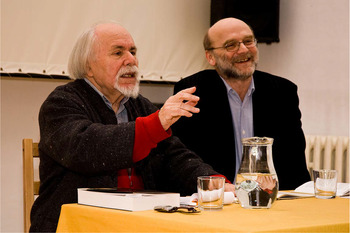
Ludwik Flaszen and Leszek Kolankiewicz, Wrocław, 2007. (Photo by Maciej Zakrzewski; courtesy of the Grotowski Institute)

Flaszen gifted me a copy of the third edition of Cyrograf with a truly baroque dedication: “To a Vodouist, in a shamanic whirl, in lasting and warm friendship — your brother in sorcery.” The third edition had been altered and expanded to include extensive excerpts of his legendary Głowa i mur (The Head and the Wall), which was vetoed by the Gomułka regime’s censors and the entire print run was pulped in 1958. (“Vodouist” is a nod to my relationship with the Haitian group Sen Solèy, or Saint Sun, formed around Jean Claude “Tiga” Garoute and Maud Robart, but also to my translations of classic Vodou studies by Maya Deren, Alfred Métraux, and Louis Mars, published in the theatre journal Dialog. I met the members of Sen Solèy in the days of the Theatre of Sources.) It is not clear to whom the shamanic whirl was to refer to — perhaps to both him and me, the two of us together. Ludwik’s fascination with shamanism went back at least to his takeover of the Theatre of 13 Rows in Opole and coming into possession of a copy of Arseni D. Avdeev’s Proiskhozhdenie teatra (The Origins of Theatre; Reference Avdeev1959), where in chapter three the author delves into secret societies, representation of spirits, as well as shamans and sorcerers who appear in prints that juxtapose Native American and Siberian shamans. The word “sorcery” comes from Mickiewicz’s Dziady (1823; Forefathers’ Eve), while “brother” is a reference to Grotowski’s Holiday: The day that is holy. Yet Flaszen was not as animated by the occult or the magical spirit as Grotowski was, even if in 1963 he wrote a column titled “Teatr skazany na magie˛” (“A Theatre Sentenced to Practice Magic,” Flaszen Reference Flaszen2010:95); the title was later recycled for a volume of his theatre reviews and commentaries. “In the clear light of reason, theatre is a dubious institution” (95) he writes, because it produces a community in which “the collective affirms its identity” (96) in exactly the same way as when collective powers are produced: “Theatre by its nature overlaps with the realm of magic, which [the realm of magic] is so embarrassing for us civilized people” (96). It was Flaszen who authored Cyrograf, but it was in Grotowski that he saw the mad artist from Mann’s Doctor Faustus, who signs a pact with the devil to unleash his creativity. Flaszen himself modestly assigned himself the role of a horrified humanist chronicling the rise and fall of a “condemned soul.”
And he rose to this task beautifully by writing his magnum opus, Grotowski & Company (2010). He worked on that book for years. The English edition, which came into existence through the efforts of Eugenio Barba, was followed four years later by Polish, Italian, and French editions; then a Portuguese version appeared in Brazil and a Spanish one in Argentina. After the publication of the Italian translation, edited by Professor Franco Perrelli, the Università degli Studi di Torino awarded Flaszen an honorary doctorate. The French version is translated by Erik Veaux, who, like Flaszen, holds the Order of Merit of the Republic of Poland, and also rendered into French the work of Witkacy, Borowski, and Białoszewski. Flaszen and Veaux met in Opole, which Veaux visited in 1963 at the instigation of Barba. I met them both, Flaszen and Erik Veaux, when I lived in Paris. They made an endearingly amusing duo, still together after 50 years. Grotowski & Company is not only a landmark study of Grotowski’s theatre — of which Flaszen was a cofounder and masterly commentator coining the phrase “Poor Theatre” — but also a remarkable commentary on the history of Polish culture under Gomułka, Gierek, Kania, and Jaruzelski (1956–1984). This is amply borne out in: the two long essays “The Children of the October Look to the West” (Reference Flaszen2010:19– 45) and “Grotowski Ludens”; the shorter essay “O duchu zabaw w PRL” (On the Spirit of Fun and Games in the People’s Republic of Poland); the very brief “Addenda”; and the aforementioned interview with Sobolewski, “Trzewik Montaigne’a” (Montaigne’s Shoe). The “Addenda” contains a note on the famous Kraków School of Critics, which apart from Flaszen included the likes of Andrzej Kijowski, Konstanty Puzyna, and Jan Błoński, all of whom attended Kazimierz Wyka’s seminar at the Jagiellonian University in Kraków. In “Epitafium dla Wyki” (Epitaph for Wyka), published in the journal Odra after his teacher’s death in 1975, Flaszen states that the four of them were proud to engage in dialogue with the great historian and critic, who “adopted a new approach to teaching tradition by demonstrating its vitality while at the same time legitimizing innovation, which he turned into tradition” (Reference Flaszen1975:29). The author of Grotowski & Company made this approach his own. Flaszen was a Polish philologist whose scholarship, like Wyka’s, was deeply rooted in Modernism, but he remained open to all 20th‐century avantgardes. In nearly every conversation he put me to shame with his formidable literary erudition. He would endlessly quote Schopenhauer and Nietzsche — the latter in Berent’s and Staff’s Young Poland translations — Wyspiański and Żeromski, Brzozowski of course, as well as Witkacy and Gombrowicz. It even appeared that he, a critic who penned theatre reviews for Echo Krakowa (a post he had taken over from Mrożek), privileged literature over theatre. Flaszen admitted this indirectly when he confessed that his theatre education owed much to his friendship with Puzyna, who had carved out a reputation as a sterling theatre critic when he was still at college. He admired Puzyna, who would later develop a fascination with socially grounded and politically committed student theatre. He himself, with his soul and bones, was a man of the Romantic theatre of archetypes. He was not much unlike the eponymous character of The Hamlet Study, which Grotowski staged in Opole in 1964. In their rendering, Hamlet was a bookish type, a highbrow scorned by the Polish hoi polloi, a tzaddik rattling out clever platitudes — a Jew!
Flaszen was a man of letters and “Ksie˛ga” (The Book) is his testament. The pages of my copy of Odra where it was first printed in 1973 bristles with feverish underlinings, its narrow margins containing three or four excerpts from the work of Bruno Schulz. The first things “The Book” made me think of were Schulz’s fantasies about the Original in Sanatorium pod Klepsydra˛ (1937; Sanatorium Under the Sign of the Hourglass, 1978). I showed my scribbles to Ludwik when we spoke in Wrocław and he later use; one of the quotes as the motto of “The Book.” He inscribed my copy of the Polish edition of Grotowski & Company with the words: “In friendship and gratitude for being a partner in conversation — in dialogue,” with dialogue meaning, as it were, a higher level of intellectual conversation, a reference to Bakhtin — a stimulus for mutual becoming through contact. Our dialogue began in the 1970s when I guest‐hosted an interview with him for TVP Wrocław, and it continued for several decades. (In 1978 Flaszen wrote the foreword to my debut book On the Road to Active Culture.) Our public conversation On Poor Theatre inaugurated the Grotowski Institute in Wrocław in 2007; its transcript first appeared in the theatre journal Didaskalia and was reprinted in Grotowski & Company. Some years later, Didaskalia published another public conversation we had at the Grotowski Institute, “Dostoyevsky — The Grand Inquisitor — Theatre” (Reference Flaszen, Kolankiewicz and Burzyńska2010).
When he lived in Poland, Flaszen did not speak of his Jewish heritage, not even obliquely. He alluded to it for the first time when we met in Paris. At the time, though, he carried himself like a Russian émigré with a sheaf of Cyrillic newspapers under his arm. He wrote:
It was not until we met in 2014 at Sip Babylone, a café‐cum‐pastry‐shop in the Raspail Boulevard, located two blocks away from Flaszen’s Paris apartment, which served him as a meeting point, that I did see a Jew in him, a rebbe pondering a complex Talmud point in a yeshiva. He brought with him a folder with a printout of an interview published in Widok, and stated several times that it had been published by the Institute of Literary Research (IBL) at the Polish Academy of Sciences (PAN). (This was vitally important to him, probably because Wyka had helmed IBL for nearly two decades.) He made it a point to quote all the sentences that mention queering — he did not pronounce the word the way it is pronounced in English but insisted on saying it “in Slavic,” pronouncing every single letter. With no end of quoting in sight, our conversation began to drag as never before. Right then and there — after 40 years of dialogue — I realized that, having completed his magnum opus, Flaszen became a man of writing, of the letter, remaining firmly within the bounds of the tradition he legitimized.
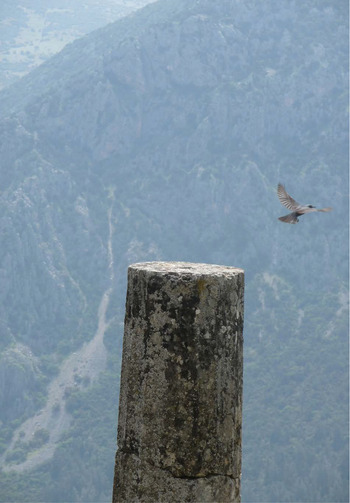
Five years before that meeting, fate took us both to Delphi where we had been invited to speak at the 14th International Ancient Drama Meetings on “Xénos — métoikos” (The Other — the Immigrant) held at the renowned ECCD arts center. Early in the morning, before the slopes of Mount Parnassus became blanketed in July heat, we would venture out sightseeing. We visited the sacred spring of Castalia — not as poets (though Flaszen did write poems, with no intention of publishing, in the early 1950s and when he staged Dreamers) but as men of letters. We went to visit the Sacred Precinct of Apollo and — courtesy of the then ambassador to Athens, the Orthodox theologian Michał Klinger — the Corycian Cave, of which I had read so much in Carl Kerényi’s exhilarating Dionysos (Reference Kerényi and Manheim1976). The sacred path leading to the ruins of the temple where, mounted on her tripod seat, the Pythia presided over the adyton, climbs uphill, but Ludwik handled the hike surprisingly well. We reached the spot of the Navel of the Earth — which had been pinpointed by two eagles dispatched by Zeus — formerly the site of a golden statue of Apollo and, purportedly, of the tomb of Dionysus. Pausanias reports that the front pediment of the second temple of Apollo bore a depiction of Apollo’s twin sister Artemis, their mother Latona, and, of course, Apollo with the Muses, whereas the back one was covered in carvings of Dionysus and the Thyades, or, as Walter Otto notes in his fascinating study, Dionysus in the heat of fury (Reference Otto and Palmer1965). The sanctuary was dedicated to Apollo, but in winter it was Dionysian dithyrambs that were sung there rather than Apollonian paeans. As we stood there, trying to figure out where things used to be, a bird alighted on one of the stump‐like columns of the old peripteros, and burst into song.
That was when it dawned on us that Nietzsche was wrong to contrast the Apollonian and the Dionysian, the pictorial and the musical, in The Birth of Tragedy (1872). As regards the pictorial element, I have never had dreams more vivid than the ones I experienced in the guesthouse of that European arts center in Delphi, which commanded a beautiful view of the Corinthian Gulf. And the bird perched on the capitol of the column pointing toward the sky serves as a reminder of the musical element, intoxication. Under its spell we became inadvertent companions of Dionysus. A very special moment. Later, as we climbed even higher, to the ruins of the stone theatre, we took in the view of Apollo’s sacred precinct as if we were Nietzschean bacchantes gamboling in the mountains and spotting the image of Dionysus in the valley. Nine months later Flaszen gifted me a copy of the first English version of his magnum opus with the following dedication — perhaps the most beautiful one I had ever got from him: “Lest you forget what — and how! — the bird perched atop the Apollo temple in Delphi sang.” I have not forgotten and now I am telling the story.
Bird and a column from the temple of Apollo in Delphi, Greece. (Photo courtesy of Krzysztof Bielawski)

An old house in Wrocław’s town square in Przejście Żelaz;nicze is home to the Ludwik Flaszen Reading Room. The Grotowski Institute’s library has inherited Flaszen’s private book collection (its Wrocław portion, as the Paris one is not available yet): 7,000 volumes in a dozen or so languages, including French, Russian, and Uzbek. When Flaszen was departing this world in Paris after a long life he was over 90. Now he continues his Wrocław life in the Reading Room, even if his present existence is somehow relative. Overshaded by death, yet not fully dead, immersed in reading, the eulogist of the Book — ever an incorrigible mechtatel (dreamer) — he is still dreaming about the holy original. He browses through his book collection to find nothing but corrupt copies, inept forgeries, apocrypha descending into decline during our daily apocalypse. I am reciting Kaddish for him. May a gust of wind (ruah: breath and spirit) pass through the pages of these books, may images rise from them, freeing from the columns of text flocks of swallows and larks and that bird that keeps returning to the top of the column in Delphi to sing an intoxicating Dionysian dithyramb.