Introduction
A growing body of scientific evidence demonstrates that social determinants, such as one’s position in a social or economic hierarchy, can influence health outcomes and access to health care. Reference Marmot1-Reference Braveman and Gottlieb3 In the past 2 decades, place has emerged as a social determinant of health, with notable disparities in education, income, and wealth associated with specific geographic regions. Reference Nunn, Parsons, Shambaugh, Shambaugh and Nunn4,Reference Padilla, Kihal-Talantikit, Perez and Deguen5 Likewise, geographic inequalities undergirded a plethora of adverse health outcomes attributable to poverty, insufficient social support networks, presence of food deserts, proximity to toxic environmental hazards, and crime proliferation. Where a person lives, works, and socializes determines access to medical care services, usage of those services, and quality of care received. Reference Padilla, Kihal-Talantikit, Perez and Deguen5
Moreover, during a disaster event, socioeconomic status can influence survival because the effects of a disaster event on a population are unevenly distributed. Children, the elderly, and individuals with disabilities have greater sensitivity to adverse impacts, and marginalized groups, such as lower-income communities and some communities of color, are disproportionately affected by adverse events during disasters. Reference Gamble, Balbus, Berger, Crimmins, Balbus and Gamble6 The role of socioeconomic inequality in determining health outcomes was clearly evident with the increased rate of adverse health outcomes, death, and dislocation of vulnerable and marginalized populations in the aftermath of hurricanes Katrina and Rita along the US Gulf Coast in 2005. Reference Crouse-Quinn7 Thus, the impacts of natural disasters can be understood as a product of both physical exposure to an environmental hazard and social processes that shape human impacts. Reference Wisner, Blaikie, Cannon and Davis8
Hurricane Harvey made landfall near Corpus Christi, Texas, on August 25, 2017, as a Category 4 storm. In the following days, much of the Houston metropolitan area experienced over 30 inches of rainfall, with some locations experiencing over 50 inches. 9 The resulting flooding covered nearly one third of the city and affected more than 200 000 homes. Thousands of Houston residents evacuated, many to the DFW metroplex. Reference Pines10,Reference Liu, Morhsedi and Milller11 Harvey ultimately caused 88 deaths and an estimated US $125 billion of damage, making it the second-costliest tropical cyclone in US history, following Hurricane Katrina. 12
During disasters of Hurricane Harvey’s scale, hospitals are among the first institutions impacted, and, as such, they are often faced with a surge in demand for medical services that can overwhelm their resources. Reference Mehta13-Reference Stephens, Wilt and Molinari15 Medical surge affects not only medical services in the impact zone but also those in cities that receive evacuees. Reference Edwards, Young and Lowe16,Reference Eastman, Rinnert and Nemeth17 Careful planning and coordination are required for a health care system to meet this increased demand. Reference Gage and Burch18 Previous research has examined the strategies used by hospitals to prepare for a hurricane-related surge, Reference Mehta13 modeled the operations of a hospital during a disaster-related surge, Reference Adalja, Watson and Bouri19 and considered the capacity to provide health services during a long-term recovery. Reference Runkle, Brock-Martin, Karmaus and Svendsen20
Few studies have characterized patient populations seeking medical care during a disaster based on social vulnerability. Research on social vulnerability has identified specific sociodemographic indicators that influence differential sensitivity, adaptive capacity, and the ability to recover from disasters. Reference Cutter, Boruff and Shirley21 The Centers for Disease Control and Prevention, Social Vulnerability Index (CDC SVI) takes a combination of contextual demographic and socioeconomic factors into account, allowing for the comparison of relative levels of disaster-related social vulnerability within a given area. Reference Flanagan, Gregory and Hallisey22 For example, Flanagan et al. applied this index to explore the impact of Hurricane Katrina on local populations. Reference Flanagan, Hallisey, Adams and Lavery23 In keeping with this line of research, this study’s objective was to determine the spatial and statistical relationship between social vulnerability, as estimated by CDC SVI, and the locations where residents sought emergency medical care related to Hurricane Harvey. The results of this study have implications for disaster preparedness research and practice.
Methods
Data Sources
Medical Visits Used for Outcome Measures
Medical visit data from the North Texas Syndromic Surveillance System were extracted using Electronic Surveillance System for the Early Notification of Community-based Epidemics (ESSENCE), Reference Burkom, Elbert and Magruder24 a tool for collecting, analyzing, and storing syndromic surveillance data. The data set included records from Texas Health Services Region for two-thirds of the time period surrounding the 2017 Hurricane Harvey event. The data set included all 109 contributing emergency departments (EDs), 55 in the DFW metroplex, and 3 in the Houston area, as well as records from 7 disaster medical assistant teams (DMATs). DMATs are multidisciplinary teams comprising physicians, nurses, paramedics, and emergency medical technicians who are deployed to augment communities’ medical resources in response to federally declared disasters. Reference Mace, Jones and Bern25
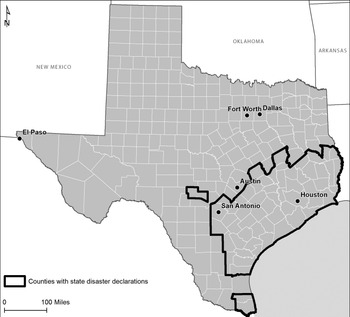
Medical visit data were included for patients who reported residing in zip codes within the 60 counties with governor-declared emergency declarations due to Hurricane Harvey or whose accompanying chief complaint or triage notes included the terms Harvey, hurricane, evacuee, or evacuate. Figure 1 displays the resulting study area of interest for the analysis. The complete data set was sorted into 3 categories: patients presenting at EDs in the DFW area, patients presenting at EDs in Houston, and patients presenting at DMAT clinics in Houston. All surveillance data were de-identified and exempted from an institutional review board (IRB) review.
Study area: Texas counties with state disaster declarations due to Hurricane Harvey.

The data were examined for 2 time periods: a short-term period (STP) from August 24, 2017, to September 8, 2017, and a long-term period (LTP) from August 24, 2017, to September 29, 2017. The start date for both time periods was determined by the switching detection algorithm in ESSENCE. Reference Chretien, Burkom and Sedyaningsih26 This algorithm is designed to detect the beginning of an epidemic or event (in this case, the medical surge event). The end date for the STP reflects the end date of the DMATs deployment, representing the end of the core response for Hurricane Harvey. The end date for the LTP was determined by an interrupted time series (ITS) analysis, Reference Jandoc, Burden and Mamdani27-Reference Wilt, Adams and Thomas29 as reported by Stephens et al. Reference Stephens, Wilt and Molinari15 The LTP coincides with longer response and recovery from Hurricane Harvey and the closure of the last shelter in DFW.
Predictor Measures
As one of the major disaster-related social vulnerability indices, CDC SVI comprises 4 themes that describe social vulnerability: Socioeconomic Status, Household Composition and Disability, Minority Status and Language, and Housing Type and Transportation. CDC SVI also provides a ranking of overall social vulnerability. Reference Flanagan, Gregory and Hallisey22,Reference Flanagan, Hallisey, Adams and Lavery23 Figure 2 presents CDC SVI and its 4 themes, as well as the variables that make up each theme. CDC SVI values are available in the form of percentile rankings, based on aggregated census tract-level data from the 2012–2016 American Community Survey, 5-year estimates.
Centers for Disease Control and Prevention, Social Vulnerability Index themes and variables.

In addition to CDC SVI data, this study included data on population density (persons per square mile) from the US Census Bureau 30 and data on Hurricane Harvey-related flooding from the Dartmouth Flood Observatory (DFO). DFO used earth observation imagery to map the extent of inundation during Hurricane Harvey. Reference Brakenridge and Kettner31 Using a georeferenced image of the extent, we assigned a value to each zip code tabulation area (ZCTA) in our study area, indicating the percentage of the zip code’s total area inundated during the flood event.
Data Management
ESSENCE provided medical visit data with zip codes as the geographic units, and CDC SVI rankings were associated with census tracts, which do not exactly correspond with the areas covered by zip codes. Therefore, it was necessary to spatially connect the zip codes with tracts in order to link CDC SVI with the ESSENCE data. We selected a subset of the visit data that included the patients’ zip codes. This subset included all the visits from Houston and DFW EDs and approximately 53% of the DMAT visits. We then joined the zip codes to their ZCTA units.
Although zip codes do not closely align with census tracts, several methods exist for relating the 2 geographic units. In this study, we geocoded ED visits to the population weighted centroid of their ZCTA and assigned to each visit the CDC SVI values of the tract containing its centroid. Previous research has found that geocoding to population weighted centroids improves accuracy as compared to geographic centroids. Reference Henry and Boscoe32 While stochastic geo-imputation methods can further improve accuracy, the difference is negligible when detailed demographic information is unavailable, as was the case in this study. Reference Henry and Boscoe32,Reference Hibbett, Liese and Lawson33
Statistical Methods
For each ZCTA, we calculated the proportion of total patients observed to seek care who presented at DMATs, Houston EDs, and DFW EDs. The sum of the proportion that presented at DMATs or at Houston EDs was considered the proportion of patients who stayed in place, or were not displaced from Houston by Hurricane Harvey, and represented the main response variable of interest (PSTAY). Note that total patients seeking care were observed with error; it did not include patients who were unable to seek care, chose not to seek care, or sought care outside of the study area. We calculated this proportion for both the STP and LTP. Where visit data were missing for some ZCTAs, we employed empirical Bayesian kriging to impute values. (See Online Supplement for details.)
We used global Moran’s I tests to detect spatial autocorrelation in PSTAY values and to identify the presence of significant clusters or “hotspots.” In order to assess the relationship between the location at which patients presented for care and the explanatory variables, we built spatial lag regression models using R. 34 (See Online Supplement for details.) In a spatial lag model, a change in 1 observation of the explanatory variable cascades globally throughout the response variable. Because of this, the marginal effect is interpreted from the “total impact” value, which includes both direct (local) and indirect (cascading) effects. In our case, the marginal effect of a change in an explanatory variable on PSTAY includes the direct impact of a change in the explanatory variable on PSTAY for that observation plus the indirect impact of a change in the explanatory variable on PSTAY for all other observations summed. The impacts were estimated using the R function impacts with 500 iterations, which simulate a multivariate normal distribution to create a distribution of impacts. Reference Bivand, Pebesma and Gomez-Rubio35 The final impact estimates reported are the empirical mean of the simulated distribution with accompanying simulated P values.
Results
Descriptive Statistics
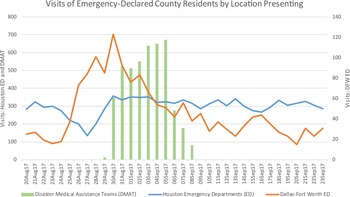
Descriptive statistics are presented in Table 1 for the variables used in the statistical analyses. In the STP, there were 1058 visits to DFW EDs, 4573 visits to Houston EDS, and 2602 visits to DMATs, for a total of 8233 visits, with zip code information available. In the LTP, we observed 1674 DFW ED visits, 11 243 Houston ED visits, and 2602 DMAT visits, for a total of 15 519 visits with zip code information available. The mean PSTAY increased from 0.36 in the STP to 0.39 in the LTP, despite DMATs only remaining open during the STP. This is likely because, as Figure 3 illustrates, the number of Houston ED visits, part of the numerator in PSTAY, was relatively low in the immediate aftermath of Hurricane Harvey and increased several days after the storm.
Descriptive statistics for daily emergency medical care visits during and after Hurricane Harvey in Houston and Metropolitan Dallas-Fort Worth, TX, August 24–September 29, 2017, by zip code tabulation area

1 Hurricane Harvey made landfall in Texas on August 25, 2017.
2 Imputed using empirical Bayesian kriging.
3 DFW (Metropolitan Dallas-Fort Worth in Texas).
4 Total zip code tabulation areas included.
Visits of emergency-declared county residents by location of presentation.

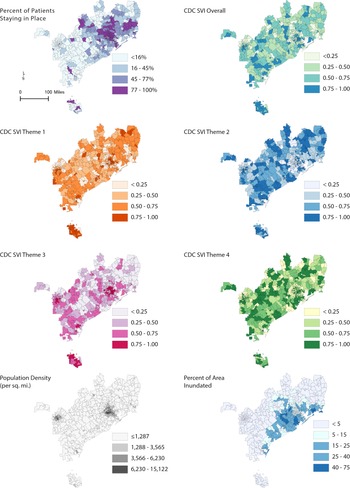
Figure 4 illustrates the spatial distribution of all the variables used in the analysis. For Percent of Patients Staying in Place, we see an apparent cluster of high values in the eastern region of the study area, in some ZCTAs near Houston. Farther west, near San Antonio, is a cluster of lower values. Population density and flood extent are also concentrated in those particular areas. CDC SVI themes are more evenly distributed, though their highest values overlap somewhat with those of population density. It is important to note that values for PSTAY presented here and used in the analysis include the estimates generated by empirical Bayesian kriging. (See the Online Supplement for more details.)
Spatial distribution of variables by zip code tabulation area.

Spatial Regression Impact Estimates
In each model and for both time periods, the estimated coefficient for the spatial lag was positive, indicating that if a neighboring ZCTA had high PSTAY, the ZCTA observed also tended to have high PSTAY. Two CDC SVI themes were significant: Socioeconomic Status as well as Household Composition and Disability. Table 2 presents the estimated direct, indirect, and total impacts for both time periods, as follows:
Estimated impact of social vulnerability, population density, and flooding inundation on location of medical care access during Hurricane Harvey, 2017, Houston and Metropolitan Dallas-Fort Worth, TX, by ZCTA

ZCTA = zip code tabulation area; EBK = empirical Bayesian kriging.
In the STP, a 1-unit increase in socioeconomic vulnerability yielded a 0.205-unit increase in PSTAY from the direct impact and a 0.496-unit increase in PSTAY from the indirect impact for an estimated total impact of a 0.701-unit increase in PSTAY. Similarly, but with smaller absolute magnitude, in the short-time period, a 1-unit increase in housing composition and disability vulnerability yielded an estimated total impact of a 0.348-unit decrease in PSTAY. Flooding inundation also had substantial positive impact on PSTAY, with estimated total impact of a 0.639-unit increase in PSTAY when flooding inundation increased by 1 unit. In the LTP, estimated direct impacts of vulnerability were somewhat larger while estimated indirect impacts were smaller, yielding smaller estimated total impacts with improved precision, as evidenced by smaller P-values. The estimated impact of flooding inundation was still positive and somewhat larger with improved precision.
Discussion
Key Findings
Using a social vulnerability framework, we conducted a statistically robust study to examine the spatial associations between social vulnerability and the site of emergency health care for a total of 8233 medical visits in the STP and 15 519 visits in the LTP, originating from 652 zip codes in southeastern Texas. First, we determined that higher levels of socioeconomic vulnerability were related with a greater proportion of patients seeking emergency care in the Hurricane Harvey-affected region. This finding is consistent with work identifying that socioeconomic status plays a major role in the health outcomes reported in the aftermath of disaster events. Reference Nomura, Blangiardo and Tsubokura36-Reference Horner and Downs38 Populations of low socioeconomic status may have experienced economic barriers and financially related transportation barriers to evacuating from the region that was most impacted by Hurricane Harvey, forcing them to seek care in the disaster area when encountering health issues. We also found that physical barriers due to increased flooding were associated with seeking medical care in the hurricane-affected region as opposed to in an unaffected area. This is in accordance with research demonstrating that severe flooding contributes to loss of infrastructure, which disrupts standard means of mobility, transportation, and, consequently, seeking health care. Reference Du, FitzGerald, Clark and Hou39
Living in a zip code with greater household composition vulnerability, such as one with many elderly residents or many residents with disabilities, was associated with seeking health care in an unaffected area during the Hurricane Harvey disaster. This finding is in contrast with previous studies finding that evacuation from a disaster-affected area decreased with age, Reference Lazo, Bostrom and Morss40,Reference Dostal41 as well as research finding that usage of EDs significantly increased for older persons in areas most impacted by the 2012 Hurricane Sandy disaster event. Reference Malik, Lee and Doran42 This finding was also inconsistent with studies finding that persons with disabilities and other impairments had increased vulnerability to disasters and were not well prepared for disaster events. Reference Miller and Arquilla43-Reference Strine, Neff and Crawford45 Contemporary disaster research acknowledges the disaster vulnerability of persons living with disabilities and chronic illnesses and advocates for targeted interventions for such vulnerable persons. Reference Davis, O’Shea and Beach46 Our findings suggest that, in this particular case, this population was able to seek medical care outside of the disaster impact area.
Based on our analysis, socioeconomic vulnerability had the greatest impact on whether persons seeking emergency medical care during a disaster did so in a disaster-impacted area or evacuated and sought care in unaffected locales. This finding is similar to work that has found that aspects of socioeconomic status explain the greatest proportion of geographic variation in social vulnerability to hazards and disasters. Reference Cutter, Boruff and Shirley21,Reference Cutter and Finch47 In the short term, flooding also contributed to more persons staying and seeking health care near their homes. This is a plausible finding considering that Hurricane Harvey led to over 500 000 vehicles and 300 000 buildings and other structures being flooded, as well as over 42 000 persons being forced into evacuation shelters due to extensive flooding. Reference Blake48 Flooding caused by Hurricane Harvey severely disrupted transportation infrastructure and mobility in southeastern Texas, potentially preventing many persons who intended to evacuate from actually doing so once water levels began to rise. The overall finding that socioeconomic vulnerability and flooding had the largest impacts on locations of health care seeking can be explained by the global phenomenon of impoverished persons residing in low-income communities with poor infrastructure to handle inundation. Reference Winsemius, Jongman and Veldkamp49
These findings have implications for public health practice, preparedness, and response. Our results indicate that low-income communities with high poverty and unemployment rates and low educational attainment may be less likely to evacuate. Improved flood protection infrastructure also remains an important consideration, as flooding continues to be a barrier to evacuation in some neighborhoods. Meanwhile, this study found positive outcomes for persons who are vulnerable based on age, household composition, and disability status, which may be indicative of successful evacuation and preparedness efforts among these groups of people.
Such contrasting findings between areas with high socioeconomic vulnerability and household composition vulnerability regarding the capability and location of health–care-seeking behaviors may also be indicative of the Medicare and Medicaid landscape in the state of Texas. As a federal insurance program that primarily supports elderly persons and younger persons living with disabilities, Medicare is a well-supported program in Texas and parallels private health insurance in regard to per capita expenditures and inpatient utilization, Reference Franzini, Mikhail and Zezza50 highlighting the comparable coverage of the 2 insurance modalities across the state. However, Medicaid, a federal-state assistance program supporting low-income persons, has yet to be expanded in Texas, which also is the US state with the largest uninsured population. Reference Buettgens, Blumberg and Pan51 Considering this study found that persons with vulnerabilities related to old age or disabilities were able to seek medical care beyond the Hurricane Harvey impact zone and persons with socioeconomic vulnerability were not able to do so, the limited coverage of Medicaid in the state of Texas may likely be contributing to the limited ability of low-income persons to seek care in safer, less-impacted localities in the aftermath of a major hurricane disaster.
Additionally, these findings may be useful for health care providers during a disaster event. Those serving in disaster-affected areas may expect to encounter an overflow of socioeconomically underprivileged persons in their clinics and EDs and may need to anticipate the health care needs that are characteristic of extreme flood events. Reference Du, FitzGerald, Clark and Hou39,Reference Paterson, Wright and Harris52 Providers in nearby but unaffected areas receiving evacuees may expect to see a greater number of patients with disabilities and age-related vulnerabilities in their practices.
Limitations
This study is subject to a number of limitations. First, the findings from this work were generated from a specific region (southeastern Texas) during a specific event (the 2017 Hurricane Harvey disaster) and may not be generalizable to areas elsewhere in the United States or for other disaster events. Second, we incorporated ED data from only 3 hospitals in Houston, Texas, to represent EDs in the Hurricane Harvey-impacted area and imputed values for ZCTAs that were missing outcome data using empirical Bayesian kriging. The results may not represent the scope or scale of medical care access among all EDs in areas directly affected by Hurricane Harvey. Third, we geocoded our data based on ZCTA centroids, which is less precise than geocoding based on full addresses and assumes that the correct zip code was recorded in the ED data. Fourth, 47% of the DMAT records were missing zip code information and therefore excluded from the analyses. For the subset of records with zip codes, age was slightly lower (M = 44.9, SD = 18.7) than for the DMAT data as a whole, t(5741) = −2.2, P = 0.03. A slightly higher percentage identified as female (47%) than in the full data set (43%), whereas a lower percentage identified as male (52%) than in the full data set (55%). Fifth, our analyses only include data for persons who presented for medical care during the Hurricane Harvey impact period. The results may therefore underrepresent the full scope and scale of medical issues that required care or treatment. This limitation hinders us from extrapolating our findings to the most socially vulnerable populations in the Hurricane Harvey-impacted region whose vulnerability may have prevented their access to medical care during the disaster, which is of concern. Finally, there are factors beyond the sociodemographic characteristics of race, ethnicity, age, disability status, socioeconomic status, transportation vulnerability, to name a few, that influence evacuation decision-making and the capability to evacuate for a storm. Risk awareness and perception, pet ownership, and social networks are among a host of other determinants that could also guide evacuation decisions. We do not examine such additional factors in this study, but future studies should take them into consideration.
Future Research
Future research that would be a natural progression from the present study may involve assessing social vulnerability at the patient scale as opposed to the population scale, as well as conducting an accessibility analysis of essential health care facilities from neighborhoods of varying social vulnerability levels. While population or area-scale social vulnerability may be useful for identifying health care facilities that are more inclined to be inundated with medical needs from persons residing in socially vulnerable places, evaluating social vulnerability at the individual scale may provide additional insight into the magnitude of vulnerability and particular medical needs with which these persons present. In addition, understanding geographic access to essential medical facilities, such as hospitals, DMATs, and pharmacies, during disaster events can provide insight on the extent that accessibility may differ by area-level vulnerability status. Examining the travel time and distance to hospitals, DMATs, and pharmacies during the Hurricane Harvey event may further clarify the contributions of space and place to the inaccessibility of these essential health care facilities for areas of high social vulnerability.
Conclusions
In the aftermath of the 2017 Hurricane Harvey disaster event, a medical surge was encountered in EDs and DMATs of areas in southeastern Texas directly impacted by the storm, as well as areas receiving evacuating patients. In the present study, we determined that socioeconomic vulnerability and flooding were significantly associated with persons seeking emergency medical care in Hurricane Harvey-impacted areas, while vulnerability related to household composition and disability was significantly predictive of persons evacuating to unaffected areas to receive medical care. Both social vulnerability and physical exposure to flooding were significant predictors of patients’ locations when presenting for care during Hurricane Harvey and may have influenced evacuation. This study contributes to the literature by applying geospatial methods to examine the impact of disaster-related social vulnerability on the locations of health care receipt. Overall, our findings support an approach to disaster preparedness research that integrates aspects of the physical environment and the socioeconomic situation of the population, with particular attention paid to differences among communities within the disaster area.
Acknowledgments
The authors would like to thank Marissa Grossman, PhD, for consultation on statistical methods and the 2 anonymous reviewers for their constructive feedback.
Funding Statement
NIH Grant T32 ES 007069 supported the development of this manuscript.
Conflict(s) of Interest
The authors declared no potential conflicts of interest with respect to the research, authorship, and/or publication of this paper.
Disclaimer
The findings and conclusions in this study have not been formally disseminated by the CDC or the Agency for Toxic Substances and Disease Registry and should not be construed to represent any agency determination or policy.
Supplementary material
To view supplementary material for this article, please visit https://doi.org/10.1017/dmp.2020.421