INTRODUCTION
The Arminidae Rafinesque, 1814 constitutes a poorly known group of living nudibranchs, with nearly 75 nominal species divided into six genera (Kolb & Wägele, Reference Kolb and Wägele1998). Arminids are characterized by having an elongated, flattened body and a narrow posterior end with longitudinal ridges or pustules on the notum. The notum bears marginal sacs along its marginal edge. Arminids have a distinct oral veil and retractile rhinophores with longitudinal lamellae. In some genera a caruncle is present in front of the rhinophores. Typically, the radula has a broad, denticulated rachidian tooth and falciform lateral teeth (Kolb, Reference Kolb1998).
Armina Rafinesque 1814, is the most species-rich genus of the family with more than 50 nominal species, and includes the most derived forms of the group (Kolb & Wägele, Reference Kolb and Wägele1998). Features shared by members of this genus are the continuous anterior margin of the mantle, the presence of branchial and hyponotal lamellae, and the close distance between the rhinophores, which, together with the head, are clearly separated from the anterior margin.
Armina exhibits a worldwide distribution with twelve nominal species recorded for the western Atlantic and eastern Pacific: A. tigrina Rafinesque, 1814, A. muelleri (Ihering, Reference von Ihering1886), A. abbotti Thompson, Cattaneo & Wong, Reference Thompson, Cattaneo and Wong1990, A. wattla Marcus & Marcus, Reference Marcus and Marcus1967, A. juliana Ardila & Díaz, Reference Ardila and Díaz2002, and A. elongata Ardila & Valdés, Reference Ardila and Valdés2004 (Marcus & Marcus, Reference Marcus and Marcus1960, Reference Marcus and Marcus1967; Kolb & Wägele, Reference Kolb and Wägele1998; Ardila & Díaz, Reference Ardila and Díaz2002; Ardila & Valdés, Reference Ardila and Valdés2004) from the western Atlantic; and A. californica (Cooper, Reference Cooper1862), A. columbiana O'Donoghue, Reference O'Donoghue1924, A. digueti Pruvot-Fol, 1955, A. vancouverensis Steinberg, 1963, A. cordellensis Gosliner & Behrens, Reference Gosliner and Behrens1996 and A. cuvieri (d'Orbigny, 1837) from the eastern Pacific. Despite these current records, a general taxonomic revision of the western Atlantic and eastern Pacific is not available. To date, taxonomic confusion in this group has led to erroneous identifications and widespread synonymy because of the description of several new species.
This work offers a revision of some species of Armina from the Atlantic and eastern Pacific, including the study of the internal anatomy of the organisms. New characters are examined to provide the basis for a phylogenetic hypothesis of the group to confirm its monophyly, as previously presented by Kolb & Wägele (Reference Kolb and Wägele1998) and Ardila & Valdés (Reference Ardila and Valdés2004). Additionally, this study discusses possible phylogenetic relationships within the members of Armina and clarifies the patterns of geographical distribution. We explored the possible events of vicariance that the genus has undergone in the Atlantic and eastern Pacific.
MATERIALS AND METHODS
Material of the genus Armina from the western Atlantic and the eastern Pacific, deposited in the Natural History Museum of Los Angeles County (LACM), the US National Museum of Natural History (NMNH), the California Academy of Sciences (CASIZ) and the Museo de Historia Natural Marina de Colombia (MHNMC, INVEMAR), was examined. The specimens were dissected and the internal features of the reproductive system were examined and drawn using a dissecting microscope with a camera lucida. The bucal mass was removed and dissolved in 10% sodium hydroxide until the radula was isolated from the surrounding tissue. The radula was rinsed in distilled water, dried, and mounted for examination by scanning electron microscopy (SEM).
Eleven species of Armina were included for the phylogenetic analysis, including four species of Armina from the Mediterranean, and eastern Atlantic: Armina maculata Rafinesque, 1814, Armina neapolitana (Delle Chiaje, 1824), Armina tigrina Rafinesque, 1814 and Armina loveni (Bergh, 1866). The information was obtained directly from the available material rather than the literature. For the phylogenetic analysis, 17 characters were scored. To calculate the most parsimonious phylogenetic tree, the data were analysed using PAUP (Phylogenetic Analysis Using Parsimony), version 4.0 (Swofford, Reference Swofford2001) determined by the Branch-and-Bound algorithm. The characters were polarized in PAUP selecting the genera Histiomena Mörch, 1860 and Dermatobranchus van Hasselt, 1824, as the outgroup (Kolb & Wägele, Reference Kolb and Wägele1998). The outgroup includes the species Histiomena convolvula Lance Reference Lance1962 and Dermatobranchus sp. Information for these species was obtained from Lance (Reference Lance1962) and Miller & Willan (Reference Miller and Willan1986). Bremer analysis (Bremer, Reference Bremer1994) was performed to estimate branch support. Synapomorphies were obtained using the character trace option in MacClade 3.04 (Maddison & Maddison, Reference Maddison and Maddison1992) based on the strict consensus tree from the PAUP.
RESULTS
The review of the anatomy of the specimens allowed us to validate four distinct species of Armina for the western Atlantic: Armina muelleri, A. wattla. A. juliana and A. elongata; and three for the eastern Pacific: A. californica, A. cordellensis and Armina sp., being Armina sp. an undescribed entity, examined in this study.
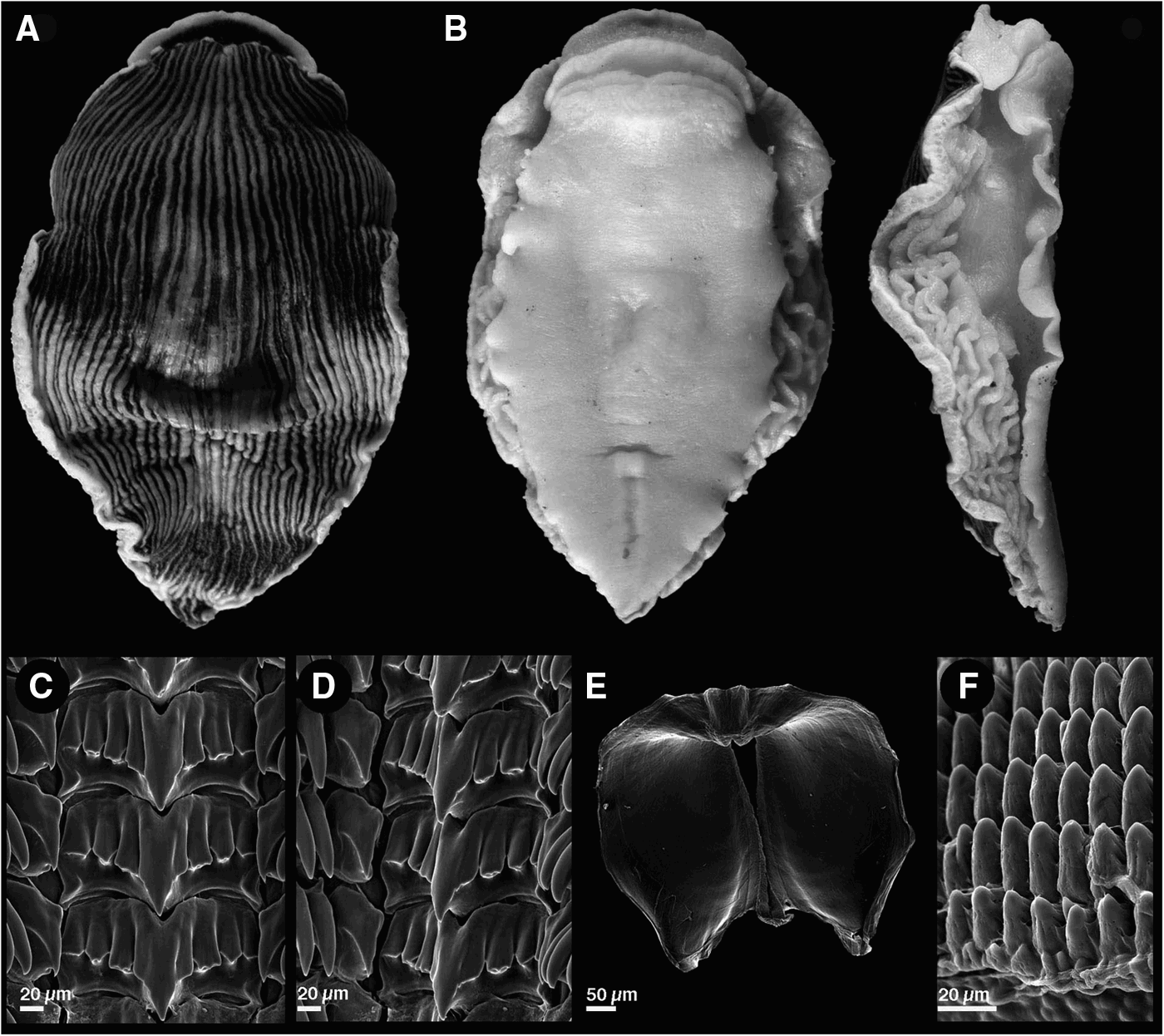
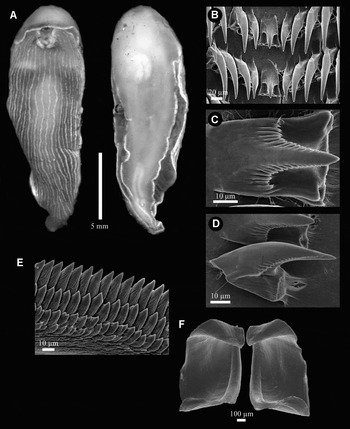
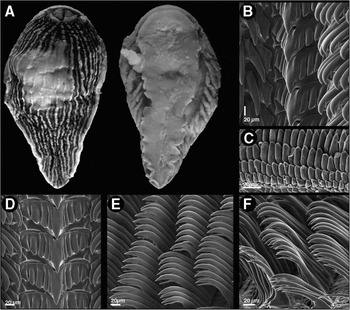
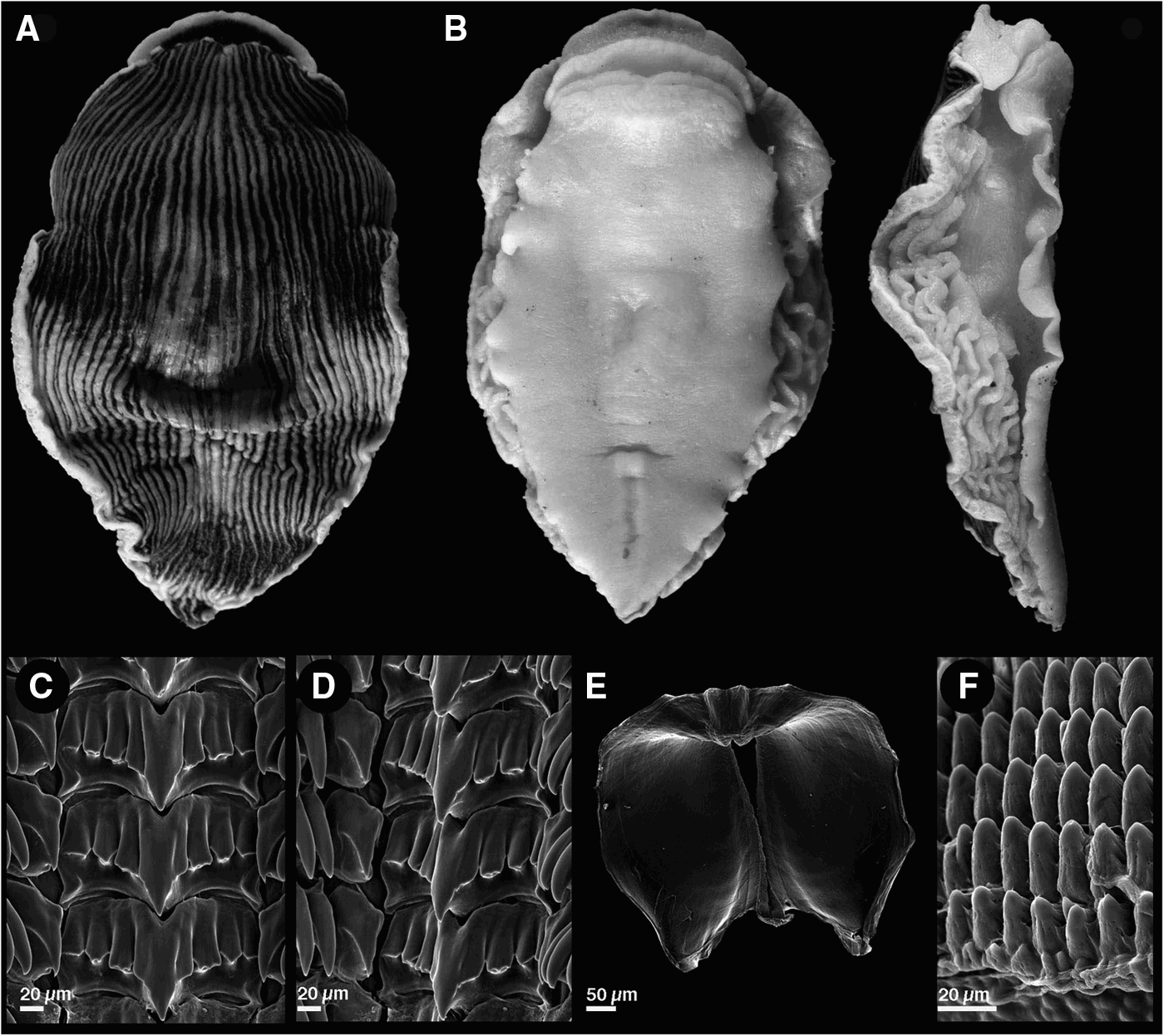
Armina muelleri (Ihering Reference von Ihering1886), CASIZ 135208, Lesser Antilles. (A) Dorsal and ventral views of the preserved animal; (B) lateral view of the body; (C) rachidian teeth; (D) lateral view of the rachidian teeth; (E) jaws; (F) detail of the jaw elements on the masticatory processes.
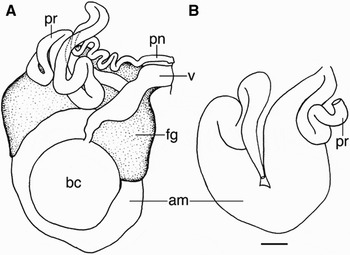
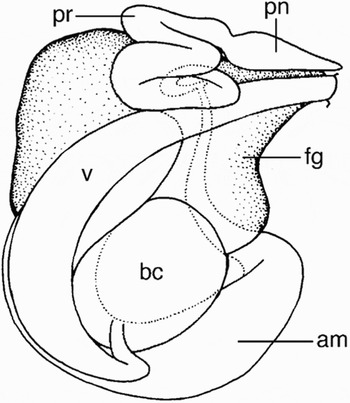
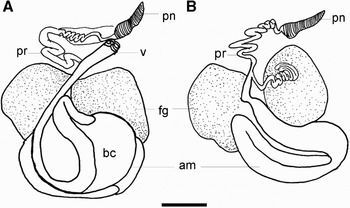
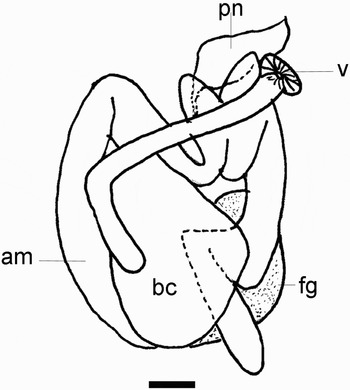
Reproductive system of Armina muelleri, MHNMC INV MOL3901, off Salamanca Island, Colombia. Scale bar = 1 mm. (A) Frontal view of the reproductive system; (B) detail of some reproductive organs from a posterior view. am, ampulla; bc, bursa copulatrix; fg, female glands; pn, penis; pr, prostate; v, vagina.

MATERIAL EXAMINED
CASIZ 135208 Caribbean Sea, West Indies, Lesser Antilles, off coast of Dominica, on sand 3 m depth; MHNMC INV MOL3901 off Salamanca Island, Colombia, 20 m depth, hard bottom with pennatulaceans.
DESCRIPTION
The preserved specimen is dark brown with longitudinal notal ridges, oral veil and edge of the notum yellow. The body is wide, elongated and flattened. Notum with dorsal ridges wider, entire ridges, and thinner, broken ridges intercalated (Figure 1A). The oral veil has two tentacular lateral extensions lacking any projections. Genital opening located posterior to and below the branchial lamellae (Figure 1B). Hyponotal lamellae elongated with an oblique arrangement.
Radula: rachidian tooth very broad, bearing 3–4 large denticles on each side of the smooth median cusp (Figure 1C). Lateral teeth elongated and lacking denticles (Figure 1D), external lateral teeth smaller than the rest. Jaws have a denticulated masticatory border with four to five rows of denticles (Figure 1F).
Reproductive system: the ampulla is very wide and convoluted, connecting directly to the prostate and the female glands. The prostate is elongated, convoluted, and the folds are long. The deferent duct is thin, compact and convoluted. The vagina of the material examined is variable, but in general is short, and wide. Furthermore, following the description of Marcus & Marcus (Reference Marcus and Marcus1960) the vagina of this species is considered shorter and thicker than other species from the western Atlantic (Figure 2).
REMARKS
Armina muelleri was originally described in Brazil by Ihering (Reference von Ihering1886) and re-described by Marcus & Marcus (Reference Marcus and Marcus1960). Those descriptions agree with the material examined by Ardila & Valdés (Reference Ardila and Valdés2004) and the samples from Dominica examined in this work.
DISTRIBUTION
Armina muelleri was recorded only for the coasts of Brazil and the southern Caribbean of Colombia (Ihering, Reference von Ihering1886; Ardila & Valdés, Reference Ardila and Valdés2004). With this study its distribution extends to the Lesser Antilles on the coast of Dominica. Found on hard substrate with pennatulaceans (Ardila & Valdés, Reference Ardila and Valdés2004) and on sand bottoms.
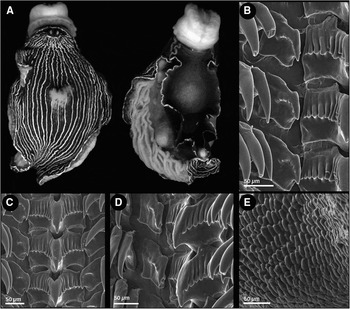
Armina wattla Marcus & Marcus Reference Marcus and Marcus1967, APMO4020601, Florida. (A) Dorsal and ventral views of the preserved animal; (B) first lateral teeth; (C) rachidian teeth; (D) rachidian teeth, lateral view; (E) detail of the jaw elements on the masticatory processes.

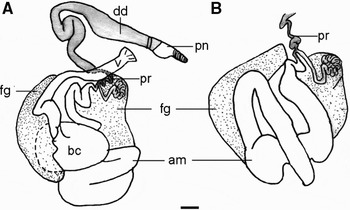
Reproductive system of Armina wattla, USNM 575215, Gulf of Campeche. Scale bar = 1 mm. (A) Frontal view of the reproductive system; (B) detail of some reproductive organs from a posterior view. am, ampulla; bc, bursa copulatrix; dd, deferent duct; fg, female glands; pn, penis; pr, prostate; v, vagina.

MATERIAL EXAMINED
USNM 575214 North Atlantic Ocean, Gulf of Mexico, Texas, 1.8 m depth; USNM 575215 North Atlantic Ocean, Gulf of Campeche, Mexico 23–36 m depth; USNM 805044 North Atlantic Ocean, South Carolina, Sullivan's Island, United States; USNM 35311 North Atlantic Ocean, North Carolina, Cape Hatteras, United States, 27 m depth; USNM 848832 North Atlantic Ocean, off South Carolina, United States, 58 m depth; APMO4020601 St George Island, Florida, United States, 3.9 m depth.
DESCRIPTION
Preserved specimens are dark with contrasting yellow longitudinal ridges; the margin of the oral veil, the apical portion of the rhinophores and the edge of the notum are also yellow. The body is wide and elongated. Dorsal ridges are more spaced than in A. muelleri, although thick and narrow ridges can be alternating on the notum (Figure 3A).
Radula: rachidian tooth wide and broad like A. muelleri, but the median cusp flanked by six to seven denticles, 1–2 of which sit on the central cusp (Figure 3C), the first intermediate lateral tooth, according to the original description, bears seven denticles. In the specimens examined in this study, denticulation was observed mainly in the first lateral tooth (Figure 3B). The jaws have a masticatory border with numerous rows of denticles (Figure 3E).
Reproductive system: vagina distinctively longer than in A. muelleri. Additionally, genitals with unions between ampulla and prostate and female glands not observed in detail (Figure 4), whereas these connections are observed clearly in A. wattla (Báez & Ardila, Reference Báez and Ardila2006). Details of the original description can be reviewed in Marcus & Marcus (Reference Marcus and Marcus1967).
REMARKS
Ardila & Valdés (Reference Ardila and Valdés2004) conclude that A. wattla is a species very similar to A. muelleri in the radular and reproductive morphology. Then, they propose that A. wattla and A. abbotti are junior synonyms of A. muelleri and recorded this species for the Caribbean coast of Colombia. At the same time, those authors found that the species name A. abbotti was introduced by Thompson et al. (Reference Thompson, Cattaneo and Wong1990) for the north-western Atlantic specimens misidentified by Abbott (Reference Abbott1954) and Eyster (Reference Eyster1981) as A. tigrina. However, it was not a formal description of the species A. abbotti and Thompson et al. (Reference Thompson, Cattaneo and Wong1990) were limited to give a name to the material referenced by Abbott (Reference Abbott1954) and Eyster (Reference Eyster1981).
Nevertheless, Báez & Ardila (Reference Báez and Ardila2006) found internal morphological characteristics that distinguish A. muelleri from A. wattla, arguing that A. wattla is a valid species and restricted to the north-western Atlantic, conserving the synonymy of A. abbotti with A. wattla. They also recognized A. muelleri as another valid species, extending its distribution from the southern Caribbean and Brazil to the Lesser Antilles. For a comprehensive discussion on the synonymy between A. wattla and A. muelleri and later recognition of each one as a valid species, see Báez & Ardila (Reference Báez and Ardila2006).
DISTRIBUTION
Armina wattla is restricted to the north-western Atlantic: North Carolina, South Carolina, Georgia and Mexico (Marcus & Marcus, Reference Marcus and Marcus1967; Báez & Ardila, Reference Báez and Ardila2006). In this study it is recorded from the coasts of Florida.
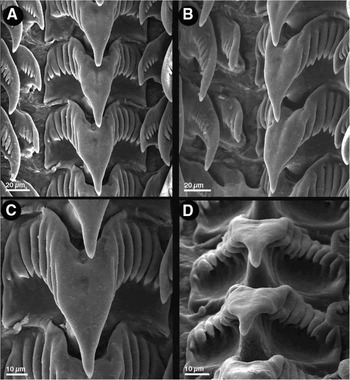
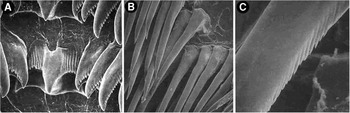
Armina juliana Ardila & Díaz Reference Ardila and Díaz2002, LACM 2908, Colombia. Paratype. (A) Rachidian teeth; (B) rachidian teeth, lateral view; (C & D) detail of the rachidian tooth.

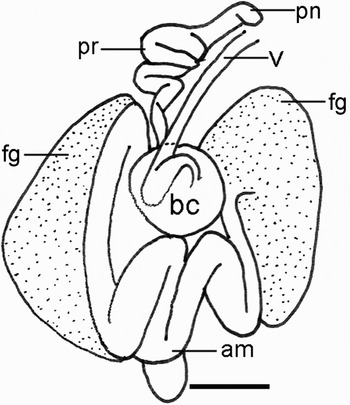
Reproductive system of Armina juliana. LACM 2908, Colombia. Paratype. Scale bar = 1 mm. am, ampulla; bc, bursa copulatrix; fg, female glands; pn, penis; pr, prostate; v, vagina.

MATERIAL EXAMINED
USNM 575409 North Atlantic Ocean, off Cape Canaveral, Florida, United States 540 m depth; paratype LACM 2908, off Palomino Colombia 306–312 m depth.
DESCRIPTION
The living animals are red with white longitudinal ridges. This species can be distinguished from other western Atlantic species by the genital papilla position, located anterior to branchial lamellae and with foliar hyponotal lamellae irregularly arranged.
Radula: rachidian tooth broad, bearing 7–12 elongated denticles flanking smooth median cusp (Figure 5). Lateral teeth conspicuously denticulated. Original description was by Ardila & Díaz (2002).
Reproductive system: ampulla long, wide and convoluted. The connections between ampulla and prostate are not clearly differentiated. Prostate short with long folds, although holotype with prostatic folds shorter than in paratype and other Florida specimens. Vagina is narrow; holotype and paratype with short vagina but long in Florida specimen (Figure 6). Ardila & Valdés (Reference Ardila and Valdés2004) redescribed A. juliana and illustrated its reproductive system.
DISTRIBUTION
Armina juliana was originally restricted to the southern Caribbean upper slope (Ardila & Díaz, Reference Ardila and Díaz2002). The present study extends the distribution of this species to deep waters of Florida on muddy bottoms.
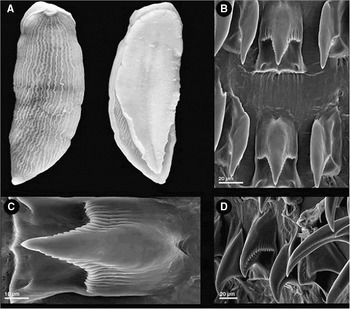
Armina elongata Ardila & Valdés Reference Ardila and Valdés2004, MHNMC INV MOL3902, Colombia. Holotype. (A) Dorsal and ventral views of the preserved animal; (B) rachidian teeth and inner lateral teeth; (C) detail of the rachidian tooth; (D) detail of the innermost lateral tooth; (E) jaw elements on the masticatory processes; (F) jaws (from Ardila & Valdés, Reference Ardila and Valdés2004).

Reproductive system of Armina elongata, MHNMC INV MOL3902, Colombia (from Ardila & Valdés, Reference Ardila and Valdés2004). Scale bar = 1 mm. am, ampulla; bc, bursa copulatrix; fg, female glands; pn, penis; pr, prostate; v, vagina.

DESCRIPTION
The preserved specimen is pale greyish with white longitudinal ridges. The body is elongated flattened and narrower posteriorly. The oral veil with the margin white and has two large, tentacular lateral extensions. The lateral extensions are as wide as the notum (Figure 7).
Radula: radula distinguishable from other western Atlantic species of the genus by its extended and narrow rachidian tooth and denticulation present on its median cusp (Figure 7).
Reproductive system: ampulla large and convoluted; prostate is short and convoluted. The vagina is very long and curved (Figure 8; Ardila & Valdés, Reference Ardila and Valdés2004).
DISTRIBUTION
Armina elongata is only known from type locality, off Manaure, Colombia, on coralline algae and gravel substratum.
Armina californica (Cooper, Reference Cooper1862), LACM 2004.16.2, California. (A) Dorsal and ventral views of the preserved animal; (B) rachidian teeth, lateral view; (C) detail of the jaw elements on the masticatory processes; (D) rachidian teeth; (E & F) detail of the lateral and outer tooth.

Reproductive system of Armina californica, CASIZ 088148, Panama. Scale bar = 1 mm. (A) Frontal view of the reproductive system; (B) detail of some reproductive organs from a posterior view. am, ampulla; bc, bursa copulatrix; fg, female glands; pn, penis; pr, prostate; v, vagina.

MATERIAL EXAMINED
CASIZ 88148 Panama, Pacific coast, Islas Ladrones, 78 m depth; CASIZ 74276 Isla Tortuga, Baja California, Mexico, 11.7 m depth; CASIZ 76624 Bahia de Todos los Santos, Pacific coast, Baja California, Mexico; CASIZ 71761 Alaska: Central Aleutian Islands, 27–268 m depth; USNM 805043 South Pacific Ocean, Peru; USNM 805040 North Pacific Ocean, California, 133 m depth; USNM 805041 North Pacific Ocean, Canada, Halibut Bank, 51–80 m depth; USNM 805042 North Pacific Ocean, California, Monterey Bay, 50–557 m depth; USNM 577659 North Pacific Ocean, Alaska, 27–162 m depth; LACM 140819 Los Angeles Bay, Baja California, Mexico, 30.6 m depth; LACM 2004-16.2 South of Pt Vicente, Los Angeles County, California, 62 m depth; LACM 140817 North of San Jose Island, Baja California, Mexico, 25 m depth; LACM 87-120 Scott Islands, Cook Bank, Queen Charlotte Sound, Vancouver, 57 m depth; LACM 87-113 off Cape Beale, Barkley Sound, British Columbia, 85 m depth; LACM 1240-41 off San Diego, California 145 m depth; LACM AHF 926-39 west of Cope Rule, Socorro Island, Mexico, on shell bottom 80 m depth.
DESCRIPTION
The preserved specimens are pale yellow. In one specimen, the coloration of the notum is dark with longitudinal notal ridges, oral veil and edge of the notum pale yellow. Specimens examined showed extensive form variation, from flattened and elongated to thick, curved and round specimens.
Radula: a wide rachidian tooth with five to seven denticles on each side of smooth median cusp (Figure 9).
Reproductive system: long vagina, narrowing and curving in most of specimens. Armina californica is the species that presents the longest vagina compared to the eastern Pacific and western Atlantic species. Immediately underneath the penis is the vagina opening, like in most of the members of the genus (Figure 10).
REMARKS
Although Marcus (Reference Marcus1961) compares and discusses A. californica with A. columbiana, based on individuals obtained from the same locality (Tomales Bay, California); Cooper (Reference Cooper1862) and O'Donoghue (Reference O'Donoghue1924) argued that the similarities between these two species are more important than their differences and that the criteria to differentiate those species from another one were minimum. For example, Marcus (Reference Marcus1961) considered the possession of nuchal papillae a distinguishing characteristic between these two species. Also, this author suggested that based on the radula A. vancouverensis is probably the valid name for A. columbiana, but in view of the incomplete state of knowledge of the eastern Pacific species of Armina he postponed the question of the name, that until today has not been resolved. In the case of A. digueti, clear differences in radula do not appear comparing A. vancouverensis with A. columbiana; he only mentioned some degree of difference with A. californica from the same region where A. digueti was obtained (Marcus, Reference Marcus1961).
Variations in the radula, arrangement of the notal ridges, and related patterns of pigmentation served to separate the species, in the case of A. californica, A. columbiana, and other species (A. digueti and A. vancouverensis). However, according to Lance (Reference Lance1962), it is improbable that characters of such small magnitude will justify retaining all four as distinct species, considering that they were collected in the same locality. On the other hand, the reproductive system follows the same pattern and the variation observed can be attributed to the size and/or development of the individual or is due to fixation.
We recognize A. californica as the valid name and we regard A. columbiana, A. digueti and A. vancouverensis as junior synonyms. Additionally, the description of A. californica agrees well with specimens examined in the museum collections.
The specimen examined of Armina cuvieri from Perú was erroneously identified. According to the material examined this specimen is A. californica. Additionally, the name of A. cuvieri is a junior synonym of A. tigrina, a species restricted to the Mediterranean (Thompson et al., Reference Thompson, Cattaneo and Wong1990).
DISTRIBUTION
Armina californica is widespread throughout the eastern Pacific from Alaska to Perú on soft bottoms, sands and gravel (Marcus, Reference Marcus1961).
Armina cordellensis Gosliner & Behrens Reference Gosliner and Behrens1996, CASIZ 105717, California central. Holotype. (A) Rachidian and inner lateral teeth X 400; (B) outer lateral teeth 200X; (C) outer lateral tooth 1500X (from Gosliner & Behrens, Reference Gosliner and Behrens1996).

DESCRIPTION
Two traits distinguish this species from other species of Armina: notum granular with low rounded tubercles and rhinophores well separated from each other. Cusp of rachidian tooth flanked by 8–13 elongated denticles per side. Lateral teeth with seven to nine small and triangular denticles (Gosliner & Behrens, Reference Gosliner and Behrens1996).
REMARKS
Armina cordellensis can be separated from other eastern Pacific species by the presence of pustules on the notum and the separated rhinophores, characters that make it similar to Histiomena and Dermatobranchus. Nevertheless, the internal morphology of the radula and the reproductive system showed the patterns characteristic for Armina.
DISTRIBUTION
Armina cordellensis is known only from Cordell Bank in the central part of California.
Armina sp., CASIZ 068627, Baja California. (A) Dorsal and ventral views of the preserved animal; (B) lateral view of the body; (C & D) rachidian teeth with lateral tooth; (E) outer lateral tooth.

MATERIAL EXAMINED
LACM 71–154 Baja California, Mexico, 54–90 m depth; CASIZ 68627 off Isla Cedros on bottom, Baja California, Mexico, 69 m depth.
DESCRIPTION
Colour of preserved specimen completely yellow. Wide and thin longitudinal notal ridges intercalated. The rhinophores are elongated and grooved. Front edges of foot with projections. It has twenty-three branchial lamellae and four rows of hyponotal lamellae. Armina sp. is distinguished from other species occurring in the eastern Pacific by the position of the genital papilla, anterior to branchial lamellae, and the position and shape of hyponotal lamellae (foliose and irregularly arranged; Figure 12B). The reproductive system could not be examined, because it was poorly developed and therefore impossible to be described.
Radula: rachidian tooth broad, median cusp smooth bears six or seven elongated denticles on each side. Lateral teeth clearly denticulated until the most external edge of radula (Figure 12).
REMARKS
Three specimens of another Armina morphospecies collected in Baja California were examined, leading us to corroborate its differences with the other species registered for the eastern Pacific. The traits of these specimens are similar to those of the western Atlantic A. juliana, such as the genital papilla located below the branchial lamellae and the position and shape of the hyponotal lamellae. This morphospecies is not present at great depths (restricted to 30–50 m depth), differing from A. juliana, which has been collected between 306 and 460 m. Another difference with A. juliana is the shape of the central radular tooth and the number of denticules located at each side of the median cusp of the central tooth. The lateral teeth are similar and also have clear denticulations, similar to the first lateral and to the outermost ones. The reproductive system of the specimens examined could not be studied in detail. For these reasons it is necessary to study the genitals of this species to obtain diagnostic characters for this species.
DISTRIBUTION
Armina sp. is found in Baja California, Mexico, on muddy bottom.
Armina tigrina Rafinesque 1814, CASIZ 74516, Italy. (A) Dorsal and ventral views of the preserved animal; (B) rachidian teeth with the first lateral teeth; (C) detail of the rachidian teeth; (D) rachidian teeth, lateral view.

Reproductive system of Armina tigrina, CASIZ 68478, Italy. Scale bar = 1 mm. am, ampulla; bc, bursa copulatrix; fg, female glands; pn, penis; pr, prostate; v, vagina.

MATERIAL EXAMINED
CASIZ 74516 Italy, Tyrrhenian Sea, Naples (specimen erroneously identified as Armina loveni); CASIZ 68478 Italy, Tyrrhenian Sea, Naples (specimen erroneously identified as Armina neapolitana).
DESCRIPTION
Body elongated and flattened. The preserved material is pale brown to yellow principally on the ventral part. On the dorsal side of the notum 23 ridges are visible. Numerous branchial lamellae and hyponotal lamellae are elongated with an oblique arrangement (Figure 13A). Tentacular lateral extensions are lacking any projections. The genital opening is located posterior to and below the branchial lamellae.
Radula: rachidian tooth extended and narrow with its median cusp bearing 15 to 30 thin denticles on either side of the median cusp (Figure 13D). The lateral teeth also bear denticles.
Reproductive system (Figure 14): the ampulla is broad and convoluted. The transition from a coiled ampulla to the prostate and the female glands is not distinguishable. A prostata is not distinguishable. The penis is elongate and protrudes dorsally from the vagina. The vagina is long and narrow.
REMARKS
The specimens of A. tigrina (type species of the genus) that were examined were identified initially as A. loveni and A. neapolitana, two Mediterranean species. Additionally, the material of North America that was identified as A. tigrina is considered here as A. wattla, after a detailed examination of the morphology of radula and reproductive system of these specimens.
DISTRIBUTION
Armina tigrina is found in the eastern Atlantic, Mediterranean Sea and on the west coast of Africa (Thompson et al., Reference Thompson, Cattaneo and Wong1990).
PHYLOGENY
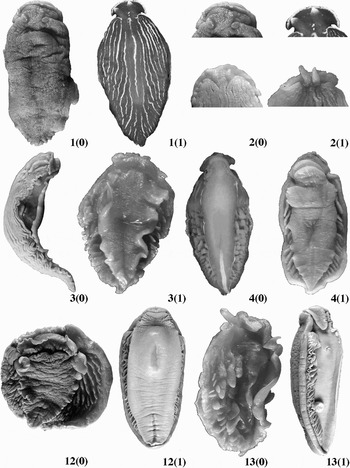
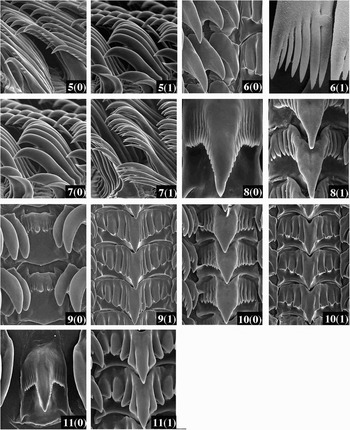
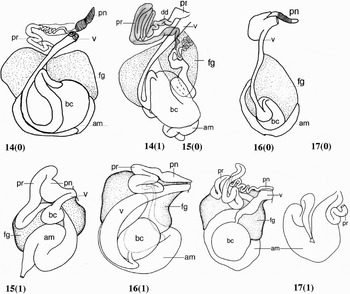
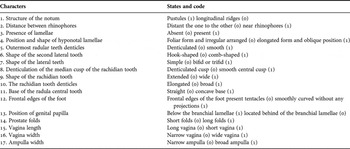
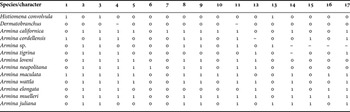
Characters used to determine the phylogenetic relationships of Armina are listed in Table 1 and illustrated in Figures 15–17. Seventeen binary characters were studied. The character states are indicated with numbers: (0) plesiomorphic condition; (1) apomorphic conditions (therefore the polarity of the characters was based on the comparison with the outgroup). Based on the polarities discussed below, the distribution of plesiomorphic and apomorphic character states is found in Table 2. The characters are detailed below:
(1) structure of the notum. Two different notal structures can be observed within Armina in this study: pustules and longitudinal ridges. Although the outgroup have different character states, Dermatobranchus presents the longitudinal ridges on the notum, therefore this state is considered plesiomorphic (0) and the notum with pustules is apomorphic (1);
(2) distance between rhinophores. Histiomena and Dermatobranchus show separated rhinophores (0), in Armina they are close together (1);
(3) presence of lamellae. The absence of lamellae is plesiomorphic (0), its presence apomorphic (1). Dermatobranchus does not have lamellae whereas they are present in Histiomena and all the studied species of Armina;
(4) position and shape of hyponotal lamellae. Only two species, A. juliana and the Californian Armina sp., present foliar, irregularly arranged hyponotal lamellae in the same way as they are observed in H. convolvula; for that reason this state is considered plesiomorphic (0). Most Armina species show hyponotal lamellae elongated and obliquely arranged; this is considered the apomorphic condition (1);
(5) outermost radular teeth denticles. The outermost radular teeth of the eastern Pacific A. cordellensis, Armina sp., the western Atlantic A. elongata and A. juliana, and the Mediterranean A. tigrina are denticulated. Because Histiomena and Dermatobranchus also have denticulated outermost teeth, this condition is considered plesiomorphic (0). Whereas the eastern Pacific A. californica, the Mediterranean A. loveni, A. neapolitana and A. maculata, and the western Atlantic A. muelleri and A. wattla have simple or smooth outermost teeth, this is considered to be the apomorphic (1) state;
(6) shape of the second lateral tooth. In Histiomena, Dermatobranchus and most species of Armina the second lateral tooth is hook-shaped (0). A comb-shaped tooth, observed only in A. neapolitana, is considered to be the apomorphic state (1);
(7) shape of lateral teeth. The lateral teeth of A. californica are bifid or trifid (1), whereas in the rest of the studied organisms they are simple, hook-shaped (0). Nevertheless, the simple lateral teeth can be denticulate;
(8) denticulation of the median cusp of rachidian tooth. In H. convolvula, Dermatobranchus, A. tigrina and A. elongata there are denticles on each side of the median cusp (0), whereas A. californica, Armina sp., A. cordellensis, A. loveni, A. neapolitana. A, maculata, A. wattla, A. muelleri and A. juliana present a smooth central cusp (1);
(9) shape of the rachidian tooth. The rachidian tooth is narrow and extended in A. tigrina and A. elongata, as well as in H. convolvula and this is considered to be plesiomorphic (0). Other studied species of Armina show a wide rachidian tooth (1);
(10) the rachidian tooth denticles. The denticles of the central tooth are slender or elongated (0) in A. cordellensis, Armina sp., A. tigrina, A. neapolitana, A. loveni, A. wattla, A. elongata and A. juliana, as well as the outgroup. In A. californica, A. maculata and A. muelleri those denticles are broad; such a state is considered apomorphic (1);
(11) base of radular central tooth. In H. convolvula, A. tigrina and A. elongata the base of the central tooth is straight (0). Other studied species of Armina show a concave base (1). It was not possible to define this character in Dermatobranchus;
(12) tentacles present on frontal edges of foot. Those tentacles were observed in Histiomena, Dermatobranchus, A. californica, Armina sp., A. maculata and A. juliana; this state is considered plesiomorphic (0). The front edges of the foot are smoothly curved without any projections in A. tigrina, A. loveni, A. neapolitana, A. wattla, A. elongata and A. muelleri; this is the apomorphic state (1). This character was not defined in A. cordellensis;
(13) position of genital papilla. The genital papilla has been observed anterior to the branchial lamellae only in two species examined: Armina sp. from the eastern Pacific and A. juliana from the western Atlantic. This state, also observed in Histiomena, nevertheless is the apomorphic condition (1). In Dermatobranchus the genital opening is located posterior to the branchial lamellae (0), as well as in the rest of the studied species of Armina;
(14) prostate folds. Histiomena, Dermatobranchus, A. cordellensis, A. loveni and A. neapolitana present a prostate with short folds; this state is considered plesiomorphic (0). Other studied species of Armina have long folds (1). It was not possible to define this character in A. tigrina and Armina sp.;
(15) length of the vagina. In Histiomena, Dermatobranchus and most species of Armina the vagina is conspicuously long (0), with a length higher than 50% of the total length of the reproductive system. The vagina of A. juliana, A. muelleri and A. cordellensis is shorter (1);
(16) width of the vagina. In Histiomena, Dermatobranchus and most species of Armina the vagina is conspicuously narrow (0). The vagina of of A. maculata, A. elongata and A. muelleri is wider (1) than in other species of Armina examined in this study; and
(17) width of the ampulla. In Histiomena, Dermatobranchus, A. loveni and A. neapolitana the ampulla is narrow (0); whereas in A. californica, A. cordellensis, A. tigrina, A. maculata, A. wattla, A. elongata, A. muelleri and A. juliana it is broad (1).
External morphological characters studied in the phylogeny of Armina.

Radula characters studied in the phylogeny of Armina.

Internal characters of reproductive system studied in the phylogeny of Armina.

Morphological characters studied in Armina species.

Data matrix of character states in the taxa involved in the phylogenetic analysis. 0, plesiomorphic condition; 1, apomorphic condition; – missing data.

DISCUSSION
Phylogenetic analysis
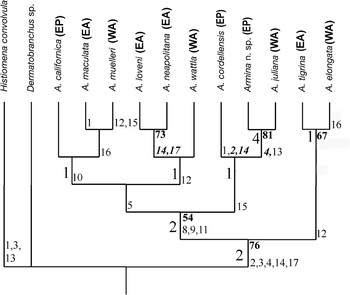
The phylogenetic analysis of the data matrix resulted in a single most-parsimonious tree, 29 steps long. This tree has a consistency index of 0.59 and a retention index of 0.69. The Bremer support analysis shows that most of clades are relatively poorly supported (Figure 18).
Cladogram of the most parsimonious phylogenetic hypotheses of Armina. Decay index is shown on the left side of the branches. Bootstrapping support values are printed in bold on the right side of the branches (50% majority rule, 10,000 replicates). Numbers on the right side of the branches, refer to characters listed in Table 1. Characters printed in bold and italics presented at least one instance of reversal and homoplasy respectively. EP, eastern Pacific; EA, eastern Atlantic; WA, western Atlantic.

Several characters can be used to define the genus as it is currently accepted. Some of these synapomorphies have secondarily reversed in a few species. These characters are: closer distance between rhinophores (character 2); hyponotal lamellae elongated and obliquely arranged (character 4); long prostate folds (character 14); and ampulla broad (character 17). On the other hand, median cusp smooth (character 8); rachidian tooth broad (character 9); and base of central radular tooth concave (character 11) are synapomorphies of Armina, but A. tigrina and A. elongata have lost them secondarily.
The phylogenetic hypothesis produced allowed the identification of four distinct clades within Armina. The first one includes A. californica + A. maculata + A. muelleri, and is characterized having boad rachidian tooth denticles (character 10); this is called ‘clade muelleri’ herein; with its three species sharing 12 states of the 17 characteres. The ‘clade wattla’, formed by A. loveni + A. neapolitana + A. wattla is defined by having front edges of foot without projections (character 12), which also defines the ‘clade tigrina’ composed of A. tigrina + A. elongata. This state is considered homoplasic since it evolved independently in both groups. Another group, ‘clade juliana’, is formed by A. cordellensis + Armina sp. + A. juliana; it is defined by a short vagina (character 15), although this state also appears independently in A. muelleri.
Biogeographical relationships
In the proposed phylogenetic hypothesis there is a clear biogeographical structure that may be related to several instances of possible vicariant events. The ‘clade muelleri’ includes three species from three different biogeographical regions: A. californica, from the eastern Pacific; A. maculata from the Mediterranean; and A. muelleri from the western Atlantic, with the Atlantic species A. maculata + A. muelleri forming a sister clade of the eastern Pacific species A. californica. The split between the eastern Pacific species and the Atlantic clade could be due to the separation of the east–west communication between these two regions as a consequence of the formation of the Isthmus of Panama. This model has been proposed to explain the biogeographical structure in several other clades of opisthobranchs (Gosliner, Reference Gosliner1995; Gosliner & Johnson, Reference Gosliner and Johnson1999; Valdés, Reference Valdés2001). The ‘clade wattla’, contains exclusively Atlantic species, but it is interesting to note that the eastern Atlantic species A. loveni + A. neapolitana are a sister clade of the western Atlantic species A. wattla. A vicariant event related to the enlargement of the Atlantic Ocean could be involved in producing this pattern. The ‘clade juliana’ contains three species, two species belong to the eastern Pacific and one species to the western Atlantic. The eastern Pacific species Armina sp. + the western Atlantic species A. juliana form a sister clade of the eastern Pacific species A. cordellensis. This pattern is similar to the ‘clade muelleri’ and possibly caused by the same events.
In other groups of opisthobranchs studied, eastern Pacific and Atlantic species are generally grouped together in monophyletic groups, sister to each other. In this study, however, the pattern is more complex with several clades containing both eastern Pacific and Atlantic species. These observed differences could be explained by the different levels of diversification that those groups achieved previous to the closure of the east–west communication. Groups that were highly diversified should display more complex patterns with vicariant events widespread throughout their phylogeny. Another possible explanation derives from the fact that all previously studied groups are found on rocky environments and could potentially maintain longer communication than deeper-waters soft bottom groups that would be effectively isolated much earlier.
ACKNOWLEDGEMENTS
This paper was part of the National Science Foundation supported project ‘Phylogenetic Systematics of Nudibranchia,’ funded through the PEET grant DEB-0329054 and partially benefited from the Spanish Ministry of Education and Science grant CGL2006-05182/BOS. The scanning electron microscopy (SEM) work was conducted at the Natural History Museum of Los Angeles County (LACM), supported by the National Science Foundation under the MRI grant DBI-0216506. Giar-Ann Kung assisted with the production of the SEM images at the LACM. We thank the personnel and facilities of the reference collection at California Academy of Sciences, Natural History Museum of Los Angeles County, The US National Museum of Natural History and the Museo de Historia Natural Marina de Colombia for their assistance, and Ana Mejia and Cesar Bautista for their cooperation and support in Los Angeles. This article is the result of the thesis presented by D.P. Báez for the MSc in Sciences—Emphasis in Marine Biology—Universidad Nacional de Colombia.