INTRODUCTION
Treatment of patients with cancer continues to be a therapeutic challenge. This is largely because of the inadequate responsiveness of certain types of cancer to conventional chemotherapeutic and biologic reagents; increased rate of relapse; and the development of other subsequent psychological disorders such as anxiety, depression, and adjustment disorders (De Boer et al., Reference De Boer, Ryckman and Pruyn1999; Smith & Newland, Reference Smith and Newland1999).
The prevalence of psychological distress in the general cancer population is about 1.5–51.9% and varies depending upon the type of cancer and the tools used for assessments (McDaniel et al., Reference McDaniel, Musselman and Porter1995; Pirl, Reference Pirl2004; Mhaidat et al., Reference Mhaidat, Alzoubi and Al-Sweedan2009). In addition, cancer diagnosis adversely affects family members of the patient, particularly those who are giving most of the care, i.e., “caregivers.” Invariably, relatives must deal with the emotional and physical consequences of cancer diagnosis, and the debilitating aggressive treatment regimens. Psychosocial disturbances such as major depression have been reported in 2.1–66.4% of the relatives of cancer patients (Edwards & Clarke, Reference Edwards and Clarke2004; Ozono et al., Reference Ozono, Saeki and Inoue2005; Papastavrou et al., Reference Papastavrou, Charalambous and Tsangari2009; Tsigaroppoulos et al., Reference Tsigaroppoulos, Mazaris and Chatzidarellis2009). Therefore, cancer diagnosis and treatment are considered very stressful events for both patients and their relatives.
The prevalence of psychiatric disorders among cancer patients and their relatives can change in response to several factors that include patient's age, gender, income, cancer type, and phase of treatment (Massie et al., Reference Massie, Gagnon and Holland1994; Wong-Kim & Bloom, Reference Wong-Kim and Bloom2005). We have recently showed a significant association between the occurrence of depression among patients, and knowledge of cancer diagnosis and the stage of the cancer (Mhaidat et al., Reference Mhaidat, Alzoubi and Al-Sweedan2009). In the present study, we investigated the prevalence of depression among relatives of cancer patients in Jordan. We also reported the relation between depression symptoms among relatives of cancer patients and several demographic and disease- associated factors.
METHOD
A cross-sectional survey study was conducted between September 2007 and May 2009 at King Abdullah University Hospital (KAUH), a major university hospital and a tertiary care facility (>400 beds). This hospital is the only cancer treatment facility in the north province of Jordan. The sample for the present study was chosen randomly and included a total of 302 relatives of cancer patients, which represent the 98% of relatives who agreed to participate in this study.
Medical records were reviewed to identify patients with cancer and to evaluate the stage of disease and treatment type. Relatives of cancer patients were privately interviewed in a special room and asked to fill out a questionnaire consisting of two parts. The first part included demographic data, socio-economic status, presence of insurance for the cancer patient, living place, and time to access the hospital from home. Information about cancer patient's relative's knowledge of the cancer diagnosis, type and stage of cancer, and type of treatment, were collected from medical records. The medical records included a note indicating whether the patient's relative knew about the cancer diagnosis. The second part of the questionnaire was concerned with evaluating depression status, and was based on the Hospital Anxiety & Depression Scale (HADS) (Zigmond & Snaith, Reference Zigmond and Snaith1983). Each item in HADS was rated on a four-point scale giving maximum scores of 21. Scores were divided into four ranges: normal (0–7), mild (8–10), moderate (11–15), and severe (16–21) depression.
All participants answered the questionnaire in the presence of a clinical pharmacist, who was trained to conduct the questionnaire by the treating physician. The clinical pharmacist was also involved in the explanation of any patient's relative's concern regarding the study. The interviewers informed all participants that there was no financial reward for their participation. The study's protocol was carried out according to the principles described in the Declaration of Helsinki, including all amendments and revisions. Only the investigators had access to the collected data.
Concerning medical insurance in Jordan, the Ministry of Health insures all governmental employees, retirees, and their families. Jordanian universities provide medical insurance for their students and employees at KAUH. Moreover, the hospital receives a number of patients who are treated at the expense of the Royal Hashemite Court; which is considered a form of medical insurance.
It is important to note that because of the extremely strong social relations and commitments within Jordanian society, it is common for a patient's relatives to be heavily involved in the patient's illness. Therefore, they are considered the equivalent of caregivers in other societies.
Statistical analysis was performed using the Statistical Package for Social Sciences (SPSS) version 15, χ2 test was used. p-value of <0.05 was considered statistically significant.
RESULTS
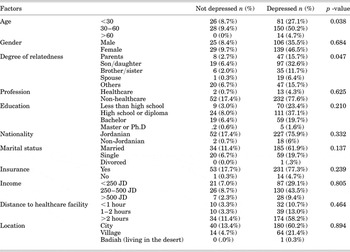
Three hundred and two of the cancer patient's relatives participated in this study; 56% were males and 44% were females with a mean age of 43 ± 6 years. Majority of patients were insured and living in cities, less than one hour away from the healthcare facility. No significant association was detected between the occurrence of depression among cancer patient's relatives and the investigated socio-economic factors except for the degree of relatedness and age. Detailed demography is shown in Table 1.
Relationship between demographic factors and occurrence of depression among relatives of cancer patients

JD = Jordanian Dinar, which is equivalent to about 1.4 U.S. dollars.
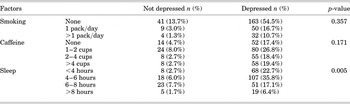
The prevalence of depression among relatives was 81.9% distributed as 24.85% with mild depression, 45.18% as moderate depression, and 11.6% as severe depression. As shown in Table 2, none of the daily habits was significantly correlated to the occurrence of depression except the number of sleep hours. Whereas reduced number of sleep hours has significantly (p ≤ 0.05) contributed to the occurrence of depression among relatives of cancer patients, neither smoking nor caffeine intake showed a significant correlation.
Relationship between daily habits and occurrence of depression among relatives of cancer patients

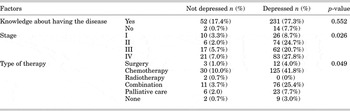
We then studied the relation between disease-related factors such as knowledge of having disease, type of treatment; disease stage, and the occurrence of depression among relatives. Results shown in Table 3 revealed that both the stage of disease and the type of cancer treatment were significantly (p < 0.05) correlated with the occurrence of depression among patient's relatives.
Relationship between disease-related factors and occurrence of depression

DISCUSSION
In the present study, we assessed the prevalence of depression among relatives of cancer patients in Jordan. Results revealed that 81.9% of relatives of cancer patients developed signs and symptoms of depression. Age of patient's relative, sleep disturbances, and the stage of the disease significantly contributed to the development of depression among relatives of cancer patients.
Previous studies have shown that the prevalence of depression in caregivers or relatives of cancer patients was variable and ranged from 2.1 % to 66.4% (Edwards & Clarke, Reference Edwards and Clarke2004; Ozono et al., Reference Ozono, Saeki and Inoue2005; Papastavrou et al., Reference Papastavrou, Charalambous and Tsangari2009; Tsigaroppoulos et al., Reference Tsigaroppoulos, Mazaris and Chatzidarellis2009). In our study, the prevalence of depression (detected by HADS) was found in 81.9% of relatives of patients, which is higher than that reported by other studies. This result points out the need to screen relatives of patients with cancer for depression and to provide early intervention. In addition, this variability might be explained by different samples being studied, assessment measures employed, and different diagnostic criteria applied (Fallowfield et al., Reference Fallowfield, Ratcliffe and Jenkins2001; Jacobsen & Jim, Reference Jacobsen and Jim2008). Moreover, the higher prevalence of depression reported in our study could be because of cultural issues related to the negative public perception about cancer prognosis. Unlike other reports (Papastavrou et al., Reference Papastavrou, Charalambous and Tsangari2009) suggesting that depression is greater in patient's caregivers/relatives with lower income or education, our study revealed no statistically significant association between demographic factors other than age, and occurrence of depression.
Results shown also revealed that relatives of cancer patients at advanced disease stages are more likely to experience depression. This might be because of the higher levels of physical debilitation and advanced illnesses among cancer patients in advanced disease stages (Passik et al., Reference Passik, Dugan and McDonald1998). Moreover, results here showed a correlation between the number of sleep hours and depression. This correlation could be related to the fact that changes in sleep patterns or sleep disturbances are symptoms of depression.
Another factor that influences the prevalence of depression among cancer patients' relatives is the type of therapy used for the patient. Our results indicated a positive association between the type of therapy and depression in that the occurrence of depression was higher with chemotherapy and surgery. Given the potential side effects and potential complications, it is possible that chemotherapy and surgery increase emotional distress and decrease quality of life of patients, which could be negatively affecting the emotional status of patient's relative.
In conclusion, we showed, for the first time, the prevalence of depression among relatives of cancer patients in Jordan as being higher than in other studies conducted in other areas. Positive predictive factors include close relatedness, being middle aged, and patients being in advanced disease stage and on chemotherapy or undergoing surgery for cancer treatment. More attention is needed to detect changes in the psychological state of vulnerable relatives of cancer patients, in an effort to reduce the occurrence of depression.