



Numerous recent reviews have established that immigrant communities, including Asian American and Hispanic groups, face chronic disease disparities compared with the non-Hispanic white population(Reference Kandula, Ahmed and Dodani1–Reference Velasco-Mondragon, Jimenez and Palladino-Davis4). Having a healthy diet, and in particular, consuming fewer packaged and processed foods, and more fruits and vegetables are important components to reducing chronic disease-related morbidity and mortality(Reference Aune, Giovannucci and Boffetta5,Reference Monteiro, Cannon and Moubarac6) . For immigrant communities, disparities in diet quality exist, particularly related to Na, refined grains, sugary drinks and whole fruit consumption(Reference Awata, Linder and Mitchell7–Reference Rehm, Penalvo and Afshin9); however, very few programmes and policies targeting improvement of dietary quality that have been implemented in the past 10 years have been inclusive of these groups(Reference Russo, Li and Chong10). Moreover, studies in immigrants often focus on acculturation, which has been associated with both improved and worse diet quality following migration(Reference Kirshner, Yi and Wylie-Rosett11,Reference Rodriguez, Allison and Daviglus12) and tends to distract from the underlying absence of culturally appropriate programmes and policies. There is a critical need for approaches to address chronic disease disparities for immigrant communities that respect cultural significance of foods and preserve healthful aspects of traditional diets, while promoting new, healthy behaviours(Reference Satia13).
The food retail environment – including both the community nutrition environment and geographical access, as well as the consumer nutrition environment – has been recognised as an important determinant of chronic disease, food access and the ability to achieve a healthy diet(Reference Black, Moon and Baird14–Reference Glanz and Yaroch16). Living in an immigrant neighbourhood has not only been shown to be associated with healthier dietary patterns(Reference Park, Neckerman and Quinn17) and better access to healthy foods(Reference Osypuk, Diez Roux and Hadley18) but also to have a high proportion of fast-food restaurants and ready availability of unhealthy options (i.e. convenience versions of traditional foods high in Na and fat)(19,Reference Galvez, Morland and Raines20) . Little to no characterisation of interaction with the food retail environment or food shopping behaviours amongst immigrant communities exists in the current literature other than a few examples in Hispanic communities(Reference Ayala, Mueller and Lopez-Madurga21–Reference Sanchez-Flack, Baquero and Linnan23). Understanding how immigrant communities interact with the food environment is imperative to identifying culturally appropriate opportunities for nutrition policy and intervention that will act to improve dietary behaviours for these groups in the long term.
Improving the food retail environment, particularly in urban settings, has increasingly become a target of public health intervention and food-related policy. However, the introduction of supermarkets in low resourced areas does not appear to influence changes in diet quality(Reference Cummins, Flint and Matthews24,Reference Elbel, Moran and Dixon25) . One potential explanatory factor for this may be that immigrant communities may procure their food in different ways than the mainstream population, owing to preference for specific cultural ingredients or products, or limited health literacy/English language proficiency. Individuals may be routinely travelling outside of their residential neighbourhood for grocery shopping, and therefore, geographic proximity to a grocery store does not translate to usage. Culturally and linguistically diverse populations have reported rejecting stores that sold unfamiliar items and only frequenting stores with culturally appropriate options and a variety of ethnic foods(Reference Pitt, Gallegos and Comans26). In particular, there is emerging data that immigrant community members travel outside of their neighbourhood to go to the supermarket in New York City (NYC)(Reference Elfassy, Yi and Nonas27). Thus, existing efforts to improve only the geographically proximal food retail environment may have limited impact on immigrant communities. Conversely, stores that specialise in ethnic-specific items may offer a way to reach a large number of individuals who are not from the neighbourhood surrounding that store.
The objective of this analysis was to describe the grocery shopping patterns of one of the largest and underserved immigrant groups in the USA, Chinese Americans. National and local data demonstrate that Chinese Americans have similar poverty rates as other racial/ethnic minority groups (national poverty rate: Chinese American – non-citizen immigrant, 26 %; white, 11 %; black, 26 % and Hispanic, 24 %(28,Reference Echeverria-Estrada and Batalova29) ; NYC poverty rate, Chinese Americans, 21 %; white, 14 %; black, 22 % and Hispanic, 25 %). Yet, broad racial stereotypes, both societally and in the research community, suggesting that this community suffers from few health disparities(Reference Yi, Kwon and Sacks30) and has contributed to limited knowledge of dietary behaviours and a lack of nutrition-related interventions in this group. In NYC, Chinese Americans face a higher burden of a number of diet-related, chronic disease disparities compared with whites, including hypertension, pre-diabetes, stroke and gastric cancer(Reference Fang, Foo and Jeng31–Reference Huang, Li and Tsai34). For Chinese Americans at the national level, hypertensive heart disease in adults(Reference Jose, Frank and Kapphahn35) and non-alcoholic fatty liver disease and obesity in children have emerged as particular issues(Reference Malespin, Sleesman and Lau36,Reference Zhou and Cheah37) . In characterising the interaction of Chinese Americans with the food retail environment, the goal of this analysis is to highlight potential mechanisms by which this population may be reached (e.g. leveraging ethnic grocery stores as a gathering place for Chinese American community members across the metropolitan area) and how new interventions may be developed (e.g. connecting Chinese Americans to non-ethnic, but more proximal stores) to improve food access, diet and ultimately stem the emerging tide of chronic disease within this group.
Methods
Study design and participants
The Examining Norms and Behaviors Linked to Eating (ENABLE) Pilot Study focused on Chinese American adults and families led by the NYU Center for the Study of Asian American Health in 2018. Settings and venues to reach participants were co-identified with the help of partnering community-based organisations serving the Chinese American community in NYC. In-language (simplified Chinese) fliers were hung at three different community locations to introduce the study prior to being onsite. Study staff were then available at times before, during and after regularly scheduled classes (e.g. cooking class, English as second language class) to invite participants to fill out the ENABLE survey. Recruitment also occurred at two health fairs. Participants were also recruited via emails addressed to NYU Center for the Study of Asian American Health’s vast community-based organisations partner network; an online REDCap(Reference Harris, Taylor and Thielke38) survey in both English and simplified Chinese was circulated. Participants were eligible for inclusion in the study if they self-identified as Chinese American and if they responded they would be able to answer questions related to grocery shopping. Data collection occurred from February to June 2018.
Participants who met eligibility criteria completed surveys with trained, bilingual research staff or were also given the option to complete the survey online. The survey was developed with input from community partners and focused on aspects of the food environment. Questions assessed whether participants shopped in their neighbourhood of residence, the closest store to their residence, the details (i.e. store names, addresses and cross streets) of the top three stores where their family purchased groceries, frequency and the reasons for shopping at these stores. The reasons for shopping at the stores were derived from the published literature in Black and Latinx populations, and through conversations with community-based organisations partners(Reference Sanchez-Flack, Baquero and Linnan23,Reference Pitt, Gallegos and Comans26,Reference DiSantis, Hillier and Holaday39) . Questions developed for this survey are available in Supplemental File 1. Participants were provided with an incentive of their choice (i.e. gift card and umbrella) valued at $10.
Measures and statistical analysis
The list of grocery stores derived from participant surveys was compared with the 2016 New York State Agriculture and Markets (NYS Ag & Markets) list. The NYS Ag & Markets list includes all stores in the state of New York that sell perishable food items. First, the named grocery store was verified to be on the NYS Ag & Markets list using store name, address (cross streets from ENABLE data), zip code and store number if available (e.g. chain stores). These multiple factors for verification were required because there were some national chains named with more than one location (e.g. Costco), and in other cases, similar names of local stores (e.g. New York Mart; New York Supermarket). The exact address was derived for each location, and the names cleaned to be consistent so as not to cause duplicates in the data. Using the cleaned list of named grocery stores, two Chinese American community health workers independently searched on Google and yelp and identified whether the store was ‘ethnic’ or ‘non-ethnic’. An ethnic store was defined as one that appeared to carry mostly culturally specific or specialty produce or items; culture was not limited to Chinese – it could be predominantly Chinese, Japanese, Mexican, Korean, etc. This was a relatively straightforward process – in particular because many of the non-ethnic stores named were larger local or national chains (e.g. Key Food in NYC and Trader Joe’s). Any discrepancies were discussed between the two staff members and with Dr S.S.Y.
Using an emergent approach to categorisation, shopper pattern types were identified (see Results). Demographic, sociocultural and health characteristics were assessed according to shopping pattern types. Sex, education (college graduate v. less than college graduate), income (>$55 000 per year v. ≤$55 000 per year), insurance (Medicaid, Medicare, Other public, Private and None), English proficiency (speak English very well v. speak English well, not well or not at all), nativity (US born v. foreign born), self-rated health (fair/poor) and self-rated diet (fair/poor) are reported in percentages. Mean age, years in the USA and acculturation were calculated. Acculturation was based on the Stephenson Multi-group Acculturation Scale(Reference Stephenson40). Two dimensions were explored: dominant society immersion – for example adopting behaviours, attitudes (‘I regularly read American magazines/newspapers’, ‘I feel at home in the United States’); and ethnic society immersion – e.g. cultural traditions, speaking the native language – or language of the country of one’s Asian ancestry (‘I eat traditional foods from my native country’; ‘I think in my native language’). The Stephenson Multi-group Acculturation Scale consists of a fifteen-item dominant society immersion subscale and seventeen-item ethnic society immersion subscale(Reference Stephenson40). Each subscale is averaged to produce an estimate of acculturation for each respective dimension with a maximum possible value of four for either subscale. The reasons for shopping at different stores were also assessed according to shopping pattern types. Food insecurity was assessed using the two-item set of questions validated by Hager et al.(Reference Hager, Quigg and Black41). Participants were also asked their opinion about future programming.
Grocery store and home location data were geocoded using a combination of Texas A&M University geocoding services(42), Google Maps and geosphere packages in R (3.5.0) and RStudio v.1.2.5. Exact addresses were used for grocery store locations; however, zip codes were used for the home locations. To maximise participation amongst community members, some who may be reluctant to share precise address, we allowed for participants to report their zip code only. For home location, the distHaversine function in the geosphere package of R was used, which uses the haversine formula to determine the distance between two points on a sphere given latitude and longitude. It uses the centroid of the participant’s zip code as a proxy for home location. Straight line distance in miles between home and store location latitude and longitude coordinates was calculated, and shopping routes to the top forty primary grocery stores were visualised using curved lines to show the relative distance. Comparisons of participant characteristics by shopping pattern type were conducted using t tests and linear regression models for continuous variables, and χ 2 tests and multiple logistic regression models for categorical. Data were analysed using STATA v. 15.0.
Results
A total of 239 people participated in the ENABLE survey. Due to missing data, 234 participants were included in the analysis (n 5 missing information on grocery shopping) and 227 participants were included in the geographic analysis (n 8 missing zip code). Table 1 presents demographic characteristics of study participants. Approximately two-thirds of participants resided in Manhattan (34·2 %) and Brooklyn (33·3 %). The majority of individuals had a college degree or more (60·4 %), nearly half were on public insurance (45 %) and approximately one-third were categorised as food insecure (35·1 %) or spoke English very well (30·2 %). Of individuals who were born outside of the USA, the mean time spent in the USA was 16 years. Around one-fifth of participants self-reported fair or poor diet quality (21·3 %), and approximately one-sixth of participants self-reported fair or poor health (16·1 %). When asked which suggested programmes they would prefer to improve eating habits, a majority of individuals supported nutrition education (69·9 %) and advertising for healthy foods (56·5 %).
Demographic characteristics of Examining Norms and Behaviors Linked to Eating participants
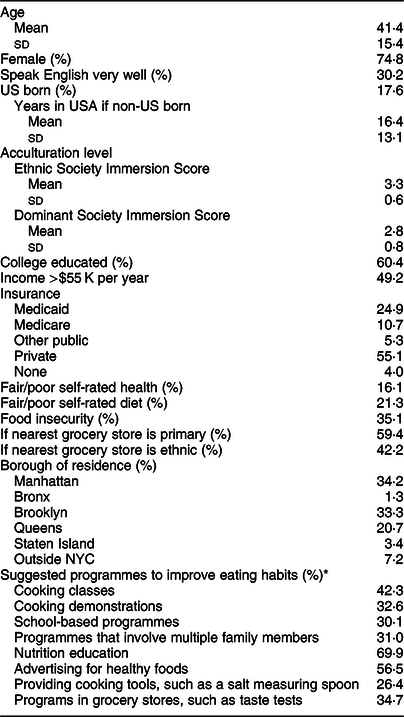
* Response to question: what do you think can be done to improve the eating habits of people in your neighbourhood? Select all that apply.
Characteristics of the grocery stores (i.e. ethnic v. non-ethnic) and frequency of shopping were used to categorise grocery shopping patterns. As these patterns have not been previously established, strict a priori assumptions were not applied to the categorisation process. However, based on the formative research in the community, it was hypothesised that at least two patterns would emerge: (1) those who shopped at an ethnic store as their primary store and (2) those who shopped at a non-ethnic store as their primary store, but supplemented their shopping less frequently at an ethnic store. Instead, three distinct patterns emerged, which are described below. The first step of the categorisation process was to characterise weekly shopping at a grocery store (yes/no); twenty-nine individuals reported not performing weekly grocery shopping. These individuals were considered separately from those who performed weekly grocery shopping for two reasons. The first reason was conceptual: those who are only shopping every other week may be ordering out more and/or not cooking. Second, similar to analyses of consumption of a specific item (e.g. sugary drinks), non-consumers are considered separately from those who do report consumption. These twenty-nine individuals were categorised as type 3 shoppers (12 %). Of the remaining participants who did perform weekly grocery shopping, we then differentiated those whose primary grocery store was ethnic (n 108, 47 %;type 1) and those whose primary grocery store was non-ethnic (n 94, 41 %; type 2).
Type 1 (v. type 2, type 3) shoppers tended to speak English less well (18·4 v. 41·4, 55·6 %); have lower levels of education (37·5 v. 78·0, 92·6 % with college degree) and income (36·1 v. 59·3, 56 % making ≤$55 000 per year); to be on public insurance (57·6 v. 22·8, 35·7 %); have fair/poor self-rated diet (28·7 v. 12·8, 20·7 %) or be food insecure (47·2 v. 24·2, 14·8 %; Table 2). Conversely, type 2 and type 3 (v. type 1) shoppers tended to be US born (24·7, 35·7 % v. 6·7 %); more acculturated to American society, with higher dominant society immersion (greater identification with the dominant, American, society), and lower ethnic society immersion (less identification towards the ethnic, Chinese, society). Type 1 (v. type 2, type 3) shoppers were also more likely to have their nearest grocery store be an ethnic grocery store (71·7 v. 12·8, 31 %).
Comparison of shopper type characteristics
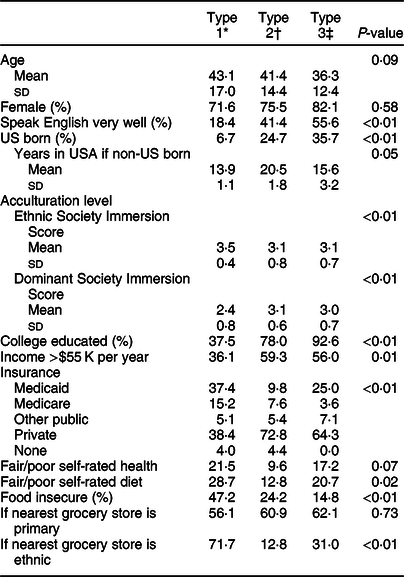
* Type 1: performed weekly shopping at their primary ethnic grocery store.
† Type 2: performed weekly shopping at their primary non-ethnic grocery store.
‡ Type 3: did not perform weekly shopping.
Shopper types differed somewhat with regard to the reasons why they shopped at their primary store (Table 3). Type 1 shoppers prioritised proximity to places they frequented and language (product labelling, spoken by cashiers). Type 2 shoppers prioritised food quality and cleanliness, and type 3 shoppers prioritised ease and availability of items/brands they wanted to buy.
Top five reasons for shopping at primary store by shopper type
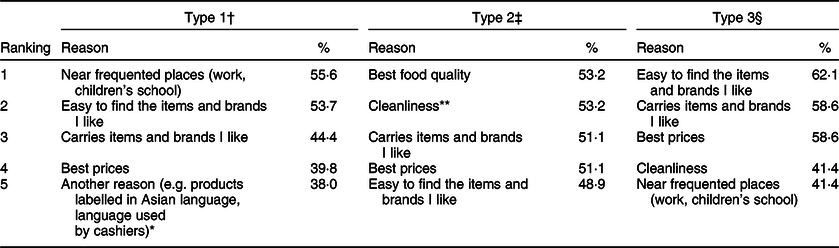
* P < 0·01 v. % of type 2 or type 3 shoppers who indicated this reason (type 2: 7·5 %; type 3: 13·8 %).
** P = 0·01 v. % of type 1 or type 3 shoppers who indicated this reason (type 1: 30·6 %; type 3: 41·4 %).
† Type 1: performed weekly shopping at their primary ethnic grocery store.
‡ Type 2: performed weekly shopping at their primary non-ethnic grocery store.
§ Type 3: did not perform weekly shopping.
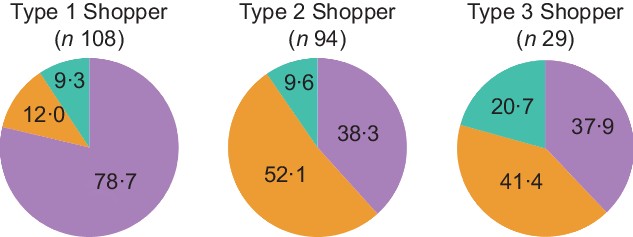
The majority of type 1 shoppers (78·7 %) did not shop at any grocery stores in addition to their primary ethnic store, while more than half of type 2 shoppers (52·1 %) shopped at an ethnic grocery store in addition to their primary non-ethnic store (Fig. 1).
Shopping at additional stores across shopper types
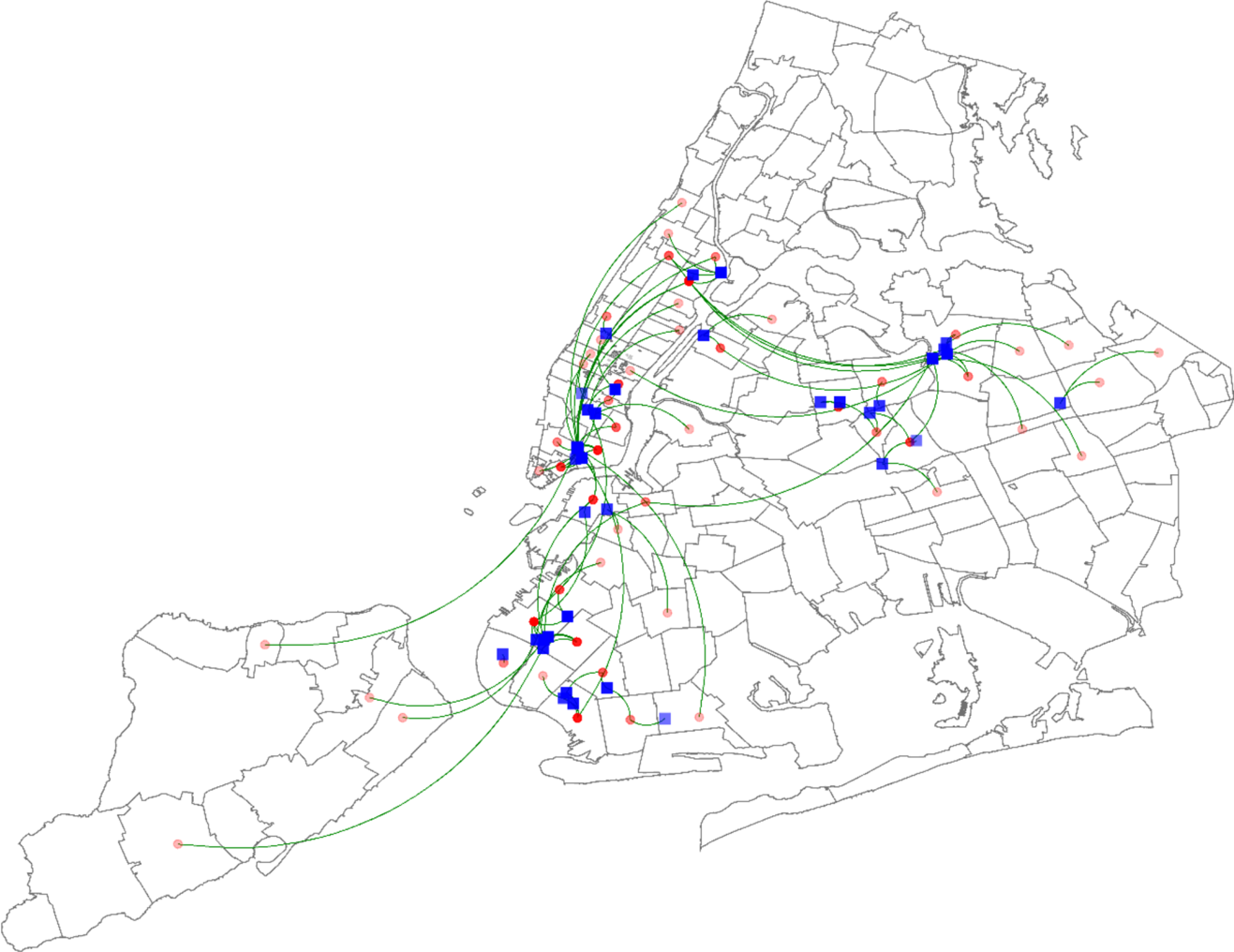
The straight line distance between participant homes and stores ranged between 0·07 and 26·78 miles with a median of 0·79 miles and an interquartile range of 0·44–1·90 miles. Shopping routes to the top forty primary stores are visualised in Fig. 2. Distance travelled to a primary grocery store differed by shopping pattern type. Type 1 shoppers travelled the furthest distance to their primary grocery store (M = 2·88 miles; sd = 5·16), whereas type 2 shoppers travelled the least distance (M = 1·33 miles; sd =1·96). On average, type 1 shoppers travelled over 1·5 miles further (β = −1·55; 95 % CI −2·81, −0·30) to access their primary grocery store when compared with type 2 shoppers.
Shopping routes (green curves) between approximate homes (red dots) and top forty primary stores (blue squares). Straight line distance in miles between home and store location latitude and longitude coordinates was calculated, and shopping routes to the top forty primary grocery stores were visualised using curved lines to show the relative distance
Discussion
This study assessed the grocery shopping patterns amongst urban dwelling Chinese Americans. Three primary patterns of shopping were identified: type 1: performed weekly shopping at their primary ethnic grocery store; type 2: performed weekly shopping at their primary non-ethnic grocery store and type 3: did not perform weekly shopping. Differences in demographic characteristics emerged based on the type of shopping. Type 1 shoppers tended to have lower levels of education and income; to be on public insurance and to be food insecure, whereas type 2 shoppers were more acculturated to American society. Type 3 shoppers were more similar to type 2 than type 1 shoppers, but were also unique according to specific characteristics: for example, like type 2 shoppers, they had high acculturation and education levels, but more similar to type 1 shoppers, a modest proportion of them reported their nearest grocery stores as being an ethnic store (i.e. proxy for ethnic neighbourhood residence). We conjecture that type 3 shoppers may be important to treat as distinct from those who perform grocery shopping more frequently. First, because they may have alternative consumption patterns (e.g. consuming more ‘prepared foods’ and cooking less meals at home)(Reference Wolfson and Bleich43), and second, because this subgroup may require a different type of health intervention that encourages cooking at home or making healthier choices when eating out rather than being focused on grocery stores or grocery shopping.
Overwhelmingly, type 1 shoppers exclusively shopped at ethnic grocery stores; only a small percentage shopped infrequently at another store that was non-ethnic. Type 1 shoppers tended to be less acculturated to US society and to be more disadvantaged, with lower levels of income and education, and higher levels of food insecurity. While the authors are not aware of this being previously characterised in Chinese Americans, this finding is consistent with prior work indicating low acculturation level to be associated with preferences for Hispanic grocery stores (tiendas) amongst Latina women in California(Reference Ayala, Mueller and Lopez-Madurga21,Reference Emond, Madanat and Ayala44) . Low-income ethnic minorities in London (Afro-Caribbeans, South Asians) have also reported a preference for shopping at ethnic grocery stores(Reference Rawlins, Baker and Maynard45). For the type 1 shoppers in this sample of Chinese Americans, a combination of limited English proficiency and corresponding preference for in-language signage or clerks, limited knowledge on preparation of non-Chinese foods(Reference Zhou and Cheah37), and relatedly, a preference for cultural foods may be operating in concert to contribute to the higher burden of food insecurity.
Cooking traditional meals is an important means to preserve cultural identity in immigrant communities. Availability of culturally specific foods has considerable influence on shopping behaviour. In this study, type 1 shoppers tended to report that the most important reason for shopping at their primary grocery store was because it carried brands/items that they liked(Reference Rawlins, Baker and Maynard45–Reference Webber, Sobal and Dollahite47). On average, type 1 shoppers travelled one and a half miles further to their primary grocery store. Walkability to stores is often a priority for low-income and minority populations, given the lack of resources (i.e. money and time)(Reference Pitt, Gallegos and Comans26). However, the present findings indicate that cultural identity may take priority over convenience for Chinese American immigrants given that individuals travelled further to obtain culturally relevant foods – a pattern which may be generalisable to other groups.
Grocery store-based interventions have been shown to be a promising setting in which to provide education and improve healthful behaviours in immigrant communities(Reference Ayala, Mueller and Lopez-Madurga21,Reference Sanchez-Flack, Baquero and Linnan23,Reference Truong, Tat and Booy48) . For the Asian American community in particular, one stellar programme, the University of California at San Diego Moores Cancer Center’s Asian Grocery Store-Based Cancer Education Program, has been demonstrated as an effective and sustainable strategy for disseminating cancer-related information to Asian and Pacific Islander communities(Reference Truong, Tat and Booy48). Beyond this example, however, to our knowledge, there few other grocery store-based interventions have been empirically tested in the Asian American community.
Third places – or social, public gathering places apart from home or work(Reference Oldenburg49) – have been identified as potentially effective settings to improve people’s health. We conjecture that ethnic grocery stores have been underutilised as a potential third place for reaching Asian American and other immigrant communities. Potential interventions include those that have been demonstrated to be effective for other racial/ethnic groups, such as pricing or economic incentives, nutrition education or grocery store tours(Reference Adam and Jensen50,Reference Nikolaus, Muzaffar and Nickols-Richardson51) . In this sample of Chinese Americans, the majority of participants supported nutrition education. Prior efforts that have trained community members to disseminate culturally tailored messages have been particularly effective at increasing purchase of heathy foods in racial/ethnic minority communities(Reference Adam and Jensen50). Another potential intervention might be taste tests – for unfamiliar foods (e.g. bok choy for Hispanic communities), new preparations of foods (e.g. consuming uncooked vegetables for Chinese communities) or culturally stigmatised foods (e.g. brown rice in East Asian communities)(Reference Gore, Patel and Choy52–Reference Wong, Russo and Min54).
Initiatives at non-ethnic grocery stores are also important. Connecting less acculturated shoppers with nearby non-ethnic grocery stores might decrease food insecurity, especially among those who use resources to travel further distances to ethnic stores. Additionally, shoppers may feel more social connectedness in the community as a result of shopping at the local store, interacting with their neighbours, or with familiar store clerks – which might act to ‘substitute’ similar feelings of cohesion within their ethnic store. Involving producers and distributors in increasing access to ethnic food items in stores has also been shown to improve food access for these individuals(Reference Adam and Jensen50).
There are a few limitations to note. The study was cross-sectional, which may limit interpretations of associations. Data were self-reported, and as such might be subject to social desirability bias. Additionally, the sample was not systematically recruited, so the results may not be generalisable to all Chinese American immigrants. Home addresses were not collected from participants to maximise participation rates; thus, zip codes were used to represent the home location in the geographical analysis. Further, straight-line distance was used to approximate distance. As a result of both of these methods, the distance to grocery stores may be under- or overestimated, but it is a simple way to give a relative comparison of the travel distance between participants and their nearest shops. Distance was also not a primary exposure or outcome of this study; thus, we feel the characterisation of the data in this way was appropriate. Last, we do not have measures of diet, items consumed or purchased, beyond the ‘overall rating of diet’ question; however this question has been previously shown to correspond to the diet quality and the Healthy Eating Index(Reference Adjoian, Firestone and Eisenhower55). Despite these limitations, our study fills an important research gap about the grocery shopping patterns amongst Chinese Americans and provides important evidence for designing targeted, effective interventions to improve the diet of this understudied population.
There are distinct behavioural and geographical grocery shopping patterns amongst urban dwelling Chinese Americans. Identifying such patterns may help to reach this understudied group through tailored health interventions. Similar patterns may exist among other immigrant groups in urban settings. Approaches including nutrition education and/or social marketing of healthy foods in key social gathering locations, that is ethnic grocery stores, may help to improve diets in Chinese Americans and other immigrant communities. Alternative strategies for reaching those who do not perform regular grocery shopping should also be explored. Last, understanding these distinct patterns and accompanying acculturation level may also help to improve the feasibility, acceptability and longer-term sustainability of nutrition interventions in immigrant populations.
Acknowledgements
Acknowledgements: The authors would like to thank our study participants, Ziwei Ran, Funing Yang, Alice Liang, Judy Ah-Yune and the East Harlem Health Action Center for their invaluable contributions to this project. The authors would also like to thank the reviewers and editor for their helpful comments in reshaping this manuscript. Financial support: This research was supported in part by NIH/National Institute on Minority Health and Health Disparities (U54MD000538) and National Heart, Lung, and Blood Institute (R01HL141427). The contents of this publication are solely the responsibility of the authors and do not necessarily represent the official views of the NIH. Conflict of interest: None. Authorship: S.S.Y. conceived the paper; S.S.Y., R.G.R. and B.L. ran analyses; S.K., P.R. and Y.L. provided critical feedback; and S.S.Y., R.G.R. and B.L. contributed text and final edits. Ethics of human subject participation: This study was conducted according to the guidelines laid down in the Declaration of Helsinki, and all procedures involving study participants were approved by the Institutional Review Board at the NYU School of Medicine. Written informed consent was obtained from all subjects/patients.
Supplementary material
For supplementary material accompanying this paper visit https://doi.org/10.1017/S1368980020002682



