Implications
Organic rabbit producers lack knowledge about herbage intake and weight gain for rabbits raised on pastures. To ensure productivity, rabbits are fed a supplemental cereal/legume mixture or commercial pelleted feeds. This article provides original results that describe factors that restrict herbage intake and their implications for rabbit growth under several pasture type, herbage allowance and quality conditions, with a restricted amount of pelleted feed. When rabbits graze on pastures dominated by legumes, weight gain can exceed 20 g/day, which is sufficient to reach commercial weight after 55 days of fattening. Farmers may want to consider advantages of introducing legumes into pastures for rabbit grazing.
Introduction
For organic rabbit producers, herbage is the least expensive, but also least known, the source of feed, particularly in terms of intake and nutritive value. Therefore, a better understanding of herbage intake is needed to appropriately adjust the size of the grazing area and the amount of feed supplementation with cereal/legume mixtures or commercial pelleted feeds (ITAB, 2010; Martin et al., Reference Martin, Duprat, Goby, Theau, Roinsard, Descombes, Legendre and Gidenne2016). In an initial study, Martin et al. (Reference Martin, Duprat, Goby, Theau, Roinsard, Descombes, Legendre and Gidenne2016) estimated that, in the conditions of their study, herbage represented 43% (30.6 g dry matter (DM)/kg metabolic weight (MW), equal to kg0.75) of daily total intake (71.4 DM/kg MW) for grazing rabbits in organic production. Rabbits use herbage efficiently (Martin et al., Reference Martin, Duprat, Goby, Theau, Roinsard, Descombes, Legendre and Gidenne2016), meaning that they graze a large part of the biomass offered to them. However, rabbits tend to be selective and prefer young and protein-rich vegetation (Cooke, Reference Cooke2014; Gidenne, Reference Gidenne2015).
To improve grazing management in organic rabbit systems, it is particularly important to identify factors that influence rabbit herbage intake and their consequences for rabbit growth and health. Xiccato and Trocino (Reference Xiccato and Trocino2010) indicated that rabbits have a highly effective appetite control that is regulated by a chemostatic mechanism when digestible energy (DE) in the diet exceeds 9.0 to 9.5 MJ/kg DM. Below 9.0 MJ DE/kg DM, stomach capacity may limit intake (Gidenne, Reference Gidenne2015). Currently, few data are available to assess herbage intake according to the management of rabbits fattened on pastures: area per rabbit, herbage allowance, etc. Martin et al. (Reference Martin, Duprat, Goby, Theau, Roinsard, Descombes, Legendre and Gidenne2016) indicated that herbage allowance was the main determinant of herbage intake in the conditions of their study. The aim of this study was to characterise rabbit herbage intake and weight gain, and the factors that restrict them under different pasture type, herbage allowance and quality conditions (owing to the season, climate, pasture plant species and grazing management).
Material and methods
Experimental design
The study was performed at the experimental unit of Perpignan University in France, under a Mediterranean climate, and according to French organic standards for rabbit farming. Three trials were conducted in winter 2014/15, summer 2015 and spring 2016 (one per season) to obtain a wide range of herbage allowance and quality conditions. Table 1 lists the main characteristics of each trial. Each trial began at weaning (around 45 days old), when rabbits were transferred to moving cages and ended at slaughter (100 days old). Within each trial, 30 rabbits were allocated to 10 moving cages (three rabbits per cage) with 0.4 m2 of grazing area per rabbit (the minimum density specified by the standards). Cages were moved each morning. Rabbits that died (two in trial 1, one in trial 2 and two in trial 3) were not replaced. Rabbits were hybrids of traditional breeds (Fauve de Bourgogne and Papillon) and were born at the experimental unit.
Main characteristics (mean±1 SD) of the trials on organic rabbit production

GRF=GRass and Forbs; LEG=LEGumes; NMP=natural Mediterranean pasture; DM=dry matter.
* Rabbits on Sainfoin were moved to Clover on day 49 for 12 days.
During each trial, one group (five moving cages) of rabbits grazed pastures dominated by legumes (LEG, mainly sainfoin – Onobrychis viciifolia) and one group (five moving cages) grazed pastures dominated by grasses and forbs (GRF). Groups were balanced according to weight at weaning and litter of origin. Five pastures were grazed:
i. a pure stand of tall fescue (Festuca arundinacea) (winter 2014/15 and spring 2016);
ii. a natural Mediterranean pasture (NMP) dominated by grass species (summer 2015);
iii. a pasture dominated by sainfoin (winter 2014/15 and summer 2015 with irrigation, with 70% and 56%, respectively, of aboveground DM in sainfoin);
iv. another pasture dominated by sainfoin (spring 2016, 70% sainfoin); and
v. a pasture dominated by subterranean clover (Trifolium subterraneum) (winter 2014/15). Owing to insufficient sainfoin area, rabbits were moved in this pasture on day 49 for 12 days.
In addition to grazing, rabbits received a complete organic pelleted feed. According to the supplier (EVIALIS, Saint Nolff, France), it contained 86.5% DM, 16.5% CP (N×6.25), 3.5% crude fat, 37.5% NDF, 21.2% ADF and 9.60 MJ DE/kg DM, and was made up of wheat bran (38.1%), lucerne (35%), sunflower meal (18.6%), maize (5%), bentonite (2%), soya bean meal (1%), calcium carbonate (0.2%) and sodium chloride (0.1%). The pelleted feed was limited to 60 g fresh matter (FM)/rabbit per day, and was always completely consumed by the rabbits.
Grazing measurements
Herbage samples were collected weekly at two locations (0.25 m2 each) for each cage: on the side of the cage, to measure herbage allowance, and in the former cage location immediately after moving the cage, to measure grazing refusals. Electric grass shears were used to cut herbage at the height of 3 cm. Samples were weighed (corresponding to FM), dried at 60°C for 48 h and weighed again to estimate DM concentrations. Herbage intake was estimated as the difference between herbage allowance and refusals, and expressed per kilogram of MW. Fibre concentrations (NDF and ADF) of herbage allowance and refusals were measured according to the sequential procedure of van Soest et al. (Reference van Soest, Robertson and Lewis1991) every 3 weeks. Crude protein concentrations of herbage allowance and refusals were measured weekly according to the Dumas method (NF ISO 16634-1, 2008), including full combustion of the samples and analysis of the resulting nitrogen gas using a vario EL cube instrument (Elementar Analysensysteme GmbH, Hanau, Germany). Fibre and CP concentrations of herbage intake were calculated as the weighted mean difference between concentrations of herbage allowance and refusals. Digestible energy of herbage intake was then calculated with the equation of Fernández-Carmona et al. (Reference Fernández-Carmona, Cervera and Blas1996) as a function of ADF concentration:
 $${\rm DE}{\equals}15.9{\minus}0.219{\,\times}{\rm ADF}$$
Individual rabbits were weighed weekly. Mean daily weight gain was calculated for each week and the fattening period. A subset of the rabbits were slaughtered following the French regulations on animal welfare, that is, with electric stunning before slaughter, on day 50 for trial 1 (one rabbit per cage), and at the end of the fattening for trial 2 (two rabbits per cage) and trial 3 (three rabbits per cage). Their gastrointestinal tracts were extracted and weighed.
Data analysis
Data considered unrealistic for herbage intake were removed. Based on the frequency analysis of rabbit DM intake, we removed outliers that lay outside 0 to 90 g DM/kg MW. Outliers may be related to measurement errors because of variability in herbage biomass, sampling difficulties when herbage is the dense or little difference between allowance and refusals when allowance is high. In total, 216 observations, from 300 possible observations, were retained. Logarithmic regressions of herbage intake as a function of herbage allowance were calculated. Analysis of variance was performed to determine the effect of pasture type (two levels, 216 observations) on herbage allowance, intake and refusals, CP and DE concentrations, DE and CP intake. Type III ANOVA with Helmert contrast was also performed for herbage allowance, intake and refusals, CP and DE concentrations, DE and CP intake to determine the effect of conditions (pasture type×season, seven levels, 216 observations) using R software (‘car’ package). The Tukey’s posthoc test was used to test differences across all pasture type×season combinations using P<0.05 as the significance threshold. Digestible energy intake and CP intake (mean per cage from weaning to the end of the experiment) were the most relevant indicators of the nutrition level from quantitative variables measured or calculated in our study. Regression analysis was performed to determine the effect of DE intake (after log-transforming) and CP intake (after log-transforming) on daily weight gain (35 observations). Afterwards, logarithmic regressions of daily weight gain as a function of CP intake were calculated.
Results
Herbage allowance and quality
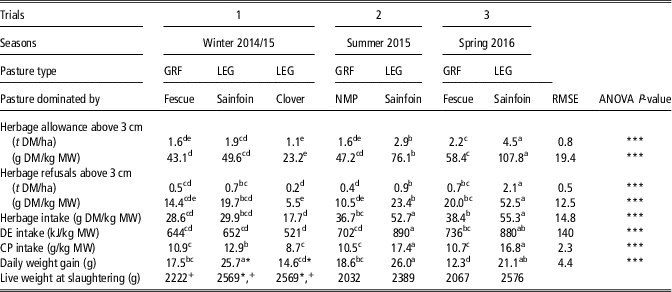
As herbage allowance was not controlled, it varied widely (54.7±48.6 g DM/kg MW). Over the three seasons, mean herbage allowance was 27% higher (P<0.01) in LEG (62.3 g DM/kg MW) than in GRF (49.2 g DM/kg MW) (Table 2). Crude protein concentration was 141.6 g/kg DM on average, but 56% higher (P<0.01) in LEG than in GRF (179 and 115 g/kg DM, respectively). Digestible energy concentration of herbage allowance was 9.1 MJ/kg DM on average, and lower in LEG than in GRF (9.0 and 9.2 MJ/kg DM, respectively, P<0.05).
Analysis of variance analysis of the effect of pasture type×season on herbage allowance and refusals, digestible energy (DE) and CP intake, rabbit weight gain and live weight at slaughtering

GRF=GRass and Forbs; LEG=LEGumes; RMSE=root mean square error; NMP=natural Mediterranean pasture; DM=dry matter; MW=metabolic weight.
a,b,c,d,eValues with different superscripts differ significantly at P<0.05 (Tukey’s posthoc test).
* Rabbits on Sainfoin were moved to Clover on day 49 for 12 days.
+ Live weights were measured for all rabbits on day 50 before one rabbit from each cage was slaughtered.
***P<0.01.
Herbage intake
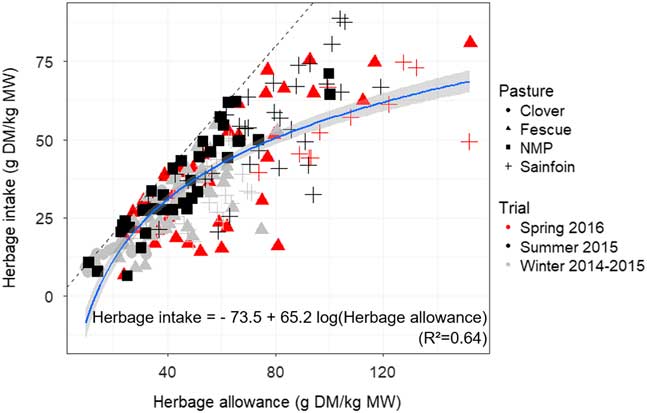
As expected, herbage intake varied greatly (36.3±18.0 g DM/kg MW) among trials and pasture types (Table 2). Mean herbage intake was higher in LEG than in GRF (39.5 and 34.1 g DM/kg MW, respectively, P<0.05, Table 2) and increased (28 to 60 g DM/kg MW) with rabbit mean live weight (1.24 to 2.37 kg). Herbage intake (HI) was logarithmically related to herbage allowance (HA) and increased to a plateau (Figure 1):
 $${\rm HI}{\equals}{\minus}73.5{\plus}65.2{\times}{\rm log}\left( {{\rm HA}} \right)\left( {R^{2} {\equals}0.64,\,P\,\lt\,0.001} \right)$$
(Colour online) Logarithmic relationship (solid line) between herbage allowance and herbage intake (g dry matter (DM)/kg metabolic weight (MW)) by rabbits. The dashed line corresponds to situations where herbage intake is equal to herbage allowance. Pastures dominated by legumes are clover and sainfoin, the others are dominated by grass and forbs. NMP=natural Mediterranean pasture.

Only 30 observations of herbage allowance (out of 216) were considered unrestricting, as they exceeded 85.0 g DM/kg MW. The maximum of mean herbage intake within a cage measured in these conditions was 88.7 g DM/kg MW in LEG and 81.0 g DM/kg MW in GRF. Mean CP concentration in herbage intake was 164 g/kg DM, but was 58% higher in LEG than in GRF (208 and 132 g/kg DM, respectively, P<0.01). The calculated DE concentration (9.8 MJ/kg DM) did not differ according to pasture type.
Total intake
Pellet intake averaged 34 g DM/kg MW (it was limited to 54 g DM/day per rabbit). This corresponds to about 51% of total DM intake. The highest total intake expressed in DM was observed during summer on NMP with 103.7±9.0 g DM/kg MW, corresponding to 468 g FM/kg MW. Total FM intake equalled 17% of BW on average, but the maximum intake as a percentage of rabbit BW, 42% (840 g FM/rabbit of 2 kg or 499 g FM/kg MW), occurred during spring on sainfoin when DM concentration in herbage intake fell to 13% (mean=25%).
Mean CP intake was 12.9±3.5 g/kg MW. It was higher in LEG (15.0±4.3 g/kg MW) than in GRF (10.7±2.0 g/kg MW, P<0.01) (Table 2). Mean DE intake was 709±176 kJ/kg MW and it did not differ significantly (P=0.08) between LEG and GRF; however, DE intake was 27% higher in LEG than in GRF in summer (Table 2). The highest DE intakes were observed on sainfoin in summer (1035 kJ/kg MW) and in spring (1019 kJ/kg MW).
Daily weight gain
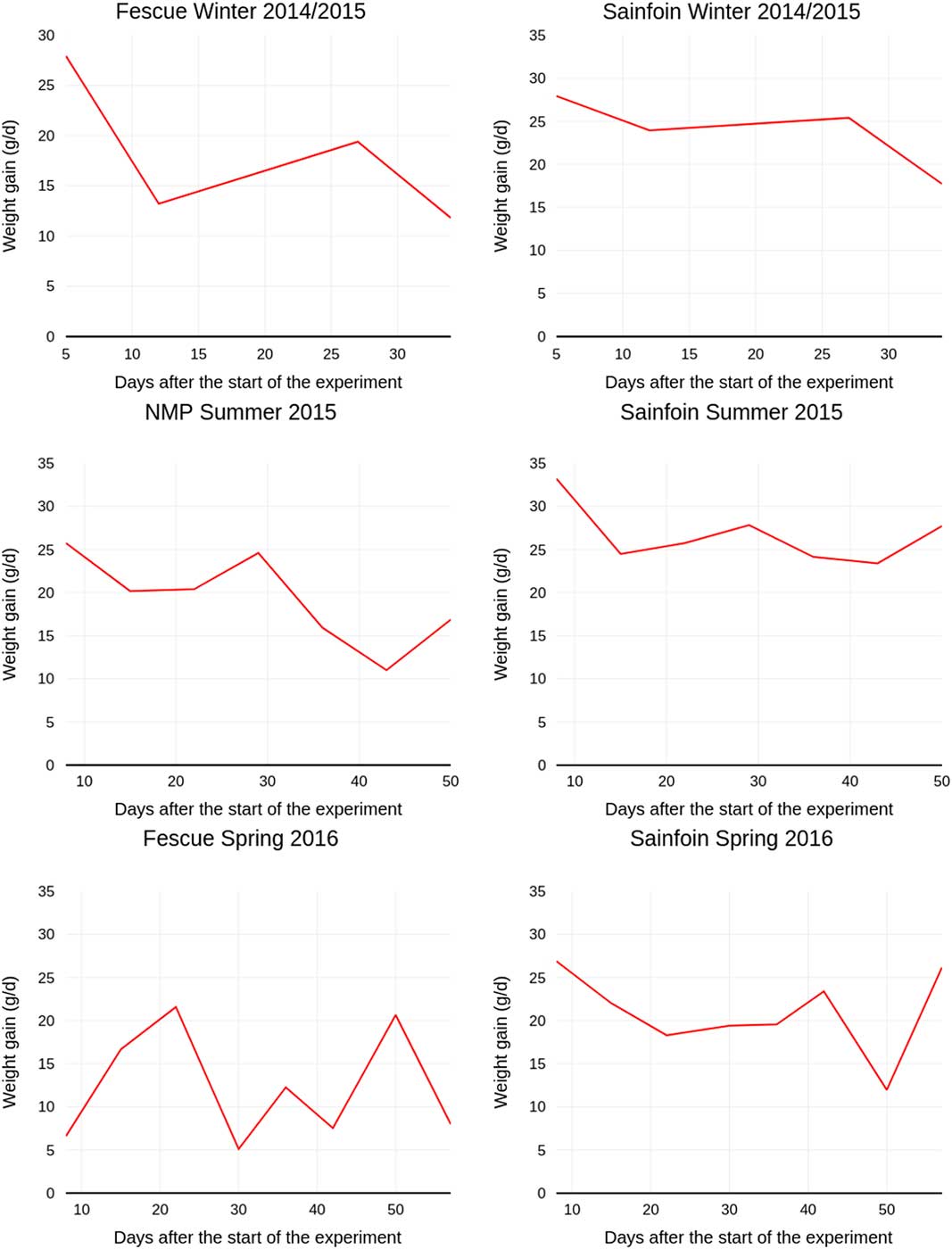
Daily weight gain ranged from 3.7 to 38.2 g and varied greatly from week to week (Figure 2). Within each season, mean daily weight gain from weaning to slaughter was always higher for rabbits grazing LEG (22.6±10.6 g) than GRF (16.0±9.4 g, P<0.05). During spring, however, mean (of LEG and GRF) daily weight gain was 37% lower than that in summer (16.4 and 22.4 g, respectively, P<0.01). When all trials were considered together, contrary to DE intake, CP intake had a significant effect on daily weight gain (Supplementary Table S1):
 $$\eqalignno{{\rm daily}\,{\rm weight}\,{\rm gain}{\equals}{\minus}&20.0{\,\plus}35.9{\;\times}\log \left( {{\rm CP}\,{\rm intake}} \right)\cr&\left( {R^{2} {\equals}0.40,\,P\,\lt\,0.001} \right)$$
(Colour online) Rabbit mean daily weight gain over time according to pasture type (grass and forbs: left; legumes: right) and season (winter 2014/15, summer 2015 and spring 2016). NMP=natural Mediterranean pasture.

The relative weight of the gastrointestinal tract accounted on average for 21% of the live weight of the rabbits slaughtered.
Discussion
Feed intake of grazing rabbits
Herbage intake increased with increasing herbage allowance to a plateau. Studies and meta-analysis describe a non-linear or exponential relationship between herbage allowance and herbage intake for dairy cows and ruminants (Delagarde et al., Reference Delagarde, Prache, D’Hour and Petit2001; Peyraud and Delagarde, Reference Peyraud and Delagarde2011; Pérez-Prieto and Delagarde, Reference Pérez-Prieto and Delagarde2013), with maximum intake regulated by nutritional characteristics. In our study, only 30 observations of herbage allowance (out of 216) were considered unrestricting as they exceeded 85.0 g DM/kg MW. No solid conclusion can be drawn on the nutritional characteristics that regulated intake, but the influence of ADF and DE concentrations are to be explored in future studies.
Maximum daily total intake was 104 g DM/kg MW. Similarly, the intake of rabbits fed pelleted feed ad libitum in conventional systems ranged from 89 to 101 g DM/kg MW (Gidenne and Lebas, Reference Gidenne and Lebas2006). Fresh matter intake of grazing rabbits was much higher (+293%) than rabbits fed pelleted feed ad libitum. For highly palatable feedstuff (whole fresh carrots; Goby et al., Reference Goby, Huck, Fortun-Lamothe and Gidenne2013), growing rabbits were able to ingest up to 642 g FM/rabbit or 443 g FM/kg MW, corresponding to 40% of their live weight (1.64 kg). Feeders in that study were empty each morning, which indicates that rabbits did not reach maximum intake. Results from Goby et al. (Reference Goby, Huck, Fortun-Lamothe and Gidenne2013) and our study indicate that when fed fresh forage (alone or with pelleted feed), rabbits have higher intake than when fed pelleted feed alone. Gidenne and Lebas (Reference Gidenne and Lebas2006) claimed that this increase is linked to decreased residence time in the digestive tract because of higher fibre concentration in the feed. Mugnai et al. (Reference Mugnai, Dal Bosco, Cardinali, Rebollar, Moscati and Castellini2014) observed that New Zealand and Leprino breeds grazing rabbits had a higher ratio of the full gastrointestinal tract to live weight (18.6% and 19.0%, respectively) than those reared in cages with no access to grazing (18.0% and 18.1%, respectively). We also observed a high relative weight of the gastrointestinal tract (21% of live weight), which could indicate that grazing increased its development.
Crude protein intake and other factors that influence daily weight gain
From our observations, herbage CP concentration has a direct impact on growth as already observed by Martin et al. (Reference Martin, Duprat, Goby, Theau, Roinsard, Descombes, Legendre and Gidenne2016). Yet, along with the difference in CP concentration between GRF and LEG, differences in their protein digestibility and contents of essential amino acids, such as methionine, cysteine, lysine and threonine, must also be considered (Xiccato and Trocino, Reference Xiccato and Trocino2010). The concentration of condensed tannins in sainfoin may limit protein digestibility, as Legendre et al. (Reference Legendre, Hoste and Gidenne2017) observed recently for conventionally reared rabbits.
Other factors may decrease rabbit growth, such as stressful events (e.g. temperature, predator visits). Seltmann et al. (Reference Seltmann, Ruf and Rödel2009) determined that post-weaning growth decreased when rabbits were exposed to cold and wet conditions before weaning, especially for the lightest kits. Consequently, environmental conditions during pre-weaning could influence results of fattening experiments. Differences in weight gain among seasons may be related to this phenomenon, since the pre-weaning periods in winter 2014 and summer 2015 were, respectively, 5.9°C and 7.3°C warmer than that in spring 2016. Parasitism, which was not explicitly considered in this study, could also explain part of the differences in weight gain among trials. For instance, the lower daily weight gain during spring 2016 might have been related to the presence of nematode eggs found in faeces, which will be the subject of future studies.
Potential to decrease concentrate supplementation
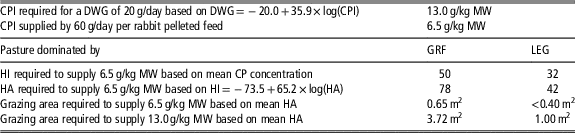
With an objective for daily weight gain of 20 g (from 1.4 kg live weight at weaning (45 days old) to 2.5 kg live weight at slaughter (100 days old)), and under our experimental conditions, the pelleted feed supplied half of the protein intake, and herbage needed to supply the remaining half (Table 3). To do so, the grazing area (0.4 m2/rabbit) is sufficient when LEG are grazed but it should be increased to 0.65 m2/rabbit when GRF are grazed. This could be done by decreasing the number of rabbits per cage, by increasing the area of the cage or by moving the cage twice a day. For rabbits fed only herbage, the grazing area of LEG must increase to 1 m2/rabbit, that is, by a factor of 2.5. For GRF, even if rabbits ate 100 g DM/kg MW, the grazing area must increase by a factor of 9.3 owing to the lower CP concentration on GRF and accordingly to a different log relationship between herbage intake and herbage allowance on this type of pasture. This suggests the possibility of feeding growing rabbits without supplementation, but more easily on legume pastures and overall with more grazing area per rabbit.
Determination of the grazing area required to fatten rabbits from 1.4 kg live weight to 2.5 kg within 55 days (daily weight gain (DWG) equal to 20 g/day) under our experimental conditions

CPI=CP intake; MW=metabolic weight; GRF=GRass and Forbs; LEG=LEGumes; HI=herbage intake; HA=herbage allowance.
Herbage allowance seemed to be a major factor regulating energy and protein intake, and consequently growth. These initial results for intake and growth of rabbits raised on pastures under organic production standards indicate the need for further studies and modelling to better understand the relation between herbage intake and growth. The results can provide farmers with recommendations on feed supplementation and grazing area per rabbit, depending on their objectives.
Acknowledgements
This study was supported by a grant from the INRA division PHASE (MarkPast project), the INRA committee for organic farming AgriBio4 (CuniPat project) and the INRA metaprogram Integrated Management of Animal Health (GISA, PROF project). The authors thank the AVEM association for providing organic sainfoin seeds, and all the colleagues involved in data collection and analysis, especially J. Le Stum (IUT Perpignan), A. Meynard and C. Bannelier (INRA UMR GenPhySE).
Declaration of interest
The authors declare that they have no conflicts of interest.
Ethics statement
The trials were conducted following the French regulations on organic animal breeding and animal welfare.
Software and data repository resources
The data are deposited in an official repository.
Supplementary material
To view supplementary material for this article, please visit https://doi.org/10.1017/S1751731118001775