Introduction
Despite Ethiopia having the largest ruminant livestock population in Africa, production levels are characterised by low lactation yields, poor growth rates, extended reproduction intervals and a relatively late age at sexual maturity (Zinash and Seyoum, 1989; Assefa and Ledin, 2000). The major constraint limiting production is the seasonality and quality of feed resources, especially during the dry season. Available feed resources include native pasture, browse, cultivated pasture and dual-purpose forages, agro-industrial by-products, weeds and cereal crop residues (CCR) (Assefa and Ledin, 2000; Savadogo et al., Reference Savadogo, Zemmelink, Nianogo and Van Keulen2000). However, native pastures are only productive during the short rainy season, while the availability of cultivated pastures and forage-crop species are restricted and generally not traditionally utilised within smallholder systems. As a result, the main feed resource, particularly during the dry season, is poor-quality CCR.
In Ethiopia, CCR represent about 40% to 50% of livestock feed provision with maize and sorghum stover, together with teff (Eragrostis tef), wheat and barley straws comprising the most commonly used materials (Mengistu, 1985; Yami et al., 1989; Assefa and Ledin, 2000). Oil seeds are widely processed in smallholder farming systems and, while oil seed cake is an excellent concentrate feed for livestock, only 25% of that produced is used locally (Mengistu, 1985; Yami et al., 1989). Grain processing co-products are also fed, but high cost, variable quality and irregular availability limit their use within the smallholder sector.
High levels of neutral detergent fibre (NDF) and lignin plus low levels of nitrogen (N) result in restricted digestibility, poor intakes and depressed microbial protein production when CCR are offered alone (Abule et al., Reference Abule, Umunna, Nsahlai, Osuji and Alemu1995; Tolera and Sundstøl, Reference Tolera and Sundstøl2000; Akinlade et al., Reference Akinlade, Smith, Raji, Busari, Adekunle and Adewumi2005). Supplementation of CCR with legume forages increased concentration of ammonia-N, microbial-N and volatile fatty acid (VFA) in rumen fluid and stimulated degradation due to an increased supply of N, fermentable carbohydrates, sulphur and other essential nutrients (Abule et al., Reference Abule, Umunna, Nsahlai, Osuji and Alemu1995; Tolera and Sundstøl, Reference Tolera and Sundstøl2000). Bartholomew et al. (Reference Bartholomew, Ly, Doumbia, Khibe, Kone and Traore2003) and Savadogo et al. (Reference Savadogo, Zemmelink, Nianogo and Van Keulen2000) suggested that for smallholders to improve the feed self-sufficiency and enhance animal production through optimised feed utilisation, the adoption and production of legume feeds with a high N content is required. A legume forage such as cowpea is an excellent human food and livestock feed, and its dual-purpose nature (grain and forage) makes it an attractive crop where land is scarce (Singh et al., Reference Singh, Ajeigbe, Tarawali, Fernandez-Rivera and Abubakar2003). The same authors described cowpea as a drought-resistant and fast-growing crop and well adapted to semi-arid regions of the tropics. Additional benefits of including cowpea in mixed crop/livestock systems include preservation of soil moisture, increased soil fertility and reduced soil erosion for enhancing environmental protection. Cowpea cultivation as a food and feed crop not only has the potential to increase the nutritional status of smallholder household members and enhance livestock production but also provides a number of environmental benefits leading to enhanced sustainability.
The objective of this research was to identify the potential of forage and dual-purpose cowpea haulms as a source of supplementary dietary N to fattening lambs offered maize stover (MS) with respect to improvements in feed intake, growth rate, digestibility parameters, N retention and carcass yield.
Material and methods
Feed preparation
The study was carried out at the International Livestock Research Institute site in Debre Zeit, Ethiopia. This site, at an altitude of 1850 m, has an annual rainfall of 860 mm and a mean daily temperature of 18°C. Two genotypes, 12688 (forage type) and IT96D-774 (dual-purpose), were sown (broadcast manually) at the rate of 3 kg/ha. The field, uncultivated in the previous 2 years, was prepared using a four-furrow disc plough (Tondam Model 765; Alvan Blanch Development Co. Ltd, Chelworth, Malmesbury, Wiltshire, England) and a disc harrow (Tondam Model 280; Alvan Blanch Development Co. Ltd); 1 and 2 ha of genotypes 12688 and IT96D-774 were grown, respectively, to ensure sufficient yields, with plot size derived from known yields of the two genotypes grown at this site. The plots were maintained under rain-fed conditions throughout and no fertiliser, herbicide or pesticide treatments were applied. Although a tropical hailstorm severely damaged the plants 5 weeks post-sowing, they recovered to provide sufficient material for the feeding experiment.
Cowpea haulms were collected, following the grain harvest (manual pod removal), which occurred when 50% of the pods were mature. This corresponds to the normal harvesting stage for cowpea when used as either food or feed in smallholder mixed crop/livestock farming systems in the tropics and on this occasion 126 days post-sowing. The haulms were dried in an open-sided, concrete-floored shed for about 21 days, prior to chopping (3 cm) using an Alvan Blanch mill (Model ABFC-200; Alvan Blanch Development Co. Ltd). This was to ensure that a uniform material was offered, to reduce selection and to simplify feed preparation. Cowpea haulms yields of 486 and 249 kg/ha were obtained for genotypes 12688 and IT96D-774, respectively. Ten samples were randomly collected from different sites within the chopped material, then bulked and chemically analysed for dry matter (DM) and N prior to the start of the growth study. The MS used was obtained from a crop of Hybrid BH660 (Ethiopian Seed Enterprise, Awassa, Ethiopia) sown in mid-June. Following manual removal of the cobs (118 days post-sowing), stover remained in the field for a further 35 days prior to harvest. MS was stored and chopped (10 to 12 cm). The commercial concentrate (CC) comprised wheat bran and neug (Guizotia abyssinica) cake (879 and 121 g/kg DM, respectively), with the proportions chosen to provide a N content similar to that supplied by the highest level of cowpea supplementation, approximately 185 g N/kg DM.
Animals and housing
In all, 68 male Ethiopian Highland (Arsi) sheep were purchased from the Nazareth-Arsi-Negele area in early September. The animals were 8 to 12 months old, with live weights of 17 to 22 kg. They were quarantined 2 km from Debre Zeit, during which time they were treated with a broad-spectrum anthelmintic and levamisole against lungworm. They were vaccinated against both sheep pox and PPR (pestes du petits ruminantes) and dipped using chlorfenvinphos against ectoparasites. In all, 56 sheep were allocated to individual 1.15 × 0.75 m pens, within a naturally ventilated shed for the 30-day adaptation and 92-day experimental periods. The remaining 12 sheep were kept separately as potential replacements. During the pre-experimental period all sheep were offered grass hay ad libitum and 50 g cowpea haulm daily with water freely available.
Experimental design
A randomised block design was used to generate seven groups of eight sheep, blocked by weight. One group was slaughtered at the end of the pre-experimental period to determine initial carcass weight and other slaughter parameters while the remaining groups were allocated to one of six treatments detailed below. Initial live weight was determined by weighing the sheep on 3 consecutive days, prior to feeding at 0700 h, using a Salter balance (50 kg × 0.2 kg, Model 2356S; CEMB Hofmann (UK) Ltd, Manchester, UK). All sheep were offered MS ad libitum together with one of the following six treatments daily:
(1) no supplement (negative control)
(2) 150 g DM genotype 12688
(3) 300 g DM genotype 12688
(4) 150 g DM genotype IT96D-774
(5) 300 g DM genotype IT96D-774
(6) 300 g DM CC
The quantity of CC corresponds to that commonly used in practice, while the cowpea levels were designed to represent either a similar level of N supplementation or half of that. In addition, 3 g bone meal and 2 g salt were offered daily as top-dress. MS was offered at 600 g DM per animal in the first week of the study, then the amount was adjusted to twice the previous week’s mean daily intake on an individual animal basis.
Feed intake and growth rate
Cowpea and CC supplements were offered at 0800 h with the MS ad libitum 2 h later. The negative control animals (no supplement) were offered MS at 0800 h. All feeds were prepared the previous day and stored in labelled plastic bags. The DM of the dietary components was assessed weekly by drying representative samples at 60°C for 48 h. Any uneaten supplement was placed to one side of the feed trough before offering the MS; clean water was available throughout the experiment. Feed refusals were collected daily at 0700 h, weighed and sub-samples stored in labelled plastic bags. These were bulked on a weekly basis and sub-samples assayed for DM determination.
Live weight was recorded every fortnight on 3 consecutive days at the same time each day. Three animals died due to larval infections (Coenurus cerebralis) of the tapeworm (Taenia multiceps) within the first 3 weeks of the experiment. These were substituted with three animals from the replacement flock.
Digestibility experiment
During week 11, 24 animals (four per treatment) were selected from the growth study (similar live weight basis) and placed in individual metabolism crates to determine diet digestibility. The evaluation comprised 3 days adaptation to the crates and an 8-day collection period. Feed preparation, feeding and refusal collection were the same as for the growth study. Total faeces and urine collections were initiated on the fourth day. Faecal collection bags were emptied twice a day (0700 and 1700 h), the faeces weighed (Sartorius balance, Type TVU 1P65, Göttingen, Germany), thoroughly mixed and 20% stored frozen in labelled plastic bags for further analysis. Urine was collected at 0700 h each day, sub-sampled and stored frozen. A total of 100 ml 10 M H2SO4 was added to the urine collection buckets to ensure that the pH remained below 3.0, so as to prevent volatile N losses. At the end of the digestibility study, the faecal samples were thoroughly mixed and sub-samples (20%) were oven dried at 60°C for 48 h. The sheep were returned to their pens and maintained on the same feed until slaughter. Final live weight was estimated by weighing on 3 consecutive days immediately prior to slaughter.
Carcass weight
The 48 sheep were randomly selected and slaughtered over a 3-day period. Hot and cold carcass and total internal fat weights were recorded. The following estimates were also calculated:
• Initial dressing % (mean of eight sheep slaughtered at the start of the study, A), = (W1/W2) × 100
• Initial carcass weight (B, individual animal basis start of growth study) = A/100 × W3
• Final carcass dressing % = (W5/W4) × 100
• Carcass weight change per animal = W5−B
where W1 = initial mean carcass weight (eight animals), W2 = initial mean live weight (eight animals), W3 = initial weight (start of growth study), W4 = final weight (end of growth study, pre-slaughter), W5 = carcass weight (cold), feed conversion ratio (FCR) = total DM intake/total live weight gain, total internal fat = kidney fat + omental and mesentery fat.
Chemical analysis
Faecal and feed samples were ground (Thomas-Wiley, Laboratory Mill, Model 4; Thomas Scientific™, Swedesboro, NJ, USA) to pass through a 1-mm sieve. DM (at 105°C for 24 h), ash, crude protein (CP, N*6.25, AOAC, 1990), NDF, acid detergent fibre (ADF) and lignin (Goering and Van Soest, Reference Goering and Van Soest1970) were analysed. NDF was analysed without sodium sulphite and the values reported are inclusive of ash. Urine samples were sub-sampled and analysed for N (AOAC, 1990).
Statistical analysis
Data were analysed using a general linear model (GLM) of Statistical Analytical System (SAS, 2001, v. 8; SAS Institute Inc., Cary, NC, USA) to generate LS means and significance of difference between treatments. Duncan’s multiple range test of the GLM procedure was used for multiple comparisons among LS means. When comparing the five treatment groups against the negative controls, some results were identified as significant (P < 0.05) despite the absence of what could be considered as ‘biological’ significance, to limit this effect significance was considered at P ⩽ 0.01.
The basic statistical model used:

where Yij is the independent variable (feed intake, feed digestibility, live weight gain, carcass yield) and μ the overall mean, ti the effect of treatment and eij the residual error.
Results
Chemical composition
Chemical composition of MS, both cowpea genotypes and CC are presented in Table 1. Cowpea ash contents were higher than either MS or CC, while MS contained more cell wall constituents (NDF, ADF and lignin) than either cowpeas or CC and had a lower CP content (38 g/kg). The content of cell wall (NDF) in CC was lower (361 g/kg DM) than in both cowpea types. While the lignin content of MS and both types of cowpeas were broadly similar (83 to 101 g/kg), the proportion of lignin in NDF was much higher in cowpeas (0.22) than in MS (0.13). The forage-type cowpea and CC had a similar CP (185 g/kg), both marginally higher than the dual-purpose-type cowpea (168 g/kg).
Chemical composition of feedstuffs

DM = dry matter; n = 10.
Values are mean of the 10 replicates and are expressed as g/kg DM with the exception of DM (g/kg).
Effects of supplementation on intake and digestibility
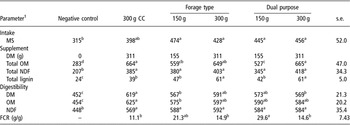
Throughout the study, all supplements offered were completely consumed and resulted in observed DM intakes slightly exceeding the planned levels (Table 2). MS intake was significantly (P < 0.01) increased, by both forage and dual-purpose cowpeas at both levels of supplementation relative to the negative control group (Table 2). In contrast, CC supplementation did not significantly affect MS intake nor was there any significant difference in MS intake when CC was compared with both cowpeas at either level of supplementation.
Effect of supplementation on daily feed intake (g) and digestibility (g/kg)

1MS = maize stover; DM = dry matter; OM = organic matter; FCR = feed conversion ratio; n = 8.
Negative = MS ad libitum; CC = commercial concentrate.
LS means in rows without common letters differ significantly (P < 0.01).
N intake was significantly (P < 0.01) increased by supplementation of both types of cowpeas at either level and CC relative to the negative control. The highest N intake was observed for forage type at the high-level supplemented group and it was significantly different relative to all other groups. Cowpeas and CC supplementation significantly increased total organic matter (OM), NDF and lignin intakes relative to the negative controls. The highest intakes were obtained with high-level dual-purpose cowpea. OM intake was similar between CC and both cowpeas at the high level, while no significant differences in NDF intake were identified between any supplements. Lignin intake, relative to the negative controls, was increased significantly with both types of cowpea, although the actual quantities involved were slight. No significant differences in intake between CC and either cowpea genotype at low level were found. There were no significant difference between forage type and dual-purpose types at either level for OM, NDF and lignin intake.
Apparent DM, OM and NDF digestibilities were significantly (P < 0.01) increased by supplements relative to the negative control group. There was no significant difference between forage and dual-purpose cowpeas at either level for all three digestibilities.
Effects of supplementation on live weight gain
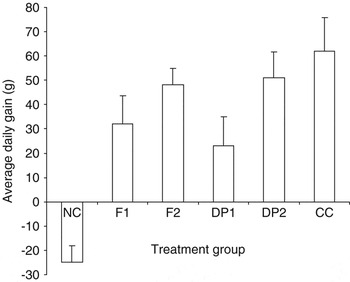
Average daily gain (Figure 1) was significantly (P < 0.01) improved by CC supplementation (62 g) and at both levels of forage (32 and 48 g, respectively) and dual-purpose-type (23 and 51 g, respectively) cowpeas relative to the weight loss of the negative control group (−25 g). While there were no significant differences between CC and either cowpea at high level, or between cowpeas at low level; the sheep offered the higher levels of cowpeas showed greater weight gains. The treatment effects observed occurred throughout the study period (Table 5). For both types of cowpea, supplementation at the higher level improved the FCR (estimated as DMI/live weight gain) to levels similar to those obtained with CC.
Effect of maize stover supplementation with either forage or dual-purpose cowpeas or CC on average daily gain. NC = negative control, F1 = Forage type at 150 g, F2 = Forage type at 300 g, DP1 = dual-purpose type at 150 g, DP2 = dual-purpose type at 300 g and CC = commercial concentrate at 300 g, n = 8.

Supplementation effects on nitrogen retention and lean tissue gain
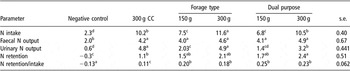
All supplements increased N intake, faecal and urinary N output, and retention (calculated as intake minus faecal and urinary losses) (Table 3). The highest intake and urinary output levels were obtained when forage-type cowpeas were offered at 300 g/day. Significant differences between cowpea types were found at the higher supplementation level in terms of intake and urinary output. The lowest urinary N output of the supplemented diets occurred with the dual-purpose cowpea offered at the lower level and was not significantly different from the negative control group. However, urinary N output was significantly different for all other supplements compared with the negative control group. N retention was significantly different between CC and dual-purpose at higher level and negative control compared to supplement groups. Rather than estimate N digestibility, which tends to be positively correlated with N intake as a direct consequence of the relative reduction in the contribution of endogenous N to faecal output, N retention is expressed relative to N intake. The higher values for cowpea, compared with CC, suggest that cowpea N was more efficiently utilised, while the reduced values with the higher versus the lower level of cowpea inclusion indicate that retention efficiency is inversely related to dietary levels.
Effect of supplementation on N intake, retention and N digestibility

All values as g/day except N retention/intake (g/g).
Negative = maize stover ad libitum, CC = commercial concentrate.
LS means in rows without common letters differ significantly (P < 0.01), n = 8.
Supplementation effects on final live weight and slaughter parameters
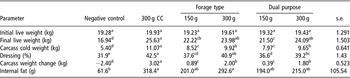
All cowpea treatments and CC supplementation significantly increased final live weight (Table 4) relative to the negative control group. The CC-offered group generated the highest gain (5.7 kg) over the study, while the negative control animals lost 2.4 kg over the study to finish at 16.9 kg.
Effect of supplementation on final live weight, carcass weight, dressing percentage, carcass weight change and internal fat

Negative = MS ad libitum; CC = commercial concentrate.
LS means in rows without common letters differ significantly (P < 0.01), n = 8.
Carcass cold weight and dressing percentage were significantly increased for all treatment groups relative to the negative controls. The largest effect was obtained with the CC-supplemented animals with carcass cold weights significantly greater than that for those offered cowpeas at either level. In contrast, the dressing percentage of the CC group did not differ significantly from that of forage-type cowpeas at higher level although overall the dressing percentage of all cowpea-supplemented animals was poor. The greatest carcass weight increase was obtained with the CC group, while the negative control treatment produced a substantial decrease. Level of internal fat was significantly increased with CC and higher level forage-type cowpea, compared with the negative control group. While the differences in the internal fat content of the negative controls, forage type (150 g supplementation) and dual-purpose type (150 and 300 g supplementation) were not significant, that of the negative controls was one-third of the lowest supplement group.
Discussion
NDF and CP contents of 738 and 38 g/kg, respectively, for the MS used in this study, are characteristic of poor-quality CCR (Smith et al., Reference Smith, Manyuchi and Mikayiri1988; Tolera and Sundstøl, Reference Tolera and Sundstøl2000; Akinlade et al., Reference Akinlade, Smith, Raji, Busari, Adekunle and Adewumi2005). The low level of daily intake (0.315 kg DM or about 1.5% live weight) when MS was offered alone is a direct consequence of the observed poor digestibility (452 g/kg DM), which will limit the rate of passage of indigestible material from the rumen (Van Soest, Reference Van Soest1982) and generate high levels of reticulo-rumen fill (Aitchison et al., Reference Aitchison, Gill, France and Dhanoa1986). It is, therefore, unlikely that offering MS of this quality alone will support anything more than maintenance requirements (Savadogo et al., Reference Savadogo, Zemmelink, Nianogo and Van Keulen2000) in sheep. AFRC (1993) guidelines suggest that 20 kg male wethers require about 3.8 MJ metabolisable energy (ME) daily for maintenance. Mosi and Butterworth (Reference Mosi and Butterworth1985) reported MS intakes of 2.9 MJ ME, while in this study (using a value of 5.7 MJ ME/kg MS calculated from the OM digestibility values (MAFF, 1984) obtained in the digestibility study) with observed intakes of 0.35 kg DM, it is unlikely that the negative controls consumed much above 2.0 MJ ME daily, and hence their continual loss of body condition over the feeding study.
Excess levels of MS were supplied as both Aboud et al. (1993) and Savadogo et al. (Reference Savadogo, Zemmelink, Nianogo and Van Keulen2000) had reported earlier that goats and sheep, when offered the opportunity, were capable of selective feeding leading to increased intake and improved growth performance. Thus generous feed allocations can be used as a strategy to help alleviate the low nutritive value of dry-season forages and CCR. Moreover, allowing selective consumption would also reduce the level of supplementation required to support production. However, in this study no evidence of selection was observed, with MS residues essentially identical in terms of chemical composition, to the original material offered. For instance, lignin contents of the MS residues for the negative control, CC, forage and dual-purpose types at 150 and 300 g supplementation treatments were 10, 8, 9, 9, 10 and 8 g lignin/kg DM, respectively. Interestingly, Mosi and Butterworth (Reference Mosi and Butterworth1985) observed that animals offered MS alone showed less selectivity against lignin than when supplemented with trifolium hay, suggesting a degree of substitution.
The extent to which substitution occurs, the degree to which a supplemental feed is consumed in preference to the basal forage, varies greatly. In this study, all forms of supplementation increased the intake of MS, with no substitution effect observed when the low and high inclusion rates of cowpea were compared, an effect similar to that observed by Bonsi et al. (Reference Bonsi, Osuji, Nsahlai and Tuah1994). Smith et al. (Reference Smith, Manyuchi and Mikayiri1988), Varvikko et al. (Reference Varvikko, Khalili and Crosse1992) and Abule et al. (Reference Abule, Umunna, Nsahlai, Osuji and Alemu1995), all observed no effect on CCR intake when supplemented with legume forages although, in agreement with this study, supplementation increased total DMI, N retention, apparent DM digestibility and N retention. These findings contrast with Savadogo et al. (Reference Savadogo, Zemmelink, Nianogo and Van Keulen2000), who reported that sorghum stover intakes declined with even low levels of cowpea supplementation.
The results obtained in this study with respect to parameters such as digestibility and live weight gain show that a major proportion of the effects observed with the highest supplementation level was obtained with the lower level. Supplementation of MS with 150 g forage-type cowpea increased the average daily gain by 57 g compared with the negative control, and represented 0.68 of the improvement obtained when twice the quantity of cowpea was offered. A slightly different result was found with dual-purpose cowpea possibly due to the lower level of CP in this material. When supplemented at the low level, average daily gain increased by 48 g relative to the controls; however, this represented 0.45 of the response obtained with 300 g. Singh et al. (Reference Singh, Ajeigbe, Tarawali, Fernandez-Rivera and Abubakar2003), who supplemented sorghum stover with cowpea, found that the average daily gain response diminished with levels of 400 and 600 g/day, providing only marginal improvements over that obtained with 200 g, indicating that there was no significant nutritive or economic advantage from feeding high levels of cowpea as a supplement to fattening animals. No feed intake or utilisation efficiency data were presented in this study.
Live weight change for the six treatment groups during the growth study

NC = negative control; F1 = forage type at 150 g; F2 = forage type at 300 g; DP1 = dual-purpose type at 150 g; DP2 = dual-purpose type at 300 g; CC = commercial concentrate at 300 g; n = 8.
The wheat bran/neug cake CC used in this experiment produced a slight, but non-significant, increase in MS intake relative to that of the negative control group, i.e. the improvement in basal forage intake was minimal. However, since an objective of this work was to increase CCR intake and utilisation, and not to simply increase total intake, these results suggest that it may be impractical to supplement CCR with CC (due to cost, poor availability and variable quality) in Ethiopian smallholder farming systems.
Although the improved MS intake following cowpea supplementation may be due to an increased supply of readily degradable carbohydrate, stimulating ruminal fibre degradation (Silva and Ørskov, Reference Silva and Ørskov1988), it is more likely the result of enhanced rumen ammonia levels (Mosi and Butterworth, Reference Mosi and Butterworth1985; Bonsi et al., Reference Bonsi, Osuji, Nsahlai and Tuah1994; Akinlade et al., Reference Akinlade, Smith, Raji, Busari, Adekunle and Adewumi2005). The increased faecal-N output results partly from the greater synthesis of rumen microbial protein, a possible increased passage of undegradable feed protein due to reduced rumen retention times or to an elevated hind-gut (caecal) fermentation. With regard to urinary N levels, the greater loss associated with the higher level of cowpea supplementation reflects the inability of rumen micro-organisms to efficiently utilise the elevated ruminal ammonia levels. This indicates that a ration consisting of MS and a high level of cowpea may be deficient in readily available carbohydrate, relative to the quantity of N released, which is thus inefficiently used by the rumen micro-organisms. This might also explain the slightly lower N retention values relative to intake with the higher levels of cowpea supplementation. This asynchrony, as suggested earlier, could be reduced and N utilisation improved if high levels of cowpea were offered in two or three discrete meals or after the basal forage. It is also interesting to consider possible effects resulting from the lipid component of the neug cake (Yami et al., 1989). While its inclusion rate is unlikely to have suppressed ruminal fibre degradation (as dietary lipid levels will not have exceeded 20 g/kg DM), it will have been absorbed post-ruminally, potentially contributing directly to carcass fat deposition.
When supplementation level response is examined in terms of carcass parameters, while CC is superior in all aspects, the higher level of either cowpea significantly enhances carcass weight, dressing percentage and carcass weight change, with carcass fat contents also being higher but not significantly so, relative to the negative controls. These data suggest that a portion of the live weight gain may be due to increases in gut fill rather than actual carcass weight gain and indicates the importance of a range of measurements to assess diet quality.
The negative N retention for sheep given MS alone demonstrated the inadequacy of the unsupplemented diet to provide sufficient N and, consequently, the live weight loss and depressed carcass yields observed. The inclusion of cowpeas and CC not only increased MS intake but also enhanced overall digestibility. Using digestibility values derived from the literature (Hess and Fernandez-Rivera, Reference Hess and Fernandez-Rivera2000; Koralagama et al., 2008) for cowpea and estimating that of CC from the weighted digestibilities of the two main ingredients neug cake and wheat bran (MAFF, 1984; Nsahlai et al., Reference Nsahlai, Umunna and Osuji1998; Mesfin and Ledin, Reference Mesfin and Ledin2004) suggest that cowpea haulm and the CC offered will have had broadly similar OM digestibilities (circa 0.65 g/g). By applying these values, supplementation with CC improved apparent MS digestibility from 0.45 to 0.59 g/g, while the forage and dual-purpose cowpeas increased digestibility to 0.54 and 0.55 and to 0.55 and 0.51 for the 150 and 300 g treatments, respectively, thus explaining the improvements in intake.
Ideally, an economic assessment should be made with respect to the cost of the various supplements, total feed intake, period required to achieve a marketable weight of animal and the price obtained before a decision can be made regarding cowpea type and the level of inclusion. However, simply considering that CC has to be purchased while a smallholder farmer will generate cowpea crop residues as a co-product to grain production, suggests that supplementation with cowpea haulms will be more economic. In addition, it would appear that high levels need not be offered, as a major proportion of the improvements in digestibility, intake and weight gain was achieved at lower levels. It is also likely that, considering the technical problems and cost associated with the chemical treatment of CCR to improve digestibility, cowpea and other legumes (Hess et al., Reference Hess, Beuret, Lotscher, Hindrichsen, Machmuller, Carulla, Lascano and Kreuzer2004), supplementation offers a safer and more environmentally benign way to enhance rural livelihoods. An important secondary benefit of cowpea utilisation in livestock production systems is the improved subsequent crop yields obtained as a result of direct N fixation, or from the enhanced quality of manure mixed with other wastes such as bedding when applied as organic fertiliser.
Conclusions
The supplementation of CCR with cowpea offers an opportunity to enhance the ruminant production on smallholder crop-livestock enterprises in Sub-Saharan Africa. The utilisation of cowpea haulms, irrespective of cowpea type, has been shown to provide an appropriate and cost-effective way of increasing production in rural areas than the use of CC. There appears to be little advantage of feeding high levels of cowpea as a supplement, although the actual level will depend on the compositional quality and availability of both the CCR and cowpea forage. Cowpea appears to be more efficiently used when offered in small rather than large amounts as a supplement to CCR. This will also permit supplementation to occur over a longer period of time, i.e. an increased number of animal days, when limited quantities are available.
Acknowledgements
This research was funded by ILRI, Ethiopia. The assistance of ILRI Nutritional Laboratory, Animal Husbandry and Field Gene Bank’s staff is gratefully acknowledged.