

The older population worldwide is predicted to increase rapidly to 2 billion by 2050, with more than 1.2 billion older persons residing in the region of Asia and the Pacific (United Nations, 2012). The transition will be more pronounced in East and North-East Asia, where approximately one in three people will be older than 60 years by 2050. In Malaysia, the older population is expected to rise from 7% in the year 2020 to 15% by the end of 2035 making it an Ageing Nation. This transition is projected to take place within 2 decades. In contrast, the population aged 65 years and above in developed countries like France took more than 100 years to increase from 7% to 14% (Kinsella & He, Reference Kinsella and He2009).
Such a rapid increase in the population of older people has profound social, economic and political implications (Kinsella & He, Reference Kinsella and He2009). For example, the statutory retirement age is 60 years. The compulsory retirement savings for private sector workers provided through the Employment Provision Fund, however, is usually exhausted within 10 years of retirement. This suggests that many of the oldest old are likely to spend the last few years of their life in poverty or fully dependent on family members for their financial provision. This poses a potential threat to the quality of life (QoL) of every older person (Mathieson, Kronenfeld, & Keith, Reference Mathieson, Kronenfeld and Keith2002). This is alarming as with the rapid rise in life expectancy, the older population is facing a distinct possibility of added years with lower QoL. Income, however, only contributes partially to quality of life. In addition to health and environmental factors, quality of life may also be influenced by positive transitions from working to non-working life through social participation and contribution. In order to accurately quantify QoL and factors that dictate QoL specific to the Asian culture, it is crucial to develop a reliable measure of QoL specifically for this age group.
The assessment of the life satisfaction and expectations of older people requires the use of relevant and valid outcome measures and survey tools. QoL is a commonly used endpoint of health technology assessment and is the stated endpoint of policies aiming to promote active ageing (Bowling, Reference Bowling2009) rather than concentrating on functional decline and physical aging alone. However, Malaysia being a multicultural society requires a more specific tool that is suited for its cultural background as research has shown measurements should be adapted specifically for the population of interest (Guillemin, Bombardier, & Beaton, Reference Guillemin, Bombardier and Beaton1993).
Control Autonomy Self-realisation Pleasure-19 (CASP-19)
While available tools only focus on health related-QoL, CASP-19 evaluates various additional aspects of QoL (Bowling, Reference Bowling2009). The CASP-19 QoL questionnaire consists of a summative scale of 19 items, in four domains: control, autonomy, self-realisation and pleasure; the scale includes both positively and negatively worded items. It was developed based on the needs satisfaction model which assumes that QoL measures should assess the degree that the human needs: control, autonomy, self-realisation and pleasure, are satisfied (Mathieson et al., Reference Mathieson, Kronenfeld and Keith2002). Control is defined in terms of an individual's ability to intervene in his or her environment, whereas autonomy is freedom from unwanted interference from others, through the reflexive process of self-realisation and pleasure through activities that make them happy. (Bowling & Stenner, Reference Bowling and Stenner2011). Each of the items is scored on a four-point scale (‘Often’, ‘Sometimes’, ‘Not often’ and ‘Never’). Total scores therefore range from 0–57. The higher the score, the better the perceived QoL.
The CASP19 has been used in many national studies including in the English Longitudinal Study of Ageing (ELSA), the Survey of Health, the British Household Panel Survey, the Aging and Retirement in Europe study (SHARE) (Börsch-Supan, Hank, Jürges, & Schröder, Reference Börsch-Supan, Hank, Jürges and Schröder2010; Siegrist & Wahrendorf, Reference Siegrist and Wahrendorf2009), The Irish Longitudinal study on Ageing (TILDA), and the Health and Retirement Survey (HRS) (Sexton, King-Kallimanis, Conroy, & Hickey, Reference Sexton, King-Kallimanis, Conroy and Hickey2013). Using the same tool as other countries gives an added advantage of an easy comparison of QoL in different countries and is a useful starting point for the assessment of QoL in Malaysia. The only study using CASP-19 reported in Asia to date was conducted in Taiwan using the Traditional Mandarin language (Wu et al., Reference Wu, Chie, Kuo, Wong, Liu, Chiu and Blane2013).
Previous studies have suggested that CASP-19 is useful for measuring QoL in older people as it is able to measure QoL directly and can stand alone as summative index (Bowling & Stenner, Reference Bowling and Stenner2011; Hyde, Wiggins, Higgs, & Blane, Reference Hyde, Wiggins, Higgs and Blane2003; Wiggins, Netuveli, Hyde, Higgs, & Blane, Reference Wiggins, Netuveli, Hyde, Higgs and Blane2008). However, other studies have also suggested modification of the scale due to poor internal consistency and dimensionality of the control and autonomy domains, while in a more recent study, the HAPIEE study, they recommend CASP12 for use in a European setting (Kim et al., Reference Kim, Netuveli, Blane, Peasey, Malyutina, Simonova and Pikhart2015; Sim, Bartlam, & Bernard, Reference Sim, Bartlam and Bernard2011).
The use of the CASP-19 in different countries has derived several factorial models of the measure such as a 3-factor, 12-item version (UK population) (Wiggins et al., Reference Wiggins, Netuveli, Hyde, Higgs and Blane2008), a 9-item, 2-factor model (Irish population) (Sexton et al., Reference Sexton, King-Kallimanis, Conroy and Hickey2013) and a 5 factor, 19-item version (Taiwanese population) (Wu et al., Reference Wu, Chie, Kuo, Wong, Liu, Chiu and Blane2013). These results suggest that more cross-national validation of the tool is required especially for use with non-European populations. This study therefore sought to translate and validate the CASP-19 for use in the Malaysian older population.
Methods
Interviewers administered the English, Mandarin and Bahasa Malaysia versions of the CASP-19 to individuals aged 60 years and above. The English 12-item Short-Form Health Survey (SF-12) (Ware Jr, Kosinski, & Keller, Reference Ware, Kosinski and Keller1996) questionnaire was co-administered with CASP-19 for the first 216 participants who filled in the English version of the CASP-19 in order to assess construct validity. CASP-19 was either completely self-administered or, for participants who were unable to read due to low vision or low educational levels, administered with the assistance of trained researchers who would read out the questionnaires and responses verbatim. Participants were recruited as part of the screening assessment for the Malaysian Falls Assessment and Intervention Trial (MyFAIT) (Tan et al., Reference Tan, Khoo, Chinna, Hill, Poi and Tan2014) and from volunteers who attended health promotion events at senior citizens’ groups. The basic demographics collected included age, gender and ethnicity.
Mandarin and Bahasa Malaysia translations
The Taiwanese Traditional Mandarin translated version of the CASP-19 was considered appropriate for the older ethnic Chinese who received their education entirely in the Chinese language using the Traditional Mandarin written language (Wu et al., Reference Wu, Chie, Kuo, Wong, Liu, Chiu and Blane2013). The available English CASP-19 was translated into Bahasa Malaysia and back translated by bilingual psychologists fluent in both the English language and Bahasa Malaysia. Differences were resolved by consensus of an expert panel consisting of experts fluent in both languages from the disciplines of Psychology, Geriatric Psychiatry and Geriatric Medicine. This process was performed according to the four stages described by Guillemin (Reference Guillemin1995). Both translations are included in Appendix 1.
Test-retest reliability
The questionnaires were re-administered to a sub-sample of the same individuals four to eight weeks after their initial test using telephone interview. This method was preferred in order to save time and reduce the burden on participants. Furthermore, as the literacy rate among our older population was low, many participants had difficulties when responding to the questionnaires without assistance. Telephone interviews were also found to be time-efficient and had lower levels of missing data compared to postal questionnaires (Feveile, Olsen, & Hogh, Reference Feveile, Olsen and Hogh2007).
Statistical analyses
The data collected was analysed using the IBM SPSS statistical package (IBM Corp, 2012). Results from participants who had two or more missing responses were eliminated in subsequent analyses. SF-12 scores were correlated with CASP-19 scores using Spearman's correlation. In the initial step of the validation procedure, the current CASP-19 and CASP-12 measurement models were tested using confirmatory factor analysis (CFA) (Arbuckle, Reference Arbuckle1997). When neither of these models fitted the data to anticipation, Step 2 investigated alternative factor structures using exploratory factor analysis (EFA), followed by CFA to test models indicated by EFA. In Step 3, parameter estimates and model fit statistics generated by CFA were used sequentially to refine the model structure identified in Step 2.
Steps 2–3: Model revision
Descriptive statistics were inspected and items were removed in cases that, for example, had severe ceiling effects or low inter-item correlations. The sample was then divided into two random sub- samples comprising 40% (sub-sample A) and 60% (sub-sample B) of the cases. Sub-sample A was used for model revision and development, with sub-sample B used for confirmatory testing of models. The idea of splitting the sample has been common practice, if specified CFA model fits poorly, subsequence EFA analyses might suggest alternative models or reasons why the model had poor fit. (Frank J. Floyd & Widaman, Reference Frank and Widaman1995). (Handbook of Research Methods in Social and Personality Psychology, 2000).
Step 2: EFA followed by CFA
EFA was conducted in sub-sample A, using a principal component with varimax rotation for correlated factors. Well-fitting models were chosen based on eigenvalues greater than one, patterns of factor loadings and overall fit indices.
Step 3: Model modification based on fit diagnostics
The best fitting model developed in Step 2 using modification indices linked with certain parameters were examined and modified where required. The models developed in Steps 2–3 were validated in sub-sample B using CFA and assessed using the goodness-of-fit statistics described above. The schematic representation of the four-factor model can be found in Appendix 2.
Ethics approval
This study was approved by University Malaya Medical Centre (UMMC) Medical Ethics Committee (reference number: 925.4).
Results
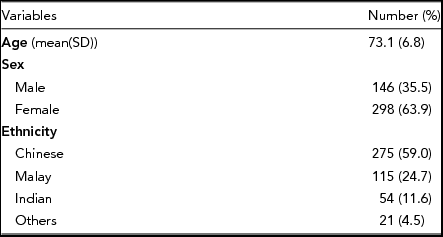
A total of 466 participants with a mean age of 73.1 years (standard deviation 6.8) completed the CASP-19 in the English language, Bahasa Malaysia or Traditional Chinese language. The results of 32 questionnaires were excluding due to missing data. The results of 345 CASP-19 questionnaires were answered in English, 57 were answered in the Chinese Language and 64 were answered in the Bahasa Malaysia. Table 1 shows the characteristics of participants. There were twice as many female participants as males.
Demographic characteristic of participants

Validation with SF-12 and test-retest reliability
Exactly 216 individuals completed the SF-12 questionnaire alongside the CASP-19. There was a statistically significant, moderate correlation between CASP-19 and SF-12 (Spearman's rho = 0.396, p = 0.049).
Test–retest reliability was conducted with 43 English, 54 Chinese and 52 Malay questionnaires. The CASP-19 showed good test-retest reliability with Spearman's rho of 0.769, p = 0.035 overall (see Table 2).
Cronbach's alpha score for overall CASP-19 score and different language.

T1 = first time questionnaire was completed. T2 = second time questionnaire was completed.by 131 participants. *The numbers were reduced due to missing values for CASP-19 scale
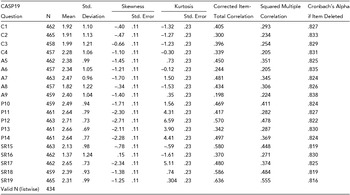
Cronbach's Alpha for CASP-19 in English, Malay and Chinese
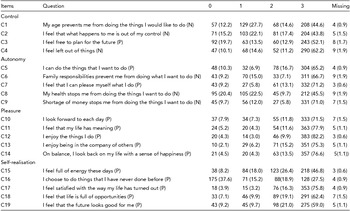
Table 2 shows the Cronbach's alpha and mean inter-item correlations for CASP-19 for individual languages, while Table 3 shows in the inter-item correlations for individual items. Poor inter-item correlations of below 0.2 were observed for A9, which corresponded to the questions ‘Shortage of money stops me from doing the things I want to do;. Table 4 shows the response proportions to items not responded to by the participants. There was no significant difference in the number of items left unanswered intentionally.
The overall mean score, standard deviation and Cronbach Alpha for each item in CASP-19

Item response proportions and % of missing values for the CASP-19 scale, n = 466

Confirmatory factor analysis
The different available models were tested with our sample participants. The models used to compare were the original CASP-19 with the four domain model from SHARE, TILDA and the five domain model developed by Taiwanese population. This is shown in Table 5. The best psychometric properties were observed when tested with the Taiwanese five domain model.
Overall Model fit for different CASP 19 model.

Discussion
The English, Mandarin and Bahasa Malaysia CASP 19 showed good internal validity, test-retest reliability and responsiveness. The correlation with SF-12 scores, however, could only be considered moderate, comparative to results obtained from a similar study in UK (Sim et al., Reference Sim, Bartlam and Bernard2011). Nearly all the original 19 items of CASP-19 displayed acceptable item-total correlation apart from item 9 which asked about shortage of money preventing the individual from doing what they wanted. With confirmatory factor analyses, the shorter 12-item versions in two to four domains had similar model-fit to the existing 19-item four domain model with the 19-item, five domain Taiwanese model displaying marginally better fit compared to the other models.
The decision to compare the CASP-19 to SF-12 was dictated by the limited QoL questionnaires validated in our setting (Shafie, Hassali, & Liau, Reference Shafie, Hassali and Liau2011). While the CASP-19 was significantly associated with SF-12, the moderate correlation between the two scales may reflect the fact that the SF-12 generates a health-related QoL score, and is unlikely to capture other non-health related aspects of QoL that are measured by the CASP-19. This therefore emphasises the need for the availability of an age-specific QoL measure capable of measuring QoL in general, in order to determine holistically, factors that may influence QoL in our old age.
There are cultural and socio-economic differences between our population and the original population this scale was developed for. The total scores of CASP-19 covered a large proportion of the possible range, which is compatible with previous studies (Gilleard, Hyde, & Higgs, Reference Gilleard, Hyde and Higgs2007; Sim et al., Reference Sim, Bartlam and Bernard2011). However, when applying QoL scales across different cultures, concerns arise with floor or ceiling effect as was observed for the autonomy domain of CASP-19 and the pleasure domain of CASP-19 where a majority were calculated to have the lowest or highest score. Autonomy is defined as being as free from the unwanted interference of others (Hyde et al., Reference Hyde, Wiggins, Higgs and Blane2003). Western culture emphasises personal independence, which is not the case in many Asian societies. This may be the reason for the difference in responses. Malaysians may not view autonomy or pleasure as an important part of their lives due to observed cultural differences among Asians; family is viewed as an important component of social support and self-development but not as a burden. In addition, filial piety is regarded with great importance across all of Malaysian society and therefore observed by all ethnicities of different cultural backgrounds. Therefore, the components involving family and self were not separated, resulting in a ceiling effect for those domains.
In the Boyd-Orr survey, the mean CASP-19 score was 42.2 (Gilleard et al., Reference Gilleard, Hyde and Higgs2007; Hyde et al., Reference Hyde, Wiggins, Higgs and Blane2003). In ELSA-1 (English Longitudinal Study of Aging-wave 1), the mean score was 42.5 (Netuveli, Wiggins, Hildon, Montgomery, & Blane, Reference Netuveli, Wiggins, Hildon, Montgomery and Blane2006). Sim et al. in 2011 reported a mean score of 40.2 (Sim et al., Reference Sim, Bartlam and Bernard2011). All of these values are lower in comparison to our older Malaysian population, which scored a mean of 44.4. Despite being a developing nation, Malaysian older adults therefore appear to have better QoL. It is of further interest to note that there is a significant difference in the scoring based on ethnicity where the Malay population scored highest followed by Chinese, Indian and others. The ethnic Malays who are Muslims believe in fate; that any occurrence in life is be to accepted with grace as it is a blessing of God. This naturally results an accepting nature towards any circumstances within the older Malays in Malaysia, which may explain the higher scores among them. In addition, Doctrine of the Mean by Confucius states that followers should avoid extreme emotions and hence this practice may suppress people from expressing elated mood. Out of fear that extreme pleasure is followed by sorrow, Chinese people tend to be more emotionally constrained and not display their joy or happiness as much compared to the ethnic Malays (Wu et al., Reference Wu, Chie, Kuo, Wong, Liu, Chiu and Blane2013).
Although there is no major difference in model fit index between the TILDA model and the Taiwan model, the shorter version of TILDA model will be more helpful in the utilisation of tool for data collection in large samples in population studies to enable meaningful comparisons with established ageing cohorts in temperate climates. Shorter versions are more time efficient and less complicated. This will suit our population where only a quarter of the older population had formal education (Department of Statistics, 2010).
Limitations
Limited demographic data had been obtained as the primary focus was to validate the CASP-19 in our population ahead of larger cohort studies that can now confidently use the tool. Our population consisted of a convenience rather than a representative sample with which we compared mean CASP-19 scores. It is likely that individuals with better QoL are more likely to volunteer for research studies. Qualitative work to explore the concepts of autonomy and pleasure would be a useful next step.
Conclusion
The CASP-19 has now been translated into the Bahasa Malaysia. Collectively, the Bahasa Malaysia, Traditional Mandarin and English Language versions of the CASP-19 have acceptable psychometrics, with the 12-item and 19-item scores in two to five domains all having similar model-fits. The validity of CASP-19 and other QoL scores currently widely used in the published literature may, however, be limited by the cultural differences in perception on autonomy, control and the difference in emphasis on self. Future studies should therefore consider developing more culturally sensitive QoL assessment tools that would more accurately characterise differences in QoL in Asian populations.
Acknowledgements
This research study was funded by a University of Malaya Research Grant, (RP-010-2012E) and the Malaysian Department of Education-High Impact Research Grant (UM.C/625/1/HIRMOHE/ASH/0)
Conflicts of interest
None
APPENDIX 1

APPENDIX 2
Four Factor Model for CASP-19