Non-communicable diseases are the leading cause of mortality worldwide(Reference Murray, Aravkin and Zheng1). Among these, CVD are particularly prevalent, with high blood pressure representing a major risk factor(Reference He, Li and MacGregor2). In 2019, high systolic blood pressure was the leading global risk factor for mortality, contributing to 10·8 million deaths and accounting for 19·2 % of all deaths(Reference Murray, Aravkin and Zheng1).
A large body of evidence has demonstrated a direct association between high sodium intake and elevated blood pressure, CHD and stroke(Reference Jula3,Reference Yang, Vernooij and Zhu4) . In addition, excessive sodium consumption has been linked to a range of adverse health outcomes, including kidney and heart damage, headaches and gastric cancer(Reference Arab, Khorvash and Heidari5–Reference He, Tan and Ma9). Globally, high sodium intake is estimated to contribute to 1·89 million deaths and more than 44 million disability-adjusted life years, with over 40 million disability-adjusted life years attributable to CVD, particularly stroke(Reference Wang, Jin and Wang10).
Reducing sodium intake during childhood is especially important, as elevated blood pressure in early life tends to track into adulthood, increasing the risk of hypertension and CVD later in life(Reference Gowrishankar, Blair and Rieder11). Moreover, childhood is a critical period for the development of food preferences(Reference Nicklaus and Meiselman12). Repeated exposure to high sodium levels has been associated with a heightened preference for salty foods, potentially reinforcing excessive sodium intake across the life course(Reference Liem13).
Given this evidence, reducing population-level sodium intake has been identified as one of the most cost-effective public health strategies to prevent cardiovascular events and reduce the burden of non-communicable diseases(Reference Santos, Sparks and Thout14,15) . Accordingly, the WHO’s 2013 Global Action Plan for the Prevention and Control of Noncommunicable Diseases established a global target of a 30 % reduction in sodium consumption by 2025 and encouraged member states to implement evidence-based interventions such as food reformulation(16).
Available evidence indicates that a substantial proportion of children worldwide consume sodium above the tolerable upper intake level, with most dietary sodium derived from processed and ultra-processed foods(Reference Gowrishankar, Blair and Rieder11,Reference Spaniol, da Costa and Souza17–Reference Chamarthi, Shirsat and Sonavane21) . In this context, food reformulation has emerged as one of the most effective and cost-effective strategies to reduce population-level sodium intake, as it operates independently of individual behaviour change(Reference Santos, Sparks and Thout14,Reference Trieu, Coyle and Afshin22,Reference Trieu, Huang and Aminde23) . A growing body of international research supports the effectiveness of sodium reformulation policies and increasingly uses modelling approaches to estimate their potential health impact(Reference Federici, Detzel and Petracca24–Reference Van Raaij, Hendriksen and Verhagen26).
However, despite this expanding literature, there is a notable lack of studies that specifically simulate the impact of setting sodium reduction targets for processed and ultra-processed products on children’s sodium intake(Reference Dunford and Poti27–Reference Wang, Skeaff and Cameron29), particularly in Latin American countries, where dietary patterns, food supply characteristics and regulatory contexts differ substantially from those in high-income countries in other regions of the world. Most existing modelling studies focus on adult populations and are concentrated in Europe, North America or Australia, limiting their applicability to children in this region(Reference Federici, Detzel and Petracca24–Reference Wang, Skeaff and Cameron29). Addressing this gap is essential to inform evidence-based policy design and to support the development of effective sodium reduction strategies tailored to children in Latin America.
Mandatory reformulation programmes have consistently been shown to be more effective than voluntary approaches that rely on cooperation between governments and the food industry(Reference Gressier, Frost and Hill30,Reference Hyseni, Elliot-Green and Lloyd-Williams31) . These mandatory initiatives typically involve establishing maximum sodium limits across specific food categories, as implemented in countries such as Argentina, Colombia and South Africa(Reference Kaldor32–35). Although such regulations do not constitute technical barriers to trade, trade-related concerns, particularly those raised by industry stakeholders, may discourage governments from adopting them, especially in contexts where a substantial share of the food supply is imported and non-compliant products could be excluded from the market(Reference Garton, Thow and Swinburn36–Reference Natero, Alcaire and Thow38). Consequently, robust evidence on the potential impacts of mandatory sodium reduction policies is essential to inform decision-making and ensure that public health benefits are maximised.
Objective and context
In this context, the objective of the present study was to estimate the potential impact of mandatory maximum sodium content policies, varying in scope, on sodium intake among children aged 6–59 months in Uruguay.
The study was conducted in Uruguay, a small high-income country in South America with approximately 3·44 million inhabitants. Although nationally representative estimates of sodium intake are not available, the high prevalence of cardiovascular conditions indicates that excessive sodium consumption is a relevant public health concern. Approximately 37 % of adults have high blood pressure(39), and CVD account for 23·5 % of all deaths(40). Importantly, elevated blood pressure is also observed early in life: 15 % of school-aged children have abnormal blood pressure levels, and 7·8 % have hypertension, underscoring the need to reduce sodium intake at the population level and particularly among children(Reference Estragó, Tabárez and Muñoz41). Although Uruguay has implemented mandatory front-of-package warning labels for products high in sodium, fats, saturated fat and sugar(Reference Ares, Antúnez and Cabrera42), no mandatory sodium reduction policies have yet been introduced.
Methods
This study adopted a two-step design. First, alternative mandatory maximum sodium content policy scenarios were formulated. Second, their potential impact on sodium intake among young children was estimated. The development of the scenarios was informed by dietary data from a nationally representative survey that included 24-h dietary recalls in children. Due to the lack of reliable estimates of discretionary salt use, the analysis was restricted to sodium derived from processed and ultra-processed foods. This approach allowed for the identification of food groups contributing the most to sodium intake in early childhood. A comprehensive database of processed and ultra-processed products available in the Uruguayan food supply was used to assess sodium levels across food categories(Reference Natero, Antúnez and Alcaire43).
All scenarios were based on the sodium reduction targets established by the Pan American Health Organization (PAHO)(44). One scenario reflected full alignment with PAHO targets, while two additional less stringent scenarios applied narrower coverage, prioritising subcategories based on their contribution to children’s sodium intake.
In the second stage, the expected impact of each policy scenario was quantified by modelling reductions in the sodium content of products within the selected subcategories. These adjusted sodium content values were then integrated into individual dietary intake data to estimate changes in habitual sodium intake among children. This modelling approach allowed for the evaluation of population-level effects of mandatory maximum sodium content policies without assuming changes in consumer behaviour or compensatory dietary substitutions.
Dietary recall data
The study used 24-h dietary recall data from the 2018 National Survey on Children Development and Health (Encuesta Nacional de Desarrollo Infantil y Salud)(45). Dietary recalls were conducted on a subsample of 555 children aged 6–59 months, born in Uruguay between 2013 and 2018 and residing in localities with 5000 inhabitants or more. A total of 635 dietary recalls were conducted, including 555 first recalls and 80 second recalls (14 % of the total). Data collection took place between September and December 2018, capturing dietary patterns typical of spring and summer in Uruguay. Both first and second recalls were evenly distributed across all days of the week to ensure representativeness.
Dietary intake data were obtained through standardised, interviewer-administered 24-h recalls using the multiple-pass method in face-to-face interviews. The second recall was conducted 3–10 d after the first. Interviews were carried out with the adult most knowledgeable about the child’s dietary intake(45).
Food composition data
The analysis focused on processed and ultra-processed foods included in the PAHO regional sodium reduction targets for 2021(44). Each food item reported in the 24-h dietary recalls was assigned to the corresponding PAHO categories and subcategories. To better reflect local dietary habits, two additional subcategories were created: fresh pasta without filling and fresh stuffed pasta, given their frequent consumption in the population.
The sodium content of each subcategory was derived from a food composition database generated through an in-store survey conducted in 2021 using a mobile application(Reference Alcaire, Giménez and Ares46). The database was compiled approximately 6 months after the entry into force of mandatory front-of-package warning labels and may therefore partially reflect sodium levels following reformulation efforts prompted by the policy. It included a total of 7343 products, of which 4719 corresponded to the PAHO target subcategories. The mean sodium content for each subcategory was calculated and used in the analysis.
Data analysis
Children’s sodium intake
Habitual sodium intake from the subcategories included in the PAHO regional targets was estimated using SPADE.RIVM package(Reference Dekkers, Verkaik-Kloosterman and van Rossum47) in R software(48). Mean sodium intake was estimated using the SPADE (Statistical Program to Assess Dietary Exposure) one-part model, an age-dependent method designed to estimate the habitual intake of nutrients consumed daily. The estimation process involved three main steps: (i) a Box–Cox transformation of the observed intake data to approximate normality; (ii) modelling the transformed intake as a function of age to estimate key model parameters, including within-person and between-person variances; and (iii) back-transformation of the intake distribution values to the original scale using a modified Gaussian–Hermite quadrature method(Reference Dekkers, Verkaik-Kloosterman and van Rossum47). Results were obtained at the aggregate level (6 months to 4 years) and stratified by 1-year age groups (i.e. 6 months to 1 year, 1–2 years, 2–3 years, 3–4 years). Average values and 95 % CI were calculated. The relative contribution of each PAHO subcategory to total sodium intake was also estimated and expressed as percentages.
Simulation of reductions in sodium intake
Sodium intake was simulated under three policy scenarios to estimate their potential impact. The first scenario applied the 2021 PAHO regional sodium reduction targets to all food subcategories(44). The second, less stringent scenario included only those subcategories contributing at least 1 % to children’s total sodium intake. The third scenario was even less stringent and included only subcategories contributing at least 3 % to sodium intake.
For each policy scenario, the mean sodium content of each subcategory was recalculated. The sodium content of individual products was compared with the corresponding PAHO targets. Products exceeding the maximum target values were considered eligible, and their sodium content was reduced to the target level. Products already meeting or below the target remained unchanged. This approach resulted in skewed (asymmetric) distributions, leading to the use of the mean, rather than the median, as the summary measure of sodium content.
Using the updated mean sodium content for each subcategory, sodium intake was recalculated for all children and by age group. The impact of each policy was expressed as both the absolute reduction in sodium intake (mg/d) based on differences in means and the corresponding percentage reduction relative to the baseline intake.
Results
Sodium intake
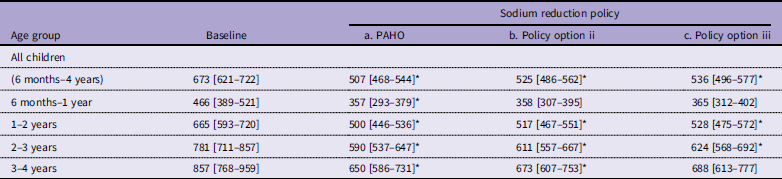
The mean daily sodium intake from processed and ultra-processed products included in the PAHO regional targets was 673 mg. As expected, sodium intake increased with age (Table 1). Children aged 6 months to 1 year consumed an average of 466 mg/d, whereas those aged 3–4 years consumed 857 mg/d, representing an 83·9 % increase between the youngest and oldest age groups.
Average daily children’s sodium intake from the processed and ultra-processed products included in the Pan American Health Organization (PAHO) regional targets considering the sodium content of products commercialised in the Uruguayan market in 2021 (baseline) and under three simulated policy scenarios: (a) all subcategories included in PAHO targets; (b) Policy option ii, including only subcategories contributing 1 % to children’s sodium intake from processed and ultra-processed products; and (c) policy option iii, including only subcategories contributing 3 % to children’s sodium intake from processed and ultra-processed

Table 1. Long description
A table comparing average daily children’s sodium intake from processed and ultra-processed products across different age groups and policy scenarios. The table has 5 rows and 4 columns. Column headers are Age group, Baseline, Sodium reduction policy b. Policy option ii, and Sodium reduction policy c. Policy option iii. Row labels include All children, 6 months–1 year, 1–2 years, 2–3 years, and 3–4 years. Each cell contains values representing sodium intake in milligrams. Notable trends include increasing sodium intake with age and variations under different policy scenarios.
Note: Averages were estimated using SPADE.RIVM package(Reference Dekkers, Verkaik-Kloosterman and van Rossum47) in R software. The estimated sodium intake of sodium reduction policies statistically significantly differing from baseline at a significance level of 0.05 are highlighted with *.
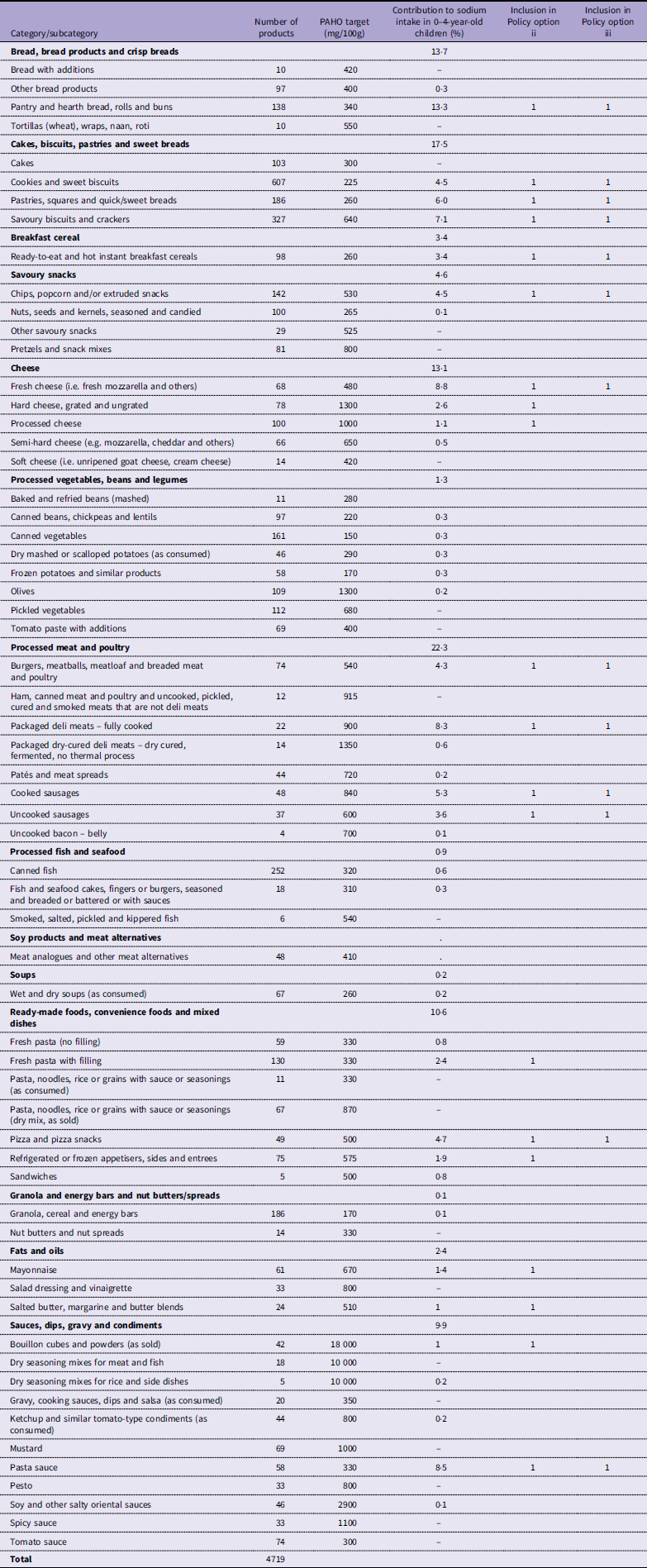
Six food categories accounted for 87·1 % of children’s sodium intake from processed and ultra-processed products included in the PAHO regional targets: processed meat and poultry (22·3 %); cakes, biscuits, pastries and sweet breads (17·5 %); bread, bread products and crisp breads (13·7 %); cheese (13·1 %); ready-made foods, convenience foods and mixed dishes (10·6 %); and sauces, dips, gravy and condiments (9·9 %) (Table 2).
Contribution of the categories and subcategories of the sodium reduction targets of the Pan American Health Organization (PAHO) to children’s sodium intake at baseline. Subcategories included in the less stringent policy options ii and iii are identified

Table 2. Long description
The table presents data on the contribution of different food categories and subcategories to children’s sodium intake. It includes 137 rows and 8 columns. The columns are labeled as follows: Category/subcategory, Number of products, Percent contribution to sodium intake of all children, Included in Policy Option ii, Included in Policy Option iii, Bread, bread products and crisp breads, Bread and additions, Other bread products. Each row lists a specific food category or subcategory along with its corresponding values. For example, Row 1: Bread and additions, 30, 429, 0.3, 1, 1, 0, 0. Row 2: Other bread products, 97, 400, 0, 0, 0, 0, 0. The table provides detailed insights into how different food items contribute to sodium intake among children, highlighting key categories such as processed meat and poultry, cakes, biscuits, pastries, and sweet breads, among others.
At the subcategory level, pantry and hearth bread, rolls and buns were the single largest contributor, accounting for 13·3 % of total sodium intake (Table 2). This was followed by ten subcategories, each contributing more than 4 %: fresh cheese (8·8 %); pasta sauce (8·5 %); packaged delis – fully cooked (8·3 %); savoury biscuits and crackers (7·1 %); pastries, squares and quick/sweet breads (6 %); cooked sausages (5·3 %); pizza and pizza snacks (4·7 %); cookies and sweet biscuits, as well as chips, popcorn and/or extruded snacks (4·5 %); and burgers, meatballs, meatloaf and breaded meat and poultry (4·3 %).
Characteristics of the sodium reduction policy scenarios
Three policy scenarios were examined, differing in the scope of application of the PAHO sodium reduction targets. The first option (i) applied the targets comprehensively across all subcategories. The second option (ii) was less stringent, applying the targets only to subcategories that contributed at least 1 % to children’s sodium intake. This approach resulted in the inclusion of twenty subcategories across nine main food categories (Table 2).
The third policy (iii) scenario was even less stringent and applied the targets only to subcategories contributing at least 3 % to total sodium intake. Based on this criterion, thirteen subcategories across eight categories were included (Table 2), representing seven fewer subcategories than in the second policy scenario.
Simulation of reduction in sodium intake
Estimated sodium intake under each of the three sodium policy scenarios is presented in Table 1. Considering the CI, all policy options resulted in statistically significant reductions in sodium intake at the aggregate level.
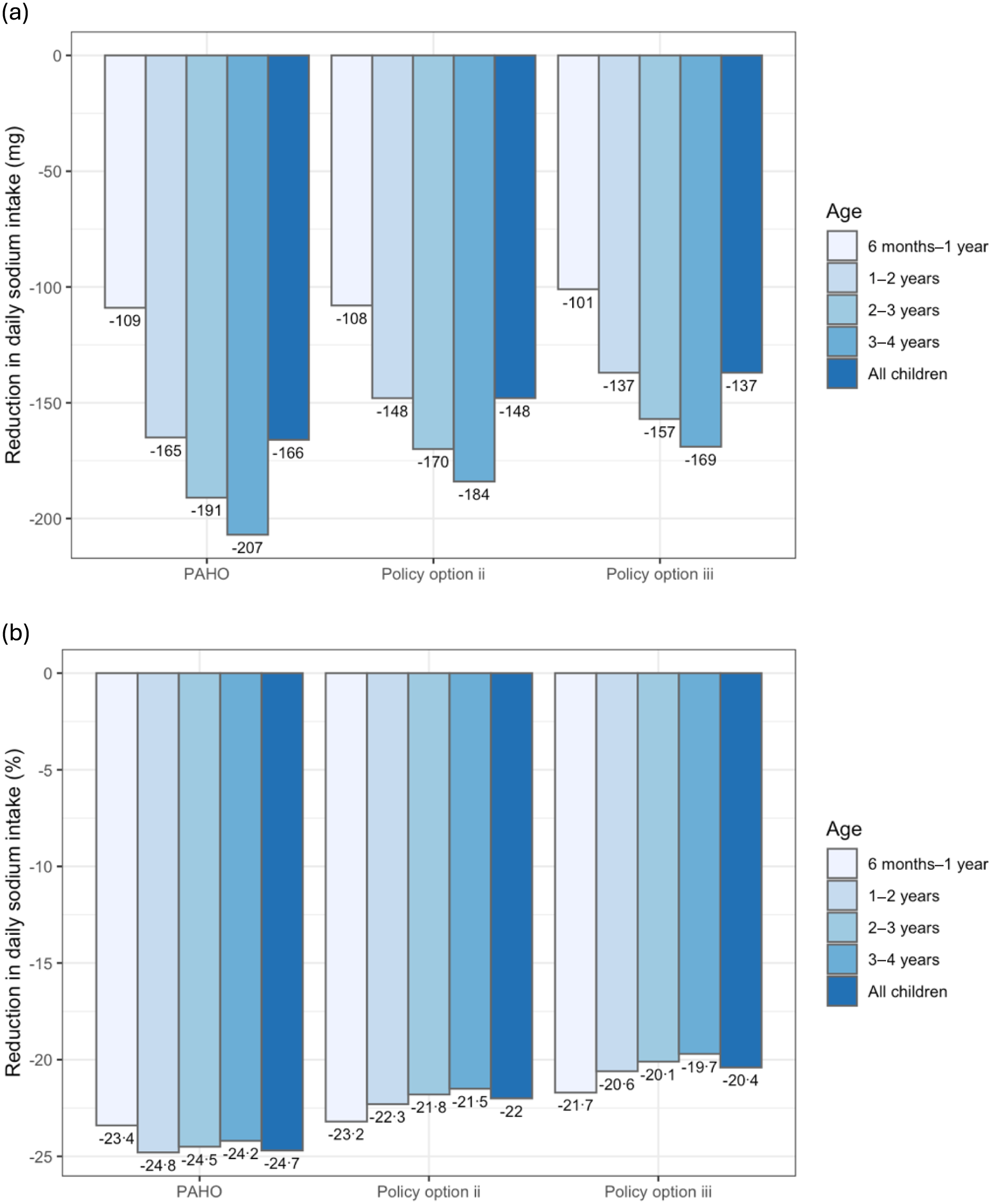
Full implementation of the PAHO sodium reduction targets across all subcategories would result in a mean reduction of 166 mg of sodium/d, corresponding to a 24·7 % decrease in sodium intake from the processed and ultra-processed products included in the targets. The absolute reduction increased with age, from 109 mg/d among children aged 6 months to 1 year, to 207 mg/d among those aged 3–4 years (Fig. 1a). However, relative reductions were similar across age groups (Fig. 1b).
Simulated reductions in sodium intake, expressed as mg/d (a) and percentage (b), after the implementation of different policy options for all children and separately for different age groups.

Applying the targets only to subcategories contributing at least 1 % to total sodium intake yielded comparable results (policy option ii). This scenario resulted in an average absolute reduction of 148 mg/d across all age groups (Fig. 1a), corresponding to a relative reduction of 22·0 % (Fig. 1b). The difference in impact compared with the full policy scenario was not statistically significant (Table 1). However, the policy did not result in a statistically significant reduction in sodium intake among children aged 6 months to 1 year.
The least stringent policy scenario (option iii) also resulted in a statistically significant reduction in sodium intake at the aggregate level (Table 1). As shown in Fig. 1a, this scenario would reduce sodium intake by an average of 137 mg/d. However, reductions were not statistically significant for two age subgroups (6 months to 1 year and 3–4 years), indicating lower effectiveness compared with full implementation of the PAHO targets.
Discussion
This study examines the potential impact of maximum sodium content policy scenarios in Uruguay. In the absence of a national food consumption survey for adults, this analysis represents the most comprehensive available effort to model how alternative maximum sodium content policies may affect population-level sodium intake, with a focus on early childhood.
The findings indicate that sodium intake from processed and ultra-processed foods is already substantial among very young children. Estimated sodium intake from these products was 446 mg/d among infants aged 6–12 months and increased to 665 mg/d among children aged 13–24 months. These results are concerning, given that current complementary feeding guidelines for infants and young children explicitly recommend avoiding processed and ultra-processed foods during this developmental period(49). Similar patterns have been observed globally, with these products increasingly introduced early in life despite their poor nutritional quality and high content of sodium, free sugars, calories and unhealthy fats(Reference Spaniol, da Costa and Souza17,Reference Conway, Heuchan and Heggie18,Reference Chamarthi, Shirsat and Sonavane21,Reference Martínez Steele, Popkin and Swinburn50,Reference Popkin and Laar51) . This shift represents a significant public health concern, as these foods tend to displace natural and minimally processed foods that are essential for optimal growth and development(Reference Monteiro, Louzada and Steele-Martinez52).
Sodium intake recommendations for young children are derived from adult reference values (2000 mg/d) and adjusted according to relative energy requirements(53). For children aged 2–4 years, estimated energy needs range from approximately 1032–1152 kcal/d. Under the PAHO nutrient profile model, which proposes a maximum of 1 mg of sodium per kilocalorie(54), the results suggest that sodium intake from processed and ultra-processed foods alone accounts for roughly 75 % of the recommended maximum intake. This leaves little room for sodium from other foods or discretionary salt. The substantial contribution of processed and ultra-processed products to children’s excessive sodium intake is consistent with findings from studies conducted in multiple countries, which show that the majority of dietary sodium is derived from processed and ultra-processed foods(Reference Gowrishankar, Blair and Rieder11,Reference Spaniol, da Costa and Souza17–Reference Chamarthi, Shirsat and Sonavane21) .
An expected but nevertheless important finding is the progressive increase in sodium intake with age. Although dietary guidelines recommend avoiding discretionary sodium and limiting the consumption of processed and ultra-processed foods high in sodium before the age of two(49,53) , the results indicate that elevated sodium intake is already present well before this age and continues to increase as children grow older. This trend appears to be driven by the growing contribution of ultra-processed foods, reinforcing concerns about the early establishment of dietary patterns that may persist throughout adolescence and adulthood. Qualitative studies conducted in Uruguay suggest a gradual relaxation of parental restrictions on ultra-processed foods, influenced by their widespread availability, social norms and beliefs that children become less vulnerable to the adverse health effects of these products as they grow(Reference Vidal, Antúnez and Ares55–Reference Girona, Machín and Vitola57). These findings underscore the potential role of mandatory sodium content reduction policies in lowering children’s sodium intake.
The modelled maximum sodium content policy scenarios demonstrate that sodium intake can be meaningfully reduced, in agreement with previous modelling studies conducted in other countries(Reference Santos, Sparks and Thout14,Reference Trieu, Coyle and Afshin22,Reference Trieu, Huang and Aminde23) . The estimated average reduction (approximately 150 mg/d) is consistent with findings from other modelling studies in children(Reference Dunford and Poti27–Reference Wang, Skeaff and Cameron29). Such reductions have the potential to lower the prevalence of hypertension in childhood and reduce its incidence later in life(Reference Leyvraz, Chatelan and da Costa58).
Regarding the comparison of scenarios, those covering a broader range of food categories achieved the greatest reductions in sodium consumption and are therefore more likely to generate meaningful public health benefits. Although the estimated impacts of the three policy scenarios did not differ significantly at the aggregate level, only the most comprehensive strategy, fully aligned with PAHO regional targets, resulted in statistically significant reductions across all age groups. As the number of subcategories included in the policy decreased, reductions in sodium intake were no longer statistically significant for some age groups. These findings suggest that narrowing the scope of the policy may compromise its effectiveness, even when a relatively large number of subcategories is retained. Modelling alternative policy scenarios can provide valuable insights for decision-making during the design and negotiation of regulatory measures, helping to balance feasibility considerations with the need to achieve meaningful public health impact.
Limitations
This study has several limitations. First, the analysis focused exclusively on sodium from processed and ultra-processed foods and did not include discretionary salt use or foods consumed outside the home (e.g. restaurants, bakeries or street vendors), which may contribute substantially to total sodium intake. Second, although the food composition database was comprehensive, it did not capture all products available in the Uruguayan marketplace. In addition, sodium intake was calculated using the mean sodium content of each subcategory. However, in practice, products are not consumed uniformly, and some items may contribute disproportionately to overall intake due to higher market share or consumption frequency. As a result, the estimates may not fully capture real-world consumption patterns. A more accurate approach would involve the use of sales-weighted sodium content data, which account for differences in product consumption. However, such data were not available.
Due to the lack of nationally representative food consumption data for adults in Uruguay, the modelling approach could only be applied to children. Despite these limitations, the study provides valuable comparative insights into the relative performance of different maximum sodium content scenarios and offers valuable evidence to inform public policy decisions. Future research should prioritise the development of more comprehensive dietary datasets and improved modelling frameworks to assess the impact of sodium content reduction policies across the entire population.
Conclusions
This study provides the first systematic assessment of the potential impact of mandatory maximum sodium content policies in Uruguay using a modelling approach. The findings demonstrate that these policies have the potential to reduce sodium intake in children. Strengthening national food consumption data systems, particularly for the adult population, is essential to refine these models and support the development of comprehensive sodium reduction strategies that can effectively improve population health in Uruguay.
The impact of maximum sodium limit policies varied according to their scope. Results showed that reducing the number of subcategories included in the policy may diminish its effectiveness, even when the selected categories account for a large share of sodium intake. Despite this evidence, the design and implementation of a national policy establishing maximum sodium content levels remain limited and will require strong political commitment and coordinated action across the food system.
Policies aimed at reducing the sodium content of processed and ultra-processed foods should be complemented by additional measures, including public communication campaigns to reduce discretionary salt use and broader efforts to promote healthy dietary patterns from early childhood. This is particularly relevant in the Uruguayan context, where discretionary salt is expected to be an important contributor to children’s total sodium intake(Reference Bhat, Marklund and Henry59).
Data availability statement
Data will be available upon reasonable request to the authors.
Acknowledgements
Leandro Machín, Elisa Fernández, Lucía Antúnez and Leticia Vidal are thanked for their contribution to the creation of the product composition database.
Author Contributors
Virginia Natero and Gastón Ares: Conceptualisation, Methodology, Investigation, Formal analysis, Writing – original draft, Writing – review & editing. Florencia Alcaire: Conceptualisation, Methodology, Formal analysis, Writing – review & editing.
Funding Statements
Funding was obtained from Global Health Advocacy Incubator and Espacio Interdisciplinario (Universidad de la República, Uruguay).
Competing Interests
The authors declare no conflicting interests.
Ethical statement
The study did not involve human subjects. The original surveys were approved by the ethics committee of the School of Medicine and the School of Nutrition of Universidad de la República, Uruguay (Protocol 070153000171-18).